Replay available
Syrma SGS Technology (NSE:SYRMA) Q2 2027 Earnings Call
Syrma SGS Technology (NSE:SYRMA) Q2 2027 earnings call, held 2026-11-02. Watch the replay and read the transcript on 6ix.
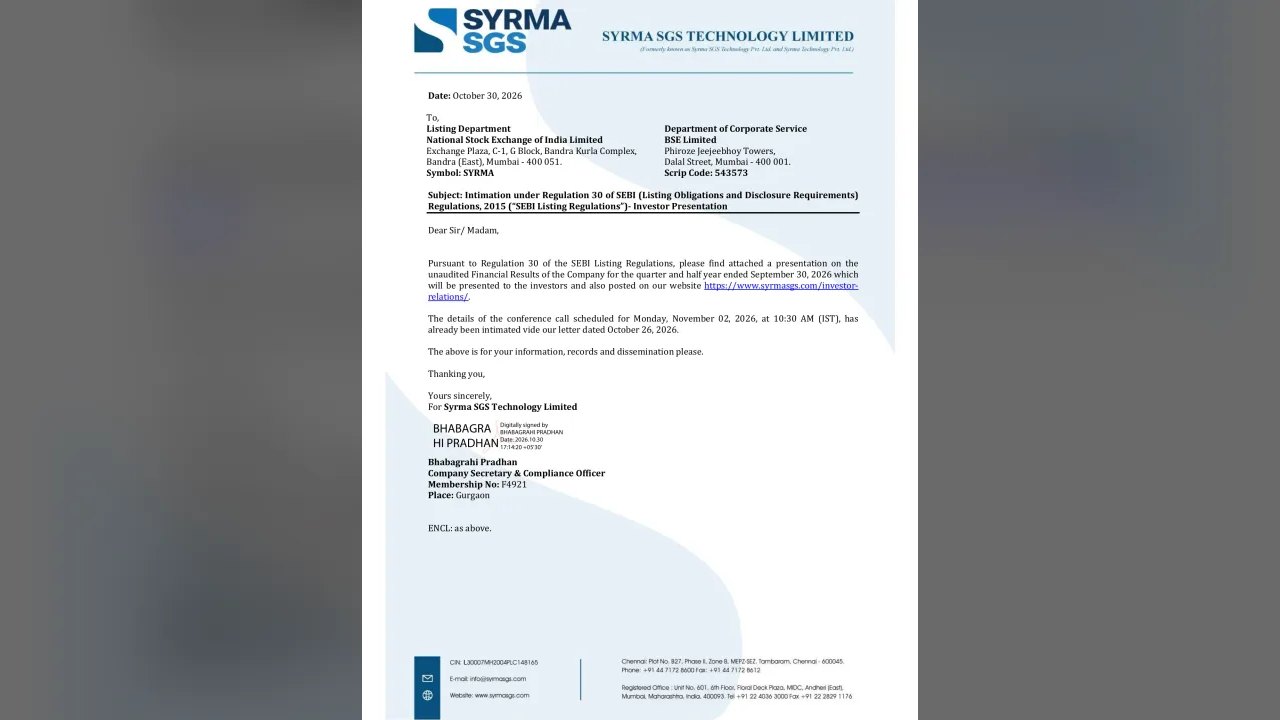
- Company
- Syrma SGS Technology Limited (NSE:SYRMA)
- Period
- Q2 2027 earnings call
- Date
- Mon, Nov 2, 2026, 8:06 AM ET
- Replay
- Watch the replay on this page · 1 h 24 min
On 6ix: 6ix.com/event/syrma-sgs-technology-limited-syrma-q2-2027-earnings-call
Replay
Transcript
Automated transcript · Written by software from the replay's audio. It can mishear names and figures; the replay is the record.
0:00 Ladies and gentlemen, good day, and welcome to Syrma SGS Technology Limited Q2 FY 'twenty seven Earnings Call hosted by GM Financial Institutional Securities Limited. As a reminder, all participant lines will be in the listen only mode, and there will be an opportunity for you to ask questions after the presentation concludes. Please note that this conference is being recorded. I now hand the conference over to Sharon Chokshi. Thank you, and over to you, sir. Thank you, Saisha. Good morning, everybody. On behalf of GM Financial Institutional Securities, I welcome you all to the q two f y twenty seven earnings call of Syrma SGS.
0:51 We have the senior management of the company joining us today morning, And I will now hand over to Mr. Nikhil Gupta, Head of Investor Relations to take the call forward. Thank you and over to you Nikhil. Yes. Thank you, Salim. A very good morning to all of you. On behalf of Syrma SGS family, we welcome you all to the SYRMA SGS Quarter two and half year twenty twenty seven Earnings Call. We have with us today Mr. Jayesh Gujran, Managing Director Mr. Jayesh Doshi, Wholesale Director Mr. Jerry Singh Brah, Chief Executive Officer and Mr. Vijay Agrawal, Chief Financial Financial Officer, Syrma SGS, to discuss the performance of the company during the second quarter and half year fiscal year 2027, followed by a detailed question and answer session. Kindly note, during the call, certain statements that will be made are forward looking, which involve several risks, uncertainties, assumptions and other factors that can cause results to differ materially from those in such forward looking statements.
1:49 All forward looking statements made herein are based on the information presently available to the management and to the company. And the company does not undertake to update any forward looking statements that may be made during this call. In this regard, we request you to kindly review the disclaimer statements in the earnings release and all other factors that can cause a difference. With this, I'll now hand over the call to Mr. Jay Sugilan, Managing Director of SGS. Thank you. Good morning, everyone. A pleasure to speak to you on the Q2 FY 'twenty seven and H1 FY 'twenty seven earnings call. The quarter gone by has been very, very satisfying and almost on all the parameters whatever we have guided, we have either delivered better performance or almost the performance which we had committed.
2:40 The most significant and satisfying aspect to the management is that a 71% growth has been achieved while maintaining physical hygiene. I think that's the most critical factor for us. We had a negative operating cash flow in Q1 and as committed, we sort of see the from the prism of one year, this quarter we have turned positive and we generated INR120 crores of positive operating cash flow, which is approximately 30 odd percent of EBITDA and that's what we have committed to everyone. Another very heartening factor is that in H1 of FY '27, we have almost surpassed all the figures of FY '25.
3:33 In FY 'twenty five, we had a revenue of revenue from operations of INR3787 crores. This time it's about INR3578 crores. EBITDA was INR $3.24 crore for full FY 'twenty five. For this year, for this half year, it is INR $3.55 crores. TAC was INR 184 crores. This year, it is INR $2.30 exports were $8.54 in FY 2025, in H1 they are $90.01, ODM it was $4.53 crores in FY 2025, it's $5.91. So on all the qualitative aspects, we have surpassed what we did in FY 'twenty five in H1.
4:19 And this gives us the confidence to revise our guidance upward that we would be able to deliver a 40% to 45% growth this year on an annualized basis, which would translate into around INR 7,000 crores of revenue. And we recommit or reaffirm that this revenue growth will be achieved maintaining the fiscal discipline. Last quarter, my working capital, net working capital had gone up to about seventy one days. It has come down back to sixty three days. And with this, we are confident that next year that is FY 'twenty eight, we should be able to cross the $1,000,000,000 revenue mark in revenue.
5:10 The second effect, which is sort of which the management is seized off is the supply chain constraint, which the industry is facing today. And whenever there are supply chain constraints, it has a cost push effect. We have pass through mechanisms with all customers, but we don't get a value add on the cost push and that results in slight dilution in the margin profile. The absolute figures being maintained, but the margin profile does take a small step because you get the same value addition on a higher base of the cost push. All over projects of diversification, backward integration, be it the PCB project, the camera module project, the magnetic project, they have all been sort of initiated the construction and commissioning.
6:06 The major one, which will have a significant impact in the long run on our positive impact rather on our revenues and margin profile is the PCB project. It is on stream and we expect as we are committed to power on the equipment by March, start the trial production. It takes about three to six months to get all the quality certifications, customer approvals and all those things. So that by about September '27, we should start the volume production. This would result in twenty eight-twenty nine, a significant bump up in our margin profile because PCB project is a comparatively margin accretive.
6:52 Exports, as we have always been maintaining, are one of the cornerstones of our growth strategy. And exports is in the DNA of Syrma SGS. We have been exporting for thirty five plus years or forty plus years. And exports have grown significantly. We expect this year that export should cross the INR1700 crore mark. We had estimated at the start of the year, it will be about around INR1600, anything between INR1500 crores to INR1600 crores on a base of INR1200 crores in FY 2026. If we achieve and I'm very confident that we'll achieve the INR1700 plus crore mark, next year it should give us a INR2000 crores in exports.
7:41 We have beat up our marketing presence in USA. And going forward, I think we'll see a slightly higher trajectory on a sustained basis in export growth. This year, they have been phenomenally at about 71% growth this year versus 41% last year versus 31% in FY twenty twenty five. Another thing which the management had sort of shared with the street that we would like to increase the ODM part of our revenue. While the percentage is remaining stagnant because my non ODM revenue is also showing a very strong increase, what gives us the satisfaction is that the ODM revenue in H1 FY 'twenty seven is INR $5.91 crores versus INR $2.73 crores of the previous year, H1 previous year, which is 117% growth.
8:41 Last year, we did an ODM revenue of INR $8.25 crores. So in all probability uncertainty will be crossing the INR 1,000 crores to INR 1,100 crores mark in the ODM revenue. So all these are projects, which have a longer gestation and I think they have started bearing fruit now. And going forward, we are very confident that we would be able to A, grow at 30%, 35% for the next three to five years on a larger base, lower export base. This half year, my EBITDA margin is a tad lower than 10%. I expect the year to close at 10% to 10.5. And going forward, that is twenty seventwenty eight with my margin accretive projects coming into stream, I expect that we should be anything between 10.5% to 11% or maybe marginally better than 11 I think we'll have more clarity once the supply chain constraints are eased out and we expect that for the industry and the chambers and the trade that the supply chain constraints will remain for the next five to six months and are expected to ease out only April to June '27.
10:03 On an overall basis, I think the company is on a solid footing and we have strived over the last three years to build a risk mitigated model such that we are not dependent on any one vertical, any one geography, any one customer or major customers, which can sort of disturb the equilibrium of the growth. It's a truly sort of a risk mitigated in terms of exports accounting for about 26%. My none of my customers accounting for one odd customer may be about 12% to 14%, but all other customers would be less than 10% of my revenue. Automotive, industrial consumers would continue to form the backbone.
10:51 Healthcare, railways, whichever small ways will show higher trajectory of growth in terms of percentages, but the base being small, they would still contribute to some 10% or 8% of our revenue. So I think a very satisfying thing and full complement to the team, which is trying to deliver these results with qualitative sort of keeping the qualitative factors into mind. With this, I hand over to Vijay to run you with all the details for financials and the final thoughts on the financials. Over to you, Vijay. Thank you, sir.
11:36 Good morning, everyone, and thank you for joining us for this quarter two and H1 FY 'twenty seven earnings call today. I'll briefly walk you through our financial performance for the quarter and the first half of the year, followed by our working capital position and capital allocation priorities. We have delivered another quarter of strong growth and robust numbers. The performance reflects the continued momentum across our diversified end markets and our focus on scaling the business while maintaining profitability and financial discipline. Let me start with the financial performance first. Our consolidated total revenue for quarter two FY 'twenty seven is approximately INR 2,000 crores, registering a strong year on year growth of 73% and sequential growth of 25%.
12:22 Our consolidated total revenue for H1 twenty seven is INR3603 crores, representing a growth of 71% year on year. Operating EBITDA for quarter two increased by 68% year on year to INR193 crores and for H1 it is INR355 crore with a 68% growth on a Y o Y basis. Our EBITDA margin for H1 is 9.9% as compared to 10.1% last year and despite a slight moderation in the operating EBITDA margin, our absolute profitability continued to increase substantially. PBT for the quarter is INR155 crore and for H1 is INR306 crore, resisting a strong 95% growth year on year basis for H1.
13:11 Similar with PAT for the quarter grew by 87% to INR124 crore and for H1, it grew by 98% to INR230 crore. PBT margin improved from 7.4% to 8.5% and while PAT margin increased from 5.5% to 6.4% when compared on a year on year basis. This improvement in the bottom line reflects the growth in operating profitability and the benefit of operating leverage into my financials. When we see the revenue growth, it was broad based across multiple all the verticals. Automotive sector business recorded a revenue growth of 91% year on year basis, increasing its contribution to approximately 26% of operating revenue.
13:57 We continue to see strong business momentum in this segment, supported by our customer relationship and participation across multiple automotive platforms. The consumer business contributed approximately 29% of our operating revenue for the quarter. Healthcare business grew by 61% year on year. This is actually a good margin business for us, maintaining a stable contribution to overall business. Industrial business recorded a strong growth of 86% year on year and 31% sequentially. As highlighted in our previous call also, apart from automotive segment, we expect this segment should grow faster in the second half of this year. IT and Railways also performed strongly, while revenue growing by 59% year on year, 82% sequentially.
14:45 Its contribution increased to approximately 14 of our operating revenue during the quarter. Overall, the performance across our end markets demonstrated the benefit of our diversified business portfolio. And this diversification remains important as we continue to expand our presence across industries and build capabilities in higher value manufacturing programs. Coming to the Sport business, as highlighted by Mr. Gujral also, our Sport revenue increased by 91% year on year to approximately INR $5.14 crore for the quarter and INR $90.01 crore for H1, registering a growth of 80% year on year for H1. Our export performance reflects our increasing participant participation in the global supply chain and our availability to serve customers across broader range of customers and markets.
15:38 Our ODM revenue for the quarter is INR $3.22 crores and for H1, it is INR $5.91 crores, registering a year on year growth of 117% for H1. Coming to customer concentration for H1, our top five customers contributed approximately 38% of our revenue, top 10 approximately 50% and top 20 is contributing near about 66% of our revenue. Coming to order book visibility. As on September end, we are carrying the overall open order book plus visibility position of INR7420 crores, of which auto is approximately 30%. Consumer and Investor segment is contributing approximately 24.5% to 25%.
16:24 Healthcare is 8% and IT and mail release is contributing 12% year over year. We remain confident that the volumes continue to scale, newer programs mature and our operational efficiencies will continue to improve our overall profitability over the medium term. Moving to our working capital position and cash flows. Our net working capital cycle improved to 63 as of September 26 compared to seventy one days in the previous quarter and seventy three days as of September 25 on a year on year basis. This is an encouraging development, particularly in the context of ongoing supply chain constraints and still we have been able to maintain a disciplined working capital investments. During H1 FY twenty seven, our net operating cash flows was approximately INR120 crores, resulting into OCF to EBITDA conversion of approximately 34% for the S1.
17:21 Coming to balance sheet position, our balance sheet continues to remain healthy and support our growth plans. As of September 26, we continue to maintain a net cash position of INR258 crores, supported by a strong healthy treasury balance position of approximately INR1000 crores and a gross debt position of INR746 crores. We continue to invest prudently in capacity expansions, technology and manufacturing capabilities, strategic growth initiatives while maintaining financial discipline. During the quarter, we incurred approximately INR200 crores of CapEx, of which around INR 140 crores is towards the PCB project and balance sheet towards other brownfield capability enhancement across the multiple units. Coming to our ROCE returns.
18:08 The returns for this period, H1 is adjusted annually ROCE is 21.4%, reflecting an improving working capital productivity. Our investments into the PCB projects are progressing. We have already spent more than INR 200 crores for the project and expecting to spend another INR200 crores in the balance of the year. We continue to target a commercial production start of this facility by April 27. We remain mindful of the importance of margin discipline, working capital management, cash conversion cycle, capital efficiency as the business grows. Our priority is to deliver consistent and profitable growth supported by operational excellence and disciplined capital allocation and long term customer partnerships.
18:55 With that, I would like to thank you all the investors and stakeholders for their continued support. I'll now hand it over to the operator to open the floor for questions. Thank you. Thank you very much. We will now begin the question and answer session. The first question is from the line of Sameer Sinha from Macquarie. Congratulations. This has been an excellent last few quarters. I have a couple of questions. First is in terms of the ODM revenue, clearly, has been a is a good area for you as well as margin accretive.
19:55 Can you give us some more details on are you expanding ODM beyond your healthcare and medtech sort of vertical? Where else could it go? And what sort of products are you developing for your customers? That's the first one. And then the second is, can you talk about just the with your updated guidance for this year, it still kind of implies a slowdown in the second half, but second half is generally or seasonally the stronger part of the year. So can you help kind of meld the two, please? Thank you. So if I understood your first question was on the ODM part and second also on the guidance for the full year. On ODM part, we continue to grow strongly in MedTech, defense, in RFID and other parts of the business.
20:45 It's a long gestation project. We are also developing ODM products for the industrial segment. Over the next two to three years, we'll see a significant bump in this. So ODM primarily will be in healthcare, defense, power electronics, RFID and magnetic. As far as the revenue guidance is concerned, we have had a good half year and that gives us the confidence to revise the guidance from the 35% to 45% to 45%, which means we should be touching or crossing the INR7000 crore mark this year and $1,000,000,000 next year, with sort of resulted increase in the margins also and the margin profile.
21:33 For the year ended March '27, we expect the EBITDA margins to be anything between 10% to 10.5%. And going forward, these would see a further accretion in '27, '28 and '28, 'twenty nine, as I said in my opening remarks, was the high margin accretive projects start yielding revenue. Right. I was just checking on, mean, the implied growth rate for the second half is much lower. Is that just conservatism, because seasonally it's a better part or is it just a higher base? On the demand side, we remain very bullish. The supply chain is still an area of concern. And what happens after the midterm elections, what happens in Middle East, these are all conjectures.
22:24 So I would rather sort of on the side of caution. The dampening of the growth, which I'm saying that we're saying if you have grown at 71%, while you're saying 45% for the full year is essentially driven by our concerns on the supply chain, which as of date doesn't seem to be easing out. It is expected to continue for the next six to nine months. And what the analysts, the trades, the industry says, somewhere in Q1 of FY twenty twenty eight, we could see some stabilization or easing on the supply chain. So whatever we are guiding is keeping ourselves sort of cautious of the supply chain cost, not on the demand side. Demand side, we are very, very bullish.
23:15 Got it. Okay. Thank you very much. The next question is from the line of Aditi Bhatia from Investec. Mister Aditi, please go ahead. Hello. Am I audible? Yes, sir. You're audible. Sir, again, speaking on the revenue guidance itself, if we just analyze the second quarter revenue number, we get to almost INR 8,000 odd crore rupees of revenues for the full year.
24:15 It's just first quarter, we are still speaking about around INR 7,600 odd crore rupees of revenues. So is it that supply side challenges are further becoming more difficult versus what we have seen in the last few quarters? Because these concerns have been there. And despite that, we've been kind of delivering anywhere between 50% to 70% kind of revenue growth. So just trying to understand, is it that scenario is getting more difficult or is it that you're just being aptly cautious? So there are two aspects to it. See, as we have all the time being saying, we don't work on quarter on quarter basis and a 71% growth in first half is because some of the orders of the customers have been front loaded. So we expect that rationalization should come in and coupled with the supply chain, we believe that delivering of 4045% annualized growth would be the target of the company. Now whether I deliver 7,000 or 7,500 or 7,400 today, it all depends on the supply chain.
25:21 And because I may be ready with a product, but my customer may not have a component, so his sale may not happen. If his sale doesn't happen, it has a trickle down effect on me. So I being the intermediary in a B2 business, I am walked in by two. My customer is ready, my supply chain is not ready, my sales suffer. I am ready, my customer is not ready, my sales suffer. Hence, keeping all the things into account, we are guiding a 45%, 40%, 45% growth rate for the current full year, which would take us to 7,000 plus. Vijay, would you like Sure. To ahead and understand. Arita, while we have also previously communicated the quarter on quarter seasonality is there, in H1's consumer segment is much more front loaded. So we have done almost INR 1,100 crores plus kind of revenue on the consumer segment side.
26:12 So gradually, we may see a taper down of this one particular segment and other segment going up. That is why this quarterly seasonality will play. Full year basis, we are guiding 45% -plus kind of overall revenue growth. Understood. Perfect. That's helpful, sir. And in the annual report, we had spoken about one of the framework agreements of almost $250 odd million. If you could share more details around that, what kind of revenue accretion may happen on account of it, what are the time lines like? And whether it's a one off contract? Or are you looking to be entering into a similar contract? Because you have it is kind of indicated that, that would be the intent? We have entered into that same contract and it will start yielding revenues next year.
26:59 I'll request to throw more light on that. So we have made very good progress on that agreement. So all the NPIs, all the sort of early production runs have been done and we have a ramp up plan agreed with the customer. But these are all sort of very demanding, discerning customers. So we go step by step. So as Mr. Bourjjal said, we see the full impact of this in FY 'twenty eight and beyond. And this will continue. It's not a one off contract for this having entered into their supply chain, the global supply chain becoming an integral part. I see this particular vertical of the customer to become one of our major growth drivers in the coming years.
27:46 '27, '28 in any case will be there, but once we get integrated, we have opportunity to tap the wide product range which they make. So these are all long term gestation period contracts and the growth which we are seeing in the current year is the customers which we have onboarded a couple of years back and they have started yielding the volume production or the series production in twenty six-twenty seven. The customers which we have onboarded last year, late part of last year and this year will give revenue impact, feasible revenue impact in 'twenty seven, 'twenty eight and beyond. Sorry, sir, if you could also indicate who the customer could be or what kind of products are we speaking about?
28:34 What could be the revenue? Confidentiality doesn't allow me to name the customer. You will appreciate that. These are into the industrial power management, power distribution, data center. So that's a broad mix. And these will be sizable contracts, sizable revenues generating out of this next year onwards. Any indication that you can give on the revenue number, sir? But I think annualized can be at least INR500 crores to INR600 crores to start with. Sure. Understood. Thank you so much. Thank you very much. The next question is from the line of Santosh Syrma from Aventispark.
29:23 Please go ahead. Hi, sir. Thanks for the opportunity, and congratulations for great set of numbers. So just wanted to double click on what was driving the second quarter results. If you could explain how much of this growth was driven by any new customer ramp up or any new program wins that you mentioned in the previous calls? And also how much was the pull forward in demand that you were mentioning? Just on a related note, you have also reached a revenue run rate closer to INR 2,000 crores in a quarter and guiding for $1,000,000,000 kind of revenue in FY 'twenty eight. So I just wanted to understand how ready is the platform to deliver these kind of revenue, both on the domestic front and also on the export front. So if you can explain if there is any additional hiring or any major CapEx that is required in the base business to ensure we get to those revenue levels?
30:29 So there are three or four parts to the question. One is the growth coming in from new customers and existing customers. Well, it's a secular growth, all customers new and the old are firing. What is more significant is all the verticals are growing at a very fast pace. So if I compare H1 twenty seven to H1 twenty six, our automotive business has grown by 80 plus Healthcare has grown by 78%. Industrial 58%. IT on a small base was over 100%. Railways by 45% and consumer by 62%. So all the cylinders, the verticals are firing.
31:16 Now within this 85% growth, my new customers would also add to that growth. My exports have grown by 79% in H1. My ODM has grown by 100%. So we see a secular high trajectory growth in almost every vertical and the segments. Going forward, these segments would continue to fire the growth. And the three segments because of their large base, which will continue to grow, automotive, industrial and consumer. Healthcare railways have a smaller base, even if they grow at 100%, 120%, they would not form a significant impact on my overall top line. But being high margin products, they will be adding accretive to the margin profile of the company.
32:11 No significant investments are required for these businesses. They are the normal businesses, which we are catering to. The only thing is the profile of customers has changed. So when the profile of the customer changes, it does not necessitate a significant increase in capital investment. What is sort of required is strengthening your processes, procedures, communication channels, program management, electronic interface on the supply chain. So the heavy lifting is not in the CapEx, it's in the capabilities. And there we are having very structured programs to sort of come up to the expectation or sort of exceed the expectation of these global customers in terms of processes, which are robust today, but they have to be aligned to the global requirements.
33:13 Absolutely. And I have a follow-up. So if I understood right, growth is mostly organic coming from the base business. And the new projects that we are working on is mostly an add on. So can you provide stated update on some of the projects that we are working on. So in addition to the PCB project, I believe we have also applied under ECMS schemes. And also, is there any project that we are considering to apply under ISM scheme? So if you can help us if you can provide a status update on that, that would be helpful. Okay. In the ECMS scheme, we have applied for, I think, five or six projects.
34:02 One is the PCBs, which is under sort of construction when we'll see the power on by March and trial production by March, April and series production by June, July to August, September quarter. So for twenty seven-twenty eight, the PCB project will deliver six months approximately of production, commercial production, series production. Twenty seven-twenty eight will be a full year. The second project which we have got is under the ECMS scheme is the CCL. We intend to commission it in the year twenty eight-twenty nine as of date. The third one is HDI Flex and other things. Some PCBs are being clubbed with the current phase of the project. HDI and all that will again come in 2829 not before that.
34:54 The fourth application, which you have got is for camera module. The facility construction has started. We have got the expression of interest or intent from the customer for camera module for automotive application. And we expect that by around end of this fiscal, we should be in a position to start production in that. The last one which we have got in the ECMS is in the magnetic strength. It's a small investment, nothing major, but it would add in the coming year 2829, a decent amount of high margin business to my thing. Magnetic per se would not significantly alter my top line, even if I do 10,000,020 million dollars it doesn't alter my top line, but they are very high margin accretive projects.
35:44 So that's as far as the ECMS is concerned. On the ISM2, our status is very, very clear right from day one from the ISM days that we are very interested into entering into this sort of ecosystem, but we would enter only if we have a credible partner. Currently discussions are going on, but nothing concrete, which I can share with anyone that we are going into this aspect or this part or whatever it is. But we are interested and hopefully we should sort of have something concrete in the next six months. Thank you, sir. Just on the camera module side, are we contemplating any JV here and also how should we think about the CapEx and revenue contribution from that business?
36:38 See, the CAGR of module business to start with would not have a significant CapEx. It will be less than about INR 25 to start with, crores, INR30 crores to start with. It is a capability which we have built in. I expect decent revenues in the automotive sector from this, But you say, do I expect INR 1,000 crores from this? No, it could be to start with, it could be INR 5,100 crores and they are scaling up as we sort of diversify our portfolio in the camera module. Currently, we are concentrating on high end camera modules for automotive sector. We are currently not contemplating camera modules in the consumer sector, which means the mobile or the laptop and other things.
37:25 So once we start doing that, then we share with it, but currently it's only camera module for the automotive sector. Thank you very much, sir. All the very best wishes. Thank you very much. The next question is from the line of Mayank Pandey from MK Global. Syrma. So my first question is to get your sense on what you're observing in the overall business ecosystem. Could you tell us if you're observing some trends with respect to inventory stockpiling at your customers? Like last quarter, you mentioned that you're observing supply chain pressures and you might look to hold on to some strategic inventory. Is that a trend that you're also observing at your customers?
38:20 Or are we observing any shift in their ordering patterns that may be favoring longer term contracts or shorter term contracts, ordering contracts more? Any light you can throw in terms of how your customers are navigating the supply chain challenges vis a vis when they talk to you? See, on the supply chain challenges, think, which is a good challenge to have in the sense that while we are sort of every member in the industry is having the supply chain offering, the demand side doesn't show signs of respite. The automotive sector is very bullish and keeps increasing its demand quarter on quarter or month on month or whatever it is. So it compounds the problem of supply chain costing.
39:07 Now this naturally results when my supply chain gets constrained, the delivery lead times get extended to thirty six weeks or forty two weeks or whatever. Obviously, the customer and we, we work in partnership and in tandem, the customer would give us a longer visibility, a longer commitment for the longer lead items. So that sort of assures us that the business going forward would continue to grow at that pace. Customer also stocks inventory, but since the customer is B2C, whatever is produced when the demand is going up, it shifts. So in a B2B, it is a stocking of the inventory.
39:52 So customer would also be stocking critical parts on which it is facing supply chain constraints, which essentially are in the electronics and electronics are being supplied by us. On mechanical and other things, the cost pushes there, the supply chain constraints are not. So the copper may have gone up, but the wire shortage is not there. In electronic components, it's slightly different because of our data center. But then we with the customers work in partnership in a very close transparent interaction and both of us work in tandem because the strength is the weakest link. If my customers think is the weakest link, then he suffers. If I'm the weakest link, then he suffers. So we try to mitigate that.
40:44 And inventory, despite all these cost rates, is still at about seventy one days and overall working capital at about sixty three days. I think that's a very heartening feature. Right. So are we not seeing any evidence of any kind of inventory stockpiling as we have seen in the past, let's say FY twenty twenty three, twenty four sort of era when there was an expectation that inventory should be stockpiled in anticipation of demand. In this case, are we not seeing any kind of inventory stockpiling by customers for I'm talking specifically to the B2B customer. They're not looking to stockpile. My inventory from March '26 has gone up by from INR 1,000 odd rupees to INR 70 crores. But number of days it is still seventy one.
41:39 March 26 also it was seventy one days of inventory and September 26 also it is seventy one days of inventory. Now this highest, if you see the isolation, there is a 50% increase, but then there is a 50% increase in revenue. So the number of days remains the same or comes down. Quarter on quarter, there could be a mismatch that in some quarter, I talk more, I get something by the end of the quarter and I have to ship it next quarter, the inventory of the March, September end or June end may go up. But on an annualized basis, we will strive and we are sort of focused on maintaining that fiscal discipline on working capital and it could be anything between sixty to sixty five days. The desire is to be having below sixty days, I don't see that desire to be fulfilled in the coming six months.
42:29 If we can maintain it at about sixty odd days plus minus for two days, I think it's a phenomenally good job. And just to add in this INR 15 crores, 70 crores of total inventory, still we are maintaining certain strategic inventories of only critical components, which are having a longer delivery schedules as of now. And as Mr. Gujarat has previously also communicated, the situation may go on quickly towards beyond FY 'twenty seven also. So till the time the overall situation eases out, we will continue to maintain this kind of inventory level. See, I would rather on the side of caution and maintaining a higher inventory level versus not being able to meet my customer requirements. To me that one is the second one, meeting the customer requirement is far, far more important than a couple of INR100 crores also in inventory, because that brings in stickiness with the customer.
43:30 Understood, sir. Sir, if I can just ask one more question that your export performance has been very strong and it has continued to strengthen like even the monthly run rates have continued to strengthen for you. Could you just help me understand which verticals are driving the strong export growth performance? And what does our contract on the export side look like? Is it fixed currency or do we get the full benefit of any currency appreciation that happens? You can just help me understand that. Thank you. See, my export primarily are in the industrial medtech and automotive sector, A little bit on the RFID consumer application, which may be classified as, but these three verticals constitute the bulk of the exports.
44:15 And all these three verticals are growing very strong. The engagement with the customers and the new customers, which we are onboarding or the dialogue which has started with the new customers is primarily in these three segments, medtech, industrial and automotive in that quarter. We believe and we are confident that export would continue to grow. And when we say we have grown at 31% in FY 2025, 41% in FY 2026, 70 odd percent in 80 odd percent in FY 2027 half year. Please appreciate this is only because we are onboarding new customers. Neither North America nor Europe is growing at that rate. So we are onboarding big global on to our customer portfolio sort of thing and that is yielding themselves.
45:12 And this global customer being onboarded is a continuous phenomenon. So the customers which we onboarded in 'twenty three, 'twenty '4, 'twenty four, 'twenty five are giving results now. And the customers which we have onboarded in 'twenty four, 'twenty five, 'twenty five, 'twenty six will give serious results in 'twenty seven, 'twenty eight. And the customers which are on boarding today would result into series production, volume production in 2829. So this continuous replenishment of the customer portfolio, export customer portfolio with big logos gives us the confidence that exports would continue to be one of the cornerstones of our strategy for growth.
45:57 And exports being margin accretive, it will also help us in delivering superior margins, which I have said that this year we expect to deliver anything between 10 to 10.5. Going forward, this could be 10.5 to 11 or even greater than 11 in twenty seven-twenty eight. And as far as your concern on the question on the ForEx thing is concerned, these are fixed price contracts unlike in the garment industry because there's a lot of import content also, we don't have to sort of calibrate the prices with the ForEx movement in terms of export customers. Another sort of side advantage is that my export revenue gives me a natural hedge for imports.
46:49 So if I export good worth INR 1,600 crore piece in a year, for example, in the first six months, INR 900 odd crores has been exported, it provides a natural hedge to the foreign currency on imports. We also have a pass through mechanism related to the foreign exchange impact for almost all of our large businesses. For domestic. For domestic business, yes. I hope that answers your question. Thank you. Thank you very much. The next question is from the line of from Wealth Management Limited. Please go ahead.
47:38 Yeah. Good morning, sir. Thank you for the opportunity. Congratulations on excellent show once again. Sir, the first question is in terms of the, you know, the PCB revenue, how do we see this, you know, for FY '28 and '29 in terms of what kind of contribution we can expect in the margins? See on the PCB revenue, what we had guided was that PCBs would have a 1.2 to 1.25, max 1.5% of the investment as the revenue. So, for the FY 2728, since we will be having full production, commercial production only for about six to seven months, we expect a revenue of approximately INR 200 crores to INR $2.50 crores or INR 300 crores.
48:32 Going forward, 'twenty seven, 'twenty eight, 'twenty nine, it would see the full impact. So if we invest about INR 800 crores of investment, we should expect about INR700 crores to INR800 crores in 'twenty eight, 'twenty nine from this end. So it will be directly related to the investment which I made and how much is the investment we are planning to make still? So by the end of this year, we will be incurring about INR400 crores to INR450 crores kind of a CapEx. By the end of next year, we'll be completing it by another maybe another INR 400 crores to INR $4.50 crores. So maybe total investment towards the project could be INR 800 crores to INR 900 crores of investment will come through by March 28. Have I understood? Yes. Okay.
49:18 So that March 29, FY '29, we should have a full, you know, revenue potential impact. Considering 1.5 times asset term, the total revenue can be in the range of INR 1,200 to INR $13.50, assuming a full capacity ramp up in the year one that is FY 2029. And if there is a maybe 70% to 80% kind of capacity utilization, the revenue can be in the range of maybe as Gujaratya diluted between 900 to 1,000 crores. And what kind of margin we should work with, sir? So on a steady state basis, the EBITDA margins at a full capacity ramp up should be within the range of 15 to 18. And this excludes the incentive. Right? Yes. It excludes the PR. Right? If you're referring to.
50:04 Yeah. In... Includes or excludes, Sorry. Say what's that again? Without it. Without Okay. Okay. Understood. And if you could help us in terms of the CapEx at a concerned level, what kind of CapEx we should budget in which particular segment for FY '27 and '28? So PCV, we have clarified. Apart from PCV, the normal greenfield come bound CapEx is what we estimate somewhere around 100 to 150 crores per year for next two years. And no other adjacency, the camera module or on the other side? Camera module related, like the special initiatives, just like camera module, there is a JV, any module, which we have done, there is a JV, Kaga JV is also there. So for those JVs, there will be a different CapEx, but for Alumaster, it will be in the range of around INR40 crores, INR50 crores.
50:58 Camera model, again, to start with, it will be around INR30 crores. And gradually, as we get more and more business, we may expand further more CapEx there. Similar way for Kazakhiri also, it's not insignificant, will be still in the range of like INR 30 to 50 crore at max. Got it. Is there any way to get some idea in terms of the new customer contribution in the, you know, quarter or half year revenue? So generally, it is like a mix of everyone, and then we see new customer, new customers whom we have onboarded in FY 'twenty five. Actually, we are getting revenue benefit from those customers in this year. So that's where we see the customers are technically a new customer because we might have actually seen initial revenue volume from them in FY 2026 also.
51:47 But this year, are getting that full volume, ramp up volume. So that's where we see this growth is like across all the customers that we. Okay. Let me put it in another fashion. Yeah. Is it possible to get some quantification in terms of, customers onboarded in last eighteen months kind of a thing? Would that be possible? So last year, we onboarded near about 32 customers, as we have previously also communicated. This year, I think in total H1, we have onboarded near about 18 customers so far. Got it. Sure, sir. Thank you. I'll call back in the queue for further. Thank you. Thank you very much. The next question is from the line of Kishore Kumar from Unifi Capital.
52:35 Please go ahead. Thanks for the opportunity and congrats on the fantastic quarter, sir. Sir, just a follow-up to Achal's question on PCB. This PCB can be used for captive purposes as well as for the external sales. How are you looking at the output? Are we looking at more towards external sales right now? And as we get approval, we'll start using it for capital purposes? This is my first question. Okay. Now on the PCB part, we would be using it for both internal consumption and external sales of PCB. The accrual cycle in both cases is by and large the same. For example, if I'm doing anything for Suzuki, whether I sell it to a vendor of Suzuki or I use it for internal consumption, the approval process has to be followed.
53:31 Where the approval process can be sort of shrunk or reduced is my own design products in the PCB space, where I don't have to take a role of the customer because I am taking the ownership of the design. So hence we intend to start with the ODM part of PCBs in the immediate phase, We also will have to do all the testings and regulatory checks and approvals, so that the product meets all the guidelines and the specifications and the parameters. So bulk of the sales over a period of time will come from external customers.
54:18 Understood, sir. Also, can you We have our content in house consumption also. Understood, sir. Clear now. Also, can you give us some insights on the type of the PCB we'll be doing for a single, double or six layer PCBs? Bulk of the consumption in PCBs is from eight layer, bulk of it. Above eight layers, there are something in the display modules of the sort of dashboard, electronic for the cars, there it could be 12 layer or 14 layer. Bulk of the PCBs are less than eight layer and will be kept into all those segments. We are also putting up a single layer line to cater to the requirements of the consumer electronic part where the PCBs are typically single.
55:07 So bulk will be two layer to six layer and some six to eight layer, little in eight layer and above in terms of volume and back. Clear, sir. So just a clarification on the revenue growth for this quarter. We did about 70 percentage growth. You did mention about some orders being front loaded, some of our customers. I just wanted to understand what percentage of the value growth is coming from the price increase that we have done on back of the raw material price inflation in comparison to the underlying volume growth? Is there any number that you can quantify us? See, the cost push typically has been around five watt percent.
55:53 So we have shown a material margin decline of a material cost increase of about 3%, but that could also be because of the product mix. This is all a pass through. So we can assume that if we have done about INR 1,900 crores of revenue in this year this quarter or INR 2,000 crores of revenue this quarter, INR 50 crores to INR $60.70 crores could be attributed to the cost push, 3% to 5%, INR $60.70 crores. I have no absolute figure to be very honest, but that could be attributed to the cost and rest is the volume growth. Clear, sir. Got it. And can you just brief us on the performance of recently acquired entities, Navicom and Elcom? And how is the newly started venture with EleMaster going on? That's it, my end.
56:48 So on Navicom, Elecom, I think Vijay will throw light on. Elimaster, we commissioned the factory in September '26, which is about sixty days ago. Approximately September 3, I think we or September 2, we commissioned the factory. Being a new factory, it has to go through all the regulatory approvals like the ISO, the IRS certification and perhaps the RDSO certification also. We expect to complete all these activities in this year. So this year, we don't expect a sizable revenue from the EleMaster joint venture in that entity. However, next year once these regulatory approvals and certifications are in place, we expect it to deliver anything between 150 to 200 crores of revenue. Am I right with you? Yes. Elimaster in FY twenty seven-twenty.
57:43 On Elicom and JD, Syrma Jhori, I think Vijay So Elcom has contributed approximately INR135 crores of revenue during H1 into my consolidated revenue. And similar with Syrma Jawri Metec Limited contributed approximately INR140 crores of revenue towards my overall consolidated revenue for this period. Sir, any comments on the future outlook for these two acquired businesses? Telkom, we had previously communicated we expect this year somewhere between INR300 crores to INR350 crores kind of our revenue. This is a good growth business, currently delivering a growth between 20% to 25%. And we are again targeting how do we at least achieve a steeper growth from here onwards based on our new customer additions or maybe certain market expansions also, which we are currently working upon.
58:37 Similarly, HJML this year has been growing good growth. As of now in H1, we have received 140. Full year basis, again, we should be targeting somewhere around INR300 crores as against two twenty to two ten of last year. So we expect a 45% to 50% growth in Syrma Jhori this year. And what is very satisfying in that is that we have onboarded some very good clients. Last, should have I forgot to share it in my opening comment. We have commissioned high grade medical plastic facility in Syrmajhori. It would be molded extrusions and blow. This should give us good revenues with margins in the coming quarters.
59:23 That's a new facility which we have set up in Jodhpur. We are not into the medical grade plastics, we are now doing it for internal consumption and third party. Understood, sir. Got it. Thank you very much. The next question is from the line of Indrajit Agarwal from CLSA. Please go ahead. Hi. Thank you for the chance. My first question is on the PCB business. Is it fair to assume that in FY 'twenty eight and FY 'twenty nine, it will be relatively lower margin, hence you could have a bad loss in this business for a couple of years? And as a result, what kind of tax rate we can see on a blended basis at a consolidated?
1:00:13 EBITDA margins are still should be in the range of 15% to 18%. Yes, in the initial year when the capacity utilization are maybe around 40%, it can be a little lower. Still, we do not expect a pat loss for this period as of now. All right. And of the INR 900 crore investment, what is the kind of time frame we can assume that the government how much government subsidy should come in? And what is the kind of time frame we should expect it to come in? PLI income, which is there based on the yearly revenue number, once the year is closed within a certain period, we'll have to calculate and apply for it. We can initially assume at least six to nine months or maybe a twelve month kind of a time lag for that PLA revenue realization.
1:00:59 Similarly, on the CapEx incentive, which is mainly from the state government, again, the project is ready by the end of this March 27, we should be compiling all these things, filing it, which may take another six months. And then thereafter, another six months maybe further realization of the thing. That's the initial estimate, but that is what we can target at least. So to give a quantification, we are investing approximately INR 400 crores by March '27. So, if we file our application by March '28 at the outside, we should be able to recover the INR 200 crores of capital subsidy. The PLI whatever revenues we increase incur in 2728, I'll be eligible to file the application only after March 20.
1:01:46 Typically, the windows for the PLI open somewhere in July August. So, the claim will be filed in July August of twenty eight and then energy to six months for recovery. Got it. This is helpful. Given the recent rise in some of the input materials like CCL, etcetera, has the dynamic of this business changed? And are you looking to get into backward integration further in this? We have plans to enter into the copper clad laminate, but we would not like to open too many fronts simultaneously. Hence, we will put in the copper clad sort of going for the copper clad laminate plant once my PCB plant has stabilized. And I expect the PCB plant to stabilize somewhere middle of next year, because if I power it on in March and start the trial production, I should be able to stabilize the production processes by middle of next year.
1:02:44 And then is the time when we'll start planning execution of the CCL plant. And the CCL plant if we start planning execution sometime between the third third quarter or fourth quarter, third quarter of FY twenty eight, it will get ready by around December 28. It will get series production in 2829. Sir, lastly, what kind of minority should we, like, book in the accounts for FY '27 and FY '28, the quantum? Sorry? The minorities that you put in P and L, right? So what... Yes, P and L will be fine. So minority is mainly related to this Elcom and SG and together. So as of now, for the six month period, my minority profit is like approximately INR 14 crore.
1:03:35 Full year basis, it can be around in the range of INR 30 crores to INR 45 crores. Thank you so much. Thank you very much. The next question is from the line of Sumant Kumar from Motilal, Oswal Financial Services Limited. Please go ahead. Yes. So my question is regarding IT and Railway. Can you talk on the margin profile of this segment? IT and Railway. IT and Railway. So we are doing memory modules. We are doing assemblies of high end gaming laptops, maybe other laptops for MSI and few other customers there. On the railway side, we are on this HVAC controls for cabin coaching, railway signaling system, door controls, those kind of products is what we are manufacturing largely.
1:04:29 See, on the margin profile, IT business is typically a low margin profile business. Railways is a superior profile margin business compared to the entire it is equivalent or superior to the industrial segment. IT per se is a low margin business comparatively. And since we are not making end to end products, when I make a motherboard, my customer gets the PLA because he is assembling the final computer. So we don't get the benefit of the PLA. For the laptop, if you are making for MSI, currently the volume is being small for the Indian market, the motherboards are being imported. So hence we are not eligible for PLI. We are endeavoring that we should start making the motherboard so that we get the PLIs in the coming years. But as of this, we are not getting PLIs and it's a low margin business.
1:05:24 A very low working capital or zero working capital involvement, the model is that. Can we say the combination of IT and railway, the margin is better than consumer and in between auto and consumer? Railways is equal to Combination of both. Combination of both, I'm talking about. IT and railway because It's very tough to quantify because if I do INR 80 crores of railways and I do INR 300 crores of IT, the margin gets skewed. The INR 300 crores will be a low margin business. So marketing is, railways is a superior margin business. IT is equivalent to the high volume, low margin consumer business. Thank you. Thank you very much. Next question is from the line of Keshav Lahodi from HDFC Securities.
1:06:18 Please go ahead. Hi. Thank you for the opportunity. Sir, I want to understand one thing. If I see your order book growth, it has been growing by around 25%, 30%. But if we see the top line growth, that is pretty healthy. Why is there a mismatch from last couple of quarters, how should we rate? See, order growth, sir, when we share the orders, it is the orders which we receive, not contracts or the same of contracts with the guidance which we receive. And typically what happens if I have received a guidance for a full year, I don't take it as an order. The order may come in the beginning of the quarter to deliver it in the quarter. Since the guidance is there, I'm already ready with the production schedule and the material. Hence, there could be a slight sort of mismatch, the order growth may not be equivalent to the revenue growth because we work revenues are based on the guidance, the commitment, agreement which we have signed off with the customers.
1:07:14 They convert into purchase orders maybe at the beginning of the quarter. Automotive industry typically works quarterly for a rolling forecast. So they give a rolling forecast, which is not considered as an order, but they give orders at the beginning of the month to ship this much. So hence, there could be a slight there could be a mismatch because of this. Also, as we have seen due to supply chain constraints, now we are getting orders for a little longer period also in case of few select customers, specifically in the auto segment here. So previously, when it was a much lower number beyond one year, beyond twelve months, now we've seen a lot of orders beyond twelve months also there. So of my total INR 7,400 crores, near about now INR 1,200 crores is related to a period which is beyond twelve months.
1:08:06 Understood. Got it. And if we talk about PCB manufacturing, the return ratios are looking very strong. How should we see it? Because you said twelve fifty per round of our top line on 800 per round of investment. Of that, 50% might be, you know, recovered by a subsidiary of 15, 20% margin business and p and a benefit above 18%. So what is the return ratio you are looking in this business once it will ramp up? So going by the projections number, assuming all CapEx incentives are there, the return ratio should be north of 30%, 35% plus you are right there in that observation. But that gives us heads up at least to grow the business faster, target much more maybe other geographies apart from India also. And that is where one can see a larger growth in that business.
1:08:55 Okay. So the reason why I'm asking this question because 30%, 35% return ratio do not look very attractive, possibly what margin we are factoring in our assumption that might be on the slightly higher side considering the industry dynamics? No. You see, if you see the margin profile of the unlisted space, which is currently working in India, the margin profiles are even superior than this. So when we say 50%, we have considered all the factors into account and since the one is an automated plant, our operating cost will be lower. So very confident that we'll be delivering 50 odd percent margin without the P and I. And the returns will be higher because of the capital subsidy here, but that's part of the investment policy of the government.
1:09:47 Understood. Just a last follow-up on this. The 15% margin plus 4% to 5% PLI benefit to approximately 20% margin business. Is that understanding correct? We say 17% to 20%, because once you have the PLI, the dynamics of the market and all that, it all depends on the market dynamics at that point of time, whether we sort of share the PLI with the customer or not. So that's why I say 17% to 20% margin profile should be available. Understood. That is helpful. Thank you so much. Thank you very much. The last question for today is from the line of Rahul Maheshwari from Ambit Private Limited. Please go ahead. Hello. Good good afternoon, and thank you for the opportunity.
1:10:36 Three questions. First, in the annual report you had given about the ARC system, which is being deployed across the manufacturing for quick decision making. So can you give bit some examples and also how much the efficiency drive, which is helping the company? Second thing in terms of the backward integration, which is which the main objective is to make the supply chain more resilient, whether it's towards wire harness camera models. Any... On a long term basis, how much apart from supply chain resilience, how much margins it can add up to? And the last part on the JVs and the partnerships, especially on the Cargo Electronics, how much big it can become in terms of the overall scheme of things for next four, five years?
1:11:28 So on the ARC systems, we started implementing it somewhere last year, and we have implemented it in three or four of the plants and remaining plants is ongoing. The initial results have shown a 5% to 6% OEE improvement on the lines, on the SMT lines. I think once the system is mature, we expect that the OEE should increase by anything between 6% to 10% across all plants, which I think would result if we have just as an example, we have 40 lines and five hundred hours is a line which works for a month. So we have twenty thousand hours of OEs sort of capacity available, a 5% increase in OE would result into one thousand hours of additional line capacity available, which is equivalent to approximately two lines.
1:12:33 So the initial results are very positive and I think we have taken the right choice being the first Indian company to implement this arc to give us superior performance on the S and P lines. Your second question was related to the backward integration. Wire harnesses is the project which we have started. It is more targeted for high end applications, not that we'll not be using it in house, but I would rather use these capacities for high end applications in aerospace, defense and other things to get a superior margin profile.
1:13:19 Till such time these facilities are qualified for that purpose, we will be doing the wire harnesses, which we consume in house. Now when we consume without, if theoretically, I'm giving a 10 or 15% EBITDA margin to my vendor, that gets retained within the company. But since wire harness internal consumption, I don't have the exact figure what is the sort of value of wire harnesses, which we buy from oxide. I will refrain from putting a figure on the savings, which we do. I'll have it collected, but it's not a very significant portion. It's more targeted towards third party external and exports. On the third question of Tata Mr. Gujarat, just to interrupt in between, I meant that overall three backward integration projects, whether it was towards the wiring, harness, magnetics and the camera modules.
1:14:14 In the long run, how much these all can contribute in terms of EBITDA margins improvement or the supply chain results? See, these businesses would be compacted even if I do INR100 crores, INR200 crores of wire harness as an example, and I am doing INR1 billion of revenue. So even if I get a 15% EBITDA on this, it will not tilt the needle significantly until this business scales up over the next five years and which we're targeting to a significant 400,500 growth business. Same is the case with revenue or camera model. Camera modules are for the automotive industry. Automotive industry has its margin profile.
1:15:01 So with percentage or two percentage increase or decrease in the margin profile, but in a camera module for automotive industry, we cannot expect a 40% margin. If automotive industry is working at about 25% gross material margin, camera margins would be plus minus something. Okay. And are very strong. We just signed off agreement with them couple of months back. And again, that since it's a new company now, it would require the regulatory approval, the quality approval, we have to take IATF sixteen thousand nine forty nine for automotive sector and this we cannot take till we do some two months of production, three months of production.
1:15:52 So this year we will not see a significant revenue coming in from this venture. Next year You can see around INR100 to INR150 crores of revenue coming in from the Kada joint venture, INR150 crores to INR200 crores coming in from the Telemaster joint venture and INR 200 crores to INR 300 odd crores coming in from the PCB. So these are the three new verticals, which will sort of give revenue in the next year. But in a five year tenure because I completely agree it takes time to ramp up, etcetera. But in a five year period, each such kind of strategic partnerships can be at least $100,000,000 type of INR 50 to INR 100 crores. INR 100 crores. INR Okay, sir. Sure.
1:16:42 Sure. And sir, just last question. When you mentioned in the quarter one also about the critical component, you are taking a strategic investment rather than the tactical. How much in your percentage of your COGS or your operations is the critical component as a rough range would also be required irrespective of naming the components? See, typically in an electronic sub assembly or something, electronic components are 60% to 65%, 70% of the total cost. Rest is the PCBs, mechanicals and other things. So if I take the electronic BOM at about 70%, 75% as we call it, the electronic BOM, The controllers and all that and all those things would be about 40% of that. So 28% of my total BOM, very rough estimate and it could vary from product to product. It's the critical component which we are stocking.
1:17:39 Even the passive component has been elongation of the supply chain, the lead times. So it's not that I only have to stop the controllers and not the capacitors. Even capacitors and resistors, they also have seen the delivery lead time stretch from four weeks to eight weeks to twelve weeks to sixteen weeks. While the active components or controllers have seen it jump up to from thirty six weeks or whatever. So it's across the family of components in the electronic BOM where we have to sort of see which is the shortage component and what is the coverage and stop that. Got it. Thank you so much to you and your team. Best wishes. Thanks. Thank you very much.
1:18:28 Ladies and gentlemen, this is the last question. I would now like to hand the conference over to Managing Director, J. S. Kudral for closing comments. Thank you, everyone, for attending the call. I conclude by saying that I think we are on a very firm footing. The efforts with the team and the management under the guidance of the Board has put in over the last three years, four years since we came into the public domain, started yielding results. And this will only be further strengthened and the results will only improve. On all critical parameters, I think we are well placed to deliver better than the industry growth rate, while maintaining physical discipline, I think that's the underlying statement and with superior profit margins.
1:19:23 We are well sort of aware of the market realities, the dynamics. Unfortunately, unstable market conditions, geopolitical conditions is the new normal, which was not just pre COVID. So our organization is being built towards that end that how do we sort of navigate these turbulent times in terms of global supply chains. While manpower and resources, human resources are one of the most critical factors, I think adoption of technology on which I'll request Jayjit to delve on it in short in his remarks, I think will play a key role in optimizing our operations over the longer run.
1:20:15 It is not a quarter on quarter thing, all these new adaptions for example, the arc which we have adapted, it's not a one off thing on one off quarter. It is a sort of a medicine which we have to play, a long inning which we have to play to improve operational efficiencies. And as the operational efficiencies have improved, I think the figures are speaking for themselves. My overhead structure has come down, and I expect it to further come down with adoption of technology and making the organization future ready to meet the requirements of the global customer. Serving a $10,000,000 company, having the thought and the mindset to service them is entirely different than serving maybe a $500,000,000 Indian company.
1:21:06 So we are gearing it up for that. With that, I it was my comments, and I think we are very confident of what we are building. And I think over the coming years, you would only see improved performance of all parameters. Quarterly, again, I sort of a word of caution, we don't work under with the length or trim of quarters. We work at least for a year and when you're building an institution, even a year is a small sort of a time frame. It takes three to five years to build institutions or longer, the culture, the DNA, the ethos, everything. With this, I hand over to Jayjit and thank you very much. Jayjit, over to you.
1:21:53 So I'll just amplify on the point on how we are deploying technology in various aspects of our business. I think there are three parts of it. The first area we are doing it is in improving our core operations. We already discussed the ARC system, but we also benchmark every plant, every line. And we are deploying technology, but also capability building at scale of our supervisors and ops managers. So the intent is that we get the full benefit of the assets we have, as Mr. Bujal had explained. And also, we, every quarter, become more efficient on all the operating parameters across our plants. This becomes even more important to use technology because we've been growing rapidly, right? So as the manufacturing footprint grows to maintain that efficiency, both capability and technology is a big enabler.
1:22:44 The second area we're deploying technology is being able to scale up our ability to work with very sophisticated and demanding customers. So be it in our material ordering systems, be it in our crafting facing systems, even the way we interact with the customer, EDIs, with their kind of inventory, etcetera. So that's the second layer of technology, which is being deployed. And the third layer of technology we are deploying is, which I think with a little bit of use of AI right now, we're going to expand that, is to deal with the complexity of our business, which is every component has large number of components which go into it. The supply chains are complex. We have to do a lot of RFQs very, very fast. So we have been using technology in handling that complexity.
1:23:37 In particular, we've seen some very good success with using AI tools. So those are three layers we are in the middle of deploying and that's something we are very vigilant on that we have to scale up and maintain our efficiencies. We have to be very, very smart on all of these technological layers. I think with that, we thank you everyone for attending this call. Thank you, Syrma. Thank you very much. On behalf of SYRMA SGS Technology Limited, that concludes this conference. Thank you for joining us, and you may now disconnect your lines. Thank you. Thank you.
Follow Syrma SGS Technology Limited into a list and get an email when it puts out news.
Latest news releases
- NSE:SYRMA — Syrma Sgs Technology Limited has informed the Exchange regarding a press release dated October 30, 2026, titled "Press Release for unaudited Financial Results for quarter and half year… · Fri, Oct 30, 2026
- NSE:SYRMA — Syrma Sgs Technology Limited Press Release Sep 22 2026 · Tue, Sep 22, 2026