Alpip Mundra
at team
Replay available
Steelcast (NSE:STEELCAS) Q1 2027 earnings call, held 2026-07-30. Watch the replay and read the transcript on 6ix.
On 6ix: 6ix.com/event/steelcast-limited-steelcas-q1-2027-earnings-call
Automated transcript · Written by software from the replay's audio. It can mishear names and figures; the replay is the record.
0:00 Ladies and gentlemen, good day, and welcome to Steelcast Limited Q1 FY 'twenty seven Earnings Conference Call. As a reminder, all participant lines will be in the listen only mode, and there will be an opportunity for you to ask questions after the presentation Please note that this conference is being recorded. I now hand the conference over to Mr. Alpip Mundra from team. Thank you, and over to you, mister Mundra. Thank you, Renju. Good morning, everyone. We we welcome you all to Steelcast Limited earnings call to discuss the Q1 FY twenty seven financial results. Today, from the management side, we have with us mister Chetan Sammoli, Chairman and Managing Director Mr. Vishen Thamoli, full time director Mr. Subash Sharma, Executive Director and CFO and Mr. Umeshwad, company secretary.
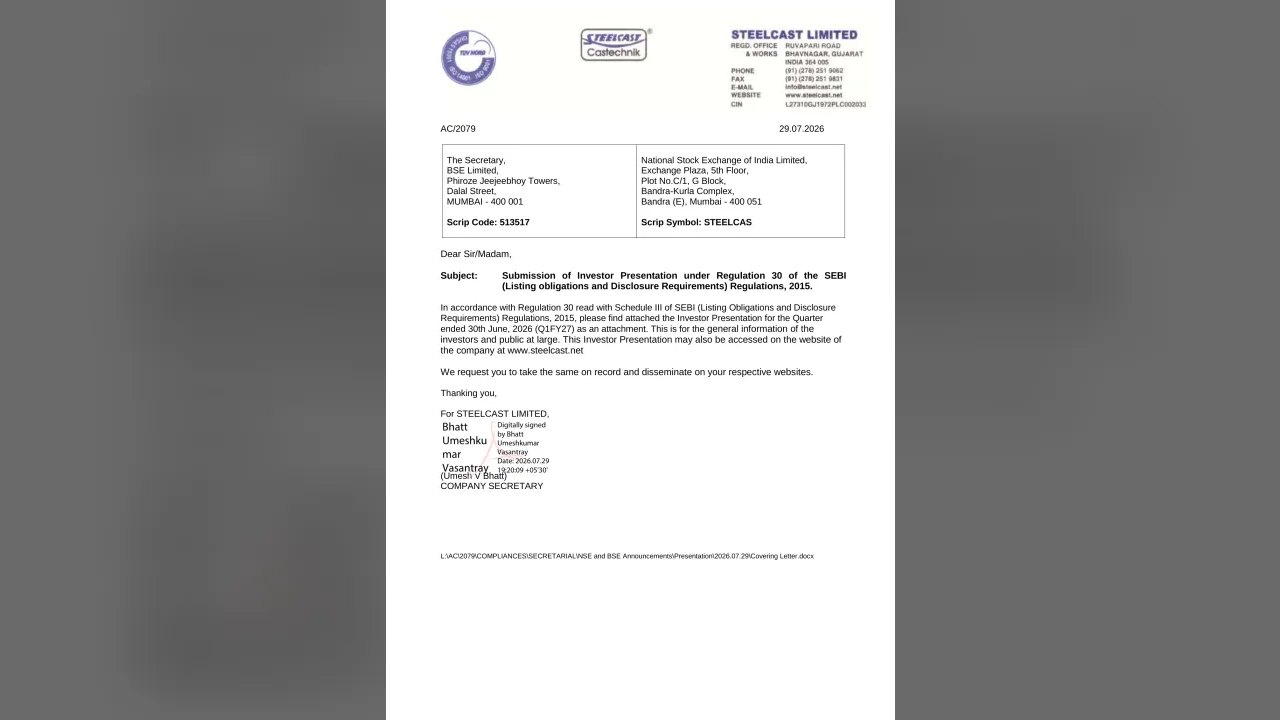
0:52 Please note a copy of all the disclosures is available in the investor section of the website as well as on the stock exchanges. Further, a detailed safe harbor statement is given on page number 27 of the investor presentation of the company. Please note that anything said on this call, which reflect the outlook for the future or which could be constructed as a forward looking statement, must be reviewed in conjunction with the risks that the company faces. Now I shall hand over the call to Mr. STEELCAS STEELCAS STEELCASS:] STEELCASS:] Thank you, Thank you, Arpitbhai, and very good morning to everyone. We welcome you to Steelcast's earnings conference call to discuss the company's performance for the first quarter ended 06/30/2026.
1:38 Our Board meeting concluded yesterday and the financial results along with investor presentation have been uploaded on the stock excel and the company's website. We trust you had an opportunity to review the same. Now let me begin by sharing an overview of the global and Indian economic environment. The global economy remained silent despite geopolitical tensions, trade policy shifts and supply chain realignments. Global GDP growth was estimated at 3.3% for the calendar year 2026. India continued to be the fastest growing major economy supported by robust domestic consumption, sustained government led infrastructure spending and strong policy focus on manufacturing and localization. GDP growth is estimated at 6.5 to 7% for the calendar year 2026.
2:29 Industrial activity remains strong across manufacturing, infrastructure and mining, creating a favorable demand environment for key industrial sectors. Government initiatives such as Make in India, PLI schemes and infrastructure investments continue to support India's long term manufacturing and industrial growth story. Let me now briefly touch upon industry trends before moving on to our financial performance. The casting and forging industry continues to benefit from strong demand across mining, earthmoving, construction, railways, defense and other industrial sectors, supported by increased infrastructure investments, manufacturing, localization and global supply chain diversification. Demand fundamentals remain robust, driven by strong equipment utilization in the mining and construction sectors, continued expansion in infrastructure projects and growing requirements for ground negating tools, wear pads and high performance steel castings used in excavators, loaders and heavy earth milling machinery.
3:31 The Indian foundry industry is projected to grow at a healthy pace, supported by investments in transportation, energy, mining, industry development, while the forging industry continues to benefit from opportunities across automotive, defense, railways and heavy engineering sectors. Let me now briefly highlight our quarterly financial performance for Q1 FY twenty twenty seven. During Q1 FY 'twenty seven, the revenue from operation was at INR124.82 crores, a growth of 17% from INR106.69 crore in Q1 FY 'twenty six. EBITDA during the quarter was at INR 35.24 crore, a growth of 17.37% from INR 30.02 crore in Q1 FY 'twenty six.
4:19 EBITDA margin was at 28.23% from 28.14% in Q1 FY 'twenty six. PAT during the quarter was at 23.71 crore, a growth of 19.26% from INR 19.88 crore in Q1 FY 'twenty six. PAT margin was at 19% from INR 18.64 percent in Q1 FY 'twenty six. Ladies and gentlemen, as we look ahead, the company remains firmly committed to sustainable and capacity led growth. In line with our increasing production requirements and our focus on reducing carbon emissions, we are significantly centering our renewable energy footprint.
5:05 Currently, two renewable power projects are under implementation, a 2.4 megawatt hybrid power plant comprising of wind and solar and 1.4 megawatt solar power plant. Both projects are progressing and are expected to be commissioned before 12/31/2026. Simultaneously to cater to growing market demand and enhance our manufacturing capabilities, the Board has approved the establishment of greenfield foundry with a capacity of 8,500 tonnes. This facility will manufacture steel castings across wide range of applications from five kilograms to 1,000 kilograms and involve a planned investment of approximately INR 120 crore over the next two years. While energy costs have remained elevated due to the impact of global geopolitical developments and sustained pressure on fuel prices. We have successfully ensured adequate fuel availability to support uninterrupted production.
6:03 Backed by these strategic investments and operational preparedness, the company is fully geared to meet the growing demand of the market and capitalize on emerging growth opportunities in the years ahead. With increasing input cost of various raw materials and natural gas, we would be having price correction on upward basis, and this will be effective 07/01/2027. In the end, I would like to say that as communicated to you in the previous quarter, we remain confident in our ability to sustain growth momentum, maintain healthy profitability and deliver long term value creation, targeting a growth trajectory of approximately 20% CAGR over the coming years.
6:49 And for FY 'twenty seven, we expect a growth of 25% compared to last financial year. There will be a sequential improvement in top line from year on for several quarters. Margins will remain in guided range and focus is to drive top line. Operating leverage benefit should kick in with scale increasing. Increasing CapEx should give you a sense of how the demand scenario is playing out and how our existing clients are looking at increasing sourcing from us. With these remarks, I would like to thank all of our stakeholders for their continued trust and support. I now invite your questions and look forward to an engaging discussion.
7:38 Thank you. Thank you. We will now begin the question and answer session. The first question comes from the line of Shubi Gupta with Treneto Asset Managers. Please go ahead. Good morning, sir. So my first question is that we are seeing... As you mentioned, that we are seeing hike in fuel prices and other raw materials. So how much do we plan to pass on of that to the customers?
8:25 And I think it started from July. So how much has already been done and how much will be done in the coming quarters? As you all know that we have the sales price variation formula all of our customers. The input prices have increased from March onwards. So the price correction effective April 1 was very minimal. And most of it will come from effective of July 1. And all the major raw materials are part of the formula, and we'll be able to pass on everything, all increases. Okay. And for this ground engaging tools, how much of the revenue contribution is coming from that segment?
9:19 As of now, it's less than 1%. But by FY 'twenty nine, we expect this to reach 4.5 to 5%. And sir, how much was it last year for FY 'twenty six? I think more or less same as the current year, but we are in the midst of developing new parts. So once they are approved, we will go into serial supplies. And gradually, year on year, we will see an increase with FY 'twenty nine numbers at maybe about 4.5% to 5%. Okay, sir. Thank you. Thank you. Thank you.
10:10 Next question comes from the line of Ankur Kumar with Alpha Capital. Please go ahead. Hello, sir. Thanks for taking my question. Sir, you said this year, there will be a 25% growth. So that will be like volume or volume plus this price increase that you are talking about? It will be see, in fact, the price increase, it will happen whatever it has to happen, but we will have a volume growth of 25%. And sir, as in even in this quarter, our margins are quite good and this 22%, 20%, 26%, 27% types, and we have not got any price increase. So do you think margins will also go up in the coming quarters?
10:59 Yes. Margins are likely to go up because of increase in input costs, which will be compensated to us. And the operating leverage, we're also kicking as volumes increase. So this increasing co pricing, what is the rough number, sir? See, it varies from component to component. It varies from customer to customer. But whatever increase we may we may have in all the input prices, we will be able to pass on everything. So would you like to comment any range of 5%, 10% range?
11:44 I think it'd be difficult to project, but one can assume that all the increases in all major raw materials will be passed on, and this is part of the standard formula with our customers from many, many years. Got it, sir. And sir, on The U. S. Railroad side, we were expecting things to start flowing. When can we expect that? Lately, last several months, we have changed our track. We have changed our strategy. We are not pursuing the U. S. Railroad for the time being because there are many opportunities in better markets, better products, better pricing.
12:30 So we will address this railroad maybe later cash on the opportunity is available for the other industrial sectors. Got you, sir. And sir, on this new CapEx, when can we expect things to start in terms of capacity expansion and when can we expect revenues to start? Internal target date to commission the plant is first thirty first March, FY 'twenty eight. And as of as we speak, we are quite confident of achieving this. So we'll have some additional volumes for FY 'twenty nine also. So this current utilization will go to around 100% by FY 'twenty eight is our expectation?
13:22 I think we already uploaded on the stock exchange. We plan to reach 90% by FY twenty nine. So and planning about 90% is not advisable because you will have many, many bottlenecks when the utilization goes above 90%. So when we have this 90% utilization, the new projects will also start kicking in and giving us higher volumes. Sure, sir. Thank you and all the rest. Thank you. Thank you.. Next question comes from the line of Harshil Solaki with Equity Capital. Please go ahead.
14:13 Hi. Good after... Good morning, team. So I had two questions. I'll list them altogether. But in the annual report, our number of employees have gone up by 32 employees, which is only 3% increase. So I wanted to understand whether this strength will be able to help us achieve a 25% volume growth, or do we need more employees to train them and then get ready? This is my first question. The second is, as you mentioned, you have not got any price hikes. But if you see our gross margins have improved in this quarter, so I wanted to understand what has driven this improvement in the gross margins, whether this has due to the lower cost inventory, which we had or is there a product mix change which has helped us achieve this?
15:05 And one is what could be the peak revenue potential that is possible from the new CapEx of 120 crores that we are doing? These are my three questions. So as far as people are concerned, we are adequately staffed from for all levels. For the current year targets and our budgeted production, we have people available. Going forward, somewhere towards the middle of this year, we'll start recruiting people and train them and so they are ready for FY 2028. And then if there's any more requirements, we will again recruit sometime in FY 2028 or FY 2029.
15:54 Now so that takes care of your question on the people requirement. On the margins, there's a very minimal increase we have got effective April 1. The major will come now effective July 1. But probably the improvement in margins is because of scale, which has higher volumes. So as I said earlier, the operating leverage will kick in once volumes grow. And to answer your this big question of the revenue potential, in the new facility, it will be about INR 300 crores.
16:48 Okay. Okay. I understood, sir. I have more questions. I'll call back in the queue. Thank you. Thank you. The next question comes from the line of Diraj Shah with Philip PCG. Please go ahead. Yes. Good morning, sir. Thanks for the opportunity. Sir, wanted to understand your order book is on current date. $1.40. $1.40 crores. If you compare it with, let's say, last year same time, what kind of growth it is there on the order book side? We are generally booked for about forward four months. And every month, the orders are replenished.
17:36 But there I don't have the numbers now, but there will be increase this year compared to last year. You know? Okay. Okay. And, sir, when you are guiding for, you know, planning to incur a CapEx of $1.20 crore in next two years, so which, segment you are seeing an incremental growth or which customers is giving you confidence to put up a new plant? So as you know, we cater to nine different sectors, which is, of course, part of the investor presentation. And so this will be coming from these nine sectors only. I'm sorry, we will not be able to give names of the customers, but it will be from this end user industries, which we are catering now.
18:29 Okay. And, sir, as you mentioned about the ground engagement tool that will contribute almost 5% of the revenue, how about in case of defense since you are also actively engaging, you know, focusing on the defense side also? Defense side, we are pursuing, but we are giving that lately, you know, past one year a low priority because the opportunities, the pricing is far better than defense in what we are doing. So we have shifted the focus to sectors rather than defense. Okay. Thank you so much, sir. That's it from my side. Thank you, sir. Thank you.
19:16 Thank you. Next question comes from the line of Krishna with Electrum PMS. Please go ahead. Yeah. Thank you for the opportunity. So a couple of questions. So first, if you could elaborate more on the growth drivers in terms of segment that we're focusing on, you know, in order to drive this 25% growth 7720% CAGR over the next three years. Secondly, some more color on the new parts that we're developing, meaning which segment or is it more export focused on domestic? Thirdly, the new CapEx that we're doing, so are we focusing more on exports? Because what I see that in q one twenty seven, although the tariffs and everything was there in the last one year, one one and a half year, we have seemed to increase our export mix year on year. So what are the reasons for the same? And, you know, if our exports is more focused towards Europe and other regions rather than U. S, so an export mix also will help?
20:15 Historically, if you see our exports have been anywhere from 45% to 50%. In the current year, we'll do exports of about, say, 49%, 50%. Next year, the domestic should be slightly better, maybe 53% and export 47%. So this has been the range several years. And the demand is coming from all the sectors which we are catering now and from customers from each of these sectors. Sometimes the export mix increases, it goes as high as 60%, 62% also here. But if you see over a longer term, it's 45% to 50% exports and balance is domestic.
21:08 So in terms of new parts, any color on what we're developing for this segment? See, I think if you've been attending our investor calls before, there is a continuous drive for new parts development. In last about eighteen to twenty four months, we would have developed more than 100 parts. So all these parts, they will now be going into serial supplier. Plus, in addition to that, the overall demand is also on an increasing trend here. So the higher the increasing volumes will be coming from new parts as well as increase in the demand from the customer. It's a composite effect. Thank you.
22:00 Next question comes from the line of Mosam Shah with Wealth Guardian. Please go ahead. Hello. Congratulations on the consistent margin generation. And I have few questions. So, basically, just wanted to know this 90% capacity utilization for FY twenty nine that we are targeting. Is it post commissioning of the new capacity that we are building, or is it only on the existing 29,000 tons? No. No. This 90%, what we plan to achieve by FY '29 is on the existing capacities. Because as you said, this would be commissioned in FY 'twenty thirty March 1 of FY 'twenty eight. So for FY 'twenty nine, this would be already...
22:54 Being the first year of operations, we are not yet fully adding that capacity, but somewhere along the line, we will start seeing revenues from that facility also. So the reason of doing this is because we are reaching 90%. So we need to create additional capacity. Okay. And just wanted to confirm this FY twenty six capacity utilization was 48% and this quarter one capacity utilization is 63%. But for the whole for the whole year, we plan to do about 63. Okay.
23:41 Okay. And also wanted to confirm on the order book number, it's $1.40 crores. Right? Yeah. $1.40 crores. Okay. And any update on the Israel defense component that we had supplied? I think... But the the trials are going on, and we should hear something in the coming few months. Next question comes from the line of Aman Srivastava with Belveda Capital Private Limited.
24:32 So I just wanted to know over next twelve to eighteen months, what would be our new part contribution to business from existing customers, which is currently not in the existing business? So yes, I just to feel in next two, three years how big it can be. Roughly, we can assume about 20% of revenues coming from the new parts. On a this is a very ballpark number, but we'll have to really deep dive and go and see component wise. But over the next two, three years, 20% of the business will come from new parts and 80% should come from the existing parts because of increase in demand.
25:27 Oh, okay. Okay, sir. So, sir, we have guided, like, a 25% growth for twenty seven and twenty percent over next few years. So qualitatively, can you tell us what is driving this demand? So as I said earlier, this is a combination of the new parts going into serial supplies and also increase in the demand from customers. It's a composite effect. And all our nine secondtors have been requesting us for improvement in supplies, increase in orders. So overall, the engineering industry in general is doing good in India.
26:24 You. Next question comes from the line of Amitabh Patsya with Sathal Ventures LLP. Please go ahead. Thanks for the opportunity, sir. I have a question with respect to the new CapEx. Whether the land is available for the new one and whether the raw material sourcing would differ from this greenfield expansion or we are tapping to the alarm ecosystem again? See, the government of Gujarat has given this 100,000 square meters of land some months back. So we already had this land parcel available. Secondly, the new facility is exactly 12 kilometers from the existing facility.
27:09 So the raw material procurement will be will have the same strategy as what we are doing now for our existing facility. Have I answered your question, two questions? Was The there a third third one is just on if you can spray some light on the development in ship breaking industry and whether the outlook looks positive from a raw material sourcing perspective for you because lots of budget is ongoing in the market. Steelcast does not use any raw material from the ship breaking because what we need is we make high strength, low rise steels, carbon steels, and we need a much cleaner scrap with very low sulfur, phosphorus and carbon.
27:58 We source our raw materials from elsewhere. Okay. But your industry penetration has been mentioning alarm ecosystem as a as a supplier. So there are a lot of, see, downstream industries which have come up because of this. And we do buy from those downstream industries, not from Aland, but rolling mills and some other industries which are downstream to ship breaking. So it's from the location advantage point of view. Okay. So you are using this ecosystem as a supplier, but not strictly from ship breaking? Yes, absolutely. Yes, please. Okay.
28:43 Thanks for the clarity. Thank you. Thank you. Thank you. Next question comes from the line of Saket Shaurabh with Sagri Capital. Please go ahead. Hey, am I audible? Yes, please. Yeah. Thanks for the opportunity and for the detailed presentation, sir. Sir, you've talked about nine segments that you cater to, which is six plus, say, six existing and new three. So what would be say contribution of say different segments like how much earthmoving segment would contribute and so on sir? Just wanted to get a sense of segmental contribution and how has it trended say over last five year if there is a data around that. Just to get a sense how we have because one of the major I think the turnaround thing that you have managed is reduced dependence on specific sectors and specific clients.
29:39 So can you just help me with this data, sir? See, the major contributing industry sectors are mining or tooling and construction. All these, we account for around 70%. And for the other six, it's about 30%. But over the last several years, we have added this new industry sectors to derisk our sales. So say ten years back, our sales to mining equipment industry was about 84%, which has dropped to above 54 now. Earthmoving was near zero, which is now about 36%.
30:28 Construction, we were at 15%, 16%. We are now at about 20%, 21%. And other sectors, as I said, so we have broadened our sales by adding customers or addition of new parts. And even the export geographies are earlier, there were two, which are now we are now going with about 16 countries here. So net net, we have substantially de risked ourselves. Of course, this is not the end of the story. We'll continue working on this for the next several years.
31:14 So this is what it is. Sir, I think this is fantastic. This underpins the long term mindset that the management has not just displayed, but executed upon as well. Now the second question would be sir, how does that geographical split look like currently? So when I'm looking at geographical split in North America, Europe or say Japan or how do you segregate and what would be the specific contribution within exports? So the major exports, of course, they are U. S. And Germany, I think both constituting about 70%. And in the balance 30, we have other 14 countries here. So the idea is to keep driving this and make sure that the dependence on U. S. And Germany reduces over time.
32:07 Got it, sir. And what was their share, say, five to ten years ago, U. S. And Germany, were they still 70 odd percent or much higher? I think ten years ago, we used to sell only to U. S. And Germany. Okay. Again, sir, great Thank progress on that as you very much. Thank you. Thank you. Next question comes from the line of Manish Goel with Thinkwise Wealth Managers, LLP. Please go ahead. Thank you so much, sir. Sir, first question, sir, you said in FY 'twenty seven, we expect 63% capacity utilization.
32:52 So that actually implies more than 18,000 tonnes sales and which would lead to a 30% volume growth, whereas you sir guided for 25% volume growth. So, if you can clarify on that, number one. Number two, on exports, sir, this 49% share what we said in FY 'twenty seven, that also is referred to volume, sir, if you can clarify. Yes, you are right. I did say 25%, I should have said 30 because indications from most of our customers are very strong. So just I was just trying to be conservative and saying a number of 25%.
33:39 But yes, 30% is also a distinct possibility. And as I said earlier, the export and domestic mix will be one can assume fifty-fifty days as well. Okay. So in volume terms also? Yes, please. Okay. Okay. And what was the volume in quarter one for exposure in Kanesh, sir? Export Kanesh? I think about 51% was 62% was export. Out of 54,000. That is the value wise, sir. That is value wise. I was just asking for the tonnage, sir. Sorry.
34:27 Yeah. Yeah. The total tons we produced was 4,700 tons. 4,700 tons and 60% was exports. Okay. Okay. And sir, on margins front, the presentation says we'll maintain margins, but as you you were mentioning in your opening remarks that margins would see benefit of operating leverage and also now with price hike. So, last for the full year EBITDA margin was 27%. So, can we expect at least 150 to 200 bps higher margin around 28.5%, 29% margin, down by 27%. Yes, theoretically, that should happen, and this is what we are going to strive to achieve.
35:17 And sir, one clarification. Just sorry, sir. Last question. This the revenue share, what you mentioned for, say, mining was 54%, earthmoving 36%. Can you please clarify that again? Last question, sir. I'll just repeat those numbers. For the current year, our sales to mining will be about 27%, earthmoving will be 43%, construction will be 15%. Okay. And defense, how do you see that revenue share? Defense will be about 1%. As I said, we have shifted our focus from defense to other sectors because in terms of demand, in terms of pricing, by all respect, the opportunities are better.
36:10 The focus is less for defense. But overseas custom, can it be become a meaningful volumes in probably next two, three years, sir? We don't have any firm plan. Maybe currently, we are doing about 1% that might go up to maybe 1% to two percent. But we don't have that focus over the three year period more than this. Okay. And GET now from current year because presentation also says that FY 'twenty seven will see growth. So now have we started getting traction approvals for our products from the customer? Yes. That's a continuous process. Just to give you an example, in FY 'twenty six, we did about 1% GETs.
37:01 In the current year, we'll go about 3.5% of the sales. And gradually, it will go up to about 6% in FY 'twenty nine. Thank you. The next question comes from the line of Subham Tamarakar, CFA from Alturas Investment Management Private Limited. Please go ahead. Hi, am I audible? Yes, please. Yes. Hi, sir. Thank you for this opportunity. Sir, I have one question with respect to inventory. So I was looking at your financials and seems like there's a rise in inventory and which has not converted in sales.
37:55 So is there any specific reason for this dispatch is not happening? See, for our kind of industries, first, when the increase in production happens, there is a pile up of inventory. And with a time lag of one to two months, you'll see again inventories going down. So and then month on month, we then work on elevated levels there. But when the ramp starts for short term, maybe one to two months, we will have additional WIP, which has not been converted to sale. Okay. Get it. And with respect to our capacity utilization, is the capacity utilization of this quarter and what we are expecting by the end of this year?
38:47 By the end of this year, we'll do about 63%. And for the quarter, April, May, June, we did 66. Next question comes from the line of Harshil Solanki with Equity Capital. Please go ahead. Yes, sir. I have only one question. So in the annual report, you have mentioned that you are transitioning some manufacturing process to electricity based systems because there is a shortage of natural gas l n... LPG, etcetera. So I wanted to understand whether you will be looking to add more of solar and whether in the longer run, this will lead to more savings for us. Have you thought of anything On on this which page are you referring to?
39:57 I'll have to go back, but I have noted down in the notes. Maybe if you want, we can take it offline. Yeah. I just want to read that statement again. Just trying to understand. So if you know the page number, we can refer and respond to you. One second. Just let me pull it out. So page number 30 page number 30 of the annual report, the heading is proactive energy transition. See, one is, of course, as you know, we have got two power plants under commissioning now. One is hybrid, which is solar and wind, which is 2.4 megawatt and 1.4 megawatt exclusively solar.
41:08 Second is we are considering to transition ourselves from instead of using natural gas, we use electricity. So this is a thought process, which is an ongoing thing. So maybe over time, over two, three years, instead of using natural gases, we will use electricity. Okay. So I was just trying to understand whether this will lead to further cost savings for us and that is the whole idea in the next two, three years. Yes. The only thing is we are not able to predict the natural gas prices, whether they go up, whether they go down because compared to February end prices, natural gas is about 50%, 55% expensive.
41:58 At the current gas prices, there will be saving when you use electricity. But over a longer term, we don't know what could be the natural gas pricing. Okay. Okay. Got it. And one more question, right? What are we planning to do with the incremental cash that we generate over the current year and the next few years? Because one twenty gigawatt CapEx is done, but we'll generate significant cash also. So any Yeah. So so So as we have said, we are a debt free company. We want to continue to maintain this debt free status. So whatever cash accruals we will have, we'll generate from now onwards in the coming two years, we will use to increase this capacity here.
42:49 Okay. Got it. Yes. This is helpful. Thank you for answering my question. Thank you, sir. Thank you. Next question comes from the line of Ankur Kumar with Alpha Capital. Please go ahead. Hello, sir. Thank you for the follow-up. Sir, I wanted to understand for this 18,000 tonne of guidance, but we have done 4,000 about 4,000 in Q1. So and you said that we're seeing very good demand from all our customers. So can you comment which all are going to contribute much? And when is it like linearly growth over the next three quarters? Or how should we think about it? See, as I said in my welcome remarks that sequentially for coming few quarters, there will be increase in top line growth quarter on quarter, a.
43:45 B, the demand is from all the nine sectors we have been catering to. So Yeah. So have I answered your question? Sorry, sir. I think I couldn't understand... Couldn't hear fully, sir. Can Can you please repeat? As I've said earlier in my that welcome speech that there will be increase in top line, and that's the drive we are having to drive towards increasing top line. So automatically, the bottom line is taken care of.
44:40 Quarter on quarter, you will see improved sales. Got it. Improved volume as well as improving realization. Actually, absolutely. And the composite effect of that will be we will expect minimum 25% growth over the last financial years. And to a previous participant, you also said margin can also go to 28.5, 29 types. Yes. The question was, can we get additional 1% to 2%, which I said, yes, it's a distinct possibility. And with the operating leverage kicking in, this should happen. Thank you. Next question comes from the line of Keay Manunath, an individual. Sir, please go ahead.
45:39 Hello, sir. Please. Congratulations on the consistent good of goodness of the numbers. Question is, how you're planning an expansion and you want to finance it by internal accruals only. My suggestion is, why don't you go for the right issue for about 60% of the budget cost so that the efficiency and electronics will work out substantially. Because, for example, if you price issue at around 200... 300, the bulk of the project cost can be financed by premium itself, which may not be serviced. And it give more flexibility and it'll be less vulnerable.
46:26 The results can be used elsewhere also. My second question is, now you have been earning more than double the equity every quarter by our consistent hardware, perseverance, foresight. Why don't we consider a bonus issue? It gives more visibility. It'll improve our brand equity, and it'll improve the shareholding count also. And the third is we are... With the consistent improvement in quality, why are we not focusing on certain specific defense components so that we can improve our sales productivity in the long run? So thank you. So your first question was about the right issue.
47:11 Now company already has INR 120 crores of reserve. If you see March 26 balance sheet, if money is there. Now we are investing INR 120 crores over the next two years. So that we will be giving using the internal cash accrual to fund this investment. So with funds with enough of funds already with the company, would it be prudent to do a right issue and take more money from shareholders? So this this is something... Taking at a substantial premium. True, true. But at this point of time, sir, we submit submission. Submission is, if the project cost is INR100 crores, if you take a premium of even INR200 crores, the project cost for the company will come to just INR10 crores.
48:06 Okay. I'll take your suggestion to our Board of Directors, but please understand the company does not need any more resources from the shareholders. In fact, if the equity goes up, then the earnings per share will go down. So these are some sectors that... Yes, marginally, but it will go down. Second, on your suggestion of bonus issue, yes, surely, I will take up in the forthcoming board meeting. Yes, sir. And your first question is about defense. Now at at this point of time, we have a lot of opportunities from other areas other than defense. And according to according to us, these are better than, you know, defense supplies and more... And I and I always tell people that one of the most riskiest business is defense business here because you're selling only to one customer.
49:07 Yes, sir. Okay. So risk... Risky defense is is is is very, very high. Of course, it's... This... In India and the stock market, defense is a big fancy word there. But I see a lot of risk in the defense business. However, your suggestion is well taken. And if there are any opportunities which comes along the way, we will surely cater this. Thank you. Thank you. And thank you for your compliment Thanks a lot, sir. Thank you. Next question comes from the line of Saket Saurabh with Sardari Capital. Please go ahead. Hi. Thanks for the follow-up, sir. I have two quick questions. One, so is our exports are slightly underreported when I say that maybe the domestic, might be a Tier two supplier and then domestic supplies can further be used by, say, a tier one supplier or the OEM to use at export location. So that is one point.
50:16 Second question is that, usually, it happens is that the pass through, cost pass through varies from exports clients to domestic clients for other auto. So usually for domestic players, the pass through could be on a monthly basis, but for domestic... As for exports, it could be even quarterly. In our case, it seems the major pass through has happened almost with a quarter lag. So any specific input from that and how does our lag between cost pass through? So these are the two questions, sir. So generally, when there is an increase, we get an increase with the lag of one quarter. And whenever there are reduction in input costs, the pricing is dropped with the lack of one quarter.
51:08 So this time, the costs are increasing. So we will get compensation and they are effective July 1, as I said earlier. What was the other question? I'm sorry, I forgot. So first question, Anwar, regarding exports, right now, say, if our exports revenue is fifty-fifty, but is there a say, exports is 50 and domestic is 50. So is there a possibility then that, you know, we supply to... Say, we are tier two suppliers to some of our accounts, and they further export our component later on? So... Which might mean that, you know... Yeah. Yeah. Yeah. I I can answer your question. First of all, Steelcast is tier one supplier everywhere. Okay. I think more than 98% or 99% of sales are as tier one supplier, we give directly to the OEMs.
52:01 Now the OEMs in India might be exporting some portion of what we supply. So if you consider that, then the export numbers with direct exports and indirect exports will be slightly higher. But we really don't know which customer exports how much. Okay, sir. Okay, got it. And sir, is currency fluctuation also a pass through? Some companies have contracted it in a similar manner that any currency dip or upside is also pass through. What is in our case, do we hedge or do we In our case, we share the rupee depreciation or we share the rupee appreciation.
52:51 We with the customer. Okay, sir. Okay. Thank you, sir. Thanks for the opportunity and best of luck for the Thank coming you. Thank you. Next question comes from the line of Manish Gwal with TechWise Wealth Managers LLP. Please go ahead. Thank you so much for the opportunity again, sir. Just on the order book, sir, you mentioned it is $1.40 crores, sir, which is probably the next quarter revenue. So, like on visibility side, sir, what is driving the confidence for such strong volume growth in such a challenging geopolitical situation?
53:40 See, there are several factors. One is, of course, indications from our domestic and export customers of increased volumes. The commodity prices are at elevated levels. Infrastructure spending in India as well as abroad is on an increasing trend. And other sectors like railways, there's a lot of investments happening. So across all industry sectors, there is an increase in demand. And industries like casting and forging will do well. If you see, say, automobile, that too is growing at 15%. So in spite of all the geopolitical issues, India is slightly insulated. We have a large domestic consumption.
54:38 However, there will be some cost pressure here and there. But overall, India as a country and the engineering industry in general should do well. Okay. So ideally, this INR 140 crore execution would be like three to four months? Or how should we understand, sir? See, this is the value of orders. As I've said before, we have this home business for three months and every month, an additional month is at it. So at any point of time, we generally have three, four months of order booking. Ladies and gentlemen, that was the last question for today. We have reached the end of question and answer session. I now hand the conference over to the management for closing comments.
55:41 Thank you to each one of you for being part of our earnings call and participating in this call. We appreciate your support and trust in us. We hope we've been able to address most of your queries. In case of further queries, you may reach out to our Investor Relations Adviser Ernst and Young, and they will help you to connect with us. And once again, thank you very much for being part of on this call. And also thank you to Ernst and Young team for organizing this call, and thank you again to everybody. Thank you. Thank you. On behalf of Steelcast Limited, that concludes this conference. Thank you for joining us. You may now disconnect your lines.
Follow Steelcast Ltd. into a list and get an email when it puts out news.
at team
Chairman and Managing Director at Steelcast Limited
full time director at Steelcast Limited
Executive Director and CFO at Steelcast Limited
at Treneto Asset Managers
at Alpha Capital
at Equity Capital
at Philip PCG
at Wealth Guardian
at Belveda Capital Private Limited
at Sathal Ventures LLP
at Sagri Capital
at Thinkwise Wealth Managers, LLP
CFA at Alturas Investment Management Private Limited
at Equity Capital