Pratamesh Parab
at MUFG India Private Limited
Replay available
Sportking India (NSE:SPORTKING) Q1 2027 earnings call, held 2026-08-03. Watch the replay and read the transcript on 6ix.
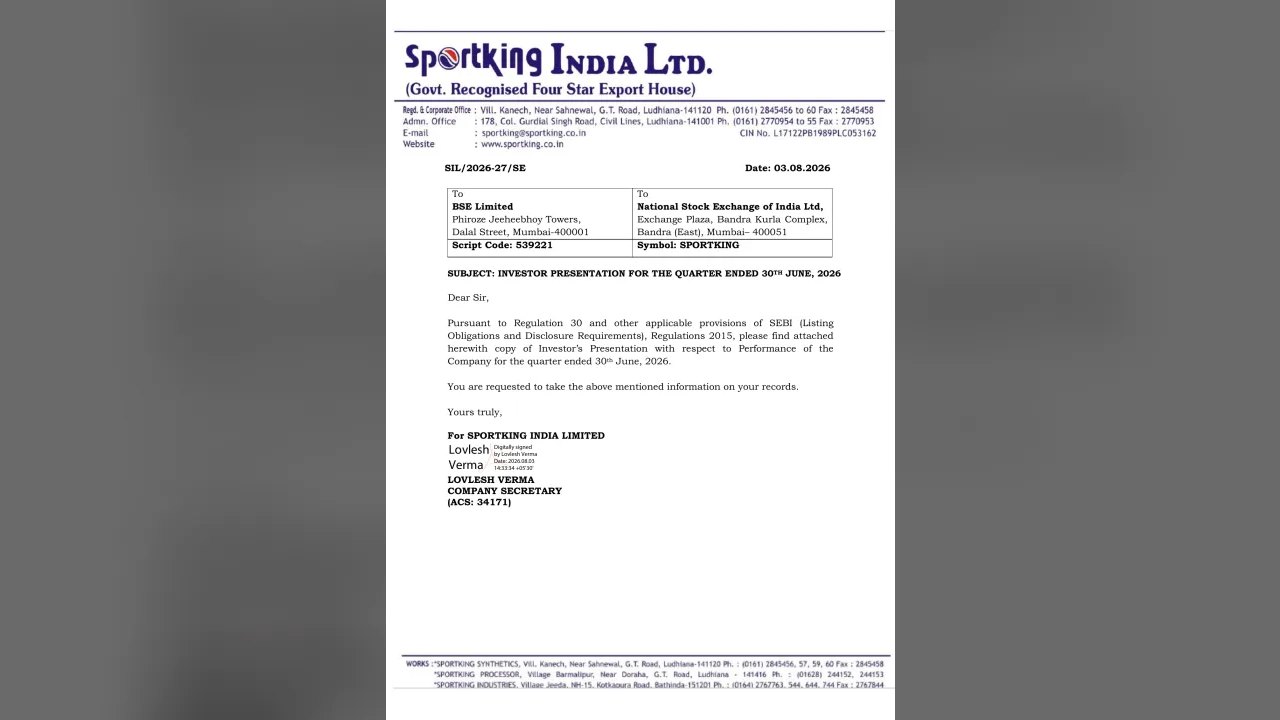
On 6ix: 6ix.com/event/sportking-india-limited-sportking-q1-2027-earnings-call
Automated transcript · Written by software from the replay's audio. It can mishear names and figures; the replay is the record.
0:00 Ladies and gentlemen, good day, and welcome to SPORTKING India Limited Q1 FY 'twenty seven Earnings Conference Call. As a reminder, all participant lines will be in a listen only mode and there will be an opportunity for you to ask questions after the presentation concludes. Please note that this conference is being recorded. I now hand the conference over to Mr. Pratamesh Parab from MUFG India Private Limited. Thank you, and over to you, Mr. Pratamesh. Thank you. Good afternoon, everyone. Welcome to the SPORTKING India Limited Q1 FY 'twenty seven Earnings Conference Call. Today on the call, we have Mr. Munish Avasti, the Chairman and Director Mr. Sandeep Satheva, Chief Financial Officer and Mr. Lavish Verma, the Company Secretary. I hope you have gone through our press releases and the Investor Day.
0:57 As a short reminder as a short disclaimer, before we start with this call, the call will contain some forward looking statements, which may be based upon our beliefs, opinion and expectations of the company as of today. These statements are not a guarantee of future performance and will involve unforeseen risks and uncertainties. With that, I would now like to hand over the call to the management for their remarks. Thank you and over to you, sir. Thank you. Thank you so much. And good afternoon, ladies and gentlemen. I hope all of you had the opportunity to go through our investor presentation and earnings release. We are pleased with the strong start of financial year 'twenty seven. During the quarter, we delivered healthy revenue growth along with a significant improvement in profitability.
1:43 The quarter was particularly encouraging as the growth in earnings was driven by a combination of better yard realizations, strong export demand and disciplined raw material procurement. Despite some increases in raw material prices during this period, our strategic buying approach enabled us to effectively manage input costs and protect margins. Market conditions remained favorable during the quarter with better realization across our product portfolio, particularly in cotton yarns, which supported the strong improvement in margins. Demand from all the markets continued to remain healthy, and we are also encouraged by the outlook going into the second quarter. On the domestic front, we expect demand to remain supportive in the coming quarters, aided by the festive season and improving consumption trends.
2:32 From an industry perspective, the global sector is gradually recovering after a prolonged period of demand moderation and a lot of consolidation has happened in last few years. Over the last few years, industry experienced challenges arising from inflationary pressures, inventory corrections across large periods and weaker discretionary production in key markets. However, with inventories largely normalized and demand conditions stabilizing, the business environment has become more constructive for textiles and factories. We have also been testing a continuing shift in global sourcing patterns. As India is emerging as a preferred sourcing destination for Yaad, the country's core ecosystem, large manufacturing base, proven execution capabilities and growing compliance is standard position favorably in the evolving global supply chain, NAV scale.
3:26 We believe companies with scale, quality and reliability such as us are well placed to benefit from this structural opportunity. On the policy front, developments remain encouraging. The recently concluded India UK free trade agreement and the progress towards a comprehensive India EU trade agreement has the potential to significantly improve India's competitiveness going forward in key export markets over the medium term. We believe such initiatives will support growth, creating market opportunities and strengthen the long term prospects of the Indian tech side industry. Coming to cotton, one of the positive developments for the industry has been the alignment of Indian cotton prices with international markets after prolonged period, during which the domestic cotton traded at a meaningful premium.
4:15 This has improved the competitiveness of Indian spinners and created a more balanced operating environment. While global cotton prices have shown some firmness in recent months, we remain focused on prudent procurement and efficient inventory management. Our outlook on the new crop is getting better every day. There were initially some scares with the monsoon, but things have gotten better, and we expect same or better crop next year. Another encouraging trend has been improved has been the improvement in global economy and demand. Supply chain realignment, healthy export demand and increased sourcing diversification by international customers, which has supported the annualizations and profitability.
5:03 These factors contributed meaningfully to our performance during the quarter and remain the same as we speak. On the strategic front, I'm pleased to share that our solar power projects has successfully commenced commercial operations. This marks an important milestone in our journey towards sustainable and cost efficient operations. The project is expected to reduce our annual power cost by approximately 12% to 15%, while simultaneously increasing the share of renewable energy in our overall power consumption. In addition to the cost benefits, this initiative reinforces our commitment to responsible and sustainable growth. Our 150,000 spindle greenfield expansion project in Kundisha is also progressing as planned.
5:49 We are very excited with that. Construction activities are underway and the first phase of production is expected to commence during the third quarter of the current financial year. And we intend to finish the whole project within this financial year. This expansion will provide the necessary headroom to support future growth, strengthen our market position and cater to increasing customer demand and newer geographies, we expect the project to start contributing progressively as we move ahead. Looking ahead, we remain optimistic about the medium to long term outlook for the Indian textile industry, structural shifts in global sourcing, improving trade relationships that support the policy environment and growing opportunities for Indian exporters, big Indian exporters provide a favorable backdrop for future growth.
6:39 As Sporting, our focus remains to drive operational excellence, strengthen customer relationships, invest in future ready capabilities and create sustainable long term value for all our stakeholders. Thank you very much. With this, we could we'd be happy to take your questions. Thank you. We will now begin the question and answer session. The first question comes from the line of Riyan Syed with Trinita Asset Manager.
7:33 Sir, my first question is around your outside business. So, your Europe has shown now a growing demand while the India FDA is expecting low. Is echoing. I really can't hear you what you're saying. Now it's clear. Hello? Yes, better, better. Can you just speak slowly? Yes, okay. Sure, sure. So my first question is around your Europe business. Now, Europe has shown improving demand, while the India UK FDA is expected to benefit Indian digital exporters. So have you already started receiving incremental inquiries or orders from UK customers or do you expect the benefits to materialize only after FY 2028 onwards?
8:25 Okay. I think you're talking about the incremental demand coming out of the UK FDA, right? No, I think these things take time to play out. I think that just happened last month, and we have not received any orders really, which has been coming out of this U. K. FDA right now. But we expect because it's a long term and medium term phenomena. I think once the people start doing sampling and they start getting orders, it will take six to nine months for it to really show it on our order books. Sir, my second question is around your Odisha Phase one. So Odisha Phase one is expected to commence production in quarter three FY twenty twenty seven.
9:15 So could you provide the expected spindle prediction in Phase one plus the utilization ramp up time line and the EBITDA margin profile going to plant optimal utilization? So we plan to start the business in the plant in somewhere in the next quarter. And we expect to ramp up the whole plant. It takes it's a long it's a big plant. So it will take us around five to six months to fully ramp up. And I think by March end, we should be working we should be at about 90% capacity utilization for the whole plant. So around about EBITDA accretion, this plant has many incentives, which are embedded.
10:09 So we expect the margins coming out of that plant to be at least 300 to 400 basis points or even more than what we do in our old plants. Okay, sir. Okay. As a last one question from my side. Sir, just wanted to understand regarding the export market scenario. So has the competitive intensity from Bangladesh, Vietnam and China changed in your key export markets over the last six months? And are you seeing any market share gain because of supply centric diversification? So see, has been the tipping point for what has happened in last eight, nine months.
11:00 Chinese market was very subdued for last four, five years. And we have seen an increased demand. So most of the incremental demand, which has come into India for yarn exported from China. Bangladesh continues to be steady as they were. And China, we continue to see every month, we see them as a buyer. And we think that this is going to go on because there the cotton crop is also getting a little smaller. And there, right now, the cotton prices in China for last six, seven months and what is expected in the next six months also are going to be much higher than the international prices.
11:48 So there's a lot of arbitrage they have to incentive to import yarn. So we feel this competitiveness is going to stay. And a lot of consolidation has also happened. So I think there are we can feel this is supposed to be the worst quarter, which we are going through. And we see still see a lot of demand in these times, which is pretty extraordinary. So we expect whatever has happened in last three, four years, all the consolidation which has happened, the spending which has shut down across the world. I think this is what is propelling this cycle. Sir.
12:34 Next is from my side and good luck to upcoming quarters. Thank you. Next question comes from the line of Abhishek Shankar with ICICI Direct. Please go ahead. Yes. Thanks for taking my question. Hope I'm audible. Yes. Congrats on the good side of results. So I just had a question on the inventory part. See, we've seen some uptick in the cotton prices over the past same prices of the plant. So how we are going aim at that Mr. Shankar, sorry for interrupting. Your voice is breaking. Your voice is breaking, Mr. Shankar. Can you please come in the range and talk? Yes. Is it on good now?
13:20 Yes. Please go ahead. Yes. So my question was regarding the inventory. So in the past three to four months, we've seen that cotton prices have moved up a bit. There has been some spike. So I just wanted to ask, sir, if I'm right, you might be procuring cotton cycle of about, say, five to six months. So if you had procured a cotton, say, about October last time during the crop, so now there will be a new inventory that should come in, right? So, will there be the impact on the cost of materials? So, see the cotton, generally we procure cotton for the whole season by February, March. So that's our normal procurement cycle and which we did this year as well.
14:11 And prices generally go up in this period of time almost every year because of the of the season. So we don't have a problem right now. We covered for like four, five months. And we expect the new crop to come early this year because of less rain predicted. So we expect by October, we shall start seeing a moderation in cotton prices because right now these prices are just because there's not much crop left. So I don't see much impact of I think the major the most important thing is how competitive we are to the world, which is actually prices can be higher or lower.
15:03 And we see Indian prices being competitive going forward because there's a lot of tightness happening in Chinese balance sheet and in U. S. Balance sheet. And while Indian, I think we will end up this year with formidable stock, and we are expecting a good crop next year. So I think this competitive pricing should stay. So I think that is more important for us to maintain our margins. Yes. Just one more follow-up question to that. So considering the cotton prices will be favorable ahead and you also highlighted in your comments that demand continues to remain strong. We can expect the cotton and spreads or your spreads to further from here in Q2 and Q3?
15:53 See, again, in this macro environment, we really can't comment too much going forward. But yes, the current quarter looks to be similar or even better than what we have delivered this last quarter. Okay. Thank you. I'll get back into the queue. Thank you. Next question comes from the line of Manoj Gyatnapuri with Infinite Financial Services. Please go ahead. Hello. Hello, Manoj? Yes, Good set of numbers, and I just have a few questions. So as of last quarter, you had roughly around ninety days of export and sales booked and two quarters of spread visibility, if I'm not wrong.
16:40 So rolling that to today, so what does your current book visibility look like? And are you still seeing that order strength or, you know, any early signs of bias pausing for now as of, know, the spreads are nearly around already three years of high? So we continue to see that this is generally our strategy. We have an order book ranging from seventy to ninety days in any year, whether it is this year or even the last year or whichever year because this is our policy we work with to manage our risk of having higher inventory. And we continue to do that. We still have the similar kind of order book as we had end of the last quarter. And second question is on the solar power plant, which recently got commissioned. So how much of the guided annual savings are actually like total this quarter, if you could elaborate on that on the operating expenditure side?
17:40 Sorry? What? I didn't get it about solar part. What do you want to know? Yeah. Basically, how much have you, you know, guided annual savings, right, previous quarter? Previous quarter, the saving was very, very marginal because it was operational only for ten days. So So this quarter, it shall be much more, yes. And one last question. So what's your visibility on the recent import duty? Is it like do you expect it to be a very long period? Or do you seem to already price in with your FY 'twenty seven guidance? Like what do you expect about it? So right now, this M4 duty is the exemption is still October, October 31.
18:29 And so we had planned accordingly. And we are talking to the government to extend it. So that those talks are still going on and government is listening to us and hopefully, we'll get a favorable solution to that. So could we like expect any fresh incremental upside from here? Not in the medium term because we already have the inventory for next two quarters. So anything so this is we are telling the government to remove the import duty because that solves this hanging forward all the time. So anything if government does that, it will help us in being sourcing competitive cotton going forward and we can choose from wherever we want to buy.
19:23 Yes, absolutely. All right. That's it from my side. All the best. Thank you. Next question comes from the line of Puneet with countercyclical PMS. Please go ahead. Hi, sir. Thank you for this opportunity. So what was the cost of procurement of cotton in Q1 and realizations that we had for our products? So I can share you with the spreads actually. We don't share the cost and all these specific numbers. So spreads were the overall spread was 133, vis a vis INR 107 last quarter.
20:12 Got it. So we generally have around ninety days of inventory. So now that you mentioned that the cost of procurement is going up, Can we expect the spreads to go down now? I mean, even though you mentioned that this quarter is even stronger than the last quarter in the coming quarter. I mean, So how is yes. So the thing is, we always have an order book of ninety days and the prices have gone up in last ninety days. So even the raw material might have shifted up a little because we keep on most of our purchasing was done three months back.
20:58 So the spread because broader look what we had last quarter was at a lower price than what we have right now. So that will increase the spread. The prices have gone up by 10% to 10% about 10%, 11% in last quarter. Got it. So in terms of annual cost saving of the solar project, so can you quantify the number for an annual run rate? It should be around INR 15 crores with this new with this solar pump, yes. Got it. And in terms of the new CapEx, which we are guiding to add to our production in Q3, So if we can get a range of how much additional production can we expect from that project that new greenfield project in Q3 and onwards?
21:56 Right now, we are not considering anything for Q3, but whatever we get will be bonus. But in Q4, we expect almost 30% to 40% of the revenues of the total potential to kick in. Got it. Got it, sir. And my last question would be in terms of our product mix. So has there been any change in the product mix if we compare year on year? And what is the percentage of value added products in our total volumes in Q1? So, the definition of value add is very different for everyone. So, we are so there has been a slight shift in not in the product mix, but maybe different blends.
22:49 We are running both blends. We are running different counts. So but otherwise, there's not been much different in what we do, what we did last year other than we are doing it more efficiently. That's it. Got it. So most of the delta is just because of higher price realizations rather than any change in product mix? No, it's a little bit of product mix and a little bit of better conditions because last two, three years were pretty visible from the demand point of view. So yes, most of it has to do with the spreads and better efficiencies. We have worked a lot on our efficiencies.
23:37 Number of people we employ has come down making the similar amount of with the same production and better cheaper power. And so many things which have cumulatively helped in these margins. Got it. And sir, you do you believe that these higher realizations are sustainable for the coming year? And have we also added any new clients to our existing clients? And have we also started exporting to China where you mentioned that we are witnessing higher prices? So China is not like it's not that we are getting higher prices in China. It's just that China has come as a big buyer.
24:31 So for the country as a whole, So it has made the whole complex go higher. The demand has been more, so the prices have moved up. Talking about the new additions of clients, which is ongoing. We keep on adding and subtracting the clients. This is an everyday phenomena. So there's not much change to it. What was your other question? Got it, sir. So basically, I mean, most of the higher prices is due to the better demand in China. So tomorrow, say for some reason, the demand environment in China again depreciates. So I mean, is it likely that the prices would fall back again to the normal levels considering that is the only catalyst right now?
25:23 It is not the only catalyst. It is just given an impetus to it. And out of we make almost 400,000 tonnes every month and China is just buying 20,000 tonnes. So, it's not even for it's very small minuscule portion of Indian textile basket. So, we this China can be so we don't expect China to go out of the system because there are some inherent advantages Chinese have to import India. But we see a lot of other factors coming in that Bangladesh is struggling with the spinning lately because of gas prices and capital prices. And then we see from next couple of quarters, we see the traction coming out of these FTAs and we expect Indian demand to go up significantly.
26:22 So there these things will keep on playing part. So some things will go bad and some things will do good. So we can't really predict what's going to happen. But overall, things look good. Got it. And now with the U. S. Tariff thing past us, did we see a jump in our exports to The U. S. In this quarter? And what is the outlook, I mean, for the financial year? So we don't export anything to U. S. Directly. But we have seen a lot of our vendors who export to U. S. Sales, they have been their lifting has gone up in last six months.
27:11 So, we see a clear trend of those customers who were not buying in HIB or buying very less quantity from us, have almost doubled their uptake. So yes, I think that has of course helped in last six months. Got it. Thank you very much. I'll join back the queue. Thank you. Next question comes from the line of Prateek Shivastava with Nivesh Wisdom. Please go ahead. Sir, again, congratulations on a great set of numbers. So my question is of this 18.8% EBITDA margin, what can be attributable to this temporary important import duty?
27:58 And more importantly, is this margin sustainable in long run? So see, this specific import duty, which has come right now is not actually this will help us in the future because this has just happened right now when we had already secured our raw material for this year. So this is there is no contribution for this duty for these numbers. But of course, this will help us in our forward numbers. And about sustainability of the margins, so we can it's a very difficult market to predict what's going to happen in the future. But in the medium term, yes, I think for next two quarters, we shall be in and around these percentages.
28:50 And going forward, we as a company think that we will get a lot of lift from our lease up once it kicks in next year fully. And that will definitely give us a better margin than what are the margins, right, like what are the normal margins. So these might be a little elevated margins. But if you see the turnover has also gone up. So if you see the absolute EBITDA numbers, I think they shall be higher. But in percentage terms, we can be a little bit up or down after two quarters. But I think the absolute EBITDA number should keep on trending higher next year also. Got it, sir. And sir, just continuing on this, sir, we saw that even in FY 'twenty two, our margins were very high, right? I think it went somewhere around 23%, 28%, somewhere around that. Then again, went down from 23% to 26 and went back again from nine to 13% range.
29:52 Now again, we're seeing 18%. We see that, of course, the business is highly cyclical, commodity, bit driven business. Now with Orita, CapEx also coming up. What is management taking action to make it more structural business and not this highly cyclical commodity business? I think, see, that year was an aberration. Frankly, if you ask me, 28%, there was a lot of issues of supply chain disruptions and there were many duplication of orders. So that year was a aberration. But otherwise, we expect our margins to in the long term margins to stay after our lease up plan to stay around 15%.
30:38 So what we are doing for that is like, first, we are putting up a new greenfield project, which makes us geographically more competitive. We have better government support from there. And we keep on making ourselves lean with automation, modernization on time and a lot of investment in our energy. So all these things are making us more efficient, which will help us in having more consistent margins around 15% for the company even in bad times. And these 28% and year was an aberration. So I won't take it as a benchmark for the volatility of margins.
31:31 Otherwise, they stay between 12% to 14%, which is where we are comfortable actually. Got it. Okay. You. Thank you very much, sir, and all the best. Thank you. Thank you. Next question comes from the line of Prerna Jinjanwala with Elara Capital. Please go ahead. Hello. Mr. Jinjoonwala, please go ahead with your question. Jinjoonwala, please unmute yourself and go ahead with your question.
32:17 Since there is no reply from the line of Mr. Jinjoonwala, we'll move to the next participant that is Raman Kevey with Sequent Investments. Please go ahead. Hello, sir. Can you hear me? Yes, please. Sir, you mentioned that the spend during the quarter was 133 per kg, and you also mentioned that the raw material... The cotton prices are on an increasing trend. So after two quarters, when our low cost inventory gets used up, when we buy... Will we will we be able to pass on the high cotton inventory to the end use customer? I just want to understand whether this $1.33 rupees per kg spread, is it sustainable for, let's say, one or two years down the line?
33:08 It's very difficult for me to predict right now. And we are expecting first of all, we are expecting cotton prices to come down from where they are in once the new crop comes in. And that should help in we don't need to go up a lot in business. And then in our order book, we all right now, our order book or whatever we did last quarter, we didn't capture the rail highest prices. So it was the impact of stock, the inventory gain was very minuscule. So overall, what we see is that in last six months, if you buy cotton today and you sell cotton today, those margins, those grades have also significantly gone up than what it was last year.
34:02 So it is the impact of inventory is a little bit is there. And it will be most of it to be reflected in the next two quarters rather than what it was in the last quarter. Because last year last quarter, if the price of cotton was lower than even our average price of yarn was also lower because we keep a ninety day book. Understood, sir. And so from the with respect to new CapEx, will be in like you are investing INR 1,000 crore in Phase one wherein we will have 40% capacity addition. So from what I can see, this will increase your... Our quarterly run rate by... Our revenue run rate by $2.50 to 300 crores.
34:48 So for next year, let's say, FY '28, what utilization are you expecting it? Can it reach 96% utilization? Of course, that's our target that we want to reach 96%, 97% utilization by the start of the next financial year. Understood. And sir, my last question is on the export side. Exports have been around 50% of our business. And it it grew at a slower pace when compared to the overall revenue. So mainly because of the Middle East crisis. How are you seeing the demand from the export front for the coming quarter? And will there be any significant impact in Q2?
35:46 So first of all, Middle East crisis didn't have any much impact on demand. So this was all I think it's in every quarter, there's a couple of percentages are we keep the similar kind of target for our exports. Sometimes we export more and sometimes we export less. But overall, our focus is always to go at 55% to 45% within this range. So this will stay as and we see a lot of demand from its port. So this is not something which was by design, just that maybe some domestic orders were executed first. Understood, sir. Thank you so much.
36:33 Thank you. Next question comes from the line of Bhavika Singhri with Niveshav. Please go ahead. Yeah. Thank you for the opportunity. Sir, I have a follow-up question on the previous one. On the export side, apart from Bangladesh, are we seeing any demand from other regions? And how we are doing apart from Bangladesh to other regions, including China, if you can comment on that? Yes. So demand see China and Bangladesh are the most prominent importers from India. So out of a basket of 115,000 tonnes run rate what we are doing right now as a country, I think 60,070 around 75,000 tonnes from these two countries.
37:25 So rest is and the similar so we have the similar kind of spread when we talk about our exports. So 60% to 70% of our export is to these two countries. And rest is divided between many countries. So we have a similar kind of exposure as our country has to for exports. Got it. So currently, as you said that there has been like a slowdown in the Bangladesh or like, the... This quarter particularly, Bangladesh have been, like, a muted one. So can you give us the understanding that how Bangladesh we expect in the coming quarters and going forward? Are we expecting a recovery from there or like the demand scenario, if you can? Ma'am, I think you misunderstood me. What I was referring to was the spinning sector in Bangladesh is undergoing a crisis.
38:22 The demand and because of that, it is helping us in stimulating more demand out of Bangladesh. So Bangladesh is not doing fantastically well right now and continues to do that. And we expect it to do even better going forward with all the crisis they are having there of energy crisis and all these crisis among the spending will there. So there is no problem with Bangladesh demand. Got it. And the second question is regarding the acquisition which we have planned. So when you are expecting it to be reflecting in the books and how much addition we are expecting from those acquisitions, the fabric and the garment division? Ma'am, that is still wonderful, right. Unfortunately, it's taking a little more time than what we envisaged.
39:11 But I think it will take another maybe another one quarter and we expect the full impact to come start coming, which should be around INR $2.50 crores from next financial year. Okay. And the greenfield expansion, which we are expecting to go live in this next quarter, are we expecting any contribution in this financial year from that capacity or it will be fully like commercialized from the FY 'twenty eight, like it will start contributing from FY 'twenty eight? No, I think we expect to get handsome revenue out of that unit from quarter four this year also. We expect to start getting it fully in the from next financial year.
40:01 Okay. Yes, that's all. Thank you so much. Thank you. Next question comes from the line of Abhishek Sankar with ICH. Please go ahead. Yes. Thanks for taking my question again. So this is regarding the merger only. So just a follow-up to that. So I think you mentioned last time that you be doing it in behalf of cash or by insurance of shares. So is there any update or like is it going to be a preferential issue or how much cash is going to this year? And other thing is how what will be the peak debt post merger? So merger will be predominantly preferential shares. So there'll be a small outflow of cash. I think it will be less than maybe around 25 crores, 30 crores.
40:57 So the now peak debt post I think merger won't have a lot of debt involved. So I think there won't be any incremental increase in debt because of that. Next question comes from the line of Pushkar Jain with Milli Capital. Congratulations on great set of numbers. I just wanted to know about the incentives that we are going to receive as part of Odisha investment. So if you can give some light on that. We are going to get 2.50 subsidy on the power, whatever we use. And then we have a capital subsidy of INR 13%.
41:53 And then we have some land subsidy, which we are going to get after we attain a specific number of employment. And then there is an employment subsidy, which is about INR 7,000 per employee. So these are the major subsidies. And of course, there are other geographical advantages, like we can cater to the Eastern part of the world, which we are doing right now from North, which is which will help us in cutting down our transportation cost. Right. 30% of capital subsidy, right? 30% of the capital subsidy on plant efficiency. Right. So any amount that will There's no cap to it. So whatever we spend, we'll get 50% of it.
42:41 Thanks a lot. Mr. Chen, are you done with the question? Yeah. Yeah. Thanks a lot. Thank you. Next question comes from the line of Dia Chen with Safar Capital. Please go ahead. Hi, sir. Am I audible? Yes, please. So how much are we investing in the greenfield project? And, also, can you explain the CapEx that we are targeting for the next two to three years? So ma'am, right now what we have announced is about $9.75 crores and which will be completed by the end of this financial year. And beyond that, so we have got land for we can go up to we can triple our capacity at Odisha. We have that kind of land there.
43:37 So rest, what we spend in the future in next two, three years will depend solely on our balance sheet. If our balance sheet will allow, we will go we have a lot of plans. So we are just looking at our balance sheet. And we know we only and we know what kind of leases we want to take. So we will take those decisions as we feel comfortable with balance sheet. Okay. And with the improved realizations, how much growth are we targeting for this year and FY 'twenty eight? So this year, last year, our top line was around INR 2,500 crores. This year, we are expecting somewhere around INR 3,000 crores. So that's what 20% up. And next year, we see this with the new plan, we see this going up to around more than INR 4,000 crores.
44:45 Next question comes from the line of Raj Patel with RK Investments. Please go ahead. Yes. Hi, sir. Am I audible? Yes, please. Congratulations on the great setup number. Sorry, but miss the previous part, I have joined this call late. So just wanted to confirm that post after the proposed forward integration, what percentage of revenue do we expect to come from the value added product such as fabrics and garment over the medium term, let's say, five to five years? Five years is too longer time for me to tell you or even give an because we have a lot of plans for our Government and Fabric division, which we are which we will announce once we are more comfortable and we have more visibility.
45:36 But in next one year, we would say around 10%. 10%. Got it, sir. And my next question was with regards to this solar project. So as we have now commenced the operation, so have we started seeing realization for the anticipated power cost savings? And how should we expect the full benefit from Q2 onwards? Of course, we got only ten days of power from that project in last quarter. But of course, we expect the full ninety days to kick in from this month. And so of course, whatever power will be generated depending on what kind of weather we have, we will get all that benefit start getting this full benefit from this quarter.
46:32 Okay, sir. And sir, any guidance for this solar project for the full year? So that we have shared that it should be around 15 crores. INR 15 crores. INR Got it, sir. That was really helpful. All the best for the future. Thank you. Thank you. The last question comes from the line of Fahal Sharma with DD Capital. Please go ahead. Good evening, sir. Thanks for the opportunity. So I have some questions with me. First is that given that current year spreads have reached multiyear highs and also such spreads have historically attracted fresh capacity additions.
47:18 So I just wanted to ask that what gives management confidence that spreads will remain healthy for a longer period? So we give a long term guidance of one such new project comes in a guidance of 15%, and we'll stick to that. So that is a safe number to give. But we see upward bias towards it because of many reasons. Lot of consolidation is happening and the difference between the margins of small care and big care is increasing. So we don't expect so this market has been pretty good for last six to eight months, but we haven't seen many projects which have been announced.
48:10 And we also announced this project much before the things got good, but because we go by our balance sheet. So we don't see a lot of rush for people to put in stintles in this environment. And we don't see everybody doing similarly well because right now, a lot of benefit is to the big players because of the compliances. The Europeans need all the compliances. It is not very easy for small players to spend a lot of money. We have spent almost INR 100 crores in last two, three years for compliances. So all these factors, which are becoming more important lately are giving some edge to big players. So I think we feel that this will help us in maintaining these margins in the next in the cycle we are in now.
49:05 And we might not the 18%, 19%, 20% might not be sustainable in the long term, but we expect them to be healthier than where they were in last two, three years going forward next year. Understood, sir. And my next question is regards with like could you elaborate on the strategic rationale behind the proposed acquisitions of Marvel Diodes and Subhagia sales? And also like by when do you expect these business to start contributing meaningfully like to revenue and the profitability? So of course, the strategic initiative is just to because these are the businesses we have been for last thirty, thirty five years, but we have not scaled them up. And now looking at what is happening around the country with all the FDA signings being signed and everything, We see a huge opportunity in these businesses.
50:07 And so this acquisition will give us the foray into these downstream businesses and our company, the financial strength of our company will give us a muscle to hire better talent, more talent and to make a road map for future growth of these businesses. We are working on that. And I think by next six to eight months, we shall share with you the vision for what we have for our downstream businesses. But in the short term, we expect these businesses to start contributing to the tune of 8% to 10% to our top line and anywhere close to the similar kind of a beat as what we have in our bottom line for next year.
51:00 Thank you. Ladies and gentlemen, that was the last question for today. We have reached the end of question and answer session. I now hand the conference over to the management for closing comments. Thank you so much. Thank you, ladies and gentlemen, for joining the call. And we appreciate your continuous experience of us. And we hope that we continue to deliver as we did this quarter going forward. Thank you. Thank you. On behalf of SPORTKING India Limited, that concludes this conference. Thank you for joining us. You may now disconnect your lines.
Follow Sportking India Ltd. into a list and get an email when it puts out news.
at MUFG India Private Limited
Chairman and Director at SPORTKING India Limited
Chief Financial Officer at SPORTKING India Limited
Company Secretary at SPORTKING India Limited
at Trinita Asset Manager
at ICICI Direct
at Infinite Financial Services
at Nivesh Wisdom
at Elara Capital
at Niveshav
at ICH
at Milli Capital
at Safar Capital
at RK Investments