Mike Hazell
CEO at SAGA PLC
Replay available
Interim Results Investor Presentation hosted by Saga (LSE:SAGA) on Investor Meet Company, held 2025-09-25.
On 6ix: 6ix.com/event/saga-plc-saga-interim-results-investor-presentation
Automated transcript · Written by software from the replay's audio. It can mishear names and figures; the replay is the record.
0:01 Good morning, ladies and gentlemen, and welcome to the SAGA PLC investor presentation. Throughout this recorded presentation, investors will be in listen only mode. Questions are encouraged. They can be submitted at any time via the Q and A tab that's just situated on the right hand corner of your screen. Please just simply type in your questions and press send. The company may not be in a position to answer every question received during the meeting itself. However, the company can review all questions submitted today, and we'll publish those responses where it's appropriate to do so on the Investor Meet company platform. Before we begin, we would just like to
0:31 submit the following poll. And if you could give that your kind attention, I'm sure the company would be most grateful. And I would now like to hand you over to the executive management team from SAGA PLC. Mike, good morning, sir. Morning, everybody, and welcome to SAGA's results for the six months ended 07/31/2025. My name is Mike Hazel, and I'm the group CEO, and I'm joined today by our group CFO, Mark Watkins. I'll kick off with a quick overview of our first half performance, and then Mark will take you through the financials in a bit more detail. I'll then provide you with a brief update on our strategy before we leave time for questions.
1:13 So I'm pleased to report that we've had a strong first half with a performance ahead of our expectations. We've seen first half revenues increase, profits perform ahead of our expectations and a significant reduction in net debt. Underpinning this performance was the continued momentum that we're seeing in travel. Alongside a strong trading performance, we've also continued to deliver the strategic actions that we've previously laid out. We completed our refinancing in February, putting in place a new 2031 corporate debt facility and repaying our 2026 bond maturity and the Roger DeHaan loan facility. To support the delivery of the next phase of our strategy, we've reorganized our management team with new leadership in place across insurance and travel.
2:03 In July, we successfully completed the sale of our underwriting business with cash proceeds £17,000,000 ahead of our forecasts, and we are making good progress on preparations for the launches of both our Regius and NatWest box partnerships later this year.
2:21 In doing so, we're making rapid progress towards a less complex, lower risk business model with more predictable earnings that will allow us to focus on our core strengths of customer insight, marketing and data in support of our medium term growth plans, particularly in travel. Taken together as we go through this morning, you will see clear progress being made on both underlying trading performance and our strategic execution plans. This gives me even greater confidence with regard to the £100,000,000 profit target that we laid out in April.
3:01 On this slide, I've laid out some of our key trading metrics. I'm not going to speak to every line, but you can see even at a glance the strength of our trading performance across travel and insurance and the foundations that we've put in place for money, all of which set us up well for future growth. Now I'll hand it to Mark to go through our financials. Thank you, Mike. Good morning, everyone. It's a pleasure to be here today. I'll spend the next few minutes covering the detail of the financial results before covering the outlook for the remainder of the year. SAGA had a really good start to the year, delivering a strong financial performance in the first half, largely driven by our travel businesses and our insurance broking business.
3:49 Underlying revenue, which excludes some accounting adjustments and one off items, increased 7% on the prior period. Underlying PBT from continuing operations of £23,500,000 is marginally behind the prior period, but importantly, is ahead of our expectations. This was largely driven by the continued growth in our travel businesses and an improved performance in insurance broking, offset by higher finance costs. This was as expected due to the successful refinancing at the beginning of the year. The group continued to be highly cash generative in the first half with available operating cash flow of £89,400,000 in the period, a 64% increase. This does reflect some seasonal strength, which I'll touch on again in a moment.
4:40 Net debt reduction continued and the position at July 31 was GBP 515,100,000, GBP 102,100,000 lower than thirty first of July twenty twenty four and seventy seven point seven million pounds lower than at the year end. Alongside strong trading EBITDA, which grew 8%, this supported further deleveraging with the total leverage ratio now at 4.3 times compared with 4.8 times at the same point in the prior year.
5:13 I'll now focus on the headline underlying profit contribution from each of our business units. Our travel businesses continued to generate strong customer demand, delivering £41,600,000 of underlying PBT in the first half, a 33% increase on the year before. Our insurance broking business performed well in the first half despite the anticipated decline in earnings. Performance was ahead of our expectations. The standout performance of this business is that after a number of years of decline, policy volumes for motor, travel and private medical insurance have returned to growth. Other businesses and central costs marginally increased due to lower investment income as the group now holds a lower level of cash than previously.
6:01 The result of this is that underlying PBT before tax increased from £27,200,000 in the prior year to £38,700,000. Insurance underwriting is now classified as discontinued, but the strong performance in the first half supported our ability to capture an additional GBP 17,000,000 of cash from the sale, which completed on the July 1.
6:27 Debt reduction is a clear strategic priority for SAGA, and I'm pleased with the progress made in the period. During the first half of the year, net debt reduced by £77,700,000 to £515,100,000 with the leverage ratio of 4.3 times also below the year end level of 4.4. Available operating cash flow for the six for the first six months was £89,400,000 64% higher than last year. This is driven by step forward in cash generation from all of our businesses, together with the GBP 10,000,000 dividend paid by our underwriting business. Net service costs have increased due to the HBS refinancing, which was drawn in February this year, and restructuring costs have increased due to the Aecle disposal and the Aegis partnership.
7:19 While the cash generation is strong in the first half, it does include some positive seasonality from both the Ocean Cruise and insurance broking businesses. These are benefiting from positive working capital positions with ocean holding a higher level of customer advanced receipts and policy growth in insurance broking also benefiting cash. So let's now turn our attention to the full year. Bookings for the full year in cruise are strong. We do have or expect profitability in the second half to be marginally lower than the first, purely due to the normal seasonality within that business. The peak trading months for our holidays business are typically August to October.
8:04 And as a result, we expect that underlying PBT will be materially higher in H2 as we benefit from the economies of scale and operational leverage within that business. In insurance broking, we expect the trends that we saw towards the end of the first half of the year to continue for the second half, but a step up in investment in the second half means that profitability will be lower than the first. What this all means for the group is that the momentum we have seen in the first half gives us confidence to move up our guidance for the full year. We now expect the full year underlying PBT to be in line with the prior year, and importantly, our net debt leverage ratio to be below that of the prior year. With that, I'll now hand back to Mike for an update on strategic progress.
8:55 Thanks, Mark. Now I'm going to take you through in more detail the delivery on our strategic priorities and our growing confidence that we're paving the way for long term sustainable growth. Underpinning everything that we do is our brand and customer insight. So it's worth a moment to remind you how that makes us different. SAGA is one of the best known and most trusted brands in The UK. This is built on our deep understanding of our target customer and our extensive customer database, which together provide us with a competitive advantage that sets us apart from our competitors. Nobody understands older people better than us, and we have more than seventy years of experience designing products and services exclusively for them.
9:46 We know who they are, we know what they like, and we know how best to communicate directly with them. This means that in a growing, attractive, and affluent market for people aged over 50, we are ideally placed to succeed. Our businesses leverage these advantages through a series of consistent principles that I've shown on screen. With the customer at the heart of our strategy, we deliver quality and value through a suite of differentiated products uniquely tailored for our customer group using the insight that we've developed over decades of experience, all supported by our powerful marketing and publishing channels that drive deep customer engagement.
10:33 Since joining SAGA, I've redoubled our focus on these principles, all of which are now central to our growth strategy.
10:43 In April, we laid out our medium term profit target of a £100,000,000 and a leverage ratio of of less than two times by January 2030. A strong first half performance gives us even greater confidence in these targets and our time line to achieve them. Our four strategic priorities laid out the routes by which we would deliver these targets, and we continue to make good progress on each of them, progress that will be obvious as I now touch on each business.
11:18 Travel is now the largest contributor to SAGA's profits. In March, we announced that we had combined the leadership of our operations of our previously separate cruise and holidays businesses under the leadership of Nigel Blanks, previously the CEO of our cruise division. No longer operating in silos, a single management team ensures consistent, excellent customer experience and a coherent marketing strategy across cruise and all of our holidays. Best practice is shared across the different product lines, and customers are more easily introduced to a wider range of holiday options for their next experience.
12:05 SAGA has been taking older people on holiday since 1951, and we are the experts in catering for their needs. Our customers are time rich and have money to spend. They like to travel outside of peak season, enjoying quieter destinations, sometimes quite adventurous ones. What unites them all is that they know SAGA can offer when needed a little more support than our peers to ensure that they really make the most of their holiday. We take our customers to places they might not otherwise go, tailoring the experience to meet their needs. We open the world to them and allow them to enjoy traveling for longer.
12:52 By understanding these needs, we create holidays exclusively designed for this age group, catering for them in a way that the mass market can't. By playing to these strengths, we separate ourselves from our competitors, and all of our travel businesses are now growing as a result. Ocean Cruise remains at the heart of SAGA's travel offer with its enduring popularity only getting stronger. Forward bookings remain strong and repeat bookings are consistently high. This performance is down to the quality of our product and our relentless focus on our guests. Tailor made for our customers built on decades of cruising experience, our customer satisfaction and TMPS scores are market leading.
13:44 Our two ships provide a tailored luxury experience within a boutique cruise environment, setting us apart from the mainstream providers or the megaships, which constitute the wider market. Smaller and easier to navigate, our specially designed ships provide a tailored experience for our customers' holiday. From our nationwide chauffeur car pickup service at the start of their holiday to the number of single cabins we have catering for solo travelers to the start to the quality of of service and hospitality onboard. And we continually look to improve and refresh our proposition across dining, trips, and entertainment.
14:30 You can see on the screen a picture of our newly launched French restaurant aboard the spirit of discovery. Refined but contemporary, it offers a fantastic dining experience and is proving extremely popular with our guests. We aim to do things differently. I think I might have lost you for a second, so I'll start again. We aim to do things differently, catering for our distinct customer base. And in doing so, we generate strong demand for our product and loyalty to our brand. That demand is driving higher higher load factors, more early bookings, and increasing per diems, the amount customers pay per day, as our need to discount reduces.
15:27 But importantly, our customers still recognize the great value for money they are getting. This is a trend we are confident will continue as we carry on giving customers what SAGA knows how to do better than anyone else. River cruise holidays are perfect for our customers, sitting between our more active land based touring options and our no fly hassle free ocean cruise experiences. River cruising offers a gentle river based touring option without the need for lengthy coach journeys and multiple changes in hotels. Customers wake up each day in an exciting new destination. We we moved our river cruise business under the leadership of our ocean cruise team several years ago, and we've been aligning the service experience across the two propositions.
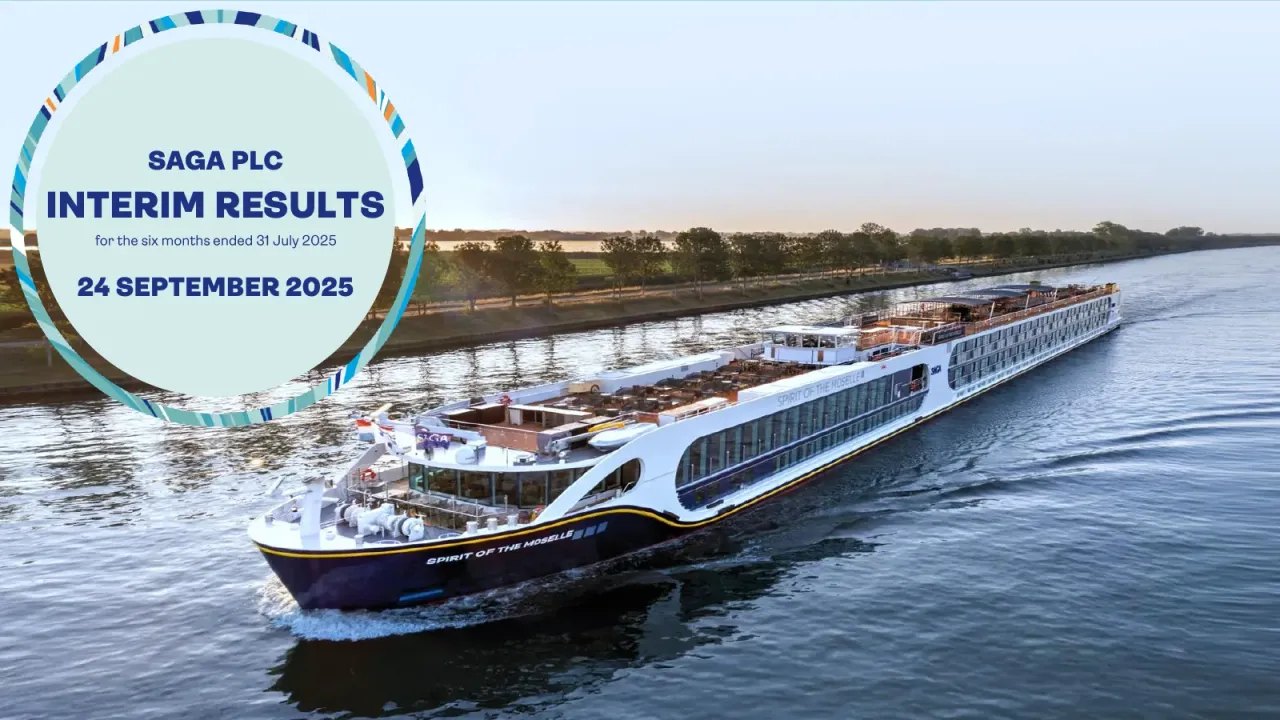
16:23 As you can see from the page, the results have been very successful with load factors per diems and customer satisfaction performing very well. Building on this success, we are scaling up and adding more ships, this summer launching our newest vessel, the Spirit of the Mazel. Our next river ship is already in development and due to launch in 2027 as part of our ongoing growth ambition for this part of our business. Our cruise performance has somewhat outshone our holidays business in recent years, but we've been making great progress there too. And there are clear opportunities to build on this under our new leadership structure.
17:10 At SAGA, we offer holiday options that meet our customer needs whatever their age. We tend to find a younger, more active customer attracted to our land based touring holidays, often as a gateway to a more relaxed river cruise in the future. Other customers look to enjoy a hotel stay at an interesting destination through one of our specially selected hotels, complete with SAGA hosts on-site to make sure they get the most out of their holiday. Whatever their choice, we understand that older customers are drawn to different aspects of travel to those generally catered for by the mass market. With more time available to them, older customers will typically choose to stay a little longer to more deeply experience the destination they are visiting.
17:59 They are interested in understanding the language, enjoying local cuisine, and visiting culturally significant sites. Beaches and swimming pools are nice, but our customers would typically prefer a nice meal overlooking amazing scenery without the sound of children splashing around behind them. Our holidays offer had over time become a little too generic, missing the opportunity to fully play to these differing demands of our customers, something that our cruise businesses have been doing brilliantly. Now under the leadership of Nigel Blanks, previously the CEO of our cruise division, we are bringing the focus more squarely back onto our customer and differentiated experiences tailored for them.
18:47 It's early days, but as you can see, this refocus, which will take a while to fully flow through to our program, has already started to work. Revenues and profits are continuing to grow from an already strong performance last year, and satisfaction levels have materially improved. Our insurance business is in a transitional year as we prepare for our NGS partnership. Nonetheless, we've made significant steps forward towards our new simplified lower risk operating model and traded well in the meantime. Under the new leadership team that we put in place earlier this year led by Lloyd East, we've been investing in marketing and price to support the long term growth and prepare us for the Aegis partnership.
19:42 And the results have been strong. Three out of our four policy lines are now growing after several years of decline, and our customer satisfaction scores reflect the refocus on customer that Lloyd and his team are bringing. Much credit goes to our insurance colleagues for SAGA's insurance business being ranked in the top 50 organizations for customer satisfaction by the Institute of Customer Service, one of only two insurers to be named in that group. Preparations for our AGS partnership have continued at pace as we work toward a simplified lower risk insurance business model.
20:28 We completed the sale of our underwriting business in July, meaning that SAGA is no longer exposed to underwriting risk, and we will transition a large part of our broking operations to a GS late this year as we go live with that home and motor partnership.
20:48 I'm particularly excited about how new products and services can drive future growth. In particular, we are focused on creating more ways to engage on a deeper level with our customers more frequently. Take our money business, for example. The partnership we signed with NatWest earlier this year is exciting in its own right given that we are expanding our suite of differentiated products. But more than this, it is symbolic of how we could pursue additional innovative partnerships across different business lines in the future. Elsewhere, we've already been deepening our customer relationships with lesser known products within the SAGA portfolio.
21:36 For example, our SAGA wine club, Vintage by SAGA, with more than 10,000 customers regularly now buying wine from us. Similarly, our SAGA connections introduction service for older people engages with 13,000 subscribers, checking their connections on the website multiple times a week, significantly increasing their exposure to SAGA's wider product set in the process. These are great ways for us to remain front of mind with customers beyond their annual holiday and insurance renewal. With our primary focus remaining on core travel and insurance propositions, you can nonetheless see the obvious crossover from those businesses to these types of additional service.
22:26 So there are undoubtedly opportunities to cross pollinate and build on areas like this to amplify our customers' engagement with SAGA.
22:39 Our publishing business lies at the heart of our customer engagement strategy. Celebrating the lifestyles of older people, it provides deep and regular engagement with our customer group and in a digital world is increasingly a powerful source of insight into what is on their minds and what attracts their interest. As you can see from this page, our award winning magazine, newsletters, website, and online articles are a fantastic aspirational communication channel that positively portray the lifestyles and interests of older people. This month's magazine encapsulates that perfectly. You will have seen coverage of our interview with Pierce Brosnan and Helen Mirren splashed right across the mainstream press, in every instance, crediting the SAGA magazine in the reporting.
23:38 And we have a real opportunity to build on this amazing content given the early success we are seeing across our digital channels and platforms. Our print magazine is already the largest paid subscription magazine in The UK. By now, surfacing this content on our website and refreshing it regularly, we are driving highly engaged customers into the heart of our business where they spend more time and then come back again to see what else we've got to say. They sign up for more content, allowing us to then communicate with them more broadly. We are now seeing 1,300,000 monthly visits to our magazine website, 37% of which are new to SAGA, and these numbers are growing each month.
24:29 Building on this brilliant content, we are sending around 10,000,000 newsletters each month covering anything from lifestyle tips to personal finance matters and seeing opening rates of up to 49%, a clear indication of the quality and relevance of that content. By refreshing our website, both our SAGA homepage and the magazine site are driving traffic into the SAGA environment and exposing customers to individual business unit offers and messaging while they browse. You should recognize this slide from April where Mark and I laid out our medium term targets, so I wanted to update you on our progress.
25:18 We previously guided that UPBT, that is underlying profits, for 2526 would be lower than that of 2425, largely due to the increase in financing costs. You will have seen from Mark's slides that as a result of our strong first half performance, we now expect UPBT to be in line with our 2425 profit performance. Trading EBITDA is now expected to be ahead of 2425, demonstrating the strong trading momentum that we have seen.
25:57 And with leverage falling, we now expect year end to be below that of 2425. So while it is too early to update any medium term projections, we have clearly made a strong start and are ahead of where we expected to be this year, giving us even greater confidence as to the level and timing of those medium term targets.
26:25 Finally, to wrap up. We've made significant progress in the first six months of this year. We've delivered a strong financial performance, particularly in travel, and we have significantly reduced our debt. Alongside this, we've achieved some significant strategic milestones toward our more customer focused, simplified business model going forward. That puts us in a great position as we head towards the full year. Looking ahead, we expect to go live with our Aegis insurance partnership in q four twenty twenty five, beckoning the start of a significantly less complex, lower risk insurance model for us next year. We will continue to build on the momentum we are seeing across our travel businesses, leveraging the benefits we are already seeing from the combined operations that we've now put in place.
27:22 And we'll go live with our NatWest box partnership at the end of this year, which will start us down the path of engaging customers in more differentiated products and services beyond our travel and insurance offerings. In short, we'll keep delivering on what we said we would do. That concludes this presentation. I'm happy to now move to questions. Perfect. Mike, Mark, if I may just jump back in there. And thank you very much indeed for your presentation this morning. I'll just bring back up your cameras there for the Q and A. Ladies and gentlemen, please do continue to submit your questions just by using the Q and A tab that's situated on the right hand corner of your screen. But just while the team take a few moments to review those questions that have been submitted already, just like to remind you that a recording of this presentation, along with a copy of the slides and the published Q and A can all be accessed via your investor dashboards.
28:15 Guys, you can see that we have received a number of questions throughout your presentation this morning. And thank you to all of those on the call for taking the time to submit their questions. But, Shange, at this point, if I may just hand over to you to chair the Q and A with the team. And if I pick up from you at the end, that would be great. Thank you. Thank you. And so, Mike, it's been so the question here is, it's been very helpful to see the group projected profits through to year 2030. Could you please advise at what at what level of profitability you expect to start paying dividends?
28:49 K. That's a great question. Thank you. It might be helpful just to bring up slide 36 towards the back of the pack. Are we able to do that? I can then just bring that to context. No. We don't have the appendix in it. No. No. No. It's it's No. It's the guidance chart. Page 26. Oh, sorry. Of course, it's the a different slide for this one. Yeah. So, look, I I think this is a helpful chart just to have in front of us when we talk about the prospects of dividends in the future. Our focus right now is delivering on what we've laid out, which is growing our profits and then generating the deleveraging. Very confident in all of the building blocks towards that, and you can see those on the page. The way to look at dividends is right now, our priority is, is to reduce the level of debt in the business and drive profits. However, as we look at that chart on the right, you can see that our leverage,
29:47 reduces quite dramatically over that time scale. So whilst dividends are not on, our minds right now, as we move towards the right hand side of that chart, between years three to five, then dividends become a nearer prospect. We're not gonna give specific guidance as to what point we would switch that on, but clearly, focus in the short term will be reducing debt. And then as we move into the middle and then towards the right hand side of that chart, we've got greater flexibility in our capital structure to think about dividends, investments, and just a lot of options on the table then. But right now, we're focused on delivering the profit growth and the deleveraging that would unlock that optionality.
30:31 Thank you. So a question on debt. So how much is how much the debt is fixed and how much is variable, and how will the fall in interest rates speed down the debt payment? Mark, do you wanna take that?
30:49 Yeah. Sure. Thanks, Mike. So no. A good great question. So so just just for just for context, we've we've got two forms of drawn debt in the group. We've got a term loan facility, which is £335,000,000, and and we have two facilities that are drawn for the ships, which is £316,000,000 of gross debt. Both both are fixed interest rates. So the the term loan, if if if you look into the back of our presentations, it is a variable rate instrument, but but we have hedged that variable rate. So so effectively, we fixed that for for the next few years. So all of our debt is now fixed interest rates.
31:39 In terms of in terms of falling interest rates, the the and how quickly or whether there'll be a benefit to reducing debt because of the falling interest rates. As I as I said, the the debt is the debt is now fixed interest rates. So so falling falling base rates that doesn't doesn't impact our interest costs.
32:04 Thank you. So congratulations on your turnaround strategy. It there seems to be a rebalance between travel and the insurance business. Could you please provide the ratios, the revenue and profit ratios between these two distinct businesses? So, Mark, I don't know if you've got the ratios to hand, but to give the bigger picture, look, for for a long while, we've had a very large insurance business with significant complexity, cost, and volatility. And alongside that, we've had a brilliant travel business. Clearly, those that have been following us for some time will see the the the ebbs and flows that have come with having, running a a large and complex
32:55 insurance business. But the way I look at this is, first and foremost, we're not an insurance business. We're not a travel business. We are a business that understands the needs of older people and delivers products and services to make sense of those needs. And over time, those our ability to meet those needs and indeed those needs themselves will change. When we look at those needs right now, just taking insurance in the first instance, the best way to meet those needs, offering brilliant service, but also the right price and cover is by partnering with first class insurance businesses that do their side of the equation brilliantly whilst we help them deliver products and services for older people using the insights and expertise that we've developed over many years. So very confident that we've got, the the right insurance model going forward, but
33:48 it does mean, that as we rapidly grow our travel business and adopt that lighter capital, lower cost insurance model, that the balance between insurance profitability and travel will change. Hence, this slide does call out to a much greater extent the strengths we have in travel, which will be the lion's share of our profits certainly in the near term whilst we then continue to grow our our insurance business. On this chart, which is sort of rapidly becoming my my my central slide to talk to, you can see where we go over the next few years. From a starting from a year where the majority of our profits will come from travel, we'll continue to grow ocean and holidays profitability, but you can see that we do have growth ambitions for insurance. So what we're doing is not shrinking our insurance business, but creating a platform to then grow from by doing what we're great at and doing what AGIUS are brilliant at on the insurance
34:52 operations side. And we've got ambitions in money and more broadly, to launch new products that will introduce growth further down, the the time scale. So, you're right to call out our our heritage in travel and our strength in travel is by no means, a a side business. That will be our core to our proposition, But I wouldn't see insurance as not being core because, actually, if you look at it from a number of customers as opposed to profitability, then, actually, the number of customers in insurance will always be significantly higher than the number of customers in travel. So we do need to make sure that we we focus on both. The balance between profitability of the the two, you probably got that in front of you now, Mark. So do wanna just quickly call that out, and then you've got the growth on the page?
35:42 Yeah. And, I mean, if you look back over the interim results, so for the first six months this year, the trip travel business generated around 75% of the group's revenue, and it was a little bit higher on a profitability basis. If you if you if you take our gross profit before sort of central costs, it accounted for about eight 83% of of our of our profitability. Yeah. As as as the question sort of states, that that that ratio was very different in the past, and and and that's a reflection of the strong growth we have seen within within the ocean cruise business as as as as that business has grown very strongly over the past, few years, I. Sort of pre COVID, predelivery of the new ships.
36:31 Thanks, Bob. Thank you. How much of the growth in ocean and river cruise is attributable to pricing versus passenger volumes? So again, this is sort of laid out within the presentation. So if you look at the load factor statistics with within our ocean cruise business, we we we saw a four percentage point increase within our load factor. That that is how how many people are how how many people are traveling with us. And and we also quote a per diem figure, which which is how much passengers will pay per night to to stay on our cruise cruise business.
37:24 That increased year on year 8% to 391 pounds. So so we've got a balance between load factor growth, I. E, how many passengers and how utilized the ships are and and also price growth in the period. I I think when we look forwards, the shifts are now operating pretty much at full capacity. And therefore, we would expect over the next few years for for the growth in that business to be driven by per diem growth as as opposed to low factor growth. Thank you. Any further news on unwinding property held for sale? Mark, do you wanna give a quick update? Not much to say. Yeah. So so our property portfolio, the the the really the really quick update is that there is no news.
38:17 So so we still we still carry those properties as as held for sale, and we're still exploring, you know, various avenues to to to sell those properties. Thank you. How do you prioritize debt repayment, business investment, and shareholder returns with the incremental Do you want do you want me to cover that again, Mike? I'm conscious that you two seem to be breaking up a bit. I don't know if I'm breaking up as well, but it might just be worth reading that question again so that people can hear the the question properly. How do you prioritize debt repayment, business investment, and shareholder returns with incremental cash going forward?
39:07 Yep. Okay. So, Mark, do you wanna answer that? Yeah. Sure. So so it's a it's a very, very similar question to to the one we had around dividends and and and what the criteria would be for us to start paying dividends. So so as you can see on the on the chart here, our our our priority at the moment is to reduce leverage, to reduce debt. But as we move through that journey through to the end of the chart on the right hand side, we effectively have more options in terms of how we allocate capital across the business. So dividends will clearly be a topic that comes back onto the agenda towards the right hand side of that chart. What what I would say is that the HPS financing that we put in place at the beginning of this year has has allowed us to make longer term decisions in terms of investing in the business. So so we are we are now we are now investing appropriately into the business in terms of a, you know, a medium, long term horizon to to to to effectively grow the business over the plan periods.
40:20 Dividends and and and what we do with excess capital will will be something that we guide people to closer to the time. Yeah. Look. I think I think that long term point is is really important. We've we've delivered a lot of strategic progress in the last six months and indeed the last couple of years that puts us in a position to now start taking some long term decisions. How we deliver shareholder return in the short term is by reducing our debt and growing our profits, and that comes with making sure that we're investing for the long term as part of our strategy. As we move through the profile, profits improve, debt reduces, leverage reduces, and then as we said earlier, the prospect of dividends increases as we go through that curve, but but that's the order of priority.
41:08 Next question, Sharanj? What does your customer insight tell you is the next unmet need for people 50? So I'm I'm really pleased to get questions like this because it it it encourages all us all to be thinking about SAGA as not just a travel or insurance business, as I said earlier. The but but, likewise, what I've also said repeatedly is there are many areas where older people are not well served today, but and we will explore those as part of our new business and new opportunities exploration. But what we're not gonna do is start calling out things that we may or may not get involved in today only to apologize and let people down in the future. So we will be exploring new things, but we'll share those with you at the market at the point we've got something tangibly in process rather than simply over promising and then under delivering.
42:08 You'll start to get to know Mark and I pretty well over as we go forward, and I wanna be promising and then delivering on things that that we then know we can deliver. So, yes, there are many areas where we think we can expand into next, but we'll talk to you about those when we've got something tangible in the pipeline. K. So what plans do you have to grow the cruise business? Any new ships or any new partnerships? Okay. So the the cruise business comes with ocean and river, and there's different dynamics between those two. So firstly, the the numbers you've got on the page here are based on a two ship ocean cruise model, And the growth prospects with that are being driven by maximizing demand, which is driving load factors, and there is continued load factor growth to come, albeit we're now in the 90%.
43:04 But as we get into those levels, we then are able to then drive our per diems, which is the amount that customers pay per day, not by putting up our headline prices much, but more by simply not having to discount and market as heavily in order to drive the demand because the demand is already there from the repeat business. So we've got significant levels of demand, and that is now driving up the per diems. And alongside that, we're also putting more value into the proposition, which again means that customers get more value from their per diems. So the growth in Ocean will come from load factor growth to a point and then ongoing continued per diem growth driven by that strong demand. Both of those things are at play with our River Cruise business as well because we've got strong load factors and rising per diem, so a very similar dynamic.
43:59 However, the benefit we have in river is we're adding new ships. And so unlike having to pay hundreds of millions of pounds for an extra ocean ship, scaling up our river fleet is actually a much smaller charter based model, and therefore, we're able to scale up more easily. Therefore, you will see that we've added the Spirit of Moselle this summer, and we've got another ship arriving in 2027, and that won't be the end of that pipeline. So you can expect to continue to see expansion in the River fleet alongside the growth in load factors and per diems driving that growth. Thank you. Can you provide some guidance on the commission structure of the new insurance partnership? So I think the way to look at the insurance partnership is firstly, it is helpful to call out the commissioned structure because that is an important aspect of the AGS model.
44:55 So we are moving away from taking high risk volatile earnings from an under an end to end underwriting through to broking insurance model. So we are moving to AGS where our home and motor business model, which is the lion's share of our policy numbers, would be delivered through a GS taking the underwriting risk, managing the operations, and then we bring our customer insight marketing and earn a commission of those policies as opposed to taking the insurance risk associated with those policies. So just to emphasize, therefore, that it is a more certain, stable, and predictable income stream that is commission based. In terms of guidance for commission, we're we're simply not able to share what the commission rates are because you can appreciate Aegeus won't want us talking about what our commercially confidential commission rates are. However, to to help people think about what the earnings profile of the insurance business will be post the Aegis partnership launch, what we've guided to is how much money we expect to make in the first full year of the partnership.
46:11 So what we said is in the first full year post transition, we expect to make the same level of profits from our broking business as we did last year. Last year, we made £14,500,000 of profit in our broking business, and therefore, in the first full year of the transition on a commission based model with greater line of sight and growth we expect to start by making that amount of money and then grow from that base in line with the chart that you can see on the page here. Importantly, just to help you understand what we mean by the first year post transition, we go live at the end of this year, and then we spend the next twelve months migrating policies across to the Aegis platform. So as policies renew and as new business is put onto the books, every new policy or renewable go on to the GS platform.
47:07 But a policy that renews the day before we go live at the end of this year will effectively not move across to the GS platform for, well, one year minus one day. So that's why it takes a little while to to move across. Therefore, once we've fully been through that twelve month migration of policies, thereafter, we're fully onto the GS platform. We're fully onto their operational system and into the new model. And from that point, Tom, we'd expect to make at least as much as we did from the old insurance broking model, but on that lower risk, more certain income profile growing from that base. Thank you. So would not seem to be a natural destination for competitive savings products. Why were they selected, and how do you expect them to help you transform your money business?
47:59 So firstly, NatWest is has got deep reach into The UK consumer. There is a significant crossover between our customer base and NatWest as a trusted brand. Nobody should look at NatWest savings products as the benchmark for our proposition. What we have looked to do is to create a product that we believe would be highly competitive and highly differentiated for our customer set and take that into the market. So it yeah. I wouldn't be hung up on what NatWest do today. What we're doing is launching with NatWest boxed partner who is creating a platform for us to effectively bring to market different products to those which NatWest themselves offer.
48:44 But we have the bit like a GS, we have the whole infrastructure behind NatWest that means that we can bring our customer base, our expertise, and our insight and create products and services starting with a savings product that is different to what's on the market today and give our customers great value and service. So I'm confident that there will be an exciting product and and indeed more products to come in the future from that channel. Thank you. The insurance industry is seeing a shift from repair and replace to predict and prevent, but this involves smart technology. How how can SAGA energy help people 50 make the most of this shift?
49:37 So I'm gonna read this question again because it's taken a while to digest. So insurance is starting to see a paradigm shift from repair and replace to predict and prevent. Given that the predict and prevent often involves smart devices, how might SAGA and NGS approach this to ensure all the people? Look. I'm ask you answer this question more broadly. Our job is to in insurance and indeed across a lot of complex markets is to make our customers' lives easier and make this sort of approach more simple. So if you think about not just in our insurance business, but across our money business as well, we spend a lot of time on the phone to customers. We've got a lot of channels through which we communicate to customers, not least our newsletters, where we're giving advice to customers as to how to best approach whatever challenge they might have in relation to a product or a market. So what I would suggest here is we are better placed than anybody else to help older customers in this market and indeed any other markets. As we move into preparing for the Aegis partnership, we're spending a lot of time to make sure that Aegis' operations and service levels replicate the quality service levels that we offer today, and that includes making sure there's always somebody to speak to to help with whatever that customer needs help with. And and I think your your question here is poking at how older people need a bit more support than more generally,
51:08 and and that's what SAGA does best. So I'd suggest that we've both got the people at the end of the phone that can help our customers with these sorts of challenges, but also that's where our magazine and our newsletters are giving brilliant advice every day. And any of you that aren't on our newsletter distribution list, get yourself on there because I think you'll see very, very quickly how that is exactly what we're doing through those newsletters. Thank you. So I've got one last question. If the stock market dislikes debt and this dictates your strategy, why don't you offload the ships and move to a capital light model? Look. I think the way to look at that is our ships are brilliant assets, and we wanna keep hold of them. And if you look at the rate at which we're deleveraging and the strategy we've got for growing our profits, there is no need to offload our ships.
52:07 In fact, it'd be nice to have a third one at some point, but let's not get distracted by that. So if you look at the pro the plan we've got, and it's on the page there, look at the rate of deleveraging that will come and the profit growth that will come simply by doing what we are doing today. If we were to to sell or lease and sell back ships, trust me, that profit profile on the left would look very, very different. So you might not have a lot of debt. You wouldn't have a lot of profit either. So the right approach here is to take the assets that we've got, recognize they are brilliant assets within our control, and use them to drive our profitability. And that profit will pay down the debt. And as you can see on the page here, we are not very far away from being in a very strong position in terms of profitability and leverage. And what you've seen from the last six months is that's not a hope. That is something that we're delivering on rapidly as we move through this timeline.
53:10 Perfect, guys. If I may just jump back in there. Thank you very much indeed for being so generous of your time and addressing all of those questions that came in from investors. And, of course, if there are any further questions that do come through, we'll make these available to you immediately after the presentation just for you to review to then add any additional responses where appropriate. But Mike, perhaps before really now just looking to redirect those on the call to provide you with their feedback, which I know is particularly important to yourself and the company, if I could please just ask you for a few closing comments just to wrap up with, that'd be great. Thank you. So so, look, just to summarize, I think you will have seen pretty clearly the progress we've made in the last six months. We're trading the business well. The benefit of the strategy we're applying is it's giving us the breathing space to now make long term decisions and deliver on that long term plan that we've had in front of us for for most of this presentation, and it's working.
54:01 So you should look at Mark and I and indeed our wider management team as a team that will continue to deliver on what we say we're gonna do. And the last six months, that has translated into trading performance ahead of our expectations and delivery on all of our strategic actions in line with our plans. So we'll keep doing that, and we'll see you in six months' time to show you how we've continued to do that through to the full year. Perfect, Mike. That's great. And thank you once again for updating investors this morning. Could I please ask investors not to close this session as you will now be automatically redirected for the opportunity to provide your feedback in order the management team can better understand your views and expectations. This will only take a few moments to complete, but I'm sure it will be greatly valued by the company. On behalf of management team of SAGA PLC, we would like to thank you for attending today's presentation.
54:50 That now concludes today's session. So good morning to you all. Thanks, everybody.
Follow Saga PLC into a list and get an email when it puts out news.
CEO at SAGA PLC
CFO at SAGA PLC