George Bennett
CEO at RAINBOW RARE EARTHS LIMITED
Replay available
Preliminary Results hosted by Rainbow Rare Earths (LSE:RBW) on Investor Meet Company, held 2025-10-29.
On 6ix: 6ix.com/event/rainbow-rare-earths-limited-rbw-preliminary-results
Automated transcript · Written by software from the replay's audio. It can mishear names and figures; the replay is the record.
0:00 Good morning, and welcome to the RAINBOW RARE EARTHS LIMITED investor presentation. Throughout this recorded presentation, investors will be in listen only mode. Questions are encouraged and could be submitted at any time via the q and a tab situated on the right hand corner of your screen. Simply type in your questions and press send. The company may not be in a position to answer every question it receives during the meeting itself. However, the company can review all questions submitted today and publish responses where it's appropriate to do so. Before we begin, I'd like to submit the following poll. I'd now like to hand you over to George Bennett, CEO. Good morning, sir. Good morning, and thanks for hosting this investor presentation. I'll move forward to usual disclaimer, and we'll move on. Thank you. I just want to reiterate that we're very excited about the progress we've made this year with RAINBOW. And as I said, we are still what we believe is a low cost and responsible source of rare earths.
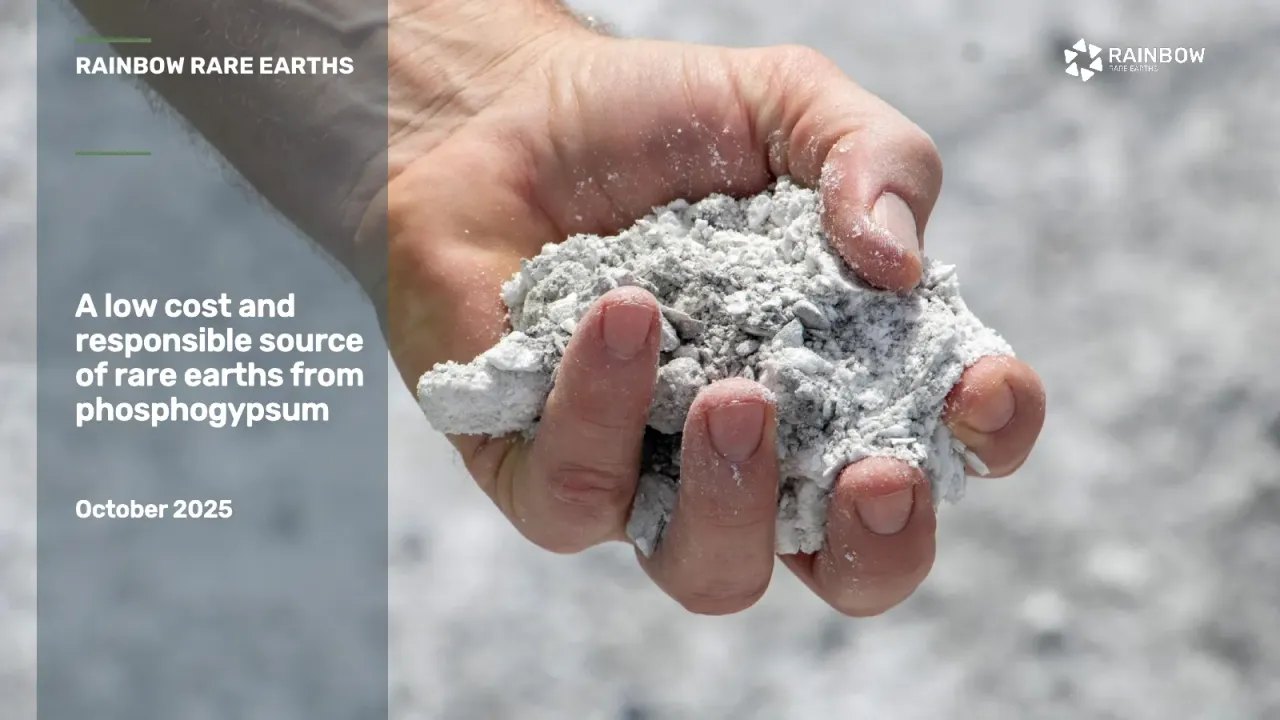
0:57 We've been pioneering the recovery of rare earth elements from phosphoryl gypsum. I might add that there's lots of academic research on the extraction of rare earths from phosphoryl gypsum. So it's been done before in lots of academic papers, but none of those academic papers have ever presented a economic extraction process. And that that's what RAINBOW has done. We've been able to to take our experience as a as a technical team and to to produce a flow sheet that extracts rare earths from phosphorylipsum in a very, very economic way. As I said, it had been done before for over the last thirty, forty years. There are lots of papers, but none of these were economic. So so even though people might see say, are you the first ones to do this? There's risk.
1:42 No. It's been done, but they haven't been able to do it economically. So, you know, basically, we are very low cost extractor of rivers because we don't have all the costs associated with hard rock mining, which I'll go into later for those new to the company. And by having developed this IP in an economic way to extract roofs, we were we've been able to do this with the Paleobor project in South Africa, which is the tier one roof project, and we are busy doing this with in partnership with Mosaic in in Brazil and Ubaraba, which is a far longer life and it's also a very near term project. We all know that the West is in chaos at the moment with the trade war between China and The US, and The US, in fact, putting tariffs on not only China, but almost every every country out there in the West. So right now, the geopolitics are a little bit crazy, and China is using rivers as a weapon in these negotiations with with the West and essentially because not only are they have they been banning the export of permanent magnets and certain rare earth materials to The US, it's also to European countries as well. So we see that the China's also crack down in foreign companies trying to stockpile RARE's and this has led to the West trying to
3:14 accelerate building independent supply chains for these critical minerals outside of China. And RAINBOW is very much at the forefront of this critical mineral supply chain being rolled out and developed outside of China and we're very excited to be part of this independent supply chain that's being created. We know that RARE's are 17 elements, but not all of these elements have equal value. The four main RARE's that are of exceptional value at the moment are neodymium and persodium, which are required in permanent magnets, as well as dysprosium and terbium. Dysprosium and terbium are also very, very important in permanent magnets, but also they are used in permanent magnets and applicable for defense and and and and for the for the military. So the heavy rears are becoming very, very important at the moment because the biggest source of rears at the moment, heavy rears is is Myanmar, which is controlled by China, and there's very little happening in the West at the moment in these key heavy rears being in Serbian.
4:19 Now when the Ford and European car manufacturers were had to shut down production earlier this year with the export of permanent magnets outside of China, everyone thinks that these permanent magnets only affect electric vehicles or plug in hybrid vehicles. But no one sort of realized until this happened that your just internal combustion engine motor vehicle, in other words, your diesel or petrol vehicle, also requires permanent magnets to make them work. So your drivetrain in a normalized vehicle has seven permanent magnets in it. So, you know, you have about a kilogram of permanent magnets in the in the normal vehicle. You have about three to four kilograms in the plug in hybrid vehicle, and you have between three and five kilograms in the pure electric vehicle. So yes, these these permanent magnets are critical not only in vehicles, but wind turbines and all your modern technology, your drones, your you know, so permanent magnets go into MRI machines for instance using the the chemical space. So they affect the all modern tech and all basically the vitamins of modern technologies we'd like to describe them.
5:27 We also see a massive new frontier of demand being involved over the next decade for permanent magnets requiring RARE's and these are not only industrial robots, but humanoid robots. Humanoid robots are take three to five times more permanent magnets in the EV And we've seen a massive explosion of of drone deliveries in The US. For example, Amazon, these are real. This this is not just a Star Wars look alike photo. And then advanced mobility or basically air taxis at the moment. The first air taxis commercial flights have started taking place in The US and these have exceptionally large amount of risk in their in their in their in in these these air mobility vehicles.
6:15 And just to give you an idea, from LAX to San Diego, which will take you about an hour to an hour and a half depending on traffic in the motor vehicle, will take you eight minutes in one of these air taxis. But at the price of a Uber Black, So you can see why there'll be a massive increase in demand for this type of transport. And of course, with drones, with the modern warfare now we see in Ukraine and and Russia being fought largely with drones, we can see drones playing an even more important part from from from a military aspect. And, of course, these drones also require lots of permanent magnets requiring rivers. So the macro we believe for permanent magnet demand globally across all applications is very, very much in place and growing. We've seen the deal done between MP Materials and the Department of Defense in The US in July where they agreed to to set a floor price for n d NDPR, there's neodymium and prasidinium, to enable NP Materials to be able to know that they're gonna get a minimum price for these rare elements and the resource.
7:28 And that led to almost immediately a change in pricing out of China for NDPR. We know that China has been manipulating price of these materials to the low end of the chart. As you can see there, circa $60 a kg or slightly below that. But the minute this DoD deal was announced and we've seen since then that the Australian government is talking about setting a full price for critical minerals, not only risk, but other critical minerals, as well as the EU now saying that we are going to entertain floor prices for critical minerals. We saw the price of NDPR move from circa $60 a kg in China in July 2025 or sorry, May 2025 and July to up to about $85 a kg in September. It has come back slightly, but we still believe that we are gonna see a price bifurcation of NDPR between what the risk pays and what the Chinese are trying to keep the price at. And we've seen this with the Sprosium and Turbium.
8:33 For the last six months in Europe, we've seen dysprosia materbium trading at between two and three times the Chinese pricing for these two key root elements, which bodes well not only for the market as a whole or the industry as a whole, but also for RAINBOW because we have a significant amount of dysprosia materbium in our in in what we're going to produce, in our product that we're to produce. And as I said, the fact that we've seen different pricing out of China is going to support us when we negotiate contracts for these elements that are currently underway with RAINBOW and various OEMs and potential off takers. As I said, this year has been a very exciting year for RAINBOW. We've pioneered the breakthrough of of using CIX now with and large large lab testing in in here in South Africa where we've we've been able to produce a very high grade mixture of a product that could either be a mixture of oxide or a mixture of carbonate depending on what our off offtakers require, but with very, very low impurity levels.
9:46 And we believe it's one of the highest grade mixtures products produced anywhere in the world at the moment at over 55% grade of of TREO in that mixture of carbonate or mixture of oxide and with purity levels sitting at below 7%. Now the Chinese spec for mixed red carbonate sits at between 4244% and we had over 55%, so a much higher spec than what the Chinese require and facilities and refining facilities in the West will require. And the Chinese impurity level has to be below 10% and we're below 7%. So we think this is a significant achievement by the RAINBOW team. And also very importantly is that by incorporating continuous ion exchange into our flow sheet, which is a technology used in mining in various minerals like uranium for instance, we've been able to reduce our volumetric flow by over 300 times from circa three forty cubes an hour of pregnant lead solution of down purity rejection steps of first CIX and then some precipitation steps, we have reduced that flow down to circa four to five cubes an hour and that's also successfully incorporating serum depletion into MREC product now. So that means that our final downstream
11:17 separation circuit will be very, very small. And we've recognized that and we're able to achieve this and now they have at a very low cost I might add and in record time is turning out to be very, very positive forever on all fronts and I'll talk about that later. As I said, the interim study and the subsequent test work that been performing in our lab here in South Africa has confirmed that we are at the bottom of the cost curve in the industry. We build Chinese pricing and the couple of western sort of benchmarking reports out there that show that we below the Chinese cost of production. And we know that we're one of the highest margin producers.
12:06 We will be one of the highest margin producers in the world as well. So we're at the top of the margin curve and we're at the bottom of the cost curve, which is good for any project and any sort of mineral that you're looking at. Just to give the audience background, you aren't familiar, one of the reasons why our project is much lower cost than other projects is that because initially, a, we are Brownfields site, we're within five kilometers of an established mining town in South Africa called Palaboa. What you see there is the the fence in the area of our Brown project. We're gonna be taking the roofs out of those two phosphory gypsum stacks that you see there. And the top right hand corner is the old mothballed Sasol phosphoric acid plant that produced a waste residue or phosphory gypsum and deposited on these stacks.
13:01 Now just out of out of that photograph, just above it, you've got a phosphate mine run by Foscol, and this phosphate mine produces a high grade phosphate rock, which is a concentrate in the slurry, and for sixty years was fed into that phosphoric acid plant you see in the top right hand corner there. That phosphoric acid plant added sulfuric acid and heat to create phosphoric acid which is used throughout the world for for and a key ingredient into fertilizer. And in the production of phosphoric acid through this process, it creates a phospho gypsum waste product. And the rarest that you upgrade it in the phosphate slurry, deported into the into the into the gypsum stacks following the the waste gypsum stream into these two gypsum stacks. So we're now at 35,000,000 tons of resource at point 44% TREO, which is very high grade for this type of deposit. If you compare this to ironic grade project, which is a have a very low mining cost, that point north four to north 8% on average grade, and we have between sort of six and ten times higher grade than than and on your average ironic clay project.
14:16 And we've got a lot of infrastructure already in place, which helps bring down our our CapEx. We've already it's already fenced. We've got a high voltage switch high voltage power lines running through the project. We've got a high voltage switchyard within the confines of of our Brownfield site and so forth. And we service by road and rail as well as air within the airport at Pilobara. So very accessible, 500 kilometers served by highway outside of Johannesburg and served by rail as well. So anything that we need to bring in for this project is easily accessible compared to a lot of projects which might sit in the middle of the jungle, the middle of the Australian Outback, or the middle of the bush somewhere in Africa. The project economics, as you see on the screen, as I've mentioned at the publication of our interim report in December last year, our CapEx was $326,000,000 and the operating cost per kilogram of of total earth outside was sitting at circa 12 to $12.90 to $13 a kilo.
15:27 Test work and the work we've achieved in the lab this year has been able to confirm that those metrics are firmly in place and we'll be making some announcements very shortly on this, and I'll talk to that a little bit later in the presentation. But importantly, we're going to be a significant producer of separated neodymium and prasidinium oxide and we're producing what's known as an ECG plus product, which has got our dysprosium and terbium as well as samarium, eropium and ganglion and yttrium in our product, are sought after and Itrem is very sought after by defense in The US at the moment. So it's also a key risk that we have in our resource. The project's got sixteen years and this ECG plus group is exactly what LIMITED have done since they've been in production in Australia. LIMITED have always separated NDPR themselves.
16:20 They did that in Malaysia and not on-site in Australia. They've recently built their their own separation refinery on Australian soil, and they've started separating NDPR themselves on on China. And the SCG plus group was always sent to China for separating. So they never ever separated the heavies themselves. It was done in China. And in the last three or four months, Lance have just commissioned the heavy separation plant in Malaysia and they're now separating the SCG plus group themselves in Malaysia. But as I said, this is only sort of been only occurred over the last four months or so. So RAINBOW are doing we've realized we need to do what the LIMITED has done for for many, many years, separate the NDPR and we're gonna produce a very high value ECG plus group, which we have seen massive demand in from refiners who wanna secure the CCG plus group in the West and that be it in Japan, South Korea, Europe, France as I say, as well as The US and Canada. So there's massive demand for for this SEG plus as well as, obviously, we're talking to OEMs about our separated in the oxide to feed their their supply chain as well as people like this common metals in the in The UK who or also, we have a letter of intent to supply separated in the PR. So those those ongoing offtake discussions are firmly in place, and we
17:53 will be reporting on those shortly as well. Just to confirm, this is done by August media, just confirming RAINBOW is at the very top of the margin curve and that we believe is being reaffirmed by the work we've done in our trade off studies over this period over the course of this year, and I'll talk about that a little bit later. I think this is a very strong chart. If you look at the bottom right hand side left hand side, sorry, of of this chart, it shows the RAINBOW basket at $60 a kg NDPR, which is at the low roughly the low point of the price cycle for neodymium and prasidinium.
18:38 If RAINBOW had been in production at the time, we still would have generated $60,000,000 of EBITDA at at steady state. And, you know, whereas at that price point, MP Materials were losing money in The US, which is why the Department of Defense came to their their rescue with that deal. And and Linus, we're we're just making a marginal amount of money. And RAINBOW would have still been very, very profitable. So that shows where we are show that we are very robust as a project in terms of the price cycle. If we look at the the base case for the PEA, and it's the same price for NDPR, the $110 a kg, which is the benchmark price now set by NP Materials.
19:27 And that's a price we use in our PEA that if at steady state, RAINBOW would generate $180,000,000 of of EBITDA per annum, which we believe is for the size of the project and the capital is one of the best we still know it's one of the best projects in development in the world today. As I said, we've used this year at MIMITED to with our laboratory we built at MIMITED to maximize RRE recovery and impurity rejection using continuous ion exchange as the first stage, which we recognize that having the best impurity rejection in in our final product that feeds the final separation circuit is very, very key to being able to achieve the purity that we do wanna produce in our separated oxides and our ECG plus group.
20:20 As I've mentioned earlier, we've also successfully incorporated the serum rejection step reducing some 65% of metal content for separation, which means once again that final separation circuit can be far smaller than one would envisage if you didn't use a continuous ion exchange to reduce your volumetric flow. I've spoken about this reduction in volumetric flow and it has a major positive impact on size, energy and reagent use in the final separation circuit. The fact that we've incorporated CIX and precipitation steps, that's the RP rainbow brings in terms of being able to produce this high grade mixed with product with very, very low impurity levels. And on the top right hand side, once again, you can see what TRO was over 55% that we've been able to produce this year consistently now, far higher than what we were able to produce in our first pilot that we ran in 2023 and 2024 and is much higher than the Chinese spec required. So this bodes well for RAINBOW, we are seeing the positive results of that already.
21:37 We mentioned in our environmental sorry, our economic update in December last year that we saw some optimization opportunities. We've been working very hard on some trade offs or studies and looking at optimizing the front end part of our process flow sheet, which is circa 90% of the of the the OpEx and CapEx for the project. So it makes sense to focus in this area. And as mentioned, these these are progressing very positively, and we expected to announce the the first of these these trade off studies and the the the results of that optimization work very soon. And we believe it's it's gonna show, you know, very, very, very good results in terms of power, labor and capital costs for this project. And we'll be announcing these optimization results in stages as we've 100% signed off on the CapEx numbers in these trade off studies.
22:38 And basically, we expect these trade off studies will enhance the project economics, which is already very, very good as you can see. And and and and when I'll talk about the DFS shortly. But very importantly, these optimizations, the time we've taken to to use this this time was during the the the delay in the DFS is resulting as in us producing a far far better project, derisk project for our shareholders. And I think that's what the shareholders need to to consider is that, yes, we've announced that there will be a slight delay in DFS, but this delay is not resulting in high CapEx or higher OpEx and a reduced project economics.
23:29 The the this delay will result in a far, far better project dearest project for our shareholders with bit better CapEx and better project economics. And I think that's a credit to the to the RAINBOW technical team because I'd rather see us deliver the correct technically proven project than rather one that we rushed to meet a DFS timeline that the test work didn't support. And in the end, we end up with with a with a project that that doesn't work or fails or, more importantly, takes a lot of money to fix. I don't wanna point to other projects in the world, but there's a project, ironic clay project in Brazil that's in production that only produces a mixture of concentrate sorry, a mixture of carbonate, which they sell to China. And this project had to stop because they had problems with design of their flow sheet, and they've had to reengineer the plant and stop production, and this cost them hundreds of millions of dollars.
24:35 And as I said, with experience within the RAINBOW team in terms of developing many, many projects as a as all coming out of the mining engineering team on behalf of clients, we're now doing it for ourselves. And we we've always said we will make sure that we deliver a technically sound and proven project the fact that we're taking a bit longer, but with improved project CapEx and economics that we believe will will will be shown once we publish the results of those of those optimization studies, I think that the technical team should be giving credit for RAINBOW and I'm very pleased to say that. Once again, this is a couple of photographs of our world class lab that we now have at RAINBOW that's enabling us to achieve the results that we're looking for in a far for quicker environment and far for lower cost.
25:28 So if we hadn't built our own lab, the cost of of the work to get to where we are would have been circa 10 times higher. So instead of spending a million dollars over this period on on our lab, we would have spent 8 to $10,000,000 if we'd still been doing this work in The US or using outside laboratories. So I think that's also another very positive that the market should be pleased about. So the next steps, and I think this is a key because we spoke about it briefly in our year end financial statements, is that we've done extensive piloting test work. We've established the production of those high grade low purity feed stream, which is key to achieving separated oxide of desired purity levels.
26:15 And as I said, this has been achieved by producing this very high grade mixed product, which could either be a carbonate or an oxide depending on on the base feed stream into the final separation circuit. It's also given us flexibility, as I said, to decide what is the best product to feed into the final separation circuit. And because of the the delay we had with continuous eye chromatography, and I'm not gonna make any excuses, we did see a delay because we always, you know, test work, one never knows what the pathway and what test work will will will deliver because, essentially, CRC was more of an r and d route that had not been proven commercially, and we believed if proven commercially, it was a very good way to separate the growth oxides. But we weren't getting the results that we that KTEC promised us. We did get initial results, but we couldn't get any better results.
27:14 And we recognize that if we continued down this path of continuous ion chromatography, we didn't know how long that development pathway would take. We might still prove it down the line, but we knew it would lead to even further delays in our DFS. And once again, it wouldn't be proven on the commercial scale even though it would have been improved in piloting. So we started looking at a well known solvent extraction versus continuous ion chromatography. And as I said, we will make an announcement on this. So we're evaluating both processes. But what I can say is that solvent extraction is the proven gold standard for separation, and we're just evaluating the commercial aspects of this, and we'll make some announcements quite soon.
28:04 But we know that the final route will deliver 99.5% purity of separated NDPR, and we will produce a high value ECG plus group. And this this this week, we know we will achieve, and we will make some announcements very shortly on the evaluation of SX over eye chromatography. It's important to note that even though we've acknowledged that because our test work was never when we announced the the the timeline for the DFS at the end of twenty twenty five was always predicated on successful test work to deliver separated NDPR. And as I've mentioned, you know, one can never put a a your timeline for test week is always predicated on your results. So you get certain set of results and it might lead lead in a set in a different direction. As I've said, during our our test week, we realized that we could achieve this very high grade mixed with product.
29:07 For our final separation, we could reduce the volumetric flow. And and by by investigating these options to produce as much higher grade So product to feed our downstream, that test took a bit longer. But rather come up with a with a better product which takes a bit longer than not pursue improving your your your your product and and making sure you got a final a final separate product that's the best that we can produce in the market. And I think, you know, we've shown that by taking a bit longer, we are gonna produce a far better project, much better results, And all these results are very important as that because they're helping us with our project in Brazil. The the project at Uberaba is progressing in terms of economic assessments.
29:57 We expect that economic assessment to be completed by the end of this year, and we expect that we will see a very, very positive project out of Ubaraba similar to what we see at Peribor because all these learnings have been we've been able to apply to that project, which is a far longer life project than than at a much higher grade. And I'll talk about Uber rather a little bit later again. But importantly, our overall timeline hasn't changed. We're still expecting to be in in production in 2020. Sorry, in construction in 2027 for production in 2028. And even though we have a slight delay in the DFS, we don't see that overall timeline moving out, which I'm pleased to say. Once again, we are from an ESG point of view and green project, this is a very good, we're taking roofs out of a waste product, the phosphoryl gypsum.
30:55 You know, we're also gonna be selling this phosphory gypsum to the South African market, which are not in our project economics yet. They will add to the economics of this project. And we are anticipating being able to sell, we hope, somewhere between 400,000 to 600,000 tons of this phosphoryl gypsum into the South African gypsum market. And when we can get we have a letter of intent with the biggest gypsum trader in South Africa for them to be able to sell this product for us. And we, in fact, we're just updating those numbers and getting an idea of pricing for our feasibility study, which will add to the pricing economics. But also once again, over a forty year life, even after we finished processing this phosphoid gypsum, we'll be selling this phosphoid gypsum into the South African market and eventually those stacks will be 100% level with the ground. It's a complete rehabilitation of the site, which for any project we believe presents very strong ESG credentials.
31:58 As I said, because we've been very we've had a lot of profile of extraction of RAREZ out of phosphoryl gypsum, we've had a number of approaches from from from from from and elsewhere in the world. As as you can see there, we are spoken about the MOU we have with Ubara in Brazil to jointly extract the rarest out of the phosphoryl gypsum that's been produced by their phosphoric acid plant in Ubara in Brazil. As I said, this is a plant that's going to run for another forty plus years. We're very excited about that. It's even higher grade than Parabola. We've been approached by Canadian junior to look at maybe doing the same thing with their their their projects. They're looking to develop there. We've been approached by by OCP and and Saudi government mining company, Mauden, a subsidiary of theirs called SIRC to look at the phospho gypsum stacks they have in Saudi Arabia. But these are long term r and d projects with with these two countries, and we'll see how those develop. But it gives RAINBOW, we're getting a lot of profile. We've had a lot of success in being able to do this extract risk out of phosphoryl gypsum economically, and that's why we've seen these approaches from other potential projects around the world, which I think a strength in RAINBOW is that we will not be a single project RARE EARTH company.
33:24 We will have multi jurisdictions and multiple projects which which will derisk RAINBOW politically from a political risk environment as well as a project environment. If you have a look at the Yubaraba project, you can see in the bottom right hand side that photograph of the phospho gypsum stacks looks almost identical to the photograph of Balaboa. To the top right of that is the phosphoric acid production facilities. It's a very large scale facility. I was there two weeks ago going through the draft of economic assessment, which we believe will result in a very, very strong project. And we've already got the site allocated by Mosai within their facilities there. Once again, this is within plant site.
34:17 It's already fenced. It's really good roads. It's got access from from the the city of Ubaraba, which is about 15 kilometers away. It's in the middle of the sugarcane belt in in Brazil. We're not chopping down any virgin bush or displacing villages or chopping down virgin rainforest for this project. It's already in a well established brownfield site. And as I say, we're very excited about the very low cost that we've engaged in being able to get to an EA in this stage for circa $230,000 share fiftyfifty between Mosaic and RAINBOW, we're gonna come up with a project that we believe is gonna be exceptionally And, you know, for $230,000, if this was a a project newly discovered somewhere in Brazil, in the jungle in Brazil, you would still be start establishing your jewelry for $230,000.
35:12 So this, we think, is a significant achievement between RAINBOW and Mosaic to achieve what we're achieving here. In terms of RAINBOW's team, we've got a very strong team as I think I've indicated to this audience before. But we've got a very, very strong technical team in form of Dave Dodd, Chris Larueck, and RAINBOW RARE EARTHS and Tammy. She's also a process engineer, but she's the manager of our studies. All these guys come out of mining engineering business background. So we now do take projects from grassroots all the way through to design, construction, and commissioning. We've done it many times on behalf of of of many different projects as a team and the same team now is doing it on behalf of RAINBOW internally.
36:04 So so we would like to think that you've got a experienced team here that we'll be able to deliver because we've we've we've we've delivered this so many times before. And with Pete Gardner, our CFO, he's been involved in many mining financing been involved in the mining financing for many, many mining projects in his career, and I'm pleased to say that he brings a wealth of experience when it comes to the debt financing for RAINBOW. And it's an area which I don't have a lot of experience in, but Pete has. He's done it before on behalf of of other companies he's worked for. And, of course, I have a lot of experience on the equity side of raising money for mining projects but Pete brings that experience on the debt side as well.
36:53 I'd like to thank you all for your participation and I'm open to questions by the audience. George, thank you very much for your presentation. Ladies and gentlemen, please do continue to submit your questions just by using the Q and A tab situated on the right hand corner of your screen. Just while the company take a few moments to review those questions submitted today, I'd like to remind you that recording of this presentation, along with a copy of the slides and the published Q and A, can be accessed via investor dashboard. As you can see, we have received a number of questions throughout today's presentation. Please ask you to read out the questions and give responses where appropriate to do so, and I'll pick up from you at the end. Over to you, George, just to go through the q and a.
37:45 Thank you very much. I haven't seen the first question come up yet. Hi, George. Can you see the q and a tab on the right hand side? I'm looking for it. But The small blue button at the bottom of your screen that says chat? Yeah. I've got chat chat. I've got q and a. So but look. Oh, here we go. Perfect. Questions are coming in. Okay. How can the company improve and increase the pace of hitting the commercialization milestones, which unfortunately seem to be slipping in recent year or two?
38:38 As I said, it's a question I think I'd probably largely answered in my presentation, which is we announced the delay in the the DFS till the end of twenty twenty five, year ago. And as I said, we we acknowledge that there's a further delay, but the further delay is for very good technical reasons. It's gonna we will deliver a far well, not a far more, but we will deliver a technically sound and and proven process with better project economics. So even though there is a delay, know, most delays you see in projects lead to non improved economics and non improved CapEx. We believe we'll be delivering both of these and we'll be delivering a derisk project, which as I said, worth having a slight delay and not and have a better project, more robust project down the line. And I think this is important. But also importantly, as I said, the overall timeline we believe hasn't slipped out significantly.
39:39 We're still targeting production. There is no reason why we won't start construction of our plant in South Africa in 2027 and to be in production in 2028. And that timeline, that overall timeline is still in place to be in production in '28. There's a question of why not start selling MREC first and then develop the separation refinery. This RAINBOW does have that ability. As I said, we're producing a very great MREC or mixed with this product for higher than the industry specifications. And if we wanted to, we could do what various projects in the world are doing, which is stopping on MREC and selling that. But we know that we are having success with our final separation routes, which will be to separate NDPR and produce the ECG plus group and we will think we'll get far far higher value by by doing that and we will do it at one time.
40:45 By producing the ECG plus group, we do have the flexibility now to start production, produce NEPR and ECG like LIMITED have done for many years, and then we can target doing that final separation ourselves of the ECG plus group possibly in Europe or possibly in The US. And we know The US is looking for heavy rear separation, and we know Europe's looking for heavy rear separation. So it gives RAINBOW that flexibility. So so what I'm saying is that there's possibly a hybrid in this question is that we we will separate NDPO ourselves, we'll produce a mixed roof ECG plus product and then we've got the ability, you know, in a couple of years' time to do the refining of that product and separating that heavy product elsewhere in the world.
41:34 And we think we'll get a lot of funding to be able to do this from various funders, be they European funders or US funders. So having read the annual report, it's saying it looks like we're not going down the separation route of CRC, but we're looking at Essex. I have spoken about this in my presentation. As I said, we we are when we were looking at the we did achieve separation using ion chromatography, but not to the levels that we we were requiring to have a saleable product.
42:20 And we realized that the timeline to get to achieving that with out chromatography would take far longer than what initially envisaged. And as I said, the test work, it takes you in a direction. If you don't get the right results, you will experience delays. No one can say definitively when you'll finish a test work program from a timeline point of view because results point change take you in different directions. As I said, when we realized that we weren't getting the purity required with ion chromatography, we started thinking that we should look at maybe the alternative which is solvent extraction, is the global gold standard. As I've mentioned, we're busy evaluating these solvent extraction versus ion chromatography and we expect to make an announcement on that very shortly.
43:09 But what I can say importantly is that the reason why looking at solvent extraction came into play is that we've been successful in reducing our volumetric flow as I mentioned from three forty cubes an hour to circa four or five cubes an hour and that we realized it made sense to look at evaluating solvent extraction versus ion chromatography. I'm just looking. I've got a question here. Did the US government receive an equity interest for its 50,000,000 commitment?
44:10 So this the DFC's $50,000,000 commitment into RAINBOW is for equity in the Paloboros project. So yes, they will be getting equity, it's not debt. This we believe gives RAINBOW a strong partner in the US government by the DFC, which I think is very beneficial for all shareholders. But more importantly, this is based on the percentage of equity they get will be based on forward forecast risk pricing, which is very positive as we all know. And it will be based on the final NPV value of the project. So I can't tell you exactly what that equity commitment is that equity will be, but it will be RAINBOW will still be by far the majority shareholder in this project by a long way. And as I said, it the calculation is based on on very positive metrics, I believe, for RAINBOW.
45:20 I'm just saying that regarding the timelines and cons and and considering in house resource, does this delay the publication of the DFS mean there's a knock on effect on the Ubarabra project? So I'd like to say that, no, there's no knock on effect. It's positive. Because of the time we've used to look at various optimizations and trade offs in the front end flow sheet, which we believe are gonna be very positive for the project. And as I said, we'll be announcing results of those trade offs very shortly in stages. We've been able to apply these to the Ubarabra project. So it's making the Ubarabra project even stronger. We're applying these trade offs and these optimizations to the Ubarabra project. As I mentioned, the project economic assessment will be complete by the end of twenty twenty five, and the Mosaic are looking to fast track this project into production as well. And so we so so basically, it's had a positive impact on on Uberaba, not a negative impact. Hopefully, that answers the question to to this this the satisfaction of the questioner or the inquiry.
46:38 There's good question here. Is any equipment under use currently under scrutiny by Chinese government? I'm pleased to say that all the equipment in the Parabola project and the Ubarawa project, the stock standard off the shelf processing equipment used in the mineral mineral industry worldwide. You know, we're using leach tanks, we're using agitators, we're using pumps, vacuum vacuum filters or or or or you know, we'll be using vacuum filters or filter or or belt filters. These are all supplied by Western supply companies. Continuous iron exchange is those those those those units are built here in South Africa. So there's nothing here that requires that is coming out of China that we require for this project. So it's all stock standard stuff off the shelf as well as reagents and the resins.
47:35 So so the resin we're using in our in our continuous ion exchange unit are readily available via either dark chemicals or pure light out of The US or or elsewhere. So there's nothing there, and the reagents are are stock standard, sulfuric acid, oxalic acid, sodium chloride, and so forth. These are readily available in South Africa and in the West. There there's no risk there from that point of view. Says, can you talk about the recent acquisition of LCM by USA RARE EARTHS and whether that impacts the agreement in place? I'm pleased to say I've already had discussions with the chairman of LCM who was a bigger shareholder in LCM, is now part of USA RARE EARTHS. Is that in fact, if anything, it increases his his requirement for separating NDPR from from RAINBOW because with USA REALIST now behind LCM, they are going to be expanding a facility and building a new facility in The US as quickly as possible. They're expanding their facility in The UK already and now building a new facility in France.
48:55 And if anything, as I said, this has strengthened our relationship between LCM and RAINBOW. So very positive result because US areas need upstream supply which and they're looking also to go upstream and get the supply which they need to feed not only LCM, but which will eventually feed the enlarged permanent magnet facility they have in The US. Have samples been sent to potential off take off takers from RAINBOW? I'm pleased to say we have sent sample, but we are in our pilot plant in South Africa. We are producing even more sample over the next couple of months, which will be sent to potential off takers for the because the the the as I said, improved flow sheet is is resulting in a a far better product for for offtake negotiations and these samples we are going to be sending over to various offtake customers within the next couple of months. We'll be sending more samples to these guys.
50:10 Is the Clara resources a serious competitor to RAINBOW? I don't believe so. Clara is a honey clay project. In Brazil, these projects are typically much lower grade, and and, yeah, they were producing some they they said they would be going all the way into producing all the heavy roof project, and we are also gonna be producing disposing of material in significant quantities. The world needs these these these these heavy roofs even more so than near the nearest Indian, it would appear. And so, you know, we need the Clara. We need other projects to coming on stream. Just another thing on terms of of DFS timelines and project timelines. You know, RAINBOW realized that we had risk on these fossil jetsam stacks when we started drilling them in January 2021.
51:03 So from January 2021, when we started realizing that we had a resource and we we drilled this resource out at Paloborua, and we've developed a flow sheet as I said, which is we knew that had been done in academia but never economically. We've now developed an economic flow sheet very successfully over the last few years and we are targeting to be in production in 2028. It's a eight year timeline. Just to give you the audience, one achievement this will be for RAINBOW to give an audience a bit of a sense of of why rare earth projects typically are far longer timelines and all mineral projects in fact are are take longer. Aerofura in Australia was actually founded in 1997. They produced their bankable feasibility study in 2019.
51:49 They still aren't constructing their project. Northern Minerals in Australia, they they were initially incorporated in 2006. That's twenty years ago, and they're only in construction now. Peak Resources in Tanzania, they were they were incorporated in 2005. The team at RAINBOW produced their bankable feasibility study for that project in 2015. This is when the whole RAINBOW team worked with me at MDM Engineering. So we know that project very well. They're still on some construction. You got Vital in Canada. They were incorporated in 2004, and they're only a project that's in development in in Canada right now. So that's just when when I've mentioned before that, you know, projects take twenty twenty five years to go from discovery to production, that's not an unrealistic timeline for real projects.
52:48 So what RAINBOW is doing at Paloborra is exceptionally fast track still even with the the the delays of the DFS. And and we and and those and all this learning will be able to apply to the the Uberaba project in Brazil, which we believe will be even a shorter timeline than the Palaboa project. So, you know, we are we are fast tracking. We are basically like a Ferrari in a racetrack in the terms of from from from cradle to grave of of the rainbows project at Paloboa, and we believe we'll see a a similar, even better timeline for the project in Ubaraba. So, yes, I'm not going to make excuses for the delay. I believe we will deliver for shareholders, which is key, a lower risk well, not a lower risk, a derisked project with by the time we announce our final separation route as well as a far better project in terms of project economics, NPV, CapEx, and so forth. So, yes, we do have a delay, but in the overall scheme of things, this is a very, very fast track project that's coming to the market in terms of production. And I and I think that the RAINBOW team can be can be congratulated on that in terms of what technically would be have been able to achieve over the last few years.
54:13 In terms of can you provide more background on the pilot plant, your plan to run, which steps it in the lab, and the size and cost of the pilot plant? Well, I'm pleased to say that the cost of our lab is significantly lower than the cost of doing all this work at outside laboratories like we were doing for the past few years. As I said, it's circa one tenth of the cost, very importantly. And in terms of running the pilot plant, we had a budget in place to run this pilot for the final separation at in in America by bringing the pilot plant back to South Africa, doing the far more extensive test work in house, which is delivering a far more robust project in terms of of of economics. We are still on budget with that in terms of our initial budget that the raise covered last year as well as running the pilot plant.
55:07 As I said, by bringing the pilot plant to run it in South Africa, we've saved a fortune. We are starting a new pilot plant run, which will be commissioned next month, and I welcome any investors to come and visit us in South Africa. And this pilot plant is producing product for further offtake discussions as well as just for for to confirm the parameters of our final separation circuit that we'll be announcing the route as I mentioned very, very shortly. Obviously, in terms of funding, the market is asking, you know, when are RAINBOW going to be coming to the market to close the next funding gap. We're a development company. As you know, every year we produce a qualified statement, which the market picks up on us that RAINBOW again need more funding. If you look at the history of RAINBOW and all the funding we've done, we've been able to achieve this very successfully.
56:10 I'm glad to say that all the fundings RAINBOW has undertaken since I've been I've been with the company, have been at a premium to the market price, and we've done this very successfully. Last year, we did the core deal, which was non dilutive. And and, yes, we will be funding. We already done the line in negotiations with strategic funders, which will once again, I'm looking at the funding option which will give the best result in terms of dilution and protecting shareholder dilution and without doing this at a massive discount to the market price. We haven't done any funding since I've been involved with RAINBOW at a discount to market pricing and I would like to think that we will continue in this way when we do announce our next success and funding to take us through to FID, which we believe will be which will be at the end of twenty twenty six to allow us to go into construction in 2027 as I've mentioned before.
57:20 So hi, George. Can you comment on The US push to to source new roof supply and how long before that supply will arrive? And what is your interpretation of the political overlay in our market? Once again, as I mentioned, even if new roof sources are found in Greenland or in in or in Ukraine, these projects are twenty years away from production. So, yes, The US is supporting the development of road supply outside the market, but this new supply is not gonna come on stream in the near term. So all the projects that are near term like RAINBOW, you've got Northern Minerals being built, you've got you've got Aluca in Australia being built and so forth. I think those projects need to come on stream to fill the shortfall and demand for separated earth outside.
58:16 And I believe that there's not going to be enough supply coming to the market in the next fifteen years, which will result in any sort of impact on pricing for RARE's going forward for the next fifteen to twenty odd years, as I've mentioned. And I think that concludes our time for this presentation. Thank you. George, thank you for answering all those questions you have from investors. And of course, the company can review all questions submitted today and will publish those responses on the Investor Meet company platform. Just before redirecting investors to provide you with their feedback, which I know is particularly important to the company, could I please just ask you for a few closing comments? Yes. I'd like to think that the market continues to have confidence in the RAINBOW team. As I think we've shown we've published some very, very good test work results in terms of purity rejection and the purity of our final product going to the final separation circuit.
59:14 We have had a delay, which we are not going to hide behind other than the delays resulting in a far better project, I believe, for shareholders in terms of all metrics, in terms of de risk, in terms of CapEx, OpEx, NPV and so forth. And we are still on track to be in production in 2028. So I thank the audience for their time and listening to to me, and I welcome any further questions of we we can answer. And if anyone wants to talk to the technical team independently, we are very happy for people to question our technical team because we are very confident in what we are developing and delivering for our shareholder base. Thank you. George, thanks for updating investors today. Can I please ask investors not to close the session?
1:00:01 It should now be automatically redirected to provide your feedback in order that the management team can better understand your views and expectations. This will only take a few moments to complete, and I'm sure it'll be greatly valued by the company. On behalf of the management team of RAINBOW RARE EARTHS LIMITED, we'd like to thank you for attending today's presentation, and good morning to you all.
Follow Rainbow Rare Earths Ltd. into a list and get an email when it puts out news.
CEO at RAINBOW RARE EARTHS LIMITED