George Bennett
CEO at RAINBOW RARE EARTHS LIMITED
Replay available
Interim Results hosted by Rainbow Rare Earths (LSE:RBW) on Investor Meet Company, held 2024-04-03.
On 6ix: 6ix.com/event/rainbow-rare-earths-limited-rbw-interim-results
Automated transcript · Written by software from the replay's audio. It can mishear names and figures; the replay is the record.
0:01 Good morning, ladies and gentlemen, and welcome to the RAINBOW RARE EARTHS LIMITED investor presentation. Throughout this recorded presentation, investors will be in listen only mode. Questions are encouraged. They can be submitted at any time via the q and a tab that's just situated on the right hand corner of your screen. Please just simply type in your questions and press send. The company may not be in a position to answer every question it receives during the meeting itself. However, the company can review all questions submitted today, we'll publish those responses where it's appropriate to do so on the investor meet company platform. Before we begin, I would just like to
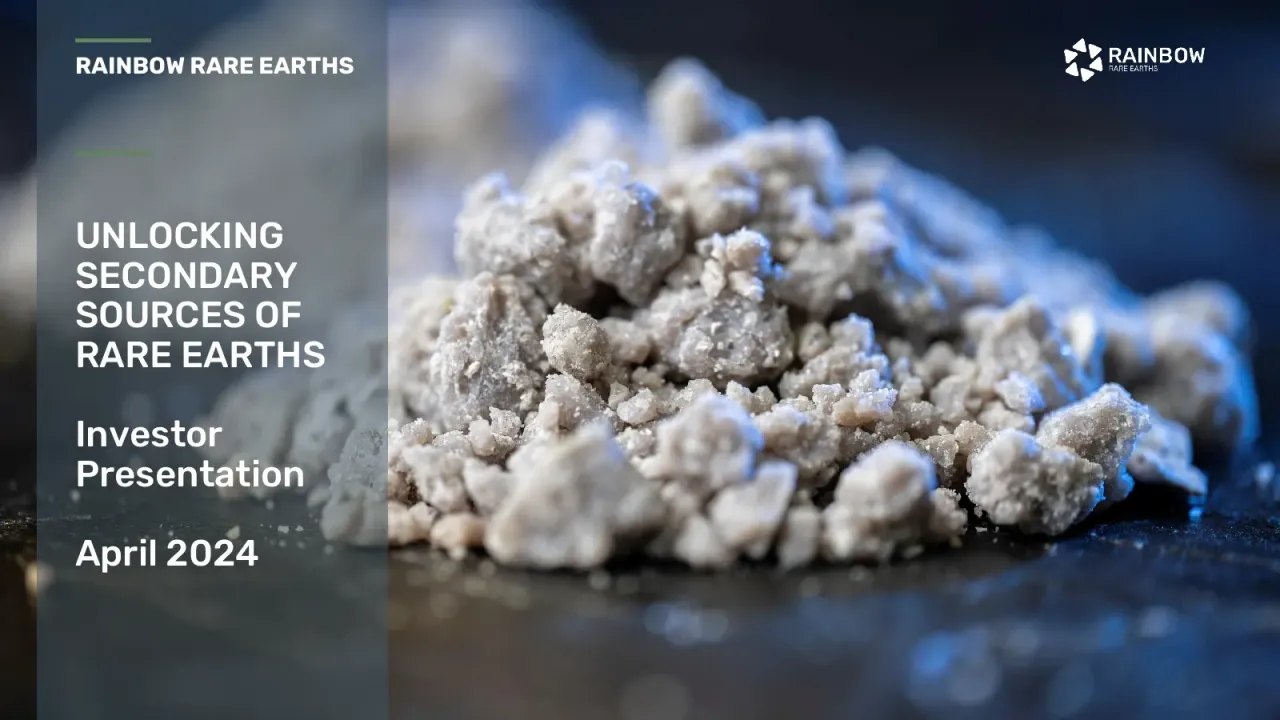
0:32 submit the following poll. And if you'd give that your kind attention, I'm sure the company would be most grateful. And I would now like to hand you over to the executive management team from RAINBOW RARE EARTHS LIMITED. George, good morning, sir. Good morning, and thanks for hosting RAINBOW once again. It's been, I think, six months since our last update, so it's appropriate, especially on the back of our interims. So I'll go straight away into the presentation, as you can see, hopefully, on the slide in front of you. And we will go to the usual disclaimer, and now I can get on to the presentation per se. Once again, many of you have seen this slide before. It just footprints our economics based on the preliminary economic assessment we published in October 2022. I would like to point out once again that we only started working on this project in January 2021. So we achieved a major milestone on a very fast track basis by getting out a very positive PEA in October 2022, highlighting the strong and robust economics of the project based on spot risk pricing at the time.
1:42 And unfortunately, risk prices have come off considerably since then, which we'll talk about later. But one key point on this slide I'd like to indicate is that the CapEx of the project, some two ninety five dollars odd million, we are quite comfortable as a RAINBOW team that we will be more or less in line with this CapEx number. And because of the optimization, we've seen through a pilot plant running that we've been doing in Palabor sorry, on the Palabor material at Mintech. And what we're seeing in Florida is that we are quite comfortable that we are in the same realm of CapEx, which is key point for the investors to note. Just going on to the rapid progress that we've made. This is a new slide for most of the audience, and I would like to just spend a bit of time on this slide.
2:37 As you know, the pilot plant that we've been running at Mintek in South Africa has achieved some major milestones, and that is that we have proven to be a successful producer of rare earths in the form of a mixture of carbonate, which we have been shipping to the back end pilot plant that we're running currently at at KTEC in Florida. So the back end pilot plant is ongoing, and we produced some 35 kilograms of mixed rate carbonate, which is feeding the back end pilot plant. And I'll go into this further in the presentation. We also announced that the initial separation work in Florida, I think it was in late January, has achieved very good results in the sense that neodymium presidinium as a group and the continuous ion chromatography process had achieved some 68% purity on its initial separation, and we are therefore working on getting that purity up to 99.5% in the next two stages through the CRC circuit, which is expected in the next quarter in 2024.
3:53 We also acknowledge that this work is taking a bit longer than anticipated. But one of the key reasons for this is that we are having independent assays done to verify the assays by the laboratory in Florida called FIPA. This stands for the Florida Industrial and Phosphate Research Laboratory. And, basically, at each stage of the process, we are taking some sampling and getting it independently verified. Due to the workload on this laboratory, what should have been a two to three day turnaround, and our timetable is taking some two to three weeks for this independent verification. But it's key in terms of getting signed off on the pilot plant, which is integral for the integrity of the DFS.
4:38 As I've said, it's very important for us to get the sign off because we want independent oversight to make sure that our DFS is bankable when we when we publish it and we have the project finance banks having a look at this DFS and making sure that they are happy with the technical liability of our process from start to finish. Instead, we would rather do something right the first time around and it takes a bit longer as this will be much more efficient and much more cost effective and and for the project in longer term. So in summary, while it's taking a little bit longer than the original timetable, the back end process work remains on track. Results are being achieved in line with expectations.
5:24 And also, at this point, I want to point out that it doesn't impact our overall aim of reaching first production by the end of twenty twenty six. In terms of funding on this slide, I think what's happened, which is key over the period that we're reporting on is that we've been identified as a strategic near term source of risk by the U. S. Government. And this is why the DFC, which has made a commitment to fund $50,000,000 in to project code, which was announced at COP28 through current strategic shareholder TechNet. And this derisks the terrible CapEx funding that we require. As I've mentioned, that we're still comfortable that we'll be circa the $295,000,200 million dollars of CapEx.
6:16 Just to continue to talk about funding, our interims recently highlighted that RAINBOW will have additional funding requirements in order to take the project to FID stage, but this has been earmarked before and it should not be used to the market. We are in the process of evaluating a number of options for this. The Chairman, the CEO and the Board are major shareholders of the company, and we're highly cognizant of managing shareholder dilution. We're, therefore, looking for the right option. And I also want to point out that our track record of raising money over the last few years has been, I would say, very good in terms. We've always received strong backing in the market as well as from the directors of the business. And we have generally raised money either at a premium or at market pricing over the last number of years, and we would expect this track record to remain in place.
7:10 To move on, we've also had a resource update where we did some more drilling on these stacks. We with the input from Ottoman in The U. S, you are doing stack design Ottoman or the global gypsum stack phospho gypsum stack experts. And with on the back of their revised bulk density calculations, we've seen that the project life will increase by some two odd million two odd years as we've seen a 5,000,000 ton increase in our reported tonnage in the resource, which is obviously very positive for the project. We've also announced a strategic supply chain agreement with less common metals in The UK.
7:58 Less common metals are the only rare earth metal and alloy manufacturing facility in The UK who are expanding in The US, and they need separated reoth oxide. So this is a positive step for RAINBOW. The reason why they signed this MOU with RAINBOW is because they foresaw RAINBOW as a development project that is going to go into production, and we will be one of the lowest cost producers of separated reothoxides, and we would be able to go into production at current pricing. The other key sort of new milestone that we've achieved in the last six months is that we've signed a letter of intent for phosphoryl gypsum offtake. We intend selling between four hundred and six hundred thousand tons of gypsum per annum into the SA domestic market as well as the surrounding markets.
8:53 And this over the length of the project, we'll eventually fully delete these gypsum stacks. So it's a very, very good ongoing ESG story. And as I've mentioned, that this will also slightly reduce our CapEx and OpEx, which wasn't taken into account in our PEA. And then lastly, what's key on this slide is the diversification of RAINBOW that we've achieved. We signed an MOU with Mosaic with regards to Ubarawa Phospho Egyptian project in Brazil that our own exciting opportunity. We've announced some initial results, And we are, as I said, started by the large scale of this project, but it's much longer life than Palabolla much, much longer life, and there's a far bigger opportunity, so very important. And on the right hand side, you can see photographs of mixer carbonate that we've successfully produced at the pilot plant in South Africa.
9:49 This is also a new slide for the audience. This is an independent verification by August media that RAINBOW is probably the got the best operating margin of any development project in the world right now. As you can see on the right hand side, that's RAINBOW, the green bars RAINBOW confirms the high margin per kilogram of rare oxides produced. As you can see, the light gray slide on the left is a U. S. Producer, and the other light gray slide is an Australian producer, and the rest of our development projects around the world be Australia, South America or North America. And August confirms our high margin is that we've always said we thought we were one of the best margin businesses development projects in the business, and this is a confirmation by August Media.
10:42 And also in terms of global average lead times from discovery to production, the average is between fifteen to even twenty five years. And RAINBOW have achieved rapid progress in literally two odd years, and we are looking to be commissioning our plant and going into production in circa five to six years. So very, very short time line to your traditional development project, which we think is also a significant plus for RAINBOW. Now in terms of this slide, we've seen RARE's pricing slide since the October 22 PEA. RARE's prices are down some 70% since their peak in 2022.
11:32 But even at this low pricing environment, because of our EBITDA, we still are in a pricing environment at these low levels that would see RAINBOW still making some $80,000,000 of EBITDA per annum. On the very left hand side of that left hand chart there, our box is priced at $78.46 as the current RARE EARTHS basket price for RAINBOW, including disposal and terbium credit to our basket, and that's based on $60 a kg for NDPR. I would like to point out that currently, NDPR is sitting at about $51.52 dollars a kg kg. So it's not too far away. This has come off below some 10% last month where we saw NDPR pricing getting as low as sort of $47 a kg. So since the beginning of April, we've seen an improved 10% improvement, as I said, in RE pricing.
12:34 And forecasts are that roof prices will strengthen towards the end of twenty twenty four and into 2025, and we should see roof pricing for EDPR around about $80 to even possibly $100 a kg again. So time will tell, but what's important to note here that RAINBOW is very resilient even in historically very low rate pricing scenario. And we're one of the few projects we think in the world that even at this very low pricing would have positive EBITDA, and it's quite substantial in RAINBOW's case. Moving on to our next slide. Once again, the slides reiterate the longer term supply and demand fundamentals remain compelling and in place since 2017 to 2022, we saw a doubling of permanent magnet demand because of the various uses of permanent magnets increasing.
13:36 And the forecasts are over the next eight to ten years, we'll see a doubling of demand again. So the macro is still very strong. We see the electrification of the transport system continuing. We see wind turbine continue to be rolled out in turbine power due to renewable energy, demand for renewable energy increasing to meet net zero targets in 2050. And we see continued uses in consumer electronics still continuing to increase. And of course, we have the very strategic RARE EARTHS in defense the strategic nature of RARE EARTHS in defense continuing with an f 35 fighter jet requiring some 420 kilograms per jet. We see Arleigh Burke missile destroyer requiring some 2,300 kilograms. So there's 2.3 tons of of rears per per destroyer, and a Virginia class submarine requires 4,200 kilograms of rare earths. So it's 4.2 tons of rare earths. So the strategic nature of rare earths is not lost from the US government, and we'll talk about that later.
14:54 Moving on to as you know, that this slide confirms that it's imperative for sources of rare earth supply chain to be rolled out outside of China. We it's not healthy for anywhere in the world to have one dominant producer like we see in China and Myanmar combined and also very dominant in the downstream processing of separated rare earth oxide into metal and alloy and also into permanent magnets. We've seen a spike of investments announced recently by the U. S. Government, by the Department of Energy, Export Import Bank, Ex I'm Bank and the Department of Defense as well as Australian government to address these gaps in the supply chain and try to increase independence try and build an independent supply chain outside of China.
15:55 And as I said, we've seen the DFC's investments in Kalaburra as part of this concentrated and concerted effort and recognizes the project's role as a strategic source of responsible rivers, which will be sourced outside of China, and it will be so short term productions timelines make this very attractive for the U. S. Government, hence, the commitment by the DFC of $50,000,000 into the RAINBOW RARE in South Africa.
16:29 Once again, many of you have seen this slide. We have experienced team from Chairman all the way through to our technical team with a long track record of delivery of mining projects, mineral processing, plant design, and this is a mineral metallurgical chemical process plant that we're designing at Palabor because we have no mining per se. But as I said, a very experienced team that can bring this project to fruition and increase value for shareholders.
17:02 Just looking at Slide 10, most of the audience, I think, you're seeing here have seen this slide. Once again, these are the phospho gypsum stacks at Palabor that were that are the results of phosphoric acid production produced in the phosphoric acid plant. There's mothballed in the top right hand side of your photograph there. This was previously run by SASL, the big chemical condominium in South Africa, And they ran a pilot plant in 2012, which successfully extracted some three tons of mixture of carbonate from these from the phosphate gypsum at Tullabur, and it made RAINBOW's team realize that these risks were extractable and gave us the confidence to go into this project as we have done. Just looking at the targeted production volumes on the bottom of that slide, Once again, we will be some 30% of Linus' NDTR production current production when we come into production and set by the very, very much lower OpEx.
18:04 We know that, therefore, our profitability will be much higher per tonne of oxide produced. And I would like to point out that LIMITED's market cap is circa $3,500,000,000 compared to where RAINBOW sits at the moment, and we will be onethree of their size in terms of production but far, far higher profitability. So that, once again, indicates the potential rerating of RAINBOW going forward. Slide 13 is also sorry, yes, Slide this is Slide 11, sorry, not Slide 13, where we just want to once again, I want to highlight what is helping RAINBOW achieve such low OpEx and CapEx numbers compared to a typical RAREZ project in some of our peers. This is a brownfield site.
18:53 It's already fenced, as you can see, which has been fenced for sixty years. By that red fence line, you can see a fence of this nature normally costs many, many millions of dollars for a large project site. The blue dotted line there are the overhead power lines that are in place that we don't have to to spend money on on on bringing overhead power lines from a power source. We've got a high voltage switchyard at the base of the one stack, Stack A, as you can see, which is the largest stack. The phosphoric acid plant at the top left hand side of your photograph has been mothballed and it won't ever be operated again. In fact, it's currently being taken down by Bossaert Phosphates. You still have 15% of the project, but we have a call option to take our ownership to 100% of these stacks during the course of the next eighteen months, which we will do so.
19:51 That's subject to an announcement last year. So we will have 100% of the site. Once again, in the PEA, we had our pilot plant sorry, we had our plant sitting on the site of the moss called phosphoric acid plant, but we are now moving it to the base of stack A. This will require less pumping. And because the original site was some way uphill, we will save on these pump costs, on these on pipeline costs in our final project CapEx. And the size of stack C the new stack size is on the right of stack B, and that is also slightly downhill, so it will reduce our deposition costs as well with having it on a revised footprint there. Originally, Stack C was on the left of Stack A, but it's now going to be on the right of Stack B, further reducing cost for the project and keeping our OpEx within that range that you see of the PEA.
20:57 This one slide, once again, highlights RAINBOW's unique position in the magnet supply chain. We don't have the cost of mining. In other words, we don't have hard rock drilling, blasting, and so forth. We don't have to produce a mix with concentrate. We don't even have to crack it because these these gypsum stacks are chemically cracked already. We can go straight into separation. And as I said, that makes RAINBOW quite unique because we are extracting raws from a secondary source, and that's driving our economics and our project CapEx. On Slide 13, it's basically, we're talking to RAINBOW's green credentials once again. We think it's incredibly important going forward And certainly, for lots of investors, looking at the credentials of projects more and more. And we're also looking at the OEMs. We're looking at the source of the from the OEMs or having responsibly sourced the components for the EV manufacturers and so forth. We're seeing the market starting to consider responsibly sourced materials should be valued differently, and this is happening across other commodities, including steel, nickel and copper. We've seen that Benchmark Minerals have just launched a green nickel price yesterday, where they will be quoting a green nickel price. We've seen commentators calling
22:30 for the LME to have two prices of copper responsibly produced copper commanding a premium price to copper deemed to be sourced from unresponsible projects and countries. And we also seen that there'd be a there's a premium for green steel. For example, out of Finland, we believe that green steel sourced in Finland currently is achieving a 10% to 15% premium by German EV manufacturers. So that puts RAINBOW in a very strong position where we believe this is one of the greenest, most responsibly sourced of rare earth magnet material separated oxide magnet material of any project at the moment. As I said, it's a brownfield site. We're doing a cleanup of the legacy phosphoryl gypsum stacks. We are neutralizing all the acid water associated with these these stacks, and we'll be acquiring sulfuric acid from Petabo Mining Company, the copper mining company, just a couple of kilometers away from us next door, which is keeping our price of sulfuric acid at a very, very low low low price in our in our OpEx.
23:45 And to give you an example, in our PEA, the sulfuric acid price we use was $95 a kg because it was being given to us by PNC next door. They have 10,000 tons of waste sulfuric acid to get rid of every single month. And at the time in The Congo, Glencore were paying $450 a ton for sulfuric acid. So that's just a footprint, our key source of reagent is. We're also gonna be selling this phosphate gypsum into the South African gypsum market, which means that over an extended period of time, we will completely level those stacks. It will be a complete rehabilitation of that site, which not many projects can claim. So we think this the ESG credentials of the Turbot project are extremely strong.
24:30 And as I say, when OEMs are looking to source reliable, ethical and traceable supply of rare earths, RAINBOW will very easily fit into that category in terms of being, we believe, a Tier one supplier. And we've already seen this with we've commenced offtake discussions already with a couple of OEMs. And they are more focused on supply than price because the price of a permanent magnet in the EV is less than 1% of the cost of the vehicle. So they are more worried about security of supply than actual pricing of the permanent magnets themselves. And we've entered into negotiations with two large OEMs already.
25:17 Just to talk a little bit about our process that we've embarked on. So most of you guys listening and know that we've gone through for continuous ion exchange and continuous ion chromatography technology over traditional solvent extraction. On the left hand side, you can see solvent extraction requires hundreds and hundreds of of mixes of set settlers compared to the units on the right hand side, which is a continuous iron chromatography unit, which will do the final separation for RAINBOW. We only need three of these units to get our purity, and this technology is already being used by ReTech in Norway to separate reefs and to separated oxide. So we know we're using the right technology. It's also a technology that's used in various industries on larger scale than what we require at Pelleboa. So it's a proven technology in other industries, and we are just proving it on the separated that we are busy going to produce in the back end in Florida.
26:29 The RAINBOW process also has far fewer processes as we've spoken about, which is one of the reasons why we continue to see this project in a low capital intensity environment and obviously, a very, very low OpEx.
26:46 These are a couple of photographs over the last six months of what we've been able to achieve once again is that we've completed the pilot plant run at Mintek in South Africa. Here, Mintek is a very established R and D team in South Africa, one of the key laboratories in the world. We ran a completely integrated circuit for twenty four hours, seven days a week for three weeks in March. And this has had very successful results, which we'll be reporting on shortly. But as we've already announced that we produced some 35 kilograms of mixer carbonate, which we've been continuously shipping to the back end pilot plant in Florida. And we've also in the front end, we've identified a number of optimization opportunities, which is why we are confident that we'll be keeping that capital number more or less in line with the PEA, and we'll be announcing those optimization results shortly.
27:49 And then we announced at Lakeland in Florida, we have started processing our mixture of carbonate. Now they've got over forty years of pioneering continuous ion exchange that we see is used in uranium plants worldwide and CRC technology. The back end pilot plant has commenced operations towards the end of last year. And basically, in January, we announced the first successful separation of RARE EARTHS into the various groups on the continuous ion chromatography stage, and initially grading some 68% purity. And we are now and we also saw a successful separation of what's known as the SEG group, also at 63% purity already. That's samarium, europium, gandelion, which we weren't even planting in our PEA.
28:39 And then we started seeing the initial successful separation of dysprosium and terbium, which will come out lower. So we're expecting final stage purity at our target purity of 99.5 in the next quarter with the dysprosium and terbium to follow. And we're also hoping to have an update on the ECG group, which would feed into our DFS because there's a definite market for this that we weren't anticipating, which will add to the project economics of RAINBOW's project at Pallabor. And likewise, the sale of phosphorylipsum is not in our PEA revenue model It will come into the DFS now, which will have a positive impact on the DFS, and we would expect to make the RAINBOW project even better than what we initially reported.
29:28 As mentioned, the U. S. Government announced at the COP28 conference in Dubai in December third of December twenty twenty three, the commitment by the DFC into the Rainbow Road project via TechNet. Here's a quote from the CEO, as you can see, and you can download this presentation at at at your leisure. But, basically, we see the US government at multiple levels, And it's a very bipartisan engagement because, you know, within two weeks of that announcement, we had a site visit by a con congressional delegation to Palabora, which was both Democrats and Republicans. And we are very encouraged that that this is bipartisan sort of focus of the US government. And even if there's a change of of of governments in the next election in The US, we don't see any focus changing on Critical Minerals strategy of the U. S. Government. As I said, this is totally bipartisan.
30:31 Once again, as reiterated, our time line to production is still on stage at this stage. The pilot plant operations are firmly underway, and we have optimized front end flow sheet, and we will expect to see some optimization out of the final separation taking place at KTEC. MITI Engineering have really started on various parts of the definitive feasibility study, which we are expecting to be completed end of this year or early in the next quarter sorry, in the first quarter of twenty twenty five. Paragon are doing are one of the companies that are looking at doing the reclaim of these gypsum stacks. They've got extensive experience in reclaiming mining tailings dry projects in Africa, and they ran a successful pilot plant in January and February at Palobawa.
31:28 And basically, as I said, we'll announce those results shortly. We have the leading global designer of phospho jetsam stacks. Ottoman has started working on the design for the DFS, and that's on track. We also have a resource update expected in twenty twenty second quarter of twenty twenty four. And we've already announced the increase of the last from the drill program we did late last year, which is positive. The environmental work is also being done by tier one WSP Golda, the tier one global EIA consultants, and their work is is very, very far advanced, And we will be submitting all our updated permits and the new permit for the the new stack site shortly, and that's on track as well.
32:25 And once again, we also signed the letter of intent with Nexus for the sale of the gypsum byproduct. And these these negotiations with them have gone very well in terms of they're already coming to us with the with with with further sampling from our pilot plant to confirm that they will be able to sell the tonnage that we envisaging once we're in production. We also want to highlight to the audience the multi asset nature of the company. As mentioned earlier, we've signed the MOU, the LCM in The UK who are expanding in The U. S, and they need separated ore oxides ex China, and they've focused on RAINBOW being one of the key sources of separated oxides for the expansion they're doing in China sorry, in The U. S, which is feeding the General Motors, a new EV electric vehicle plant that they're rolling out in Texas.
33:22 So that's very positive for RAINBOW. And then we signed the MOU with the with Mosaic in Brazil. I'll talk about that shortly. And then we have the MOU with Morocco OCP in Morocco. Once again, to talk a bit more about Brazil, which we're very excited about, we signed the MOU with Mosaic, a global phosphogypsum producer, a circa $15,000,000,000 market cap business. We're very proud that RAINBOW could MOU, the company of this nature. We are we're looking at fifty-fifty project to develop the extraction of the arrears out of the phosphoryl gypsum stacks and the phosphoryl gypsum plant sorry, the phosphoric acid plant in Brazil.
34:07 This is a far, far longer life than the Palabora project, and it's a far, far bigger volume. And we expect to be making further announcements on this opportunity shortly. As I've mentioned, the initial results we've published with the roof grade and the stacks is some 20% to 30% even higher grade than the Palabur project, which is very exciting. They didn't impress it in a percentage of risk in the basket at some 25% is also extremely high for for most projects worldwide, and we have dysprosium and terbium. The the two other magnet barriers that we are chasing at Peloborua are also in the mosaic phosphoryl gypsum stacks and then the feedstock.
34:52 So very encouraging by encouraged by the initial assays, and we will be and we are undertaking further work, which we'll be announcing results on shortly. But once again, it gives RAINBOW project diversification and also country risk diversification, which few rare earth projects in the world can claim, I believe. Just to finish off, why RAINBOW? Once again, we believe it offers a unique opportunity. This slide basically is the upside forecast for when RAINBOW comes into production. We're expecting at forecast rate prices when RAINBOW would be in production in end of twenty six, 2027, that with an NPV well over $1,000,000,000 we'll be generating some $300,000,000 of EBITDA per annum on the $300,000,000 CapEx.
35:43 And we see our EBITDA margin north of 80%. So very compelling numbers for forecast numbers, and we think this makes RAINBOW a compelling investment case, as I've been saying for some time now. Thank you once again for your time and listening to me, and hopefully, you will be satisfied with some of the answers I'm sure I'm gonna be asked. Thanks to the audience again. Perfect, George. That's great. And thank you very much indeed for your presentation this morning. If I may just jump back in there before we look to move to questions. Ladies and gentlemen, please do continue to submit your questions just by using the Q and A tab that's situated on the right hand corner of your screen. But just while the company takes a few moments to review those questions that were submitted already, I would like to remind you that a recording of this presentation along with a copy of the slides and the published q and a can be accessed via your investor dashboard.
36:34 George, we obviously received a number of pre submitted questions ahead of today's event. So perhaps if we look to take these first and then move on to the questions that have been submitted throughout your presentation this morning, that'd be great. The first question that we have here reads as follows. Are you able to give further assurances on the allocation of the licenses required? Is this likely to be problematic for the project at Palobawa?
36:59 No. We don't believe it'd be problematic at all. Permitting risk is included in our standards of risk disclosure for the project. But we're currently working in a new environmental and social impact assessment for the new stack site. The work streams are all well advanced to allow permit applications to take place and be launched shortly in 2024. The project will also require some updated licenses for in other words, water use license, waste management license and air emission licenses. Bearing in mind, is brownfield site. So they already have these licenses, but we are making amendments to these licenses. All the work for these amendments is also well, well progressed, and we basically sort of circa 80% to 90% through these for the work required. As I mentioned that we're doing the submissions shortly, and we're on track to have the licenses awarded to us in time for sort of construction.
37:58 As I said, it's difficult to predict the exact time frame. But luckily, in South Africa, there's a statutory process that once your applications are in, there's a statutory process, which means you then have quite a firm time line. And as I said, we're quite confident that we'll have these licenses awarded within the timelines that are stipulated by the government. And the fact that we are cleaning up the legacy environmental issues at the site, and we're treating the acid water currently associated with the unlined gypsum stacks, and we'll be restocking the processed gypsum on new line stacks designed in accordance with the RC standards and the greater principles as well as creating important jobs in the area. We don't see any reason why these revised and the new EIA license for the new stack site would be withheld. You know, it's it's super beneficial to the area as well as to the existing stack site. And we so we're very confident that the relevant licenses will be issued.
38:59 Thank you. Perfect. Thanks, George. The next question that we have here asks, what, if any, were the outcomes of the presentations in South Africa and more recently in Switzerland? We've attended three investor conferences in the first quarter of twenty twenty four. And at each conference, we've had very, very busy schedules, including the BMO, the Bank of Montreal Conference in Miami. At all of these conferences, we had a very busy meeting schedule. We've seen a lot of interest coming from big strategic investors and private equity groups. We have a focus on energy transition, and these groups tend to take a longer term view. And we also have seen engagement from OEMs looking for offtake agreements.
39:47 And as I mentioned, also private clients and family offices, they tend to take a long term view similar to the PE groups. We've been highlighting to these investors the various catalysts that we see coming up in 2024, and the project continues its development pipeline. And we believe this will drive rerating of our stock in the short to medium term. Thank you. That's great. Just turning to the next question that we have here. In your experience, what is likely to be the biggest pain point in the next couple of years in the run up to production?
40:26 Well, we probably see financing of the project could be seen as a major challenge, but I'd like to point out that the funding commitment of $50,000,000 into project from the DHC in Washington via Techmed has considerably derisked this issue. We given that we envisage the equity portion being $100,000,000 with debt covering the remaining $200,000,000 That means RAINBOW will only need to come to the market for the remaining $50,000,000 in construction equity, which we believe will be achievable for a company of our size, especially as we consider the robust economics anticipated for the project once we publish our DFS and which will also be published in a higher pricing environment, we believe, and forecast pricing environment, I might add. So we see us able to raise this money quite comfortably. And given that we also would anticipate a rerating of the stock after achieving the milestones we've set ourselves in 2024.
41:30 Also, with the DFC already committed to $50,000,000 of equity into the project, they've indicated that they will be they'd like to be a cornerstone in the debt, and that would make it far simpler to bring on other debt providers when they have the U. S. Government as their cornerstone. So therefore, we're keeping our timetable on track. It is also challenging as there's certain aspects as permitting of the debt financing that we can't control 100%. But as mentioned earlier, we believe these are well in hand. And we're confident that with the also the aspects of the build period in terms of this being a twelve to fifteen month period, due to the team's extensive experience in this area, we don't believe that this will present problems for for the team to deliver on the build period that we set out in our schedule.
42:23 Thank you. Perfect. Thank you. The next question that we have here asks, imagine RAINBOW RARE EARTHS in the year 2030. Do you imagine the company involved in a bigger part of the supply chain, or will your focus always be on raw material supply? Well, RAINBOW is already going further down supply chain than the majority of our peer group in the sense that we are not just supplying raw material. Most we will be basically three steps away from this. For example, most projects initially produce a mix with concentrate, then they might go into mix with carbonate. And finally, very few projects are going into separated grid oxides. RAINBOW is going all the way through to separated grid oxides, as we've mentioned, so quite far down the supply chain in terms of beneficiation.
43:16 And that's once again supported by MOU signed with LIMITED the UK that we're going to supply separated ore oxides to the metal metal and plants in The US and in The UK. As I say, they produce alloy, sintered alloy to the magnet producers like Vackerstrum, the German permanent magnet manufacturer, and Arnold Magnets in The US. So we have gone quite a long way down the strategic supply chain. The big opportunity for RAINBOW is how we can apply RPG other phospho gypsum deposits globally, and we started this process with the Yubaraba project in Brazil, which is the most similar project we have found in terms of the nature of the original ore body. In other words, it's a hard rock carbonatite. And it also has a phospho gypsum state that's being created by the byproduct of phosphoric acid production.
44:06 But over the longer term, we're also evaluating how to apply our IP to other sources of phosphoryl gypsum, which has resulted in our MOU with Morocco and OCP, which will be a far slower process. But we are still we're still seeing by OCP as having the IP that could possibly unlock some rare, some new phospho gypsum stacks going forward. So we're very encouraged by this. But as I say, our focus is on Brazil at the moment, which we see is a fast track project similar to the Palobora project and which will give RAINBOW a huge country derisking and diversification project diversification. Thank you. Perfect. Thanks, George. And perhaps the final pre submitted question that we have here before we then move to those that have been submitted live.
44:52 On page four of your most recent presentation, it shows that Argus expects at Paloborra to have the highest operating margin per kilogram of REO production. Could you explain in dollar terms the cost differential versus traditional mines? Thank you. Once again, I have reiterated this point in the presentation, and we're very pleased about that. And just to footprint this, Canaccord recently produced a study that said the average peer group has a NAV breakdown price of $80 per kg for NDPR, but actual incentive price encouraged financing of these projects would be at over USD 100 per kg of NDPR.
45:39 Now this compares with RAINBOW's operating cost of some $34 per kg of separated real oxides, and that's a four magnet separated real oxides. And this is due to the fact that we've got none of the costs associated with traditional mining projects. We also hear from various industry commentators that Chinese costs of separated ore oxides are around $40 per kg for NDPR. So they are losing money or module at current prices. This is for separated ore oxides. And this is what we hear. And as I said, this has also been supported by people like Benchmark. You also have put out a recent study indicating that at these prices, the Chinese producers are marginal or losing money as well, we believe. So we know we're in a good space even in current tariff pricing.
46:31 Our project would be making significant EBITDA margin and EBITDA as I say, at current pricing. So we are very confident that by the time we're in production, we're to see higher pricing, which bodes very well for our project. And as I said, the market needs higher pricing, even the Chinese producers. So we believe higher pricing will be on its way, and we've hopefully seen a bottoming of these rate prices with the recent 10% increase in pricing that I alluded to earlier in this presentation. Thanks very much. Perfect. Thanks, George. And and, George, as you can see there in the q and a tab, we have received a number of questions throughout your presentation this morning. And thank you to all of those on the call for taking the time to submit their questions. But, George, at this point, if I may, sir, just hand back to you just to read out those questions and give your response where it's appropriate to do so, and then I'll pick up from you at the end. Thank you.
47:29 To be honest, for some reason, I can't see these questions on my screen. I know we've had a problem with bandwidth in South Africa at the moment, which is why I'm not on video. But could you just maybe I'm not seeing these questions. George, just try and get them through to me. Yeah. George, on the right hand side, there will be a a q and a panel. If not, I'll be more than happy to continue reading out the questions to you, sir. Okay. Wait. Okay. I found it. Sorry about that. Perfect. So I see. Has KTHS X and CRC technology been used to extract uranium on a scale similar to that's needed to meet the levels of rare production foreseen in the Palobor PEA?
48:16 The answer to that is yes. We've seen OCP in Morocco actually bought the RP from KTEC a number of years ago, and they're using it to successfully extract uranium and thorium from their phosphorylipsum in Morocco. Now OCP are the biggest producers of phosphoric acid for the fertilizer industry in the world, and they're the biggest producers of phosphorylipsum in the world as well. So the fact that this is successfully applied in Morocco, we are more than confident that it's of scale large enough to deal with the volumes that we're dealing at Pellobor, which are nearby any near the volumes that OCP are doing in Morocco. Does the proposed $50,000,000 buy in of the DFC to Palomor relate to both the front end and the back end processing of RARE EARTHS? That's another question. And yes, this $50,000,000 commitment by the DFC is for the full process plant that we will be building, taking us all the way through to separated red oxides using the and also using the CRC technology.
49:39 Another question, have we found any bottlenecks in RAINBOW's processing flow sheet that might impact scalability? I can honestly answer this 100%. There have been no bottlenecks that we've seen. At the moment, as I said, the front end pilot plant has successfully produced 35 kilograms of mixture of carbonate. The pilot plant, I might add, at at front end pilot plant was treating 20 kilograms per hour of feed. Now a typical mineral processing pilot plant would treat two to three kilograms per hour of feed. So the Mintech pilot plant that we built there is six to 10 times larger in scale than a typical mineral processing pilot plant. And also very importantly, we ran this on a continuous twenty four hour seven operation for over a three week period. We ran various sections of the pilot plant over a six month period and then the final twenty four hour seven operation for three weeks. And most pilot plants on a continuous basis run for six or seven days. So once again, far, far longer than a typical pilot plant. So we this is just to prove that we've got no bottlenecks, and we're we're very confident in the scalability of the project.
51:05 Are there any elements that need removing after the RA extraction before they can sell the gypsum back into the market? That's another question. I can answer this by saying the phosphory gypsum that we will redeposit on the new stack site will be a cleaner benign phosphory gypsum, and there will be nothing further needed to sell it into the South African market. As I said, the sale of, say, 4,000 to 600,000 tons per annum into the SA market is very positive for RAINBOW because at current gypsum prices, this will add circa $78,000,000 to the bottom line of RAINBOW, which is not taken into account into our PEA. So of course, it's always dependent on current gypsum pricing. But at current gypsum pricing, that's the number we're looking at. So I think very, very positive for the project going forward.
52:01 Another question is, at what point do you envisage acquiring the remaining 15% stake in the project? I think I mentioned this in the presentation, It'll be later this year or early twenty twenty five. William D. Says, what confirmations do you have that Pettibor will supply RAINBOW with sulfuric acid? We've had a number of conversations with Petalbora Mining Company, and then all these conversations with their marketing department, they've confirmed that they want us to be the an offtake partner for the excess sulfuric acid. So we have no we have no issues in terms of securing a final supply agreement. The reason why we haven't entered the supply final supply agreement is that we need the final, final consumption numbers from the definitive feasibility study. Once we have those, then we will be able to enter into firm offtake with Balabur. But remember, you know, they need to get rid of some 10,000 tons per annum I'm sorry, per month of sulfuric acid, and we require circa 5,000 tons per month. So they will still have excess sulfuric acid to get rid of. And the more they can sell to us, the better for them.
53:22 The front end pilot plant is still running and working on optimization of the process. Was the job done now? Now the front end pilot plant is complete. We've seen numerous optimizations of our flow sheet, which have all been positive, I might add, and this will be subject to an announcement shortly where more detail will follow on these optimization on on the positive optimization. But, yes, this this is this is complete now. For the next six months, what's the challenges, risks or obstacles for the next to the twelve month timeline? Probably, the the key challenges is the is I'm trying to think. Well, as I said, permitting is on target.
54:15 The components of the DFS are on target. As I said, we're looking at the end of this year or the first quarter of next year at the latest at the moment. What might affect that time line is if there's any further delay in achieving final separation, which we don't envisage, or is any delay to to possibly permitting, but we don't see any problems there. So to be honest with you, we we don't see any real obstacles. We we see that we are on on on track, and we will hopefully, as I said, be on track to meet those timelines. Can you talk to the present level of RARE EARTHS prices and what's driving it in the short term? Well, as I mentioned, we've seen RARE EARTH pricing come off 70% since the peak in 2022.
55:10 And what we believe are a number of reasons. We've seen a slowdown in EV take up over the last year, that is 2023, which led to reduced sort of demand in the short term for permanent maintenance. We also saw a slowdown of wind turbine rollout. But you all know that legislation is driving these sectors where we see an uptick in EV demand, both in China and the rest of the world as well as an uptick in sustainable energy in the form of wind turbines being rolled out and that pace growing or the pace increasing that we're currently seeing in the rollout of wind turbine power generation. We also saw a big collapse in the Chinese construction sector, which meant that air conditioning units are not being fitted into new construction projects. Now I'm not sure the audience is aware, but some two odd years ago or three years ago, China gazetted that every single air conditioner in China has to have permanent magnet motors.
56:21 This is to reduce emissions. That means they could have more efficient motors that would require less electricity to drive, and that meant improvements in emissions. With the collapse in the construction industry in China, we've seen a reduction in the number of air conditioners requiring permanent magnet being rolled out. And then lastly, we have probably seen some Chinese manipulation. There was last year from Myanmar, there was an increase flood of stockpiled material coming onto the market. And this is this also put pressure on prices, but that has now been abated as far as we understand. So that's why as I said, we believe that the recent lows we've seen in RARE's pricing last month have probably those were the lows we believe and all the forecasts are for recovery in pricing. And hopefully, we've seen that recovery start, as I've mentioned before.
57:21 And why do you think the value of RAINBOW RARE is so depressed? I've just answered that question. So we have CapEx of US$295,000,000 to build your mine. However, competitor with the greenfield project in Africa claim they can build their mine for USD 200,000,000 to produce NDPR. And we have the competitor you're talking about. I don't want mention that other than they are not going all the way through to separated real oxides. I think their project stops at the first stage of mixture of concentrate. And obviously, that's a much, much lower level of CapEx required.
58:06 That's all I can say there. And I think those are all the questions that I see. Perfect, George. That's much. Perfect. That's great. And thank you very much indeed for answering all of those questions that came in from investors. And, of course, if there are any further questions that do come through, we'll make these available to you immediately after the presentation has ended just for you to review and to then add any additional responses, of course, where it's appropriate to do so, and we'll publish all those responses out on the platform. But, George, perhaps before really just looking to redirect those on the call to provide you with their feedback, which I know is particularly important to yourself and the company, If I could please just ask you for a few closing comments to wrap up with, that would be great. I suppose closing comments are that, yes, it's been a difficult market in terms of RARE EARTHS pricing for the last fourteen eighteen odd months. But as I say, we see this has bottomed out.
59:02 And that means the forecast project economics for RAINBOW remain very, very encouraging. We've been we've had fantastic results of the from the Funtian pilot plant producing mixed with carbonate, which in itself is a saleable product. Lots of projects stop at this stage. So RAINBOW is largely derisked by the production of successful production of mix of carbonate. But as I said, we're not stopping there. We are going all the way through to separated oxide, which we've been we're very positive with the results we've seen to date. And we believe that final derisking step in the next quarter will be significant rerating for RAINBOW. And we're very encouraged by the support we've seen in the market from approaches by OEMs to who are looking for now talking to RAINBOW for strategic offtake or strategic supplier of these separated red oxide that we will be producing because I believe RAINBOW is a real project that it will go into production.
1:00:05 So all in all, we are very excited about the next twelve months. And as I said, we hope to see a rerating of the project based on positive results coming out on a number of fronts for RAINBOW. Thank you very much. George, that's great. And thank you once again for updating investors this morning. Could I please ask investors not to close this session as you'll now be automatically redirected the opportunity to provide your feedback in order that the management team can really better understand your views and expectations. This will only take a few moments to complete, but I'm sure will be greatly valued by the company. On behalf of the management team of RAINBOW RARE EARTHS LIMITED, we would like to thank you for attending today's presentation. That now concludes today's session. So good afternoon to you all.
Follow Rainbow Rare Earths Ltd. into a list and get an email when it puts out news.
CEO at RAINBOW RARE EARTHS LIMITED
CFO at RAINBOW RARE EARTHS LIMITED