Mr. Raju
at Antique Stock Broking Limited
Replay available
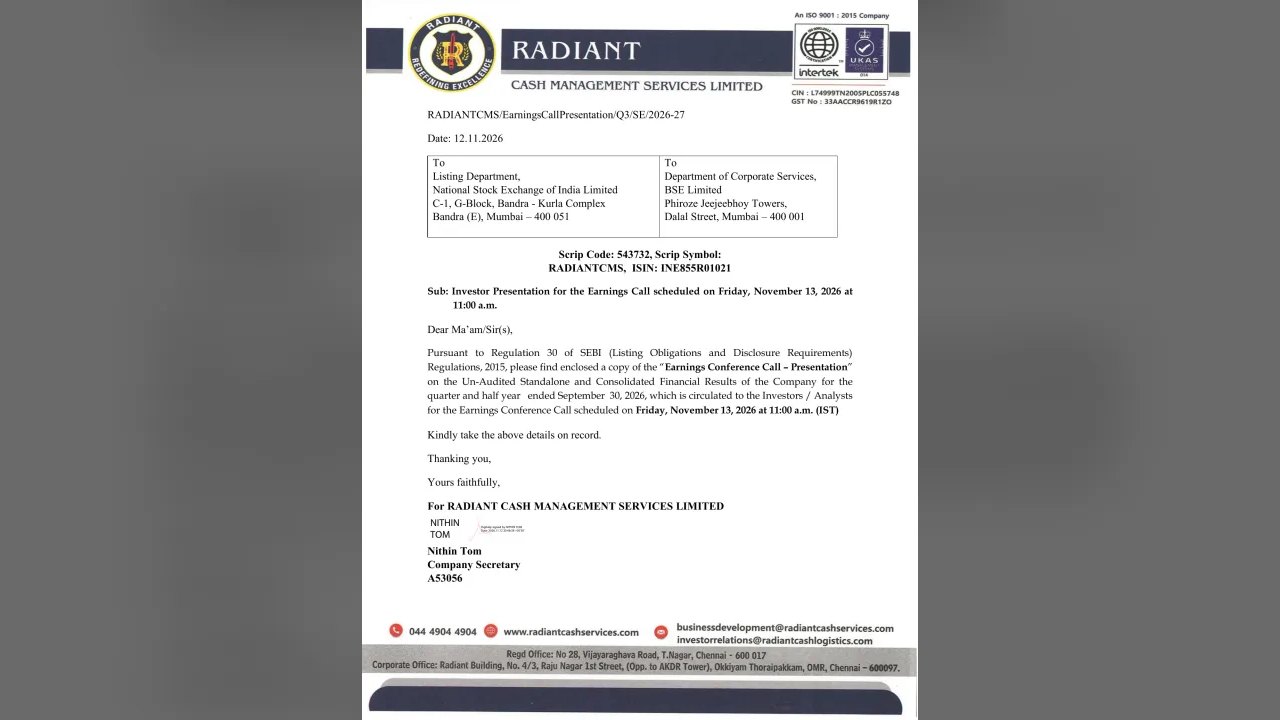
Radiant Cash Management Services (NSE:RADIANTCMS) Q2 2027 earnings call, held 2026-11-13. Watch the replay and read the transcript on 6ix.
On 6ix: 6ix.com/event/radiant-cash-management-services-limited-radiantcms-q2-2027-earnings-call
Automated transcript · Written by software from the replay's audio. It can mishear names and figures; the replay is the record.
0:00 Ladies and gentlemen, good day, and welcome to Radiant Cash Management Q2 FY 'twenty seven Earnings Conference Call hosted by Antique Stock Broking Limited. As a reminder, all participant lines will be in the listen only mode, and there will be an opportunity for you to ask questions after the presentation concludes.
0:29 Please note, this conference is being recorded. I now hand the conference over to Mr. Raju. Thank you, and over to you, sir. Yes. Hi, good morning, and welcome, everyone, to the Q2 FY 'twenty seven earnings conference call of Radiant Cash Management. Today, we have with us the management team of Radiant Cash represented by Mr. Colin David Dev Sahin, Chief Managing Director Mr. Alexander David, Hold Time Director Mr. Venkataraman,
0:59 CFO and Mr. Muthuraman, Head Strategy and IR. With this, I hand over the call to the MD sir for his opening remarks. Of course, we will have other Q and A session. Thank you and over to you sir. Thank you very much. Good morning, ladies and gentlemen. Thank you for joining us today for Radiant's investor call. The overall performance for the quarter has been underwhelming. The revenues grew by 7.6% year on year despite flat cash volumes in our lean season. However, a significant increase in manpower cost triggered by revision in minimum wages and shortage of armed gunmen and higher van costs resulted in lower profitability for this quarter.
1:53 The company along with other peers in the industry have taken this up with all the clients and have been successful in obtaining price revisions ranging from 12% to 15% across all the clients as we had mentioned in our last earnings call, the effect of which will be seen from Q3 onwards. We continue to grow our direct clients business, which now accounts for almost 20% of our standalone revenues. Cash Management operations also continue to grow at a healthy pace. We have started deploying AI tools and other technological support for optimization of costs, particularly in manpower intensive areas such as route management, banking and recon and billing.
2:48 We hope to see the full benefits of these measures in the next quarter.
2:55 We handle cash volume of Rs. 410,000,000,000 during the quarter, a flat performance over the same period last year. We had the least gross cash losses in this quarter since our listing at just Rs. 1,000,000. We continue to have the lowest cash losses in the industry by a wide margin because of our robust risk management system. Radiant Valuable Logistics continued its revenue growth and clocked INR 3,000,000 for the quarter. However, profitability continues to be a concern, sorry that was 30,000,000 for the quarter.
3:47 However, the profitability continues to be a concern with breakeven period moving further. Our new team has been inducted for business development and load factor improvement with which the management is confident of achieving profitability by the end of this financial year.
4:06 Radiant Acemany, our fintech subsidiary clocked a healthy turnaround in revenues and achieved near EBITDA breakeven performance in this quarter. The subsidiary is currently scaling up its sound box and QR code deployments with several rural and urban banks and improving its transaction revenues on installed base on POS machines. Mr. Alexander David will provide more details on Radiant A's 20 performance and future plans. Overall profitability for the quarter was core at 3.5% PAT margin and 5.4% ROCE. However, the management is confident that the worst is behind us and the coming quarters will report much healthier numbers.
4:54 This confidence stems from the recent price revisions from all our customers, ongoing cost reduction exercises with support of technology and improved performance of RVL and Radiant Ace Money. We remain committed to providing transparent updates on our progress and answering any questions that you may have. I would now request Mr. Alexander David to speak about the performance of Radiant Cash Money followed by Mr. Venkat Raman, the CFO, to speak about the financial performance and KPIs. It's over to you, Alex. Thank you, sir. Good morning, everyone. Thanks for joining this earnings call. I will be presenting the update on Radiant Ace Money, our fintech subsidiary.
5:42 Radiant Ace Money has had good growth in revenues during this quarter, aided by healthy orders for Soundbox deployment, steady growth in transaction revenues from the existing BC network and white label solutions to smaller banks and NBFCs. Post the discontinuation of PIDF subsidy in December 2025, the focus of Radiant Ace Money in the last three quarters have been to pivot to more stable transaction revenues and also leverage its network for deployment of sound box, POS machines and QR codes. This has helped the subsidiary achieve near breakeven at EBITDA levels for this quarter. As mentioned in our last analyst call, Radiant Ace Money is in the process of diversifying its revenue base to establishing corporate PC network for banks, providing white label UPI solutions and offering its fintech software solutions for smaller banks and NBFCs.
6:36 Towards this end, we have signed up MOU with two small finance banks, one urban bank and a few NBFCs. The management is confident of scaling revenues from these clients in the current financial year. Currently, we have a network of close to 20,000 BCs during this quarter. We freshly deployed 21,000 sound boxes and facilitated transaction volume of close to INR 200 crores in this quarter. We will continue to provide regular updates on the progress of Ace Money to our investors as we scale greater heights in the coming months. I would now request our CFO, Mr. Venkat Raman, to present our financial performance. Thank you. Thank you, Alex. Good morning, everyone. Thanks for joining us on this investor call today. I will present the company's key performance indicators and financial performance for the second quarter ended 09/30/2026.
7:29 The retail cash management business grew at 6.2% during this quarter over same period last year. Growth was largely driven by BFSI and organized retail with some recovery in growth from e commerce logistics sector. Railways, petroleum and e com segments witnessed sluggish growth in this quarter. In this quarter, we handled 410,000,000,000 of cash, a flat performance over same period last year. Direct clients accounted for 19.2% of our revenues for this quarter, up from 18.4% in the previous quarter and 15.7 in the same period last year. We service 79,374 points spread across 15,165 pin codes and 9,217 locations during the period ended 09/30/2026.
8:15 The point coverage represents a 5% growth over same period last year. Our gross cash losses for this quarter stood at 1,000,000 or 0.0002% of the total cash handled during the period. This is the best performance in the industry, a reflection of our strong focus on risk management and ex servicemen culture in our company. Radiant Valuable Logistics reported revenues of $9,900,000 reporting sequential growth of 35% in Q2 of FY 'twenty seven over over Q1 of FY 'twenty six and is well on its way to achieve positive EBITDA in the current financial year. Coming to financial performance, the consolidated revenues for the quarter were $1,120,000,000 representing 4.4% growth over the same period last year. Stand alone revenue growth was 7.52%.
9:08 The stand alone EBITDA margins for the quarter was 7.62% as again 15.2% in the same period last year. Key reasons for this margin reduction were sharp increase in manpower related costs, mainly employee costs, labor and government costs and service charge expenses towards cash activities, which represents 70 of our total cost. Sharp increase in minimum wages in a few states and shortage of licensed government in several Southern states resulted in higher manpower costs. As mentioned in our last earnings call, the company has taken up the manpower cost increase with all its customers and has been successfully in getting price increase in the last quarter. The effect of the same will be reflected in the current and subsequent quarters. The consolidated EBITDA margins for the quarter also correspondingly fell to 6.8% from 13.1% in the same period last year as the subsidiary Radiant Cash Management performance improved to near breakeven levels in this quarter.
10:02 The working capital management continued to remain excellent with debtors at about eighty days revenue in September 26. The balance sheet continues to be
10:09 healthy with total cash and cash equivalents of about Rs. 1,500,000,000 of our own funds as on 09/30/2026, including cash used in retail cash management operations. Net debt continues to remain nil. For the remaining quarters of FY 'twenty seven, the management expects healthy improvement in profitability on account of core business profitability improvement supported by the recent price increase price hikes from the customers, strong cost reduction measures being undertaken by the company, improvement in performance of Radiant Valuable Logistics and better growth in revenues from core business. The management is actively working towards meeting each of these milestones and confident that the same will reflect the financial performance in the coming quarters.
10:56 I now hand over the floor for question and answers. Thank you very much. We will now begin the question and answer tone telephone. If you wish to remove yourself from the question queue, you may press star and two. Participants are requested to use handsets while asking a question. I repeat, anyone who wishes to ask a question may press star and one on their touch
11:37 The first question is from the line of Amit, an individual investor. Please go ahead. First question is from the line of Keshav Garg from CounterCyclical PMS. Go ahead.
12:05 So if we compare our performance with the industry leader, then I'm unable to understand that how come the industry leader margins are pretty stable at mid twenties. And whereas if we look at our performance, then our margins from a similar level to the market leader, they have really collapsed to single digit margins. So, I mean, in the same industry, it's very hard to see that how come two players, there is such a huge divergence from the same starting point?
12:47 Hi, Keshav. Sorry, we cannot we do not have sufficient information on competitor performance of other segments of their businesses for us to directly comment on. But our costs, as we have explained, the particularly driver government costs and the cash executive costs have gone up. Manpower account for 70% of our revenues and that is the main cost that have gone up. And in fact, with other peers in the industry, we have presented to the clients and that is how we have been able to successfully get these price hikes. So, the same complaints were raised by all the peers in the industry, including the competitor that you are referring to. Understood. Now sir, is it the case that the industry leader is able to get a higher
13:41 price from the customer for the same service? Or is it that it is exactly at par what we are getting from, let's say, Bank A and what the industry leader is getting from Bank A for the same deal, is it similar pricing or they enjoy some kind of premium over us?
14:02 The pricing is more or less fairly similar across for a bank across its service providers. So, may not have differential pricing. Where there is a direct customers, it's a free competitive market, anybody can price the way they choose to.
14:18 Right. So, I mean, if the pricing is same, then the cost structure because I mean, ultimately, fuel cost is the same for everybody. The cost of your vehicles is the same for everybody. Even the salaries are the same. So then how come there can be such a huge differential?
14:40 Sorry, I cannot answer that without knowing the comparable performance for the similar industry. For the Retail Cash Management segment, if you can give a comparable, then we can answer. That is not disclosed by any of the peers. So for me to do a line by line comparison, I don't know how their cost structure and performance in their other segments are.
15:02 I understand where you're coming from, but this is a uniform concern that the price hike manpower cost increase is a uniform concern that the industry association had taken up with the Indian Bank Association and that is how we are able to get these price hikes. So it is a uniform concern across all the players. Now sir, what kind of price hike in percentage terms on a weighted average basis have we been able to get and is it the same for all the industry players across? Yes. We've been able to speak to the banks and we are looking at the price hike as I mentioned in my initial presentation of 12% to 15% price hike across the board.
15:56 So, we are also very seriously looking at our own model in terms of any price cutting, I mean cost cutting that we need to do. So, what we have seen in the last quarter, I mean there's also a lean quarter in retail cash management. So we are purely into retail cash management. We are not so much into some of the other segments. Though we haven't carried out an analysis of peers. Now we do that in a very detailed manner nor is that an issue for discussion here. Currently, I feel that from this quarter onwards, we'll be able whatever impact has been there, I think we'll be able to address and improve upon it.
16:43 So everything else being same, our since we got around 12%, 14% price hike, so the 8% standalone margin should become at least 20% in the coming quarter. Is that understanding correct? I won't be able to give exact number on that because the start dates for different banks are at different points of time and there are variance in the business for cash flow and operations at slightly different rates and the mechanics work differently. But there will be a definite significant improvement, but I don't want to put a number of 20 or 21, whatever that you have. To add on to what Mr. Matraman has said, I think the impact can be seen from the fourth quarter onwards.
17:28 And it will be a different impact from the fourth quarter. I mean, currently in the third quarter, it's being applied. So And it will have a different impact in the coming financial year that you'll be seeing. Sure. Now sir, is the fuel cost and is the fuel cost pass through? Is there any some formula based? No. There is no pass through of fuel cost. Okay. Understood. And sir, the wages that we pay, are we paying the minimum wage or higher than minimum wage? Okay. The answer depends on the different states. There are certain states where we do we are able to manage at the minimum wages, particularly North And Central states and Southern states is well above minimum wages.
18:26 Understood, sir. Now sir, we pay a very healthy dividend, sir, but and sir, we have a huge net cash, I believe, above $1.50 crore on our balance sheet. So so instead of dividend, if we do a share buyback, so that will be of huge advantage to the company, sir, because, ultimately, the earning per share will increase if the number of shares decrease. So because dividend is a one time thing. Once the cash goes out of the company, that is the end of it. Whereas by putting... Doing a share buyback with the same amount, the company can reduce the total number of shares so the earning per share will increase even with the same profitability. So so that would be a permanent advantage, and so the government has recently removed taxation on buybacks. So there is no tax at all.
19:17 So that would be of huge benefit if we can consider that. It's a very good point that you brought out and we have been looking at it, but for the buyback to have a substantial effect, it has to be of a very substantial nature, which at this point and we also there is also a diverse opinion on this amongst the shareholders, where quite substantial percentage also looking at a healthy dividend. So, have to go with whatever is the current
19:56 majority opinion in this as well as the feedback given to us by financial advisors. So it's a good suggestion from you and we'll have a look at it. Sir, actually just taking the point further now since the promoter holding is an individual name, so the tax tax incidence on dividend is 36%. So whereas if complete as a open market share buyback and promoters do not participate, so the promoter shareholding will go up to
20:29 that extent. And, sir, at a later stage, whenever the sentiment is good and our stock price is doing well, promoters can sell the shareholding in the open market and bring their shareholding down to the current level, and they need to pay only 14% tax on the gains that they make while selling. So so on one hand, you are paying 36% tax on dividend. And on the other hand, if you follow this, then you'll end up paying 14%. So that's a huge tax saving. So that
21:00 is the humble suggestion. And sir, do we have any CapEx going forward? Nothing meaningful. No major this thing, Harin. Most of our vans we take on lease. So other CapEx are very miniscule. And sir, in our subsidiary, what exactly is the business of the subsidiary? And you alluded to the fact that you are expecting it to breakeven. Is there any CapEx in the subsidy level?
21:31 We had some CapEx in sound boxes, but I think right now not at CapEx, that is just inventory in the case, but it is self liquidating
21:42 purchases. No major CapEx in subsidiary as well. And sir, what exactly is the business of our subsidiary? Yes. We are currently looking at multiple products. One is we are distributing sound devices, which after some time, we're also hoping to get some recurring revenue from that. We're also doing loan disbursements and white label ATMs as well. So it's a couple of different lines of product for the fintech side. Something you'd like to add? Sure.
22:15 We provide white label UPA solutions to urban banks, etcetera, who otherwise do not they have migrated to a core banking, but do not have a mobile solutions to their customers. So we provide a white label solutions for these banks. We provide we have a 20,000 strong DC network. So obviously, we help facilitate digital transactions and earn commissions on that. We deploy sound boxes and QR codes for banks and NBFCs. Then we do have tie up with corporate
22:57 VC network for couple of small finance banks to roll out their network to their retail clients. And we are also taking up technology service provider solutions both in India and now we are exploring in other markets as well.
23:20 Understood, sir. Sir, and the receivables went up significantly as on September 30. So
23:28 is this a new normal or we expect them to again come down at earlier levels? No, that was a onetime September collection was slightly lower. I did got this October's collection. We had a good collection in October, and it got subsequently corrected in the first week of October. Understood, sir. Thank you very much and best of luck. Thank you.
23:54 Thank you. Next question is from the line of Rohan from ACMS. Please go ahead. Hi, sir. If we look at the Radiant Cash top price, there has been consistent well restriction for the shareholders, almost 60 to 70% from the IPO price, sir. What makes you confident to say that they ahead the outlook is promising? And what are the chances of recoup of the investor losses, sir, since IPO?
24:27 Yes. That's true. I mean, the stock price probably reflects the reported financial performance as well. We have had a drop in profits PAT reported in last two years and continued in the current quarter. But it was a confluence of different factors. We are taking corrective measures. First is the price revision that we get from the customers should improve our profitability.
24:55 There are about four factors that the CFO listed in his servicing as well. We had ventured into two new verticals, basically Radiant Cash Money and Revaluable Logistics. We grossly overshooted the time taken for breakeven of these two businesses. But there is clear visibility Acemone is already almost near breakeven levels in this quarter. And Valuable Logistics also has grown 35% top line between Q1 and Q2. And we have
25:30 today, we have can confidently say that we have a strong team there to help improve the revenues to well above the breakeven levels before this current financial year. So these two are investments, diversification investments as a long term strategy that we wanted instead of depending only on retail cash management. So it is an essential investment for us for the long term sustainable growth for the company. So we are expecting those two businesses to start generating cost contributing positively to the PAT in this current financial year. So that is number two. We are embarking on a strong cost reduction measures with the help of technology, which were either to not available earlier for us, which we are doing manually.
26:17 So that also will definitely start yielding results. So we our hope is to restore our profitability to the
26:27 IPO time levels. Got it, sir. On stock price, we don't have any control on how it will move. Got it, sir. And the next question is, with the U. Charges have started incurring post Diwali as per the government notification. So what sort of positive impact you expect for your bank and how it will help you?
26:53 I don't know if this is a trigger or not, but our October performance have been fairly healthy, very healthy. It's a festive season as well. But over a longer period of time, the higher volume is what will attract these MDR charges. So probably cash volumes will improve. We are not able to give a pinpoint a number on how much growth will come because of this. But independent of that, the overall cash circulation in the economy is growing and the cash volumes that we are handling are growing, although at a lower pace than what we would have liked. But we are facing our bet on adding more clients as well to our network and that should help drive our growth in the longer term.
27:46 Perfect. This answers my question. Thank you very much for the opportunity. Thank you. Next question is from the line of Khrushy Parekh from Bugle Rock.
28:07 So what I want to understand is that considering the retail focus that we have, what kind of trends we are witnessing when it comes to the business touch point growth or the volume growth, basically, the number of touch points that we are increasing? Because at certain level, it seems that we are slowing down
28:29 in that area. So how is it growing at industry level? How are we looking to cater to tap into it? And what kind of pricing action do we see on the direct front? Yes. So the pricing front, we don't make a distinction between direct and bank clients. It is fairly the same pricing mechanism works. And yes, unfortunately, again in a sense, the business growth points growth from the banks have not been as robust as it had been in the past before our listing. So that is why we embarked on this ambitious growth to improve our direct clients business
29:18 and have been extremely successful. Today, it is about 20% of our revenues. Probably in a year or a couple of years, it should reach onethree of our revenues will be from direct clients. We have hired senior resources, sector specific senior resources who have rich experience in specific sectors. So that should help improve add more clients. Largely the focus areas for us will be wherever there is a large amount of cash volume. So organized retail, NBFCs, hospitals, government businesses, these are the areas where we are seeing fairly good traction in terms of prospects to add more new clients.
30:05 Anyway, core business as an e com, e com logistics, railways, etcetera, we are already present in with almost all the players. So, we are providing limited scope for adding points there. But these sectors, our penetration is the cash for the industry as a whole, the penetration is low in NBFCs, in hospitals, in
30:33 organized retail, etcetera. So, that is where our focus is. We are hiring industry specialists to help grow these businesses as a direct clients. So first of all, what are the reasons for lower penetration in some of these industries to begin with considering cash has been handled for a long period of time? And secondly, what kind of use cases or, you know, cost benefit is something that we are looking to provide to them to ensure that they outsource their cash management to people like Reliant? Yes. So first is, I mean, why the penetration is low?
31:14 This service has all along been provided by banks as a premium value added service to their sellers. It was never offered as a standard offering to all the clients by banks. So and more important, none of the public sector banks except
31:38 FBA offer retail cash management as a service. If you are an organized retail player banking with any of the public sector banks, you don't have an opportunity to avail a service of this nature. So that is where we are focusing on improving our direct customers where providing this service. So penetration is low because
32:01 few banks offer this and public sector banks as an SBA probably 50% of the market size. So that is a completely untapped market. The second question you asked is about the value proposition. Our value proposition is extremely complete.
32:23 The price that we charge for a point to for a client to pick up cash every day for twenty six days can start with as low as INR 2,500 for, say, 1 lakh in a day. So that kind of that is really that works out to hardly less than INR 100 per visit. And then you imagine the time and amount saved by the company and correspondingly, the safety of that cash.
32:55 If the person who is handling today handling that cash loses that money, that is even one day, that is equivalent to three, four years of service charges that they provide to us. And our if you can see our cash volumes in the year are roughly around INR 1.6 lakh crores. And based on our revenues, if you see, our charges will be hardly
33:18 few tens of basis points compared to say 2% that an MDR for a credit card is charging. So there is 200 basis points, so there is this 20 or 25 basis points that we charge. So again, between cash and credit card, there's a compelling value proposition to use our services. Between doing it on their own and outsourcing also, the safety and the low cost makes it a compelling value for us. Okay.
33:45 And specifically on the authorized retail prime or maybe, say, some of the other sectors as well, what kind of trend are we observing when it comes to the cash that is being handled on a per unit basis? Is it like steady? Is it decreasing? Or how is it?
34:09 Yes. Equivalent of same store sales growth number for our stores. As in for a company as a whole, it is fairly muted growth at roughly about INR 1.6 lakh crores of cash that we handled in the last year as well as the current year.
34:31 But the number of points have been steadily increasing. So in a sense, there is a marginal drop in per store cash handled over this period. But we are not betting on that growth. The same store sales growth is not what our growth is betting on. Our bit is more on adding more points to this network.
34:56 So that because of the under penetration that can help sustain the growth over a long period of time. Okay. And what kind of
35:09 touch points when we start to increase over next three, four, five years?
35:15 Yes. We are currently close to 80,000 touch points that we handle in a given calendar year. And I mean the market is huge. I mean we believe we will be the market leader in this retail cash management industry at this count and probably about 40%, 45% share. So the industry as a whole is handling less than two lakh points. India has two crore retail outlets. So the penetration level is 1%. So the growth what we can achieve is fairly large. We have to get our act together in terms of business development and direct clients and explaining the value proposition to get this.
36:02 Okay. Sorry, just the number that you mentioned was 2,500 a month, right? For a touch point. Yeah. For a starting point of say 1 lakh everyday we collect for twenty six days. Sure. The client will pay retail outlet will pay 2,500 rupees. Okay. I understand. And secondly for For months. Got it. And secondly, sir, you mentioned that white label ATM business is something that you're looking to offer. So my one question that I have over here is that ATM growth in India has been pretty much steady, I mean, for last two, three years, especially with the rise of UCI and everything. So what kind of business case does it make to have a white label ATM installed or even for that No,
36:55 no, think you got it wrong. We provide software solutions for mobile banking and white label this thing for banks. Don't have to operate any white label ATMs ourselves. For banks, we provide white label solutions where, say for example, there is X, Z cooperative bank in Mumbai. Have core banking solution, but they don't have a mobile banking solution for their customers. Our solution can be customized to that particular bank and it will interact with their core banking solutions and their mobile banking enabled. So that is white label mobile banking solutions. We do have a tie up with one large ATM service provider for white label ATM solutions that has been going on for the last four years now.
37:51 I understand. I understand. And what kind of growth is MBTA show over here considering the number of ATMs are largely being flat in the system? I think ATM is very, very small in that overall picture. It is more we have 20,000 plus business correspondence. We have as in a sense, we have a target to deploy over 50,000 plus sound boxes in the current year. And those are the bigger revenue drivers and transaction volume from the already installed base. Okay. Okay. Got it. And lastly, the pricing hike that you mentioned in your opening remarks.
38:39 So largely, they will be deployed over this next by December quarter or some of it flows into March quarter as well? Most will be implemented by December. By December. Talking about the price revision? Price revision is being implemented. Some of them are coming through now from November 1. So as I mentioned earlier, the impact will be clearly seen in the fourth quarter and also it will be a steady impact, it will be a good impact on the coming financial year. Okay, got it. Thank you so much. Thank you.
39:30 Next question is from the line of Amit, an individual investor. Please go ahead. Hi. Am I audible? Yes, you are. So sir, just want a couple of questions. One is in terms of the price hike of 12% to 15% that we've taken, is this across retail as well as banks? And or or are the bank contracts sort of locked in until renewal and they will reprice later? So do we see that across both the segments? And the second question is, in terms of the cost the guard shortages, do we see that easing after the wage increases that we have given? Or do we still see a shortage? And do you expect another round of wage increases or labor core costs coming within the next twelve months that might eat into this price increase?
40:28 Yes. First question, most of the hikes are actually from the banks only. Okay. So banks as an instance, we had a running contract. We had to escalate it because of the pricing manpower increase and minimum wage increase and banks have not waited for the subsequent renewal, but indeed the interim increase across the board for almost all our clients have given their price hike. The second question is, yes, so the gunman shortage is we don't have a clear visibility when it will ease, but at this point of time, Convene costs are high and across specific states only. It is not as in a sense, there is no problem in most of the North, East in and the Central States.
41:21 It is peculiar only in a few specific states. We are looking at alternate options to address that as well. Okay. But do you see that because of the wage increases we've given, do you see this easing? Or do you think this will continue for some time? Especially with the government with the Agniwir tenures being increased, do you see that as being a challenge? I don't think Agnivir will have a direct impact. Agnivir tenure increase will have any direct impact on this immediately. But this is not just for us, it is across the board. Banks have also raised this as an issue. A connected issue and servicemen who come to work for us, they're largely those who have done a full service and after retirement is when they come to us.
42:22 And this announcement of two years of Agnewil is going to have no impact on us in whatever way. Okay. And just one follow-up question. In terms of the price increases, has this been taken by all the competitors across the board? Or has because there's been one M and A which has just completed where a global player has acquired an Indian player. So there is a concern that they may be cutting prices to try and win business. Is this has any competitor kept prices lower to win business? Or the industry as a whole has taken this increase across the board? No, this was the whole industry together because of increase in minimum wages and increase of the fuel price following the Iran situation.
43:14 So it a unanimous decision taken by all of us. And so we approached the banks jointly and then in terms of move to the end customers and that's how this has happened. So there is nobody who is trying to now try and undercut and we are the largest players in the market. So no one can no smaller player can make any telling difference Mhmm. Okay. In this manner. Okay. Thanks. And this price increase is across public and private sector banks, both. Right? This is largely with regards to multinational and private sector banks. In case of public sector banks, they have requested us to speak to their end customers and that's what we are doing.
44:05 That's going to take a little while longer. Next question is from the line of Dilip, an Individual Investor. My first question is, this price hike that you have taken, 10% to 12%, If to what extent it is confined to sectors you have around BFSI, e commerce, retail, etcetera.
44:52 I'm sure certain businesses like organized retail, the price hike, you don't have to wait for four, five, six months of paying to go. So you must have already gone to them earlier, right? And it's only for large banks that you had to put on for this year. For others, since this price came in started eight, nine months back, you must be revising the price, right? My question essentially is going forward, how what is the real impact on the 100% of the business? Will it impact like 40%, 50% of the business? The rest of the business you must have taken, you will have waited for a negotiation to happen. No, no. 80% of our business are through banks.
45:41 Only 20% is direct customers. Okay. So, even the so called e commerce is Yes, true bank. You understand the way we disclose, we disclose both. As in what is the top one customer client, top one, top three, top five client and then top one, top three, top five end customers. The sector that we are giving classification is on the end customers. I will be servicing an e com customer, but the mandate has come to me through a bank. So I have to negotiate only with the bank for the price increase, not with the e com player, not with the organized retail player. Unless it's a direct customer, direct clients are only 20%. There, what you say is correct. We have been negotiating for price increase and have been successful few of them as well.
46:34 So, I'm thinking is you have increased the price, let's say, 1215%, let's say, 1212% And so the business is growing at a particular level, right? Our core business is growing at 2%, 34%. So even if you take 12% hike and then you need that most of it falls through because there will be a parallel in certain costs as we go along, you would still not reach the desired profitability, right? In the call, you said that you are trying to reach the IPO level profitability gradually and gradually. So what other levers you have apart from price increase to reach to the 20% plus kind of a margin or even medium percent plus kind of a margin despite high loan won't take you there?
47:33 That's my question. Yes. I think CFO explained in the initial call and I also answered in one of the questions earlier. One is the one of the key reasons why our profitability has dropped is also because of the investment in Radiant Valuable Logistics, which is in the stand alone numbers and in Radiant Ace Money, which is in the consolidated numbers. Both of them are very close to arresting the losses and start contributing positively to the EBITDA impact in the coming quarters. So that is one big improvement vis a vis a year back or two years back, how the numbers will be. The second, obviously, the price hike is one is going to be the main driver for improvement in profitability.
48:25 The second is the arrest in losses of these two initiatives. The third one is, as in we are embarking on a irrespective of the price side, we are embarking on a strong cost reduction measures with tools that were hereto not available to us because of the AI this thing. So we do expect that a good amount 70% of our cost is manpower cost. So wherever there is optimization that we can achieve with the help of these technology tools, We are seriously looking at those and we are confident that that will also add to our improvement in profitability. And fourth and most important in the longer term is that as we explained, our services have significant scope for growth. The top line growth of muted performance of 5% to 7% in the past, we believe it will be an aberration.
49:24 We have taken serious corrective measures. We are hiring subject matter experts, individual subject experts to various sectors where we believe there is a significant growth opportunity and that should start generating results. So these are the four drivers with which we think that over a period we should be able to restore to IPO level profitability. Yes. Thanks for the very good answer. My last question would be, if I understood you were doing around INR 10 crores, INR 12 crores of valuable business, right? That's the price sometimes that I don't know what's the outlook going to be. So they have to swing substantially, say, from minus 5% operating margin to plus 20% kind of operating margin for you to really change the number, isn't it? I mean from what I understood, a very small part of the business to swing the margin even if it goes to breakeven, it won't really make a difference, isn't it?
50:31 I know that's my understanding. No, no, In the past there were losses, yes, negative losses that are getting arrested. Forget about the positive contribution, were losses which are pulling down our overall EBITDA margins even on a standalone basis. So that losses are getting arrested to that extent it will improve. So each of these will add few percentage points overall. The biggest will be the price increase. The second biggest will be these arrest of losses in RVL and elsewhere. The third is the cost reduction measures that we are looking at and over a longer period of time, top line growth. Understood. Yes. Thanks, Rahul.
51:19 That was my question. Thank you. Thank you. The last question for today is from the line of Balakrishnan, an individual investor. I just have one question on the like just on the macro level, I saw that the next two years is going to be election period, where there are so many elephants coming in between states, largest states as well. So I think in the past, we have seen that during elephant periods, so think the centralization period, we saw that the cat movement volume reduction and because of that, we have some impact at the overall level.
52:11 So considering that, the next two years, since we have so many elections lined up, how do we see the impact in our business because of that? Good observation from you, but we have had multiple elections in the past as well. So I'll tell you that our normal movement of cash and cash funds is not impacted and we take suitable clearance from the election commission as also the police and local electoral authorities are kept informed and our cash funds carry certificates. So, there is no impact on the cash movement as far as our industry is concerned because of the elections.
53:04 Yes, there are certain aspects sometimes cash funds are stopped by authorities for a check. But once you see that this is part of normal cash logistics, There's no impact in terms of the volume that has moved during these periods. Yes. I understand that our bands won't be kind of blocked during the election period. But I'm coming from the point that, like, generally in the cash movement, right, between the people, like, people carrying the cash and using it for shopping or whatever it is. That gets reduced during the election period due to some restrictions. Right? And I think if I remember correctly, during the central election period, we have some...
53:53 That two, three months... Two months period impact we have it in our business as well. So that's where I'm actually coming like. If we have so many elections lined out between now to next two years, do we see any impact in our overall cash volume handling? This is a new question. We have not encountered this so far. And in our own movement of cash, elections have no material impact. Okay. Yes. And the next question I have is like, so our top line growth overall, right, we can remove this subsidiary part, the ASP and the other things because it's still evolving.
54:43 But the core cash volume handling, right, so that is almost flat for quite a period now. So I think, said that you mentioned that the points that I'm increasing above points is the one way that we can improve the top line. But is there any target that we have in mind, like how much improvement that we can achieve in the midterm, let's say, like two, three years down the line. The cash volume is still flat, but by increasing the number of pinpoints, what's the target that we have in our mind to improve the top line? Okay. Two things. One is add the point, cash volumes will also grow.
55:31 Yes, there could be some reduction in existing points, but new points as we add, there could there will be an improvement in cash volumes as well. And that is how the industry has operated and the economy as a whole, you see the currency in circulation growing at 810% per annum plus. So, yes, the past standalone core business growth has been muted. We have been continuously taking corrective measures and as I explained earlier, the past growth was driven largely by banks which were doing offering this to service to more and more new clients. Because of whatever reason banks are not providing that much growth, so we have taken it upon ourselves to develop the business through direct customers and we've had somewhat success. Today it is 20% of our revenues, But we believe that that will help us in the long term sustainable growth.
56:37 So we are deploying serious resources in developing our own direct customer base. And so we have to wait and see how effective our the measures that we are taking today are. Okay. Is there any guideline that you can give for the revenue growth we have as in our aspiration is to meet mid teens of revenue growth. The participants line has been disconnected, sir. As that was the last question, I now hand the conference over to the management for closing comments.
57:24 Thank you very much. The performance for this quarter is underwhelming as this being a lean period and a sharp increase in manpower costs, which account for 70% of our total cost. The recent price revisions and the ongoing efforts by the management to reduce costs in our core business and turnaround in our other divisions would help improve our performance the remaining quarters of this year. I want to express my gratitude for your continued support of Radiant. We are confident that our continuous efforts will lead promising results for all stakeholders. I thank you all for your time, your very insightful questions and your continuing interest in our company.
58:16 Thank you very much. Thank you. On behalf of Antique Stock Broking Limited, that concludes this conference. Thank you for joining us, and you may now disconnect your lines.
Follow Radiant Cash Management Services Limited into a list and get an email when it puts out news.
at Antique Stock Broking Limited
Chief Managing Director at Radiant Cash
Hold Time Director at Radiant Cash
CFO at Radiant Cash
Head Strategy and IR at Radiant Cash
at CounterCyclical PMS
at Bugle Rock