Transcript
Automated transcript · Written by software from the replay's audio. It can mishear names and figures; the replay is the record.
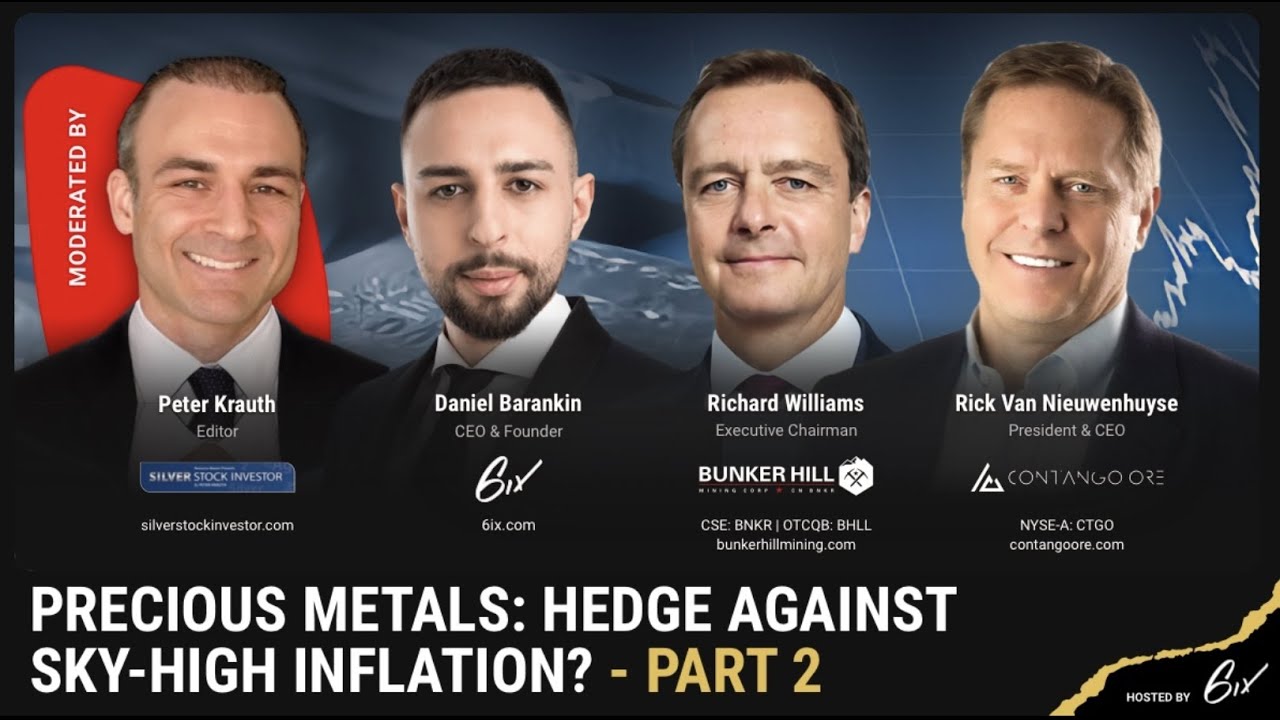
0:11 Hello everyone and welcome to today's investment webinar with Six.com. I'm Peter Prout. I will be your host. Today's topic is precious metals and are they a hedge against sky-high inflation? We have 3 great panelists with us today. Daniel Barankin, who is CEO and founder of Six.com, Vic Ren-Nuñez, who is president and CEO of Contango Ore, and Richard Williams, executive chairman of Bunker Hill Mining. So I will start off with my presentation, which is all about silver and gold as potential inflation hedges.
0:55 So let's start looking at inflation. We've been hearing a lot about it. The Fed just recently decided that it was no longer considered transitory. So what has been happening? Well, in the last 12 months, the US official inflation rate is up at 6.2%. That's the highest rate in 31 years. Used cars are up 26%. In a year, gas is up 50%. Utilities up 26%. And rents that are not even included in the Consumer Price Index are up over 10%. But official inflation statistics are not necessarily what everybody else agrees on. There are some alternative research groups that produce inflation statistics.
1:44 Shadow Stats is one example. And they use the Bureau of Labour Statistics original model that goes back to 1980 in terms of how the US calculated inflation. And based on that model, inflation is actually up at 14% in the US. And so if we look at the chart on this slide, this shows us how inflation can erode your wealth and this chart shows the effect of inflation at 5.4% over 10 years. So if you start with $100 today and inflation runs at 5.4% you'll actually have only $59 of buying power with your $100 in 2031. So that certainly is quite damaging to savings.
2:34 What's happening with bonds? Well negative real yields are certainly hurting returns on bonds. Real yields are interest rates minus inflation. This chart shows us the 10% US Treasury minus inflation. Although the Treasury is paying 1.6%, if you subtract 6.2% inflation, the current rate, You're actually losing 4.6% every year on a 10-year US Treasury.
3:09 So how does gold react to inflation? It certainly is known and proven to be a great inflation hedge over not just centuries but even millennia. An interesting way and frankly probably one of the best ways to see what gold is likely to do is to follow what we call real rates. Real interest rates are the basic interest rate minus inflation. And when real rates are either falling or negative, you tend to have a positive environment for gold. And so going back to late 2018, real rates started to fall and gold started to pick up. In fact, it was trading around $1,200. It's been rising since and then with the last sort of year and few months gold has been tried trading sideways and a lot of people are now getting bored with gold thinking that it's not doing anything, it's not producing anything.
4:08 But if you look at what it's done in the last say 3 years or so, it's actually up about 50% which is fantastic for a shiny rock or a barbarous relic. If you look at what silver does in this same environment, well the correlation is very close to how gold reacts to real rates. So silver behaves very much in the same way. If you look at how silver has preserved wealth over years, well if you just have to look at that look back at to the year that the Fed was established 1913, silver was priced at 60 cents an ounce. Today we're at about an average of about $25 an ounce. So if you compound that return, that's about 3.88% annually compounded over 108 years. So you could certainly argue that silver does a pretty good job, despite its volatility of preserving wealth against inflation.
5:06 So let's look at inflation versus different types of asset classes. Well Vanguard did a study not long ago that showed A 1% increase in inflation was actually outpaced by commodities, which in that same environment of a 1% increase in inflation actually gained about 7-9%. This chart shows us different kinds of inflation scenarios. The first we have here is the falling inflation rate scenario. On the left, the middle scenario is stable inflation rates. And the right-hand scenario is rising inflation rates, which is where we are right now. Well, as the chart shows in that red circle, shares, stocks tend to be down in this kind of environment. They tend to lose on average 10% a year. Bonds tend to lose 4% a year, but mining shares tend to be up over 13%, precious metals gain 24% and commodities tend to gain 26%.
6:10 So as we can see, gold, silver and commodities tend to certainly be great hedges in rising inflation environments. Let's do a quick look at an outlook on interest rates and inflation. The Fed has promised they would keep rates low. They said that They would only raise them in 2023 with high inflation recently and then finally caving on the transitory misnomer. They're starting to talk about perhaps doing a raise late 2022, but I'm not sure that that's going to stick and for how long. 2021 is expected to have a budget deficit in the US of a $3 trillion level.
6:58 Global debt is at a record $300 trillion. So I argue that the Fed has no room to raise rates meaningfully. If they did start raising rates next year it would be very slowly. They would telegraph that very much in advance. It would probably take them as much as 6-9 months to get anywhere from the current level of 0% to maybe 1% or 1.5%. Even that could crush the markets, the markets could have a fit and very likely the Fed would cave back off and I think at that point all bets would be off for gold and silver, which would likely take off when they would see that the Fed has no real ability to effectively and conclusively raise rates.
7:45 There is something perhaps to mention on yield curve control. The Fed controls short-term interest rates. The market tends to control long-term interest rates. But the Fed doesn't like to see long-term interest rates rise too much either. Something they haven't used often, but they could, is yield curve control. That's where they would buy or sell. I believe mostly buy rates, buy long term bonds if they saw rates start to rise meaningfully and keep those capped as well. When we look at inflation, I think that we're heading towards a similar scenario to what we had in the 1970s called stagflation. That's where you have persistently high inflation, an anemic economy that tends to be struggling, little progress on the economic side.
8:32 And we have a Fed that's incapable or unwilling to properly forecast they're not really credible and it's hard to deny the inflation scenario right now we see that all around us things like shrink inflation where you have products that perhaps keep the same price but the packaging gets smaller so what you're effectively getting is less of the same thing for the same cost. We know that over the past year container shipping prices have doubled. There are ongoing supply chain disruptions. We see multiple countries around the world invoking protectionism where they want to rely on domestic supplies. We see price hikes across the board and these are likely to remain permanent. I don't think anybody expects the price hikes that we've seen to be scaled back. And 1 great example of this is Dollar Tree, a large chain in the US that sells everything or many things for a dollar. They recently upped their basic price from a dollar to a dollar 25 so that was a 25% gain in price that was quite the inflation boost overnight of 25% and again I certainly don't see someone like Dollar Tree backing down from $1.25 to $1.00 any time soon.
9:56 So with that, that concludes my short presentation. We're going to now give the panelists a chance to give their thoughts on inflation. And we will start with Daniel Berankin. Daniel, the floor is yours. What I'd love to do in my presentation is show some quick visualizations of equities, commodities and indicators against the M3 money supply looking from 1971 to 2021.
10:26 And so first and foremost, I believe that inflation is primarily a function of monetary policy and that the clearest representation of this is by looking at the M3 money supply. By way of a quick non-technical definition, the M3 money supply is the total sum of everyone's money. It includes cash, savings accounts, long-term saving accounts, institutional money market funds, short-term repurchase agreements, and larger liquid assets. And the argument that I'd make and that many others would make is that as the M3 money supply increases, the price of assets, goods and services also increases. And here what you can see is that from 1971, there's been a significant increase in the money supply. And in particular, over the last few years, that increase has ramped up quite exponentially.
11:11 And so today there are more than $22 trillion in money supply and money always finds a home. And so what I'd be looking at specifically in this presentation, where has money currently found its home and where might it find its home in the future? And so in this chart over here, what we're looking at is the S&P 500 Priced relative to the M3 money supply. And what's really clear to see here in this chart is that the relationship is remarkably correlated. And I would argue remarkably causal. Or as there has been increase in the money supply, what's happened is that it's found its home in the S&P 500. And if we look, for instance, at Tesla, we can see that relationship is even stronger. Where here you can see that relationship almost 1 for 1. And so increasingly what we're seeing is that today, a lot of the expansion in the monetary system as measured by the M3 money supply, is finding its home in equities, and in particular in tech equities, S&P 500 and so forth.
12:08 What's interesting then, is what's happening to the US cost of living. And so here in this indicator, what we're looking at is, what is the US cost of living relative to the M3 money supply. And there are 2 particular things that I find remarkably fascinating about this chart. The first thing is that relative to the increase in the M3 money supply, the cost of living has actually gone down. What that means is that if you're able to keep pace with the increase in the S&P 500 by owning it or by investing in Tesla over the last 3 years, your purchasing power has actually increased. On the other side, however, what you can see is that when you account for the US cost of living on a non-adjusted basis, or simply what is the cost to pay for various goods, services, assets, and so forth, there's been a significant increase in the cost of living. What that means is that wealth inequality is becoming much more significant.
13:01 It means that individuals who are able to ride the expansion and the money supply wave over the last 3 years have done very, very well, while many other people have not done so well. And what this means that there is a great chasm. The question becomes, what implications does it actually have? What does it mean when most people are not invested in the S&P 500 over the past 3 years? What does it mean when most people have not benefited from the expansion of the money supply?
13:27 Specifically, I'd argue it means that the purchasing power of the average individual has decreased. And as a result, they're able to buy fewer things relative to what they would like to buy. And what we can see here in this chart, which looks specifically at Thanksgiving, Black Friday and Cyber Monday sales from 2018 to 2021, is that we've had the first year where we've seen underperformance. And this is very, very, very surprising. When you look at the general rate of increase and the creation of new products, new goods, new services, people don't want things less now than they did a year ago. What's changed is that their ability to afford those things and purchase those things has decreased. And as a result of their loss in purchasing power, what we're seeing is that people are spending less money.
14:12 And this is already beginning to happen, most recently here documented in the 2021 Thanksgiving, Black Friday and Cyber Monday period, and I suspect that we're going to continue to see this in the years to come. Where this becomes very interesting is, well, what does that actually mean for the general equities market? When we look at the last 3 years and the ability, for instance, of Tesla and S&P 500 and many other such equities to go and absorb the capital that's come into come into creation. What happens when individuals are less able to go and afford the goods and services that those companies produce? Very likely they spend less money. As they spend less money, the consequence of them spending less money is that those companies may in fact be at a greater likelihood or a position to miss earnings or to not grow as fast.
15:04 What's interesting in particular about this chart over here with gold is that relative to the increase in the M3 money supply, the price of gold has actually decreased. Similarly, what we can see is that here in the, if we look at the price of silver, this exact same pattern exists as well, where relative to the increase of the M3 money supply, the silver price has declined as well. And similarly, if we look at copper, even factoring in its recent boom over the last little while relative to the increase in the M3 money supply, it's also on a price adjusted basis has decreased. And so the argument that I present and the way that I would look at this is that in an environment where people are able to purchase less things, in an environment where on average people haven't kept pace with the increase of the empty money supply. And so on average, their cost of living has increased. What effect might that have on their ability to purchase the goods and products and services that are currently being produced largely in the S&P 500?
16:00 And therefore, as that as that change of consumer behavior trickles into the earnings and outcomes that these companies have, what's going to happen to the valuations of those companies and money, as it always does, must find a home where might it find its home? I would say to look very closely at the metals and mining sector, because what I see is that the commodities, the gold, the silver,
16:24 copper, and so many, many others, right now are underrepresented in the sense of their current price relative to the M3 money supply, and that in the future, they may be seen
16:38 far more interestingly as safe, even assets, especially where, as in a context of stagflation, as Peter mentioned earlier, we might see poor performance on the part of existing companies in the S&P 500 and so forth. Thank you. Thank you for that, Daniel. Next up, Rick Van Nuenhees from Contango War. What are some of your thoughts? Yeah, so I think, you know, money supply is certainly, I think, the biggest Yes, so I think money supply is certainly the biggest driver, as both of you have outlined. I think there's another monster in the woodpile, and that's this global push to move to a non-carbon future.
17:27 And we're seeing at all levels of government around the world, this massive push to change our energy supply from carbon-based to non-carbon-based. So, and as well, the transportation, all transportation being pushed away from using fuels to electric. That's a huge transition. It's going to take many, many, many years, and obviously the driver is climate change and our desire to not see the planet warm continue to warm. There are all sorts of accords and objectives that governments have adopted. I don't know that they're going to necessarily meet them all in the timeframe that they say they're going to, but they're making changes to laws, changes to taxes, changes to just about everything that affects all of our lives to make this transition happen over the next 20, 30, 40, 50 years, however long it takes.
18:39 It's really good for metals. I think that's consistent with what Dan was saying, that We're going to see a push to use all these various metals. Copper is probably at the forefront. I think Gold and Silver. Silver is obviously used very much for photovoltaic screen panels and what have you. So gold's probably the one that has the least amount of specific use as a metal but I think for other reasons gold is a currency and as we print more money, I think we'll see gold do what gold usually does, which is basically the ultimate hedge against inflation.
19:30 If you look at the timing of this, it was interesting. I think Peter, you mentioned stagflation and I think Dan, you did as well. The last time we really saw this was in the 70s.
19:43 And That period of time was really focused on the reasons going on for inflation and stagflation that happened then was really driven by the oil crisis, where the Middle East decided they weren't going to give us as much oil as we were
20:02 wanting to use. We ended up with high oil prices and energy prices that affect transportation clearly. So all of those things pushed. We had double digit inflation for a long period of time basically throughout from the mid 70s through the early 80s. I think we're going into that same kind of scenario. Now this is completely self-imposed. It's not the middle east saying we're not going to give you the oil. We're saying to ourselves we're not going to use the oil. We're going to transition to alternative energy, alternative transportation or electric vehicles. It doesn't do any good to run a Tesla if it's fired by coal. You haven't helped the planet one bit.
20:49 Both of these transitions have to happen. They're being mandated to happen, so they're going to happen. I don't think they're going to happen as quickly as governments are agreeing to when they go to Scotland or when they go to Paris. We're going to use a lot of metals to accomplish this because there's no other way to make electricity and generate power for Tesla's and other electric vehicles, or where we go hydrogen. All these things are going to take a huge amount of metal. So I think it's great for the metals business. I think to accomplish this is going to take a lot of money and there's no better way than just printing it, which is what we've gotten used to doing, what we've gotten used to our governments to do.
21:40 That's what we've seen ever since I can remember. We keep debt financing things and the solution to debt is more debt apparently. I don't know when this train ends, but it probably ends at some point in time, or you just hit the reset button. It's all good for metals and I think it's particularly good for Gold and Silver. Silver has always been a little more of an industrial metal than Gold. But I think this is a big driver and it's completely self-imposed. It's not the Middle East saying we're not going to deliver you the oil. There's always that, how much oil they're going to produce, the OPEC plus, how much they're going to produce. But we all know you're going to need a lot of oil as well because the population continues to grow.
22:27 So we can't stop that either. So the more countries that advance their GDP and advance their people and get they're able to buy more things and as
22:46 long as that's going to be mandated to be electrically driven, i.e. A non-carbon energy future and a non-carbon transportation future. That's gonna require huge amounts of money and huge amounts of metal. So I think all of us are in a good position here. Thank you.
23:06 Thanks for that, Rick. Appreciate your comments. Next up, Richard, what are your thoughts on this?
23:17 Great, thank you very much indeed. Peter, firstly, and Daniel, in particular, giving such a nice broad look at where the markets are going and with respect to inflation. One of the most encouraging things 1 listens to is that both gold and silver tend to do well in an inflationary environment. And I was particularly persuaded by the view that mining stocks are undervalued right now relative to what inflation could could could bring them towards. To what inflation could bring them towards. And where I sit right now in the Silver Valley in Idaho on a development project, fully permitted and good to go, is when Capitalize will be providing our investors exposure not just to silver, but also to zinc and lead. It's a polymetallic asset.
24:10 But its history is relatively instructive, given what you've just been talking about is what happened in the 1970s. Because this mine was bought with a company that owned this mine and was his primary asset was bought in 1968 in a hostile takeover by Gulf Resources, valued at that point at 1 billion US dollars in 1968. It had a great future ahead of it with respect to meeting demand for essential metals as they were judged at that time. But from 1969 to 1980, a series of new regulations, environment primarily, clean air, clean water, Environmental Protection Act, and then finally, the Superfund Act, raised the costs of operations here in terms of the fact they need to recapitalize to ensure they could meet those new environmental regulations, the point at which they had to stop what they were doing here in 1980.
25:11 And it essentially remained fallow ever since. No doubt about the metal in the ground, no doubt about the fact that you can make money from that metal, because it's a relatively shallow, relatively high grade, thereby high margin operation, if you can get it moving. But with respect to our discussion at the moment, I want to bring up a couple of things. Firstly, to double down on what Rick said with respect to the increased demand for certain metals created by the wish to refurbish the world's power system, if you call it that. In particular, coming out of the COP26 conference in Glasgow,
25:57 is an increase in the demand for base metals in particular, that is well beyond that which the current supply can meet. So you end up in a supply constrained environment that is clearly going to be inflationary for those metals over time, which is good for miners, should they be able to produce and then feed that into the market.
26:22 Connected to that, of course, is silver, which you quite rightly pointed out is over time useful as a hedge against inflation, and it tracks gold. But Rick also mentioned a point that actually it's an industrial metal to a degree, 54, 55% of silver's use goes into electronics or into power or into the type of systems that the green economy is looking for. So you end up with this split characteristic for silver, whereby for some it's a good hedge against inflation, whereas for others it's an exceedingly useful industrial metal that will over time, because of its reflective photovoltaic and its conductive capabilities, be very useful for all that the world needs with irrespective of climate change targets, but with respect to the move towards increasing use of electric versus fossil fuel power, however that is driven.
27:18 But also with silver and those who have, who own silver equities is typically silver around about 70% of it comes from mines where silver is only but one of the metals produced such as bunker. So if you are an investor in a polymetallic mine or even a diversified portfolio where you have exposure to silver, if you also have exposure to the zinc and the lead and in some cases copper and other metals that come with it, you get the double whammy of getting exposure to inflationary commodity prices driven by the energy transition and also commodity prices driven by the hedge against inflation. But as we see, and Rick knows it Well, as we see when you end up in these inflationary environments, in terms of commodity price inflation, and Daniel touched on it, you end up with an inflationary environment for input prices as well.
28:11 And that is compounded by the need to deliver and we're delighted by this, of course, as a world, higher standards of what's generally called ESG behavior. So not only are you factoring into your micro economic, your input cost business calculations, the positive news associated with future silver, lead and zinc prices, you're also having to factor in the likely cost because of constrained supply of power, labor, reagents, etc. Into your models. And then layer on top of that the need to ensure where you can and where it's sustainable, that you're at the front end of what ESG, stroke impact, stroke green investors are expecting.
28:58 And so the complexity today versus the complexity, say, when you were talking about the 1970s,
29:05 is, I believe, at a different level. But what we are seeing as a mining group, and Bunker Hill is but one example of this, is a lot of interest in whether we can produce metal, maintain costs at a level at which our margins increase as commodity prices go up and sustain that over the longest period of time. Which again is why we chose Bunker Hill because of 100 years worth of sunk capital, we actually able to start mining with that which was left behind at a much higher margin than would have been the case if we'd had to capitalize the whole thing at the start.
29:45 So I'd say trying to add to your discussion specifically on inflation, I concur with everybody's point here that we're an inflationary environment. We are also potentially as a result of the demand for green metals, starting to enter a new super cycle with respect to base metals that a particular metal such as silver can benefit from, not just as an inflation hedge, but also as an industrial metal.
30:11 And so, for a company like ours that will be producing a metal mix starting off at say 70% zinc lead and 30% silver. We will in the short term be benefiting almost exclusively from the base metal inflation, but over time, as our metal mix switches to 50-50, we believe that we'll be getting exposure to both the anti-inflation incentive, as well as the green energy incentive going forward. And therefore, I think we represent something of an interesting example, micro example for other companies and for investors looking in at how they can get maximum exposure to this inflationary environment. Peter. Thanks for that, Rich. I Certainly appreciate all those thoughts.
31:03 And let's now go to each panelist one by one. So let's start with Daniel. Thank you, Peter. Everything that we do at 6 is born out of the mission that people should be part of building the future rather than feeling like it's something that happens to them. And make no mistake, in the inflationary environment that we're in today already, the world has already happened to many, many people, where their cost of living has risen, where their ability to go and use the capital they have and purchase the goods and
31:34 services that they had been accustomed to, to maintain their quality of life. For many folks that are not involved in the stock market or not involved in investing, the world is passing them by and leading to negative outcomes. And so the idea for 6 is to usher a world where anyone is able to unlock their own social mobility. The challenge is how on earth do you do that? How on earth do you, in a context
31:58 as complicated, for instance, as monetary policy, in a world where there are tens of thousands of public companies, how do you actively protect yourself, your family, and pursue your own social economic mobility?
32:12 And so the answer that we've come to is that, well, 6 is born out of a hypothesis, this idea that the way people invest has changed for good, and many people have already transitioned to this. Rather than waiting on advice from financial advisors or for banks, where oftentimes this advice is a lagging indicator. Instead, people are conducting their own due diligence. They're taking their investing process into their own hands. They're talking to peers. They're going to events like this, and they're looking at the stats, the data, and forming their own conclusions. And this is a shift where the more people go and join on this process, a few magical things happen. The first is that by being part of these conversations, you in a very literal sense, learn about the world from people that are building it. And so the first aspect is deeply educational.
32:59 The second aspect is that by being involved in this process, you make friends and mentors and discover people that you can exchange ideas. And rather than just having a one-sided version of whatever the argument may be, through a panel such as this one, for instance, you
33:13 can have a conversation and see whether it's a common view or an opposing view or a nuances to a view, you can see various different aspects. And to the extent that you do that, the ability to make better decisions improves and increases. And so to that end, what's really interesting is that a lot of the world has already begun transitioning to this shift. We see, for instance, that there are already 25 million active brokerage accounts here in the United States. We see already that websites, that the top 10 financial websites, for instance, receive 300 million views combined monthly traffic. Platforms like Real Vision, for instance, are doing phenomenally well and rightfully so because they bring together really great conversationalists and individuals that ordinary investors otherwise might not have access to. And so to a great extent, a part of the world is already beginning to shift into this new mode of investing.
34:04 The problem, however, is that most of the world has not yet made this shift yet. And to that end, most of the world is still excluded from financial markets and from the company building process. Where 6 comes into play is the idea of what if we take that step 1 step further? What if rather than simply talking with peers and others, you could talk directly to the executives and CEOs and the people that are actually building these companies? What if you could have direct first hand conversations, where you can be part of something, ask questions and get a live answer directly from the individuals that are on the ground making these choices and building the projects that they're building. And So to that end, what we've created here at 6 is the ability for companies to deliver great investor experiences by hosting events such as these ones, along with the ability for investors to go and attend events such as this one, where they can go and participate in the conversation and be part of the dialogue.
35:03 And so to that end, what 6 provides is an ability for individuals in a self-directed way to go and be part of this process, to go and learn about different companies, and to that end, to go and make better financial decisions as they conduct their own due diligence. There are really 3 main aspects of what 6 provides to companies and to investors. The first aspect is access. Companies are able to access investors and share their stories. This is significant because when you change the economic calculus of being able to, as a CEO, talk to hundreds or thousands or tens of thousands of investors simultaneously, it creates an incentive on the part of companies to go and open their doors and be part and to create that dialogue. Similarly, on the part of investors, we're able to access the CEOs and executives directly of companies. It creates an ability for them for the first time ever to transcend geographical or socioeconomic barriers and simply from the comfort of their electronic device, of a desktop or computer or mobile phone, be part of that conversation.
36:05 The second aspect is coverage, where through this entire process, investors are able to discover what companies are up to and some of the companies are able to share that information. And most importantly, communities can be facilitated and built as you have direct correspondence between investors and between companies. All of that can happen here and does actively happen here on 6. It's a tool that's entirely free for investors and for companies, it's something that allows for them to connect with investors as you provide an all-in-one software suite that makes this process remarkably easy. At GPH, we've had now more than 250 companies represented here on Six.com, whether it's through a panel or a summit or through some other channel. And similarly, we've had more than 100,000 investors use 6 as a platform to connect. And so to that end, as investors, and as you're thinking around, how do you combat inflation?
36:56 How do you position yourself to go and unlock your own socioeconomic opportunities? One of the best ways is to use Six.com as a discovery tool to see what companies are doing in the space and ultimately to attend events like this one where you can have a live interactive conversation. Thank you. Over to you, Peter. Thank you for that, Daniel. Before we go to the next step, I just wanted to invite viewers to submit questions in the chat area of the site, and we'll try to address what we can later on. So next up is Rick Van Uwenhuis of Contango Org. Rick, please tell us about Contango. Certainly, Peter. Thanks very much. Obviously, making some forward-looking statements and some cautionary language around resources and gap measurements.
37:51 Contego is developing a number of projects in Alaska. Foremost is our Manchurian project in partnership with Kinross and the Alaskan Native Tribe at Tetlin, and our most recent acquisition at Lucky Shot. I'll spend our time just focused on those 2 assets. We recently got uplisted to the New York Stock Exchange, symbol CTGO. That started just a few weeks ago, so we're very pleased to be listed on the New York. We're a unique company in that we don't have a lot of shares outstanding for a junior explorer in development stage exploration company. 6.7 million shares, We've got $25 million in cash. We have a recent investment by the Alaska Future Fund, which is a joint fund managed by the Barings Group, which is a $325 billion fund, and the Alaska Permanent Fund, which is an $83 billion fund. So we have a strong backing from institutional investors, at least a few institutional investors, Gabelli and Sprott are also shareholders.
39:02 I'll focus on Manchot, 1.3 million ounce Gold deposit that Contango discovered, average grade 4g, open pit right next to the Alaska Highway on land owned by the Tetlin tribe. It's private land owned by one of the Alaska Native tribes. We recently did a business partnership with Ken Ross. They acquired their 70% interest for $93 million, so they have real skin in the game. The reason we did the partnership with Ken Ross is because they have an underutilized mill here at Fort Knox just outside of Fairbanks. What we can do is mine the ore and put it in trucks, highway trucks, and drive it up the up the road. This lowers our overall capital costs significantly because we're not building a mill, we're not building a tailings facility. It lowers our environmental footprint again because we're not building a tailings facility and overall lowers our overall execution risk which is most important for a junior development company.
40:06 Here's the deposit. It sits on top of a hill on private land owned by the Tetland tribe. This year we spent 19 million dollars advancing permitting and feasibility study. We'll have that completed next summer when we'll start construction in the summer of 2022. Again, we're not building a lot, so we'll get a lot accomplished in the long summer months of Alaska. This is guidance put out by Ken Ross. The mine will produce about 220,000oz of gold a year. Our 30% share will be 66,000oz. We're looking at using an elevated cutoff grade and we'll produce over 1 million ounces at with an average grade of 6 grams per ton capital costs. And I'll use the high end of the, of the range here because we've been talking about inflation, so I'm going to expect that we'll be at the high end of the range. I'll call it $130M and our all-in sustaining costs are estimated at $750 per ounce. When you look at that, Our share of production is 66,000oz at roughly a $1,000 margin at today's Gold price.
41:23 We're generating over $10 of free cash flow. If you look at leverage, we're thinking we're going to see higher Gold prices. Obviously, for every $100 increase in the Gold price, you're adding over $1 per share of leverage. A very well-leveraged story, because we've only got a few shares outstanding. So while Ken Ross is advancing this Armancio project to a production decision in 2024, we'll actually be ramping up at the end of 2023 to full production in 2024. We'll be focused on our 100% owned Lucky Shop project, which is located right next to infrastructure, about an hour and a half outside of Anchorage, Alaska, right on the road system.
42:16 Historically produced 250,000 ounces at 1.5 ounces per ton, 40 grams per ton. Very high grade underground mine, narrow vein mining. They mine free gold here. There's a historic resource on an adjacent property called Coleman, where the previous company outlined 120,000oz at 18g. A very easy ore to process. It's basically quartz and free Gold that can be recovered using just gravity methods. Our plan is to go in and refurbish the underground at it here at the lucky, sorry at the insert tunnel underneath the lucky shop historically mined area. This is a view in cross-section. We'll extend the adit another 700-800 feet, get into the foot wall and drill the heck out of the down dip portion of the vein, cross over the vein, bulk sample the vein and get into the hang wall and drill the vein out from the hang wall as well. You can see this is where the 250,000 ounces of Gold came from in the red up here and then where the green and the blue add-ins go in and cross the vein. You can see we're outlining here about 500,000 ounces as our objective over the next 2 years.
43:38 Great cash flow generation ability at Manchot. Huge leverage to Gold. I think we'll respect that $1,000 margin. And obviously if we can increase the margin, gold price goes up relative to our costs. Again, we'll be generating a dollar per share of additional cashflow for every $100 increase in the Gold price. Meanwhile, we think Lucky Shot has a good opportunity to double our production at Contango. We certainly have been working in Alaska a long time and we know how to operate in Alaska. So I'll turn it back over to you, Peter. Thanks for that great overview, Rick. I appreciate that.
44:25 So next up, Richard Williams, if you could give us your take and overview of Bunker Hill. At very high level deliberately so that we focus much during my part of the presentation on that inflationary environment and why we think Bunker is going to help. First thing I say on this is that the company is established, really focused on regeneration. We, we observed I gave you that story before. And certainly when in some instances, not exclusively when I was working at Barrick, the amount of metal that's sitting on private land in the United States that ended up being discarded courtesy of those environmental regulations and others that came in the 1970s.
45:17 And along with that problem, you end up with communities that are shattered, as always is the case, when mines shut unexpectedly. And we, a group of ex-barrack people, came in and looked around North America for an opportunity to find a long life, high margin asset in a safe jurisdiction that we could continue to add resources and then reserves to over, as I said, a very long time to become a foundational asset of a new company. So this asset, blessed with intact permits, 100 years of sunk capital, exciting resources, existing infrastructure, superb geotechnical conditions, shallow aspect, and an excellent jurisdiction, supported by cheap power and short and secure supply chains, provided us exactly what we were looking for.
46:15 And our restart plan requires less than $50 million of capital to secure an after-tax return at very conservative pre-inflation metal prices of greater than 35%. And we believe with that, although there will be input price inflation, given the particular circumstances of where we are, we can keep that low. So all of that, therefore, in the investing circumstance that we've been talking about, provides our stakeholders and shareholders with very robust exposure to silver, zinc and lead at an exciting inflationary moment for these commodities and mining stock. And as I said, 1 that can easily sustain itself in tighter or deflationary markets should they return.
47:03 Just have a look at you've made some great points on silver, I don't want to double down too much, but I will just emphasize this point. You know, it's primarily produced from polymetallic mines. And as you'll also notice, it's not currently recycled to a significant degree, certainly not relative to other metals such as lead. And the demand, as you can see here, this is 2021 estimate, is driven by both those who seek to hold silver as an inflation hedge and those who need silver to drive industrial uses. And just shown here at the moment is the projected silver automotive demand as just 1 component of that green energy demand and why we believe it's so useful.
47:54 I'll also then move across, as is often the need and as always the need in a polymetallic asset, where we split between precious and base, to just look at the 2 other metals and highlight the fact as to why it is generally believed we're at the start of a green metal super cycle and why lead and zinc can benefit from this. As you can see, lead, which is generally referred to as the forgotten battery metal, whose use, if you look at the slide at the top left, is clearly dominated by its battery utility. And its sustainable supply is greatly assisted by its recyclable nature, will continue to play an important part in the green power revolution, even with considerable substitution by lithium-ion technology.
48:41 Because the world simply needs more battery power than could be supplied from 1 form of battery technology, be it lithium ion alone, and lead will continue to play its part. It was interesting in the side meetings at COP26, how the Indian government is looking at the role that traditional lead acid batteries will play in the Indian two-wheeled electric vehicle market, for instance. Imagine if all of those two-wheeled tuk-tuk motorbikes are converted from fossil fuel to electric power and the cheapest form of battery that works for them is lead acid and what that would do potentially for an injection of demand. Zinc on the other side as you can see here and this chart shows you how demand, forgive me, supply needs to increase to meet the scenarios for reducing global carbon emissions by either 1.5 or 2.5 degrees between now and 2050 needs to go up. Zinc is so important in galvanizing steel but as you can see it also plays a direct role in the green power revolution.
49:54 Recently listed as a strategic metal by the US government, its supply along with other critical base metals shown here, copper, aluminium and nickel, is now required to grow by a huge amount if it's going to meet those pathway targets. And again, just as an aside, but a relevant one here in terms of green metal demand, You know, one of the other discussions at COP26 is the benefits associated with increasing the amount of zinc used in galvanizing steel to global carbon emissions. Steel lasts longer, needs to be replaced less frequently, And this reduces the overall carbon footprint of long term infrastructure. So given that little highlight, which I hope has indicated that while we look and reinforce the points that were made earlier, while we look at silver, it, for instance, being a useful hedge against inflation, it bridges both that need and the emerging green energy need alongside the other metals that it comes with in our case to be very well positioned should you have the right mine to benefit from this inflationary environment.
51:11 What you see here is a snapshot and it's slightly dated of the conclusions of a PEA that we've conducted this year. And we're moving now to advance this to beyond PFS status, along with our financial partners, to bring this mine into production over the next 2 years. But I want to also outline to you all how important it is, and Rick mentioned this, to construct where you can is to be mindful, as all miners are in these boom circumstances, of trying to ensure 2 things. 1, your input costs are under control. And secondly, your sustainability costs, which are new in terms of their severity, are also kept under control.
51:58 And then the final thing that you're seeking to do is ensure that by your mining and your activity, you're maximizing the positive social impact, in our case, particularly to communities that were devastated in the 1980s, by the shutdown of the mine, so that we can attract and I don't know where it was, Daniel touched on it, the type of investors into the mining industry that haven't traditionally been here. All this money that suddenly gone into people's pockets courtesy of the surge, a lot of it sits with those who've never invested in mining before and aren't inclined to do so because of its past reputation as a dirty industry that doesn't respect the environment. And what we should see, what we would hope to see in the whole industry, and bunker is 1 tiny little part of that of course, is the ability of the industry to attract those type of investors into mining by operating at the front edge of the best practice curve. And bunker is doing what other mining companies are doing and seeking to catch that piece.
53:03 And so we look forward to providing you with more detail on how we'll be achieving all of this as we advance our technical work over the next few months. That's it for Bunko. Well, thank you very much for that, Richard. Great overview. And now we'll move on to the questions portion, Q&A. Again, if anyone has questions, they could submit them. Let's start with what we have available. The first one is apparently for you, Daniel, or me. I'll give you a first dibs at it. Can you explain why the criteria used to define the inflation rate have changed over time? My view is that it's largely politically motivated.
53:50 I think that a large part of how money currently works today is that governments for the first time are able to run infinite budgets, they're able to create infinite deficits, and from that they're able to go and provide more of the services that their constituents are demanding, whether it's health care, whether it's stabilization of the economy. And what's interesting is that the way in my view and in the view of many, many others, that money typically flows into the economy is that when we first manufacture this money, that money is viewed on the same level as all the money that's already in circulation because no 1 but the first people who receive it have it. And then as that money gets spent and it trickles through the economy, you end up seeing inflation and looking at the last 3 years, for instance, back when we had a significant dip, money was added into the economy. It was viewed as the same value as the money that had already been there. And it's taken about 3 years before that money, which was printed and added into the economy, to really see the beginning of this inflation.
54:48 The argument I'd make is, if it took us 3 years to see the start of that money, and there'd been all this additional money that's been printed since, when will we see the ramifications of that follow-on capital that's been added when we're talking about trillions and trillions of dollars, including this most recent one, that's almost 2 trillion dollars. And so to answer your question directly, my view is it's entirely politically motivated is to the extent that governments are able to say nothing to see here. There's no problem. They're able to go and extend the legitimacy of the capital that's coming into circulation, allowing those that receive the capital earlier to have greater purchasing power than they otherwise would if they were honest and upfront about it from the beginning. I'll throw it over to you, Peter, for any additional commentary. Okay, well, thanks. Well, let's jump to, I guess you could certainly say a related question.
55:36 Ellis Smith asks, with modern monetary theory taking hold in the US, we seem to be getting away with it so long as our currency remains the reserve currency of the world, what circumstances would break the dollar to create doubt as its reserve currency status? I'll take dibs at this. I would certainly agree that We appear to be, if not specifically in this kind of mode, we're certainly aiming and heading towards MMT very much so and very quickly. And what I would say is, you know, to what would break the dollar and create doubt? I actually referred to that a little bit earlier, talking about the yield curve control.
56:26 The Fed does not specifically control long-term rates. Right now, if long-term rates start to rise significantly, that means that the market is starting to require more for the risk of holding these bonds. And so it wouldn't surprise me to see the Fed stay behind the curve as they often do. And if so, if long term rates would rise quickly, I think that you run the risk of the market losing confidence in the dollar and realizing that these bonds are not paying sufficient return for the risk and people could start to move away from the dollar and start to look for hedges. So I think that could certainly have a lot to do with the kind of risks that would create doubt as to the dollar's reserve status.
57:21 And we've started to see it actually with other countries that are becoming a lot more vocal about not wanting to continue to support the dollar. The Chinese renminbi, the Russian ruble, they've they've clearly said that they're they want to sell off their treasuries and minimize their exposure to the dollar. And so and they tend to be turning towards each other or towards the euro. So if you look at the basket that makes up the US dollar index, the euro especially as the largest portion of it, a rising euro will certainly affect the value of the dollar and so I think all of these things will once again come into play. I see that we're getting very close here. We have a couple of minutes left. Let's see if we can bring up a very quick question.
58:11 Rick, do you see Do you see cryptocurrencies eroding or replacing gold's position as the go-to hedge against inflation? Well, I'm certainly no crypto expert, but I think there's room for both. I think they're different. I don't think people, I don't understand cryptos. I talk to a lot of folks and we try to have an in-depth conversation, but I don't think they really understand it either. They may have made a lot of money on them, that's great, but they're very different from Gold and Silver. I think for no other reason, they've only been around a few years, whereas Gold's been around for thousands. I think there's room for both. We seem to be able to print plenty of money for it to find all sorts of homes.
59:01 And I'm a firm believer that some of that money will get into the Gold business. And for us, because we're going to be generating a significant amount of cash flow per share, somewhere in the neighbourhood of US$10 per share, you just look at your typical ratios from cash flow, we should be trading at 10 times that. So I think we're, Contango offers a great opportunity for investors in the gold space. Thank you. So one last question. Maybe we can get this one in very quickly, Richard. What are the near term drivers and milestones for Bunker Hill in 2022? Thank you very much for that very generous question at the end here. The milestone that we're working on at the moment is we need to achieve a non-equity financing solution on the back of our PEA.
1:00:00 That you should watch for. That then allow, that will be underpinned by an agreement to settle outstanding water treatment charges due to the United States Environmental Protection Agency that we the new team inherited and that's all moving as it should. And that allows us to exercise our option and get moving here. And on the back of that, you'll see as Rick's outlined on his program, the series of standard engineering studies that you would expect to ensure that when we launch this, it's as robust as it can be. So you get a fully permitted development project and we're just completing our financing process at the moment. And thank you very much for the question, Peter, and it's a real, real pleasure to have listened to both you, Daniel and Rick, and learned quite a lot in the process. So thank you very much for having me. Well, thank you to you, Richard.
1:00:55 With that, I'd like to basically wrap things up. I wanted to mention if there are any outstanding questions, please don't worry, we're going to get them to the presenters and get responses for you. I'd like to thank Daniel, Rick and Richard, great panel members today. Thank 6 as well for hosting the event and we look forward to doing this again soon.