Automated transcript · Written by software from the replay's audio. It can mishear names and figures; the replay is the record.
23:07 action. So it's pretty exciting time from a geology and an exploration perspective. And that's just in the upper areas where we think the significant potential lies for silver exploration is actually at depth. And there's indications late in the mine's life that the silver grades were increasing at depth And that's quite exciting to us because the Bunker Hill mine at its deepest point is right around 4,000, 4,500 feet from surface, depending on where you are on the surface topography. But to put that into perspective, The Lucky Friday mine is now over 10,000 feet deep. The Galena mine, which is our nearest neighbor, is down over 7,000 feet deep. So we have an enormous down dip potential that in very perspective exploration ground that we believe holds significant silver potential.
24:10 Now, at the moment, that's pretty deep from where we're at now, and it's underwater. The water is at the 11 level, which is why we have the strategy that we have, which is a rapid restart, get into operation, become cashflow generative, and then fund that effort out of an operating cashflow as opposed to the traditional exploration equity raising. And I think in the context of the PEA that you'll see come out, I mean a lot of the potential that Sam's talking about will not be included in that PEA. So I guess what I'm trying to say is the PEA is shaping up quite nicely for us to restart based on what we have in resource and there's a massive amount of potential on top of that. So very much as you see the PEA come up, think of that as very much a floor on value for the mine.
25:06 So I'll just finish up and reiterate why Bunker Hill. We have an excellent foundation, we have a great leadership team in place here, We believe we have a world-class mineralized asset from a mineralization perspective. There's excellent silver potential. We think we have a strong vision, which is to create a new and different sustainable mining company based in the Silver Valley and our strategy is to get into cash flow as quickly as possible and then use that cash flow to realize the silver exploration potential. And really, Bunkery Hill has the opportunity, and it's quite unique, to be a long life asset, high margin, and sustainable through the full commodity cycle.
26:02 So at this point, I think we'll kind of move into some of the questions. I see that we have a few questions that have been asked. I guess the first one, what is the silver potential of the mine? I think the silver potential of the mine is excellent, and I guess I'd start that question by just referencing back the mine operated for almost 100 years and there was 165 million ounces of silver mined solely as a byproduct. So if you imagine that, there was never any exploration or geologic work done focused specifically on silver. So when we think of that and we come to understand the geology more fully, And we look at the historic drill holes. There's over 3,500 historic drill holes. And when you look through those and you look through it with the perspective that you're looking at, what is the silver potential of this asset?
27:01 I think it's absolutely fantastic. And I think that over time, our silver exploration is really going to demonstrate that. Dash, the next question. Yeah, great. I'm happy to ask the next question here. So we have a question from Jerry asking what price does silver need to trade at for your plan to go cash flow positive? So I think we'd love to directly answer that question, but certainly, and the reason I say that is because you've got to wait for the PEA for the exact amounts, but certainly with silver where it is today, I think it's a safe assumption that we're cash flow positive at the current price. Going back to the cost curve that we had up on the page there, in terms of targeting the bottom half of that, that would imply on a silver basis, kind of the mid-teens to low-teens in terms of where you'd need to be to be in that bottom half of the cost curve. Again, the work's ongoing, but given all the advantages of having the infrastructure on site and the development done for us, et cetera, it's shaping up pretty good so far.
28:20 Great. And I think I would just add to that is that it's important to keep in mind that there are significant amounts of lead and zinc. So Bunker Hill is a polymetallic deposit and even when we reach a point through exploration where the silver is the dominant revenue stream, there's going to be significant amounts of lead and zinc that are going to be continue to be produced. So the economic picture is actually 1 that, from my mind, it allows robustness through the commodity cycle, because you get a certain amount of counter-cyclical commodity movement typically between the more base metal and then the more precious side with silver. So it's about more, I guess, than just the silver price. Absolutely.
29:17 Right, Thank you. Richard is wondering when you plan a U.S. Stock market listing. So that's a great question. I'll start by saying we actually are technically listed on the U.S. Now now on the OTC market under symbol BHLL. We are in the process of upgrading that listing on the OTC markets and we hope to have some positive news on that over the next, you know, over the weeks to come. And that will allow us to greatly increase our liquidity. I mean, as our viewers probably well know, the liquidity and the investor interest in our story, particularly considering we are a US mine, is much greater in the US than in Canada. And so given that our primary listing is in Canada at the moment, certainly when we upgrade that listing, which should happen soon, we would expect a huge increase in liquidity and potential buying of the stock, which is going to be a major catalyst. Looking over the long term, one of the things that we're evaluating is moving our shares potentially to the New York Stock Exchange on the American.
30:24 And so that's where a lot of our silver peers and precious metals peers are trading today. That's where we think there will be continued interest from institutions, from retail investors, and that's certainly on our agenda as we look to grow this company. Great, thank you. Joseph is wondering what your estimated time frame for first production is. So we believe that post-financing, which we expect to happen later this year, that we can be in production between 18 and 24 months. So, you know, and I'll just add a little bit more insight to that. From a mining perspective, from an extraction of rock, you know, we could be in production, you know, much more quickly than that. But our plans require us to build a processing facility.
31:20 And that's really going to be the critical path, is the construction and commissioning of a processing facility. Right, of course. Marshall says, good work on water quality. Is there any chance you could go all electric? There absolutely is. I'm glad you asked that question because I believe personally, and it's our vision as a company, that the future of mining, much like what what Newmont is doing, is fully electric. I think that the technology is at that tipping point right now and that the future of mining, particularly underground mining, is going to be around a fully electric, fully digitally enabled mine. You know, we're certainly going into our technical studies with that in mind.
32:11 And that's definitely something that is, that we're keen to explore and move towards. Wonderful. Jason is asking, what long-term price of silver are you using to determine the potential of the mine? It's a good question. And actually, it's probably something we'll be discussing over the next couple of days here. So that's one of the many reasons I'm here on site is is the team doing the PEA will be working through a lot of the assumptions and the trade-off studies and I'll be definitely together with Sam here working closely with that team to understand how that's trending. In terms of the long-term price of silver, I mean, as viewers would often see in technical studies, we'll likely choose a price that's in line with the long-term consensus from brokers.
32:59 I believe that's sitting, I'm not saying this is the price we're going to use, but I believe that that's about $21 an ounce right now. So we'll use something reasonable around, you know, probably those levels in line with consensus. But certainly coming back to the cost curves, we believe, you know, in terms of breaking even or cashflow positive, certainly lower than that price is how we believe it will come up. Okay. Howard wants to know if you have any published resources. We do have a published resource at the moment. It's an inferred resource, and that published resource, as it stands right now, stands at 8.8 million tons, 11 million ounces of silver, 400 million pounds of lead, and 880 million pounds of zinc. Now we are going to in the very near future be publishing an update to that resource and you know you just have to stay tuned but what I can say is that we're pretty excited about it and it's moving in the right direction.
34:05 Great, okay. Martin is asking, are you seeking tetrahydrate ores that existed 5 levels and above and still do? We have seen, you know, some indications of tetrahedrite and, you know, that's certainly of interest. You know, As I'm sure you're aware, tetrahedrite oftentimes is characterized by exceptionally high grade. And there is, in the mining records that we've identified historical records and production records of Tetra Heat Drive being mined. But so yes, but I would say we'll take silver in whatever form we can find it. Okay.
34:50 Jonathan is asking, are there any regulatory hurdles to overcome prior to restarting the mine, specifically state and federal permitting? Yes. There is permitting that is going to be required. But what is interesting is that because we are on private ground and because we have patented mining claims and we're restarting an existing operation, that there's no overarching federal permitting structure and the permitting that we'll be doing is largely local and state permitting, which reduces the intensity and reduces the timeframe.
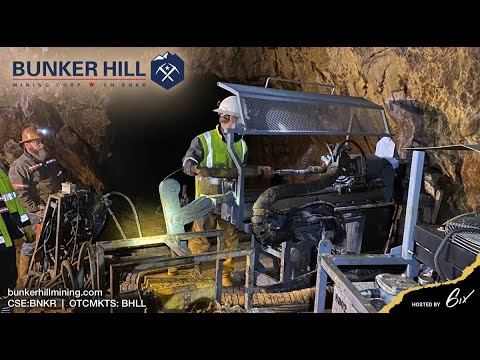
35:45 So unlike a lot of operations, particularly in the Western United States, where they're located on federal ground, permitting, the best I can say about this is we've looked at this closely, and the permitting is not the critical path for our production. The critical path is our ability to advance the project on a technical and operational front. Great, thank you. Earl is wondering how and where will you mill the ore and what is the estimated TPD at startup? So we will mill the ore, and this is actually quite interesting, and something that we believe is distinctive and sets us apart, is that we're going to mill the ore underground. So we're going to build a processing plant in the underground mine. The underground mine, you know, operated for over 100 years and it has an enormous amount of useful infrastructure that can be reused.
36:45 And that allows us to do a couple of things. That allows us to minimize the surface expression and our environmental disturbance. And it also, in addition to that, you know, we're going to be depositing all of the tails back into the underground and filling up the, you know, the historic mining workings with, you know, with those tails. Some of that will be for geotechnical reasons for the mining areas to support the mine as we move forward with operations. And some of it will be a be allow help us to address the environmental challenge of acid mine drainage as well. As far as tons per day, you know, the studies that we're looking at right now are between the, you know, the 1,000 and 1,500 ton a day range, but that ultimately will be a process of optimization.
37:38 You'll see some certainly some update and guidance on that in the PEA that we publish in early April, followed on by the pre-feasibility study, which we expect to come out later this year. Great, thank you. Manuel is asking, do you have an estimation of the restart capex? I'll take that one. So I think we touched on that briefly earlier. And so I wish I could be a little bit more specific for you, because the number will come up in the PDA and frankly, and it wouldn't be prudent, even if I didn't know it, because we are still working through it here. But all that being said, we're definitely looking at an eight-figure number, as in less than $100 million, not a nine-figure number. But we think that'll probably end up being some sort of a mid-eight-figure number. So whether that's $40 million to $60 million, $30 million to $70 million, hoping for the lower end of that, it'll be somewhere probably not too far away from that range.
38:42 To come back to what's going to comprise that capital, as Sam mentioned, it's going to be the underground processing plant, which is going to comprise the majority of that. And the reason why it's so low and modest on an overall basis is that besides the plant, I mean, we're not buying a fleet, we're not acquiring above ground tailings deposition. You know, The development work has largely been done for us to access the first phase. There's no dewatering to be done to get to the first stage. And you've got a lot of on-site infrastructure, including the office that we're sitting in right now. So long answer to your question, but we're looking at a relatively modest capital bill. Great, thank you. So what might the cost per ounce all-in sustaining cost be?
39:29 Yeah, again, We'll have to wait for the PEA in order to estimate that. But if you look at that zinc cost curve, for instance, and we can also look at it on a silver basis, but if you look at the zinc cost curve on the left-hand side of the page that we looked at earlier, if you were targeting to be in that bottom quartile, which we'd ideally like to be, no promises that we will, we're working through the numbers, is you would probably on threshold of that 75 to 80 cents per pound zinc on a co-product all in sustaining cost basis. So we'll see where the numbers come out, but that's where we would ideally aspire to be. All right. Steve is asking, are you going to do flotation and pressure filtration to produce a silver rich concentrate underground?
40:19 So, we're still again working on the PEA but yes the you know historically the mine you know used milling and flotation, differential flotation and created 2 concentrates. It let in a zinc concentrate through flotation. And that is essentially what we are going to be doing. And again, you know, that will be filtered to keep the moisture contents down for the saleable product. So the simple answer is yes, that's what we'll be doing. Perfect, thank you. Howard is asking, What have the deep grades been? So they, you know, they're, as you look deeper in the mine in some of the better silver veins that you see, when you look at the, you know, some of the individual intercepts and assays in there, it's not uncommon to see silver grades in excess of 15 to 20 ounces per ton. I think what's more important there is that the concept of silver zonation.
41:26 And what's important is typically is the ratio between lead and silver. And when that ratio begins to approach 1 to 1, it is an indicator that you could be reaching a change in deposition. So you go from a zone where silver or where lead is the primary depositional mineral to where silver becomes a depositional mineral. And that is often associated with a dramatic increase in silver grades. So when we see that, we think that at depth, we're approaching that horizon, which is incredibly exciting for us. Great. Lucas's question is, are there any available metallurgy to define concentrate quality and deleterious elements?
42:18 Any agreements in place with respect to concentrate sales? We have done, well we'd start, we have 100 years worth of historic data on the concentrate and the concentrate qualities that were produced at the mine. But in addition to that, we have engaged in and completed metallurgical testing in support of the PEA and ultimately the pre-feasibility study. So, yes, we have that information and that absolutely goes into the back part of the value chain and the marketing. We do not have any agreements in place and we think that that puts us in a very strong position. All right, thank you.
43:06 Toby is asking, is there any intention to proactively seek research coverage of the stock at some point? Dave? Absolutely, That's a great question. It's actually one of the things I'm most excited about coming on as CFO here. I mean, if you look at, as viewers will see, if they just take a quick look, we have 0 research coverage right now, which actually shocks me considering, you know, how exciting this story is. So That is one of the things that we are rapidly pursuing. We are speaking and it's been getting great traction so far, by the way. I actually am speaking with 1 research analyst either later today or tomorrow who's going to be publishing us on their watch list over the next couple of weeks. So, stay tuned for that. And there's a handful of other conversations as well from both US and Canadian brokers. So, I think coming in here, the story of Bunker Hill has not really been probably communicated to investors as much as it should have been over the years.
44:08 And I think that's largely been, you know, I think with the new management team that we have here, or that we brought in over the last year or so, that's been a huge piece that's been missing to kind of bring that out. So now that we're communicating all these catalysts and the management team, etc., we're getting a lot of interest from research analysts. And I'm pretty optimistic that certainly within the course of the next year or so, we're gonna start to see some research coverage from brokers here. So, and I think, there was an earlier question about our stock exchange listing in the US. So when you, these are just, this is low hanging fruit. I mean, this is get research coverage, upgrade your US listing. I mean, those things alone, again, no promises, we'll have to see how the market reacts, but those things alone can move the stock. So, you know, together with advancing the PEA and the PFS and all the silver exploration, we're pretty optimistic about the near-term future here.
45:06 Great, very exciting. Earl is asking, where will you ship concentrates for smelting? There's a variety of options, right? You know, there are smelters just across the border in Canada that are relatively close. But that is, at the end of the day, a commercial negotiation. So, you know, we are looking globally to place and sell our concentrate. And Dave is leading that up. Dave has done that quite a few times in his career. He knows the marketing and the concentrate sales market pretty well. But what I would say is that, we're gonna send our concentrate where we can get the best price and the best commercial terms for it. And I would also add to that, that it comes right back. And there's been a couple of questions on the restart financing in terms of who's going to actually provide that financing. The good news is we've got a range of counterparties that are going to be interested, including offtakers for the concentrate. So right now we're completely not tied up on how we're going to market our concentrates over the long term. And so there are counterparties, and I've personally done a couple of these deals myself, where you can potentially obtain financing in return for locking up concentrate.
46:29 Now I'm not saying that's what we want to do. In fact, ideally, you want to be in a situation where you're not tied into a long-term contract in a lot of cases, because our concentrate is very clean, it's very marketable, there's a lot of different homes for it. But we will do that trade-off, you know, together with other sources of financing when it comes to restart financing, we will evaluate whether there are terms on the table that would be attractive when considering all factors, including the fact that you would tie up your concentrate over a longer term period in return for financing. So definitely a lot of possibilities. Thank you. So this is our last question here, and I think it's a great place to leave off. Can you explain the key milestones for 2021? Yeah, Absolutely. So you're going to see in the next week an updated resource come out.
47:23 And that's going to be one of the key milestones. A few weeks later, you're going to see the PEA come out, and it's going to be based on and on that updated resource, then you were going to be moving forward with the pre-feasibility. In the mid-year you can expect to see pre-feasibility and then at that point that'll set the foundation for restart financing. And we'll be looking to get restart financing and begin restarting the mine. Now, in Parallel to that, there's a couple of things that you would expect to see. We have an ongoing silver exploration program. So as results come in and are made available, you should expect to be updated on progress with our exploration as well. And then some of the catalysts that Dave was talking about, the OTC listing, the TSX-B listing, we're working on those.
48:30 And as we move forward with those, we'll certainly be updating. Great, thank you so much, Sam and David, for taking us through this company presentation and the live Q&A. I also wanna thank everyone who submitted all these great questions. If you think of a question after the summit, We will be sending out an email with a short survey where you can leave your contact information and the Bunker Hill Mining team will be happy to follow up with you directly. You can also find more information on their website at bunkerhillmining.com. And as I mentioned, this summit is being recorded and will be available to watch afterwards on six.com. So thank you so much. I'll pass it back to you, Sam and David, for the final word. Thank you everybody for tuning in. It's been an exciting year and it's going to be even more exciting going forward. I look forward to updating with some positive results as we move along.
49:25 Thanks, everybody. Thanks, everybody. You