Yashish Dahiya
Chairman and Group CEO at PB Fintech
Replay available
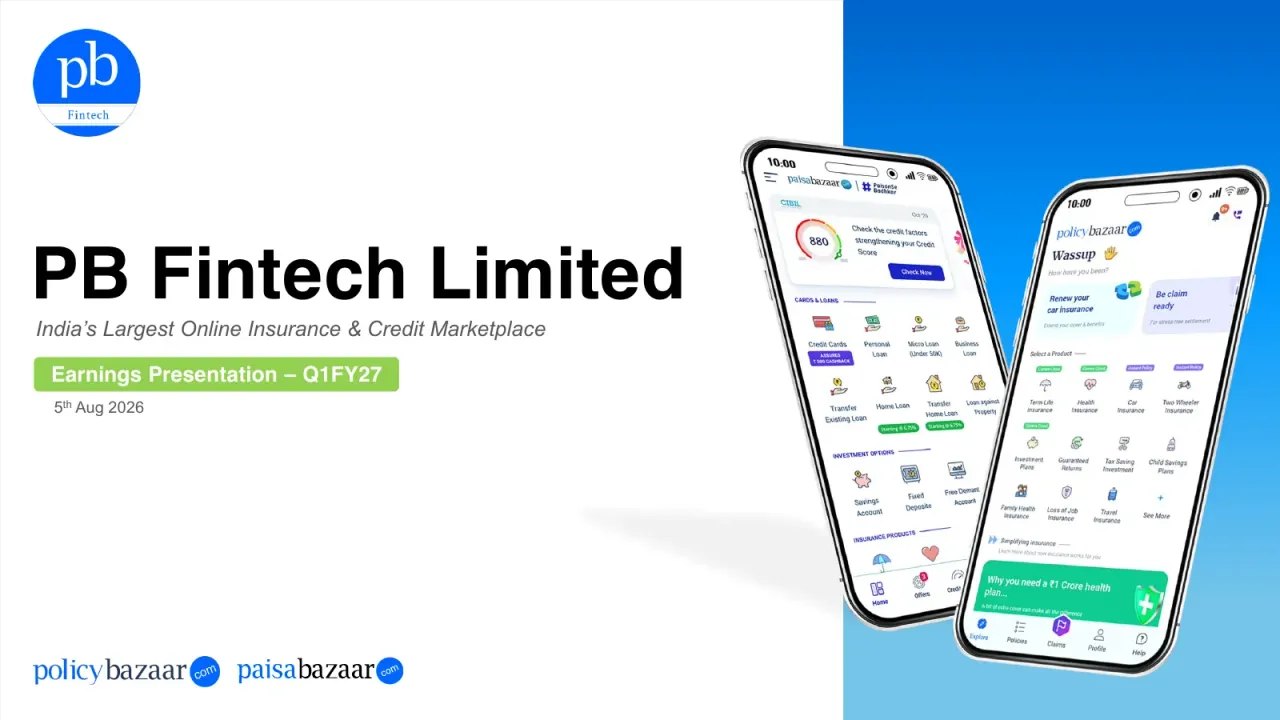
PB Fintech (NSE:POLICYBZR) Q1 2027 earnings call, held 2026-08-05. Watch the replay and read the transcript on 6ix.
On 6ix: 6ix.com/event/pb-fintech-limited-policybzr-q1-2027-earnings-call
Automated transcript · Written by software from the replay's audio. It can mishear names and figures; the replay is the record.
0:00 Hello, A very good evening and a very warm welcome to PB Fintech Limited's Earnings Conference Call for Quarter one Financial Year twenty seventeen. Today, we have with us Mr. Yashish Dahiya, Chairman and Group CEO, PB Fintech Mr. Alok Bansal, Executive Vice Chairman, PB Fintech Mr. Sarabhir Singh, Joint Group CEO, PB Fintech Ms. Santosh Agarwal, CEO, Pesa Bajar Mr. Mandeep Mehta, Group CFO, PB Fintech and Myself Mohit, Head Investor Relations, PB Fintech. I now request Yashish for his interrupting note. Thanks Mohit. Good evening everybody and thank you for joining us. We've started 27 on a strong note with healthy growth across most of our insurance and credit businesses, actually all.
0:55 The overall insurance premium is now at INR8372 crores. It's grown at 41% year on year. Importantly, this growth continues to be led by the protection categories which is our focus. New health and term insurance grew at 53% with new health growing at 59% year on year for the core business. This is an important indicator of both the opportunity in the market and the strength of our platform. Health and term both remain significantly underpenetrated as categories, and for our large and growing middle class, social security is very critical. That's sort of our big problem to solve. Our consolidated operating revenue grew 40% to INR1888 crores, with core insurance revenue growing at 46% and core credit revenue growing at 25% year on year.
1:50 The consolidated PAT increased 92% year on year, which is again both going to the new business as well as the renewal business to INR163 crores, while PAT margin improved from 6% to 9% year on year. Just to put in perspective, that also means for the last twelve months, our PAT would be just about INR750 crores plusminus right now. Starting to kind of hinge towards our target number for the year. Our core online total premium grew 41% year on year for the quarter. Core new insurance premium including savings grew at 39% excluding savings is 48%.
2:39 This is amongst the highest we've ever had. If you remember, for the last thirteen quarters now, we have been upwards of 35% for our total new premium growth excluding savings. The quality of the growth is also visible in our renewal and trail revenue. See now that beautiful time has arrived actually, while our renewal revenue has grown at 55% to INR103 crores for the last twelve months, but now we're getting to a stage when you will see higher and higher growth in renewals for the next because this is the previous three years of fresh growth starting to pay off. So you will see higher and higher numbers in renewal growth here onwards.
3:28 Building trust beyond the point of sale insurance is clearly not about just helping customers buy a policy. I think the customer gets nothing when he buys a policy. The real test comes when they use that policy, which is at the point of claims. And basically our claims servicing both in terms of issuance as well as getting the customer the policy as well as in claims. We now are at above 90% in terms of CSAT. We have supported 70,000 claims in this quarter that just went by, for health insurance. We are increasingly using technology and claims related information to make customers' conversations more transparent. Our advisors can demonstrate real time real claims outcomes. When a customer comes to us, we are able to explain to the customer in and around their area how many claims we have settled.
4:18 Should the customer be willing, we can even connect them to those customers for referral calls etc. All this is very powerful in convincing new customers to buy from us. And this is being done at scale using tech. In our credit business, the core revenue grew 25%, while as I said, the core disbursals grew 33%. So the good news is credit is also back into growth now. The total credit disbursal is now at INR 4,366 crores for the quarter. The business continues to focus on customers with all different credit profiles. So if you really think about it, there is a high customer, there is a middle end customer, there is a customer who cannot really get credit. We are helping all three solve their problems and all three obviously have very different problems. PB Partners is expanding clearly across all areas.
5:06 Now 78% of the GWP comes from tier two and tier three cities. We now have more than 500,000 advisors with the active partner count increasing 55% year on year to 1.13 lakhs for this quarter that's gone by. Our strategy has been to increasingly work with smaller higher quality advisors and equip them with technology, product access, training and service support. We of course cover 99% of India's pin codes more than 19,000 pin codes. Our quarterly premium grew 46% year on year to INR1637 crores while revenue grew 47% to INR561 crores. A few data points which we are starting to share now, the share of employee benefit expenses was about 15% of the revenue for the quarter. It was 12% in the previous quarter, but that is because it was seasonally a bigger quarter, but it's 15% of revenue right now. Our top 100 partners share of premium is 16%.
6:12 We will further work actively in reducing this. We are very good once we track something we really get it sorted. But it is 16% right now. We believe PB partners can play an important role in increasing insurance access across India by combining local relationships with POLICYBZR's technology, product breadth and service capabilities. Now this actually has quite astounded me because I don't think anybody expects this, because there's a lot going on in The UAE, but growth is not one of those things. And our UAE insurance premium grew 31 year on year for this quarter. Most of what we do is health and life insurance, similar to our evolution of our India business. Again, cross border is a big part, so people who retire need health insurance in India, people need to plan for their children's education etc. So that business has done well and has been very resilient in tough times.
7:11 Our new initiatives continue to scale forward across the board. To conclude, we are seeing strong momentum across the group. As you know, premium grew 41%, revenue grew 40%, PAT grew 92, PAT margin improved to 9%. The interesting part is to look at this over time. Over the last five years from Q1 twenty twenty two to Q1 twenty twenty seven, our quarterly revenue has grown from INR2388 to INR588 crores which is a CAGR of 51%. Some quarters something has worked, some quarters nothing else has worked, but overall our CAGR of our growth has been 51% over a five year period, which is quite astounding. At the same time, our PAT margin has improved from negative 47% to positive 9%.
7:57 And for those of us who track financial numbers better than I do, the best is just starting to come. So thank you and I'll start looking forward to questions. Thank you, Ashish. I request everyone to raise their hands for Q and A. We will wait for one minute and then we will start the conference. The first question is from the line of Sachin from Bhopa. Sachin, please unmute your mic and proceed. Thanks, Mohit. Hi, management. Congrats on once again a great set of numbers. I have three questions. Let me go one by one.
8:48 First question, Ashish clearly is very strong insurance premium growth once again, and thank you for helping us understand from where the growth is coming. But when I look at the industry, particularly health and term, they are not growing as fast, and you guys on that high base continue to show anywhere between a 53% to 59% of growth for a health and term. Where is this growth coming from? Is it mainly coming from tier two, tier three cities or it's still the urban areas which are contributing to most of the growth? And is there a slightly different set of users versus, let's say, what the most manufacturers are looking at it and hence your growth looks so better as compared to them? So you you want to... Okay. So, Sarbiv.
9:34 Yeah. I I think, Sachin, I would say two things. I mean, I think we've been consistently saying the same thing that I think our growth ahead of the market is coming from two or three key areas. One is that we definitely spend a lot of money and invest in creating demand. I think that we've been doing over a long time. Step two, we have... When people come to our platform, they see very attractively priced and very well featured products, which are tailored to their segmentation and which are, you know, tailored to their needs very specifically. So they find them to be very relevant. And the number three, and I think most important point that we have made a huge uplift in our service level and our support at the time of claims. So I think when you put these three things together, people...
10:22 You know, increasingly, we get emails from people saying that please quote my policy to POLICYBZR. I have not bought from you, but I want to, use your services. And I think that is an indication of kind of the work that has been going on. And I feel like it's still early days. I think there is a lot more to go, and I think we can continue to grow faster than the market. You know, what the level will be, time will tell. But I think these three things take a long time to put in motion. And I think right now they are continuing to drive our growth ahead of the market. I also want to give you one or two examples of things that I think POLICYBZR does, which many others don't want to do. One is like the use of monthly more. So if you see in health insurance, largely, I think we are the only platform that really sells any scale on monthly more. And almost over 30% of our business now comes on monthly more. We collect all those monthly payments. We ensure persistency, We ensure renewal. And that's an investment. I mean, you have to put in the investment to do all these things. I think that allows there's a lot of discussion about missing middle affordable products. This makes the product affordable.
11:25 It allows people who are not very high income to get things. Similarly, I just explained another product that we've been doing for a while, which is maternity. Typically, maternity has, like, a one year or a two year waiting period. We have a product where we are offering three month waiting period. Now there's a structure over there, but this gives a lot of young families a reason to buy health insurance. And then, of course, they stay and then they renew their thing. Now, again, this is a little bit of investment upfront into something that pays off. So I think these are the two things we take a long term view. We look at customer acquisition on a lifetime value basis. And number two, as I said, we have really worked on the three things that matter, bringing traffic, good products, and then offering very high level of service and claim support. And just so there's no misunderstanding on this, 82% of our business that's coming in is new in the sense they've never had an insurance policy in the past. Because what was mentioned as one thing, support is still a small fraction of the people coming in here.
12:27 Thank you, both very clear. My second question is clearly now there are two elements which on the revenue which also both become big. Number one, Yashish, as you indicated renewals and going ahead a higher part of the growth should come from renewals. And second is, as Sarabhar just indicated in the answer, health and term should continue to show a sort of a strong growth. Health in particular in the initial years has low margins. So when we look at the blend of two, how should we think about margins now that renewals is becoming bigger and bigger, Darishli margins should continue to improve going ahead, right? See, I think two things here. First of all, I think over the next twelve months at least and Sarabhi can correct if he thinks differently, but I don't think he'll think differently. I think renewals growth will beat fresh growth just because renewals growth is so high now. It's going to be quite high. Renewals growth is going to be upwards of 50% for some time now.
13:22 And I don't think our fresh growth will be that high. So that's one. But the second thing is, see I've always said one thing, we are not here for the short run and we are not here to deliver short term efficiency. So we are actually increasing our specs. We are actually increasing our acquisition spends. We are going even more aggressive than ever before. So I think, Prabhu, you might wanna answer this question in terms of margins. Yeah. I think, Sachin, again, very consistently, you know, theoretically, yes, you can make more money as renewal percentage goes up. And as she said, the growth rate could be higher. We don't know that yet. But I think the point which is more important is to say that if you are thinking of it as a lifetime value basis, then we can actually still continue to reinvest and drive growth rather than just taking it to the bottom line and showing higher profits.
14:17 So it's not about 27. I think it's really about, don't know, 37 or 47. And hence, you know, we need to keep pushing that whole thing. So I I mean, again, it would be more pleasing if we grow our fresh business at a higher rate than, honestly, if we grow our margin. So... And you're and you're consistently hearing the same thing from management across the board that that we... Our p one is growth. Efficiency will come. It will be for later. But we will get enough from our growth. Yeah. If really think about it, we crossed 1% at some point. I was just looking, right? Right now we're at 2%. And so the 3% number that we've sort of broadly indicated as a percentage of premium is not very far off. So we will hit our numbers. We will hit I think more than you expect. But let it come from growth rather than from expansion of margin and lower growth.
15:06 Thank you. Again, very articulate and clear. And last question, Yashish, when we look at some of the interviews given by the regulator, he's talking about an effort based commission change. And to some, it is also getting interpreted as, you know, it's more on the lines of perhaps an asymmetric cut for different channels. So banker might have a different cut versus, let's say, aggregators versus, let's say, manufacturers. You know, just wanted to understand, you know, how you guys are looking at, you know, this. And I also saw one of the interviews you had given in the past which talked about in a worst case scenario PB Fintech might become a manufacturer. So want to understand from you what is that worst case scenario and how should we think about that?
15:54 Yeah, I would say don't even think about the worst case scenario. Anyway, let me come to the very basic thing. Legally, as defined by the regulator, the largest amount of effort in any sale needs to be put by a broker more than any other job and that is as legally defined in terms of tasks to be undertaken by the regulator, in terms of customer support, in terms of sales, in terms of claims support, in terms of everything. So it's a very difficult position to take that the entity that is supposed to the maximum effort is somehow meant to do less effort. So these things are legal at the end of it and I would kind of leave it there.
16:41 I think there's been way too many statements and way too many things and I'm sure wisdom is developing. I use that word very carefully. And I think it'll develop more. And I think we will see the result of it as it happens. Yeah, and I don't anticipate anything that was like, you know, sometimes when you do these media interviews, it's very strange and that's why I stopped doing media interviews thankfully. I wasn't very pleased about doing them in the first place, sometimes you come under pressure and you do them because your own PR team is saying you need to do them etc. Now what actually happens is say 10 things and one of those things is the one they pick up. And that thing you said in point number nine, and they make it the headline.
17:33 And look, that's the reason, I guess, a lot of people in the regulated industry don't do interviews. It doesn't make any sense here. You're just kind of exaggerating something which is a side point. Can I just add? Pillai, please. First of all, I want to make it clear that none of us want to say anything about the regulator. I mean, I think that is an independent process and we have nothing to do with it. I think the point I just want to explain to you Sachin, you and everyone on the call is that we've had two instances in the last five years. I've only been in this business for a short time where we have seen that you had COVID. You had a great run-in increase in demand for health and term insurance. Minute COVID finished and it was like the mother of all epidemics the world has ever seen across the world, immediately the demand went away. The same thing we saw right now, we are in the middle of this GST thing. We saw Q3 very big, Q4 big. Now in Q1, it has already started to fade. And I think we'll be lucky if it goes through in Q2. So the point I'm trying to make is that demand for insurance is extremely low. So anyone who's selling insurance, by definition, has to make a significant effort to get there. And I think for a platform like ours, that effort is very, very visible in terms of the marketing spend that we have to do, the conversion you know, resources that we have to deploy, the focus on service and claims. So I think I just want to just put out that this is the level of effort that is required.
19:02 So it's not easy. I mean, nothing really the trend doesn't last more than even two quarters, really. What are the four or five things anybody who wants to sell insurance needs to do? You need to generate inquiries, you need to convert those inquiries, you need to have some mechanism to technically do this, whether you do it through paper, whether you do technology, etc, etc. Then after the customer has paid for the policy, you need to get it issued. There is a process in that document collection, medicals etc etc. There's a process that needs to happen. After all this, need to be there at the point of claims. These are the five things anybody needs to do. In this, a bulk of the cost actually goes in generating enquiries and converting enquiries. Platform part, while it seems like a big thing, actually the easy part. There are about 300 platforms in this country on which you can go and transact insurance for most insurers, for 20 plus insurers.
20:05 So I don't think platform is the problem. The problem is generating an inquiry costs a lot of money, converting an inquiry costs a lot of money and then to bring goodwill by supporting customers in getting issuance and getting claims settled costs a lot of money. Someone like us who's been there for eighteen years is just about getting to a point where they're making one-two percent of their premium as profits and that too with interest income. If you take away interest income, it is still less than 1%. Maybe it's a weak quarter, maybe for the year it would be more than 1%. It's a weak quarter in the sense of the first quarter, right? So it's a strong quarter but a weak quarter. But point is, look, if anybody can do it for less, most welcome, yeah? Like, you know, be our guest, but, you know, I don't think it's feasible.
21:01 Thanks, sir. Thank you very much. Thank you, Sachin. We will now take next question from the line of Praj Jain from Motilal. Praj, please unmute your mic. Yeah. Hi, everyone. Great set of numbers. Firstly, I think you mentioned about 70,000 claims on the health insurance front that was supported by PB, Right? And if I recollect well, you have mentioned in the past about 3,000 feet on the ground. Right? With regards to this this. So trying to understand this, you know, I think we can probably do this ratio should could have been much, should be much better, right? So, what is kind of, you know, is there a is what kind of effort that will need to kind of increase this?
22:05 An extension to that would be if you would have say, you know, and how claimed understand, you know, in in the in the policies that we are servicing, the number of claims that we are getting, how much of the... How much are we kind of supporting the claims? That just helps us concretizing more the amount of effort that you're putting? See, whatever comes to us, we're supporting 100%. And basically, why wouldn't we? And essentially, if you think about it, typically of our total policy base roughly 1.25% to 1.67% or so would claim every quarter. Of course, there are high claim quarters and low claim quarters depending on whatever, but typically about 6% of your base claims every year.
23:04 I guess it's not 3,000 people, it's a little less than that. It's a lot less than that. So... And... Yeah. Those numbers make sense. It takes a lot of effort to settle a single claim also. Yeah. Takes a huge amount of effort to get a claims order. You know? And and, Presh, I think you should understand that the flow is the customer typically goes to a doctor, doctor, or somebody recommend you go to a hospital. And then, you know, they may... Sometimes they call us before they go to the hospital. Sometimes they call us after they're in the hospital. So it's a it's a mixture of things. And actually settling or holding somebody's hand through a claim process is actually quite complex and time consuming. So the good news is that a lot of claims actually go through largely on their own. It's those claims that get stuck or there is some reduction with the customer doesn't understand, etcetera, etcetera, which come to us.
23:56 So we are a fallback. It's not like at this point, everyone is starting from us. Right, right, right. Interesting. The second question was on, again, the motor piece, where how do you see this part of the business? Health and term have been growing phenomenally well. And motor has as an industry also has has gone through slowdown. And what is the kind of growth that you would expect on the motor business? And again, on the health health front, just want to understand some recognition. You know, how do you kind of how do you kind of account for, say, a three year policy? So entire premium is accounted in the in the total premium?
24:49 Or it is it is just the one year premium that gets accounted? The reason I ask this question is when the renewal time comes, whether we'll have the the the long term renewals contributing or not. That's that's the question. Yeah. Those are two questions. So Yeah. I think on the motor front, we actually had a good quarter. Our motor plus two year direct business grew over 30%. Our motor business in POSP grew close to 50% almost. So I think both parts in motor, we've we've been continuing to do well. I... Yeah. I mean, I think we don't have necessarily a huge view on the motor business. I think, as you know, right, it's dependent on new car sales, new bike sales, and then over a period of time, you know, those policies come to us because typically, we are not a big player in the new market.
25:41 And then, you know, we we take care of the rollover and renewals. So I think that will continue. We we gain share modestly every quarter, I feel. And we will con... I think we have the infrastructure in place to keep doing that. On the health side, the way we do is we report premium on a collection basis. So we show the three year premium is part of our base or the number that is reported to you. And of course, on a renewal basis, we measure by number of policies. Our focus is not on premium, but on number of policies. And based on the whatever basis due for renewal, we compare how much we are able to renew. And I'm happy to report that both in the first year renewal and in the second year and beyond renewals, are at all time high renewal rates at POLICYBZR. And just to clarify on the multi year versus single year kind of plans, etcetera, we track a number internally. We call it indexed growth, which means annualized health insurance growth, that is not very different.
26:42 There would be a gap of five-six percent between 100 basis points this quarter. 100 basis points is the difference between index growth and overall growth. So, multi year is not pushing a big element in that. One second. Yashi, last question on the PB health, Whatever you can share more and every quarter, we can ask this to you. We just got we just got... One minute before this thing started, we just got the approval to start billing in our second hospital. Yeah, we are moving step by step. See, revenues are there. As you can see, our total loss for the quarter is about 7 crores or so.
27:33 We are also doing preventive health. We had acquired FITAFLY last year. Since when we acquired them, their monthly revenue is up four times. See, we are eventually operational workhorse here. Now we've gotten behind a new category. So you'll see us deliver stuff, right? We have our internal numbers. They are actually quite impressive. Let me look at our targets for actually, I speak my mind, so I don't care what you think about it or whether I'm speaking ahead of time. By March next year, we will have an annual run rate of about INR500 crores. We would be breakeven. I'm talking about March 27, not March 28. So, Now, we may not achieve it, we may achieve it, but that's our target. That's our internal target. We might be slightly ahead, might be slightly behind.
28:20 And I think opening hospitals is not an easy business. We are about one year into this and we've got two going and one from scratch and quite a few in the pipeline. I think we are coming into this sector. See think about it from a very simple perspective. What percentage of hospitals billing is coming from insurance? Give or take 34%, 35%, 40% depending on which hospital you're talking about. Now just take this number ten years ahead and just ask yourself a very simple question what percentage of Indian hospital billing corporate hospital billing will come from insurance? And what percentage of Indian health insurance will policy bazaar be? AND ITS FRIENDS BE? I don't say just POLICYBZR, POLICYBZR AND FRIENDS and that's all the insurance companies.
29:07 We have all friends everywhere. I think healthcare and I think the interdependence of these two is not very well understood by most. People think this is a kind of relationship of know if you get more I get less. No, it is not. Healthcare will develop if insurance is sustainable and if claims are good. That is how healthcare will develop across the country. Otherwise we are limited to these seven cities where you have... Who can afford healthcare? Who can afford hospitals today? Either you are rich or you have a government job, so ECHS, CGHS something or you have insurance, nobody else can afford hospitals. Now how many people in the country are rich and how many have government jobs and will that grow alone or will health insurance grow? So health insurance will enable health care and good aligned health care will enable insurance. So I actually don't understand the complexity here. It's of course tough. It's not easy and by the way, I don't like health care. Alok likes it, but you know it's working, it's working is all I would say. It's all good.
30:11 Great, thank you so much and wish you all the best. Thanks. Thanks Praj. Will now take next question from the line of Dipanjan Ghosh. Dipanjan, please unmute your mic. I think we lost the. Oh, he's here. Hi. Sorry. I think I was not able to unmute myself. So good evening. A few questions from my side. First, if I look at your savings business, despite relatively favorable and low base, I mean, it continues to be a little bit on the softer side. I understand you previously articulated that you're normally a platform business and a lot of the customers are pool in nature, especially on the savings side.
31:05 So is that the reason for this softness? And also, think over the last one to two years, you have been focusing on developing the children's plan and some of the pension categories. So what would be the mix within the savings business of those categories? And how would that be of growing at this current juncture? So that's my first question. Second, on Peshawazar, you have mentioned that you will be starting the daily SiPs from August 26, if I understood correctly. So what would be the monetization strategy? And has there been any pilot in terms of understanding the addressable market? And also ex of credit, what are the what is the sort of monetization or revenue pool that you think you can build on Pesa Bazaar, let's say, over the next two to three years?
31:54 Yes. So those were my two questions. Yeah. Yeah. So I think on the savings side, Dipanjan, we grew over 20% in the fresh business in Q1. So yes. Yeah. You're right in saying that it doesn't seem so great if you look at it versus last year. I mean, the sense that you would have expected more. But then, the two years before this, had a very big quarter, very big year. So I think given the state of the markets, markets are kind of choppy, they go up and down almost every day. So it's a little difficult for people to build confidence. But I think beneath this 21%, there are two interesting developments that I would like to touch upon. First is, I think we have expanded the concept of waiver of premium. So what you are referring to in child plans, the main story there was that not only can you set your goals, but you can protect your goals. Because if you buy a mutual fund, yes, you are saving for a goal, but something happens to you, that goal and the money will disappear. Right? You'll only... Whatever you invested. Whereas in favor of premium plans, you can be assured that whatever plan you have bought, that entire amount of money will be invested and you will get a return. So we have expanded this category beyond just children to say that every goal should be protected.
33:04 And I think every month, we have been expanding the percentage of our business that is coming from waiver of premium. And actually, I'm very encouraged by that. And I feel that in the next few quarters, this will help drive the business. And it's kind of talking about insurance plus investment now. We are not just talking of investment. So I think that's an interesting and positive development. And the second point that... Sorry. The second point that I want to make is GiftCity. In GiftCity, we started last September, and we have very soon become, frankly, the dominant and only player in retail insurance sales from GiftCity. Know, and savings. We are doing a very good job. We are being able to sell dollar plans both to our existing base. So very interestingly, people who have bought... Non residents who have bought plans from us in the past, they are buying them again. And, of course, to new customers who are coming. And I think the good news in this Gripsy site is that it opens up the entire spectrum of global investing.
34:05 So it's no longer just India. It's, you know, we can sell technology based funds. We can sell other countries, etcetera. So I think these two developments give me a lot of hope. You know, we we only sell certain types of products. The products have to be very efficient, etcetera. So there is a limitation in terms of how fast we can go. But we are I think these two developments will will definitely take us forward. Ashish is saying that we should talk about WAP as a percentage of the business. In the domestic business, in some centers, it has crossed 60% now in July. So I think WAP waiver of premium is the dominant story, and we are quite encouraged by that. Santosh? So, yeah, we are launching a daily SIP platform. Look, I think, see, this industry is growing at about 20%, 22% year on year.
34:56 And a lot of, I think, salaried consumers already have enough and more options to buy mutual funds. And salaried consumers are people who have a daily, you know, a monthly, I would say, visibility of their income. And hence committing to a monthly SIP doesn't hurt them. But the large part of India, which is self employed and, you know, work on businesses where the visibility of monthly income may not be that high, for them to commit monthly is very hard. So a lot of self employed people still are not in this category. I think our aim is to get those people in the mutual fund area and start... Help them start their savings journey. We've not really done a pilot to say in the daily SIP category.
35:41 Of course, you know, I've... Have had experience of building savings within policy. So with that, there's a lot of cross learning that's possible. And I feel self employed is a category that remains very low, penetration is very low of any kind of savings products there. So there is a lot of scope. See, know from a one to two year perspective, actually a lot of the savings that is being done in Pesa are not a revenue building activity. They are a stickiness building activity. Yeah. So this... I would say just to answer the second question, I don't think there'll be, you know, more than five, 10% of overall Pesa's revenue in the next two years or so. There are a lot of things that we're doing to build engagement on our app and savings, mutual funds, bonds, and a lot of work on the payment side, which is basically bill payments, etcetera. So a lot of work is happening on that side to basically build engagement that... You know, it's... I think it's a loop. You get more data around consumers. Some people want to want loans. Some people want savings. So I think being able to see that and give these products to both of...
36:43 These kind of consumers, that's the attempt. But, of course, you know, very hard to say on where we'll be, but I don't think it'd be more than 10%, 15% at best in the next two years. Sure. Got it. Maybe one small follow-up to Sarvi. Given the numbers you mentioned, would it be fair to assume that savings would be like 30% of your fresh business now more or less? And second question is, in this regard, I mean, have historically not talked about it, but could you get some color on the margin profile of savings in the first year versus, let's say, your ex health overall fresh margins? Any color on that would be helpful. Thank you. I think the balance in economics of saving business, I think, is not necessary to be discussed. I think it's fine. We do life insurance. We do term and we do, I think, market linked products.
37:31 And overall, I think we are a very good combination from a insurance company's perspective. We get very high quality customers and these customers are good for us as well as for the insurance company. Got it. Thank you everyone and all the best. Thank you. Thank you, Deepanjan. Next question is from the line of Subrathim Dhartha from Goldman. Yeah. Hi. Thanks for the opportunity. I'll start maybe with the health piece. You know, a few quarters back, you had talked about, you know, the combined operating model that you are running. Just wanted to understand, you know, how many insurers are now covered under this model and how would the economics, you know, change, under this regime versus what the previous regime was?
38:21 So if you could give us some color around that, that would be very helpful. And then on the second bit, I just wanted to understand what proportion of your motor insurance comes from motor third party. And currently, the Supreme Court yesterday passed a verdict saying that the PP period is going to be extended. So just wanted to understand how would that impact your business because yours is largely renewals, and now renewals will take longer to come in. So so that... That's, you know, my second bit. And lastly, on, you know, the POSP side of the business, thanks for, you know, the additional details that you have provided. And, you know, an interesting comment that you made was, you know, the top 100 distribute... You know, currently contributes somewhere around 16% of your premiums, and you plan to bring that down. So just wanted to understand how do you plan that?
39:12 And on the POHP side of the business, what is your focus? Is it scale or is it profitability over the next, you know, three, four years? Yeah. That that that would be my three questions. Thank you. Sarvi, do you want to answer most of these already? Yeah. Sure. I think... Subtitem, I think in terms of the core model, I think the best way to understand it is that we have aligned ourselves with... I think what chairman Sarvi also said that channels should be paid as per the quality of business that they do, not just the volume of business that they do. So if you see, we have aligned ourselves. Would rather than getting into the details of the model, I would urge and encourage you to think along these lines. It's really alignment of policy with our with the quality of business that we are bringing and then overall economics that the whole ecosystem is getting rather than just looking at us and insurance companies separately. So I think that, as you can imagine, that is a welcome step from an insurance company's perspective also. And from our perspective also, I think it encourages us to focus on the right things, which is double down on disclosure, making sure that the risk is well understood, making sure that, you know, we are focused on preventive health care.
40:25 And now with PB Health coming online, I think that is going to be a big focus area for us. So I think it's... The core model is really around that stuff. And I think directionally, I think it's... You know, I would say it is well received and it's so far, it's it's going in the right direction. And I think that's the only sustainable way for a platform and for insurance company to work because in the long run, you know, both of us have to focus on the right things, making sure the customer does well, making sure that the insurance company does well and etcetera. So I think that that's kind of on the health side. On the TP side, on the retail direct to consumer, it's about in value term, it's about 25%, 25 odd percent of our premium. It's more in terms of number of policies.
41:11 On the POSP front, it's almost half. So half our motor business would be TP. I will let Dhruv talk about the top 100, how he's going to reduce the percentage of business coming from the top 100. But I just want to tell you that in terms of profitability versus scale, we are totally focused on scale. I think we are happy to invest money behind the business as long as an investment. I think investment versus expense are two different things. As long as we're investing in capabilities and serving our partners better, that's something that we will continue to do. And we definitely believe that scale is the most important criteria for our POSP business. Over to Dhruv. I think reducing the dependence on the top 100, which is currently at about 16%.
41:57 I think the only way to do it is spread more and more today. If we look at, and I'm not sure if the numbers were published, are there roughly about give or take about 12 lakh GI agents and we cater to roughly about 1.2 to 1.4 in a quarter and we have to take this you know take this you know, higher, we have to increase the number of partners working with us. But yes, it's a slow process because the productivity of you know, the partners is lower. It will take time, but the whole idea is that how can we capture a large share of the market, as well as go towards more tier three, tier four when the productivity may be lower, but the number of partners are higher. So I think to add towards servicing, I think the focus is The focus is clearly increasing scale. I think both our core business and our overall business benefit from that scale, and we would keep the focus on that.
42:54 Thanks a lot. And, know, sir, if possible, you know, could you give us some color around the impact that there could be on, you know, the motor TT business because of this extension of the policy period? I think, Subratin, let's see how it goes. As you can imagine, what will happen is that the brand new ticket sizes will go up because of this. That will help people who sell more brand new insurance. For us, the really big opportunity could be what was in the judgment around the enforcement. So if tomorrow the enforcement goes up, so as we saw in 2019, when the Motor Vehicle Act was enacted, that those particular two months, I think the businesses went through the roof. And if the enforcement is super high as per the judgment, I'm sure you've read the details. If those cameras and fuel is not sold to people without third party insurance, etcetera, then I can... That could be a very meaningful jump for our business.
43:49 But I think let's let's wait and see. I I wouldn't say anything on that yet. Got it. Got it. Good. Thank you. Thank you, Supratil. Next question is from the line of Jayant Rojay from Exiscar. Please unmute your mic. Hello, am I audible? Yes. Jayant, you are now. Yes. First question is on the Tier two, Tier three opportunity on the online business, not the POSP business. How has the mix of Tier two, Tier three markets grown in our online business over the last few years?
44:35 And what would be the strategy to sort of accelerate that mix over the next three to five years? That is the first question. I'll I'll come with the second and the third. So, Jayant, I think it's very... We are going the same way as the country is going. And I think tier two, tier three now, depending on the business on the direct side account for somewhere between 6570% of the business. And this part is growing faster than the bigger cities. Having said that, for us, the bigger cities also continue to grow. So it's not that one is growing and the other is declining or something. Both are growing. The growth rate is faster. If you ask me the dynamic that has paid out for us on the b to c business in the last three years is a different one, which is that the South has grown much faster than the North and the West.
45:21 So the... Yes. Tier two to tier three have grown, but a more dominant narrative or the trend has been the South growing. But, yeah, we are also seeing the same thing that the Which was bit specific to us also because we were over indexed for the North in the beginning. Correct. Yes. And when you say sixty sixty five, you're b 30, right, not b 10? Yeah. I mean, I'm not familiar with this terminology, but basically, I'm saying if you leave out the top 10 cities, after that, we consider tier two, tier three, those cities are about 65 to 70% of our businesses. Understood. So second question was on Pesawazar and sorry to bring this question up every quarter. If you can help us how the EBITDA has fared this quarter because the full year expectation that we had in our Analyst Meet discussions was fairly sizable number. So how are we faring on that one in 1Q?
46:14 What did we say? If you can remind me, what did we say was the annual approximately? INR100 crores? Yes, I don't think it will be INR100 crores. I think we'll be maybe at about half of that. But this quarter is not look, breaking the of things, quite immaterial in the scheme of things, but yes, it will be about half of that. Have we broken even in this quarter? Yeah, yeah, we broke even. We were profitable this quarter. Even this quarter. Is right? Minus six. Minus Minus Minus six. This feels like Operationally, broke it. Operationally. Operationally, we go, Kiran, yes. Great. And last question is around AI, Ashish.
46:59 How have anything that early harvest gains that you identified, have you allocated more cost to tokens? If you can help us understand, have you drafted a strategy? How will you use AI over the next couple of quarters or next one or two years? Yeah. So Sarvind will take that. Yeah. So I think then we... In the same meeting that you referenced, you know, we spoke about, you know, that we are changing our operating system. And when I say operating system, it means not just technology, but our business processes, etcetera, to take maximum advantage of AI. And I think that is going extremely well. Roughly after we handle 10 customer interactions in a month, calls, emails, etcetera, etcetera. Of those 10, 30 to 40% are now being touched by AI, and that number is growing.
47:51 I think we've had some very big wins in terms of improving our sales productivity, in terms of our advisors seeing information that is relevant to them at the right time. When they're talking to a customer, what their questions are, what objections are being raised, how do they respond to them? If they get a second call knowing what happened in the previous call, etcetera, brochures being sent, documents being sent. So I think a lot of improvement on the sales productivity side. On the risk side, I think we've spoken in the past also, we've done a lot of work on risk. I think last year we saved thousand crores of sum assured, roughly 10,000 crores of sum assured. And I think our risk models continue to evolve. On the customer service side, I think I would say that that is one area where in the last two quarters we made a lot of progress. A lot remains.
48:38 But 20% to 30% of all our now interactions are being sort of automatically handled. A lot of single collection of documents, given updates, a lot of those are being done by bots rather than by human beings. And I think this is freeing up human beings to focus on quality interactions with customers, whether those are claims, are service issues, those are issuance problems. So I think we are freeing up our team to do more, I would say, meaningful work while AI is handling the rest. In terms of token, etcetera, Jen, I think it's a bit... In my opinion, it's a bit shallow to look at things in terms of saying how many tokens are we burning because if you were to set that benchmark, our team would burn our entire EBITDA in tokens. But I think that's not what we want to encourage. I think we want to encourage outcomes.
49:25 The whole focus is on outcome. That's to when I say efficiency, how many percentage less people do we need to hire so that we can deliver the same amount of sales? How many fewer customer service people are needed for as we grow our business? So I think that's what we really want to focus on. And finally, if you ask me, the real game is to give a A plus customer experience to our customer. Because if we can do that, the value of that is just enormous. And that's something that we really would like to drive. Great. Thanks, Arvind. Thanks, Ashish, congrats on a great set of points. Thank you,. Thank you, Jayhun. Next question is from the line of Manas Agarwal from Bernstein. Hi, team. Am I audible?
50:10 Absolutely. Perfect. Thank you for the opportunity. Great numbers, but I'm sorry to pull you back to regulations. I hear your comment. There was also a separate discussion around dark patterns. So wanted to understand how much of our sales on the core side would be coming from follow ups that we get from the numbers that we collect. That is one. The second question is more on h two base on the new would be very high, I suppose. So what is the right way to think of it? Because insurers seem to be guiding towards a softer h two, but want to understand how you guys are thinking about it. And third, I'll come back after you've answered these two. That is on the AI side. Just wanted to get some more numbers. I think your analyst presentation gave a 40% productive use time at the call center level, and the aspiration was to go to I think Sarabhir also talked about some of this, but wanted more clarity because if you go from 40 to 90, the number of people at your call center required just stagnates.
51:16 So want to understand what's happening and when should we expect something like that to happen. Something will definitely happen. But first of all, see, a dark pattern almost by definition requires some form of deception. We're not deceiving any dampers. We're saying we need your number. That's it. It's as simple as that. We need your number. And we're not saying that in a deceptive manner. It's right out there on the first page. If you open the page, it's right out there. So I don't see what the dark pattern is. Opinions are aplenty, but eventually this will be decided in courts at some point. Think, of course, calling and reaching out to people and converting, I said in the beginning, there are two primary parts.
52:08 One is generating inquiries, and second is converting inquiries. And both of those are heavy efforts. And at this moment, if phone numbers are not collected, generating inquiries become far more expensive. Yes, converting inquiries might actually become easier. So you might see marketing costs like, look, first of all, let's hold our horses. Let this come to some conclusion. We have way too many conversations in our industry. Eventually things move at their own pace and in the right direction. And globally, if you look at even GEICO, you look in The UK, there is nobody who is providing insurance quotes at scale, even in products like motor insurance, without collecting a mobile number.
53:08 Money supermarket does not do it, market and they have all dark patterns and DPDP, whatever Europe is, I'm assuming, ahead of us in all those things. So I guess let this play out. H '2 base, clearly, q three... I think Shantakib should answer this, but clearly q three was a very special quarter last year. And Yeah. I I think, Manas, the... I mean, there's no... Not much to say. Right? I mean, clearly, the demand that we saw in q three last year was above average, above trend, etcetera, etcetera. So, yeah, I think some degree of... You know, if you... I mean, I would not call it a slowdown. See, we've always said that 30% is our target. If we grow 60% and if we... From 60, we come down somewhere, then I'm not sure... Think about it. I think our goal is to make sure that we, you know, try and maintain above market growth rates. And I think that's what we are focused on, and the math will fall where it will.
54:08 Yeah. And I think on the AI side, if I I can take that question, I'm not sure about the 40, 90% kind of number, Manas, but we are definitely seeing improvement in productivity. And, yes, that will mean that perhaps we need to hire less number of people for the same amount of business. Having said that, you know, we are an ambitious lot. I don't think we are trying to optimize for people. We are trying to grow our business. And that's why I said that for me, the the real test of AI is not cost cost efficiency. The real test of AI is to increase the conversion, is to increase our business level. And I'm really hopeful that, you know, our team, you know, we have a very talented team, and they are focused on it. And will find ways and that will allow us, you know, both to grow the number of people and the number of business while implementing AI. See, from a three year targeting perspective internally, when we have set targets for our business, like of course there are detailed targets, but the P1 target is fresh business growth.
55:09 And everybody is told, look, if fresh business growth doesn't happen, then everything else is a bit meaningless. Of course, efficiency can be driven very rapidly, but that's a very clear communication and we don't have two communications. It's the same one to the investors and the same one to the employees and the same one to everybody amongst us and to our partners. So that's the phase we are in. I guess what I would like to believe in that is that we are like a young company which is still not at a mature stage where we are growing at 10%, 12% per year kind of story. We are still very aspirational. We want to grow. And if that means we hire more people and some of that is actually wastage, look, please appreciate we're not wasteful people, but that is better to do than to not grow because we did not have people for whatever reason.
56:01 Got it. Thank you, Thank you, Manas. Next question is from the line of Shreya Shivani from Nomura. Shreya, please unmute your line. Yeah. Hi. Thank you for the opportunity. I have two questions. My first question is on the expense bit. So usually... I mean, this this was the trend last year that your expenses outside contribution as percentage of revenue was at 61% or so. And then through the remaining three quarters, it kept declining and stuff. So this year, one q, you started at 58%. That means there has been some cost measures that have taken place. What are those? Anything you'd like to highlight over there, and how should be the trajectory for the next three quarters?
56:49 My second question is a bit on, the call center employees. I wanted to understand where does the cost for that entire thing goes in terms of... Is it in the employee benefit expenses or the other expenses? Some clarity around that will be useful. And, sorry, last one more question. Just just a data keeping point on the either the POSP premiums, if you can give or the corporate premiums that you can share and PB Connect revenues for the quarter. It was about same was about 43 crores in 1Q 'twenty six. It will help me understand how does that how is that book moving as of now? Thank you. So first thing, Shivani Shreya, sorry.
57:34 Shreya, 61 moving to 58, see our revenue grew 4146% depending on which business you look at grew in the 40% range, right? It just means the costs grew 3% overall less, so 1.4% instead of being 1.4% the costs will go like 1.35 So, I want to clarify, because that communication is very very clear, there was no particular intent to reduce the cost. It is just the cost grew at 35% and the revenue grew at 40%. That's all. And we are not in a phase where we are, you know, there was a statement that I read long back, I have a habit of connecting things with the Indian Army, I haven't started to fight yet.
58:22 So all I'm saying is we haven't started efficiency yet. You know that that will come at some point, but it's not time for that yet. Guess call center... Mandeep, can you explain this? Do you get the question? The call center part? Which line item is it from? All employees costs are in employee benefit expenses. Okay, they're all in employee benefit expenses. And POSP corporate, And of PB Connect, we made a strategic decision to no longer do the consolidation part of the business, so it should be about 73% down or so. That's because we have cut out one part of the business, the other part of the business is growing very well. So, exactly what is expected in POSP. See, in POSP, there is no good doing consolidated business.
59:07 It is very good to do retail small small partners business. So, just stopped the consolidated business last year while we are 73% down, that might have been 90% of the business then. It was zero. It was zero. Correct. Just the business did not exist. So the remaining part has just grown from there. Right. So you're saying PB Connect. Okay. I I got the part that we had backed out. So this PB Connect revenue for for that matter incrementally, it's not something that becomes... I mean, that's not an area we would want to scale up at all. Right? No. No. We are gonna scale up PB Connect, but not Okay. Not from that segment. Okay. We're gonna scale up the the retail side. So these are the retail and the wholesale side. We don't want to do wholesale. We're doing retail.
59:53 Right. So any revenue numbers you can share? Mean No. How much is the revenue this $12.12 crores. 12 crores. It's 12 crores right now from the retail side. From the retail because the entire wholesale is out from now? Entire wholesale is gone. We stopped it altogether. Right. Right. And just a clarity, all your call center, every expense from that is in the employee cost line item only. Right? That that I've understood correctly. Right? Yes. Yes. And for all the employee rate, if you call the length of the center, this will be a different line. So qualifying that all employee costs are in employee benefit. We talk about call centers. See, there are a lot of other moving parts. There is AI and product improvements. There is a mix change. There is a change between new and renewals, different verticals, how many people you needed servicing, how many people you needed renewals, all that stuff combines.
1:00:47 Just to give you an example, we have done this in the past also, at the time of IPO, each health standards involved about two hours talk time. Today, will be a thirty five forty minute talk time. Yeah. You know? So, you know, lots and other small, small things have to happen, and you obviously try to do everything, but the impact will be incremental every time. And since we are adding new people, sometimes that incremental effort may not be reflecting the numbers immediately. Suppose we are trying to build out the South India or some new city or we are trying to build out the physical teams, day one they will not be efficient. So it's not an easy answer in a single number. And Shair, just to give you a clarification on this, Q1 and this is for everybody Q1 is obviously the weakest quarter in the year and Q4 is the biggest quarter in the year. There is really no reason to expand employees from if you're going for efficiency, the first thing you would do is you would hire nobody whatsoever in Q1. That's an obvious one, right? We hired at a gross level 5,000 people in Q1.
1:01:50 That explains to you how much we are trying to reduce cost. Because most of those 5,000 will not be productive in Q1 for sure. So even in a quarter like Q1, are expanding employees. And we are also expanding what we are doing in terms of marketing. You guys saw we tied up with Anta, Bachchan. This is all happening in q one. Right? So we're not holding back in terms of growth. Got it. This is useful. Just any of those number either corporate books insurance premium or POSP premium? Yeah. Of course, we can give you that. Yeah. USP will be declared, I think. So the cockpit is about 500 crores, POSP is about 1,600 crores, the device about INR $405,100 crores. Right, right. Thank you so much. All the best. Thank you. Thank you, Triath. We would now take next question from the line of Nidesh Jain. Nidesh, please unmute your mic.
1:03:02 Mohit, so I have two questions. First question is if you can share EBITDA margin and contribution margin for the quarter? And second question is EBITDA margin was 9%, I thought. That's the PAT margin. David, can you your voice was not really what? He said EBITDA margin and contribution margin. Those he must have put an of core business? Of the Pesabalar business. Pesabalar business is just broken even on the operating basis and On the contribution side, our margin is about 41%. On the contribution side, it's 41%. So it's pretty much like as high as policy will have on the contribution side. Sure, sure. The second question is on savings business. So in the life insurance savings business, the growth has been slightly subdued. But my question is actually on the reputation risk that the platform has, because in case the investment product that we are selling where the performance is bad in future and customer loses money, how do we see reputation risk for POLICYBZR because that experience could impact future business for our platform and experience for the customer?
1:04:18 I think, Mitesh, obviously, there is some kind of dramatic downturn or something, one can't talk about that. But last two years have been interesting, right? We've not... The markets haven't done much. And if you see, you know, our persistency, etcetera. See, finally, persistency tells you the answer. Right? So the persistency has been about 100 basis points lower than at at its best, but that's all. And the reason... There's a reason for that. The reason it happens is that the person who buys from POLICYBZR buys very clearly. We... First, the sales process tells them that it's a, you know, it's an equity linked product. Secondly, we have a verification process. So all policies that we sell, independent team calls the customer and ensure that they have understood the product that they have bought.
1:05:07 So from a product perspective, and then the third thing, which is equally important, we sell the lowest cost eulips in the market. So actually, many of our ULIPS and feel that they are so poorly understood actually, even by the financial community. But many of the ULIPS that we sell have lower cost structures than mutual funds, despite the mortality expense that they have. In many cases, the mortality expense is paid back in many cases because there's a tax. I mean, all you live below 2.5 lakh rupees have a tax advantage. So actually, the products that we are selling, and I say that responsibly as the owner of many eulips, are very, very good products, actually. And I think you guys should talk more about it because I think we do ourselves a disservice that, you know, eulips have a problem in the past. But today, those... At least on policy with that, they don't have a problem.
1:05:54 So we sell very good products. And, yes, we depend on our customers' understanding of the product. And yet, you know, and I feel that they understand what they are buying, and hence, we are less likely to have any kind of challenges because of that. Sure. And last question is on PB Money. If you can share the... Any part of active users or users on PB Money platform. So I think there are there are two things. PB Money is a product that we had launched. There are roughly about 11 lakh consumers on that platform right now. It was basically a platform that, you know, people told people about their entire savings in one place. We have also now launched an entity that's called PB Money, the bonds business. We've taken our license to bonds business, and that entity is called PB Money. That is yet to be launched.
1:06:45 So end of August, lot of things are going get launched. The bonds, the single day payments, lot of things are going to get launched. We've already been doing bonds in partnership with somebody, but now we're do it on our own platforms. Sure. Thank you. That's it from my side. Thank you, Nitish. And as we do bonds, our strategy is one of making sure that because there are bonds in which customers can lose money of diversifying their investments so that we help them choose 10 bonds or something of that sort. That's the broad strategy to kind of make sure there's some level of protection beyond the bond they're investing in. Thank you, Ashish. With this we conclude our quarter one earnings conference call. Thank you everyone for joining us. For further queries, if you have anything, please reach out to the Investor Relations.
1:07:35 Thank you so much. Thank you.
Follow PB Fintech Limited into a list and get an email when it puts out news.
Chairman and Group CEO at PB Fintech
Executive Vice Chairman at PB Fintech
Joint Group CEO at PB Fintech
CEO at Pesa Bajar
Group CFO at PB Fintech
at Motilal
at Goldman
at Exiscar
at Bernstein
at Nomura