Stephen Brown
CEO at ORCADIAN ENERGY PLC
Replay available
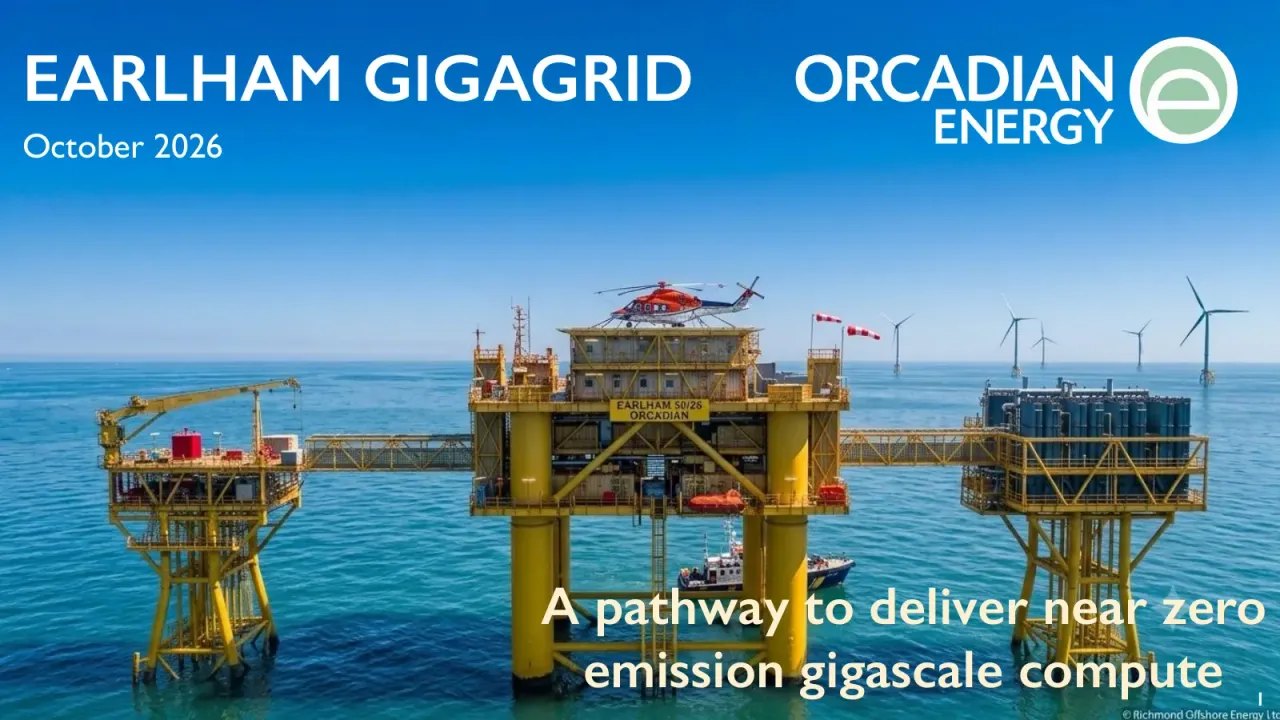
Update on the Earlham Gigagrid project hosted by Orcadian Energy (LSE:ORCA) on Investor Meet Company. Replay available.
On 6ix: 6ix.com/event/orcadian-energy-plc-orca-update-on-the-earlham-gigagrid-project
Automated transcript · Written by software from the replay's audio. It can mishear names and figures; the replay is the record.
0:01 Good afternoon, and welcome to the ORCADIAN ENERGY PLC investor presentation. Throughout this recorded presentation, investors will be in listen only mode. Questions are encouraged, and they can be submitted at any time using the q and a tab situated on the right hand corner of your screen. Simply type in your questions and press set. Before we begin, I would like to submit the following poll. I would now like to hand you over to CEO Steven Brown. Good afternoon to you. Thank you. Thanks very much indeed, and welcome everyone this afternoon. What we want to do is to give you a bit of an update on where we are in the ORCAG... GigaGrid project. That's actually quite hard to say. So, first of all, I'll show you the disclaimer. I won't leave it there for long, long enough for someone to stop the video and watch it, and move on to the whole purpose of this presentation, which is actually to bring you up to speak with what we've learned as we've been working on this project.
1:01 Because we keep learning things, and we wanna share them with you. And we've actually got some very good answers to questions that people come to us with. So why on earth put a data center offshore? I'd I'd say, at the end of this, you'll be asking yourself, why on earth would you put a data center onshore? Can an offshore power station work? Can a data center fit on a platform? How on earth do you do carbon capture so cheaply? And what is the power cost with this structure? So if you're interested, listen on. And even better, put another question in the in the chat. I have got some presubmitted questions that I will answer for sure.
1:48 But if you... Something occurs to you as I'm talking, please pass the question on, and the VOCA IMC will make it... Make sure I I get that. So let let me answer that first question. Why put a data center offshore? And the simple answer is that's where the energy is. It's where the gas is, which can be trans... Transformed into the electrical power. It's where the energy is. And one thing that data center operators seem to have learned in recent years is you have to be energy first. If you don't have the energy, there's no point putting a data center there. And the second reason is actually something I alluded to in the question earlier.
2:34 The private wire electricity price will be much lower than the grid prices, even including the cost of abating the c o two emissions. Another reason is we don't need to wait for high voltage transformers. The queue to get a high voltage transformer is getting longer and longer. And with a power station right next to the data center and no need for transmission costs, there's no need for those HV transformers. And importantly, the whole system can be completely islanded from the national grid, because securing grid connections is becoming more and more difficult in The UK.
3:24 The government has recently restructured how it does applications for grid connections. They're both costly and time consuming. And our concept is completely separate from the grid. So there's no grid integration to delay the project. And, actually, there are no neighbors to raise objections. The nearest neighbors are 10 kilometers away on the Davey platform, and you have to go a 100 kilometers to get to the beach. By being offshore, facility heat rejection is simple. It's just as difficult to cool the chips onshore as it is offshore because you have to use direct liquid cooling for the intensity of power on these chips nowadays.
4:16 But once you got the heat away from the chip, you then got to dispose of it onshore. And that means either using evaporative cooling, which nobody wants to do because that's using a lot of water, or you're having to use mechanical cooling with refrigeration systems and so on and so forth, which are noisy and high maintenance. If you're in the middle of this North Sea, you're sitting on top of a massive heat sink. In terms of administration, being offshore is much more straightforward. The petroleum license we have gives us the right... Once we have the right approvals from the government, to put facilities offshore for the exploitation of that gas field. And we think this whole project can be, approved with a single regulator, and our choice of, would definitely be the North Sea Transition Authority.
5:15 And as well as not needing planning permission and having no business rates, you don't have to buy any land. When you have the petroleum license, you have the right to put the facilities offshore. There's no one to buy the land from. And by going offshore, we've given ourselves acres of running room. There are more opportunities to install further power platforms and data center platforms, and there's opportunities to bring additional power from nearby wind farms. We're we're right in the middle of the Norfolk Boreas wind farm that RWE are planning. And there's definitely opportunities to integrate future data center projects with with that wind farm.
6:07 So I think the answer to put... Why put a data center offshore is well answered. In fact, why put a data center onshore? You'd have to be off your head. So can a data center work offshore? Well, the first question is, can an offshore power station work? That sounds like something new. Well, it's not new at all. Over the last half century, The UK's oil and gas industry has operated countless because every single platform has its own microgrid, that's delivering mission critical part. And you might wonder why is there a very nice picture of forties bravo and the sunset. That's because that was my platform back when I was a youngster.
6:57 1987, I ran production operations on that platform. The par system never shut down. That was partly because I had a great offshore maintenance engineer called Ron Chappell, and he did his job perfectly. But the industry knows how to run power stations. There's nothing to worry about there. The next question is, can a data center fit on a platform? Well, this is a little theoretical because what I'm showing you here, and look at the chart, is the par that's drawn through a rank according to the NVIDIA chipset that we're talking about. So if we go back a decade, just ten years, the NVIDIA chipset set was called PASCAL at the time, and it drew 12 kilowatts of power in a rack. And 12 kilowatts of power easily imagined is like having 12 toasters in your rack.
8:01 The the planned Reuben Ultra chipset that NVIDIA are planning to sell in 2027 draws 600 kilowatts per rack. And what that means is you need 50 fold fewer racks for your data center. So if you go back a decade and you imagine data centers, there are acres of land and square meters of, buildings and so on and so forth. You only need one fiftieth of that space now with the intensity of power going through the racks. The phrase people in the data center industry use is densification of the data center.
8:51 I hate using the word, but it's a really good, explanation of what's happening to data centers. And it's not just happening in the future, it's happening right now. So what I have here is a picture of the Colossus 2 data center complex in Memphis, Tennessee, operated by SpaceX AI, and they have three data center buildings at this location. They have three... One's called Mac... MacroHard. I think Elon was in a... Having a bit of a spat with Microsoft at the time, so he called it Microhard as a counterpoint to Microsoft.
9:39 The orange, data center in the background there is called Microharder, and the third one is now called Minihard. And that's planned to have, and the the figures are astonishing, 220,000 NVIDIA g b 300 GPUs that will pull, in total, 450 megawatts of power. But in terms of IT load, just 400 megawatts of power. That's gonna be about 3,000 racks, pulling about a 130 to a 140 kilowatts per rack. It's actually the same power that's in the Microharder building, but in a much, much less space. This building has 3,000...
10:26 312,000 square feet spread across four stories. That's actually in square meters. That's 29,000 square meters. So a 200 megawatt load would need half that, 14 and a half thousand square meters. Now put that on an offshore platform. If you had a 50 meter by 50 meter platform, you could you could put that all offshore in just six stories. No. Our plan is to have a higher power density, maybe 300 kilowatts, maybe towards the 600 kilowatts that, NVIDIA are aiming for. But it's amazing to us that already there is an onshore data center with the right level of densification to take offshore. It's not just theoretical.
11:20 It's practical. It can actually happen. And Elon Musk is doing it in Memphis, Tennessee. So we think, yes, it can definitely fit. Now the next question is, how are you capturing the carbon dioxide so cheaply? Now we've worked out from first principles going through the cost of different scenarios for our power station platform, how much more money we're spending, and we did it in in an NPV terms, discounted at 10%. We're working out how much more money we're spending to capture as much of the c o two as is sensible, which is about 95% of the c o two.
12:07 And we're spending about £11 a ton. Now if you go to OE UK's estimate of what CCS projects cost, it's in a range from 115 to £165 a ton. How on earth is it happening for so much less money offshore? And the answer is we're doing this integrated to the design of the, of the overall power generation package. There's no retrofit of equipment. And anytime you're retrofitting equipment, it's much more expensive. The system we've chosen, the Capsule GT, carbon capture system, which is based on a hot potassium carbonate absorbent, actually generate some additional power. So although there is power used to compress the c o two and reinject it back into the reservoir, we actually get some incremental power from the system.
13:16 Really importantly, there's no gathering costs. There's no transportation costs. We don't need to purify the c o two because we can deal with the corrosion issues through the selection of the right metallurgy in the pipework and in the wells. We don't need to purify it because we're not gonna transport it. We're gonna stick it straight back into the reservoir from whence it came. And the storage costs necessary for Earlham are an absolute minimum. So we're very confident that we can abate pretty much all the c o two from this power station for just 11 points a ton. Of course, we would do this even if it costs more because if you include the cost of the carbon taxes on a power station, you don't make any profit if you if you have to pay those carbon taxes.
14:17 And the way it works for a power developer is you want to build a system that has c o two capture and storage so that you avoid those taxes. I guess the taxes are doing what they're intended there. They are also putting up the cost of power for everyone, so maybe there's a policy question that needs addressing. But in terms of what we're planning to do in Ireland, we think carbon capture is the right thing to do, and it makes good economic sense for us to do it. Let's move on to the cost of, electricity from an offshore private wire. Now this is a little tricky to work out.
15:03 What we've done is we've put together cost... Internal cost estimates of, the wellhead platform and the number of wells we need to drill on the gas development project, and we've combined that with an estimate of the revenue we get for selling the gas, the current tax system, so on and so forth. And what we've done is... And rather than working forward from what the gas price is to see what the rate of return would be, we've worked backwards. We've said, for a a resource development project like this, you want to be targeting at least a 20% rate of return. And if we aim to get that 20% rate of return, we'd need to be selling the gas to the power station at 55p a third.
15:57 And that makes sense because the gas we're selling, the gas in Earlham is very high c o two. It's 49% c o two. So we expect to sell the gas at a discount because it's not purified. But because it's going straight into our power station and where we've selected turbines that can accommodate that high c o two, gas, there's no processing required. Right? I... This is my Elon Musk presentation. One of the things Elon Musk says is engineers waste an awful lot of time optimizing processes that shouldn't exist. We don't need to have a processing system for this gas. We can just use it at the, existing concentration, maybe blend in a bit more meat then just to get the, system working perfectly.
16:45 But we can sell that on process gas at a discount to the power station. And we've put together, an economic analysis of the power station. And this time, what we do is we put together the capital costs. We put in the operating costs. We put in the gas purchase cost for... So the the darker orange is the cost of buying Earlham's gas, and then we add in some blended gas from the grid because, actually, we're only 10 kilometers away from a connection to the overall gas grid. So planning that the power station continues to operate at full capacity for twenty years is actually a very sensible sum... Assumption. And we're assuming that we're... We'd have to pay 90p a thermo in the future for that gas.
17:33 And we're targeting for this infrastructure piece of the project, which is distinct from the resource development project, a 15% rate of return. So put all those bits together, then the price... The power station needs to charge the compute operator is a £124 a megawatt hour. So this is purely illustrative, but it's... It shows you how competitive the site can be in providing power on an islanded microgrid to the compute operator. Because if that compute operator was trying to buy this power onshore, the current price, what Desnet says the extra large consumer has been paying in The UK is £218 a megawatt hour.
18:25 And that's, the price of the price of the gas, the price of par from Earlham is turning out around 124. That's 60% of the current onshore price. So there's a real advantage in being in the offshore. So, we've done this analysis looking at a typical onshore site. That's actually a a a data center in Belgium. It's somewhere between two hundred and three hundred megawatts. So it's the right sort of size, compared to our offshore, plan. So when you're onshore, you're always in someone's backyard. There's always going to be issues you need to deal with by virtue of the location.
19:14 When you're offshore, you're in no one's backyard. So all those community issues have gone. You've got power from a dedicated gas field supporting a dedicated power station that will deliver power to you at the reliability you want to pay for. If you're onshore, you're reliant on the grid. And the grid's great once you can get connected to it, but you're gonna have to wait a long time to do that. If you're offshore with Earlham, you can be paying a £124 a megawatt hour rather than 218. You're in control of the emissions that are supporting your compute project. 90 to 95% of the c o two is captured and stored in the Erlum field.
20:04 If you're onshore, your emissions are defined by the grid emissions. And if you want to offset those, you have to get involved in some offset scheme or whatever. And my preference is always to engineer a better solution rather than try and greenwash the project. For cooling, if you're onshore, you're planning refrigeration systems and, air cooling and so on and so forth. If you're offshore, you're sitting on top of a massive free low maintenance heat sink. And security is quite an issue for data centers.
20:51 Kind of noticed they're becoming a bit less popular. So if you're onshore, you've got a big perimeter that you've gotta patrol, you've gotta pay attention to. It's actually... It's a large, pretty accessible facility that ends up being quite expensive to secure. When you're offshore, you've... You put a lot of water between you and anyone who wants to approach you. When you're offshore, you always have a 500 meter exclusion zone around your platform. If someone comes into that, if it's not a supply boat for you or a helicopter coming to land on the pad, then you intervene. You do something about it. And that 500 meters, zone turns out to be a 194 acres.
21:39 It's actually quite a big area, but it's a compact, site that's straightforward to secure. The only thing that's a slight negative for being offshore is it's a bit less accessible for the people who are gonna work in the data center and, pull out the server cards and chips and so on and so forth. I remember when I was a youngster, I was super excited to get in a helicopter and fly off offshore Chennai's ear to land on a... An oil rig. I'm sure there won't be any difficulty for the computer operators to find people who'd be really excited to work on an offshore setting.
22:26 So I don't think it's that big a negative, but it is the one that... One thing that is slightly more difficult by being offshore. And with communities, you have multiple issues when you're onshore. When you're offshore, the communities are too far away to be affected. But it's not just that simple comparison, that I wanna talk about. I wanna think through who in government, who are stakeholders in a a development project like this, and what are they getting out of it? Well, for us, we're the licensee. We have the license over the Earlham Gas Field and the Orwell Gas Field. And for us, it's great because that's... Low calorie gas is being monetized.
23:14 It's great for the wind farm operator that we're next to because let's get this project going. We can give the wind farm operator an alternate route to market for the power they intend to generate a 140... 100 and so kilometers offshore from the Norfolk Coast. For the communities, there's gonna be jobs. There's no noise, no disruption, no water used. It's great. For the offshore workers, these are gonna be long term high skill transition jobs, not just ones that politicians talk about, but ones where people could actually get hired. And for NESO, who is the national energy system operator, the people who run the grid, There's no grid connections. There's no strain on the grid.
24:01 This is a massive relief for them. For the people in government who want to deliver some sovereign AI where we have control of the data that AI systems are using within our own borders, we've actually got a viable option for a gigascale data center. Because we think, actually, the running room here is not just the 200 megawatts we want to build to begin with, but it can go to a gigawatt and beyond. And for Desnase, they'll have demonstration of a carbon capture and storage project proven without any government subsidies whatsoever. For an NSTA, who are the regulator for the oil and gas sector, they have two obligations to, that they have to satisfy. One is to support the government in their net zero obligation, and the other is to maximize economic recovery.
24:59 And this project does both. And finally, the compute operator, who's the partner we need to move this project forward, gets a secure data center site close to par, close to demand, and without any of the baggage that comes with trying to implement a data center onshore. So with that, I think I'll move straight on to questions, and I'll just take the, presubmitted questions first, and then I'll move on to questions that you you you put up on the screen. I can see one from James there already. So the first question is about this private wire electricity price.
25:50 And, fundamentally, it's asking what's the assumed capital cost, utilization rate, gas price, construction schedule, financing structure behind the estimate. And under what downside assumptions would the project cease to achieve the targeted 20% gas development and 15% power station returns? Well, if if the facilities cost more, if the resource was less, we might not achieve, the returns that we're targeting. If we deliver the facilities for less money, if the resource was higher, we would get a better return. So that's just a simple function. We we assume no financing structure. So it's essentially entirely an equity project.
26:38 And maybe that's a little negative. You may well be able to raise some debt against this project and get an equity return that's even higher at a smaller electricity price. So the the main thing I'd agree with 100% in that question is this is a highly competitive price. So, next question is what's the realistic critical path from today to concept selection, so on and so forth? What I what I think is once we secure the financing partners for this overall project, we think we can get to a a concept select report with NSTA, and that's the key next step for us. Within about six months, we understand the reservoir pretty well. We we need to get some new seismic, and we want to remap it, and we want to do some new modeling. We've worked out the work program there, and we need to do some engineering work on the gas plot... Platform, the power station, and the data center shell.
27:51 And once we have an agreed concept select report, what we move on to do is to prepare a field development plan and an environmental statement. When you do the environmental statement, you have to wait for consultees to come back with their comments, so on and so forth. And the minimum time it could take to do that is about another six months. Maybe it would take twelve. But I think we would have this project up and running between twelve and eighteen months from now, depending on financing, obviously. So moving on to question three on this list, can management explain precisely what aspects of Earlham's scope or timetable were incompatible with a former partner's near term priorities?
28:41 Well, I'll address the question around our, partner. You'll have seen the announcement where we said that we're not working with them anymore. They actually had a very interesting concept on how to approach the offshore compute. We were very interested in it and thought it could be very suitable. But it turned out that their pace of buildup was kind of like a few megawatts at a time, whereas we could see a way of slowing our buildup by maybe doing a 100 megawatt power station rather than a 200 megawatt power station. But it it really was what we said. The deployment time just didn't match.
29:26 So, we're still in conversations with all our partners. Every day, we get more people contacting us. It's actually very interesting and very exciting for us. Question four, beyond ORCALION, what's the next value realization milestones for the pilot interest, the CEREC operated fin license, our other assets? What strategy will management use to ensure the operational progress is communicated clearly and ultimately converted into measurable value for shareholders. But one thing I can say for sure is delivering measurable value for shareholders is all we care about. That's a 100% our focus.
30:13 We'll communicate clearly with shareholders once once we have something firm to communicate. For our oil assets and in particular, I think this asset is a little bit special. But for our oil assets in particular, like everyone else in the oil and gas industry, we're waiting for the government to approve the Rosebank and Jackdaw developments. It makes absolutely no sense in any world to not approve these developments. My frustration with the current government is immense, and I have to be very careful when I start talking about this because I could slip into a rant at any moment. So I'll pause there.
31:03 I think what will really make a big difference to ORCADIAN is seeing the oil projects can actually progress with the current government. The next question is wondering what's happening with HALO. Where are the promised acquisitions? What about IPC? We're supposed to finance all the Halo acquisitions. Instead, ORCA owes them money. Alright. Well, the reason we owe money to, IPC is that they purchased the Shell loan from Shell, which is a great help for us because it moved it from a near term liability that we needed to deal with. And IPC has been very helpful and put a date out at the end of twenty seven by which time we have to repay that. So I'm actually very happy with what IPC is doing.
32:02 I did take a little look at gas prices. And when we were focused on, acquisitions, the gas price was down around here. And to be honest, we looked at a number of deals and tried to progress against them. I would say that CEREC had did both of them. Right? And CEREC had did a very good deal with the spirit assets because they bought them here and closed the deal here. But look at the forward curve for the gas price. You're at the top of a a a ski slope here. And the first rule of acquiring production is to buy the assets a low price and sell the production at a high price.
32:50 It's much easier said than done, and the best deals are always in the past. The second rule is, and, actually, I I credit John Knight, who's executive chairman of Neo Next on this one. Always leave the decommissioning liability with the vendor. That's another thing. It's easier said than done. The third rule is always have a tax advantage. That's what Halo brings us. But as a sec... A rider to that, don't give all the value of the tax advantage to the seller. So if the question could have been summarized as is the Halo acquisition strategy dead? I'd say, no. It's not dead. It's just resting. And we we hope to bring that back in due course because we definitely want to realize the value from, from, the the tax losses that we have in Halo.
33:43 And then we have two questions about financing. Actually, on that, the second question about financing says, does the GigaGrid subsidiary structure allow third party capital to be raised directly against the ERLIN project while protecting ORCADIAN shareholders from material dilution at the listed company level. And I'd say you're spot on, absolutely, 100%. Our big preference is to raise money at the project level rather than raising money at the company level. We can't talk about future plans or things like that. And, obviously, we will do what we have to do in due course, but our focus is to try and raise capital at that subsidiary level so that we don't have dilution for shareholders.
34:38 So let me, move on to the questions that are in the in the q and a. James asked, how do you see the price differential of the electricity cost, and how sustainable is this? Well, actually, it... The answer, I think, is very sustainable. So this chart here actually shows, the relative position of The UK and U... Gas gas... Electricity prices over the last thirty, well, forty forty five years. So the the green band here is the range in electricity prices, p 25 to p 75 across the IEA countries.
35:33 The black line is the average. The blue line, which has the lowest cost electricity in the IEA, is The United States. The red line, which has the highest cost electricity in the IEA, is The United Kingdom. This is structural. This has been forced upon us by the approach to the transition project. And I did a little thing, which was I went and asked Gemini a bunch of questions about what what do you have to pay? What sits between the cost of generating power and the price at which it's sold to industrial parties? And, this is this is not something I've checked, not something that I've gone and done a lot of analysis in, but it's just what, AI, tells you.
36:30 And the the query I had to Gemini was how much do you have to pay for a 200 megawatt data center in Manchester? And, of course, I had to pick Manchester because, well, you just have to, don't you? So just to physically get the electricity from wherever it's generated to Manchester, the network and system charges are over £30 a megawatt hour. There's the transmission network use of system, the distribution use of system, balancing services use of system, There's capacity and standby charges. Then there's a bunch of government levies and policies, the renewable obligation, the contract for difference, the feed in tariff, the capacity market, the nuclear regulated asset base.
37:18 That's another 47.6 points a megawatt hour. You add them all up, amazingly, by coincidence. The difference between, a hundred and twenty four and two hundred and eighteen is 94 points a megawatt hour. You add all these up, they come to 93.75 a megawatt hour. This advantage is sustainable for a very long time, and it's the only way we'll actually get AI data centers in Europe is actually finding a way to islanded dedicated power generation systems, and the best place to do that is offshore. And then I have another question from Niall or Neil, maybe.
38:07 Do you think the delay in the n scale Loudoun data center because of grid capacity will change the narrative on offshore data centers? Absolutely. I 100% agree. So, nScale, we're planning, a 90 megawatt data center in Lawton in Essex. They've just been told that they can't get a grid connection until the mid twenty thirties. And if you... If you're in Essex, that's a really expensive place to buy electricity, because you're close to London. London is the hotspot for electricity. I think once people realize that being offshore is actually a lot better than being onshore, the narrative will change completely.
38:59 So, that's all the questions. Let me hand back because I think there's maybe a a poll or something like that that happens next. Thank you very much, Steven, for addressing all those questions from investors today. Was I just, actually just going to ask you for a few closing comments. Oh, right. Some closing comments. My closing comment is offshore is better than onshore. Offshore is the right place to have a data center. It's far from anyone. The, power cost is low, and there's no cooling problems. So come and talk to us. We have a great project here, that can re... May... Really make a difference for the AI industry in The UK. Thank you.
39:44 Fantastic, Steven. Thank you once again for updating investors today. Could I please ask investors not to close the session as you now be automatically redirected to provide your feedback which will help the company better understand your views and expectations. On behalf of the management team, we would like to thank you for attending today's presentation, and good afternoon to you all.
Follow Orcadian Energy PLC into a list and get an email when it puts out news.
CEO at ORCADIAN ENERGY PLC
CFO at ORCADIAN ENERGY PLC