Stephen Brown
CEO at ORCADIAN ENERGY PLC
Replay available
Investor Presentation hosted by Orcadian Energy (LSE:ORCA) on Investor Meet Company, held 2024-04-10.
On 6ix: 6ix.com/event/orcadian-energy-plc-orca-investor-presentation-1
Automated transcript · Written by software from the replay's audio. It can mishear names and figures; the replay is the record.
0:01 Good afternoon, ladies and gentlemen, and welcome to the ORCADIAN ENERGY PLC investor presentation. Throughout this recorded presentation, investors will be in listen only mode. Questions are encouraged. They can be submitted at any time via the q and a tab that's just situated on the right hand corner of your screen. Please just simply type in your questions and press send. The company may not be in a position to answer every question it receives during the meeting itself. However, the company can review all questions submitted today, and we'll publish those responses where it's appropriate to do so on the Investor Meet company platform. And before we begin, as usual, I would
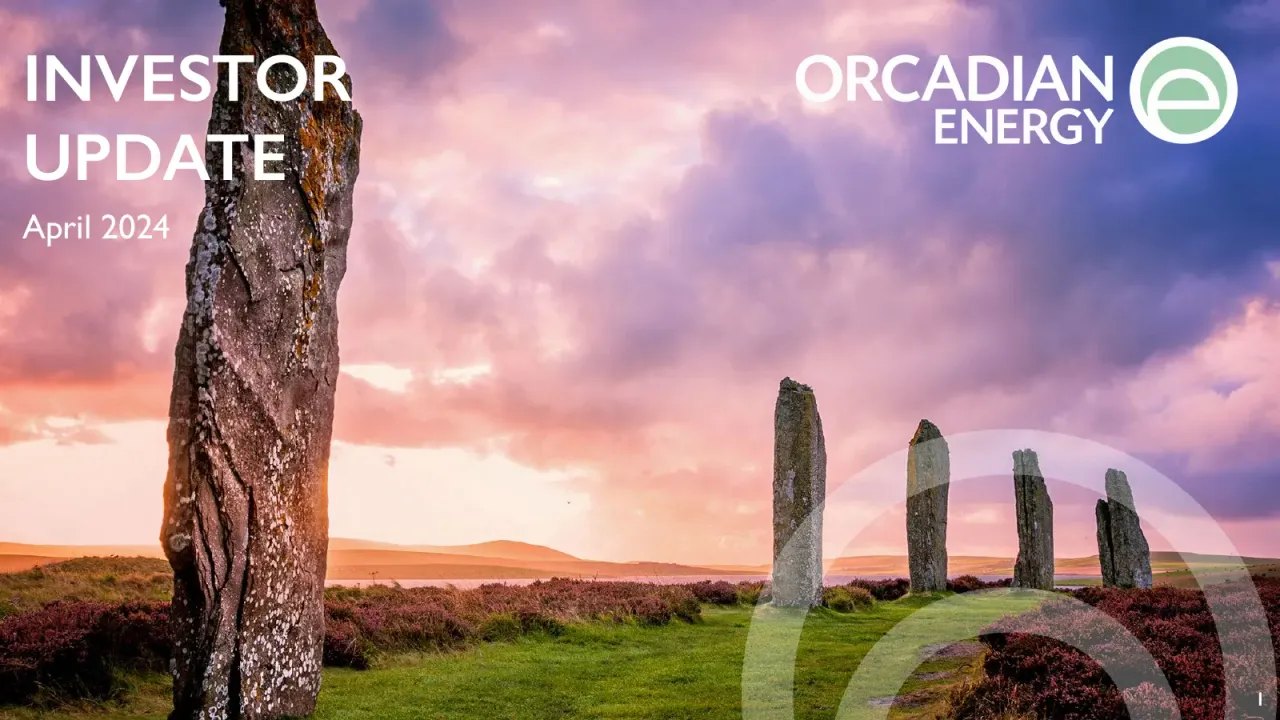
0:32 just like to submit the following poll. And if you'd give that your kind attention, I'm sure the company would be most grateful. And I would now like to hand you over to the executive management team from ORCADIAN ENERGY PLC. Steve, good afternoon. Good afternoon, everyone, and welcome to this investor update. What I'm showing you at the minute is a picture of the Ring Of Brodgar and the Orkneys. Sadly, we aren't there. We're in Serbenton, and Allan's in Leatherhead. But it's a lovely spring day here, and the blossom is spectacular. So spring is all about renewal, new tax years, and broker initiation notes. On that last point, Zoosk Capital published their initiation note on ORCADIAN this morning with a total risk NAV of 84 p a share.
1:21 And this update is about how ORCADIAN is transforming itself from a one trick pony where everything rested on successfully completing the pilot deal into a company with a broad portfolio of funded developments, innovative projects, and compelling prospects. I'll let you read that one at your leisure and move on to what our strategy is for ORCADIAN. Now, fundamentally, our main objective has always been to deliver a high return for our investors. And now that we've completed the deal with Ping, we'll do that by supporting Ping on the road to delivering FDP approval for pilot and getting that field into production.
2:10 But alongside that, we want to maximize the value of the Elkie license, which lies just to the south of Pilot. That could easily deliver a 100,000,000 barrels of oil, and we want to maximize the opportunity to develop that field as well. And since the thirty third round opened, a good while ago now, I can't recall actually when it opened. It was in '22. At the end of twenty two, it opened. We pursued as many opportunities as we actually have the capacity to do. And we've been delighted to get two offers of awards that we've received, and we're hopeful that NSTA will deliver the final tranche of awards. We were hoping it would be by the end of March. We now know it's probably the end of April, maybe early May, and we're very optimistic that we'll be we'll get three awards from three applications.
3:07 But I also just wanted to remind you of who's involved in ORCADIAN. So, obviously, there's myself. My background was with BP in the past. I'm a petroleum engineer. And, you know, what I really enjoy doing is putting together development plans that really maximize the value of an oil and gas asset. We've got Alan with us here. He's an accountant by background, but he's been involved in the small cap space and financing companies like this for a long time. And we have a couple of great non execs in Joe Darby, who used to be CEO of Lasmo, and Tim Feather, who helps navigate our way through, the market rules.
3:56 Morris and Dave make up the technical team. Morris is a great geoscientist, actually, absolutely first grade, and it's he who led all the work on those license applications. And Dave is a particular specialist in polymer flooding, that's really helped us find the very best way forward for pilot. That's the team, and that is the team. We've kept costs low, and we'll continue to do that. But I also wanted to explain to investors what our business is all about. You know, I always say that strategy is a combination of opportunity and capability. And what I would say our fundamental capability is is transforming resources, be the perspective resources or contingent resources into reserves.
4:52 And funny enough, that's actually the business of every single preproduction oil and gas company that you can invest in. And we think this chart's a really helpful way for investors to understand the preproduction oil and gas business. You know, most companies start on the left hand side with a gleam and a geologist's eye, a lead, then a prospect. And if it's good enough, it might get drilled, and with luck, you make a discovery. And there's always a lot of excitement with a discovery, but the next stage, appraisal, can be very expensive. You know, Pilot was discovered by one well in 1989, and the seventh appraisal borehole was drilled by Venture in 2007. And it's actually all that expenditure on appraisal that makes Pilot a project that's ready to take forward.
5:41 And to be honest, it's why I prefer to license discoveries that other companies have spent a fortune on than necessarily going all the way to the left hand side. But sometimes you see a prospect that's just so good, you've got to apply for it. So once you have a license discovery, all you then need is a good development concept and patience. Actually, a lot of patience, as you can tell from the length of time it's taken us to move the pilot project to the point where Ping is going to take it forward to FDP. But, eventually, you can strike a deal that sets those projects on a path to production, and that's the real champagne moment in the process.
6:28 And, actually, the real trick is to get through all these processes without having been diluted either at the asset level or the company level down to nothing. And that's a 100% our focus. Our focus is to absolutely minimize dilution as we move these projects from the left hand side of the page over to the right hand side of the page. So that's just a little bit on what I think our fundamental business model is and how we go about our business. Let's review, the assets we actually have. So, obviously, the core asset is pilot. It's still pilot even though we're we're now down to 18.75% interest. We're delighted to have such a significant interest in the project and to be carried all the way through to the first offload of production.
7:26 And that field has, in the past, had two p reserves of 79,000,000 barrels. Post farm out, we're gonna classify those as two c contingent resources development pending to be consistent with how Ping treated. And the net resource we have based on those sprule gross numbers is about 14,000,000 barrels. That feels really well appraised. There are no more money to spend on appraisal. It's just putting together the detail of the plan. You know, the most important thing for Ping to do is to select the right vessel for developing pilots. And I'll talk a little bit more about what that plan looks like. But it's not the end of us the story. We actually have, 53,000,000 barrels of contingent resources in Elk and Norville, and there's actually appraisal and exploration opportunities around Elk, which could easily double that resource base. So we think Elk actually can be a bigger development than pilot.
8:34 And we got two thirty third round offers of award, which I'll talk about a little later, so I won't dwell on them here. Let me just remind you of one of the, summary slides on pilot. The field was discovered, as I said, by FINA in 1989. It's appraised by five wells with two sidetracks. There's lots of very good seismic data on it. What I'm showing on this map is actually a particular seismic up attribute called relative extended elastic impedance. Remember that phrase. We also refer to it as REI CHI 27. And what it does is it it gives you an indication of where there's gas in good sounds, and that's where it comes up orange.
9:28 It gives you an indication where you have, either shales or water bearing sands, and that's the dark blue. But it also gives you an indication of where you have good sands full of oil, and that's the cyan spot, sort of speckled color that makes up the the main body of the pilot field on this. And this attribute is utterly fantastic at telling you where, you have oil bearing sands. And, actually, there's a minimum thickness. So, for example, the the 21273 well just to the west of Pilot found 10 foot of oil, not enough to be commercial, and that shows up as dark blue on this map because you need to have eight meters, 24 feet, 25 feet of oil bearing sand before you get a response.
10:27 So it's a really good predictor, and it's a really helpful, tool for planning development wells and also for identifying prospects in the area. Pilots got, over 250,000,000 barrels of oil in place. A polymer flood will get about 40% recovery within the developed area. We're confident on the rates we'll get from these wells because one of the wells that was tested on pilot produced 1,800 barrels a day from a horizontal short horizontal section. And we're also really confident in polymer because cap on the Captain field, Chevron and then now Ithaca have been enjoying consistent success applying polymer flood across Captain.
11:17 So, there's a lot we learned from, Ethoca on on the CAPTIN project, but we're very confident that that's the right way to develop this field. And we're gonna develop this field with our new partner, Ping. So we completed the transaction, to form out an 81.25% interest in this license to Ping on the March 31. Actually, at around about 2PM in the afternoon, There were no Easter eggs for me on Easter Sunday. That's not entirely true, but, you know, it's a carried interest. It's it's a carry that's repaid out of a reduced revenue interest for us to begin with. There's also some tax advantages built into the agreement, but we're currently not relying on any of those tax advantages in our economic evaluation.
12:15 The upshot of this deal structure is that, essentially, we have 18.75% of the NPV of the overall project, but without having to find the money to develop it. Ping will find the money to develop it. And, NSTA gave us a two year license extension to November 25 as part of bringing Ping in for the project. And NST have been incredibly supportive throughout this whole process. They really like the polymer flood approach, and they really like the ideas we have to reduce emissions on on this new project. And maybe it's worth me just mentioning something important in a in the NSTA plan.
13:04 You might have read some articles about this, but, when the NSTA published their recent plan, they're kinda segregating the existing fields into two types. There's going to be producing fields that are electrified and are low emissions, and those will get full support from NSTA to maximize economic recovery. And there are going to be fields which are not going to be electrified, and those those fields will have to set a cessation of production date, and that will be fixed. So the North Sea is gonna split into two groups. There'll be the electrified fields and the nonelectrified fields. And it'll be the electrified fields that everyone wants to own, and all new developments will have to be electrified.
13:53 So, we we see actually this shift in the NSTA plan being very supportive of bringing new developments, new electrified developments on stream. And, you know, we see it's very important that we find renewable energy to support, the, power consumption of our FPSO on pilot. There's a number of ways we can do that. We can either have a dedicated wind turbine, but there's actually a couple of planned wind farms nearby that could supply renewable energy to the pilot FPSO. Ping have been at the forefront of looking at using renewable energy and wind power in particular to support other development projects they've been looking at. So we think they're a great partner to take this forward.
14:47 They've also helped us optimize the development scheme and pilot, and they see an opportunity to reduce the upfront costs substantially by starting with a tranche of subsea wells. And the current plan is five subsea wells before first oil and another five subsea wells straight after first oil, and then eventually adding a platform and, completing the drilling program over the whole field. Because to develop pilot, you need a lot of wells. That's one of the characteristics of it. Our production profile, we think we can start at about 10,000 barrels a day, build to about 20,000 barrels a day, and produce 20,000 barrels a day for about ten years. So that's actually a great characteristic to have in a any development project.
15:38 You know? Normally, want to get the all the oil up front as quickly as possible. The risk in that is you have your one or two years on plateau. And on the in the plateau years, it's turned out to be, the year that oil the oil price goes negative or, you know, you're down to $30 a barrel just when you're having all your peak production. If you've got a long plateau as we have in pilot, you're bound to have some low prices, but you're also bound to have some high prices. And on average, you're gonna have a decent return. So we think that's actually quite a nice characteristic. But one of the other things we discovered as we were working with Ping is that by adjusting the polymer concentration, we can reduce the fluid handling requirements on the FPSO.
16:25 And, before we were working with Ping, we were looking at an FPSO that needed to handle a 120,000 barrels a day. But now we think we can get away with a vessel that can handle 50, maybe 60,000 barrels a day of fluid handling capacity. And that's another significant reduction in the upfront cost of the project. So I'm gonna give you a bit of insight into what the value of our remaining interest in this project actually is. So, this chart and I I admit to having shamelessly copied the format from a jersey presentation. I don't mind admitting that. It was a really good format, and I like to steal good formats.
17:13 Our total revenue is approaching and, like, this is ORCADIAN share of revenue. It's approaching $1,400,000,000 over the whole life of this development, And repaying the carries really doesn't actually take that much out of that initial at the total revenue number. There's obviously, you know, a fair amount of OpEx and polymer costs, and we'd be saying our EBITDA was about $800,000,000. You take off the the CapEx that's involved and your pretax cash flows over $600,000,000. And assuming that EPL goes away as legislated in 2029, we'd be left with a post tax cash flow for our share of $390,000,000.
18:09 And this is all run at a $70 oil price. I think current oil price is about 90. And on an NPV basis, our share of the pilot project is about a $140,000,000, which as you'll notice is a tad higher than our market cap. So bear that in mind. So Pilot is a fantastic project. It's great to have in our portfolio. Ping is a great operator. We're really looking forward to taking the project forward with them, and we're really looking forward to seeing that value delivered for all our shareholders. But it's not the end of what we have.
18:54 You know, we have this license to the south, which has the Elkie and Norville fields on it. Elkie is just was discovered by this well here. It found a 100 feet of oil. Normal was discovered previously by ORCA. This also found a 100 feet of oil. It's not covered by three d data, though. So we don't have good three d data on it. And this map we're showing here is actually, a map that EnQuest previously prepared prepared when they were looking at this asset. And they were looking at the ultra far amplitudes as an indicator of oil bearing sounds.
19:44 But we've taken a look at the relative extended elastic impedance map, and it tells us some very interesting things.
19:56 And what I'd like you to do is just keep an eye on Elkie North. And what you find is when you look at the REI map is Elkie North disappears. And for me, that's actually really telling because it's telling me where not to put a well. This part of Elkie, Elkie main west is definitely oil bearing. Elkie update is that looks like it's oil bearing. We don't have the REI attribute just over this little part, and we don't have any three d over normal. But we think, you know, there's well over a 100,000,000 barrels in the proven segments and the segments that are supported by this relative extended extended elastic impedance attribute.
20:53 So we're excited about LK, and we're we're actually focused on how we can move that project forward as fast as possible. And we're also delighted by the outcome we've had so far on the thirty third round. So we actually participated in the rounds, and we pursued three license applications. One, we did in partnership with Parkmeat. Actually, Parkmeat led that license application, and we were awarded the fin discovery. Finn Bewley is a very large discovery, and it lies halfway between Piper and Claymore. It's a viscous oil. It's quite a tricky oil, but the opportunity is huge. We then applied for some shallow gas opportunities, in the Mid North Sea High. We did that in partnership with Triangle Energy who are an Australian company.
21:51 There's some very compelling leads and prospects there with about 270 BCF of gas in two just two of those prospects. And then the third application we made, which has not been determined yet by NSTA, has a discovery with a 114 BCF of sales gas that could it be developed as a potential gas to wire with carbon capture project. We're quite excited about that. We think that's a project even Ed mill Miliband's gonna love. And we also have a compelling prospect with a 153 BCF of prospective resources. Well, we don't have it. We've applied for it, and where fingers are crossed, and we're hopeful. And, obviously, I can't guarantee that we'll get that. And we're now expecting these awards in early May.
22:42 And I don't know how many times I've told people when NSTA expect to make these awards, but one day, they will. So I'm gonna tell you a little bit more now about, Finn Bewley and then a a little bit more about this, Mid North Sea high opportunity. So, I said it was big. It's over 900,000,000 barrels in place. It was actually discovered in 1974. There was one well tested by BP in 1977, and it did flow a 10.6 API oil at 10 barrels a day. So we're expecting a a viscous oil in this reservoir. It's a pretty good quality reservoir.
23:28 We're expecting a viscous oil that has viscosities probably between two and a half 5,000 centipoise. That sounds very high, but actually in Alberta, they're successfully polymer flooding oils that are over 10,000 centipoise. So it's definitely possible to produce this kind of oil. The recoverable two c resource is 292,000,000 barrels, but we don't have all of the acreage. There's only 257,000,000 barrels on the blocks that we've been offered. And we're looking at lots of different opportunities, including downhole radio frequency heating to just warm the, oil that's close to the wellbore so that we can get good initial rates and actually using geothermal energy to warm the injection water so that we can reduce viscosity in the reservoir. You know, it's possible to actually reduce the viscosity by about 90% by increasing the temperature from reservoir temperature from about 30 degrees centigrade to 50 degrees centigrade.
24:39 There's actually another heavy oil reservoir above that. Maybe that one's too difficult to develop offshore, but it's there. And the license also includes the lowlander and midlander discoveries, which are high h two s discoveries that could possibly be tied back to other infrastructure. They weren't the main target we were going for, but it's always nice to get another discovery in your portfolio. If I move to the South now and look at the quad 20 nine shallow gas, we've identified, on seismic that we got from TGS. TGS actually gave us a preview of all their three d seismic over this and helped support us in the license application. They've been a fantastic partner to us, actually, on on all the work we've been doing in pilot and LK and so on, but also here.
25:32 We've identified two major prospects. One's called Glen Loch. It's got a 131 BCF and a pretty low relief structure. It's very similar to the Aviat field that Apache are developing to supply gas to forties. And then there's another prospect called Breka, that's got a 138 BCF and stack sound, very analogous to a series of Dutch, shallow gas fields that are currently on production in The Netherlands. And, you know, we're optimistic that these prospects do actually have gas in them. We've got some ideas on how to derisk it further before there's any drilling.
26:18 And development would actually be fairly straightforward. You know, you'd you'd use you'd have compression. That's one of the features of shallow gas. You start at a low pressure, so you have to start with compression. But we could tie into t number six on the cat's line and export gas into the into the grid that way. And we think there's opportunities to use renewable energy to provide the power for that compression when the wind's blowing and actually back it up with gas power, when the wind's not blowing. So we're quite excited about this and, looking forward to talking to other companies about forming into opportunities here and to farm into opportunities on Finbuhle.
27:06 So, you know, we've been very diligent in trying to expand our portfolio and increase the number of opportunities that we're looking at. And this here is an update on what our resource position now is. And, I've ordered this table so that the prospects are on the left hand side and the projects that are just development pending are on the right hand side. And what I can say to you is that the barrels on the right hand side are a lot more valuable than one the ones on the left hand side. So, obviously, there's a huge amount of value in those contingent resources on pilot, Now a $140,000,000 NPV 10 at $70 a barrel. There's a lot of value in the contingent resources that are sitting on LK, and a lot of value to be had by taking forward the prospects that are sitting around that.
28:02 And Glen Loch and Breca net to us are another, you know, 20,000,000 barrels of oil equivalent. So 130 odd BCF of gas net to us. But a really big number on this page is the our share of the Finbuhle discovery. So we actually have over 200,000,000 barrels of contingent resource. You won't find many other companies, listed on name that have similar, scale of resource. And we've got, you know, nearly 75 b c 75,000,000 BOE of prospective resource, about 50,000,000 on a risk basis.
28:49 So we're talking about a resource base of 250,000,000 barrels and a very, you know, a very important part of that carried all the way through to First Oil. So just in summary, you know, March 31 is a watershed day for ORCADIAN. We completed that transaction with Ping Petroleum, and, you know, the company future is fundamentally underpinned by the carried interest in the pilot project. But we've been building what I think is a great portfolio of funded developments, innovative projects, and compelling prospects. Now I said I said previously, there are some big changes coming for the North Sea.
29:37 You know, if you're if you're if you own production in an asset which is not going to electrify, you're not gonna be able to push out the COP gate any longer. Those are going to become actually very difficult assets to own. But new developments, new electrified developments will be the ones that people want in the future. And we focus on licensing as many opportunities as we have the capacity to pursue. And the reason we did that is we expect a licensing hiatus under labor. I think projects will go ahead. I think prospects will get drilled, but I'm pretty sure that labor won't be running any license rounds for a little while. So we wanted to get our hands on as much acreage as possible in the in the time available.
30:26 And I've got one other thing to point to. And, you know, I shouldn't read these bloody things, but, I read, the LSE board sometimes and the ADVFN board. And one of the punters there said, we spent money like teenagers. Now my teenagers are very responsible, so that was actually quite a compliment. But, actually, all my teenagers are now grown up. They're in their twenties and thirties, but we've glossed over that point. To acquire that 200,000,000 barrels of contingent resource and 50,000,000 barrels of risk perspective resource, We, a company, have spent have raised $9,000,000. And I I would advocate you go and have a look at all the other companies who are boasting either contingent resource or prospective resource in The UK and see how much money they raised to acquire those.
31:25 So we're always gonna be low cost. We're always gonna be focused on keeping the cost as low as possible. And the higher the market cap, the happier we, as managers and shareholders, will be. So that's the summary of the story, and I'm now ready to move on to the questions. And I understand that there are actually six questions that were presubmitted. So what I'll do is go through those to begin with, and then we're we'll be open for questions from the floor as it were. Perfect. Steve, Alan, if I may just jump back in there. Thank you very much indeed for your presentation this afternoon.
32:16 Ladies and gentlemen, please do continue to submit your questions just by using the q and a tab that's situated on the top right hand corner of your screen. But just while the company takes a few moments to review those questions that were submitted already, I would like to remind you that a recording of this presentation along with a copy of the slides and the published q and a can be accessed
32:33 via your investor dashboard. Steve, Alan, as you as you say, we did receive a number of presubmitted questions ahead of today's event. And as you can see there in the q and a tab as well, we have received a number of questions throughout your presentation this afternoon. So firstly, thank you to all of those on the call for taking the time to submit their questions. And, Steve, Alan, at this point, if I may just hand back to you to address those questions where it's appropriate to do so, and I'll pick up from you at the end. Thank you. Very good. Right. So let me just move that on. Right. So the first question, and I'll read the question out just as as it's posed, and then, I'll go through I'll go through the answers. So on the Finbuhle oilfield, it's mentioned that yourself and partner will be assessing the feasibility of reducing the viscosity of the oil with maybe incorporating a geothermal system. Has this technique been used in any other global oilfield?
33:32 What is currently the heaviest oil that's being produced globally from under the sea? Well, funny enough, I have a slide on that. There's a lot of heavy oil produced offshore and some in Mexico that is even heavier than that at Finbulli. So Finbulli was measured at 10.6 API when BP tested the fourteen fifteen two well in 1977. And the Ayatsov field, which is a billion barrel field in Mexico, has a range of APIs from nine to 12 API. It's also in a carbonate reservoir, which makes development much harder, but it's it's producing very well, over a 100,000 barrels a day.
34:28 But actually not on this slide because the development's still underway. There's another field, the Keyav Field, again in Mexico, which is eight API. And Pemex are planning to spend $18,700,000,000 to develop a resource here of about 500,000,000 barrels. So there are many examples of heavy oil being produced offshore and actually some examples of much heavier, extra heavy oil, that's the phrase that people use to describe it, being produced, offshore. But the question was also about, you know, how does geothermal help you here? And is there are there any, geothermal developments happening offshore. I don't believe there are geothermal developments happening offshore, but the the using heat to increase reservoir temperature is is very well proven. I mean, all you have to do is look at all the steam projects.
35:35 But also injecting water at a higher temperature to reduce reservoir for viscosity is a proven way to improve recovery. And I've got another slide just to show illustrate that. So this is actually the thin oil viscosity range versus temperature. And we we have a set of custom correlations that we use to predict oil viscosity because we've thought a lot about it. And we use combinations of the Bennison and Petroskin, Farshad, and Begs and Robinson correlations to come up with predictions of oil viscosity at different temperatures, and we calibrate it to actual viscosity measurements, which are, you know, done in the lab at specific temperatures and with specific, amounts of gas recombined with the oil.
36:27 And based on the data that we have on fin, we think that yellow box on the left hand side, on a logarithmic scale is the range of viscosity we expect. And one of the things that a logarithmic axis does is it disguises just how dramatic the reduction in viscosity is if you can increase the temperature. So we took the reservoir temperature from about 80 degrees Fahrenheit up to a 120 degrees Fahrenheit. So that's 30 degrees c up to 50 degrees c. You go down to a few 100, centipoise. That's that's the same as, Mariner and a a number of heavy oil fields that are already producing.
37:15 So we really think this this will work. And we really believe that using hot polymerized water could easily get recovery in, fin up to 30 or 40%. So, that's that's the end of my extra slides to answer the fin question. Let me move on to the second question, on the list. And once again, I'll just read the question. Hello, everyone. Firstly, congratulations, Steve and the wider team at ORCADIAN on the progress and completion of the farm out deal with Ping Petroleum. Thank you very much. Whilst it is disappointing that the share price has fallen back firmly at the time of submitting the question, it's not a surprise as many will have taken the opportunity in making a quick profit.
38:04 Apart from that reason, there are assumptions that a cash raise will be announced, which could also affect the share price. Can you advise what is the current monthly cash burn and if the money's forthcoming from paying will be enough to ensure no fundraisers required for the foreseeable future in order to fund general costs and the eventual repayment of the shell loan? Thanks, Gary b. Right. You're right to ask this question, but I'm also right to be very cautious in how I answer it. I mean, what I can say is that we're looking at multiple options to ensure that the company has the cash it needs to meet its obligations and to progress the projects we have under license and the licenses we expect to sign as part of the thirty third round.
38:51 What you gotta remember is we're substantial shareholders, and we will always favor deals and structures that minimize dilution. So the Ping deal is transformational for the company. Now previously, we really only had one thing we could do, which was to issues little bits of equity to keep the company on track, but it opens up many possibilities for financing the company that just weren't available to us before. So, we're working on that. We won't say any more about it at this time. In due course, we'll mess up we'll we'll have more to say. So that let me move on to the third question. With a considerable payment to follow FDP approval, I imagine it's fair to assume that this will be the main focus of attention over the coming weeks and months.
39:39 In a best case scenario scenario using all your expertise, experience, and subject knowledge, what would you consider to be a realistic time frame to both plan submission and the likely time thereafter for approval using other North Sea developments as a rough guideline. Thanks. So, you know, we expect FTP approval sometime during '25. And our focus with Ping in recent weeks has been a 100% on getting this deal over the line and bringing all our partners like TGS with us. We're there now, and the next phase is actually settling on the right vessel for pilot and pulling together a field development plan that works for NSTA, OPRET, as the office of petroleum regulation for environment and decommissioning, ping, and ORCADIAN. So we'll help with the subsurface reservoir engineering aspects of the FTP as we've already done most of the work.
40:37 And what we'll be doing is up optimizing the well patterns and polymer concentrations to fit within a specific vessel's fluid handling capacities. And one of the things I've learned not to do is to predict exactly when things will happen. So I'm not gonna say exactly when we think it'll happen, but we do expect it in '25. Next question, four. Curious about the polymer flood process. With many other industries, it's normal for companies to protect their technology using patents. Watching a previous presentation, you talk about Ithaca having success using polymer flood. Is ORCADIAN's method going to be different, or does patent do patents not apply for some reason? Also, looking ahead, will ORCADIAN be able to grow future revenues by offering their expertise in the process to other companies?
41:27 So, you know, oil companies do sometimes try to patent particular approaches, but they're actually quite hard to get those patents. And in most cases, the technologies sit with the service companies, and the technologies and patents sit with the service companies and suppliers. And, you know, one of the ways we really understand what's going on on, Captain is by talking to Camera and SNF who both supplied polymer to Chevron and Ithaca for Captain. So we benefit from what those companies have learned on Captain. And we also have direct contacts with Ithaca, and we fund the team there really open to sharing knowledge and learning. And they they also publish a lot. They publish a lot of papers, and, we avidly read all those papers.
42:13 So, you know, we we don't really think that we would be selling our expertise to other companies from for a day rate. That's not really my plan. But we might well be able to leverage our experience to access other opportunities. So there there is actually potentially value from what we've learned in this whole process. I mean, what we've learned in pilot has really informed us about how to approach the opportunity. So you can see how that that's actually created one of the main opportunities that we have in front of us. So on to question five. With m and a activity happening elsewhere, do you feel ORCADIAN could end up being on the receiving end of a future takeover bid before first oil, or is it more likely that the business grows as is if a takeover was mooted?
43:09 What do you feel would be a valuation starting point for serious consideration? Thanks, Gary. That's an interesting question, Gary, but you don't really expect me to give a bitter a target price, do you? No. We went out of our way to try and capture as many opportunities as possible in the thirty third round. We're batting 66% just now, and with luck come the end of April or early May, we'll find out if our third application was successful. And we also intend working with Ping to relicense some of the discoveries and prospects that we saw around pilot. Of course, that's all competitive bid process. We can't guarantee the outcome. But, you know, as I said before, we have 50,000,000 barrels of oil equivalent in risk perspective resources and over 200,000,000 barrel of contingent resource with about 14,000,000 barrels carried all the way to first oil, you know, that potential's worth a lot of money. So the target price for a bidder is quite high.
44:11 Right. So I'm on to question six. Can I draw your attention to the statement which was taken from a an ORCA shared chat forum? I must stop reading those. Could you please respond and explain the loan conditions so that anyone who may have seen them can have an official response that can give closure? So the quote begins, Shell doesn't trust Steve and has demanded conditions that I haven't seen before. That says it all. Thanks, Kerry Gary. So you're absolutely right that a director giving a personal guarantee is unusual, but it would be a mistake to draw the conclusion that Shell doesn't trust me. I would say we have a healthy respect for each other.
45:00 And suffice to say, I provided that personal guarantee to ensure the deal was being completed and to maximize value for all shareholders. So a couple of questions that have been submitted so far, and this is from Giovanni. I believe that the company is massively undervalued at the moment as several experts working in the oil industry expressed their view to me that a fair current value for the company is in the region of 50,000,000. Do you have any idea why the share price has been decreasing each time good news arrived? Even last week, there was a bit of a jump in at the same prices before the r and s, also considering that last week's news was a massive milestone for the company.
45:49 So, you know, we were a little puzzled by the muted reaction to the, you know, what we think is absolutely transformational news that we released on the April 2. And I think on Monday, we find out why the share price softened after a pretty good rise last week. So Woodland Capital sent a t r one, indicated they've been reducing their stake. And, you know, one way to look at that is it's given lots of new shareholders an opportunity to buy shares in a post deal ORCADIAN, a pre deal ORCADIAN prices. You know, once Woodland has, finished selling their stake and the those shares are in the market rather than with the market makers, I'd expect our share price to rise again.
46:35 But, you know, I'm not making any predictions because that's that's that's a fool's game. And the second question here from Giovanni, in this scenario, while the company is so undervalued, do you have any concerns about receiving a takeover bid offer and being bought cheaply? I sort of answered that already, but, you know, I'd say I'm confident that any potential bidder would realize that to be successful, they'd have to pay a fair value for our portfolio. The, you know, the board own a lot of this company, and we won't sell it cheaply. Of course, we'd be happy to sell at a high price, so, you know, that would be good. And I think we've got the last question here from Janice m is the question is, is there going to be a placing to raise further capital in the near future? Well, I'm sure you understand, Janice. I can't actually answer that.
47:30 What I said is we're looking at lots of options, and we're very focused on options that minimize the dilution in the in the company. We're very, very focused on that all the time. But equally well, we have some obligations to meet, and we will do what's necessary to meet them. But it may well not be a placing. So I think I've finished all the questions unless anyone types in something very quickly. But I'll hand back to oh, I've got another question here. I yeah. So the first question is, will ORCADIAN be charged an interest rate for the carry? If yes, what is it? So it's 8% above SOFR.
48:16 It's what the interest rate is. And that ends up being pretty close to what the discount rate you'd use in an NPV calculation. So that's why our NPV is roughly the same as it would be if we just had 18.75% of the project. With all the knowledge available today, what would be a realistic first oil date for pilot? Well, what I'm I'm saying earlier is we think 2025 is when FTP will happen. It all depends on exactly what the plan is, and there are certain plans that could be implemented a bit quicker. But it's possible you know, it three years is kinda typical period for a project of this scale. It might be possible to get it done in a couple of years, but, you know, I'm thinking 2028 for First Oil.
49:12 And has ORCADIAN considered what dividend policy it intends to pursue once there is free cash flow? And to be honest, we haven't put our minds to that, though once we have cash flow, we would definitely want to be paying dividends. What the policy is, you know, is it 50% of free cash flow or what it I think that that's something you can only answer at the time. But once we have free cash flow, we would like to have a dividend. So I think that's now all the questions, and I'll I'll hand back to our friends from IMC. Perfect, Steve. That's great. And thank you very much indeed for addressing all of those questions that came in for investors.
49:57 And, of course, if there are any further questions that do come through, we'll make these available to you immediately after the presentation has ended, just for you to review to then add any additional responses, of course, where it's appropriate to do so. We'll publish all those responses out on the platform. But, Steve, perhaps before really just looking to redirect those on the call to provide you with their feedback, which I know is particularly important to yourself and the company, if I could please just ask you for a few closing comments to wrap up with, that'd be great. I think I've used up all my words. I don't have any words left. I've been delighted to have the opportunity to tell you more about the ORCADIAN story. And what it is I think we're really good at, which is, you know, identifying fantastic prospects and identifying opportunities to develop fields in ways that others have missed, and also to, talk to you about the other opportunities in the portfolio that actually build on the success we've had on pilot.
50:55 So, I'm always happy to come along and do these, presentations. I like to do them when there's something new to talk about. Maybe maybe I'll be back again in May if we actually get this other license that we've applied for. So thank you all for your attention, and good afternoon. Steve, that's great. And thank you once again for updating investors this afternoon. Could I please ask investors not to close this session as you'll now be automatically redirected for the opportunity to provide your feedback in order the management team can really better understand your views and expectations. This will only take a few moments to complete, but I'm sure it'll be greatly valued by the company. On behalf of the management team of ORCADIAN ENERGY PLC, we would like to thank you for attending today's presentation. That now concludes today's session. So good afternoon to you all.
Follow Orcadian Energy PLC into a list and get an email when it puts out news.
CEO at ORCADIAN ENERGY PLC
CFO at ORCADIAN ENERGY PLC