Transcript
Automated transcript · Written by software from the replay's audio. It can mishear names and figures; the replay is the record.
0:08 Hello everyone and welcome to this Capitolite live event hosted by 6. I'm pleased to introduce the speakers for today, CEO Brian Voss and Director Douglas McQuarrie. Douglas is joining us from a little bit of an interesting setup here, so bear with us. But we'll be showing you some new footage from site discussing a newly discovered zone there, And after that, we'll be accepting questions. As a reminder, you can submit your questions in the chat at any point during the event. As always, this event is being recorded and will be available on six.com to watch shortly afterwards. And without further ado, I'll kick things over to you, Brian, to get started. Yeah, thanks very much.
0:47 For those watching, of course, there's Douglas right there. You can you can see him. He can hear you and and you can hear him
0:55 He's he's in a different part of the world than I am right now, I'm in remote Quebec. I'm at the exploration camp right now. I'm in the shed and Through the star link. We're all hooked up here I'm up at the camp for a couple of reasons one of which was because of this new zone which we're calling the Cancun zone It's named Cancun because if you look at our entire 450 kilometer squared claims map, it's down in the south. It's in the south. So it got called Cancun. And then I started the video at the airport. One of the big things was, as Douglas correctly pointed out months ago, the area that we're looking has, you know, 6 inches to a foot of soil and plant life. So we're using beep mats to find the conductors underneath and we needed more beep mats. So when we start, we'll roll this video in a second, it starts with me at 5 a.m. In the airport at Pearson loading my 4 beep mats into oversize and then as we go through I'll tell you who you're gonna meet.
2:06 When I get out of Pearson and I get to the airport in Wabush, you're going to meet a young man named Mackenzie. Mackenzie is a technician in Quebec. He's not a geologist in Quebec. He's on the geology team. He's a technician. And then later on when I get to camp, you're going to meet 3 people working with us. Joannie and Miguel, those are both geologists in training in Quebec. And then Jenna, who is the geologist in camp at the moment. You may have met Pierre-Luc in the past and if not we'll try and get him on future events. He is also a geologist in Quebec and of course Douglas keeping watch over everything. So with that I would say unless Douglas you have comments let's roll tape. Morning everybody.
2:55 This is the start of another one of our online event videos. It's 05:00 in the morning on Sunday, September 22. What are we doing? We're dropping our beat mats, which you've heard about before. Dropping our beat mats into the oversized luggage in Toronto Pearson Airport. We're doing that because from the exploration camp the call has gone out for more beatmaps.
3:20 Send more beatmaps. And the reason why is because an entirely new mineralization zone, which Douglas had theorized on a map, has now been found with copper in it and it was found by dragging the beat map over the 3 kilometer long electromagnetic conductor that Douglas can see in the data set for when Anglo-American flew the electromagnetic survey in I'll say 2014 I don't know exactly the year. So we're loading up more beatmaps we're taking them out to camp this is the start of our video set for this week. See ya. Hey everybody again so we're in Wabash we just picked up our beatmaps We have 4 of them going now.
4:07 And I'm actually happy to have bumped into Mackenzie in the airport. So Mackenzie was the geotechie working with the geologist Miguel and they, as I mentioned a little bit earlier, they were working on the southern set of the claims where there's a big fold and Douglas Macquarie has always felt that that fold is really interesting because Anglo-American flew electromagnetic survey in 2014, and there's this huge 4 kilometer long conductor result, and no one had ever actually gone to walk there. So you guys went. Yep. And What did you have with you? What did you find? What did you see? We had our beat map so it would hit around like a thousand 500 on the grass and once we dug we dug maybe half a foot 2 feet and we would just follow the conductor the whole way and Just found the same layer the whole way. It was always at the same place in the same
5:04 angular position so that was very interesting and when you would break it it would smell like rotten eggs so your sulfurs all that stuff it was very mineralized lots of chalcopyrite as well in your pyritites So a very interesting layer for sure. Yeah, thanks for, first of all, thanks for finding it. Thanks for telling me what you saw. I'm really glad we bumped into each other. Yeah, when the assay results come in, I mean that's going to be a couple of months, it'll be October, November at the earliest by the time we get that. But I know Doug's super excited about the assay results. I'm gonna see if we can't sneak in some some XRF results as soon as we can and then it's a whole new huge well it's maybe kilometers long yeah maybe at surface yep and what's the grade gonna be I don't know but probably gonna hit good I mean it is calcified right it's 30 something percent copper but there's a lot in every area we dug we would find some so that's always promising I mean the area surface is huge.
6:02 So I'm just waiting for the tests. But it's a nice find. Miguel was super excited, the geologist I was working with. He was as excited as I was. So It's always fun to see when you're on the field. Good, good. Thanks man. Thanks a lot.
6:38 Have a good flight. Hi everybody. This is the third part of the day. We're still on September 22nd. I've made it up to camp and I'm sitting with the 3 geologists here in camp right now and we're talking about rock that's been pulled out of this new southern fold zone. Again to recap Doug has seen this possible mineralization zone on the electromagnetic conductors that were flown by Anglo-American many years ago never followed up. We finally followed him up and the guy who did the following is Miguel.
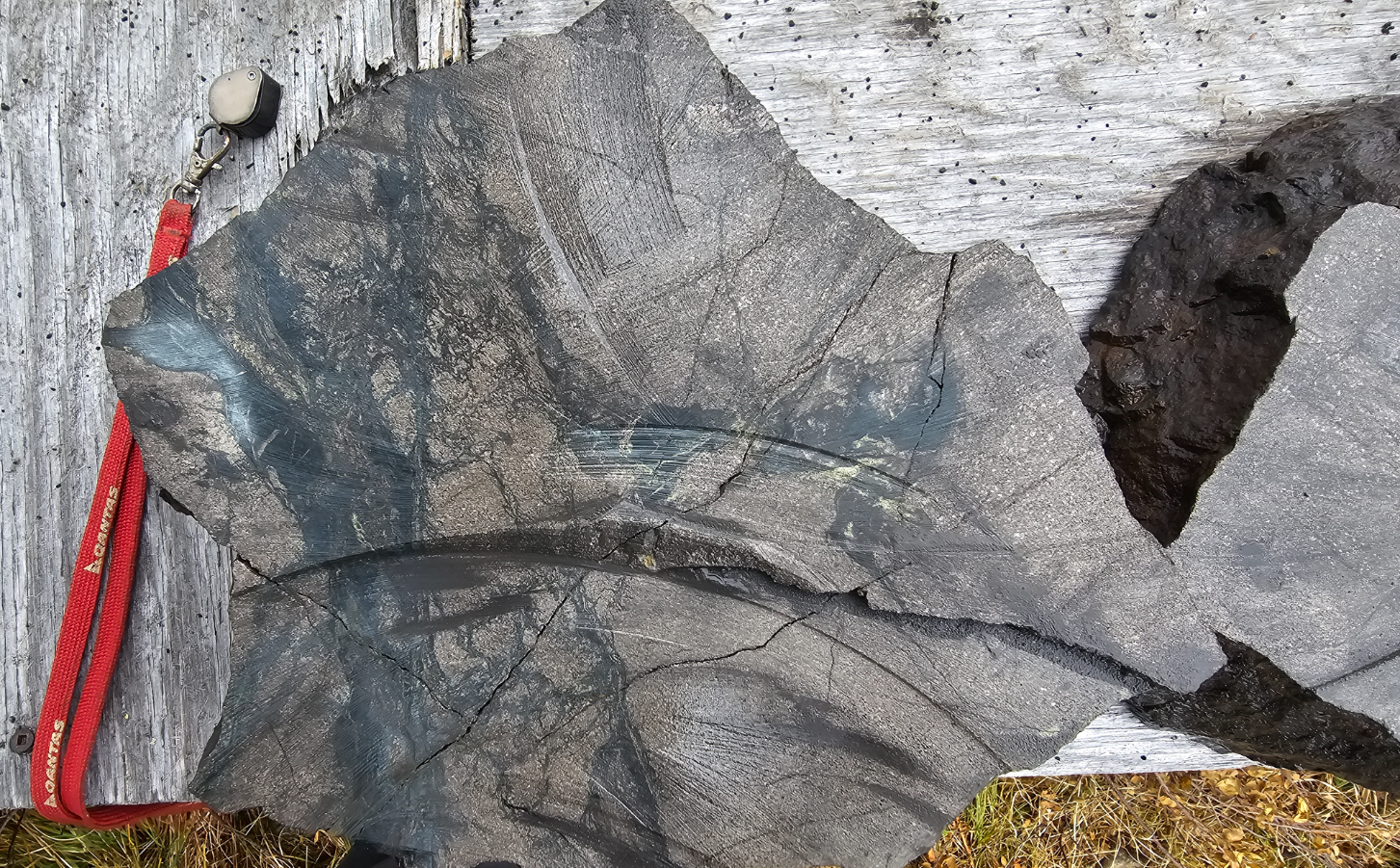
7:36 So we've got some light and some chalcopyrite reflecting in the light. Can you show us what you've got here? Yeah, this is a abridged massive sulfide that we found in the southern zone. And you can see that most of the rock is extremely rusted, but through the rust, we still can see some shiny spots, such as this one, Maybe you can see it on the camera. This is chalcopyrite and
8:08 there's certainly a few percent of that mineral in the rock and that's the mineral that contains the copper. So we got a few percent of the mineral that contains the copper. Chemical assays will come probably November we're expecting. Obviously the rock is still here, hasn't been sent to the lab yet. It'll get to the lab early October. Meanwhile,
8:30 what does all this mean for what we've learned so far in the 6 weeks or 7 weeks of camp? Jenna is going to show us where on the map of our claims that this came from and then walk us through how big it is as a zone so far and what it might mean. So what's really cool about this zone is that it hasn't been found because the conductor is on an area where there's a lot of vegetation. So basically it's this part of the fold. So when Miguel was going with his deep map, when he would detect something, he started digging some test pits. Sometimes they would be like 60 centimeters deep.
9:05 And when he would dig, he would find a massive sulfide unit. And as you can see these orange points, that's all where he was able to find the continuation. So with the beat map, he was able to go and test all these zones and was able to follow the massive sulfide over From what we have now is around 6 kilometers There's a few discontinuous areas where he wasn't able to find it because the overburden was too thick but this is still very promising because it's all on this one conductor
9:34 and this leaves this area nice and open for us to continue and locate this massive sulfide so this can also extend if we can follow this conductor upwards which is very promising it could go over 10 kilometers long. So when are we going to go chase down those next 4 kilometers? So now that we you brought all the beat maps, now we're all going to go with the beat map and tomorrow we're going to focus on that and see how far we can take it. Okay, thanks everybody. We're gonna put this as part of the pre-recorded section of the September 26th online event. And if we can
10:13 get Doug to join us, he's gonna be out of the country, but if we can get Doug to join us online, we'll go deeper in the Q&A about what all this means. Thanks very much. OK, yeah, I think that's our and then, Maxim, I don't know what you've got next. There's either a map of the zone,
10:33 cause I know the one we saw on the camera was a little hard to see. So there's a map of the zone or there's another video to play where I'm actually at the zone. Which one do you wanna do first? Yeah, let's go for the video. Okay, great. Hello everybody. I know that we've got this online event, September 26th, about
10:53 the work that's being done and a lot of attention on this entirely new zone. We're here out in the field because these entirely new zone, which we're calling the Cancun zone, no one's been here before, we have been out with beat mats and we've been following up on some electromagnetics that was flown a long time ago, and it's really in a fold, it's in a hinge where the sill and the rocks are bent back against each other almost into a V and the team, the crew,
11:25 is right now working on a 40-foot long trench all of which is only about 2 feet deep. And when they get to the rock that's there, they're breaking off parts and they're seeing pyrite, chalcopyrite, which means copper, and it's continuous through the 40 feet. And The really exciting part is we think it goes this way for several kilometers, and then it turns and goes back the other way for several more kilometers. So this is really exciting times for us, and I wanted to get this in video, and hopefully we'll have it processed in time to share at the online event. Thanks very much.
12:07 Excellent. All right, now I'm showing the map here. Yeah, let's show the map and then, by the way, while you're setting that up, I'm not certain that Doug has seen that video.
12:24 No I can't see it on my screen at the moment but it's all in my head don't worry. Okay good Let me see if I can aim you a little better. So now we've got the map up.
12:41 Anyway, maybe you can see the map. I can see that now, yeah. Yeah, OK. So this is, I think, the last thing we show people before we go to a Q&A. I think the excitement is going to be in the Q&A, but this is the current tracking. Based on information we have right now, I believe we're at 9 kilometers of what we expect to be continuous
13:03 mineralization all the way through. And that is super fantastic, which is not a technical term. So let's start with some questions and some Q&A, and I'll let Douglas handle the technicals. And Brian, do you mind just explaining some of the colors just for those that don't know exactly how to read this? Sure,
13:27 I'll start with the pink is the sill rock that we've been chasing throughout the entire 450 square kilometers. Next time we do one of these, we'll try and get you the entire map of the entire thing. Right now we're only looking at a small portion of our claim zone, and this portion doesn't show the adit, and doesn't show everything interesting up in the northern fold.
13:51 So the pink is the rock we've been chasing, and then the red is where the geology team has traced through the fold, or through that hinge, the mineralization zone, and the yellow dots that you can see are spots where they've stopped and smashed open rocks and confirmed that there's mineralization there and then there are lines with I'll call them fives little black lines I'll let Douglas explain those because I don't want to go too far field them I'm not just like he is The stair-stepping blue lines that you see there, that is the extent of our claims blocks.
14:39 So everything that's inside that square blue lines that starts up at the top and then also forms a V and heads back. Those are the areas that we have claim blocks. Yeah, perfect. We have an audience question here about what the plunge of the fold is.
15:05 OK, I'm going to I'm going to toss that one to Douglas, The plunge of the fold, what do we know at the moment? I think, Is Jenna present? Jenna is not present. It's my understanding if I go get her that we'll get an answer about 30 degrees. Then let me go try that. Yeah, I think it's very early. There's not been a lot of structural geology done that's on our plate of, I guess next year's program. But I heard numbers like 30 degrees. And we know that the blue lytic added
15:42 a plunge of 35 degrees. So whether it's consistent, that's 15 kilometers away. So a bit far to be extrapolating, but yeah, it seems like a reasonable, pretty gentle bunch, yeah. So To recap the answer, the current belief is 30 degrees, more knowledge to come later. Perfect, thank you. For sure. Will the data gathered allow for a more fulsome report on what is under the ground?
16:15 Yeah, for sure, For sure. I think, I'm not sure what our rock chip sampling program is at, but we were hoping to sample between a thousand and 2000 samples over a distance of 30 kilometers on, say, 50 different conductors. And so that program's been pretty well completed.
16:42 And I think That data will all be available once we get the assays back in November. We'll also combine that with the gravity survey that's ongoing.
16:55 The elevation control is underway at the moment. There's 2 gravity meters, 2 gravity crews working. So we'll have all that data. So I would say there should be a comprehensive news release sometime mid November, something like that.
17:14 Okay, mid November. And as a reminder, we haven't held our AGM yet for the 2023 fiscal year. I'm aiming for that to be early December. And part of the reason for delaying it was so that we could get this information, if we can, out into the world before we had the AGM and then we could spend the AGM getting really deep into the questions and the Q&As with everyone having the same information. Okay, Maxim, what else have you got? Yeah, can you just talk a little bit more to the geological significance of the rocks that you found here and how does it compare to the other areas in Blue Lake?
17:53 Yeah, that's a good question. I mean, Christmas came early, everybody. I mean, the historical resource that you've read about in our news releases is around 5 million tons of massive sulfides with copper, nickel, platinum, palladium mineralization.
18:14 So you fast forward 15 or more kilometers to the south and you dig a hole on a EM conductor that we've actually known about for many years but nobody had walked it. It wasn't exposed. It was only because of the beat mat that it was located, and the guys, the gals did a really good job digging it up. And so to dig a hole 20 kilometers from your main showing, and The first rocks you pull out have got chlopyrite in them and massive sulfide. In my opinion, it's spectacular. And you know, I've never seen anything like that before in my life, actually. And with them now saying that they basically outlined, I don't know how many yellow dots there were on that map, but over a distance of 345678 kilometers is, and every one of these is massive sulfides, pyrrhotite with visible chalcopyrite mineralization.
19:19 To me, that's spectacular. Obviously we don't know the width of the zones, we don't know the grade of the zones, we don't know the dip, and so hence we cannot round any potential size on it. But when you get a favorable rock outcropping over 5, 6, 7 kilometers, it's not going to be small. While you were speaking, Doug, I tried to eyeball the number of yellow dot points along the map that people can see right now, and I'm eyeballing about 40 or 35 points. Obviously more will be added over time, but you said you didn't know how many spots because the camera's facing away from what from where you can see in order for people to see your face. But yeah, I would say it's about 35 at the moment and climbing every day.
20:07 Sure. And you know, the reason we staked all those additional claims was because this entire area is a copper anomaly. Everything within our claims is plus 200 parts per million copper. Again, that's phenomenal. And to get this early on indications of copper mineralization in massive sulfides in continuous conductors is really fantastic. So, you know, it's going to be a really interesting play and we're going to be really busy for quite, quite, quite, quite a while on this one. And what are your immediate next steps for exploring this further? Well, I think, yes, we have to get, obviously, a sense of the overall structure of the silts.
21:03 We need to get the results from the gravity survey. We're doing a grid with about 2000 data points on a grid, 200 meter line spacing, 15 station spacing. We have at least 3 more grids we need to complete. Some of those, there's quite a few lakes. So we're talking about a March, April program on the frozen lakes to get that data. And so it's just gonna be an ongoing program. Obviously, I think the next step for the Cancun zone will be to get some sort of a backhoe or a trencher in there so we can remove that top half a meter or a meter of overburdened soil, whatever it is, and get in there and take some channel samples. That way, at least, we will then have some bona fide grades and widths.
21:59 And then we can step out, say, every 50 meters and see if we can get some size to it. Yep. And Brian, earlier you mentioned that you're securing additional claim blocks in the area. Can you just mention the importance for that and what does this mean for the future strategy? Yeah, just to put some perspective on the claim blocks. We already have the exact number, I think it might be 983 or maybe over 1,000 claim blocks. As a reminder, we have an immense area here. We've staked up everything where the lake bed sample shows plus 200 copper, as Douglas said. So we already have a huge amount. And then when the Cancun zone started the crop up, we realized it was close to the edge of our claim blocks.
22:48 And if it's really big and dipping away, we wouldn't want some of the mineralization to be on claim blocks other than what we had. So we grabbed some more just to have a buffer zone down in the bottom. So yeah, we've grabbed 17 claim blocks. And as Douglas says, eventually there'll be a comprehensive reporting on everything we've done and we'll probably include the locations of those claim blocks or the numbers of them if anybody wants them. Perfect. Thank you. And how does this newfound zone, so how have you shifted your broader exploration plan? So looking out a little bit further out and what milestones can investors expect in the near future? Well I think we'll do 2 parts to this. I'll go first and I'll let Douglas do the even better second half.
23:39 We've always said we've had kind of 3 ways to win here. One is we already know there's high grade at the adits. Can that be expanded? And if so, how into what tonnage from 5 million? The second way is, is there a low grade between the high grades? In which case you could do 1 really large mineralization. And then the third would be, can we find other high grades? And well, possibly this is it, but I'll hand the microphone to Douglas. Sure, thanks Brian. So 15 kilometers north of the adit, so that would be more than 30 kilometers north of the Cancun zone, we've seen some very nice still samples, a little bit of chloride alteration with chalcopyrite mineralization in it.
24:39 And that was observed in quite a few different places up on the Northern Highland Zone. So the same type of mineralization we're seeing over 30 or 40 kilometers. Does that mean there's a continuous ore body? Of course it doesn't. But ore bodies tend to focus in certain groups. And so the 1500 odd chip samples we've taken, hopefully that'll zone us in to areas that are the priority areas. Obviously, where we've got mineralization, those will be priorities. But just the... There's another opportunity here in that some of the very pyritic Gossan zones in the past have returned some reasonable gold grades.
25:33 And so all of our samples will be running for gold and who knows, maybe there's another that we'll be adding to our copper, nickel, platinum, palladium, yeah. Perfect, And then in terms of the milestones? Well, the first one is we're going to, it's September 26 right now, camp is going to start to shut down in the next couple of days. There's no snow on the ground. It's actually a beautiful day here, but winter's coming. And so milestone 1 for us is to get the camp shut down, get everybody out and get everything stored close by so that we can pick up again in the winter, as Douglas said, maybe we'll do the gravity over ice.
26:23 And then as soon as we can in 2025 summer season, this year, I think we started on October, Sorry, we started on August 20th. Boy, I'm thinking this is gonna be May, if not earlier in 2025, because there's so much to do now. So those are the immediate milestones. The second one would of course be getting our assays back. And we've mentioned those are going to hit the lab in early October. So presumably they're back in November and then there'll be time to think and cogitate and figure out what it all means. And then there'll be information out to everybody. And then after that, we'll try and do the AGM with a long sit down conversation with anyone who wants to come and join us.
27:14 Yeah, sorry, Douglas. Oh, I thought you were saying something. I agree with Brian completely. In many respects, we've gone, we've stepped backwards to re-explore the entire property or its copper potential. It had previous, this entire project had previously been labeled a nickel project. And it's intriguing, it's intriguing that few engineers have reported that nickel values in these surface chip samples can often be quite depleted comparisons with channel samples that they took.
28:00 So if somebody was only really looking for nickel and they were sampling depleted surface chip samples, it could account for some of the, you know, why Anglo-American perhaps ran away, they weren't getting the values they wanted. Now with copper, it turns out the copper is not depleted in these rusty zones. So by just us changing the focus to Copper has actually opened up the project again. And like I say, we will have all sorts of data to crunch on over the next few months and make up a pretty extensive plan for next year.
28:49 Perfect. And a question about the assays here. Will you assay for Gold, Silver, Lead, Zinc and Copper? Yes, I think it's a standard package for 20 elements, everything that you would care about as a perspective, well, as an exploration package, you wanna know everything, so yes. And we also did that when we did samples back in May. So, we've already got spreadsheets with 20 columns and 30 columns and 40 columns of each mineralization that's come in and we'll order the same package on all the same study package on everything we're doing now. Perfect. Awesome. So that looks like all the questions that we have for today. So thank you both for taking us through the updates and the Q&A.
29:40 And I also want to thank everyone who submitted questions. And as always, today's recording will be available to watch on demand in the coming day or so. So look out for that. And before we wrap up, just going to pass things back over to you, Brian, for any closing remarks. Look, I'm super excited. I know that Douglas is also super excited. I've been watching, because I'm on a remote Starlink, I've been watching the signal indicator go from green to red to yellow and back to green again. So I hope everyone's hearing this and seeing this. I think we've got a tiger by the tail. I mean, this Cancun zone that we're having today's call about is 30 kilometers from the Northern hinge where we think there's something fantastic. And in the middle is 5 million tons or almost 5 million tons of 1% copper with half percent nickel and platinum palladium.
30:36 I think there's growth everywhere in all 3 sections. Plus, who knows what else we're going to find. So Douglas has been doing this a long time and he's had some great success. And if he says he's excited, I think I need to be and everyone else needs to be as excited or more because he knows exactly what he's doing. Thanks Brian, you hit the nail on the head. It's just spectacular that you can walk to a point on a map, dig up a hole, and see copper mineralization in your first hole, and then repeat it over 4567 kilometers. That's Absolutely spectacular. Is it economic? Well, it's going to take us a while to figure that out, but it's going to be a lot of fun.
31:22 It will take a while, but for those who are on the call for the first time, we're in Quebec, best jurisdiction in the world, bar none. And there is a railhead 60 kilometers away. That's the town of Shefferville. There's a hydroelectric dam, which is at operating capacity, but not at capex capacity. So there's power to be had. We're in a mining, you know, the town of Sheffield was built by the Iron Ore Company of Canada in the 1950s. So in terms of economics, the infrastructure is good. The jurisdiction is fantastic. If there's a failure point, we haven't found it yet. Excellent. Thank you both for taking us through this, and thank you everyone for participating. I hope you