Transcript
Automated transcript · Written by software from the replay's audio. It can mishear names and figures; the replay is the record.
0:08 Hello everyone and thank you for joining us today for this rather hybrid event. Today I'm joined with Brian Boss, CEO and Director, who is calling in from site actually, and Douglas Macquarie, Director of Capitolite. Thank you for joining us today, gentlemen. Now I say this is a hybrid event rather because this is actually going to be a video recording recording on site visit to Blue Lake, which is still at the Blue Lake project. But we thought it would be better just to record just in case the live stream had any connectivity issues. So what is going to happen is we're
0:40 going to play a 14-minute clip and following the video there'll be a Q&A session. Please feel free to submit your questions at any point in the bottom right corner. And just a reminder, this event is being recorded and will be available to watch after. With that all said, I'll be quiet now and we can play the video.
1:08 Hi everybody, it's time for a shave but it's 7 or 8 o'clock Eastern in northern Quebec at the Freddie Lake Camps as we work on the Blue Lake Explorers Day 4 of camp and I thought I'd give you a little tour. I'm back from the day's work, had dinner, had some phone calls talking to shareholders, and dusk is a good time to walk through the camp. So let's do that. So to start our walkthrough, there's the helipad and the helicopter. We call it the Copper Chopper. You can tell by the color. We didn't pick that color. It was assigned to us by the helicopter contractor. So we are taking it as a sign of positive.
2:00 It out comes to arrive. And I'll zoom back out. And here, as you've seen in some of our videos and photos is the line of buildings for the camp and of course this is aptly called Broadway because it's the walkway that connects all the camps. It's a couple of our Geo standing there. So we'll just walk past them as we go down Broadway. All
2:36 right, so here's one of the camp spots. It's usually 4 people to a building. And what we've got here is some of the day's take from the field. And the geos are talking about the rock, bagging the rock, getting them ready to be sent off for samples. There's 3 guys in this cabin including myself. There's 4 in here. I think the current camp complement is 12. It'll go up and down. I think it probably peaks around 16 when the gravity team come, the LIDAR radar team come. So that tells you how large the rooms are. And they're 1 room for a group of people. This is our washroom, shower, laundry facility.
3:24 Down there is the generator, and it's right next to the kitchen building. So we've got a camp cook.
3:34 So that's where we eat. A water station. Everybody always needs water. It gets hot here throughout the day. And then the last is where the Geo team has its office. And as we continue down, we reach the end of Broadway. And now we're looking at the sunset. We're just sunset here in Northern Quebec. And we are on the shores of Lake Reti, R-E-T-T-Y. There's an island across from us. And as we look down, there's also another building for vehicles, boathouse, that kind of thing. There is a dock out there. Somebody's fishing, sitting and fishing on the dock at the moment, but it's for float planes to deliver.
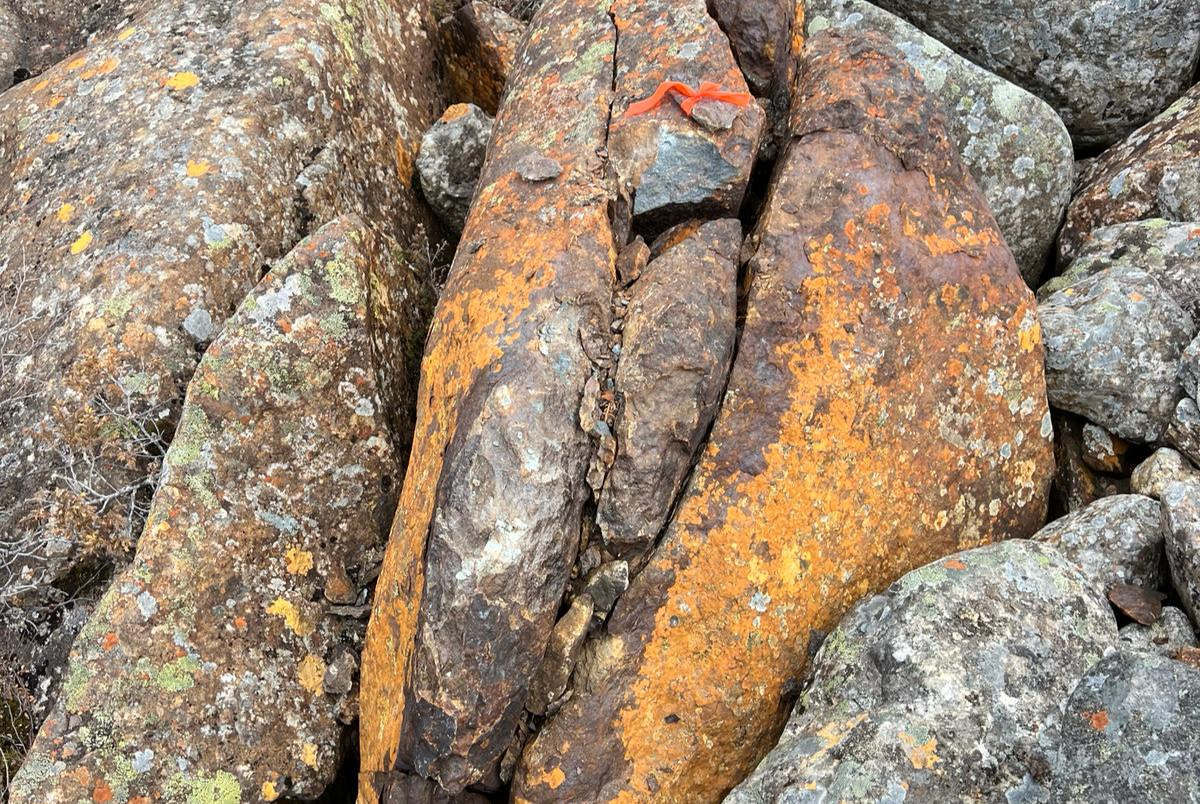
4:22 And there are some of the camp guys working on cleanup, preparation, all the other things we need. There's a staircase that gets us down from Broadway to the lake. There's a fire hose in case we're going to need it, anything goes wrong. And so we keep ourselves safe. And now we're back at Broadway. So thanks very much, everybody. I'll talk to you soon. Hi, everybody. I'm still here in camp. I just finished a video walking you down Broadway, which is the name for the main road of camp. And I'm standing in front of a collection of rocks that happened to be here on the landscape in camp. And I'm gonna use this collection of rocks to demonstrate what all of our teams are doing all day, today, yesterday, tomorrow, and for the foreseeable future as we examine the surface of the claims package that we have. So in front of me you'll see gray boulders and there's a lot of gray boulders but right in here there are some rust colored rocks and rust colored of course tells us that there are minerals in it which the gray don't have minerals. So what do we do when we find something rust colored?
5:44 We want to know if it's from the layer of rock called silt, the type of silt that has the copper and the nickel that we already know is in the region. So how do you find out? So here's a rust-colored rock. I'm going to smash it open on this rock, the geologist in the field would do it with a hammer.
6:08 I'll do it here. So I smash it open and I can see it's blue colored on the inside and that's a sulfide rock. If you had, you won't see it on camera here because it's at a distance, but if you had the ability to look closely you'd be able to see whether or not some of the other minerals, the copper, the nickel are visible here. But in either case, the geologist would put this in a bag, would note the time and location using the GPS that we have that ties everything down very tightly to locations. And then we send this off to a chemical assay lab they'll break it down and report back to us with a spreadsheet about which chemicals are in here in which percentages and that'll tell us how much nickel, copper, platinum, palladium, gold, sulfur, magnesium, anything else that we're interested in. So that's how we do it. We look for rust color, break it open to see if it's sulfide, and then bag it, tag it, and ship it away. So here's a sample with magnesium olivine in it, and we're gonna put the XRF on it.
7:30 There's an example right there. So I'm speaking to the video now. The first shot of the XRF, which I've already recorded, was focused on both the intrusion and the sulfide. So it was reading both. Now we're reading only the sulfide. So we expect to get different mathematical results. Higher, if I haven't used it, about 6.5 now. Okay. Focus in here. Am I getting that at 12%?
8:18 No, 6. Oh, 6.48 at the top. Okay, thank you. Alright. The dam that we're flying over now
9:38 is a hydroelectric station called Menahec, and it's owned by the Newfoundland and Labrador government. It has 1 customer, which is Hydro-Quebec, which serves electricity to the town of Shefferville which is just over the border 16 kilometers north up the rail line. As you can see the rail from Sept-Diel to Shefferville goes right over the top of the dam.
10:02 And what's really interesting about this dam is it's not connected to either the Newfoundland provincial grid or the Quebec provincial grid. And for our purposes, it's interesting to note that it's 60, 65 kilometers as the crow flies from the dam to our exploration site. And the reason this matters is because if we get to the point where we are successful in finding enough mineralization, get through all the steps towards mine building. One of the key important things about the economics of any mine is the cost of power. So this dam was built with 4 turbine slots. They're not full. There's an opportunity to add turbines and create electricity and either ship the electricity with transmission to our site sometime in the future, or if electric trucks have come along far enough, we could move materials somewhere closer to the dam and process it there. So these are questions for the future, but we're just flying over it anyway on the mobilization flight of the helicopter.
11:11 That gave us a chance to take the video and I wanted to share it with everyone. Hi everybody, it's Brian. We're just doing a radio check here. Gary's got the radio out as we just stopped for lunch. So We've been... Dining room table is a big rock. It's not a big rock. And we're going to get right back at it for another 4 hours. And then we'll get picked up. I will flip the camera around so everyone can see how remote we are. [♪ music playing ♪ Hello, everybody, hope you can hear me.
11:59 It's Brian from Capitolite.
12:01 I'm out here in the field. We are tracing that sill which has our mineralized material in it. I'm out here with Pierre-Luc Ballant, he's holding the camera. What I've got on my chest is the control module, and I'll show it to you in a second for something called a beat map. That's the map right there. On my back, I've got the day's food, survival gear and rock collection of what we've picked up so far. I'm going to helicopter drop this off about 4 hours ago, it'll pick us up 4 hours from now. I'm going to drag the beatmap over this shovel so you can hear the sound the map makes and then I'll explain why we use it.
12:53 Okay, I don't know if you heard that, but the rock we're looking for is a conductor. So as you can see with the maybe 2 or 3 inches of moss and low ferns we've got here, we can't always see the rock beneath our feet. So Doug's idea, and it's a good one, is we've got 2 of these beep mats, and so it throws a signal down about 10 feet, and if it finds a conductor, some of that signal is absorbed and doesn't make it back up as a reflection, which then triggers the machine to beep and it has a counter as well. Couple hours ago we went over a rock that counted about 1,700. Right now it's beeping at just 227 probably because of my steel toed boot. We'll try and include this video in the update that we're gonna send out very soon and I hope everybody's having a good day.
13:43 Bye for now. Okay so we've reached the end of 8 hours of traversing, I think is the traversing the sill line. So that's the middle sill. I think you'll see that it's pink on most of the maps. Traverse means you go across it and then parallel a little bit to go up along it then come back across and then again so you're repeating you're traversing you're crossing a line
14:13 of interest as many times as you can in a day and you're taking notes and samples and material along the way as you go. So today is Monday I think, things all run together up here at camp And I'm pleased we've been able to make these recordings, collate them, and I want to thank everyone on the team who helped put them together and get us in front of shareholders, the prospective shareholders, to see what we're doing in our exploration. It's a huge area. There's a lot of great opportunity here. Doug will be coming up to camp in a couple more days. We think the camp will probably run late into September. And I want to thank everyone for watching this live and giving questions and listening to my answers.
15:06 I wanna thank everyone who hears this on a replay later on. And Maxim, if you can, please open this for questions. Thanks very much, bye bye. Awesome, Let me just close this so there's no other video playing here. That was great. That was a great video update. Thank you, Brian, and to the team for taking the time to provide the update.
15:32 If you did come in, you did hear Brian say he's open to questions, so has Douglas. We did have a couple email submitted questions, so we'll go with those first, but do please feel free to submit your questions right now. I will leave it up to either one of you to respond. I won't direct it to anyone specifically. But the first question is, how does the geological makeup of the Blue Lake site compare to other successful critical metals projects in northern Quebec? And what makes it particularly promising?
16:04 I think Doug's going to give you the meat of that answer, but I'm going to begin by saying that where we are in the Labrador Trough is the same, It's not a scientific term yet, but it's the same rock type as where the Raglan mine is far further north in the Labrador Trough. And with that, I'll stop talking and hand it to you, Doug. Yeah, okay. So good question. I've been in the exploration industry for damn near 50 years And the one thing I've found is that no 2 ore bodies are the same They may have general characteristics They have the similar host rocks and similar geology and similar metamorphic history, all of that stuff. But when you get right down to it, the local mineral content, pressures, temperatures, shearing, faulting, folding, all of these things implant particular phenomena if you want to call it, or special mineralogy, etc. So we're not exactly looking for anything that's being found before.
17:19 We're looking for a blue lake massive sulfide That hopefully has copper equivalent of you know, 1 to 2 percent and some 2 to 3 maybe more grams platinum palladium. And as Brian said, it's just a huge property. And the sills that are the source of the mineralization are like, have a 150 kilometer stripe length. Certain places they're folded, that could be important, and certain places they contact other rocks that are sulfur rich, that could be important. And basically we're treating this as a 2 phase exploration.
18:06 First phase is to sample every, as Brian said, every sulphidic looking rock we can find over the 150 kilometers of strike and analyze it for its metal content. That's the discovery phase. There's huge potential for a major discovery. It just has not been looked at in the detail that we're looking at. The second thing is we, as you see from some of our news releases, there's around 5 million tons of historical resources, interesting looking mineralization. If we had 50 million tons or 40 million tons, then we would be into a development project. So the second phase is just to find that other 30 million tons or 40 million tons. And we think there's an excellent opportunity there.
18:58 And so, yeah, So I think to answer the question, we're looking for something quite unique. We think there's a very good chance of there being something much bigger than has been found to date. Thank you, Douglas. I have the follow-up question directed to you, perhaps, because Blue Lake, Blue Sky Potential, it's easy for management and directors to talk about the promise and outlook. Is there any key challenges in advancing the Blue Lake project, and how is Capital Light planning to address them? Brian, I'll leave that one for you. Yeah, I guess the key challenge would be, It's not like you're just driving by in the interstate and we're 15 minutes off the road.
19:51 The nearest town is 60 kilometers away. It's Shefferville, Quebec. It's a town of I think of about 400 people. It's a mining town. It was built in the 1950s by the Iron Ore Company of Canada. It's got an airport, a railroad, it's got electricity as you saw from the Mannahack Dam. And that's, that combined with a town called Wabush in Newfoundland are the 2 staging points for exploration. And so I guess the knock on the story at the moment is we have to get a helicopter and helicopters are not cheap. So that's about, from my perspective, that's the worst of it is that, the logistics require a little bit of planning. And I guess the second would be, there's a lot of logistics because as I think we may have already said, there's about 500 square kilometers of land to go look at here. So this is not a 1 and done trip.
20:50 And then I think I'll ask for further color on the answer from Doug. Yeah, I agreed, Brian. So if we get lucky, we'll have a discovery or 2 this year, If not, it'll be next year. And in parallel, we'll continue to develop the high grade potential in and around the currently outlined resource, historical resource. We're doing a gravity survey. That crew arrives in about a week's time. As far as I know, that's the first gravity ever done on this property. And the thing about gravity is, it's very deep sensing. Very deep sensing. It's one of the deepest sensing of all geophysical techniques. We have literally hundreds of EM conductors that have been outlined by previous work.
21:40 And you literally would go broke trying to drill hundreds of conductors. However, the target we're looking for happen to be conductors, the rusty rocks that Brian referred to. They're also very heavy, hence the gravity, and they're also magnetic, so a magnetometer. So you put the 3 together, you take hundreds of drill targets and you boil it down to, let's say, 10. So that makes a very focused approach to the exploration. And can you do year-round drilling there at the Blue Lake project? I think so. Certainly, there's a few times of the year you don't want to be in there, but certainly in the spring where everything's frozen, that's a great time to do the gravity. You can go over the lakes and get full coverage.
22:32 EM on the ground, everything. You can certainly, if you've got a drill site that's near a lake, it's easy enough to get the stuff in. Winter roads, give you access, etc. And certainly, in the summer, well, you've basically got a three-month window there to do the drilling as well. So, it's pretty good. Thank you. I'll just highlight that the 5 million or roughly nearly 5 million historical tonnage that's already on site and That was all worked with heavy equipment brought in by Ice Road in the 1980s, as far as we can tell. Nobody's really done much since, but the point about year-round drilling is a good one. If we only had a one-month window out of 12, it would be hard to do. But as you just heard, we can do it in the summertime we can do it in the wintertime and we can continue to do work in the shoulder seasons between so yeah it's it's it's pretty open in terms of the calendar.
23:36 Well, gentlemen, thank you for your time. Douglas did highlight some things to look forward to going forward. I'll leave it to you for closing remarks, but if there's anything else you'd like to talk about moving ahead for the rest of the year, please feel free to close us off. And just a reminder for anyone coming in, this is being recorded and it will be available on YouTube within the next few hours, so just look out for that. But I'll pass it back to you for closing remarks. Yeah, I'll do the second closing remark and give the final remarks to Doug. So today I think is late August and it's our intention to do a couple more of these before the camp closes in late September. So we'll do a couple more updates. This one is actually a great test run. I'm talking on a laptop in front of the camp through a Starlink system and as far as I can tell from my end the internet connection is actually pretty good. So if that's the case, we'll keep doing this.
24:32 And Doug, over to you. Yeah, thanks, Brian. And thanks, Kyle. I find this to be an extremely exciting project. You know, the potential for discovery is huge, and the potential to add tonnage is excellent. So I just think it's going to be a very exciting play to watch. I hope everybody just comes along with us as we discover more and learn more. Gentlemen, thank you so much for your time to work and thank you