Automated transcript · Written by software from the replay's audio. It can mishear names and figures; the replay is the record.
0:38 corner of your screen. We will be addressing them at the end. Also, this event is being recorded and you can expect a replay within a few hours post-event. With that said, Ian, thank you for doing this and the floor is yours. Thank you very much, Kyle, for that introduction and good morning, good afternoon or good evening, everyone. My name is Ian Bliss and I'm president of Northern Shield Resources. And this is just meant to be a little bit more of an informal presentation, a short run-through on the press release to dealing with the visible Gold on the assays regarding that, as well as some other recent work and summarising with a brief overview of our drill plans. I do have to warn you that there's an air show in Ottawa this weekend where I sit and everybody from the Red Arrows to Lancaster has been flying low over my house this morning. So if that happens again during this presentation, I may have to run out and take a look. No, no, we'll run out and take a look, but I may have to pause when the noise fades.
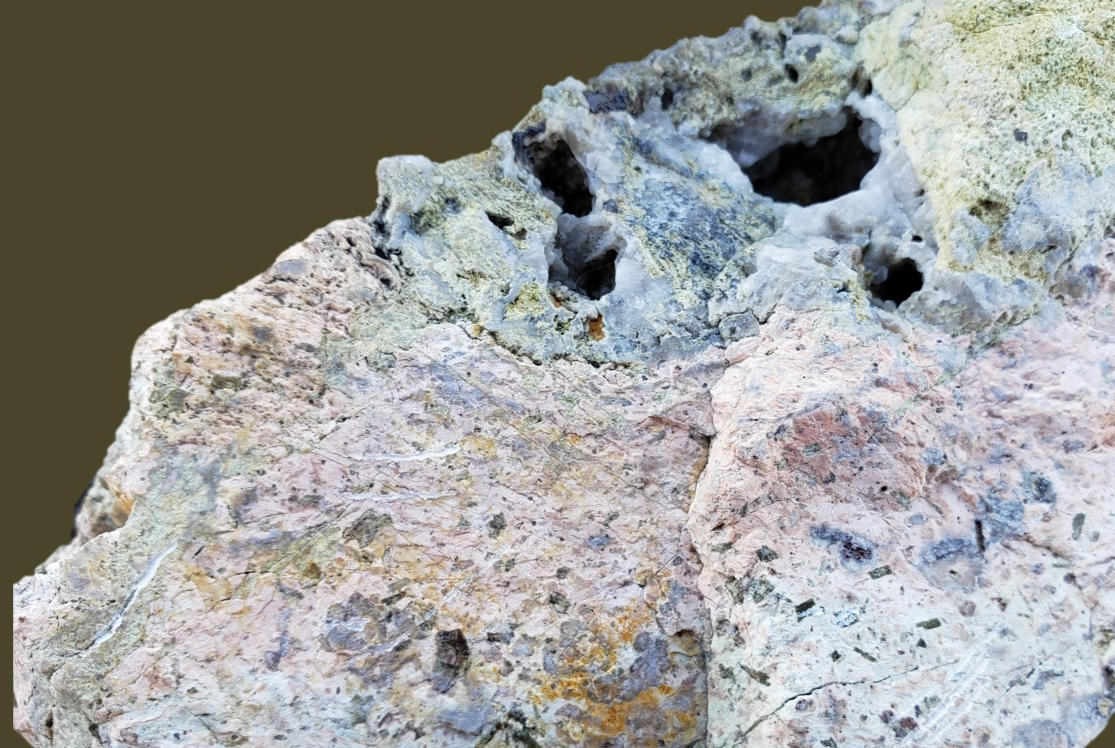
1:36 Before I start my presentation, I do have to bring your attention to this forward-looking statement advisory. So the latest press release dealt with the asset results from Visible Gold, initially announced last month. That came from an outcrop that we extended the trenching on. This is what we generally know as the Discovery Trench or hole 21 area. It's actually about 30m west of the discovery trench, but very close to hole number 21, which also had visible Gold, but very different styles of visible Gold. So the sample came back, grab sample came back with 78g Gold, 35g Silver with anomalous pathfinders, Arsenic, Mercury, Antimony and Moly, which we pretty well expect.
2:25 Classic indicators for epitomal systems, especially in Mercury is an indication of usually you're near that sort of upflow zone. Handful of other samples sort of in the in the red shaded unit that the Quartz veins was hosted in sort of running between 2.4 and 5g per ton. That's represented by the sort of white loop in here, variety of samples. These are really composite samples. They won't grab, so we're trying to get a better representation of that unit hosting the visible Gold. Again, pretty spectacular results, 78g per tonne. That's now the highest Gold assay in outcrop. We do have one other higher assay from a seller of 111g per tonne, but that was in a boulder of which we have yet to find a source from. It doesn't come from this outcrop, so there's still more high-grade to be found, but obviously very pleased to find such high-grade in outcrop.
3:17 The neat thing about this photograph, I'm just trying to clean it up without too many other side images, but this unit on top is a basalt, it doesn't really matter what it is, but you really see very little indication of mineralization. This would be a later volcanic sequence that was dumped on top, very late in the mineralization sequence. You see a little bit of cracking and alteration valence, but almost dead in Gold values. We see that throughout Rue de Saller. And so there's a lot of these areas where you get these little blankets of basalt on top, but they could be hiding exactly this. We think most of the high-grade minimization is gonna be much deeper, but the bottom line is we have these layers of volcanic rocks dumped on top of the mineralization, and that's capping it. And there's, you know, here we're lucky, we managed to see some of the basalt's been eroded, so you see through it, and of course we trench down through it. But in a lot of places you get this rock on top, and there's absolutely no indication or very, very little indication that there's 78g sitting a couple of metres down.
4:24 I'm just going to start, normally I start my presentations with a big picture working down into scale and now I'm going to start the output, which is the way kind of zooming right in. So here's this yellow star is where the new trenching and the visible Gold sample came back with 78g per tonne. I've compiled all the other surface samples plus drilling, most of this drilling is from last year, 2023. And This is the western portion of the conquest zone. Not only are we getting in a lot of Gold, but this is where we're getting all the strong indications that this is what we call the up-throne zone of the epithermal vein system. As you can see, quite a large area patch with over 100m in strike length with near continuous Gold mineralization when you compile a drilling and the surface samples. Obviously, the conquest zone continues both eastward and westward, but a very distinct patch of nearly continuous Gold mineralization. That was one of the indications early on that maybe we're getting pretty close to the main main system when you see a lot of mineralization and repatriation.
5:29 This was only about 5m west of the drill collar to drill number 21, but about 35m west of the original Conquest Trench. Up until then, that was the highest sample we had to date of 45g per tonne in outcrop.
5:49 Just Moving away some smoke, I know there was a question the other day, how relative is this to some of the other high-grade samples? I stripped away some of the lower grades, everything under 2g. I know 2g is still low, but for various reasons, those are the benchmarks or thresholds we use when plotting it because from previous work, we can tell that samples over 2g per tonne come from a certain phase of the mineralization at Bruton Cellar. Here are all samples from 2 to 78g per tonne Gold. It's only about 5m west of the collar for hole number 21, 45m west of the original discovery trench. But we're not expecting these type of grades at this level of the system. As we'll see a little bit later on, we're very, very high in the system.
6:41 So we're not expecting Gold of these values, let alone visible Gold is quite rare to get that basically in the centre. So any high-grade Gold, invisible Gold is generally an exception to the rule and so we're quite apt to see it. One of our real questions right now is what events are the visible Gold related to? They all seem to be a little bit different. The Gold that we're seeing in outcrop right now, even though it's a few metres away from hole 21, is a completely different vein. If you go back to the previous slide, Here's that Gold from the drill port from last year and that's very different than what we're seeing just a few metres away. Again, it's telling us there's multiple events going on and that's important to us because the more mineralising events that are happening, Of course, that's upgrading the Gold all the time.
7:36 Hopefully, that's continuing at depth, but it's multiple mineralising phases, which is what we're seeing. And then just to keep on zooming back, so this yellow box here, that's what we're just looking at right now on the previous slide, the western portion of Conquest. As you can see, it's only a small component of the greater Conquest area. We have Conquest further north, and that leads into windfall. What we're just looking at is just a small portion of the mineralization that we're seeing on surface, both in rocks and of course the yellow dots indicate soil samples. So that's telling us clearly out here there's more mineralization that we've yet to find. And so what we're looking at is a small component. So this is one of the reasons we're getting excited about Root & Cellar is a quite large footprint of gold mineralization.
8:25 Yes, some of it's low grade, but this is not the heart of the system. This is just mineralization that's leaking out from below. Essentially Root & Cellar is more or less a blind system. Other than in Conquest, we're really beginning to see the tops of the true system. The rest of it's blind. We're not into the epithermal system yet. This is just mineralization that's leaked up, telling us, or strongly suggesting that there is something up there. And again, the background image for this is the LiDAR results we received from that LiDAR magnetic drone survey that we just completed. We haven't received the magnetics but we received one of the images from the LiDAR this morning. So this is fresh in our hands from a few hours ago. Still needs to be cleaned up a little bit but I say it is we do have the LiDAR data and the mag should be following very, very, very shortly.
9:18 The mag is really what's important to help fine tune the positioning of the drill program. But again, the ladder is important to help find some of these structures, though most of the North-South structures we know are buried, they're deeper down so we won't see them manifest on surface and topography all the time. Clearly, you see some of the obvious ones, these northwest trending ones that actually cut the mineralization. But I had a quick look this morning with our geologists and we did start seeing evidence of these northeast structures. They're much more subtle, but in here you can see one. This is a rough position we had from the regional magnetic surveys, but based on the DEM, we clearly see a structure coming through here. There's another one coming through in here, And as you zoom in, you can see little clips of it in and around the conquest zone. So I really came to get a hold on the magnetics from the same survey, but the DEM is coming in and it's remarkable at the detail you can see on on the geology, the contacts and some of the structures.
10:19 So together with the magnetics, this is going to be quite useful in the fine tuning of the drill program. So we talked also about in the press release about some of this work this thesis student has done and it's, you know, obviously everybody gets caught up on the Gold values, on visible Gold and with good reason, but there's some really good science behind this. This thesis student took work, a case study from the Wahi epithermal Gold deposit in New Zealand and applied it to Root Zeller. We tried to keep it simple, simply plotted these elements, potassium over lumen versus sodium, and they come up with this chart and basically the red dots. Instead of using alteration minerals, which rely on the prospect or the geologist to identify exactly what that mineral is and how much is in there, the purpose of the Wahi case study was to try to see how that manifests on geochemistry, which is much more accurate than we have for all the samples.
11:23 They came up with these plots and based on their studies, if you have these sort of values, you're dominated by Agularia, which is one of the key alteration minerals to do with epithermal systems. They're the ones that show the hottest part of the system. They track it down through spectate and all the other ones. The bottom line is you get chemistry up in here, it's telling you that you're very close to the system, basically above in these outflow zones. That was a case study at Wahi, which is a 6Moz Gold deposit in New Zealand, low-sulfuridation epithermal. Our thesis student used those same plots. We don't have what's called whole rock data, which is really the academic quality of assays or analysis on rocks. We took the assays we have and When we assay rocks, we don't just assay them for Gold, Silver, Arsenic, we have all the other elements including Potassium, Magnesium.
12:24 They don't come up to active magnet quality, but we have used them in the past, particularly in our past exploration for Nickel Copper PGEs very well. In this case, the student then benchmarked it with a few, what we call, whole rock samples, but he used the asset that we have because we have thousands of data points between drilling and our surface samples. He adapted that to the same charts that they worked on in New Zealand. And you can see they get the same sort of thing where, and in this case, he's also plotting them based on Gold values. So as soon as we start getting Gold, we're starting moving up this chart, which is where you're getting Agilearia dominant, the equivalent of Agilearia dominant chemistry. So as I say, he applied this to the root and cell, it's clear that they look, they make sense on the chemical charts.
13:13 And then when you start plotting them spatially, it was very interesting what you see. First of all, this is just surface samples we're looking at. Again, here's the ones that according to this case study in Oahu should be Agularia dominant. They're colour coded in red, not only on the chart, but on the map. You can see in the conquest zone, a nice trend here, High Potassium over Aluminum is Agularia dominant. Another subparallel trend just above that. And one of the ones that are kind of interesting is these clusters of Purple, which are Agularia present, maybe not dominant, but Agularia appears to be present. And it's almost a direct continuation of what we know as a conquest trend. So it almost, this is legitimate, it's kind of telling us that that east-west portion of the conquest zone may extend another 750m further to the west. So what does that mean to the overall size potential of Conquest? Well, potentially it doubles at least that zone, but we've always thought Conquest was pretty big and actually extends up to windfall up here, but it's just telling us that there may be a structure underlying and there's high topography here, and so we're basically further away or further above what may be the mineralizing system, but it's certainly suggesting initially that that structure may continue under here. And otherwise we had no real hint that whatsoever.
14:36 So obviously moving forward, we will start looking closer at the geophysics and do more prospecting and sampling in this area to see if there's any more supporting evidence of showing the conquest zone continuing west. But obviously, if it's legitimate, adding another 750 meters of strike length is pretty significant. And again, we apply the same thing to the drill samples. If you look at the larger map on the right, again, you can see that this is the guts of the conquest zone, what we call the discovery trench area in the middle. And you can see in that discovery trench, nearly every single drill hole is coming back as Agularia dominant, Even the ones that had low Gold or Erdekston, no Gold, almost every sample from that drill program is coming back indicating Agilaria present.
15:27 This is really neat to see because as we've talked about in previous presentations, we had a lot of other indications that we were getting closer to the top of the vein system. We have Sinter, we have what we call these geyser sediments and other geochemistry, the textures, the coliform, crustiform, banding, all telling us that as we move into this area, we're getting higher temperature indications of the alteration, which means you're closer to the source. When a student came up with this plot, it just reconfirmed it, but it shows it in a very, very compelling way when you see every single sample coming back with Agile area dominant chemistry. It's interesting, you look at some of these other drill holes from 2021, mostly they're yellow, so they're spectacular, which still means you're part of the alteration system. You're just a little bit further away.
16:22 But when you look at hole number 5, for instance, which comes back, it does contain some Agilatory Dominant, but you don't see anything on either side that somewhat tells us, as we've again figured out in other ways, that maybe the main structure that we're chasing with the higher-grade Gold is not going east-west, but it's going north-south and drill hole number 5 is just drilled parallel to it. So in the next phase of drilling this fall, we'll look to come cut across this and see if we can get the better portion of that north south structure. But anyhow, very, very compelling evidence from this work that this thesis student is undertaking. We didn't expect anything like this to come out especially so clearly, but it certainly reinforces what we know about the Discovery Trench area and again highlights other areas that we should be targeting, including the area to the west potential continuation.
17:15 But even up in here, we'll see a little bit later, we have a really good IP and magnetic target in here that we're going to be one of the focuses of the fall drill program. And we can see a lot of samples nearby, both in this drill hole and along the road here, coming back with Aguilaria. Again, we know we're high up in the system, we're known to the side, so the fact that we're getting everything Aguilaria present again helps reinforce that this target in here is a valid drill target. We all get the focus on Gold, and rightly so, but work like this really helps us define that we're dealing with an epithermal system and highlights those target areas, especially when you have a deposit like Wahine, as an example, where it has worked.
18:12 But again, these systems, the upflown zone, this is a classic cross-section of an epithermal system. It's very, very simplified. They often get much more complex than that, but when we look at hole 21, the discovery trench area, we're up in here. Now, We don't see the entire centre. We see a lot of breccias. Those of you who recall from last year's drill program, we had a lot of these what we call oatmeal breccias, which are hydrothermal breccias. We also see them in that area. What that tells us too is we basically had a centre mound forming, but then a later event brought up breccia events that cut that, which is what we see, but it's all very, very typical of the outflow zone of the epithermal system.
18:58 Essentially, what we want to do is start targeting deeper in the upcoming drill program. Now, I know you think, okay, well, it's simple. We simply step back and keep on hitting it deeper. But I say, systems are often much more complex like that. Here's just a sort of quick example of structural components that I've quickly gained from other epithermal deposits around the world. The one on the right, I think is actually Wahi, this one is Bajingo in Australia. You have your main reverse S-shaped structure hosting part of the epithermal system. Here's your breadshear pipe. So if you can imagine, you know, we hit this breadshear pipe up in here, you'd think it continues down dipping to the left. And so you stand back, you drill, you first drill up here, you hit it, you know the dips, you keep on drilling it at depth, hitting it deeper and deeper, but then you cut off. If you don't go far enough, you may go through what you think should be the extension and you stop out in here, but unless you understand the structure, you miss part of it.
20:01 We understand some of the structure, but there's always things you're going to be learning along the way. That's why when we go into this drill program, even though we have great confidence that we're right above the outflow zone, there's a lot of complexities to these things. That's why you want to go in there with a bigger drill budget to make sure you cover all the different scenarios and variabilities of that structure. You can be right on top of it, but there's lots of ways that you can miss the high-grade. Even if you're drilling from this side, you drill down here, you get the vent breccia, you come in here at the wrong point, you'll get a little bit, but you're not going to get the sweet spot. The previous diagrams show the simplifications, but I just wanted to make everybody aware that these things are always a little bit more complex than the generalized models.
20:52 So again, we've just completed the drone magnetic survey. We haven't got those results yet. I've been told maybe next week, we'll start to see that data. This is from the previous helicopter-borne magnetic survey and so that was flown at a hundred meter spacing and in a north- south direction. This survey was flown at 25 meter spacing in an east-west direction so that should be better than better picking up the North-South structures. And what this is showing here is in the blue colors, we have magnetic low, so that's magnetic destruction. Your alteration will often destroy the original magnetic signature of the rocks. Here's sort of an overlay of a surface sample we have. So you can see there seems to be a direct correlation between the gold we're getting on surface and this magnetic glow. And it's not really a surprise because alteration, as I say, destroys a magnetic signature. So we think roughly the vein systems come down, something like this, they may actually sort of zigzag, like those reverse S's that I showed you before.
21:54 And we're hoping that the drone survey will show the same sort of thing, but just under much more constrained, much more detail. This was, I say, a hundred meter spacing and flown actually parallel to the structure. We really want to fly them perpendicular and so we were hoping that the drone survey will show these structures in much more detail and that's why we're going to use that data to fine-tune the drilling of these targets. We have a whole bunch of drill holes set up already, but we actually sort of stopped planning that at one point a few weeks ago when we decided to do the drilling survey because we know that's going to impact the dips and the azimuth of these drill holes and the collars. Simply from this map, there's a variety of ways you can drill it, but we want to wait for that drone data and really fine tune these targets.
22:47 But essentially, this is what we're looking at. This is a really nice one where we have now supporting Agileria data on surface from the master's thesis work. We got a really nice IP target that tells us there's an IP chargeability target sitting somewhere down in here. And again, a very strong magnetic glow underneath that. And they all seem to be linked at depth. So probably sort of our branching system. But Here's the one that sits atop the Discovery Trench, Hole 21 area. This one has not a lot of surface representation other than the Rylake Dome, which is highly anomalous, which is living of an oddball. Now those Aguilaria are burying samples just to the north.
23:35 This is the main target area for the upcoming drill program. If you look at that on plan view, I'd say this is just a quick sketch. These are not the only drill holes. All the black diamonds there are drill collar locations that were sent in on the permit application. We just started working on some of these actual drill holes. This is what we call the line 4900 IP target, which is really the strong mag, this one. These are number 1 long holes because it's fairly deep based on the mag and the IP that we have to date. We're also trying to hit multiple scenarios of that model, not only IP but the mag low. These are fairly long holes, 400m.
24:21 We can hit it a little bit shallower, but some of these are 400m. We plan 2 to 4 holes in this area and Again, the drill mag will fine-tune those position levels, but this is the general idea right now. Of course, you have the main Conquest Trench area. It looks like there's not a lot of holes planned in here. We actually plan to do the most drilling in this area. There's often 2 or 3 drill holes planned for each collar, but we stopped planning that until we wanted to get the recent mag data back because that's where we really need some high resolution. But most of the drilling over in the Conquest Trench area and this line 4900, I like this target. We haven't got a lot of supporting data, but the IP is convincing and a very, very distinct magnetic flow and that may be actually one of the main veins, not over here, but we'll see. It's a very compelling geophysical target. And then of course, we have some shorter holes on the eastern portion of the conquest zone. These ones are really trying to find that source of the 111-gram boulder, which was found down around here.
25:31 We now know we see a structure cutting up in here in the north-south direction. We have done some trenching that we start to see signs of that structure, a lot of chloride alteration, a lot of quartz, which we know is associated with the high-grade invisible Gold. These holes will target that structure. This one is targeting hole number 5 from 2021, which we believe will be drilled now parallel to that structure. Of course, up in what we call Conquest North, probably just 1, maybe 2 drill holes. We're just planning different scenarios of which way to drill it. Again, the drill magnetic survey will fine-tune that drill plan.
26:19 We don't have a lot of surface support than this other than a handful of Gold-burying samples here, boulders, a lot of anomalous soils around the edge with low-grade Gold. But we know we're at the top of this ridge here, so again, we're even further away. The vein system is down there, we're well above it because again, we have a pile of rock dumped on top. This ridge is about at least 50m higher than where we are down around the conquest zone. So we're even much further above that, so we don't expect to see much manifestation, at least in Gold values, of what we think is underlying. But we do see really widespread clay alteration in the minerals, which again is one of your outer halos of alteration in an epithermal system. We still think this is very much related to what we're seeing down in here.
27:10 1 or 2 drill holes, hopefully get into the IP target right away, but if not, at least we start seeing getting drill data to see what's below this very, very large IP target. So hopefully we see the magnetic data coming in from the drone survey next week. And that will, you know, That's not an instantaneous process to digest. That's probably a week at least of going through it in great detail, combining it with the other geophysical datasets and fine-tuning the targets. A week to get the data, a week to 2 weeks to sort of compile it and then we're ready for, should be ready for drilling. So ideally, perhaps about a month from now, we should be drilling at Rubin Cellar.
28:01 So if you have any questions, I'll be happy to try to answer them. Thank you very much.
28:10 Perfect. Thank you, Ian, for that thorough presentation. For individuals that came in a little late, we are accepting questions. There was a couple that came in via email, but this presentation covered essentially them all. You did mention perhaps a month to announce a drill program. I might have missed it though, but is there an expected amount of meters for this following drill program? Yeah, ideally we're aiming for somewhere between 2 and 3,000. Last year we went in with our, you know, just limited funds, drilled 500 meters, and we're actually very successful at that, hitting the mineralization in 7 out of the 8 holes. But we have to go deeper now. Some of these holes are 400m on their own, so we need flexibility.
28:59 The real game plan is to aim for 3,000m and hit these things deeper. Particularly in this area here, we also have to go deep, but I think we can track it down. But we're aiming for a 3,000m drill program. And there's a lot of information in this presentation. Could you just resurface? You said in that one collared zone, 400m holes, but it's a little less confident than some other targets. What is the reasoning behind going deeper there? That's one-third of the drill program. So, the reason why we're somewhat less confident is we don't have the surface data. We've got low-grade Gold around. We see the structures, but we don't have the smoking gun that we have at the Discovery Trench area where we're getting not only the visible Gold, but we're getting the centres and all these other textures that tell us, coliform, crustal, all these textures that tell us we're extremely close to one of the veins. Here we don't have that data, probably because it's deeper, there's bog here, so things are dumped on top.
30:12 And then I think the target based on the IP, at least the top of the target is a little bit deeper. And then we also see multiple targets in here. The IP is very clear where it's sitting, but then it's like it doesn't correspond to the edge of this mag. So is that correct that the IP is really just marking the fringe, in which case that's the target, or should we be targeting the centre of the mag low or on the other side too? We get a hint that there's another IP anomaly over here. So, this mag low may be really a combination of 2 different IP targets, 1 sitting up in here, 1 in here, rather than 1 right down the middle. And so with drilling, we want to be able to test all those theories. And so that's number 1, why it's a longer drill hole.
31:01 And Again, we want to test it at least in 2 places. You're right, you're looking at 800m right there and that's why we want to move to a 3,000m drill program. And here, again, there's lots of ways we can test it, but much of the drilling will take place in here. Initially, shallowly and in a slightly different direction that we took from last year, at least on some of the drill holes, but then start hitting it deeper. But again, we believe there's more complexity to the structure here than what I've shown, But the drone mag survey hopefully will begin to pick that out. So, but that's why we're drilling up mainly somewhat geophysically. This is a nice target because it's a big, strong IP anomaly. We've done 2 IP surveys. Both IP surveys have been modeled in 2 different ways.
31:52 We see this IP target on all 4 iterations of IP modeling. Again, it's corresponding to this very distinct magnetic lull. Geophysically, it's a very compelling target. We just don't have quite, you know, the smoking gun that we do over and over in the conquest discovery change area. Got you. Well, I think the audience is on the same page as me. I believe you had a very thorough presentation and addressed all questions. I don't see any in the chat, so I suppose any closing remarks how you're going to end the quarter for the year? We very much look forward to the drill program. We spent all year sort of with our heads down, diligently on a fairly low budget while we waited for that revenue to come through, doing what we can to squeeze all the evidence out of the data sets, you know, the geophysics, the geology, and now there's geochemistry. And that was a nice kind of bonus at the end of the day to see that work that the Peace Institute provided.
33:03 To me, it's a very compelling picture. I've talked to a number of people that work in the epithermal systems and they were very intrigued to see it too. We've had our head down. All the data seems to be pointing in the right direction. That's what also gives us great confidence in coming up with this drill target. It's for the most part, the geophysics, the mag, the textures, the mineralogy, and now the geochemistry is all pointing in the same direction, so that gives us great confidence. Low-sulfidation systems are renowned for their Bonanza grades of Gold. Clearly, we see that from RAP samples and channel samples that have been set up. We have up to 111g per tonne Gold, 14g per tonne Silver, 700ppm Silver.
33:53 The bonanza grades are there, but a select few of these deposits also form very large tonnage deposits. Epithermal systems are typically low tonnage but high-grade, but a handful of them are also large tonnage. We first start seeing that potential by the very large footprint of all this Gold that appears to have leaked up from depth. But Secondly, when you look around the world at these high-tonnage, high-grade epithermal systems, they're generally associated with 2 features. 1, they're either in the shadows of a Copper porphyry system or a border Copper porphyry, and we clearly see indications of that at Roon Settle with the Copper flying around. Or they're associated with Alkalic-driven systems.
34:39 We know for some time that the rocks, some of the intrusions of the volcanics are alkaline or sub-alkaline. We see that the tellurium is an indication of alkalic or sub-alkalic systems. We have all the ingredients that Room Select would be one of the few hybrids that are both high-grade and high-tonnage, And it's in a fabulous area. I mean, these things are already known for their low production costs and we're 10, 15 minutes from tidewater and infrastructure. So there's a lot of good things going for a root and silt here. A lot of science has gone into it the last year and now hopefully nature is not going to throw us a curveball.
35:24 So we're really looking forward to this program. Things can change in a hurry. Excellent. Well Ian, thank you for the thorough presentation. For any individual that came in late, the replay will be available in a couple of hours here if you want to watch the replay or if you just came in late. But thank you for your time, Ian. We look forward to the next update. Thank you everyone that attended today.