Transcript
Automated transcript · Written by software from the replay's audio. It can mishear names and figures; the replay is the record.
0:04 Okay, as folks are filtering into the room, I'll say good morning, good afternoon, or good evening, depending on where in the world you're signing in from. I've got with me today Ian Bliss, CEO of Northern Shield Resources. He'll discuss recent news, give us an update on, as you can see on screen, Canada's newest porphyry, copper and epithermal gold district in eastern Newfoundland. Ian, how are you today? I'm very well, Romain, and thanks again for having me. Awesome. A couple of quick housekeeping notes just before we get started today. This is, as always, an interactive event, so please do use the chat button at the bottom of your screen at any point during today's event to ask questions. We'll try to get to as many as we can. Some have been submitted in advance already. Any questions we don't get to today, I'll make sure that the Northern Shield team gets after the event so they can either call or email you depending on what email you gave at registration. The only thing I'll say is this is being recorded and will be available for replay probably late this afternoon Eastern time. Once it
0:53 comes to your inbox, please do feel free to share it around. It'll be at the same link but also on CYX's YouTube channel. Without further ado, Ian, I'll throw it to you for a presentation. Thanks very much, Romeo, for that introduction, and thank you all for taking the time just before the Canada Day holiday to get an update on Northern Shield's projects on the Buren Peninsula in Newfoundland. Before I begin my presentation, I do have to bring your attention to the forward-looking statement advisory. I advise you to read it in full on your own time, but there will be forward-looking statements in this presentation. Before we get on to the main part of the presentation and an update, just to remind everybody what we're looking for here. We're looking for a porphyry Copper systems with or without molybdenum and Gold, and also Gold, Silver, Tellurium epithermal systems.
1:41 What do they look like? Well, somewhere at depth, you have a very large intrusive, magmatic intrusive body that has sort of apophyses coming off of that. Typically it's on the top of those stockworks that you get the porphyry Copper mineralization. And as you move away from the sort of the heat engine, that's where you're getting your epithermal Gold systems. Usually for this away, you have your low-sulfuration and these are your coolest fluids. And then closer, you have your intermediate and then actually almost right on top, you have something called high-sulfidation. But just keep this in mind when you go from the low to the intermediate to the porphyry Copper system as we march through this presentation. You may or may not have these dietary and breadcrumbs pipes. We certainly do at Root & Cellar. And there again, there are sort of offshoots coming off, perhaps from the Porphyry stock itself, or at least from that magma chamber below. But just sort of keep this in mind as we march through this presentation.
2:34 A little bit about Northern Shield and how we got here on the Avalon. There's always been great skepticism about the existence of porphyry copper deposits in the Avalon terrain. And that's been very prevalent for years. And that skepticism was based on a preservation argument and not a formational one. No, the district itself provides empirical evidence about that preservation question. I'm gonna say that Avalon terrain has often been very prospective, but it's been completely ignored simply based on this age. And that is because these systems form relatively near surface at the time of the formation. And these rocks are now 574 million years old. The assumption was that these, those rocks, including the porphyry Copper should have been eroded. But if our porphyry and epithermal model is correct, and the Buren Peninsula very much represents a new porphyry Copper and epithermal Gold province, and hence why we think it's sometime right to challenge conventional wisdom.
3:30 I'm not gonna spend too much time on this, but the properties are located in Southeastern Newfoundland on the Buren Peninsula of Newfoundland. Never felt more welcome as an individual, as a corporation working in the area of Maristown. I say it's very mining friendly, and as we're gonna see in this presentation, also remarkably mineral rich and underexplored. So quick summary of the root and cellar project, which is a cornerstone of our projects in the Bearing Peninsula. We have 5 Gold showings surrounding a large Copper porphyry target we call Creston. The 3 Northern Gold targets, Drop Zone, Windfall and Braxton Bradley are manifest as very Silver rich and also high in Tellurium.
4:16 We do have Tellurium in Conquest, which is where most of our work has been to date, but much lower grades than what we see on the northern flanks, drops on Windfall and Braxton Bradley. More recently, we've also added a project called Kelstone, which you'll see a little bit later, and that's where this Gauss in the South Crop is located and it's sort of between Red Rock and the town of Maristown, but that has implications for potentially another porphyry Copper system up here. All this mineralisation was first discovered by a local prospector in 2012 and we're the first company to conduct methodical exploration on the project. We're finding more mineralization every day we're in the bush. I won't go into the detail of some of those grades and analysis of the different showings, but just to sort of summarise it, this is what we believe we have. We have a porphyry Copper centre at Creston, and I say we have these intermediate sulphide Gold-Silver-Tellurium mineralisation on the flanks. I'd say they're typically very Silver-rich, whereas the low-sulfidation ones are more 1 to 1 Gold to Silver ratios.
5:22 As I showed in one of the earlier slides, that low-sulfidation is typically further from your porphyry centre. And as we'll learn about a little bit later on this presentation, Conquest, oddly enough, has a low-sulfidation signature as well as intermediate and another more moderate signature. When we started to realise that it has a low-sulfidation signature, we were perplexed as to why it had to have that signature when it's so close to a potential porphyry Copper centre here at Creston. The argument is that it must be coming from another source. We believe that second source sits somewhere over here on to the northeast of Conquest further away. Now that distance is more meaningful because now it's further away from that centre, so you can be getting a low sulphurization signature at Conquest. All this information over the past 6-months to a year has really helped to build up a model of what's happening at Ruben's Cellar. Particularly, the zonation goes from your porphyry Copper core. You often get Lead Zinc along with some Arsenic and Antimony and other elements, but typically Lead Zinc and then intermediate sulphide zone.
6:24 Just an example here is a Bingham Porphyry Copper dry stick in the United States. You see the same thing. You've got a Copper moly core, you go into your Lead Zinc and then you get it into your Gold zone. It's behaving exactly as you expect for a Porphyry Copper and Epithermum Gold system. Moving on to Creston, which is really one of our main focuses these days at Root & Cellar, we started focusing on the Gold, but the indications are maybe the Porphyry Copper is just as important or the main story here. The Porphyry Copper signature at Creston is manifest as a 2km diameter anomaly that's represented both by Copper and soil samples, represented by the green dots, and a lot of grab samples from surface represented by the squares. You can see quite significant values up to 10.5% here.
7:12 A lot of mineralization that we found in these aggregate quarries down in the Southeast, but again, with some pretty significant grades of Copper. But you can see how it's a very strong donation. You have the Copper in this area here, and then you started getting your main Gold, your epithermal Gold mineralization out on the flanks. When you also add some of the other elements, these blue dots represent Tellurium. Tellurium is often associated with these alkalic driven systems and an important both pathfinder and potential added value to both the Gold and the Copper. We have that. You can see it very closely correlated to the green, the Copper-Porphyry zone in the centre. Then on the flanks we have what we call the shoulder anomalies or pathfinder halos, both Lead-Zinc but also Arsenic antimony that you see in the flanks. That's very common to see these shoulder anomalies on these porphyry Copper systems.
8:04 So I said, this outline here is what we believe is a diatreme breccia, which represents the very top of what we believe is an underlying porphyry Copper system. That's based on both outcrop and the geophysical signature you can see below. And most of that work is focused on these quarries where we see excellent exposure of the diatrium breccias. But a few weeks ago, we were poking around in here and we actually for the first time, we see the contact of that diatrium breccia pipe, and I'll show you what that looks like here. First of all, what is a diatrium breccia? Well, it's just these large sort of carrot-shaped bodies. At least this is a more simplistic model that created by the interaction basically of a magmatic system, so a heat engine interacting with groundwater that creates a steam explosion and is blasted up to surface. In reality, the much more complex are also what we call nested. In other words, you get 1 diatreme breccia pipe intruding another, intruding another. And that's exactly what we see at Root & Cellar. But here's what we discovered just a few weeks ago. Very clearly, you see the contact of a diatreme breccia on the left, including rye lights of the country rock on the right hand side of the image.
9:16 These diatreme breccia pipes are really a window into a system. They're best exposed in these series of quarries in the southeast of the property. These are operated by third parties to produce road aggregate. Here's an example of the diatomine breccia. You get these sort of pinkish fragments. These are largely Rhyolite, a rock you often associate with both epithermal and porphyry Copper systems. That's why they're using it as a road gravel because Rhyolite is a very hard rock and then it naturally fragments along the contact boundary so it's very easy to break up into road gravel. What they're actually doing is sort of eating it away down through this diatrium breccia and exposing some of the mineralisation, which is now indicative of what would be a porphyry copper system. These diatrium breccia basically act as a natural sort of drill hole. And so they're bringing up rock from depth and bringing them closer to the surface to allow us to get an idea of what's happening at depth.
10:10 But diathean breccia is a double-edged sword because they often are connected with some of the world's largest porphyry Copper and Gold systems. I'm going to say they're double-edged because they release pressure. To form a really good porphyry Copper deposit, you want to contain that pressure. Every time that diethylbreach explodes or those hydrothermal fluids come to service, they're releasing pressure and that has the potential to collapse and stop the system. It's a little bit like taking the top of a pressure cooker off in the middle of cooking. Once you've done that, you've kind of ruined your cooking. There's also been a dilemma and a concern about root cellar is if you have these multiple events of diatreme brecciation, are those explosive events destroying the pressure, in which case collapsing and terminating the porphyry copper system? But we have an answer to that in a variety of formats.
11:02 And one of them is the amount of chalcopyrite and the different phases of chalcopyrite or copper mineralisation that we're seeing in the diatreme breccia. We see 3 very distinct phases. Here's 1 that is pre the formation of the diatreme Breccia itself, because what we see is a fragment that's now hosted within the diatrium Breccia. So it must have formed prior to the diatrium Breccia. You see that fragment containing little stringers of chalcopyrite mineralization, copper sulphide, a little bit of boronite, silica and potassium rich host rock. So that's very classic copper porphyry. So that's prior to the formation of the diatreme bite. We then see within the diatreme redshell, we see this very coarse chunky chalcopyrite and boronite, sometimes forming veins, but it's filling voids along the fractures and around those fractures of rhyolite that you see and even rhyolite veins. So this must have formed at the same time as a diatreme fracture before the void spaces got filled up with other rhyolite and the chalcopyrite fluids came in and filled those voids. So that formed during the formation of the diatreme breccia.
12:06 Now what we also see is these similar calcopyrite boronite fractures, but in this case, you see them both cutting the fragments and the matrix of the diatreme breccia. So these must have come post the formation of the diatreme breccia. So 3 phases of Copper Minimalization, pre, sin and post the formation of the diatreme breccia. So that tells you that every time this thing exploded and released pressure, the system, the heat engine for this, the Copper engine was still robust enough to every time that pressure was released to keep on building back up. Despite every attempt for nature to kind of kill the system, it kept on going. That's evidence of a very powerful and long-lived heat engine at depth. It's not just the Copper mineralization that we have that's indicative of that. We also see these molybdenum-like bearing hydrothermal breccias represented by the light blue squares up in here, right next to the Copper. And also some Lead Zinc or Galenus Valorite and Pyrite mineralization that we found late last year and earlier on this year. That was a little bit of a dilemma because we expect to see that Lead Zinc much more on the fringes of the whole porphyry Copper system.
13:15 Why were we seeing them immediately next to some of the primary Copper mineralization? That was a little bit of a question we had after finding that Lead-Zinc mineralization. It's quite significant, 4% Lead, 4% Zinc. We now have an answer to that because hydrothermal systems produce both liquids and vapours. Copper and Gold are traditionally travel in the liquid phase, while certain elements like Lead Zinc and Moly can be carried by both mediums, including vapour or gases. The 2 things, first of all, the geochemical signature associated with the lead Zinc and the Moly mineralization that we recently found the quarry tell us that this is an escaping vapour phase. It's a gas phase. We see that both in the chemical signature, but also in the textural signature.
14:04 There's these rocks here again that have these little circular blebs. These are quartz on the outside filled with moly and pyrite in the middle. So these are very consistent with gas bubbles which traps Silica, which condense first on the outside of that void of a little bubble, followed by the Sulphur mineralization crystallizing in the centre. Both geochemical and textural evidence to say that these minerals were formed by an escaping vapour. And so why is that important? Well, because volatile metals escaping through or using vapour as a transport typically escape upwards. It's like a chimney and the heavier minerals, the Copper, the Gold and the Silver stayed behind at depth. And so while liquids can be pumped for quite considerable distances laterally, vapour, like smoke coming out from this chimney, typically rises vertically or sub-vertically. You can get it pumped a little bit laterally, but not as much as liquids.
15:04 The fact that we're seeing these vapour phases suggests that not only is the system long-lived after the formation of the diatreme redshift, but it's leaking out the cooler metals, the lead zinc through a vapour phase. The idea is then that if the vapour phase is rising sub-vertically from the source, then what we're looking for is that heat engine or the firebox and that's where we expect to see the Copper pour free. It tells us it's a long-lived system and it's also a little bit of a signpost telling us that we're not far away from the heat engine, which is where the Copper is expected. That's the Copper story. Moving on to Conquest, which is the main Gold zone we've been focusing on the past few years. A large area, about 4km2, with a large area here. We were actually on the property the other day with the CEO of Lab Gold, about 700m, perhaps even 1000m strike length of mineralization on surface.
16:01 Numerous other soil anomalies that strongly indicate a bedrock source, particularly somewhere in this area. And boulders over here with up to 111g per tonne Gold, including visible Gold that we've yet to find a source. But now, based on our new interpretation, we think we're extremely close and it's basically in the area. It's within a few tens of metres of where those boulders were found. So as many of you know, we've been drilling the conquest zone, 3 different drill programs, 2021, 2023 and 2025. Last year was the first time we actually started seeing really good coliform cluster found in quartz veins. In drill core here, 3.4g, some Silver and Tellurium over 4m. This is at 100m depth, so this is actually some of the deeper mineralization that we've seen in drill 4. We also see some Gold Telluride, Cranerite and Calaverite in that drill program.
16:57 We've always had a problem of only finding a lot of Gold, including some hybrid Gold. There's been always a problem about tracking that and linking up drill hole to drill hole. Early on this year, we found the solution to that. What we did, we had a closer look at the geochemistry of the mineralization, both in drill hole and on surface. Years ago, we recognised that there were 3 phases of Gold mineralization in there. One of them is very high Silver to Gold ratios like drop zone. In other words, an intermediate sulphide signature. Then there was a 1 to 1 Gold to Silver ratio, which is a low solidation and then a very strong Gold dominant event without a lot of Silver. We actually got AI to kind of look fine to that and pick out very specific parameters to those populations.
17:47 And After it did that and identified which samples were low, intermediate and Gold dominant, instead of trying to chase the Gold as a family, as an ensemble, we broke it out into those individual phases and particularly wanted to track where the low-sulfidation goal was. And what it predicted was a very, very accurate measurement of 0.73 degrees. So this blue trend here and dipping or plunging to the east at about 10 to 20 degrees. And I say that time we actually never even fed the geophysical information into the AI because we all want to test its interpretation. But as you can see from this map below, which is magnetics, that trend that AI picked out based on that population signature very strongly matches or coincides completely with some fault structures that you represent by these sort of contacts in here between the pinks and the purples and the blue. And so that reinforced that, you know, how AI interpreted this trend very much matched the structures and we'll see later on that also matches a lot of regional trends.
18:58 We then went back and sort of realized that we also had another direction in this place about 115 degrees and asked AI to calculate the plunge on that. That was about 25 degrees. We see 2 clear trends on the Gold mineralisation. 1 to the Northeast and 1 to the East-Southeast. Of course, where those intersect, at least in the conquest zone, that's where we're getting our strongest Gold mineralization on surface. I'd say that the source for those is probably somewhere to the East, as we predicted earlier, from that Corkford target north of Kelston. Interesting too, AI suggested that this is where we should attest the downplunge continuation of the conquest mineralisation.
19:49 This is what we see right where it predicted us to drill. We go back to the IP geophysics and we figure a very strong IP charge-building anomaly essentially at the same depth that it predicted the continuation of that zone. Now just to sort of put this into perspective as well and to understand the geometry of these things, we tend to think of quartz veins because they're following structures as a sheet, as a wall, but they're not. These are actually, because they're formed at the intersection of 2 structures, they tend to form a chute. And so the geometry of these, if you were to cut a line through here and kind of look down that horseshoe, you would see something like this and be more like a tube, perhaps with a little bit of apophases following the 2 different structural intersections. But it's not necessarily a continuous sheet. You might be able to follow low-grade Gold up in here, but the high-grade is going to be at the intersection of those structures and some sort of sub-rounded or ovoid-shaped cross-section.
20:47 Now, what we're doing, going back Now that we know that those orientations are important for the orientations of the ore chutes, we're going back and looking at the IP and matching that actually with the structural information from the geophysics and even from LIDAR, as you'll see, and picking up those IP targets that match the direction of 073 or 115. And so we're going through that process right now. So some of these red ones are the ones that match, Obviously, the 115 trend and the blue ones, the East, Northeast, are 073 trend. And certainly, again, we can go back and look at the IP and sort of prioritize IP targets based on that orientation. And just to go back to kind of a more, even a simple method of prospecting, we're doing what we call surgical prospecting right now. And this was really brought about by the availability of some very high resolution LIDAR data. So this is basically topographic mapping at a remarkable detail.
21:48 And as you can see in here, here's a satellite image of this golden soil anomaly up here. You look at the magnetics, there's not a lot to really hone you into as a potential target here. But when you look at the lighter image, now you get to see the topographic effect, which is probably in a large degree controlled by geology, whether it's the geology units or later faults. And because it's so detailed, you may not be able to perceive these topographic features when you're on the ground. And especially you must remember here, everything is covered in bush and a little bit of overburden and moss. But on the lighter image, you can very clearly see some structures coming through here, including this one. This is the obvious one in here that's almost East-West, but it's a more subtle one trending 115, which is now we know is the direction that we like. And so now we can go in here and even combine it with IP if you want from another layer where you see an IP anomaly in the area of these structural trends. But now we can go in here and actually pinpoint within a few metres, telling the prospectors, okay, we see a fault here and a high point on this fault. So this may be where rocks are solidified and typically the mineralisation is related to quartz solidification, which is very resistant to erosion.
23:04 We can actually pinpoint within a few metres and tell a prospect, go poke around in here, scrape around the overburden and see if you see anything that represents the structure or the mineralization. Another similar example here, again, you can see that whole train of soil anomalies that we have known about for some time. But as I say, it's a big area to poke around when there's very little outcrop showing in here. On a satellite image, you can almost make out a structural feature in here. But again, you look at the topo and very clearly
23:35 you see these fault structures, which match the orientation that we now know are important. And again, within a few meters, you can pinpoint or pinpoint a target. And that's the prospectus load of focus specifically at that location and that trend. So it's not really rocket science, but it really helps when you have this resolution of LiDAR data. And so that's really summarizing. We have that root seller. We've obviously early on in the new year, we acquired several other properties, known occurrences, mostly alterations, some mineralisation. Most of them are up here in the fortune trend. And one thing you can notice here is that this trend, this sort of corridor up here with all these known Copper, Porphyrin, Epithermal Gold occurrences matches what we see at Root & Cellar.
24:23 And that trend up in there, Perlone matches dead on that 073 trend that we see at a much smaller, at a local scale controlling
24:31 the Gold at conquest. And you see that on a regional scale. So again, the fact that the AI picked it out is probably legitimized even more because not only do we see it on the geophysics, but you see it on the whole regional trend.
24:49 A number of occurrences, Point Rosie, we briefly did a helicopter reconnaissance up here last week. The prospectors have been on the ground in here next to what we call the Stewart target, which is really the main porphyry Copper target in the whole area. We'll have a little bit of a look at that and Fedebrook at the eastern end. But more recently, as we pressed release the other day, the prospectors were out in what we call the Jasperbrook and Rattlebrook area. And There was known alteration that was very indicative of porphyry copper or high-sulfuridation epitome of gold systems, including minerals called alanite, paraffinite, tichite and nillite.
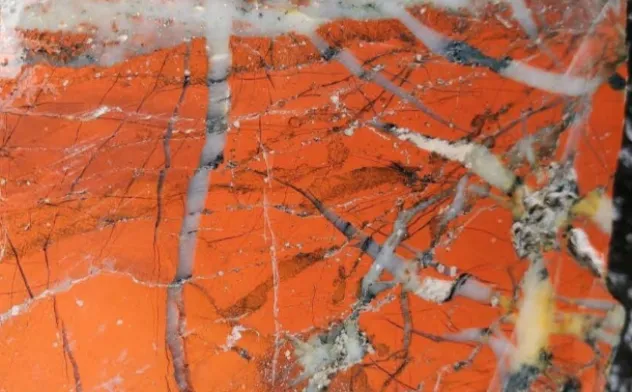
25:30 But with the prospectors, and most of that's been found in the Rattlebrook area, the prospectors now started focusing a little bit further South to Jasper, Brooke, and as you'll see, very much paying dividends and coming up some remarkably looking mineralization. First of all, you can understand why it's called Jasper Creek. This is all Jasper, so iron silicate, essentially.
25:52 This rocks those multiple phases. It's probably 3 or 4 phases of quartz vein in here. These all contain disseminate pyrite. So these are prospective for gold mineralization on its own. And then within that, you see this, what we call coliform crustiform banded quartz vein. So this comes from molten sulfidation. This is formed from molten sulfidation, epithermal gold. So this is now the first real evidence of the actual quartz veins and potential mineralization at Rattle and Jasper Brook rather than just the alteration. Very striking samples, lots of quartz veining and lots of sulphides. Here's more examples, again, very coarse, granular quartz, lots of pyrite. This one I'm really interested in because again, there's a lot of silica alteration, a lot of buggy quartz, which you can get in these systems, Pyrite.
26:40 And here there's a little bit of a purple mineral that's probably Fluorite. And When you go to some of the places in Colorado, Nevada, some of the better Gold mineralization is also associated with Fluorite in these types of rocks. Again, I'm not sure Fluorite is only identified from field observations. We've got to get confirmed by
27:02 SEM or microscope work, but it very much looks like fluorite. So a very, very attractive and prospective rock. And say, this is a very active system. I mean, the odd things about, if I go back to Jasper, these are typically more perhaps on the fringe of a porphyry system. We got a whole variation of textures that are telling us that it's not just copper porphyry, it's not just high-solidation, but now it was low-solidation. The 6th system sort of bounced up and down during its formation.
27:34 It's a very, very complex system, long-lived, which is a light-rooted cellar. It's a very key ingredient to its prospectivity and potential size. Within that, These fragmentals, we're not sure what this is. This may be another diatreme breccia. I'll be heading down there on Thursday after Canada Day. I'll just have a closer look at this rock and poke around with the prospectors. This has what we believe is a Molybdenum.
28:00 It's a quartz Silica vein. Obviously, this is a fragment. Again, it formed prior to this breccia, whether it's a diatrium breccia or not. Some minimisation is coming up from the depth, pre-formed, and then we're obviously finding a lot of minimisation like we just showed you, right in the bedrock. Again, a very active system,
28:22 multiple events. We're still trying to get our heads around what are we dealing with? Are we dealing with a low, high intermediate or poor free Copper? But when you're seeing that amount of Sulphides and quartz fanning over that range of temperature spectrums, it's actually a very positive indication. Here we're now looking at a depth slice of magnetic inversions. We're looking down 3 to 500m depth slice. Jasper Brook, this is where they're finding the mineralization. Some Jasper has been found before, but these guys pushed the lay further up the Brook and that's where they started finding a lot of the quartz pyrite mineralization. This is a magnetic target that doesn't really show up on the surface, but it shows up about 300m depth. Could this potentially be the core, often the core of these porphyry coppers may be magnetic.
29:11 It represents a valid target.
29:15 There's not a lot in here when you look at the geophysics. There's not a lot with this resolution of geophysics to sink our teeth into yet, other than perhaps this target and the one over by Boat Harbour. We're going to rely very heavily on these prospectors in the next few weeks, particularly at Jasper and Rattlebrook, but also in the rest of the Fortune trend, Point Rosie.
29:38 Because as I say, there's not a lot to go on by the geophysics other than this target, and it's simply going to be making traverses. Everybody else in the past has just followed Brooks. We'll look to actually now having a look at these rocks. I may not find the mineralization right on top of this because this is at depth, but hopefully you see some indication of the alteration. But we're going to rely heavily on these prospectors. Sometimes we'll be, as they say at Root & Sellers, more of what we call surgical prospecting. This is more of a broad brush, brush bros. But as I say, these guys continuously find minimization wherever they go. And I say this guy over here is about 75-years-old, but he knows the area very, very well, as does Jeff Burchette.
30:20 And even at 75, he can spend all day carrying rocks. Moving on to Stewart, as I say,
30:28 Ryle Brook is over here, about 10km from Stewart, which is really the most advanced target in the area. It's seen a little bit of work 10-20 years ago, including a little bit of drilling. The main target or the main manifestation at Stewart is this very continuous and already extensive alteration zone, about 850m wide up to 5km long. And it represents quite conclusively what we call the Lithocap or the advanced argillic alteration zone to a Copper porphyry system. These things often form big blankets,
31:03 not only above, but lastly extensive from the main porphyry Copper target. They all form these layers or blankets, tiers of representation of a very large granitic intrusion at depth. Then you have the small Porphyry stocks coming up and it's on that, those Porphyry stocks that you expect to find your Copper mineralization. But these little caps form these
31:27 exactly a cap or a blanket on top of the Porphyry Copper system. And This is where all the previous work focused on was drilling this, because as you can see, it's very striking, a little bit of sulphides, but very eye-catching on surface. They drilled hundreds of metres of anomalous Gold, Copper and Moly, but never really focused on drilling underneath this target as we'll see shortly. And just to give you an example of this, this is exactly what they see in BC's Golden Triangle. If you go on the website, everybody working in the Golden Triangle of BC, they have these pictures on their websites of these beautiful rusty-covered mountain tops. These are the Lithocaps. This is not where they're drilling. Here's the drill holes, the drill pads, testing these targets and then drilling underneath the Lithocaps.
32:16 The main porphyry target is hundreds of metres below that Litho cap. At
32:24 Stewart, we believe everything's been pushed on its side, so we may not have to be drilling deep to get the porphyry, but it's somewhere on the sides. But up to date, everybody at Stuart has been focusing on drilling the Lithocap. So they drilled the head or they drilled the cap and not the head, and that's what we'll be focusing on in the coming months. I'd say, just to give you a more clear example, here's the Lithocap. Here's this yellow, this alteration zone mapped up on the surface,
32:54 800m wide, 5km long. And right on one side, you see this very strong magnetic anomaly. These poor free stocks with mineralization often has a lot of magnetite in it, so they begin to get very magnetic. This is a depth slice again from about 700m down, never been drilled. All the drilling has been taking place, testing the Lithocap.
33:15 This is a valid target. It's probably not exposed on the surface, but we will be having a closer look to see if you see any indication of alteration that may tell us that this is our target. But meanwhile, perhaps later on, we'll do some IP geophysics over this, but already a very valid and compelling geophysical target where you have the Lithocap and right underneath it, in this case on its side, you have what looks like a porphyry stock. So what do we have? I say we have a complete at Root & Cellar and also extending that into the Fortune area. But certainly at Root & Cellar, we have a porphyry Copper target along with epithermal Gold, both low and intermediate Sulphide. Typically, these things, if you're finding the Gold, the Copper is often too deep to get to, but that's clearly not the case at Root & Sell. I've seen lots of Gold and I'm getting strong indications of the Porphyry Copper at Creston.
34:11 They exist in models on paper and in literature, but they also exist in real life. Here's an example from the Philippines. You have what they call the Far Southeast target, which is the Copper Porphyry, exactly like you expect to see on the model that we saw on the first slide. Then you have your Gold mineralisation, again very, very flat line. These are not vertical sheets. Just like we're now seeing at Rubin Seller, those very shallow 10 to 25-degree plunges, that's what they have at Tlopanto. So you get the Gold and the Porphyry Copper. So They don't just exist in the academic textbooks, but they do exist in real life and we think we have one there at Ruben's Cellar. Moving on, there's going to be further prospecting immediately at Jasperbrook and Rattlebrook. I think what the prospectors have been finding the last few days is extremely interesting. This wasn't really, it was always in the new property portfolio, but it wasn't one of the priorities, but it was rapidly becoming that based on what they're finding. I'm extremely excited by the rocks that they're turning up with.
35:21 Going forward also, as I say, surgical prospecting on IP and structural targets and detailed chip sampling at Bruton Cellar. When we were on the ground there the other day, actually we saw a new mineralization after some of the trails we built for the drill pads last year have been washed off by the rain a lot better. And now they're actually exposing new mineralization that we hadn't seen before. So we'll be detailed chip sampling at those, followed by some additional trenching and fairly detailed chip sampling on any mineralization that we see. If it's low-grade to try to map out these structures that can then confirm that we're onto that, basically map out those 073 trends, not just based on geophysics, but based on the chemistry. Continue prospecting and reconnaissance work in the Fortune camp, specifically at Point Rosie coming up soon, as long as obviously Ratherbrook and Jasperbrook.
36:17 We're still waiting for the 3D IP geophysical data from Creston. We're extremely keen to see that. From that, then we'll be able to find a drill target. Hopefully, that will move into a 2,000 to 3,000-metre drill program, focused at the Creston Copper target. But I think at that time too, we'd like to test a few of these IP targets along those 073 and 115 trending horseshoes that we've now been interpreting a little bit with the help of AI, but it very much matches the geophysics. This is really what we're keen to see right now, the 3D IP geophysics from Preston, which will lead into a drill program, but meanwhile doing some fairly low budget work at the Fortune trend, but some work that can change things very, very quickly. So that really includes a technical part of my presentation.
37:11 I have a few minutes for some questions if there are any out there. Thank you very much. Hey, and awesome. Thank you for running through that presentation. So I got a couple of questions, and there's a couple that came in in advance over email that we'll get to, and then we'll get to the ones that are in the live chat here. And again, if we don't get to your question today, I'll still send it through to the Northern Shield team. They'll be sure to get back to you as soon as possible. So I know in the AGM behind you, it was last week, and there's obviously, based on this presentation, a lot happening on the exploration front. How are you feeling? It's kind of a broad question, but bear with me. How are you feeling about where Northern Shield sits right now? Very excited. Very positive. We have lots on the go. The good thing about it is there are various projects at various stages of the pipeline.
37:58 As I said, The real keen interest is obviously that geophysics, everything else is matching up, that we're not far away from a porphyry target there. We'd like to see the geophysics to find out exactly where it is. That's one of the big excitements, but we've barely touched the ground on the main portion of Fortune. And I think what they're finding at Rattle and Jasper Brook is extremely exciting. So a lot of dynamics right now between root and sowing on these new projects. But it's remarkable that these prospectors continue to find new mineralisation, even over ground that's been poked around, alterations have been known there, but you just have to do the hard yards of keep going back into the bush. Now they're proving up the fruits of their labour and finding quartz staining with mineralisation.
38:48 I think it's a very exciting time. What they have been finding at Jasper Brook, that's what I'm keen to get down there later on this week. Awesome. That was the fun and the challenge of exploration geology here. Now I know the Fortune property discovery is obviously getting a lot of attention, particularly the Stewart target, but Rattle and Jasper Brook, although it's within Fortune, it wasn't really on the map, we'll say before. I know you talked to already, but can you walk us through really what you found and why it's such a significant moment for the company? Yeah, it's kind of interesting. And again, this is one time that Jeff, the prospector, proved me right because originally I wasn't super interested in the Rattlebrook area. It had this alteration and big alteration, but I was under the assumption that even though it's clearly indicating that something was nearby, that maybe it was going to be too hard to track down right away. And so the idea was to focus more on, when it comes to the fortune property, focus more on Point Rosie, perhaps Feeder Brook and even Stewart. Stewart is going to be a bigger project because there's already a lot of groundwork done. The next stage is perhaps geophysics and drilling.
40:04 But the alteration was there at Rattlebrook, but I just thought it's going to be harder to find, get ourselves some actual mineralization. And Jeff and Albert, the prospectors have proved me wrong. And I think it's really exciting. We don't know the grade. We don't know if there's any Gold in there, but there's clearly some Moly, there's clearly some Copper mineralization, including minerals that we call Anargite and maybe Cobaltite, which again indicate where you are in that porphyry Copper or high-sulfidation system. I've always said these are projects that can turn on a dime and I think that's happening at Rattle and Jasper Brook. We'll definitely get back there and just keep sending these guys in the field. Because you're right, we acquired their target, but it wasn't really one of our main focuses, but it certainly is right now, I can tell you that. No, I appreciate it. And when you're looking at the scale of Fortune properties, So 212 kilometers squared covering a 40 kilometer trend, multiple known occurrences.
41:05 How does that compare to what you were originally expecting when you first moved into the area? Well, when we first moved in, although there's other, these other currents were, were, were kind of known about, you know, obviously root cellar was the focus. It was for a variety of reasons. It was, it was a grades that were on surface that the prospect was finding. It was actually the extent. You can go to these other occurrences and find little patchy Gold occurrences, but you don't see 700m. It may be some of it's low-grade, but it's still Gold mineralization. You see that over nearly 700m, even 1,000m in the conquest zone. You just don't see that anywhere else on the surface, in the beer that I'm aware of. And then you have the Copper.
41:51 The focus has always been Conquest and it still is. It seems to be a complete package, epithermal Gold and porphyrin Copper. But I wasn't expecting it. I thought that the fortune trend was going to be more of a longer-term perspective, and some of it is. We're going to focus on the drilling, the higher budget expenditures on root and cellar at Conquest, at Preston. Stuart is more, we'll do some groundwork in there, but the heavier budget stuff will be down the road with the drilling. I wasn't expecting great momentum coming from Fortune so quickly, even though I said these guys can go in there and find something that can turn it on a dime. I wasn't expecting this. The focus is still root and cellar, but it just shows what you can find on the Bering Peninsula.
42:42 We got the fortune trend. The idea was to tie it up because word is getting out that the Porphyry potential there is real. We haven't drilled into it at Root & Cellar yet, but clearly the indications that the Porphyry potential is real. These things haven't been eroded. Epitome of Gold, which is on top, is still there. The Porphyry is still there. So we wanted to tie it up just for strategic regions. But now it's becoming more than just strategic. It's becoming an important part of the game plan. That's always exciting. I do want to jump to Root & Cellar because I know the Crest and Copper target return values of 3.9% Lead, 4% Zinc and 2% Copper from grab rock samples earlier this year. But with Fortune now in the mix, how are you, Northern Chill generally, balancing attention and resources between the 2 properties? How should investors think about that split? Yeah, well, I say, money-wise, the idea was that we're always going to be relatively low budget on the Fortune trend.
43:44 We're still trying to do an airborne survey over Fortune, but the priority now is becoming just get prospectors and geologists on the ground. Again, the prospector has shown what they can do in a very short period of time at Root & Seller. It's a pipeline of projects. The heavy lifting is still going to be done at Root & Souther both budget-wise and personnel, but I say relatively cheaply. Just putting these guys on the ground, some of it is better accessed by helicopter, which adds to the cost a little bit, but it's not significant. It's a pipeline approach, a two-pronged approach while we're waiting for the geophysics, which I was hoping to have by the AGM.
44:30 While we're waiting for that and then a drilling, at least we can get these guys on the ground that can potentially turn the dial pretty quickly on these projects. And I think these rocks, and we're only just beginning to see them, could be a difference maker. Awesome. And as you said, the geophysics is obviously something for investors to keep an eye on. But generally, before I get into audience questions, what are the next pieces of news that people should be excited about in the months ahead with the 2 compelling properties and field season underway everywhere? Yeah, I mean, the first thing is geophysics. It can be any day, but the geophysics at Creston is one of them. The rocks, the pictures that I just showed you, those samples have been shipped to the lab, so we'll probably fast-track some of those, perhaps maybe 3-weeks on those.
45:21 Meanwhile, these guys will be on the ground quite a bit. I'll be joining them for a few days at the end of the week at Jasper Brook and at Root & Cellar. It's really geophysics. Shortly after that, we should be able to pinpoint exactly where we're drilling and the scope of the drill program and then as the results and ongoing prospecting from the fortune trend. I know everybody always wants a brilliant, but I think we should pay attention to what these guys are finding on Jasper Creek because I find it quite interesting. Very, Very much. I appreciate it. Looking forward to seeing what comes next. A couple of questions. One came in advance over email. Just looking at what state of the current Treasury based on last filing.
46:10 That's about, I think, just under half 1 million. We still got the geophysics. I think the geophysics is taken out of that. I'm not sure, but it's just under half 1 million. So, we'll go into the drill program, either a small drill program with what we have, or if we have to raise more, we'll raise more. But hopefully, after results of, first of all, the free DIP geophysics and some results from Jasper. Right now, most of it is just low budget, relatively low budget prospecting and trenching. Always nice. That can be the fun part though. James asked right at the top of the hour, This is a personal question for you, Ian. Are you currently more excited about the Gold or Copper story? I guess the Copper, well, if you're talking about root and seller, I mean, probably the Copper just because it's harder to find a Copper porphyry target.
47:06 I think the Gold is legit, perfectly legit. I think if there's Copper porphyry there, there's probably a very good possibility of a Gold system as well. Copper porphyry is just harder to find. I think if there's a porphyry there, it's going to be a bigger story that everybody's going to want. Somewhat the porphyry, but they're both there. Why can't this be another Lepanto where you have both the Gold and the Copper? Firstly, Copper, just because it's harder to find a porphyry system. There are other indications of them now on the island. People are beginning to focus outside of the Bureau and on Porphyry Coppers, but nothing up and running yet. Maybe this is the one that's going to really change the tune.
48:00 I guess the Porphyry Copper, just because it's going to be a bigger win at the end of the day for everybody. That's fun. I was going to say gun to your head, but I appreciate your picking in the end. T from the chat asks, are there local communities to work with or is Root & Cellar basically in the bush? It's in the bush, but it's very, very close to Maristown. I mean, just I say you can get out, you can grab your coffee and be actually in the Creston Copper pits in less than 10 minutes. And in Conquest, where this picture is right now, the trench, you know, 10 minute drive in a car and 10 minute on the ATV. So it's very, very close. The community has been remarkably supportive. I say, I've never worked in a place where I've been so welcomed as an individual and as a corporation. When people hear what we're doing, it's not just a good luck. It's like, what can we do to help you succeed?
48:57 And the prospect is very well known and respected in the community. Everybody's rooting for him because they know how hard he's worked on this and how much perseverance he's put in over the years. So it's a very, very welcoming community. The other targets, I mean, Point Rosie is relatively remote, no communities, but, and Maristown is only about living 6 or 8,000 people, but it's a very, very welcoming area to work for Morning Say. I meet people there all the time and they want to know what they can do to help. Awesome, appreciate it. If anybody thinks of the perfect question to ask as soon as the event ends, as is often the case with me, please let me know. But thanks everybody for joining. I know there are quite a few in the room today.
49:46 The recording again will be available probably end of day Eastern time. Really appreciate you joining us. Ian, thanks so much as always for bearing with me for some questions, but also going through an update for the company. Really appreciate the communication. Thank you very much and I look forward to updating everybody on the geophysics and the prospecting as soon as we get results. Awesome. Thanks, Ian. Have a great day, everyone. Cheers.