Rodrigo Maza
CEO at NAKED WINES PLC
Replay available
Strategy Event & Investor Presentation hosted by Naked Wines (LSE:WINE) on Investor Meet Company, held 2025-03-28.
On 6ix: 6ix.com/event/naked-wines-plc-wine-strategy-event-and-investor-presentation
Automated transcript · Written by software from the replay's audio. It can mishear names and figures; the replay is the record.
0:00 Good morning, and welcome to the NAKED WINES PLC investor presentation. Throughout this recorded presentation, investors will be in listen only mode. Questions are encouraged and can be submitted at any time via the q and a tab situated on the right hand corner of your screen. Simply type in your questions and press send. The company may not be in a position to answer every question received during the meeting itself. However, the company can review your questions submitted today and publish responses where it's appropriate to do so. Before we begin, I'd like to submit the following poll. And then I'd like to hand you over to Rodrigo Mazza, CEO. Good morning, sir. Hello, everyone, and welcome to our strategy review. We are very grateful for your time. I'm Rodrigo Mazza, NAKED CEO, and I'll be presenting to you today along with Dominic Neri, our chief financial officer. Before we go into the details of our plan, let me quickly remind you of what sits at the core of NAKED WINES.
0:53 Fundamentally, NAKED is about connecting wine drinkers and winemakers. Our model removes the middleman so customers get better wine for their money, and winemakers earn more for what they do best, which is making exceptional wine. This direct, meaningful relationship builds loyalty, drives a sense of community, and gives us a clear edge in the market. I just talked about how NAKED model works, but this is what it actually delivers. This chart is based on reviews from Vivino, the largest wine marketplace in the world. It shows how NAKED consistently over delivers on quality for price when compared to traditional retail brands. This is one of the main reasons our customers stay. This is not marketing. This is actual product market fit.
1:41 Now this is our model at scale. NAKED currently connects close to 600,000 very satisfied Daniels in The UK, The US, and Australia with over 300 of the world's most talented independent winemakers. We think of our footprint as an advantage, especially in The US where the ability to legally deliver wine to over 90% of the population is far from easy to replicate. Operating across three countries also protects us from overexposure to any single market or regulatory shift. That diversification adds meaningful resilience to our business. This is a very important message. When we talk to our ideal customers and ask them what they're looking for when shopping for wine, the responses match perfectly with our value proposition.
2:30 Convenience, value, selection. These are the three key drivers, and NAKED is structurally designed to deliver on all of them. These are not just differentiators. They're the reason that customers stay longer, that they spend more, and that they tell their friends about NAKED. The issue is that we haven't been living with that. We stopped focusing the conversation on the value we deliver and what makes us different, and our amazing brand has struggled because of it. We are already changing that. Now over to Dominic Neri, our chief financial officer. Thank you, Mazza, and good morning. Before we get into the plan, I just wanted to give you a little bit of overview of who I am. So I've been here since the middle of November, and my background is consumer, and I've spent the last twelve years or so in technology with some time in The US as well.
3:25 And I've got to say, during that time, I think it's rare to see such a a significant value opportunity. If I go back to when I joined, the business I joined had 60,000,000 of liquidity, strong cash flow, a product which is really excellent. I I've really enjoyed all the all the wines that I've tried so far. And what really gets me though is the people. We've got some fantastic people in this business who are hugely engaged in our value proposition. And on top of that, we've got some amazing winemakers. I've only met a few of them so far, but they really are so enthused about both what they do and how we help them. Anyhow, the first question that I asked Mazza when I joined when I was in the interview process, in fact, is with such strong cash flow and such, you know, a fundamentally profitable business, why is the share price half the value of cash and excess stock?
4:29 And that really is at the heart of our plan today. Underlying free cash flow is positive. We've got strong cash, strong cash generation, and a business with growing profits. So this is a significant value opportunity. If we move on to our plan, you can see here three legs to that plan. The first is about cash. We've got 33,000,000 in cash today. We've also got a facility which provides about 30,000,000 in extra liquidity, which is undrawn so far. What is very clear to me is that as we come to continue sustained profitability, there really is no need for this level of cash in the business.
5:20 On top of the cash I've talked about, of course, there's 40,000,000 cash coming out over the medium term from inventory, and we'll come back to that later. So that gives something like 75,000,000 cash from our current balance sheet. The next leg of our plan is about turning this business into a profitable business and recalibrating around profit. And the key point here is, as I've said, the underlying business is now free cash flow positive. The underlying business itself is stable. It's profitable as well. And what's important is that once you understand the revenue progression that this business is going to see, and, of course, we know the cost structure, and today, we'll be talking about 23,000,000 of annualized cost savings, which will be reducing that cost structure, you can very clearly see a row a route to EBITDA of 10 to 15,000,000.
6:22 And finally, the third leg to our plan is as we return to growth. And this really is about two core things. One is about improving retention, and we've got investments in our plan of about 200 basis points of margin, which will take us back to the levels we had in 2019. And secondly, we have have a much more targeted efficient marketing plan, which will reduce 7,000,000 of spend and get our acquisition costs heading towards 2019 as well. And with those two factors, that's what returns our business to growth. So in summary, 75,000,000 of cash coming from the balance sheet, an underlying business that is already profitable, we're just unlocking that, and a business with investments and the right marketing strategy to return to growth. So that's our plan in a nutshell.
7:16 If I start to go into a bit more detail, let's focus on the balance sheet. So cash will reach 75,000,000 from our f y twenty five balance sheet. And the starting point of that is, of course, the cash we're going to have at the end of March, which is 33,000,000. This is up 23,000,000 since the start of f y twenty four. And I also mentioned that we already have unused financing of about 30,000,000. So a very, very strong cash base upon which to build our business. We also have 40,000,000 of excess inventory. So we've made significant progress with our inventory so far. We've reduced inventory by 28,000,000 in f y twenty five, and the 40,000,000 that I'm talking about today is 5,000,000 higher than we were anticipating in December, and that's because we've taken the last three months to go into a lot of detail about our US inventory and our liquidation plans, and we've identified better strategies, which is generating 5,000,000 more.
8:26 So 40,000,000 of cash coming out of inventory over the next over the medium term. There is attached to this circa 12,000,000 of liquidation costs. Now just to be clear, the 40,000,000 of net cash includes the 12,000,000 of liquidation costs. So that's 40,000,000 of cash. This 12,000,000 of costs, it covers a variety of activities and actions that are necessary to speed up our cash generation from stock. There is potential for upside in this because this is assuming very low, I. The current US wine market prices. And we're not in the position where we have to panic sell. This is not panic selling.
9:11 We have options here, and we will monitor the market closely to make sure that we're not wasting our investors' money. So 12,000,000 of liquidation costs, unlocking 40,000,000 of net cash on top of the 33 already in the balance sheet. And then the final point here is more a general point, is that this is a business, which has been heavily focused on initially growing and then sorting out, liquidity challenges a couple of years ago. We're now in a position where we can focus on the balance sheet and on our cost base. We'll come to that in a second. There are opportunities in the balance sheet, and they're not included on plans, but we are very conscious of them and very much are targeting. So 75,000,000 of cash from our balance sheet.
9:59 The next section, the second section of our of our business is recalibrating around a profitable call. So I mentioned already that underlying free cash flow is positive in f y twenty five. This is a profitable business today, and it will grow going forward. The core to this is that our underlying membership is actually already stable. So our membership today, if you look at it, is falling, year over year and has been doing for a number of years. But, actually, if you dig into that, the reason for the vast majority of that decline this year was attached to two specific, cohorts. So during f y twenty one and f y twenty two, we acquired a huge amount of new customers, I think 1,400,000 in one year.
10:54 This is about three times what we normally acquire. So during those two years, we acquired three times as many members as we normally acquire. The retention and attrition numbers percentages for those cohorts are normal. They're the same as any other year. But if you acquire three times as many members in a year, then in the future, as those cohorts gradually attrite, you lose three times the number of members each year. So at the moment, our membership base is being impacted by the very strong acquisition we did in '21 and '22. The good news is that this stabilizes. So over the medium term, the impact of those cohorts starts to mitigate, and they become highly retained cohorts.
11:44 And, actually, the underlying business, if you strip that out, is like for like broadly stable and has been broadly stable for a number of years. So what this really means is that we can have a a a high degree of certainty as to the range of where revenue is going. And if we know where revenue is going, then if we set the right cost base, we can then get to EBITDA of 10 to 15,000,000. So how do we get EBITDA to the right level? Well, we need to address the cost base. And the next two sections are about taking out 23,000,000 of annual cost savings. So the first one is removing 7,000,000 of annual savings from marketing. And I'm just gonna skip now down to our marketing slide, and I'll come back.
12:33 So we have been spending, obviously, a lot of money on marketing every year for a for a long time. What we've realized is we've done some very strong econometric modeling and then testing. And this is testing is core to our business today, and I would say this is the clearest example of a benefit coming out of our renewed strategy from last year. So we did some econometric modeling of what we were spending and got to a much better understanding for exactly where our consumers where our members were being acquired from and which channels they were coming from. And out of this, it became very clear that there were some key channels where the inefficiencies were much higher than we had previously understood them to be.
13:19 We have then done some testing in in our geographies to validate those points, and we've identified circa 7,000,000 of spend that is highly inefficient and can be cut. Now that has a small impact on our membership acquisition, so it reduces acquisition by about 10%. But, actually, what it also does is it means that we are focused on much better quality customers. So the 10% that we're losing are customers that have poor retention levels because they were coming in looking for heavy discounts. They were unprofitable as well because of that. So this revised marketing plan built on our new testing strategy based on detailed modeling analysis backed up by testing has identified 7,000,000 of savings, which has a limited impact only on our membership acquisition.
14:13 So if we go back to the section on savings one second. So we were talking about we've got stable revenues coming out of our underlying core members, which are stable. We've got 7,000,000 of savings coming out of our the 23,000,000 of annual cost savings. So that's the first 7,000,000. That comes immediately from early f y twenty six. We then have identified a further 16,000,000 of savings. 8,000,000 of that starts immediately in f y twenty six, and that's split into two areas. The first is the warehouse and logistics savings in The US and The UK, and those are contracts which are already in place. We've identified a further 3,000,000 of g and a savings, which takes place in f y twenty six, and that's because we are organizing ourselves globally, and that is generating a number of savings.
15:11 Now the primary reason for that is that will make us more effective and speed up our actions, but there are some synergies which come out to that as well. So that 16,000,000 of savings, the first 8,000,000 f y twenty six coming from warehousing and central reorganization. The rest of those savings are mostly coming from COGS and variable costs, and they will come through in the medium term. And that is quite a conservative number. We have a much bigger pipeline of cost savings, but we're assuming only 25% of our COGS savings, for example. So in summary, we're recalibrating our business around a profitable core. This generates up to 30,000,000 of cash and takes our EBITDA in any realistic scenario from 10 to 15,000,000.
16:01 And it's coming from the fact that our membership base is stabilizing, and we're putting through 23,000,000 of annual cost savings, of which 15,000,000 start in early f y twenty six. So I mentioned about our EBITDA objective here. So this is our medium term exit financials. We are seeing that our revenue will stabilize, and our guidance is that it will stabilize between 200 and 200 and 25,000,000 over the medium term. There are a number of scenarios here, and let me just talk you through them. So the key difference between them is acquisition and retention, and I mentioned this point earlier on. So what we're saying is that we're going to cut our marketing budget in all scenarios by 30%, and that will lead to 10% less member acquisition in our plan scenario.
16:57 That is what our testing is suggesting. We're trying to be conservative and say it could be worse than that. Maybe we've got the testing a bit wrong, and it could be minus 20%, and that's our lowest scenario. And, of course, there is obviously the opportunity and that, if I'm honest, some internal expectation that the different channel mix will be of a higher quality of customer and will be more productive in terms of acquiring members. So there is definitely a potential upside, and one of those is built into our highest scenario. So different levels of acquisition and, similarly, retention. In our lowest scenario, we're assuming that we retain customers up to our current levels, so no improvement. We're then assuming that the in the improved acquisition will lead to better customers, and we're also investing, as I've mentioned, 200 basis points of margin in retention improving initiatives.
17:53 And it is our belief that that will take our retention levels back to where they were in 2019, and that is the assumption built in both to the plan scenario and the highest scenario. So a clear set of scenarios showing a range of possibilities for revenue. Our internal opinion at the moment is that revenue will stabilize between 200 and 225,000,000 before growing again, and that our EBITDA will be in in any scenario above 10,000,000 that is realistically possible and could be as high as 15 as our target and clearly could potentially be more than that. So our guidance is really between the lowest scenario and our planned scenario. And finally, on to which is probably the most important slide that I'm presenting today.
18:47 We are, in any scenario, going to have a lot of cash coming out of this business, and we are very conscious of that. We have therefore put in place an objective to finalize agreement with our finance partners on a new limited to limited regular distribution policy, and we are considering share buybacks as part of that. So if we believe that there is a clear difference in value between the current share price and the intrinsic share price that the board considers is correct for the company, then we would do share buybacks. But to be clear, we will only do that if we believe it is value creating because we see a significant valuation difference between the share price and the intrinsic value of the business.
19:38 The second column is about significant medium term one off distributions. So we already have a lot of cash on the balance sheet and that clearly, we are going to have a lot more cash coming out of the business even than profits. We need to be very mindful of that and very careful with that, and governance and control over that will be incredibly strong. But, of course, we are looking for ways to ensure that that is allocated properly, and that could well mean significant medium term distributions. The key to that is the profitability that we are incredibly confident we will be reaching in the medium term. And once we've delivered significant contributions for a period of time, then any restrictions on our ability to distribute cash will start to reduce significantly.
20:28 So it is very likely we will have excess cash over the medium term, and we're committed to distributions. If we can't find the a value creating way to do that, we'll talk to our shareholders about the best way to do that. And the final two columns are really just reiterating this point. We are very focused on profitability. We're very focused on making sure that we have a strong return on our investments, and that is very much internally how we are working as a business. Of course, there are always opportunities for m and a, and we're mindful of them. There's nothing obvious that we're thinking about at the moment, but clearly things may come along. However, our underlying commitment is that we want to the significant cash we see in the business coming, we want to distribute to our shareholders.
21:16 And with that, I'm gonna pass on to Mazza, who's going to wrap up the presentation and take you through some of the growth story. Thank you, Dom. If we go to the next slide. Our path back to sustainable growth is built upon two key pillars, which are retention and acquisition. And importantly, we're going to support this through investments in technology, right, driving both personalization and segmentation as key levers on our two key pillars. On the retention side, we are focused on discovery, helping our customers finding the wine that's right for them. Delivery, making sure that we are offering convenience at the very least at part with our competitors.
22:08 And finally, but very importantly, leveraging our community, our amazing engaged community of winemakers and angels to drive growth. On the acquisition side of things, we are very much focused on investing in our brand, making sure that our brand is working for us in a way that actually builds a defensibility for the company and then protect source from ever inflating CACs. We are investing in converting long term customers. So all across our acquisition funnels and onboarding journeys, you can see significant enhancements. And finally, but again, importantly, we have invested a lot of time and effort in building robust measurement systems that ensure that we are focused on the channels and on the messages that yield the highest ROIs.
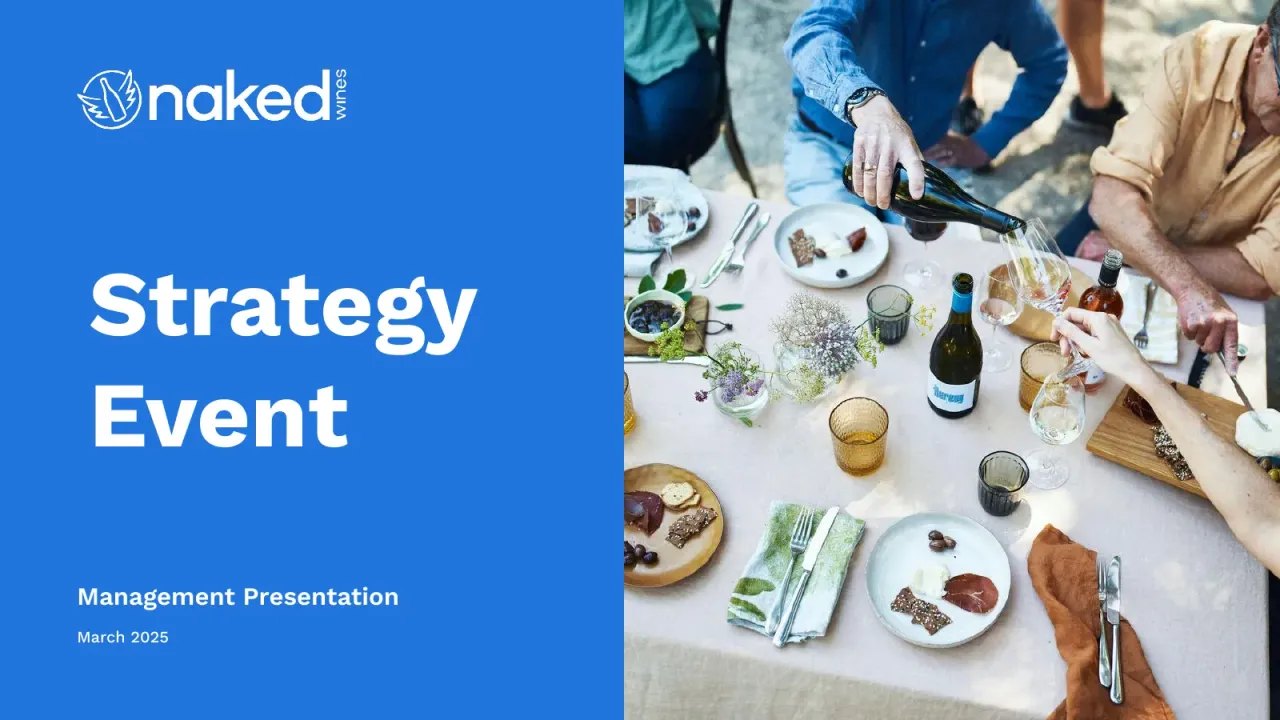
23:07 Dom already covered this slide, so I'm gonna skip it. We wanted to include this picture. Right? I think it's representative of our community. This was taken during our tasting tour in The UK last year, last summer. In this picture, you can see winemakers. You can see the NAKED team, and it's that connection. Right? Like, getting customers to engage with the winemakers to understand their story, the story of their wines. That's truly a competitive advantage that our model offers. Okay. So these are our concluding remarks. I won't go into detail into every single one in detail, but the key messages are that we have taken a lot of big steps this year from stabilizing the business to rebuilding the team and grounding our strategy in real data and insight.
24:03 We are not promising a moonshot. This is a clear disciplined plan to unlock over a £100,000,000 in value. Our team is already executing with more focus, more discipline, and more conviction than ever. And, yes, there's still work to do, but we genuinely believe we're going to get this company growing again. NAKED WINES is undervalued. This plan is how we change that. Thank you very much. Rodrigo, Dominic, thank you very much for your presentation. Ladies and gentlemen, please do continue to submit your questions just by using the q and a tab situated on the top right hand corner of your screen. Just while the company take a few moments to review those questions submitted today, I'd like to remind you that recording of this presentation, along with a copy of the slides and the published q and a, can be accessed via investor dashboard.
24:52 As you can see, we've received a number of questions throughout today's presentation. And if I may dive straight into it, the first question we have here reads as follows. How much of the cash at hand is represented by Angel Funds? Yes. Thank you very much. Great question. I think the first thing to make clear is that our angel funds are incredibly secure. So not only do consumers have incredibly strong protection through their payment processes, But actually, as that happens today, we have more liquidity than all of the angel funds added together. So everybody could withdraw every penny of angel funds, and we still would have enough cash. Now that's not at all something that would ever happen. It's just impossible. And the best proof of that is to have a look at our angel fund balances.
25:37 So if you look at our angel funds over the last five years, the angel fund balance has been remarkably stable. And, of course, that's during a period where we've come down off the sort of COVID high of revenue. So revenue has dropped significantly. Angel funds have been incredibly stable. And the reason for that, and is a core part of our profitability, is that our angel funds are very heavily weighted towards our core members. So our angel funds have became remained stable because, actually, as I was saying earlier, our underlying core members have also been incredibly stable over this period. So angel funds have been stable. They aren't gonna fall down. We obviously have huge protection, and all our angels are entirely protected. But what they are is an incredible investment.
26:24 And we were watching a video yesterday, which you could find on our investor wide website, where we've you can see winemakers talking about how these funds have been used to rescue a number of winemakers through horrible times. And it's the investments like that from our fantastic angels supporting brilliant winemakers that really makes the NAKED difference. Thank you. The next question we have here reads, what factors will determine your approach in relation to share buybacks and shareholder returns? Thank you. Again, as I said, this is the most important slide I was presenting. So we're very clear that we will only use capital where it makes a value creating sense. So if we're making investments internally on customer acquisition, we've set ourselves clear KPIs to ensure that we're adding value to our shareholders and our share price.
27:17 If we can't find ways to use that money internally for investments, then we will look at distributions, and we've talked about the potential for share buybacks. But, again, we're only gonna do that where there is a clear valuation difference between the share price and the intrinsic value of the business. If those two get too close together, then there's a risk that actually that could be value destroying, and we wouldn't do it. If we find ourselves with significant excess cash over the medium term, then we've been very clear. We will be very close to shareholders in what we do with that. I would imagine that that's going to involve significant distributions, But at this point, obviously, we don't know, and we'll talk very closely to shareholders about that. Thank you. Just moving on here. How does NAKED WINES plan to improve customer attention and acquisition through its revised marketing strategy, and how does investment in customer experience?
28:13 Yeah. So going back to a slide I shared, on the retention side of things, we are investing in discovery, delivery, and community. It's important for me to say that no not one not any one of these variables in isolation is gonna make the difference. Right? Like, we need to pull on these levers simultaneously to get retention back to where it used to be historically at NAKED. So that's exactly what we're doing, running a lot of tests simultaneously. On the acquisition side, we are looking at our channel mix. Actually, not looking. Right? Like, we are actively shifting our channel mix, moving out from moving away, sorry, from channels that are past diminishing returns, investing into new channels that are delivering on appealing ROIs.
29:13 And as I mentioned, we've built robust measurement systems in the past six months. We have run important tests at scale that prove the actual return on the investments that we make, and we will continue to adjust our marketing plans based on that knowledge. Thank you. How does NAKED WINES turn promotional offer users into long term members instead of one off buyers? That's a great question. Right? And it goes back to what I was saying. I think that over time, NAKED became overinvested in channels that don't really lend themselves for us to tell the NAKED story, right, to to present our value proposition, the things that actually makes us different and hopefully better than competitors.
30:02 And instead, we were investing in channels that push mechanics on on people. Right? Whether it's a a discount, a time bounded offer, etcetera. I think that that used to work quite well. It works in the moment, but you can't really build a brand around it. So that's one of the key drivers in our change of approach. Perfect. And I think the last question we have here reads, what impact does management expect from the potential Trump tariffs on wine? Yeah. Thank you very much. So, actually, this the the primary you would expect the primary impact of this potentially to be in The US. Actually, our US business generates a lot of its own wine. So something like 90 to 95% of the wines sold on our US site come from The US.
30:57 Obviously, we have stock levels over there, more than we'd originally intended, but some of it potentially will be quite useful. So we don't really see a massive impact coming out of any potential tariffs or anything. And if there were an impact on a small subsection, I imagine, a, it's firstly, it's gonna impact the whole market. And secondly, it would change consumers' decisions about which wines they were buying. Rodrigo, Dominic, thank you for answering all those questions you can from investors. And, of course, the company can review all questions submitted today, and we'll publish those responses on the Investor Meet company platform. Just before redirecting investors to provide you with their feedback, which I know is particularly important to the company, Rodrigo, could I please just ask you for a few closing comments? Yes.
31:42 Of course. I I would close with with what I said before. Right? Like, NAKED WINES is undervalued. I think the plan that we shared with all of you today is very clear. It's actionable. It doesn't require to take massive leaps of faith. Right? This is a clear disciplined plan to unlock over a 100,000,000 in value. We're working all hard at it already, and we'll continue to do so. And thank you again for your time. Rodrigo, Dominic, thank you for updating investors today. Can I please ask investors not to close the session as you'll now be automatically redirected to provide your feedback in order that the management team can better understand your views and expectations? This will only take a few moments to complete, and I'm sure will be greatly valued by the company. On behalf of the management team of NAKED WINES PLC, we'd like to thank you for attending today's presentation, and good morning to you all.
Follow Naked Wines PLC into a list and get an email when it puts out news.
CEO at NAKED WINES PLC
CFO at NAKED WINES PLC