Matt Pullen
CEO at MARSHALLS PLC
Replay available
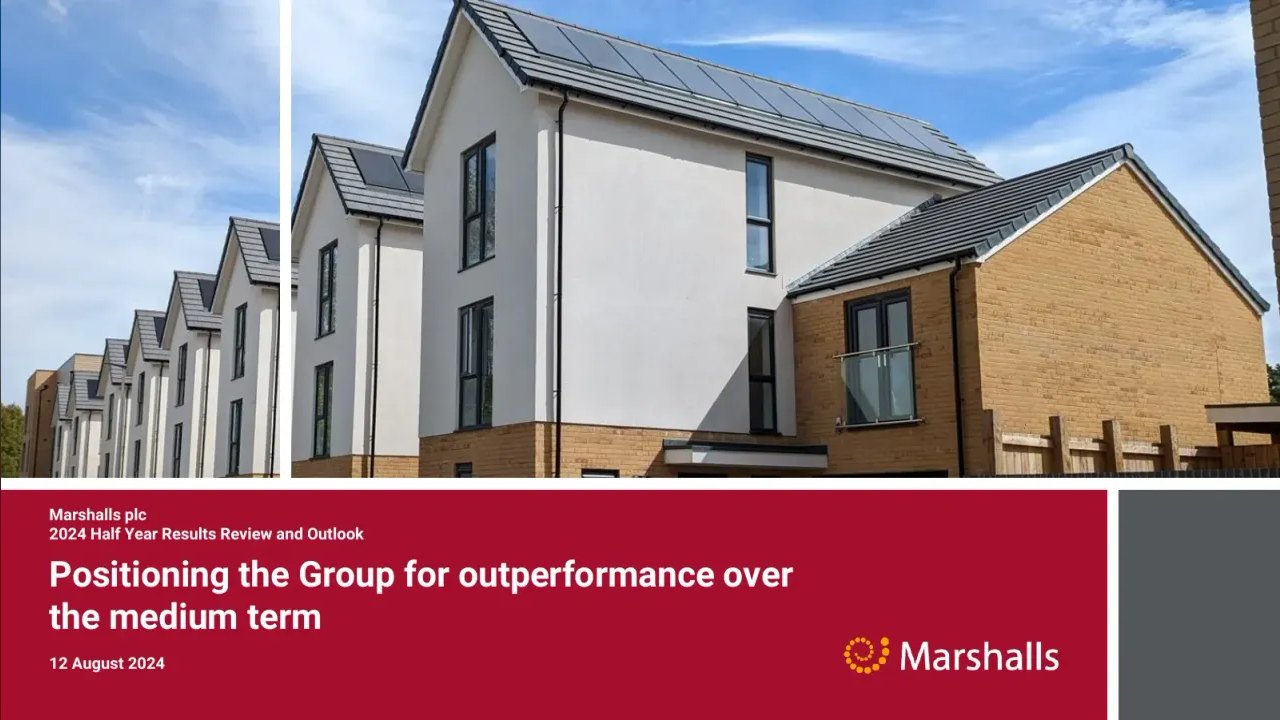
Interim Results hosted by Marshalls (LSE:MSLH) on Investor Meet Company, held 2024-08-19.
Automated transcript · Written by software from the replay's audio. It can mishear names and figures; the replay is the record.
0:01 Good afternoon, ladies and gentlemen. Welcome to the MARSHALLS PLC Interim Results Investor Presentation. Thank ahead.
0:25 And And grateful for your participation. And then now I'd like to hand over to CEO, Matt Pollen. Good afternoon. Thank you, and good afternoon, everyone, and thanks for joining the presentation on MARSHALLS twenty twenty four half year results. I'm joined by Justin Lockwood. He's our chief financial officer, and, we'll be coming back to him later. So what have we got in store this afternoon? So, I've been enrolled now for for just six months. I've been formally taken over on the on the March 1, and I thought I'd just build on some very first early impressions that I shared back in March at the full year results, and then provide a a short summary, on the the performance at the half year before Justin leads us through the full details of those half year results.
1:11 And then I'll come back towards the end of this to talk about a few thoughts on the developments of our new strategy, which we plan to communicate at the Capital Markets Day on the November 19. And then, obviously, we'll come back to answer any of the question questions that, that you raise. So let's move on to the half year in review. So, you know, I joined joined back in March, and at that time, I'd known MARSHALLS for for some time, primarily as a as a landscape business. But in terms of my first impressions, you know, this is a business with market leading brands with significant national scale working across commercial, house build, and repair maintenance and improvement markets. And it's actually been strengthened from its traditional core of landscape through the more recent acquisitions.
2:00 I've visited now over, what, 25 sites across the business, some of them quite a few times. I've met hundreds of colleagues, and one of the things that I can truly appreciate now is the amazing breadth and depth of talent and experience that that that we have, but but also, you know, hugely proud and passionate team who care deeply about the business. And that's only really reinforced my views that this is a a really great business and one with a a, you know, huge opportunities for the future. So having having had, you know, a bit of time to get below the surface of the group, it's clear that, you know, of our three divisions, the building products division, which includes our civils and drainage business and our bricks and masonry businesses, our roofing products division, which, you know, includes the more recently acquired Marley and Viridian businesses, are actually in in pretty good shape and positioned for growth as as markets recover. And I'd go as far as saying that the roofing products business here, MARSHALL Viridian, which at the time was questioned in terms of an acquisition, has proved to be a very good one given the results that you can see at the half year.
3:05 And, you know, overall and, you know, well positioned for growth as the markets recover. But I think you can see in the results that we'll go through later that the the traditional core, the landscape products business has been more challenging
3:20 and and is not performing to the true potential that that we can see, although it has done in the past. And we understand really clearly the reasons behind this, and and we are moving at pace and taking the right steps to strengthen and build on its market leading position and its competitive strengths. More positively, the group's recent acquisitions, have have diversified the business and not only creating value, but have definitely reinforced our resilience and creating a a more balanced group as we move forward into the future. And importantly, they're providing a platform to unlock more growth and value creation, which I'll return to to later when I talk about insights from our our strategy development process. Now, clearly, the markets have have been pretty weak over the last two years. However, the actions that the team took back in 2023, where we we look to reduce our costs by about £11,000,000 have not only been the right ones.
4:19 They have successfully reduced that cost base, and they've underpinned a real strength of ours, which is the operational operational gearing of the business, which we will be able to capitalize on as as the markets recover. And and to be honest, I can see that this presents significant opportunities for the group to outperform over over the medium term. Okay. So let's move on to talk about the half year in review. I think, you know, to summarize it as it's a resilient performance for the group as as a whole. We've clearly been in weekend markets. It's been compounded by some very wet weather in the first six months of the year, which has which has certainly not helped activity levels on construction sites across The UK.
5:08 As I said, our landscape business definitely experienced a more difficult period, predominantly due to the weak market conditions, but with some small market share loss. And I I'm talking less than one to 2% of market share loss. What we what we have done is understood where we can significantly improve this performance through a number of self help measures, which are well underway, which all about playing to our strengths in specification in key profitable segments of the market, strengthening our trading relationships, and simplifying our product offering, which has become overly complex over time and has lost its clarity and resonance with customers and is complex for our sales team to sell and drives inefficiencies back through the business. And this is something we're working on at this very point in time to to get that clarity back.
6:00 And we can also leverage the strength in our national manufacturing and supply chain network. When we think about this in terms of our customers, we are really the only truly national supplier of of landscape products across The UK. And this is something our customers are looking for, that surety of supply as markets recover, and we truly are the only business that can do that. And at the same time, we continue to focus on tightly controlling our costs to ensure that we are efficient. Now as a group, we've continued to focus on our our cash flow, which has resulted in really strong cash conversion and reduced net debt at the year of nearly £30,000,000. And looking out to the year end, I expect that profits will be broadly in line with the expectations that we set back in March, which is predicated on a modest improvement in market conditions through half two.
6:58 And in the medium term, I am really excited by the potential of this group. Our strategy development, we're about halfway through that, is well underway, and it's already highlighting a number of very meaningful opportunities to unlock growth and drive value creation and outperformance through the cycle. And that is only reinforced by the new government's agenda to get Britain building and the improving macroeconomic conditions that we're all starting to see with, you know, inflation back under control at around 2%, First cut in Bank of England base rates and another expected later this year. And generally, consumer confidence, you know, really starting to to improve, and that that bodes well as we move through second half of this year and into 2025.
7:49 So if we look at our our full our half year results and summarize though summarize those, revenue was down 13% in what have been very weak markets, and our profit before tax down 20%, reflecting the reduced volumes from those markets and a little bit of less favorable mix and price through the first half. However, our focus on controlling costs, delivering that £11,000,000 of cost savings that I mentioned earlier and was implemented through 2023 and through the rest of this year, and our continued discipline in managing our working capital has resulted in that reduction of net debt of nearly £29,000,000, and we have held our interim dividend in line with our policy at 2.6p.
8:38 So that's a quick summary of the half year results. I think time to hand over to Justin to walk through those in a little bit more detail. Justin?
8:47 Thank you, Matt, and good afternoon, everybody. So I'm going to walk through the detail of our financial performance for the first half of year, and that'll include some comments on each of our reporting segments and on our cash flow performance. I'll then give you an update on our balance sheet and funding position, and I'll close with a few words on our capital allocation policy. So starting with group revenue. The chart on this slide sets out a year on year revenue bridge for the first half of the year, and it's split between our reporting segments. Group revenue contracted by 12% on a like for like basis. The slide that Matt mentioned, just touched on earlier, said 13%, which is the reported level of reduction. The difference between the two is the impact of us exiting a a small business in Belgium in in April 2023.
9:39 And you can see from the slide that all of the segments have reported lower revenue year on year, and that's due to weakness in both new build housing and private housing RMI. You can also see from the from the chart that the landscape products business reported the weakest performance, and that's due to its exposure to both of those two key end markets. The discretion nature of some parts of its product range and some loss of market shares, Matt touched on earlier. In addition, there were some weaker price realizations during the period. The rate of contraction was significantly lower in our building products and roofing product segments with the latter benefiting from higher revenues of Meridian Solar, which partially offset weaker year on year MARLE revenues.
10:31 So moving on to adjusted operating profit at at group level. Now the the profitability numbers that we use throughout this presentation are stated after adding back adjusting items, and that's to show the underlying performance of the, the business. And it's the unadjusted items that are used by the board when assessing performance and, and contemplating dividend payments. Adjusting items in the first half of the year totaled £5,100,000 and principally related to, the amortization of intangible assets arising in acquisitions. So it's a, a noncash charge. So back to the adjusted results. And the chart on this slide sets out the component parts of the 19% reduction in operating profit of £34,000,000.
11:19 The reduction in profitability comprised both lower profits in landscape products and building products, and that's due to weaker sales volumes and, and some price realization challenges, particularly in landscape products. And that was partially offset by higher profitability from, from roofing products, which benefited from an increasing contribution from integrated solar. The group performance includes benefits of around £4,600,000 of of cost savings, from the restructuring activities that were, implemented 2023, and we're on track to deliver the, the full 11,000,000 of, of annualized cost savings with the final benefit going through in the second half of the year. The weaker performance from a margin perspective of landscape products and building products offset the benefit of structurally higher margins in roofing.
12:11 And as a result, the group's operating margin contracted by point seven percentage points to 11.1%. We do expect the margins to improve as as we see an increase in volumes in the marketplace and a growth in revenues, and we benefit from operational leverage. And we target to be a return on sales of of 15% in the medium term. So I'll now move on to the results of each of our reporting segments starting with landscape products. Now as mentioned earlier, this reporting segment experienced some tough trading conditions, during the period, and that's due to its exposure to new build housing and the more discretionary end of private housing RMI.
12:56 And in addition, as Matt mentioned earlier, we have lost some modest market share through certain channel partners. Against this backdrop, revenues contracted year on year by 19% on a like for like basis, and that was driven through a combination of lower volumes and pressure on price realization due to weak market demand conditions. Segment operating profit reduced by £7,100,000 to 8,300,000, and that's due to the adverse impact of of lower sales volumes on both gross profits and the efficiency of our manufacturing operations, together with a weaker price realization and a less favorable product mix. And the impact of these issues is partially offset by the benefit of cost saving actions taken last year, which contributed £3,400,000 in the first half.
13:46 Moving on now to building products. Revenue in this segment contracted by 6% year on year, and that's due to continued weakness in new build housing activity levels. We actually delivered modest growth in our drainage business, which was supported by a pivot into commercial and infrastructure end markets. However, this was offset by a weak performance in our bricks and mortars business units, which have performed relatively well in the first half of twenty twenty three.
14:14 Operating profit reduced by £2,000,000 to 6,400,000, and that resulted from the impact of weaker volumes on gross profit, partially offset by the delivery of cost savings from the restructuring actions that we took last year, and that benefited the p and l to a tune of £1,200,000. In the first half of the year, we we also successfully recommissioned some brake manufacturing capacity, and that was on the back of an encouraging increase in order intake for facing brakes.
14:43 And that demonstrates the flexibility of the capacity reduction actions that we took during 2023 where we mothballed a number of facilities, and we can bring them back online. Moving on now to roofing products. And this this business was also impacted by low levels of, new build housing activity, but it did benefit from relatively robust demand in both public and private housing, RMI activity levels. And in addition, we reported further revenue growth from Meridian Solar, and that's despite reductions in new build housing volumes. And this is because its market leading product continues to be chosen by house builders as part of their response to changes in energy efficiency regulations.
15:32 And these factors resulted in a 5% reduction in revenue with contraction in Mali being partially offset by growth from Meridian Solar. The segment delivered an increase in operating profit of £1,200,000 to 23,200,000. And this increase in profitability was driven by robust price over cost discipline and improving manufacturing efficiency, it was part of that which was partially offset by lower MARLE volumes.
16:03 So this slide sets out the profit and loss account from operating profit down to earnings. And as mentioned earlier, group operating profit contracted by 19% to £34,000,000. Profit before tax contracted at a slightly faster rate of 20% to 26,600,000, and that's despite a reduction in in in in the interest charge of £1,300,000, which arose from lower drawn borrowings and reduced leased interest charges.
16:35 The effective tax rate for the period increased by a couple of percentage points to 25, and that simply reflects the increase in The UK headline, corporation tax. Earnings per share contracted by 23% to 7.9p per share, and that's due to the weaker operation performance and the higher effective tax rate, partially offset by lower finance costs.
17:03 Turning now to the cash flow performance. And cash flow conversion was strong with a 111% of EBITDA flowing into operating cash flow on an annualized basis, and that was delivered through continued working active working capital management during the period. Finance cash flows reduced year on year due to a lower interest expense and the timing of bank interest payments. And taxation payments were lower than last year as well due to reduced profitability in the first half and the benefit from an overpayment from 2023. Net capital expenditure in the period was only £700,000. Now that comprised gross CapEx of 5,100,000, which in itself is about half the level of spend in the first half of twenty twenty twenty three.
17:53 And that's because we completed spend on the new dual block plan facilities
17:58 at our factory in St. Ives, and we're now focused on maintenance and efficiency cap rates. Given the latent amount of capacity that we have across the organization, we don't need to invest at this time in further capacity. And this spend was partially offset by the receipt of £4,400,000 from our site disposal program. We do expect, though, for the full year, gross capital expenditure to be in the region of up up to £15,000,000. The acquisition and disposal cash flows in the period comprise a contingent consideration payment under the acquisition agreement for Meridian Solar, and we expect a further payment to be made under this agreement in the first half of next year. During the period, we derecognized leases totaling $4,024,400,000 pounds, and that relates to, HGV and trailer leases, which have been evaded to Wincanton following the logistics outsourcing that was completed in the first half of the year.
19:03 And so taken together, we reported a reduction in in reported net debt of £34,600,000 during the period as an accumulation of all these factors. Now moving on to the balance sheet and capital discipline. So this side slide sets out a range of metrics that are focused on working capital management returns and balance sheet strength. And you'll see from the table on the right hand side that debtor days and credit days and inventory turn are all broadly in line with last year and in good shape. It's worth highlighting, though, that we do intend to build some inventory in the second half of the year to ensure that we're well positioned to take advantage of the expected upturn in activity levels as we go into 2025. Return on capital employed was 7.6%, which is three percentage points lower than last year and represents the weaker operational performance over the trailing twelve month period.
20:02 We're targeting to increase return on capital employed to around 15% in the medium term when volumes recover and we benefit from operational leverage and the actions that we've taken in the last couple of years to improve efficiency.
20:16 Leverage reduced from 1.9 times at the 2023 year end to 1.8 times, and we expect further deleveraging progress in the second half of the year. The balance sheet has strengthened during the period with a reduction in net debt. And with the cash generative nature of the business, we expect to see progressive leveraging as we go forward. And I'll talk more about this on the next slide.
20:43 So now move moving on to funding and liquidity. The group has a single syndicated bank facility, which totals £340,000,000, and it comprises a term loan of a 180,000,000 and a revolving credit facility of a £160,000,000. And around 95% of that facility matures in April 2027, and this provides us with a secure source of medium term funding. Pre I f pre IFRS 16 net debt reduced by £28,800,000 in the last twelve months to 155,800,000, and about 17,000,000 of that reduction was delivered in the first half of twenty twenty four.
21:29 The chart on the right of this slide sets out a longer term perspective on pre IFRS 16 net debt, and it illustrates that this is reduced by more than £50,000,000 in the last two years, reflecting the cash generative nature of the group's business model. We've got good headroom against covenants in our bank facilities with interest cover at five times against a covenant minimum of three times, and net debt to EBITDA or leverage is 1.8 times, and that compares to a covenant of being less than three times. We've also got significant headroom against our bank sources at the half year with a 100 and, 45,000,000 that is available to us, and that will provide sufficient capacity to fund our growth plans going forward.
22:22 And now finally, moving on to capital allocation, and we've had no changes in our capital allocation policy during the period with a continued focus on reducing net debt and maintaining dividend cover at two times earnings. And the interim dividend of 2.6p per share is in line with that. And I'll now hand back to Matt. Thanks, Justin. I thought at this stage, it would be useful just to share a few high level insights as as we develop our next five year strategy. So in the next few slides, I'll give you a few thoughts on that before I come to a summary. So importantly, as we develop the strategy, the the macroeconomic conditions and the market drop backdrop is increasingly encouraging across The UK and for the construction sector as a whole.
23:13 I talked earlier about the modest improvement in conditions that we're through half two, which we're already seeing with inflation back under control at around 2%, that first cut in Bank of England base rates and a and a second expected and and probably two or three more through 2025. And we're also seeing reservation rates for new houses and consumer confidence improving. And lot in half twenty. And we're a a the to drive the improvement in in the planning first process to facilitate that target of of 1,500,000 new homes during this parliament. Now naturally, this is gonna take some time to impact and and gain momentum.
24:02 However, I believe that this is a is a is a great ambition and one that we should look to support. And even in the near term, I believe that the house builders are able to to meet an increase in demand that just comes from that increasing confidence that people have in in the economy and the affordability of of buying new homes improving. Now equally important for MARSHALLS is the implementation of the water industry's next investment cycle known as AMP8, which is multiple times higher than the previous cycle. And it's a much needed investment in water supply, surface water management, and infrastructure drainage. And equally, there's a commitment to renewables emphasized by comments by Ed Miller Band, which which talk about, you know, solar as part of supporting the transition to more energy efficient homes and buildings.
24:54 And I'm sure that in time, this will this will will extend to to including embodied carbon and the reduction of embodied carbon in in building envelopes. So over the the last few months, we started the review of our our strategy, and it's allowing us to get under the bonnet of our business. And it's certainly deepening our understanding and the clarity we have of our end markets, how they're segmented, and where the real value is. It's also helping us to understand our channels and routes to markets and the importance of different customers in this value change. And equally important, where the strength of our businesses and our brands plays out to the to its fullest potential.
25:43 So what is clear, we we have enviable market leading positions and models in our two core scale businesses of MARSHALLS LANDSCAPE and MARLEY Roofing. Our landscape business has a unique and distinctive national model, which provides several sources of competitive advantage from our product ubiquity and nationwide availability. The expertise and value that we bring in our design and specification model in those key segments of commercial and new house build and consumerscape. And it's supported by a national network that enables not only cost synergies, but drive sustainability and distribution benefits too. And we know that these are real assets when we're talking to our customers and the feedback that we get from them.
26:32 With MARSHALLS Roofing, we're a clear market leader with a track record of superior value creation over many years. It's built on investing and developing in a very loyal installer base that values MARSHALLS specification of the full roof offering with integrated solar. And it's the thing that ensures that MARSHALL E continues to command the strong premiums in the marketplace that it has done for many years. Now how we leverage these strengths will be central to our new strategy to unlocking more growth and higher volume as markets recover, and it will also ensure that we can capitalize on the strong operational gearing that exists in both these businesses. And it's worth remembering I shared a chart back in March. You might not have seen it, but it's also in the the appendix of of the slides that we're sharing. But it talks about how a return to twenty nineteen volumes has the effect of doubling our profit before tax and improving our margins by 500 basis points.
27:34 In reality, we're talking here about a 20% improvement in growth and volumes over a period of time where we have strong operational gearing that we can continue to play to. So beyond our two core scale businesses, our other recent acquisitions have increased our exposure to some very attractive markets with strong regulatory, structural, and sustainability tailwinds. Firstly, this integrated solar and energy transition through Viridian Solar. We expect to see really strong growth through the increased uptake and adoption of solar PV driven by regulation both part l and the forthcoming future home standard.
28:20 And we soon see no reason why penetration of solar in new build housing across England and Wales will not mirror what we've seen in Scotland, which is already at 80%, having introduced these regulations some time ago. And when I look at the Viridian business, it's incredibly well placed to capitalize on this growth. It's already a business of £30,000,000 in scale and delivering significant margins. Secondly, in water management, there are significant growth tailwinds in in wastewater, surface water management, and infrastructure. This market, as I said previously, will benefit from both an expected recovery in house building supported by those government targets, but also from the incremental water industry investment in the AMP8 cycle, which is around £85,000,000,000, which is significantly higher from the previous scale.
29:16 And about 10 to £12,000,000,000 of that is in the areas of surface water management and infrastructure drainage where we have a a great position through our civils and drainage business, which was the acquisition of the CPM business. And today, that business primarily operates in new house build and some some infrastructure, which we pivoted to as the downturn in house building came and that we found that we had, you know, a product offering that really resonated in that market too. And it offers us significant potential for growth in this growing market. And then finally, concrete concrete bricks, which will naturally benefit from the increase in house building, but also from the increased adoption of concrete as a more sustainable alternative to clay.
30:03 When we think about embodied carbon, it's 45% less embodied carbon in a concrete brick versus clay. And our concrete bricks concrete bricks business, which was the acquisition of Eden Hall, has continued to grow its market share in tough markets with its market share today standing at 7.8%. But what we've seen through the work we're doing on strategy that there is a very wide variation of regional adoption rates across The UK with share being significantly multiple times higher in some areas of The UK than the national average. And that actually took speaks to the opportunity for future growth and outperformance for this concrete bricks business. So all these recent acquisitions present significant opportunities to unlock profitable growth and margin accretion and create more value for the group over time.
31:02 And importantly, as we go through this strategy, I believe this group is competitively advantaged for that future growth. We really understand now our core capabilities and where we have or developing those competitive advantages, whether it's our scale and national footprint or the operational excellence in gearing in our two core scales businesses of MARSHALLS LANDSCAPE and MARLEY Roofing to our market leading brands with strong positions and our significant technical expertise in specification that helps us to drive product differentiation, which we know is highly valued by all our customers. And we're also developing new centers of innovation in more sustainable technologies like solar and energy transition, water management, and concrete bricks.
31:54 And all of these advantages leveraged in the right way to meet the needs of our customers and tackle the increasing challenge of a more sustainable built environment will help us to become a partner of choice for our customers over time. So let me bring it to a a short summary before we we get into questions. So the group has delivered a resilient performance in what have been challenging end markets in the first half of this year. A modest market recovery is expected through the second half of twenty twenty four against that improving macroeconomic backdrop, and we expect that our full year profits for 2024 will be broadly in line with the board's previous expectations set back in set back in March.
32:45 As to the medium term opportunity, while most commentators and forecasts expect The UK economy and construction activity to grow through the next cycle, supported by this government's mission to get Britain building again. And MARSHALLS as a group is strongly operationally geared to capitalize on that anticipated market recovery. And finally, through our strategy review, we're deepening our understanding of the opportunities to create more value from a more diversified group with access to some increasingly attractive markets with strong structural, regulatory, and sustainability driven tailwinds. And we look forward to sharing the detail of our new five year strategy at our Capital Markets Day on the November 19.
33:35 So That's great. Matt, Justin, thank you very much indeed for updating investors. Let me just give you a couple of minutes just to a quick look at those questions. But while you do, I'd just like to remind investors that a copy of the slides along with the recording and the published Q and A will be accessed via your Investor Meet company dashboard. Matt, Justin, you've received a number of questions today from investors. Firstly, thank you to everybody for your engagement. If I may, Matt, just hand back to you just to read through those questions where it's appropriate, and then I'll pick up from you at the end. Yes. So the first question, which I can see is the financial performance benefited from cost saving measures implemented in 2023. Are there any additional cost saving initiatives planned for 2024, And what areas are being targeted for further efficiency improvements?
34:21 Justin, do you want to talk through those? Yeah. Thanks. Thanks, Matt. So I guess as a reminder, we did a number of restructuring exercises in in 2023 that collectively took about 11,000,000 out of the overhead cost base of the organization. And as mentioned in the presentation, we're we're we're on track to to deliver those. We also took further costs out of the the organization last year. I around about another £5,000,000 of costs that related to productive labor, and we we we hope and expect that productive labor to come back into the organization in due course when when we see an increase in in demand for our products. In terms of our current position, I think we're we're we're quite we're pretty comfortable with with where the cost base sits at the moment.
35:13 There are always opportunity for for for taking another look at at things, but it's more likely to be moving resource around and ensure we're targeting resource to the best possible opportunities rather than wholesale reductions. In terms of efficiency, if we're if we get out of the the overhead space, we think there are opportunities for for further manufacturing efficiencies, particularly within the the the roofing business, and we saw some of those work through in the first half of the year. But to unlock them, we we we need more volume going through the the factory. So I'd expect to see improving operational efficiency in that in that business in in due course. But we have no further plans for other material, cost reductions.
36:03 We think we've got the overhead play base in in the right place at the moment, and we're we're focused on how we position ourselves to best go to market. Thanks, Justin. Okay. Second question is how are you managing pricing strategies in the face of weak market demand? Are there any plans to adjust pricing strategies in the second half of twenty twenty four? So maybe if I if I just talk about about our core scale business of MARSHALLS PLC and some of the challenges around around performance and pricing in that market, and then maybe I'll ask Justin to talk about some of the pricing strategies in in Meridian Solar. So in in landscape, I think probably a little bit of background here. You know, I've talked about the difficulties that we faced in this market. Part of it is actually around the the model of specification.
36:52 And what we're in the process of doing is reaffirming that model, which talks to really, really developing your business pipeline and and your business development team are focused on relationships with with core tier one, tier two main contractors, house builders, and big installers. And then using your technical design and specification to close down those those those projects towards a MARSHALLS specification. And the team on the ground in the in the regional and area sales teams are working closely with merchants and distributors and subcontractors to ensure that we're maximizing the returns from from those projects that we're specifying. And equally, most importantly, is actually our what I call commercial operations, which is the focus on our contract frameworks and our pricing architectures and pricing disciplines.
37:37 And, actually, we've lost touch with a bit of that that model, which is is probably resulted in some of that that small market share loss we talked about, but also some mix and and and price as well. One of the the real challenges that that we see is that businesses come quite complex and come away from that model. So one is reinstate that distinctive model, and the second is to simplify our offer. And over the the last couple of years, our range has become too complex and too broad with too many sizes, too many finishes, and the breadth is is significant. And in essence, trying to be all things to all people. And at the same time, in our, if you like, our our pricing portfolio ladder, in simple terms, good, better, best, and super best. And what we found is in a, you know, in a tight market, we've had gaps in that product ladder.
38:26 So people, when they're trading down maybe from super best to best or best to better in a in a tight market, have not found what they were looking for and have therefore migrated a little bit to to some of our regional competition, and they are all regional. The key thing to do is simplify the portfolio to get the product ladder absolutely right in terms of good, better, best to protect that pricing and to retain the volumes and the margins in our business. So that work is part of our self help measures and is is ongoing. And we're pretty sure that if we get that right, then we'll be attractively priced in the market, but also retaining those superior margins. Justin, do you wanna talk about the pricing dynamics in solar? Yeah. So so in solar, we're we're we're seeing general market price deflation, and and that reflects the the, I guess, the supply and demand for for solar products coming out of China, which is where the majority of of global manufacturing takes place.
39:26 And a a lot of capacity has been put into that market in in the last couple of years. And And as a result, that's driving down the the cost of those products coming out to the factories, and that that is feeding through into the The UK marketplace. So we have seen in the first half of the year some modest reductions in in selling prices across The UK in in what is a present, say, a market that's growing growing pretty rapidly. We're continuing to to focus on ensuring that we we get a a good return for for our market leading product, but but we are continuing to test the market on a very regular basis to ensure that those those prices are in line with with with the the market price to ensure that we continue to build a substantial business that will generate substantial pound note margins and and growth in the future. So it's about walking that line between market share and and and profitability in the short term. Okay.
40:32 Thanks, Justin. Alright. Collaboration with SigmaRock to develop ultra low carbon tech within concrete building materials, is this ongoing? What have been the benefits? Is there good commercial uptake of any products? Now, normally, I'd hand this question over to Simon Bourne who who who is in-depth knowledge of this, but I I might just see whether Justin can answer this one, and I might build upon that answer. Yeah. Yeah. I I I can deal with this one, Matt. So we we we have had some collaborations with with with Sigma Rock, but we we we've had our own research programs independent of Sigma Rock, which have which have been running. And they've been focused on on taking cement out of out of our products and specifically cement out of our concrete block paving, which is one of the core product ranges within within the landscape products business.
41:25 We've introduced a a new mixed design called triblend, which has replaced cement with with limestone powder. Limes cement is a is a an input which uses a significant amount of energy in its own manufacturing process, And taking cement out and replacing it with limestone powder reduces carbon and and and it reduces cost. In order to unlock those those benefits, we've we've invested in in new silo capacity across our estate, and that is driving very significant cost saving and and carbon benefits for the for the organization. So I think in terms of the the the benefits of driving or delivering a lower carbon and lower cost output, it's it's largely driven by our own r and d rather than any collaboration with with SigmaRock in in that instance.
42:24 Thanks, Justin. The next question, the Get Britain building has to be good for the company. Are there any plans for further m and a to exploit this, and what is missing from the product offering that would accelerate growth? So, yeah, I I mean, I do think I'm fully supportive of getting Britain building again. As as to m and a, I think what I'd say is having been in the business for six months six months, I'm actually very comfortable with the portfolio of businesses and brands and the offer that we have. You know, we've still got room for improvement and growth in our two two core scale business of of MARSHALLS LANDSCAPE and MARSHALLS Roofing. I think there's plenty of headroom for organic innovation and growth from our our other recent acquisitions, whether that's in Viridian with solar or, you know, in in civils and drainage with our water management business or in concrete bricks given our market position.
43:16 So I feel that we've got significant opportunities for growth there. I think equally, it's important that we continue to pay down our our net debt, and and that's a priority for us. But in regards to m and a, we'll be clearer when we get through the the work on strategy and that we'll talk about in November. But I think in in short, you know, we'd never say no to a a small bolt on acquisition if it gave us a a tech a a capability or a technical solution that would benefit one of our biz existing businesses. And I think further forward, you know, the the opportunities for acquisition, you have to be keep your wide eyes wide open. If if I thought about water management and thought, right. We need some capability in our in our you know, in that area. And I look around, you you see businesses that might have some of what you want, but then 90% of the business isn't what you need. So you need to think carefully about the balance between acquisition and organically investing to get greater capability. And then we'll be clear on that as we get through the through through the strategy. And and as to kind of where our leverage should be, think, you know, I think, you know, naturally, people point to sort of a 1.1, 1.2.
44:23 I think we we need to make sure that's a little bit broadened in probably going from from naught point five up to 1.4, 1.5. Because, you know, if acquisitions are attractive and in line with your strategy, they don't always come along at the time that you you you want to dictate. So but we'll keep our eyes wide open, and it's probably more of a a something that we'll look at through the back end of the next cycle in line to our strategy. Okay. What are the plans to optimize the product mix moving forward? And are there any new products or innovations in the pipeline that could enhance profitability? So, I mean, in innovation, I always people refer to it as the lifeblood of the organization, and we have a a very strong rep track record across all of our businesses on on bringing innovation to market as we have done in landscape with with the dual block plant technology, which allows us to produce, you know, concrete paving or concrete blocks that mimic natural stone, and that's proving to be very, very successful in terms of of what it can achieve.
45:26 Well, that won't reach its full potential until we see the markets recover, and we'll be able to really to to to really leverage that value add that we can bring. But in terms of innovation across the group, I think there's a number of things. We want to be really clear about the the innovation platforms that we're going to grow against that benefit all of our businesses in in a diversified group across, you know, landscape, water management, concrete bricks, and and solar. And and one of the the things that I know is that with with Viridian Solar, we've got a young entrepreneurial innovative business. And the mindset that they have is something that I think can benefit the whole group. So we have got some really interesting interesting products in in the pipeline. I don't think it'd be right to kind of reveal those now, but they they they build on some of the successes we've had before. And and they maybe combine opportunities across a couple of our businesses like landscape and drainage.
46:19 But, yeah, it's it's a really important part of what we do, and and it will certainly it adds to the vitality of the as the businesses as we move forward. Matt, that's great. You've yeah. I might just jump in there. You've taken all the questions from investors. If any further questions, Matt, do come through, obviously, we'll make those available post today's call. I know feedback will be particularly important to yourself and to Justin, and I'll shortly redirect those on the call to certainly give you their thoughts and expectations. But before doing so, Matt, if I may just return to you for a couple of closing comments. Yeah. I I think that we're you know, it has been a a challenging first half, but what I'm I'm really optimistic about is the future of the business. I think, you know, we've got two core scale businesses. Landscape should be producing, you know, mid teens returns at the bottom line, and and we're absolutely confident that we'll get there over over the coming months.
47:08 And we've got a very strong business in MARLEY Roofing that's producing very good margins and and commanding strong premiums. But it's also then the opportunity we've got in those more recent acquisitions across solar, concrete bricks, and and sills and drainage or water management where we see some real opportunities to drive margin accretion and growth through building on our our existing positions. So, you know, this is a this is a really strong strong business, and it's really well positioned to capitalize on the market recovery and outperform over the medium term, which is which is our key driver. So, yeah, thank thank you for joining today, and, hopefully, that's that's been an informative session, and we've managed to answer your questions. That's great, Matt. You certainly have, Justin. Thank you once again for your time this afternoon. Companies ask investors not to close the session as we now automatically redirect you for the opportunity to provide your feedback in order that the company can better understand your views and expectations.
48:01 This may take a few moments to complete, but I'm sure it'll be greatly varied by the company. On behalf of the management team of MARSHALLS PLC, we'd like to thank you for attending today's presentation, and good afternoon to you all.
Follow Marshalls PLC into a list and get an email when it puts out news.
CEO at MARSHALLS PLC
CFO at MARSHALLS PLC