Transcript
Automated transcript · Written by software from the replay's audio. It can mishear names and figures; the replay is the record.
0:10 Now, without further ado, take it away, Garrett. Okay. Thank you, Bianca. Welcome, everybody, to our first ever online presentation. So I'm happy everybody could sign in. Jeremy and I will get you through a good update of our progress with Maritime. It's been a busy year over the last 12 months. We've got some exciting things happening in the company and we're happy today to present to you.
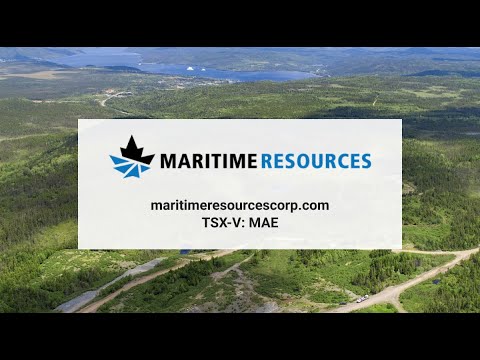
0:36 I'll get started and I'll talk through a bit of the corporate update here and a corporate strategy that we have. A few things we have underway right now and our plans for the next 12 months. I'll turn it over to Jeremy who will talk about our exploration program which is due to kick off here very soon and then we'll take some Q&A. So here we can see in this first slide this tells a lot actually just in 1 image. This is a view of the Hammerdown mine site, looking north towards the town of Keynes Point in the background, about 5 kilometers away. And you can see the footprint here of the old mine. So this was an operation that was, you know, operated in 2000 to 2004. You can see the road access, a few of the old settling ponds, and the underground portal is just on the north side of that ring road. So This was a mine site that's been completely rehabilitated.
1:33 So this is the footprint that we're working with. It's a great place to work and easy to get to.
1:42 Hold on. So Some of the key takeaways that we hope you leave with today after hearing the presentation. Our main asset, our bread and butter really in Newfoundland and Labrador is the Hammerdown Gold Mine. So this was a former high-grade operation. It was built and operated by a company called Richemont Mines. I think we all remember that company. They were purchased by Alamos. They operated the mine, closed in 2004, really due to low gold prices. So this was a high grade mine, average around 15 grams, operating during a time when gold averaged around 300 to $400 per ounce.
2:27 So they made money because they were operating, They were great underground miners. They operated with about an 8 to 9 gram cutoff grade. And what we're working with is what they left behind and a lot of material outside of their mine plant. Over the past year, we've done a lot of work to come up with a new development plan, which we then wrapped up into a new PA study that we released at the end of February of this year. And what we found was very robust operation or potential operation here that looks very attractive. Has the potential to produce 70,000 ounces a year over the first 5 years with a 1.5 year payback. Capital costs we estimate at around 57 million and at $1,500 an ounce US on an after-tax basis, this gives us a $184 million NPV and a 75% IRR after-tax.
3:27 So it's a great starter project. We've always looked at this project as the first one, and our overall goal as a company is to get to cashflow as quick as we can, and that funds the exploration and the growth of the company in the future. Also, Right after the PEA came out, we signed an agreement. It was a letter of intent with Rambler Metals and Mining, which is a neighboring company of ours in Newfoundland, on the Nugget Pond Gold Circuit. This is a proven plant with 97% gold recovery. This was a plant that was operated by Richemont for the Nugget Pond mine and also Hammerdown. And over the years it has been sitting idle and it's an asset that will work really well for Hammerdown. So we have an agreement with Rambler to evaluate it over the next 12 months with the option to purchase it.
4:21 The other key thing here that we want to leave you with is project permitting. We think this will be a pretty straightforward permitting exercise for us to get through. We think it's provincial permit only, there's very little federal involvement. It's a relatively small operation, around 700 tons a day through the process plant, going to an existing mill with an existing tailings pond. Now We're in a province that really likes mining. They envisioned 5 new mines by the year 2030, and it's one of the best jurisdictions I've ever worked in. And we also have a lot of excellent potential for resource expansion. We have a 5 kilometer trend between Hammerdown and our other deposit Orion and then again on either side, which is wide open for new discoveries, especially below 200m of depth.
5:12 All the drilling that's been done around here is very shallow. And then on top of all of that, we have a new discovery at our Whisker Valley project, where we're finding high-grade veins that are similar to Hammerdown. This is a brand new thing. We have a lot of work to do on this one, but it's very encouraging that there's other mineralization very close to the Hammerdown mine.
5:37 So I'll be making forward-looking statements, of course, and you can look at this at a later date. It's on our website as well. So as you know, we just completed a financing not too long ago in the next or the last 2 weeks roughly. So we have now a working capital of $3.5 million. Our market cap is roughly $21-22 million today and 246 million shares outstanding. We have no debt. So we're well cashed up to do the first part of our work program this year. And our major shareholders include Dundee Goodman, merchant partners that are on 18.8%, Sprott Capital partners and Sprott Asset Management combined around 16, 17%, 1832 Asset Management and EDE Asset Management.
6:28 So we've got some great institutional shareholders in support for the company and it's been great to have them and we look forward to working with them as we carry on and move this project towards development. So management and the board. So this is the team. We've been building this team up over the last 12 months and we have a few additions to add to it as we continue with the development of Hammerdown. So myself, I'm the CEO, I'm a mining engineer. I've worked in gold for a long time. I started with Placer Dome before doing some mine operations work at Suncor Energy in Fort McMurray. And then over the last, say, 10 years, I've been doing more project development work and most recently led the feasibility study for Dalredian's project in Northern Ireland as a consultant for GDS Mining.
7:23 Our CFO, Jermaine Coombs, Lorna McGilvery is our corporate secretary. We have Larry Pilgrim who lives actually 5 kilometres away from the mine in Newfoundland. He was the chief geologist at the mine when it was running. So it's great to have him on board as our project manager in Newfoundland with a lot of knowledge of the asset. Jeremy Nimi, who's on the line here with us today, is our technical advisor for exploration. A lot of experience with gold as well, most recently with GoldQuest, Noront and previously with Kinross. Eric Trombly just joined us as the technical advisor on the mining side. Lots of people know Eric, he's the CEO at Dow Rating Resources, former general manager at Canadian Malartic Mine.
8:10 That's the management team, really good experience throughout a number of areas, mine development, exploration, mine operations and developments of new projects. So this is a great team and we're going to be adding a few extra bodies to this as we go along. We have a board, 4 people on the board. John Hayes is our chairman, senior corporate development VP at Predium Resources. Mark Ashcroft is a director. He's currently the president CEO of Aurelius Minerals. And we have Peter Mercer, our other director, who's a VP and general manager at Rambler Metals and Mining in Newfoundland. So here's where we're located.
8:57 This is map here, you can little names but you can kind of see Deer Lake over here just to the southwest. And we're about an hour away from the Deer Lake airport. So it's really easy to get to a couple hour flight from Toronto, you land in Deer Lake and then an hour drive, you're actually at at the mine site. Other projects in the neighborhood, we have the Bayward operations from Anaconda and Rambler to the north, Marathon Gold, which would be number 5 on that map to the south of us. And as a little bit of a closer view of the Bayverde Mining District. So we're fortunate that we're located and operating right in this Bayverde area. And it's a great mining district. We have access to everything that you can need for what we do.
9:49 We're actually 10 minutes away from a Tim Hortons. We have services, we have trained workforce nearby. It's a great place to work. We have great road access all around us. The Trans Canada Highway is just to the south. And if you look on this map here, you can see our Orion and Hammerdown projects inside our Green Bay land holdings near the town of Kings Point in Springdale. And up to the northwest is our Whisker Valley land package. So further north up the highway is the town of Bayvert, another mining town with 2 operating mines, Anaconda and Rambler are operating mines up there. And way up on the northeast part of this map here is the Nugget Pond Gold Plant. So we'll talk about that as we go through the presentation, but kind of keep that in mind that we would be looking at hauling ore from Hammerdown up the highway to the Nugget Pond Gold Plant, a distance of around 130,140 kilometers, mostly with paved roads.
10:55 So a little bit about Hammerdown's history. As I mentioned, this was an operating mine at one time, operated by Richmont, completely rehabilitated, access roads are still in place. When the mine ran, like I said, it had a cutoff grade of around 8 grams a ton. So the life of mine grade that they pulled out of this mine was around 15.8 grams per ton, so a fairly high grade mine. They trucked it up to the Nugget Pond Mill, hold or leach system or CIP plant that gave them some really good recoveries of 97 to 98%. So this was a narrow vein cut and fill mine. They started off with a small open pit, more or less a bulk sample before moving underground. And as I said, the site's been completely rehabilitated, there's no legacy issues at all.
11:46 So fast forward to today, and we're in a different world right now. We have gold prices north of 1,700 an ounce, which is a lot higher than when the mine was operating. And we're coming in this now with a new development approach. So, we're looking at a combination of open pit and underground mining using pre-concentration or sorting as it's called technology to reduce the dilution before it's sent to the mill. Okay, We're making good use of leveraging this process infrastructure that we have available to us to simplify project permitting, keep the capital costs down, and also leveraging our local support for mining. The local workforce is skilled and trained and certainly supportive of mining in the province.
12:35 So all these things together, we think we have a great opportunity now to turn this mine back on, generate cash, and then use that cash to grow the company. This is another picture in the background of the old open pit and then the portal off to the side. I'll talk a little bit about our PEA study. This came out at the end of February. This was the result of basically a year's worth of work involving infill drilling, environmental, technical studies to come up with this new plan. So as I mentioned, it's a combination of open pit and underground mining using an offsite processing plant at the Nugget Pond site. Our initial capital costs estimated around $57 million.
13:21 You can kind of think of that broken up into about 3 areas. Individually, we have about a third of that would be at the mine, mainly for open pit pre-stripping. Third of that would be our sorting plant also at site. And perhaps the next third could be around about the third of it at the Nugget Pond mill. Over the life of the mine in this PEA study, we identified mine plan that would produce 521,000 ounces of gold recovered. In a 9 year mine life, our average gold production per year is around 58,000 ounces with a mill grade of 7.82 grams per ton. So that's the grade of the ore after it's been sorted through the process plant. Now, the first 5 years are very strong. We average just around 70,000 ounces a year with a mil grade of approximately 9 grams per ton.
14:12 So I get a little sensitivity table in here. Our base case, we did this study at 1375 per ounce, which gave us 111 million after tax NPV, 50% IRR and a payback of 1.5 years. So closer to current prices in this example here at 1650, We're looking at a $200 million project and over an 80% IRR. Little graph here showing our production profile. First few years, 5, 6 years are actually quite strong. We tail off a little bit near the end of the mine life, we're re handling and processing some low grade stockpiles, and also going a little bit deeper in the mine at that point. And we think with this, the next round of drilling and work that we do, we can probably flatten this curve off and target something in around that 70,000 ounce a year production profile.
15:09 So this is the site plan. It can see here is the highway. So to the north of this image is the town of Kings Point. And you can see the highway there on the right side of the image. We have the access roads are already in place. So when you come in off the highway, we'd have the sorting plant. It's designed for around 1400 tons a day of run of mine feed. Nominally, it could do up to 2000 tons a day. This plan will be designed to produce 700 tons a day of product, so that's the mill feed that goes down the highway to the mill. We then take the rejects from the sorting plant, we use that back in the mines as backfill, we're stored in the open pits as they're mined out for long-term closure. So you can see here the PEA mine plan at Hammerdown, we have just over 2 million tons of around 4.5 grams per ton. This would be a combination of open pit and underground mining for 300,000 ounces approximately.
16:03 Our central waste dump between the Hammerdown and Orion mine. Orion is to the south, about 2 kilometers away from Hammerdown, roughly 2.3 million tons were in the mine plan with this one at a grade of around 3.5 grams per ton.
16:20 So let's look a little bit more at Hammerdown. So measure and indicated inside the mine plan here 1.4 million tons of 4.8 grams, inferred 500,000 tons roughly at 2.5. Most of the ounces inside the pit are measured and indicated already. So, and Jeremy will explain a little bit more on the geology and why we, how we get these veins set up the way they are.
16:48 The open pit here goes down about 150 meters. It's approximately 700 meters in strike length. Yeah, we're going to definitely have, We're going to be going back in here in a few days. We have some really interesting exploration targets still remaining at Hammerdown, both a lawn strike and also at depth, as well as infill inside the mine plant. Here's another view of the PEA mine design. As I mentioned, 2.09 million tons of 4.5 grams. Our open pit, you can see some of the dimensions here. You can see the open pit has a number of underground workings. We have to mine through these cut and fill stopes. The good news is that they're filled up.
17:38 It's not a very deep mine either, so we'll carefully have to go through these underground workings. We go down to, after about 3 years of mining, we stop and we go underground from there for about 2 years. Underground has roughly 50,000 ounces, grading 7.5 grams. All these veins are average, maybe a meter wide. They can range from half a meter up to 2 meters. They're vertical and the ground conditions are very good. And so we think we can take most of these with selective long hole mining beneath the pit. And during the open pit operations, I'll mention too, We're looking at narrow veins throughout here. We're also seeing in the design and in the resource model that there are zones showing up that are outside of the vein system and in areas where a rich mod probably wouldn't have noticed mineralization grading, say 1 to 5 grams inside this pit shell. But we're starting to see that now. So there's opportunity outside of the vein swarm that we have for low grade 1 to 5 gram material.
18:51 Low grade maybe for them, but certainly not for us. The open pit cutoff grade is around 1 gram and the underground cutoff grade would be around 2.5. We also have a few stopes that we looked at in the design of PEA that we didn't include just because the sustaining capital was a bit high on them, but that's an opportunity for us to look at that in later studies. And this is another deposit that we have, It's called Orion. It's about 2 kilometres away from Hammerdown. And for the first time, we included that in our project design. It starts off with a small open pit, 5 metre benches, not very deep, only goes down about 15 meters before switching to underground, where we have about 1.7 million tons creating roughly 3.8 grams. This is diluted.
19:43 We would ramp access from the open pit. Again, a long hole mining method with uppers. This mine plan here averages about 1.8 meters in width and would run for approximately 7 years. This is a slide showing our cash flow. So we start off roughly with about a 1 year, maybe even less construction phase to get this mine up and running. Construction should be fairly straightforward. We're working with a mill that's already built, tailings pond that's already built in place. So on a construction point of view, we're gonna have to construct the sorting plant and complete the pre-stripping at the mine. So over the life of the mine here, you can see when different operations begin and on a pre-tax cumulative cashflow, we get up to close to 250 million. This is based on 1375 gold and a 75 cent Canadian dollar.
20:46 I'll talk a little about about pre-concentration or sorting. This is a technology that's been catching on more and more. It's taken some time to get to this point, but Several mines are using it around the world to basically concentrate ore within the run of mine stream and reduce dilution
21:10 that enters the mill. What you're trying to do here is eliminate any material going through the mill that doesn't pay for itself. So in our case here, with the test work that we've done, and we need to do more of it, but we've done a lot of it already, both in Germany and in the US, We've seen results that indicate using X-ray, using laser technology or scanners to identify the particles that contain the gold. And we're really looking for pyrite because that's where the gold is associated with pyrite. So basically we crush it down to 2.5 inches or less, we take out the fines and then we sort the course fraction of that feed.
21:55 So it goes through 2 sorters in series, the fines would report directly to the mill And then we've noticed that we can get roughly about 48, I think was the average mass pull in our PEA study, which is really good actually, when we recover 93 to 95% of the Gold through the sorting plant. So the big benefit for us is that we don't truck. Basically half of the material that we mine stays at the mine and the other half goes to the mill.
22:28 Our net savings we figured in the PEA study was roughly $46 per tonne or $96M lathe and mine by doing this. The other thing I'll mention too about the sorting is it's in our study or this project,
22:45 It's not required to make the project economic, not at all, actually. If we remove this from our plant, it's still an economic project. It looks really good. But adding it certainly helps. And it has the benefit of the environmental benefit as well as, as I looked at, of removing a number of trucks off the road and reducing greenhouse gas emissions.
23:12 Add the mineral processing side. So this is the couple of pictures of the Nugget Pond gold plant. It's the hydromet side of the plant that's currently idle. The grinding circuit is being used by Rambler at the moment. The PEA approach that we came up with really is to modify the gold circuit to run as an independent mill. And really all that's required is a little additional grinding circuit outside of the gold plant. So we would engineer and install new ball mill, some refurbishment as well to the plant and we can do 700 tons a day through the gold plant that's there now using the permitted tailings facility that's also there.
23:57 So we'll be looking at this over the next few months as part of our feasibility study. Here's another view of it. This is an aerial view looking down at Nugget Pond so you can see the copper circuit. This is the copper concentrator that's in use now. In the little building with the leach tanks and the thickener surrounded by the yellow dots, That's the gold plant that's sitting there right now. So our plan would be to install the grinding circuit just to the west of that and create a basically a second independent mill sharing the tailings pond. A little bit of a promotional slide here for everyone. You know, this is maritime compared to a small sample of our peer group, namely Rubicon, Hart and Puregold.
24:48 I won't dwell on this too much, but you can basically see that the mine plan that we've come up with and the PEA study shows, we have, I would say a comparable project to these other 3, with the benefit of having a very low pre-production capital cost of $57 million. Making use of what we have available now with the Nugget Pond mill and the tailings facility saves us a lot of capital and getting the cash flow quickly is our priority. So currently our market cap is around $22 million, roughly, with $3.5 million of that is in cash.
25:27 So yeah, we think we have a significant rerating opportunity. Over the next few months, we'll be getting the word out and starting the drills and advancing our project permitting and also our feasibility study.
25:43 So in terms of timeline, here is basically a two-year snapshot of what's to come. So we're still in the first half of 2020, barely, but basically we've almost completed all of these tasks. Our resource update and our PEA study were released at the end of February. We've started some additional technical studies, particularly on ore sorting again. Our permit application, we're working on that right now. We hope to apply for the project permit in June. That'll take probably maybe 9 months to a year, maybe a bit longer to get through, we think. We plan to do some infill and grade control work as well.
26:27 And then in the second half of the year, we'll continue with our environmental studies. We'll do a second resource update in the fall, which forms the basis for the feasibility study. And we're still through project permitting as well. That'll take, like I said, probably out into 2021 at least. And, you know, throughout 2021 and near the second half, we hope to be in construction and ready to turn the mine on. So it's been a busy 12 months so far since we joined the company. We have another 12 months to go to get to basically
27:07 kind of 3 areas that we want to cover off here in the next 12 months. Priority number 1 is the feasibility study. Priority number 2 is our project permitting and also exploration. We plan to do probably about 15 to 20,000 meters of drilling in the next 12 months on a number of areas hammered down within the mine plan regionally as well on areas that we've identified in the last year or 2 that look very interesting but haven't been drilled yet. And also at Arboristker Valley project where we have some brand new discoveries that we're noticing and pretty excited about. So that's the game plan and the technical side of the presentation. I'm going to turn it over to Jeremy now, and he'll walk you through the exploration potential in our plan here for the next 12 months, both at Hammerdown and in Whiscay Valley.
28:08 Okay, Jeremy. Thanks, Garrett. Good afternoon, everyone. Yeah, so like Garrett was saying, we are very much focused at Hammerdown and moving Hammerdown towards production. So a lot of our work as far as drilling goes in the next short to medium term is going to be focused at the Hammerdown area. What we see at Hammerdown is a series of parallel gold and quartz veins. These have the potential to go down quite far, as seen in other greenstone belts in Canada, the Abitibi being one of the more famous ones. So to this date, we've really only scratched the surface. We've only gone out about 250m. There's still great potential for this to grow at depth and we have the kind of grades that you could contemplate deep underground mining with.
29:00 It's pretty exciting from that standpoint. While we're doing our next phase of drilling, we're going to be looking at opportunities that are – we actually have quite a few opportunities within the PEA pit shell and adjacent to the pit shell and slightly below. So We're looking to grow our resource in addition to conversion of inferred to measured and indicated resources. Like Garrett said, along the trend between Orion and Hammerdown itself, There's quite a bit of unfollowed up gold mineralization that's been encountered in previous drilling, historical drilling, that we will go in and test. Then there's also some big pockets that are yet to be tested.
29:47 This will be part of what we'll do next. And then Whisker, 10 kilometers northeast northwest, it's actually a little bit closer than that, but Whisker is is a really wonderful, more greenfield exploration program that we have sitting on our doorstep.
30:09 We've been fortunate that we're able to consolidate a pretty big package of land. A lot of that land has already been explored in small, isolated pockets. There's been a lot of prospecting work that's been done. We pulled it all together and now we're being more systematic and treating it as a bigger regional play. And that's something that we're going to, we will continue to push forward,
30:38 you know, when it makes sense to do so, which is, you know, after we get our meat and potatoes work done at Hammerdown. We have had a lot of early success. We put a year last year into it. We flew a big regional airborne survey. We've done a lot of soil sampling, a lot of that early stage exploration work you normally do. We've gone back and done and then covered quite a bit of interesting ground.
31:06 Yeah, and including one of the big things we discovered last year is this boulder field. So we'll get into that in a bit, but there's an area where We found a lot of quite angular, high-grade gold with base metals, copper, zinc mineralization, looking very similar to some veins that we've opened up in trenches. So yeah, there's definitely a lot going on in the Whisker Valley, and that's an area of great potential for us. So this is a long section showing Hammerdown and Orion, which is where our mineral resources are, and adjacent to it the Battersbrook and Lachenbar. And you can see sort of in light gray in there, those series of drill holes.
31:55 I think an important factor here is that previous work was, We consolidated this land package as well. So there's been a lot of people have explored this in the past under different economic conditions. The gold price is obviously very favorable right now. So we're in a bit of a different position than others have been. And we're looking at it differently as well. We're looking at this as an open pit potential as opposed to just a high-grade underground opportunity. So we like the whole trend. I really love what's going on around Hammerdown and Orion. I think
32:33 it's a great place to do some brownfields exploration and to push this resource into production. So, Batters Brook, it's early stages, we haven't really gone over there and looked much, but Again, we're getting some good gold grades, kicks up to 20 grams. It's really just slightly been scratched. I think mostly been looking for base metals in the past down there. Orion, this is one part of our mineral resource inventory, and we're going to be going there and looking at converting the inferred into measured and indicated but also see a lot of potential to grow this at depth. You'll see this dotted line on the map. I'm just going to draw on here. I said I was threatened I was going to draw earlier.
33:21 This is basically the 250-metre depth marker, and you can see most of the mineral, most of this, these are drill intercepts that are showing in colours. Most of the drilling has only gone down to about 250m in the odd. The hole has gone deeper. At Orion, we actually have a fair bit of mineralization below that mark, which is really promising. It shows that the mineralization does keep going as you would expect it to. I think there's a lot of opportunity just in the fact that we've really only mostly explored the upper part of this system. And then hammer down, we'll go through that in the details in a second, but opportunities within the pit, close to the pit, and in the hangwall and footwall close by to the known resources.
34:09 And then I think the whole system just keeps continuing over to Lachenbar. Lachenbar wasn't part of our original land package. We've added that in. There's some gold mineralization which is adjacent to a series of base metal zones. That one's equally as exciting. This is a stylized cross-section through the Hammerdown open pit and underground mine from the PEA. What it shows is a surface up here at the top, and we're looking towards the East. And the deposit is truncated by what's called the Captain Emo Fault. And there have been some attempts to try and find the other portion of the deformation zone, which hosts this series of parallel quartz, gold rich quartz veins.
35:04 But yet, to date, it hasn't really been found. So part of what we'll do in the coming months is go and see if we can find this other half or other side of the deformation zone. This opens up humongous upside for us. It's because we have really high grade veins in the deformation zone, close to surface. If we can follow that down, then it's wide open at depth from there, and this is where we can really see a substantial bump in our resource. We have already some interesting things that we're going to be following up, both in footwalls and just some random 30 and 20 gram kicks over, you know, this is a couple of less than A0A meter, but then also a meter, less than 0.5 meter, 25 gram kicks out in the hanging wall. So this is a really wonderful place to be and to have such strong exploration targets sitting next door to your resource, which you're looking to put into production in the coming months to year.
36:16 This over here is our airborne survey we flew at Whisker. We flew this last year. Again, we consolidated this land package and the Hammerdown Mine would be just off this map to the southeast. The whisker package of claims follows the Rambler, sort of the Bayvert highway up to where the Rambler mill would be. So we're nestled in beside a highway basically, We have great access through old forestry roads into the property. We think there's a lot to be uncovered here. We're just getting started and it's pretty exciting. We've already uncovered some pretty high-grade gold, silver-based metals.
37:05 Really this year we're going to keep moving the story forward and working ourselves towards that bigger discovery and hopefully mineral resource over there as well. This is a little closeup of Whisker. There are 2 main areas of focus are really on the west side of the property along the Middle Arm fault. A lot of historical, more than smoke, multi-ounce hits in a lot of cases. But a lot of action happening along this structural corridor. We need to go in and do a bit more work. Last year our focus on the ground was more to the east over in the in the what we call the Whisker Valley.
37:54 I'll just draw it on here. So we have the Whisker trenches which have been uncovered and it's a pretty exciting discovery. See it in a second, but the series of veins, which look a lot like what we see at Hammerdown and a very continuous long strike east-west. And The really fun thing is they point towards this boulder field which we uncovered last year. So we really like this area. I think there's a lot of potential and you know it's an early story with more to come. This is a picture on the left side standing in the whisker trench at the whisker veins. This is called the Gary Vane system.
38:40 So we're standing on top of the veins. Working in Newfoundland is really a treat. You can get in and trench and do things very easily. Like Garrett had said, we have access to drilling companies in the lab and everything is right on our doorstep. So we can turn things around really quick. But yeah, these veins continue over 350 meters now. We extended them this year, and we'll keep following them as we go. What I like is, I said this earlier, but off in the distance here, this ridge, that is exactly where our Boulder Field is. And these seem to be pointing towards, or they are pointing towards that area. And I think it demonstrates that there's a lot more continuity than the 350 meters that we've uncovered so far. I think there's going to be quite a bit more to this system.
39:37 This is a picture of the boulder field, a map on the left-hand side with some of the grades. Again, we're getting 84 grams of gold, with 154 grams of Silver and 1.6% Copper. Pretty substantial numbers. This is along a road, so this dotted line that you see on the map on the left is an old forestry road. These are the first places you go in and explore, obviously the places you have better access to and yeah, this emerging is very encouraging, even more so the fact that it's a long trend with our whisker trench veins, the carry vein system. Early days, definitely more to come and look forward to getting in there and just continuing to be very systematic and uncovering hopefully a sizable resource on the property.
40:40 Right on, thanks Jeremy. So we'll just, we'll sum it up here. This is kind of our last slide and then we'll take some Q&A. And, you know, really we're, Maritime is really well positioned right now. There's scarcity of quality gold projects out there with a clear path to cashflow. So we think we definitely check that box. We have grade, we have a mine plan that'll work. It looks very positive from the PA study we just put out. And we have a plan in front of us for the next 12 months to get through feasibility, permitting and about 15,000 to 20,000m of new drilling. We have local and provincial support for mining, a combination of local mining skills, existing infrastructure and innovation to make this work.
41:33 The economics are very strong. It's very robust, even down to lower gold prices at 1,700 an ounce. It's well over a $200 million project. You can see here a couple of pictures we have, you know, the portal is there. It's, you know, infrastructure is amazing. The picture on the right are some of the kids from the local local public school in King's Point. So we've been doing a lot of work with the community over the last year. This is from our kids were planting some trees. We've done the PDAC mining matters program there as well, sponsor some students scholarships and we'll continue to do that. So it's a great area to work in, Really happy with it. It's been a good 12 months. We get a lot of work to do in the next 12 months, but we have a good plan and there's a lot of potential here. So that's it. We're happy to take some questions now.
42:32 Great. We certainly have a number of different questions. Starting from the top here, John Kane wants to know, when will you go into production and how much cash you have in the bank and what is the cash outflow prior to positive cash flow? Okay, we will, if we fast forward to 12 months from now, this is when I'm hoping that we have our feasibility study completed, Okay, and that's the time that we will look at doing project financing. Project permitting, I hope will be completed by that time as well. Not 100% sure of the timeline, but I would think we could try to do that in 12 months if we, with our project registration going in next month.
43:22 We have 3.5 million in cash right now. We would, the capital to build the mine, according to our PEA, we'll have to update it as part of the feasibility study, but it looks to be between $50 and $60 million. We would project finance at that time. So if everything goes according to schedule, I would think this mine could be in production in the second half of 2021. Did I miss any questions? I don't think so. Another question here from Dave Middleditch. He's asking, Is there opportunity to barge slash ship upgraded or direct the Nugget Pond port facility? Yeah, Dave, definitely there is.
44:11 There are some areas to do that. It's a coast, so there are docks around, good network of roads to get to the mill. The answer is yes, for sure. Another follow-on question from Dave. Are the 7 to 9g per tonne gold head grades prior to the ore sorting or upgraded mill feed grades? Those would be the upgraded grades. After the sorting. Victor Zhao wants to know what's the strip ratio? Strip ratio at Hammerdown is around 15 to 1. So it's a fairly high strip, but the grade is high too. For the first 3 years in the open pit, Our grade is over 5 grams per ton diluted.
45:03 The Orion mine is around 2.5 to 3 grams per ton. So it sounds like a high strip ratio and it is. We do have the advantage of having a sorting plan available to remove the dilution before we process it. So We're not processing that dilution. And as well, you have to take into account the fact that we have a very low capital cost, thanks to the mill and the tailings pond not being in place. And the Gold price. Speaking of the gold price, what are the projects economics at the current gold prices? So at current, I looked at this just this morning. So I think at around 1700 an ounce, we're about $250 million after tax MPV with an IRR of around 96% and our payback of roughly 1 year.
45:58 So. Go ahead. No, I'm good. Question here from Clyde. He wants to know, will there be any hiring there? I assume he means at site. Yeah, for sure. Our preference, of course, would be to hire locally. This year we'll be doing the exploration program and doing some more technical work on the environment side plus the feasibility study. So it'll probably be roughly a year before we get into hiring for the actual mine build. But along the way, we'll probably need some additional help. So it's ramping up here pretty quick, actually. Collins wants to know the reef that will be mined at the open pit, will it be within the crown pillar? You mentioned that they initially mined via open pit.
46:57 Yeah, Jeremy, you want to take that one? Yeah, we will be extracting the crown pillar from the historical underground mine for sure. That's what's going to come out as part of the early years of the open pit. So, yep. Great. And a follow up from Collins here, so I would stay on the line, Jeremy. Is the geology constituted of bands of reef? Yeah, it's a series of parallel quartz veins. Think of them roughly a meter or so in width and they're fairly continuous along strike lengths, so generally the run is less. So it's a series of bands. Some of them are wider and higher grade than others.
47:46 I would say that at this stage, there's still opportunity to add additional zones both to the north and to the south. So that's, that's one of the things that's really intriguing about this. You don't just have 1 vein or 1 structure that we're following. We have kind of a zone of veins. And it's a really great thing to have. Even when we just did the resource, there was quite a bit of mineralization that we couldn't pull into our resource because it was just an isolated hit and a drill hole. We're going to go back in and follow up on some of these isolated hits. We call them the interstitial mineralization. I think we can pull a lot of those, there's hundreds, when I say a few, I mean there's actually hundreds of hits that are not in the resource, that we can pull in and give us an opportunity to add more to our resource base. So yeah, the series of gains is a great thing.
48:50 Great. And Why did Richmond Mines close the mine in 2004? Mainly due to low Gold prices. They mined that operation from Gold was ranging from 250oz to up to maybe 400oz. Richemont was really well known for underground mining. They would go into advanced operations or advanced deposits and mine them out and move on to the next one. I think when they also ran up against the fault down at 250m below surface, a little bit of probing past that showed that it wasn't immediately on the other side. So they decided to close the mine and move on to something else. So it's good news for us. We have the resource available now and during a time of much higher Gold prices using the same infrastructure that they used.
49:49 And how does the new PA mine plan compare to the original plan by Richmond? Yeah, it's a little bit different and similar in the same time. We share a mill, the same mill that was used by Richmont back in the day in Talings Pond. The mine is a bit different because we're starting with a surface mine before going underground. We're also including the Orion deposit, which is 2km away, which was never mined before, So that's a brand new thing. Those are the differences. I'll mention as well with the open pit, of course, and the strip ratio that question was asked, we have a fair amount of waste rock that we would store on site. We've been doing a lot of geochemistry testing on that placed rock and so far it looks to be non-acid generating, so non-PEG, which is good.
50:42 It even met spec for construction aggregate, So potentially a source of material and revenue for the future beyond the mine, which would be nice. So yeah, the site plan has really been designed in a way to minimize environmental impacts. So the waste stockpile is avoided certain areas and making use of the existing roads that we have. And yeah, it fits really well within the current site plan that we have. So it's not a lot different from the original concept, but different in a couple areas. Certainly cutoff grades are different. We're looking at cutoff grades down to, you know, 1 gram or less for open pit mining and maybe 2 to 2.5 grams for underground.
51:32 Great. A question here from Jason Flight. He wants to know, given the narrow and steep nature of the veins, has Allamack mining been considered for the underground operation? Yeah, I think that's a good idea. I'd like to look at that a bit more. If the veins are continuous enough and we have enough strike length, I've seen that work really well in narrow vein deposits. I'm certainly interested in looking at that. It's a good idea. Do you have any concerns with reverse dilution when mining the pit through existing UG mine openings? The mine openings were backfilled.
52:20 We have good data, so it's not like we're mining through the dome mine in Timmins, where I used to work with a 100-year-old mine and not a lot of information. We have a very good 3D model of the mine, every drift and raise and stope. Certainly, I think when we're mining, we're going to be probe drilling in advance and making sure that we locate all of these openings so we avoid any surprises along the way. Mining through them should be okay. We're looking at 5 meter benches through the open pit to keep our mining dilution down as much as possible. Pretty selective mining as well, excavators, small equipment, this isn't the kind of mine you make money on because you're moving big tons per day, you're making money because you're careful about it. So a lot of great control drilling, short benches, careful mining, and then on top of that, or sorting to remove that dilution, because you know you're going to get some before you send it to the mill.
53:22 Using the rejects from the sorting plant back for underground backfill is an option and a really good one because we're back calling to the, we're coming back to the mine empty anyway, so we can back all the rejects for backfill or for placing the rock back into the pit for closure. Another question here by Collins. He asks what gold price did you folks work with exactly? I may have missed that. Yeah, the resources were done at 1,500 an ounce US. And the PEA base case was based on 1,375 per ounce US. Great. John Gerby wants to know, what happens physically and economically to the Gold circuit if the Mill Copper circuit shuts down at some point?
54:16 We thought about that too. In the PEA, we've set it up so that the Gold plant can run completely independent. With the addition of a small grinding mill, small cone crusher and some more storage in front of the gold plant, it can run independent of whatever happens on the copper side. So if they are shut down, we can still run. If they are running, we can run together. It would be basically, it would be creating 2 mills. But all the crushing is done at Hammerdown first. Then we sort it and then we chuck the product up to the mill. Joe Fryhammer wants to know, or rather he says, abativi at depth captures my attention. The only way to test that thesis in drops and holes down deep. Any specific immediate targets identified?
55:12 Yeah, there are for sure. So, you know, We actually had a call this morning, our team, and we're going through some of that and yeah, we do have some targets at depth. I don't think you necessarily have to look at depth for the offset of the hammer down primary, you know, the deformations on which the coast is open. My preference is always to follow something to depth as opposed to just a hill bearing looking at depth. But yeah, there's some, we have some good indications both of the hangwall and in the footwall that point us to a number of locations along we'll be testing those in this program so the the activities would intrigue us too.
56:05 It opens things up radically. Great. Guys we have so many questions but we're running really low on time So I'll send this to you folks as the final question and a big thank you to everyone who submitted questions. If for whatever reason we didn't get a chance to get to yours, feel free to send them to friends at six.com. That's the number 6, I X.com and we will make sure that Garrett and Jeremy receive them. But a final question for you folks. What are the company's priorities or catalysts for the next 12 months? You know, like I've like I said that we have break it down into 3, 3 things. Okay. In 12 months from now, we want to be through and completed our feasibility study so that we can raise project capital or the project financing.
56:54 Permitting is the second priority. Not in any order. We definitely have to do them all together. So Feasibility Study, project permitting, and this year is going to be a big year for drilling. I estimate 15,000 to 20,000m of drilling to be done on infill, grade control, condemnation, actually testing some of these deep targets that Jeremy just mentioned, as well as getting to our regional targets like Whisker Valley where we have identified a number of areas that you know look good and they should be drilled. So this those are the 3 big things for us for the year. It sounds fairly simple but there's a lot of work in each one. But let's start our focus is to get through all of those in the next 12 months.
57:42 Great. Well, that's the end of the q&a period. I want to thank everyone for coming out and attending. I will throw it back to you, Garrett, for the final word. Okay, thanks Bianca. And thanks to everybody for joining us. This is the first attempt at the online format and by all means, please email that address you see on the screen or on our website, give us a shout and we're happy to talk to anybody, of course, and answer any questions. So thanks for joining us and we'll be doing more of these as things go on. And Again, thanks again and give us a show for any additional information. Thank you. Thanks. Thanks.
58:31 Thanks. Thanks. Thanks. Thanks. You