Hayden Locke
Chief Executive Officer and Director at MARIMACA COPPER CORP.
Replay available
Live Q&A session hosted by Marimaca Copper (TSX:MARI) on Investor Meet Company, held 2022-12-05.
On 6ix: 6ix.com/event/marimaca-copper-corp-mari-live-qanda-session
Automated transcript · Written by software from the replay's audio. It can mishear names and figures; the replay is the record.
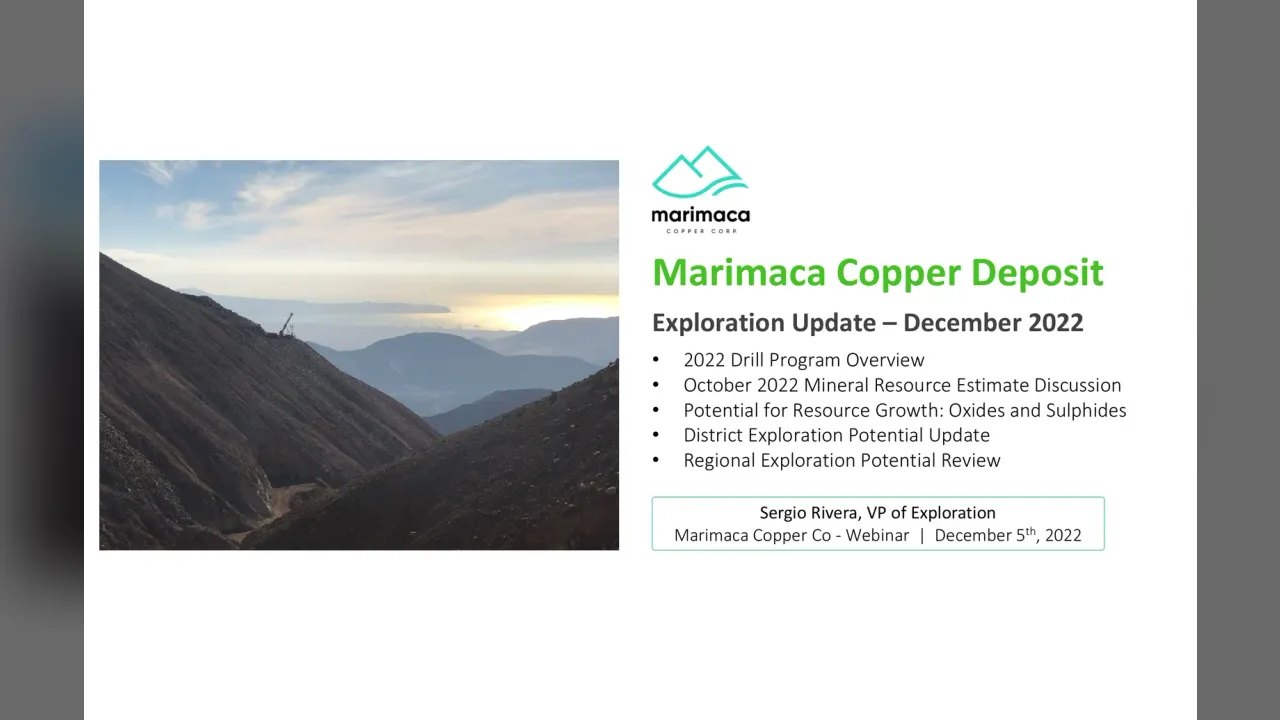
0:01 Good afternoon, ladies and gentlemen, and welcome to the MARIMACA COPPER INVESTOR PRESENTATION. Throughout this recorded presentation, investors will be in listen only mode. Questions are encouraged and can be submitted at any time using the Q and A tab situated on the right hand corner of your screen. Just simply type in your question at any time and press send. The company may not be in a position to answer every question received during today's meeting. However, the company review your questions submitted today and publish responses where it's appropriate to do so. Before we begin, we would like to submit the following poll, and I'd now like to hand over to CEO, Hayden Locke. Good afternoon, sir. Thank you very much, and good afternoon and good morning, depending on where you are in the world, and welcome to MARIMACA COPPER's exploration webinar. Our will cover off our journey of resource growth up up to the most recent mineral resource estimate at our flagship MARIMACA oxide project, as well as recent drilling results not included in the MRE, and finally, to cover off the ongoing exploration potential within our extensive land package in Chile. Following the presentation, we'll provide some time for interactive q and a, and the questions can be submitted via the platform. And with that, I'll hand over to Sergio.
1:09 Alright, Hayden. Thank you so much, and hello, everyone. As Hayden mentioned, in this webinar, we will provide for you an exploration update. This exploration update, first, overview of the results of our most recent mineral resource estimate. This was released in October, and and the corresponding report is really filed last Monday. And, this is, basically refers to the impact of the of the new results and a discussion and discussion about that. And, but but also extend to a review of the potential for growing the resources, both by extensions of the oxides of the deposit, but also, the potential of increase the resource in terms of of sulfides.
2:08 We need the actual oxide blanket. And beyond that, the potential for other, resources like MARIMATA repetitions, nearby deposit, and and also including regional potential too. Next, please. One important thing that is necessary to say about MARIMACA is that it's a project that consistently shows an increase of resources over time. Since the discovery in in '16, the resources at... The resource has grown at least four times from 250,000 tons in the first estimate in '17 to what we have right now, which is close to a million tons of copper contained in our last October resource estimation.
3:14 But we will try to demonstrate you, and I will try to show you in this presentation is that that this is still room for increase the resource both at deposit scale, say, like extension of deposit, but also beyond the deposit. Next, please. This slide shows the the summary of of drilling meters that we use for the for the estimation of this year. What we try or the company decision for the for the exploration program in in '22 was to decide to improve the resource category of the deposit. Because previously, in our estimation from from 2019, published in 2020, was a a ratio of 5050% of a measure indicated to infer resource.
4:15 So what we'll try with the grading of forty forty one thousand meters this year is try basically to improve the category of the resources. This is our main objective. But with this, we also include... But in addition to the RC drilling, that is type of drilling that we use for the infield, It... I've done some diamond drilling, say, to 3,000 meters of diamond drilling for both geologic and geotechnical objectives. And and for the resource estimation that we closed the the data at June of this year, we capture something like 19,500 meters of drilling, mostly at the RC in... At... This included the RC that we drilled up to June this year, but also what we drilled in '21, which we used for the exploration of the sulfide, but also to test the extension of the newly discovered resources in terms of mixed and secondary sulfides.
5:35 So this accounts for the total of 19,000 fine images that I mentioned. And and the map of the filler shows in in color with the histograms, the the drill holes that we use for the estimation, and in blue, the remaining infill drilling that is what we will choose for our final resource estimation that we are currently working on it, and we expect the results for the first quarter of next year. The results of of of the... Our our most recent resource estimation was not really bad in terms of improving the resource category, which is... Was our main objective, as I mentioned.
6:29 But, results in in a significant increase of of of the resource. This is this is reflected in numbers as we increased 98% of the measured indicated resources and and 92% of inferred resources. That's what can be note. So this account for the total of million tons of... Close to million ton of resource that we have. It is necessary to mention that we... In this case, we mentioned... We... Excuse me. We adjust some of the technical and and economic or economical parameters.
7:15 So we use $4 per pound of price copper. We also adjust and use the the cost... Mine cost and processing cost number that that were produced from our last economic preliminary economic exercise from from year 2020. And and these results impact part of a of a number of resource that we got, but most of the impact in increase of resource coming from from new resource properly. Say, basically, the increase of mix and secondary sulfides, but also the... An an increase of of additional, say, presuppolar water resources from borders, but also from some previous ones here that unleashed units inside the the the oxide deposit that resulting from the infill drilling. So the infill drilling demonstrate that that some of the previously leached leached units are really realized units.
8:33 And and this this increase of resource is established that that MARIMACA is is one of the largest copper discoveries globally in the last decade. At at least in Chile, it's one of probably... If not, it's probably the the discovery of of last year's with this, especially with with the number of the... Of a million ton resource. And at the same time, we have... We confirm that because the nature of of surface exposure of most of the deposit and the continuity of the deposit, things like like the strip ratio is is very low, one to one.
9:26 And... But at the same time, we have still good expectations to increase the resources from from from north, from southeast of the of the actual defined deposit by the resource. Next, please. This is the slide that... In which you can compare the models, the resource models that we use for end year nineteen, as I mentioned, published in the year 2020, compared with the actual results in terms of geometry of the of the neuralized units.
10:16 And a simple comparison shows that, obviously, what we have is an increase in the in the mixed mixed and secondary sulfides, six secondary sulfide that extend below the actual oxide deposit. And, in the three d figures on top, it's easy to see, but also it's more clear showing in our own section that's showing the the lower sections. If you compare the the section of 19 as compared with the section of 22, you can see what I what I mentioned in terms of the more continuity and extension of the mix than secondary sulfide deposits in purple and red colors.
11:04 But also that there is some extension especially to the south. You see more more bluish color that represents Grisocola in in areas that that were previously more leased or not... At non non mineralized units. But with the infill, we definitely found that that that is is already realized in terms of or what it borders. And to the we are still waiting for results for the the infielding. So as I'm I'm showing you right now, we have good expectation that about the results because you can see in the map to the right, which is one of the maps that our our most recent press releases that summarize the results that we have from from the new rules.
12:08 And contrary that we expect in our previous interpretation at a 100 meters apart hole that shows that mineralization was mostly wall. In this case, what we have... What we found is that this type of mineralization results in more broken type tachymite, which is directly related to the higher grades. So we have really good expectations that that probably we will have more nice grades of copper in in in our estimation of that coming in next... Results are coming in next year. I I will mention then the the extension of of the mineralization that is shows in in the in the map to the left in terms of potential extension of the actual oxide body to the Northeast to the Southeast, and probably part to the... Little bit to the West and and to the East.
13:12 But we want to show you a short three d view using verify of what the impact could be of the new new results from the Northwestern part. And as this three d three d view will show you, we reduced in this orange color what is represent the above point six envelope. And you can see that to the Northeast, we have not not very continuous information about what can be the extension of the above point six mineralization that is directly related to the broken type takamite mineralization.
13:59 But new holes, as you can see from from, for example, o four one one one two nine and hole one thirty two. For example, when Hole one thirty two intercepts a 118 meters of point 78% of copper, including 24 meters and 62 meters of 1.23%, which is really good grades, absolutely unexpected in in this Northeast... Eastern part of the deposit. So we have really good expectations about the the possibility that we can found another high grade course in the in the northern part of the deposit. And as the figure shows, those are still open to the to the Northeast.
15:01 All the other good possibilities that we have to increase the resource are certainly the sulfides. We try in year '21 to drill some deep holes for exploring the target of of primary sulfides beneath the the oxides. But as you remember, what we really found is the extension of unexpected ops... Mixed and secondary sulfides beneath the the oxide that not really found the primary mineralization. But we still thinking that our our target defined in... By by magnetometry, which is is located east and deep from the actual oxide body. Remember that the geometry of the deposits is like a large tabular body roughly northeast oriented and and east... Dipping eastward.
16:13 So the potential defined by the magnetometry to the to the east, but located at that is still is still open. And and I think that have a good possibilities considering considering the the precise relation that we have between the magnetic... Contacts of magnetite with the mineralization as shows in the graphic that's shown in in the slide at left. We have a nice relationship of magnetite with with high grade sulfide. So the target is still open, but what needs to be explored is deep holes because we need to to drill stiff far east as our as our common location that we use for exploring beneath the the oxide deposit.
17:12 And this is probably means a major effort in in drilling more than thousand meters holes for for test target. But we are we are pretty confident that that the target, it's... It still exists. And and the potential, obviously, is still there for for many geological reasons that we found in the in the actual drilling and and in the in the in the deep drilling of last year. So the potential is there, and it's it's very, very attractive for sulfides. Next, please. We also have a a nice potential for for satellite style oxide mineralization in in what we call the district area, which is roughly represents potential of resources not not more far than than five kilometers from the...
18:22 From what is the actual location of MARIMACA. The map map to to the left shows the reduced to ball man... Magnetometry, which is high resolution magnetometry, and shows the very well defined magnetic targets to the north, but also some target to the east. And map to look at the right shows what we got in terms of of potential of resources obtained on... In results of our last exploration drilling in 2021. We have have already... Just for the memory that we have already explored mineralization of MARIMACA style at at Mercedes, which is very similar to what we get at MARIMACA.
19:11 And and we have a nice IOCG type mineralization at at Sindi to the north. And some upside mineralization at Roble, which probably which probably represents the high parts of the IOCG deposit with more hematite rather than magnetite as we... As at MARIMACA, Mercedes, and SIMD. And at Roble, we have a more IOCG mineralization imprinted because we have there some gold related to the copper mineralization. So numbers that shows in the map represents already potential results that we can confirm by by exploration.
19:59 But the numbers represents in really good potential for more resources that can be can increase the the base of resource that we have at at MARIMACA for the future development of the of the project. And this figure from from very far figure shows what what can represent the satellite deposit that we discovered in terms of of real potential for resources that can be added to to the actual resource for MARIMACA.
20:47 The figure shows the MARIMACA resource and the... To the north, the the extension of the actual deposit to Sierra and and Tarso. But the locations of Mercedes, which is very close to MARIMACA, roughly a kilometer to the north, and Sindi and to the east as as compared with the the layout of the of the plant and dams of the project.
21:22 Next, please. And for... Just for close to finishing the presentation, I invite you to take a look of this figure. This figure represents the magnetometry that we run-in extension of the of the original surveying of district. We extend this north and south. So we have right now a belt of of more than 23 kilometers of of high resolution magnetometry along that we call the Nawayan Belt,
22:01 which which demonstrate the extension of the... Probably extension of of magnetic anomalies that that resembling MARIMACA, MERSEDIS, and and deposit that we know, especially if you if you go to the north. And it's a little bit change in resolution to the north as compared what we... In what we can observe at the central part, but it's mainly due to the fact that to the north, the area is covered by gravel. So the effect of gravels is noted in the in the apparent resolution of the magnetic anomalies. But we already have
22:45 nine nice anomalies that can be observed similar to what we have to the south. And and and we have... We also ran some geologic reviews of a few outcrops that we can see at the north, and and we already have observed some copper and magnetite mineralization in in some outgraphs
23:11 related to the to the magnetic anomalies. And and to the south, we have very clear evidence of of copper copper iron mineralization related to the to the to the anomalies that we have to the south. So I think that beyond the MARIMACA and and the sub... Satellite of Florence, we already have an attractive potential for for region exploration along that what we call the Nawaiian Belt for for even more more deposits that offers a nice potential for for exploration in the future. So this is basically what what I want to present you, and and I I let Hager for for closing words.
24:00 Thank you very much, Sergio, for presenting your discovery. As you say, it's one of the most significant in Chile in the past decade, and it's... Remains very clear that there's a lot of potential upside, and we're still in the early stages of discovery. And with that, we'll take some questions which have been submitted via the platform, continue to submit them, and we'll do our best to answer as many as we can. That's great. Hayden, Sergio, and Niko, thank you very much indeed for updating investors this afternoon. Ladies and gentlemen, please do continue to submit your questions using the Q and A tab situated on the right hand corner of the screen. But as well, the company take a few moments to review those questions submitted already, I'd like to remind you that recording of this presentation, along with a copy of the slides and the published Q and A can be accessed via your Investor Meet company dashboard. Hayden, Sergio, I've just unmuted your microphones.
24:48 As you see, you had a number of questions that were pre submitted. You've also received a number of questions throughout today's presentation. If I may, Hayden, if I could just hand back to you and ask you please to read out the questions and obviously give a response where appropriate to do so, and I'll pick up from you at the end. Thanks very much, Mark, and thank you to everyone who submitted questions. There's a few that have have been answered already, I think, by Sergio's presentation, but, we'll we'll read those out anyway. So starting off, the company's recently announced the number of drill results, which included the discovery of a new high grade pod in the northern portion of the mod. How will this impact future resource schedule for q one, q two twenty three, and how will it impact the future mine development of MARIMACA?
25:30 And lastly, how could these high grade pods play a role in the future exploration of initial discoveries at Mercedes and Cindy? I might ask Sergio to answer the last question if if I could. Sergio, so how how do those high grade pod... Pods play a role in the future exploration of the initial discoveries at Mercedes and Cindy? Right, Henry.
25:53 It's a it's a it's a really good question. And from from the experience of of the infill drilling in the northern part of the MARIMACA oxide deposit And the discovery of these new high grade boats in the northern part, I think that the main lesson that we obtained from this exercise is that sometimes for this type of occurrence in terms of oxides and sulfides, a water drill... Drilling rig is not enough to capture the existence of those high grade cells. In the case of of Mercedes and and Sindi, we really drill very few
26:38 explorations, exploration discovery holes. And I think that with the results that we have from the Northern part of MARIMACA where we found there's really unexpected high grade course, I think that it's becoming real... A real possibility that at targets like like Cindy, Mercedes and and others in the district, we will probably have fastest chances to define high grade portions of the... Of this potential new deposits. And I think that this is the the key role that the results that we obtained from from the northern part of of MARIMACA are so important for the for the exploration.
27:32 Thanks, Sergio. And in terms of this... The schedule, we don't we don't expect the, infill drilling in the northern extent of the mod to impact our schedule. We're still targeting getting, the updated full full resource out towards the end of q one or even just slightly into q two, and that timeline remains intact. In terms of the development, this new high grade zone in the North, is unlikely to change the way we develop the project. I think the the primary high grade core of the mod, is still very much intact and from surface.
28:02 What this may do, though, is add additional high grade, tons to our mine plan and extend out that high grade tonnage mine plan. It's just gonna improve the overall economics of the project. Moving on to the second question, how big could the oxide resources be in MARIMACA's land package? Sergio, another one for you. Alright, Kevin. I think it's... For for an adequate answer to this question, I think it's necessary to take in consideration and and that in in January this year, we will really release release a conceptual potential for for the quantity and grade of mineralization in all the satellite targets located around MARIMACA that are showed in the slide right now.
28:56 The potential that that we really estimate is, I think, stinking in in in just the potential quantity and grades. It was probably in the range of a 120 to 170,000,000 tonnes of between 0.30.4% copper. This is our potential estimate for all these target.
29:24 And taking into account that in the same release, we also provide an estimate for for the MARIX resource, say, the the... At that time, the recently discovered the extension of mix and secondary mineralization. In the release that I mentioned, we estimate for the Mammex, our resource in the range of 30,000,000 to 50,000,000 tonnes of 0.300.4% to 0.5%. But the real figure that we obtained from the resource of the twenty twenty two resource is that the say the the resource are already calculated in estimation results as 88,000,000 tons of point five. So So it's not to by guess, I mean. So I think that the figure that we have estimate for resources and new resources is really important. It's a substantial potential for near surface oxides in in all these target.
30:41 And so this state what we... Was our sought about the potential for the for the areas close to MARIMACA. Referring to the rest of the land package, we don't have enough information to provide a potential for, say, Nawaiian Belt, for example, because we have just magnetic targets along the belt.
31:10 Same towards south of of the MARIMACA block. And we have some some... Just some some ideas for for the rest of the property, the rest of land package, but not not not enough information like the information that we have in the in the... Along the MARIMACA district. We are just thinking that most of the land package to the south have a potential for Manto type deposits. Same for the block that we call Sierra Madina, which is located, say, probably 50 kilometers to the to the east, which also have potential for mantle type mineralization. So I would think that we have not just potential for oxides near MARIMACA, but the rest of the of the mining mining property that we have have also and a and a considerable potential for for copper mineralization from both styles of mineralization, say, IOCG or or matratite.
32:26 Thanks, Sergio. Moving on. Why haven't you drilled the sulfide target yet? Do you believe there's a possibility of a large scale sulfide, and when will you drill it? I think that's one for you again, Sergio. Yeah. Thank you.
32:41 Thank you. I think that we have a slide that I can show you. We show in the presentation, but the previous one as well. Thank you.
32:54 We discussed that that we tried to drill the primary sulfide in in... When we when we deal... Drill deep holes in in our 2021 campaign. And and the objective for that time was to found the primary sulfide beneath the oxide. The concept... The geologic concept, which is... Which results to be a myth right now because at that time, we think that it's impossible to have... To produce a secondary sulfide blanket in a in a suspected low pyrite primary mineralization as expected from a from a typical IOCG.
33:40 But we proved from drilling, from deep deep drilling, that beneath the oxide, we have mixes and... Mix and secondary mineralization. So I'm just a few intercepts... Isolated... Isolate the intercepts of primary mineralization. So I think I've shown the the the slide and take a look the... For the position of the of the magnetic anomaly and knowing the relationship of the highest charcopherate occurrences and copper grades, of course, with the with the contents of magnetite.
34:25 I think that the the primary sulfide toxicity is still untouched. I think that I think that we have three main sources of of information to to pursue this target. I think that first, we know the structural control of the realization, knowing that the background control is north south trending fractures dipping east. Secondly, we have information of the nature of mineralization that coming from the few intercepts of primary sulfide that we have, And we know the relationship of high copper sulfide grades with the higher magnetite and, of course, high measures of magnetic susceptibility.
35:18 And third, the magneting... High high resolution magnetic inversion model that is shown in the in in the slide. So I think that all this... This anomaly basically shows a good relationship on what we expect from the geometry of the mirrorization that can be the extension of sulfides. I think that I can imagine that that the nature of the primary mineralization must consist in a series of soft parallel massive chalcopyrite magnetite rich bodies extending, I don't know, 100 meters of down deep, then I think that there is still good potential for a substantial primary sulfides It must still be there, I think.
36:23 Ken? Thanks, Sergio. Moving on to some questions about the resource. There have been some comments in the market that that the operating cost assumptions used to calculate the raw resource are very different from what was used to previously analyze the project. Can you confirm this point? And then what's the justification for $4 a pound? I I will take those. Yes. We're aware of the comments around the operating cost assumptions, and we can confirm that the operating cost assumptions that we used were exactly matched that of the PEA. Now, of course, there is some there is obviously some room that we may have, needed to update those costs. But in terms of the project, and the and the best understanding we have of the cost to date, that is the most up to date study we have, and so we elected to use those costs. We did benchmark mining costs with our consultant, and found that our life of mine average assumed cost of just under a dollar 80, per ton of material moved was in line with the trailing twelve months for like sized operations in this region. So, we felt that the operating cost assumptions were reasonable and based on the most up to date study that we used.
37:37 Hopefully, the most recent, disclosure when we released our forty three one zero one has allowed people to trace through those operating costs. In terms of the justification for $4 a pound copper, again, we benchmarked, all of our peers, in the lead up to this and also did three year, two year, and one year trailing copper price and found that on average, most of the peers in the space were using just shy of $4 a pound. There's another question here. What impact do you expect the change in copper price to have on the total resources? In fact, what's very interesting about this project is it is very insensitive to copper price. So we've done some... As part of our operational mine plan that we're doing right now, in order to update our internal, financial models, we ran some sensitivities.
38:30 And to give you an idea, the sensitivity between $2.50 and $4 a pound copper, we lose less than less than 10% of the total, ore tonnage. So not very sensitive to the copper price. It is a very robust deposit, very defensive asset. What scale of operation is justified by this resource? Well, it's too early to stay stay at this point. There's a lot of factors that go into determining that, but but almost certainly, we can see a material step change in the in the, production profile, the scale of operation. We would almost certainly expect it to be up to 50,000 tons of copper cathode for an increased mine life, but there is, of course, the potential that we can increase that scale.
39:17 I would say at the upper upper end, we would be probably limited at about 60,000 tons just because the mine life becomes too short. So somewhere between fifty and sixty thousand tons is our expectation at this point, but there's quite a bit of additional work still to be done. Sergio, one more for you. What are the key risks remaining for this resource in your view? Well, the main object... Objective of of of our 2022 drilling campaign was to improve the quality of the resource. And then by this, reduce the the the risk of tonnage rate for the for the whole copper project resource.
40:11 With the actual results, we don't envisage other key risk for the 2023 resource. And this... The reason is because main risk, such as continuity and and grading of the realization, looks to be to be already solved, I think, especially if you take a look of the of the recent infield results results. This morning, we released another one that give give us an idea of what we are obtaining in terms of of good intercepts of of of the holes drilled in the northern part.
40:57 So this kind of results not not only go... Not only confirms the continuity expected from the previous 100 by 100 meter grid, but increase the quality of CORP intercepts and and, obviously, confirms the, as I'm saying, confirms the continuity and and increase the quality of copper and not decrease the the the potential risk of
41:30 of going down with rates. And I think just taking into account the results that we have and will release, I think that the main risk of the 2023 resource in terms of continuity and grade, I think, are almost under under control. Fantastic. I think that's the last question. Unless there are any more submitted, we will finish now. And thank you all very much for taking the time to listen to our webinar with Sergio, and we look forward to updating you again in the future. That's great. Hayden, Sergio, thank you very much indeed. If any further questions do make themselves available, obviously, we'll provide those to you after today's meeting. Could I please ask investors not to close this session as we'll now automatically redirect you for the opportunity for you to provide feedback in order that the company can better understand your views and expectations?
42:27 This will only take a few moments to complete, but I'm sure it'll be greatly valued by the company. On behalf of the management team of MARIMACA COPPER, we'd like to thank you very much indeed for attending this afternoon's presentation. And that concludes today's session, and I wish you all a very pleasant day.
Follow Marimaca Copper Corp. into a list and get an email when it puts out news.
Chief Executive Officer and Director at MARIMACA COPPER CORP.
VP of Exploration at MARIMACA COPPER CORP.
President at MARIMACA COPPER CORP.
at MARIMACA COPPER CORP.
at MARIMACA COPPER CORP.