Hayden Locke
Chief Executive Officer and Director at MARIMACA COPPER CORP.
Replay available
Investor Presentation hosted by Marimaca Copper (TSX:MARI) on Investor Meet Company, held 2025-08-26.
On 6ix: 6ix.com/event/marimaca-copper-corp-mari-investor-presentation
Automated transcript · Written by software from the replay's audio. It can mishear names and figures; the replay is the record.
0:00 Good morning, ladies and gentlemen, and welcome to the MARIMACA COPPER CORP. Investor Presentation. Throughout today's recording presentation, investors will be in listen only mode. Questions are encouraged. They can be submitted at any time just using the Q and A tab situated on the right hand corner of your screen. Please simply type in your questions at any time and press send. The company may not be in a position to answer every question received during the meeting itself. However, company can review your questions submitted today, and we'll publish those responses where it's appropriate to do so. Before we begin, we'd like to submit the following poll, and I'm sure the company will be most grateful for your participation. I'd now like to hand over to CEO,
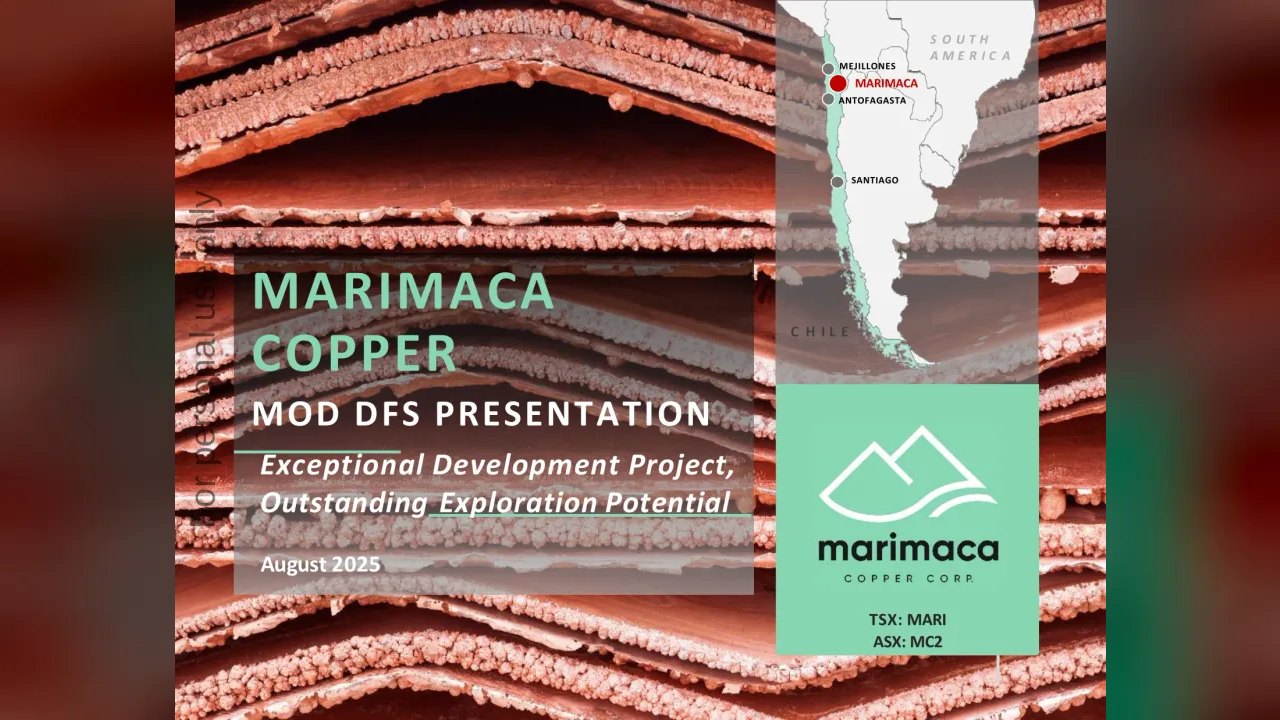
0:30 Hayden Lotte. Good morning. Hello, and welcome to the presentation for MARIMACA COPPER's definitive feasibility study for the MARIMACA oxide deposit, which is a unique copper development asset located in the low coastal range of the Antaragasta region of Chile. The disclaimers on the following pages will be provided in the presentation released on the company's website so that viewers can review them in their own time. MARIMACA is in an inflection point having delivered the definitive feasibility study for the MARIMACA oxide deposit or the MOD. The DFS confirmed the MOD is an exceptional development stage asset, which is unique when compared to the majority of development stage peers. Importantly, the company is well progressed in its permitting work streams and expects to receive its environmental approval or RCA by the end of twenty twenty five, which means the company is poised to commence construction in 2026 and begin its transition to copper producer.
1:24 The results of the DFS confirmed the expectations of the board and management in that the mod would have both absolute capital costs and capital intensity in the lowest decile of development stage copper assets globally. At $587,000,000 US dollars of preproduction capital cost for a production capacity of 50,000 tons of cathode per annum, delivering a capital intensity of less than $12,000 a ton of copper production, the mod more than achieves this. Combined with competitive all in sustaining costs in the lower part of the second quartile of producing copper assets, the mod delivers an exceptional return on invested capital metrics with a post tax NPV eight of US709 million dollars and an unlevered IRR of 31% using long term copper price of $4.30 a pound.
2:13 Using the headline number of other recently released copper studies, dollars 4.83 a pound, those figures increased to nearly $1,000,000,000 of post tax MPV eight and a 39% unlevered IRR. The mod benchmarks exceptionally well when compared to Wood Mackenzie's database of development stage copper peers. On a profitability index basis, the project benchmarks comfortably in the top quartile of all copper projects in the database. On a capital intensity basis, the project benchmarks in the bottom decile of greenfields copper projects with pre production capital expenditure greater than $300,000,000 and more than 100,000,000 pounds per annum of production. Considering the project's location in the low coastal range, of Chile, the largest copper producer in the world, the risk adjusted return metrics are exceptional.
3:05 The DFS was completed by specialist independent consultants across all technical disciplines and is the culmination of more than two years of ongoing engineering and technical work. All consultants have deep experience in the Chile mine development and operation, which provides the company with a robust basis for the next phase of engineering and development. Capital cost estimates are based on material offtakes, quantities, labor estimates and equipment lists developed through the engineering completed by the company's consultants. Engineering was completed to an AACE class three level and is supported by budget quotes from reputable contractors and equipment providers for approximately 80% of all capital items. The SXEW budget quotation is provided on an EPC basis by Tenova, a globally recognized expert in the field of solvent extraction and electro winning. Rates for earthworks and labor have been quoted from specialist Chilean contractors with expertise in mining project execution.
4:03 Importantly, the company has oversized key equipment to allow for cost effective future expansions, including the crushing facility, water pipeline, power connections, and substations and infrastructure footprint. The company sees numerous opportunities for further optimization in these capital costs, which will become the focus of the next phase of engineering. The DF contemplates the mining of only the measured and indicated resources for the project. The total ore mined in the DFS mine plan was nearly 180,000,000 tonnes with a life of mine strip ratio, including the pre strip of 0.8 to one. Inferred material included in the mine plan was assumed to have a zero grade and therefore reported to waste. The DFS mine plan delivers thirteen years of production with a core ten year period of just below 50,000 tonnes of copper cathode per annum before tailing off in the last two years of the mine plan.
4:59 Competitive all in sustaining costs in the lower part of the second quartile drive strong average EBITDA generation of just over $240,000,000 per annum for the life of mine. The mod benefits from an extremely favorable first six years of steady state production where strip ratios are slightly below life of mine averages and grade and recoveries are slightly higher than average. Consequently, the project is forced... Forecast to deliver over 300,000,000 US dollars per annum in EBITDA for each of the first five years of steady state production, and an average of just below 300,000,000 US dollars for the first nine years of steady state production using the flat $4.30 a pound copper price. Free cash flow generation is equally as impressive with forecast cash flow of approximately 220,000,000 US dollars per annum on average for the first five years of the steady state production and an average of just over $200,000,000 per annum for the first nine years of steady state production.
5:58 The end of mine life is clearly impacted by falling grades and recoveries, but MARIMACA notes that the inferred resources, which are not included in the current mine plan, have an average grade 50% higher than the last two years of the DFS mine plan, and as such, management sees significant upside to the cash flow forecast presented in the DFS. One of the key benefits of the mine is its location, which affords easy access to world class infrastructure. This has multiple benefits, including reducing capital cost and reducing execution risk. All of the infrastructure required to build and operate a mine are right on the project's doorstep, including power, water, consumables, port facilities and skilled labor. Water in Chile is one of the biggest risks facing the mining industry. The company has addressed this risk by signing an agreement, which provides guaranteed water supply using existing extraction infrastructure for the life of project.
6:54 Importantly, the company has structured the contract to allow significant expansions in future capacity. Finally, as the water is considered an industrial waste product, the company is benefiting the local community of Meciones by removing some of this discharge to the ocean in the Bay Of Meciones. The mod considers a standard heap leach flow sheet, which is similar to many operating Chilean mines producing copper cathode in this region. The geometallurgical model, which underpins the recoveries of the assumptions in the mine plan, has been developed from seven comprehensive phases of metallurgical testing. The final phase, seven, comprised multiple large diameter four meter columns, which replicated the design criteria used in the DFS. Likewise, acid consumption is developed from the various phases of metallurgical testing and incorporates the analytical acid database for the project, which has been completed for all samples across nearly 140,000 meters of drilling.
7:50 Recovery and acid consumptions are dynamic and driven on a block by block basis within the mine plan, utilizing all of the historical information generated from the various programs. The company now turns its focus to project execution. Permitting is well underway with the second round of responses submitted to the regulatory authorities in July 2025. The company remains confident of receiving the initial environmental approval by the end of twenty twenty five. The company has progressed planning for detailed design and engineering and early site works, which will kick off imminently. And the company has commenced its debt financing work streams and is well progressed in initial discussions with various lending partners. The objective is to announce credit approved term sheets towards the end of twenty twenty five. The company is focused on a multipronged strategy.
8:40 Firstly, moving the mod towards eventual project sanctioning and construction decision in 2026. With this in mind, the company is planning the various work streams to achieve this objective. In parallel, the company has identified several several opportunities to grow its copper production in the short to medium term with an objective of becoming a 70 to 75,000 ton a year copper producer within the next five years. Finally, the company has identified district scale exploration opportunities, particularly as Pamper Medina discovery, which have the potential to completely change the scale of MARIMACA's production profile with ongoing exploration work. In summary, MARIMACA's DFS has confirmed that the mod is an exceptional copper development asset, with leading absolute capital cost and capital intensity relative to the vast majority of its development PE universe, which is evidenced by an IRR of over 30% using 4.30 a pound copper and strong cash flow generation over a thirteen year reserve life.
9:39 Permitting is well underway, the company is now turning its attention to project execution and development strategies. And the company continues to assess its outstanding exploration portfolio, which offers opportunities for further oxide growth and tier one sulfide discoveries. With a first class location in the most important copper producing region in the world, the mod offers among among the best risk adjusted return profiles in the copper developer universe. Thank you for your time. That's great. Hayden, thank you very much indeed for updating investors. Ladies and gentlemen, please do continue to submit your questions just using the Q and A tab situated on the right hand corner of your screen. Just type in your question at the bottom and press send. Hayden, as you can see, you had a number of questions from investors throughout today's presentation.
10:26 So firstly, thank you to everybody for your engagement. If I may just hand back to you, Hayden, just to read out those questions and to give a response where it's appropriate to do so. And I'll pick up from you at the end. Thanks very much, Mark. We've got lots of questions. Thank you, everyone, for joining with us today. The first question is why do we keep using 4.30 a pound in the DFS instead of using multiple scenarios or higher prices like peers? Look, the answer to that, and it's a little bit cheeky, is we don't need to use a higher price to justify this project. At $4.30 a pound, I think you'd be hard pressed to find another current study in the market that has a 30 plus percent IRR. And so, therefore, we know that our project is gonna be absolutely exceptional at higher copper prices. We do, however, put a sensitivity table, in the announcement, that we released. I think it's on page, 20, which shows what happens when we adjust that that copper price assumption. Needless to say, at a five dollars a pound copper price, we are approaching a 40% IRR and well over $1,000,000,000 of post tax NPV eight.
11:32 Second question is what's the expected debt versus equity mix for the financing? And how much dilution should shareholders expect? That's a question that's still up in the air a little bit. But if we assume that the DFS CapEx number is the right number that we take into production into construction, sorry, we would expect a full financing, of somewhere just over $600,000,000 once you include working capital, which means this project can take quite a lot of leverage, as you can see from the cash flow generation. We would expect it can almost certainly take nearly $400,000,000 of debt. We will, however, to probably take a slightly more conservative approach on this. And I think the right number is somewhere between $325,000,000 and $350,000,000 There will be a cost overrun facility, which doesn't have to be financed by equity.
12:21 And so I would expect the right equity dilution number in US dollar terms to be somewhere between 200 and $2.50, maybe $275,000,000 US dollars, depending on the strategy that we take into final construction. When will Medina, Madruguador and Sulfides be rolled into an economic study to show district scale upside? Well, I think there's two different parts of this question. Pamper Medina and Madrugador oxide deposits are relatively more advanced than the sulfide opportunity at Pamper Medina. We have completed an internal PEA on Pamper Medina, but we wanna do a little bit more drilling to see if we can expand the scale of that resource. We've had some, obviously, some success on that resource right now. But I would say before the end of the year, we would like to release a PEA on Pamper Medina to show what that upside looks like. I think from my perspective, our internal study has confirmed the technical and economic viability of it. Now we've just got to really tighten up the assumptions and then the engineering work that's gone into that and also the resource work so it can be released as a forty three one zero one.
13:27 Madruguador requires some additional drilling in order to upgrade the resource to a n I forty three one zero one and Jawke compliant resource. The benefit we have at Pamper Medina is we have a lot of the historical core which allows us to upgrade that resource relatively cost effectively. Madruguador will require more drilling. So we may not get Madruguador into that study by the end of the year. On the third part, which is the sulfide opportunity, it is in an early stage of discovery. It's a very exciting discovery, and we see an enormous amount of potential for a quite significant sulfide discovery there. And so I don't think there will be any economics wrapped around that in the in the near future, But we will certainly be upsizing our exploration program in the second half of this year and into 2026 to try to get a resource at Pamper Medina as quickly as we can that the market can wrap its head around.
14:24 The fourth question, how will the sulfuric acid plant option impact mods cash costs and cash curve position? The answer to that is our belief is it's very favorable. If we look at the size of the plant we've acquired, it's a 150,000 tons. We are also in negotiations with another group that has a sulfur burner operating for potentially 50 to a 100,000 tons, which would mean that we are acquiring more than 50% of our acid from nonmarket sources. The cost differential relative to the current long term forecast asset price by Kochilco is about $30 a ton. So if you just apply that $30 a ton discount to 250,000 tons of acid, you get somewhere between $8.10 a pound reduction in operating cost on average over the life of mine.
15:19 Where it really becomes beneficial, however, is in the back half of the mine life where our acid consumption goes up, in in an absolute term, in absolute terms, and and our production comes down a fraction where it should be well over 10%... 10¢ a pound. So we see a lot of opportunity there. Obviously, it's not included in the DFS. That's upside for us to capture as we do the additional work. There will be a small capital cost associated with installing that, which we need to assess. But right now, it seems to make a lot of sense for us to have the sulfuric acid plant, owned and operated by us for a variety of reasons, not least of which is protection of our business plan. The fifth question, what's your confidence in securing the RCA approvals by the end of twenty twenty five and keeping construction on track for 2020 Based on the submissions from the government, the questions that they asked us and the follow-up work that we've done and the focus that we put on responding in a very fulsome manner to those questions.
16:20 We are more confident today than we have been at any point about receiving our approvals by the end of the year. It's still not guaranteed, but we are now growing in confidence. There is also a strong tailwind. If you've been following the news in Chile, there is a strong push by the government to reform the permitting process and support groups who do things, in a responsible and sustainable manner. There have been several large mining projects that have recently been approved, and so we are very hopeful that by the end of twenty twenty five, we will be approved. That does mean that we can start some early site works immediately. There are several permits to get before you can start full construction and operations. But but our understanding is those are relatively straightforward once you get through the initial environmental approval hurdle.
17:07 So our objective is to be ready to commence construction at some point in 2026. Now we've set the team an aggressive timeline, of third quarter. I don't know that that'll be achievable because there is a lot of work to do to get to a point where you commence construction. But certainly, we are very much hoping that we can start construction in 2026. Sustaining CapEx seems quite high. What opportunities do you see for further optimization of the DFS? That's a very good observation. Yes. The sustaining CapEx is very high, and that is one of the key areas of optimization. If you read through our presentation, we say that there are several areas of optimization. One is around contracting strategy where we have EPC quotes included in our in our budget numbers, which have an obvious impact of increasing your indirect indirect costs associated with construction. You're effectively pushing the risk to the contractor, and that comes with a reasonably significant cost. On the sustaining CapEx side, most of that sustaining CapEx is around the Ripios dumps, which have been massively oversized. And so we were a little bit late in terms of being able to optimize that, but that's going be a focus for the next phase of development.
18:20 We think we can potentially reduce the size of our Rippeo's dumps by 25%. And given the amount of earthworks that's required in that and some other design characteristics, which we think are unnecessary, we think there's a big opportunity for us to reduce the sustaining CapEx, especially in the back half of the mine life, which should have a quite significant impact on our overall economics. Can you substantiate elaborate on this statement of initial designs include oversized key infrastructure and equipment and how it affects CapEx. Yes, absolutely. We've sized the primary and secondary crushers to the full 16,000,000 tonnes per annum. So that means there's no expansion required for the primary and secondary crusher as we move to the second half of the mine plan.
19:07 We will initially be crushing 12,000,000 tons or even less than 12,000,000 tons per annum, so quite significantly oversized. We have oversized the water pipeline. So instead of using a 12 inches diameter water pipeline, we've used an 18 inches water diameter water pipeline. The reason for that is allows for future expansions to get more water up to site if we were to bring in another project, for instance, Pampa Medina and Madruguador in the future. We would need, obviously, access to water. We've also designed the pumping systems so that it can relatively quickly be upsized again to deliver that increased scale of water flow, water footprint. And then, in addition, the electrical designs have been set up so that when the future electrical demand comes in, we don't have to retrofit any of those electricals.
19:57 So we have been constantly thinking about how we best design this project to take into account our belief that there are going to be future expansions, And we're hopeful that that'll pay dividends in the future. Another question on sustaining CapEx. So then another question is, what... What's next for the company? Well, we are very much turning our attention to the next phase of development to get ourselves ready for an eventual construction decision. So that involves quite a lot of work on the detailed design and engineering side. We're in the planning phase for that right now, and we... That becomes the critical path of us being able to sanction a project. So it's gonna be a big focus for the team. Obviously, the permitting is is a key focus for every project that wants to get into production, but we're very hopeful that by the end of the year, we'll have visibility on that. Debt financing is a is a important work stream for us towards the end of this year. And then, of course, exploration is going full tilt with Sergio and his team. We will most likely expand the number of drill rigs that we will have on-site in the second half of this year.
21:09 Firstly, to drill... Infill drilling at Pamper Medina, but then big step outs to try and identify the limits of that sedimentary horizon. And then, of course, we wanna come back and drill under... Underneath the mod project to see what the sulfide potential is at depth there, which, again, I would hope we'd be able to achieve in the in the second half of this year. Final question. With Pamper Medina, is the idea to extend the life of mine or more related to increasing plant capacity and yearly production? Again, that's a great question. There are two thought processes. One, it seems quite clear that Pamper Medina, with its average grade, in the historical resource, which is about 0.7 to 0.8%, which is significantly higher than the back end of the mod life, the mod mine plan, that there would be a obvious opportunity to displace some of the lower grade material at the mod and move that, further out into the mine life and and thus bring... You know, could try to continue to stay at 50,000 tons of cathode per annum. I think my view on it is, given the amount of shallow oxide mineral resources that we have encountered and made discoveries on in and around the MARIMACA project, I think my preference would be to step up our production profile by around 20,000 tons of cathode per annum.
22:30 We certainly think Pampa Medina and Madruguador can support 20,000 tons or more of copper cathode for more than ten years of mine life. And so that'll be part of the analysis that we do as we progress through a preliminary economic assessment on the Pampa Medina deposit. But really, all all options are still on the table at this point. Both options would work quite well. I think the key is to utilize the existing infrastructure as best we possibly can. Thank you very much for all the questions. That's great, Hayden. Thank you once again to everybody for your engagement. Hayden, if any further questions do come through, we'll make you... Make those available to you post today's call. Hayden, I know investor feedback will be particularly important to you and to the company. I'll shortly redirect those on the call to give you their thoughts and expectations. But perhaps I could just ask you for a couple of final comments, and then I'll send investors for their feedback.
23:22 Yeah. Thank you. And look. Thank you to all of our investors, new and old, who have supported us through this long process to deliver a DFS. We're very pleased with the result. We think it really shows what an exceptional project this is. We're very excited for the future, not just for the development of the mod, but also for the amazing exploration potential that we will hopefully surface value on, through the course of the next six months. So thank you all again. That's great. Hayden, thank you very much once again. Can I please ask investors not to close the session as we'll now redirect you to provide your feedback in order the company can better understand your views and expectations? This may take a couple of moments to complete, but I'm sure it'll be greatly valuable to the company. On behalf of the management team of MARIMACA COPPER CORP. I would like to thank you for attending today's presentation.
24:08 Good morning to you all.
Follow Marimaca Copper Corp. into a list and get an email when it puts out news.
Chief Executive Officer and Director at MARIMACA COPPER CORP.