Shanker Patel
CEO at LORDS GROUP TRADING PLC
Replay available
Half year results for the six months ended 30 June 2026 hosted by Lords Group Trading (LSE:LORD) on Investor Meet Company. Replay available.
On 6ix: 6ix.com/event/lords-group-trading-plc-lord-half-year-results-for-the-six-months-ended-30-june-2026
Automated transcript · Written by software from the replay's audio. It can mishear names and figures; the replay is the record.
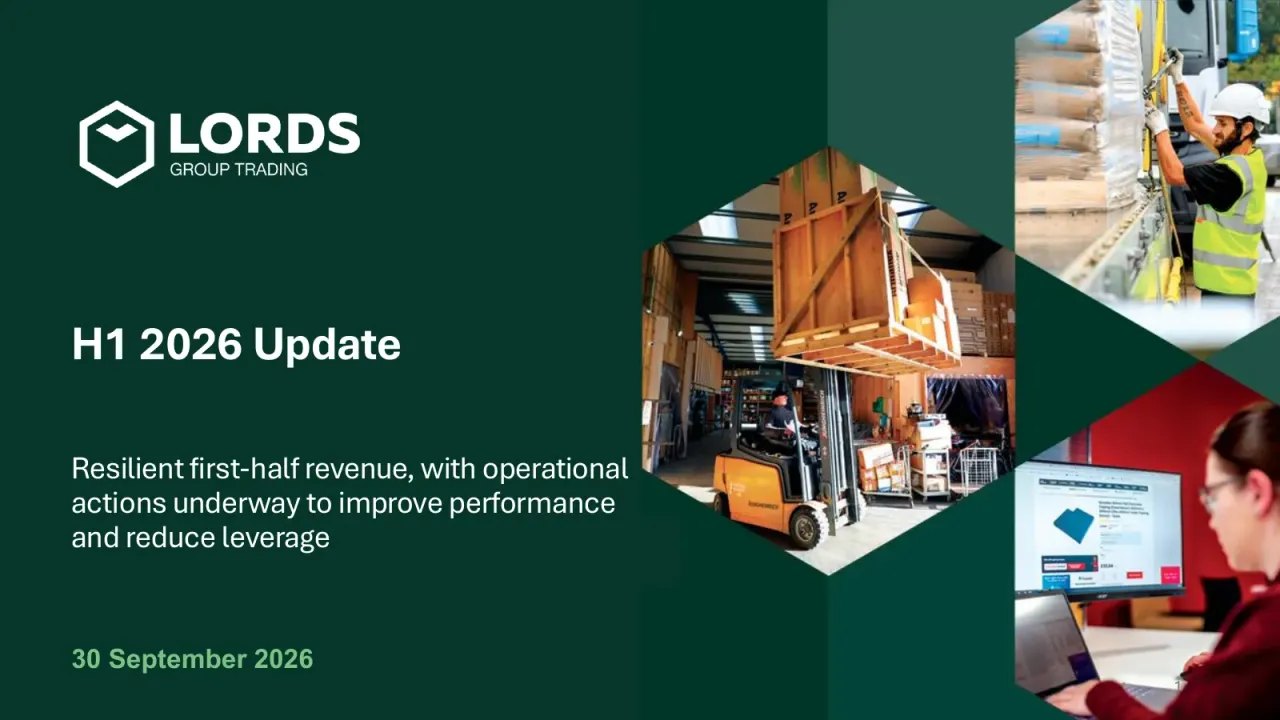
0:00 Good morning. Welcome to the LORDS GROUP TRADING PLC investor presentation. Throughout this quarter presentation, investors will be in listen only mode. Questions are encouraged and can be submitted at any time just by using the q and a tab situated on the right hand corner of your screen. Please just simply type in your questions and press send. We begin, I'd like to submit the following poll. And now I'll hand you over to Shankar Patel, CEO. Good morning, sir. Good morning. Thank you, and thank you to the attendees for joining us this morning for our h one twenty twenty six update. The update is that we have delivered a resilient first half revenue, for 2026, and we are undertaking operational actions to improve our performance and reduce our leverage. In terms of the agenda, I will go through the highlights followed by a financial review, by our CFO, Stuart Kilpatrick, and then I will go through a business review and provide a short update on the outlook followed by q and a.
0:59 2026, the first half, as I said, we've delivered resilient revenue performance, and a decisive operational response to what has been a difficult and challenging market. Management had identified the issues, and we have increased the pace of action that we need to take as a result of an unexpected weaker market than originally anticipated at the back end of twenty twenty five. Our revenues were 220 232,100,000, which is broadly in line with h 01/2025. Our group like for like revenue, unfortunately, is a negative 6.8%, where we can see that it's demonstrated by underlying demand weakness across our end markets.
1:45 Our adjusted EBITDA is 8,400,000 with a margin of 3.6%. Given the market and the need to preserve our balance sheet, we're not proposing an interim dividend. And our net debt is 26,500,000, reflecting our seasonal working capital outflow. In terms of the the main blocks of what's improved, our merchanting like for like decline narrowed to 2.3% in q two, significantly higher in q one, where we were affected by adverse weather and exceptionally wet first quarter. Another positive for us is the fact that CMO has delivered a positive EBITDA in the first half. We've also managed to increase our PNH gross margins by a 130 basis points.
2:33 And in our spare divisions, revenue has increased by 8%. We've managed to complete our refinancing in April 2026, which we covered at the year end presentations. But there have been challenges, and the things that have challenged us is that the p n a PNH market conditions still remain difficult due to a factor of reasons. And there's also been a challenge that APP, our boiler distribution business, once it's grown margin, it has grown margin on a lower market share. As I mentioned, the market recovery has been slower than expected, and that's been identified by the construction PMI, which is significantly below 50 for over twenty consecutive months. That said, with the market background, what is management doing?
3:21 We have a focus plan for each of our operating businesses. We've delivered over £3,000,000 of OpEx savings implemented to date, and we continue to focus on margin, cost, and working capital discipline. We've also reduced our CapEx going forward. We have a well invested business, and therefore, see that the current environment suggests that we ensure we maximize our cash flow and therefore reduce our CapEx to essential as well as ensure that we reduce our debt. That's the priority for the business. I'm gonna hand you over to Stuart who'll go through the financials. Thank you, Shankar. If I could take you through first half financial snapshots. Revenue, as Shankar mentioned, was very similar to last year.
4:08 But the reported revenue of 232,100,000, it masks weaker underlying demand. And as Shankar mentioned, our like for like sales were 6.8% down on the previous first half first half of twenty twenty five. Gross profit was a positive in the results, up 4.7% to £46,900,000. Now you can see our gross margin in the period has increased from 19.3% in first half twenty twenty five to 20.2% in the first half of twenty twenty six, reflecting our pricing discipline as we experienced significant volumes of price input cost increases and materials cost increases and also the improved gross margin in Plumbing and Heating where we took the strategic decision last year to prioritize value over volume.
5:00 Adjusted EBITDA was £8,400,000, a couple of million pounds less than this time last year, and a similar impact on adjusted operating profit. And you can see the decline in profitability is effectively increasing our focus on cash generation and and balance sheet management. Our net debt was 26,500,000, and this compares to last year of 20.9, so a little bit higher. And we, as Shankar mentioned, we always have a seasonal outflow of working capital in the first half. Our near term priorities are managing working capital, being more efficient in managing our inventory. We've made some good progress in the first half and into the second half, carefully managing CapEx to prioritize it on replacement or high returning projects, and the delivery of our business improvement plans, which we'll talk about a little bit later in the presentation.
5:55 We're looking at a bit more detail then at the revenue and operating expense bridges. On the left hand side, you can see our our revenue bridge starting from the position in the first half of twenty twenty five at £232,100,000. And the volume reduction that we've seen in plumbing and heating, of about 13 or 14%, like for like has reduced revenue by £16,600,000 in the half, and you can see a similar impact from the decline in merchanting of £5,400,000 on a like for like basis. That's been offset by our acquisition of CMO, which joined the group, if you remember, in June 2025. So we had three weeks of CMO in '25, but a full six months in 2026.
6:42 And CMO combined with the new branches we've opened in Merchanting, four new branches compared to the start of January twenty twenty five. They've added £22,000,000 to the revenue, and that gets us back to a similar number compared to the first half of twenty twenty five. If we then turn to operating expenses, you can see on the right hand side there, operating expenses in 2025 in the first half were £34,400,000. The businesses we've acquired, CMO principally, the new branches add £5,200,000 to those operating expenses. And we've done, in my view, quite well in terms of reducing the like for like costs by about £1,000,000 or nearly 3% despite having higher minimum wage compared to last year and the impact of the employer's national insurance, which kicked in in April 2025.
7:32 But, obviously, there's been an inflationary impact on fuel costs and transport costs with the Middle East conflict that's been ongoing since February, which we try to pass through as much as we can, but, obviously, our suppliers are also trying to pass that on to us. But quite a good reduction in like for like OpEx in the first half. I'll now turn to our merchanting division. When volume was was challenged, as I've mentioned, the gross margin was very stable. So you can see revenues down, by 4.6%, like for like down by 4.9%, slightly more, to a £112,300,000. Within that, our specialist brands of George Lyons in the civil side and our LORDS GROUP TRADING PLAY FOR LIGHT GROUP in the in the half.
8:21 And there was our businesses with greater exposure to the new build housing sector that remained quite challenging and had a tough time in the first half. Gross margin, remained stable at 25.8%, which is the same as last year, which is a creditable performance given the sheer volume of input cost increases we've seen and the market remaining very competitive, you know, in the, drive to trial and win volume. Overheads were limited or or the overhead increase was limited to £500,000 in the in the half. And that resulted in EBITDA of £4,600,000, which really is driven by those lower volumes in the first one there with a lot for lot down. And the graph shows that. You can see the profit impact of the of the volume reduction is £1,700,000, recovered a little bit by margin and offset a little bit by overheads, but that's the main driver. And the volumes are lower in merging for the profit change half on half.
9:17 Going forward, we're obviously very much focused on winning market share from our competitors, where our customer service offering is, we we feel, is is very fundamental to what we do. We want to improve our gross margin within merchanting and keep to win some marginal gains, even slight gains help us, and tightly controlling our operating costs. It's important to remark that since the end of the first half, we've taken about £1,600,000 annualized out of the cost base within merging as we've looked to to slim down and keep our costs tightly under control. We'll then look at plumbing and heating. You can see revenues declined by 14.1% in the half. And if you remember last year in March, 2025, we had a very high volume of, of boiler sales, particularly ahead of a price industry wide price increase on the April 1. I think that was our second highest level of turnover for our plumbing and heating wholesale business that month. We didn't see that again in 2026, so we've seen quite a big drop in our in our revenue of 14%.
10:29 We're also suffering from a UK boiler market, which is around three to 4% lower than than previous year. And we can see with the success of our spares business, DH and P, which has increased by 8% in a half, there are a lot of people deferring that capital cost of replacing their boiler and preferring to do it up and and patch it up for the next the next winter season. Gross margin, as I've mentioned, in Plumbing and Heating was a positive, of a 130 basis points. And that reflects the deliberate shift we made, in the second quarter of twenty twenty five to value over volume. But, obviously, we have suffered a little bit on volume, since then, and we are all set on trying to recover that volume as we go forward into the second half.
11:16 EBITDA, as you can see there, from the from the graph, the main impact has been the revenue decline of 14% in profit terms, which has reduced probably by £2,000,000. We've covered a lot of that through the gross margin of of £1,300,000 and good performance on the cost base where we're slightly better as well, which gives us a £3,500,000 EBITDA for the half compared to £3,900,000 in the first half of twenty twenty five. Strategically, you may recall that we've reduced our our depots, sizes or depot number of depots from seven down to four in the first half, which we said we would do in our wholesale business at the year end. That's largely completed in the second quarter.
12:02 That impacts our costs by about 900,000 in 2026 and about 1,500,000 annualized going into next year. And that's a good positive move given the reduction in volumes that we've had. I then turned to digital, which is primarily CMO. You can see in the table there. We only have three weeks, of CMOs consolidating in the first half of twenty twenty five as it was acquired in the early part of June. If you take on a like for like basis, though, compare the pro form a sales in the first half of twenty five to the actual sales in the first half of twenty twenty six, we're actually 17 and a half percent up year on year, but in in the knowledge that they had a tough first half in in 2025.
12:52 But that is good pro good progress. And you can see we're reporting positive EBITDA in the first half of £300,000, which is already following the completion of their integration program, recovery of their supply chain, and the reduced cost base compared to when they joined the group and aiming to try and get volumes back to the levels they were in 2024. We also moved our Condell business into CMO and part of Condell was online, and we've moved that across in May 2026, which gives us a further opportunity to strengthen that business. And going forward, our goal is to keep on doing what we're doing, improve profitability, further broaden the product proposition and continue to leverage our increased operational efficiency. But then turning to our cash flow in the first half. As I mentioned, net debt was $26,500,000 at the end of June.
13:46 We endured or we saw the normal seasonal working capital outflow of about £6,700,000 which is broadly similar to previous years. But our debt is a little bit higher than June last year, £5,600,000 higher. And leverage is above the board's medium term target at the moment, leverage being the ratio of net debt to EBITDA. We did complete the refinancing in on the 04/02/2026 of £65,000,000 of total facilities for a three year term with two one year extension options. Our headroom, which is the surplus of the facilities over the the net debt, amounts to £32,400,000 at the end of June twenty twenty six. So a significant amount of of headroom based on our debt at the end of June.
14:33 And our real drivers in the second half to address that point I just made on leverage is to drive EBITDA through greater market share of Palladium heating, drive gross margin or gross profitability in Merchanting and continue to make the progress in CMO in terms of profitability and leveraging off their current cost base. We also will drive working capital. We'll be more efficient in stock management. We've implemented a few things in the first half to drive that. And we'll keep CapEx to an essential maintenance level or for those projects that are offering a particularly high return. Thank you for for that update. On the business review, I'll go through each of our divisions individually. Merchanting, where we are seeing some momentum improving with margin and cost actions that we're taking.
15:23 Our merchanting business combines localism and specialism, offering our customers an exceptional customer service backed by superior product knowledge and highly engaged team, something that we make sure we always focus on is our is our engaged colleagues. This allows us an opportunity to be local leaders across all of the various locations that we operate from. In terms of the numbers, just to re recap, we have an overall h one negative of minus 4.9%, and that decline moderated to 2.3 negative in q two. There have been four new branches in the last eighteen months, and those four branches have delivered 15,000,000 of incremental revenue in the last eighteen months. In terms of what we're doing, our commercial priorities are based on increasing our sales intensity.
16:13 We do have a really good, strong sales team, and we're what we're focusing them on is gaining market share through improved customer service. We're also very much looking at improving our gross margin. Whilst we have maintained the gross margin, we are still seeing cost increases that are outside of our control relating to either the national insurance effect from a couple of years ago to rents, rates, etcetera. And the that cycle needs to be broken, and it will be broken only if we improve gross margins whilst we are in a difficult and potentially, market that doesn't look like it's going to grow exponentially very soon. And that leads us to ensure that our branch returns on capital employed is measured and is effective, including a review of of where they're performing compared to their peers.
17:03 The structural actions that we've taken in August, we completed a large restructuring, which will deliver 1,600,000 in annualized OpEx reduction. And we have set a gross margin challenge for h '2 and beyond, looking at mix, looking at the sales type, looking at our customer profile, and our colleague behavior. The business model remains as a branch autonomous, business, but that is supported by a differentiated range in customer service. And our dual brand sites offer a specialist in products alongside this core merchanting range, and we've seen really good success there. In our plumbing and heating division, the recovery plan is centered on gaining market share, again, ensuring that we improve our efficiency and improving our mix of products to get margin accretion.
17:57 P and H Moment offers its customers a specialist product knowledge again and differentiated offering because not only is it installed, but online and its distribution across a fine range of products in the plumbing and heating space between renewables, spares, and heating products. As mentioned by Stuart, we had an unusually successful h one last year, and therefore, our revenues on a like for like basis are 13.3% down. But we have reduced our cost base by reducing our distribution centers from seven to four, and that rationalization was completed in in q two. This will lead to an 1,500,000 annualized saving in full year '27 and point 9,000,000 expected in 2026.
18:45 In terms of the context of this business, we didn't have the repeat of the March 2025 exceptional volume volumes ahead of a unexplainedly large sorry, not explainably, but a very large price increase due to the CHMM introduction and manufacturers putting up their prices. We estimate that the boiler market is down by three to 4% and that volumes for APP is is is because it's down because of the fact that we have reduced our market share in chasing a greater gross margin, which we've delivered. The actions that are under underway is debt rationalization and cost reduction will continue. The rationalization is completed, but the reduction in in cost continues.
19:32 We have strengthened our commercial accountability. We're selling right across our three product areas of spares, renewables, and heating products. And we've installed a new sales team, which will allow us to recover our customer base and the loss of of volume as well as install an outbound sales team to focus on the smaller merchants where it's much more efficient for us to to call them rather than to send a rep around to to getting their their business. That's something that's new to us, and none of our competitors are are doing that, and we expect that to to reap rewards for us in due course. Our categories that are performing well are spares, which is up 8% in the first half, and we continue with our renewables progress, as the market adopts low carbon heating products.
20:22 We have launched air conditioning, firstly, the first half and in the second half, and it's been a very successful launch for us there with higher margins than the commoditized boiler volumes. In terms of our digital, the turnaround milestones have been reached, and the principal milestone was to get the business into profitability. And we are now focused on scalable growth. CMO still remains the largest online retailer of construction products, and it operates through nine specialist websites. A part of its strategy is to continue to create new specialisms in its online websites, and we have done that again this year with Lentils and the Brick Superstore. As Stuart mentioned, revenues are up 17 and a half percent. EBITDA is now in positive territory, and we've got sales initiatives that will yield around £2,000,000 worth of incremental sales.
21:15 The next phase of our priorities is to maintain this this revenue growth and also look for margin improvement. There are many products that are listed on the website that don't sell in greater volumes, and we're looking at how we can promote those as they are margin accretive. We focus a lot on improving the operational efficiency and the cost discipline of this business. The costs are substantially down on on how it operates in from previous years, and we'll continue to use technology to drive that further. The business has a data led marketing proposition, and that, again, is going to reap rewards as we start to look at how long the customer life cycle is with CMO. Traditionally, it's been quite short, and the repeat customers has not been as great as we've seen in our other divisions. And that's one of our focuses is to see how we can improve that with the greater offering that CMO now has with the backing of a physical business behind it across all the various product streams of plumbing and heating, general building materials, renewables, and civils.
22:22 In the next phase of our priorities, we had a business called, which was also online and selling similar products to CMO, which is now being moved across to CMO. We're seeing some really strong growth in those product areas under CMO and a cost reduction in the group with the duplication of two businesses selling the same product removed. And we're launching a trade credit software, which is digital. So rather than a traditional trade credit offering, which is essential to sell structured products, This is a digital offer where the customer will be offered trade credit through a third party provider online whilst they are browsing our website. It's called two, and we're, we're looking forward to seeing the effects of of that come through as as part of our digital journey.
23:11 I'll summarize our operational improvement program. Every operating business has a focused plan with clear ownership and regular executive review. In terms of sales for APP to grow our share, for CMO, we're revitalizing inactive accounts and offering trade credit. In some of our specialist businesses like AW Lung, we're focusing on direct sales as it sells into the house building show part of the market. We have been, positively encouraged by the, help to buy scheme, details of which are scant, but we feel that that will support a degree of growth in our AWM direct sales business as house builders mobilize to to to provide greater housing than they have been in in 2026.
23:58 We continue our gross margin focus through either improving pricing or ensuring that we get greater supplier support. The market is tough for us. It's equally tough for our supply chain, so we are looking at the supply chain to equally support as we try to improve our, as we focus on improving our margin. We'll continue our cost reduction. We have completed a large, restructure emergency. We've restructured Condale, and we've carried out the DC rationalization. But we'll continue to look at all of our costs to make sure that a cost reduction is is delivered. And we can see that in our numbers with our like for like costs not not growing in line with inflation. Working capital is a big priority for us. We will be optimizing our inventory, ensuring that our receivables collection is as strong as it can be given our markets are under pressure, and in particular, the financial viability of some of our customers will come into question in softer markets. But equally, we're also leaning on our suppliers to make sure that we get decent terms that mirror our the provision of our credit to our customers.
25:06 As I mentioned earlier, we have decided to reduce CapEx, not at the detriment of the business. We do feel that the business has been well invested, but it is time for clear financial returns and that threshold to be be as high as possible for our businesses to to deliver. In terms of the outlook, we're not expecting an improvement in market conditions, and therefore, we'll be focusing on controlling our controllables. Our assumption is that the second half conditions will be similar to the first half. The effect of the war in Iran, the higher increase in in fuel, and therefore input costs will continue to to to to make sure that our markets are softer. And that you can see that in in the PMI index, being 44.3 in August and well below 50.
26:00 Whilst we're grateful that the Bank of England did not increase interest rates recently, but we are potentially expecting the effect of a 25 basis points rise in November, which is clearly you know, has a potential of a negative effect on our markets. Our industry federation has reduced its forecast from a positive 2.3% in '26 to negative 1.8%. This is before the launch of the, help to buy scheme, and we're we're hoping to get further details of that and see how that will help bolster our end markets. So our priority is is to convert profit into cash, reduce our leverage by the year end, grow our market share in our plumbing and heating division, and improve our EBITDA through implemented cost savings, operational efficiencies, and gross profit improvement.
26:51 Thank you very much for your time, and we'll move over to q and a. Perfect. Thank you for updating investors today. Could I please remind investors to submit your questions just by using the q and a tab situated on the right hand corner of your screen? A few reference recording of today's presentation will be available in the investment company platform shortly after meeting has ended. Guys, as you can see, we have received a number of questions during today's presentation. At this point, if I could just hand back to the team to read out the questions and give responses where appropriate to do so, and I'll pick up from you at the end. Okay. Now the first question, shareholder value has been consistently ended. Resiliency has been the message consistently, but performance hasn't been good. What is going to reverse this downward spiral? Well, the reversal of the downward spiral is in part the actions that we're taking. We've moved to taking quite drastic action. It's not fun having to restructure your your business and lose, you know, colleagues that have been with us for a long time, but we have decided to to take the actions, in light of the market conditions.
27:54 But the real reversal, obviously, comes if we can get some some some tailwinds, which, you know, I don't know if the help to buy scheme is the only tailwind that the government has in in mind. But, you know, we look forward to to seeing some of that come through. And if that doesn't, we will continue to operate as well as we possibly can. We are a diversified business with quite a number of our markets challenged. And our job is to react to that to that challenge as best as we can, which I think we're we're trying to do to demonstrate, but appreciate the the the point that performance hasn't been good. And equally, it's not been good for for many of our competitors in our sector. Another question is are there further opportunities to expand exclusive or own brand products to structure improve margins and strengthen customer loyalty?
28:45 Yes. Absolutely. In particular, in our plumbing and heating division, that's something that we have been, focusing on. We have, got a team that are looking at improving our gross margins through exactly that. That's some own branded opportunities. We have launched quite a number of own brand products and have now also put in a sales team that are focused on selling the more higher margin products than the commoditized large volume boiler products and associated heating products. So the answer to that question is is firmly yes, and we'll continue to do so, and and look forward to to doing more of that in 2027. Shall take this one? The next question is Thank you. To gain market share means being competitive.
29:33 Is your pricing enabling this, and can you squeeze suppliers' margins further? As of all, our pricing is competitive. It it kind of has to be. We price scrape quite regularly, that means checking against our competitors of what their prices are. And, obviously, you know, customers will come into our branch with a with a a price from someone else and compare it to our prices. So we're we're constantly being competitive on the pricing side. And can we squeeze suppliers' margins further? We're obviously very dependent on good relationships with suppliers, but our suppliers are facing the same volume challenges we are, and there are, obviously, opportunities to do to do deals with them and enhance our margin. So that's another area of focus for the second half. As we've mentioned, improving our gross margin is two ways. It's price price up and cost down, essentially, in simple terms, and we're working on both of those equally hard.
30:32 Has there been any approaches by third parties to acquire the business, or is the majority shareholder comfortable that things will improve into significant profitability and when? Obviously, I can't answer or give any details, but but the the business has not been, or is not open to approaches, at this moment in time. And as the majority shareholder, it's comfortable that the business is a strong business that will improve its profitability as the market improves, but equally through the actions that it is taking. As I mentioned, the market itself is in a in considerable difficulty, and we're not the only business that's been affected by this.
31:24 The question, how do you work more with suppliers in partnerships? All of our businesses are actually very close to their to their suppliers, and the the the way we do that is actually work within in terms of product launches, in terms of areas where they see a gap that we could potentially fulfill. We've got that across the board between our plumbing and heating division, our merchanting division, and including CMO where category management is really key being a digital digital business. Again, there's always more and more work that we can do with our suppliers. And in particular, one of the initiatives that we've taken is to join to leave, our buying group, H and B, and go and enter into a strategic alliance with two other merchants where, again, we'll be working much closer with our suppliers rather than working through a buying group. So, again, you know, that's a big part of how we will we will see growth in our business.
32:28 So it's fantastic. The next one, so please tell me more about the current debt rise and the plan to reduce it. What is the analyst estimate for full year, end of year net debt? Was, as we mentioned in the presentation, the the debt rise in the first half is largely driven by working capital, which is a seasonal thing, which tends to reverse in the second half. Our businesses are quite seasonal with plumbing and heating being strong in September through to March and the budgeting being strong from March through to sort of November, really. So we do have seasonal impacts on working capital. We have instituted some targets on stock and inventory levels, and we've introduced some new techniques and new software to try and drive inventory efficiency more more more challengingly.
33:23 So, you know, we we think the debt will reduce in the second half just through the the natural, seasonal flow, and this estimate is, similar to where we were in the first half or nearly in the first half. Last week, quite a long question, but I'll just pick out to an aspect of it, which is the market cap has diminished since the IPO. Market doesn't like the trends. How are we going to start being profitable and what's changing for this to actually come to fruition as actions speak louder than than words, and there's a personal downbeat by consistent poor performance. We completely recognize that the market cap has diminished, but, equally, we also know that our market has since our IPO been on a downward spiral. Volumes are lower than 2019.
34:16 That's naturally going to have an effect on on our business and any other business in our sector. We are profitable, so I don't think the the point is that when we are going to start being profitable, we are profitable. And we're taking the actions to increase those profits in a very difficult environment. We have been affected massively by external forces such as increases in our cost, which we've worked really hard. And those are our actions, which speak louder than our words, that we have controlled our costs. And as our presentation says, our job is to control what we can control, and we're doing everything we can assure shareholders that we are doing everything we can to control our controllables, notwithstanding that a big part of the management is actually very much invested in in this business with a large shareholding.
35:04 So what's affected other shareholders equally affected the management shareholding, and and we will do our very best to improve that as much as we possibly can. That's great, guys. Thank you for answering those questions from investors today. Before we ask investors to share their feedback, which I know is particularly important to the company, Shankar, could I please just ask you for some closing comments? Once again, thank you very much for joining us this morning. Appreciate that our message is that we are in difficult and quite turbulent markets, but we would like to reassure that we're taking as many actions and everything in our in our control to do the best that we possibly can. Thank you very much. Thank you. Could I please ask investors not to close this session?
35:49 It should now be automatically redirected for your feedback. On behalf of the management team of LORDS GROUP TRADING PLC, we would like to thank you for attending today's presentation, and good morning to you all.
Follow Lords Group Trading PLC into a list and get an email when it puts out news.
CEO at LORDS GROUP TRADING PLC
CFO at LORDS GROUP TRADING PLC