Paul Pindar
Chairman at LITERACY CAPITAL PLC
Replay available
Investor Presentation hosted by Literacy Capital (LSE:BOOK) on Investor Meet Company, held 2026-04-27.
On 6ix: 6ix.com/event/literacy-capital-plc-book-investor-presentation
Automated transcript · Written by software from the replay's audio. It can mishear names and figures; the replay is the record.
0:00 Good afternoon, and welcome to the LITERACY CAPITAL PLC investor presentation. Throughout this recorded presentation, investors will be in listen only mode. Questions are encouraged and could be submitted at any time via the q and a tab situated on the right hand corner of your screen. Simply type in your questions and press send. The company may not be in a position to answer every question it receives during the meeting itself. However, the company can review your questions submitted today and publish responses where it's appropriate to do so. Before we begin, I'd like to submit the following poll. I'd now like to hand you over to the management team. Paul, good afternoon, sir. Thank
0:31 you very much indeed, Lily. Thank you for the introduction. Good afternoon, everybody. Firstly, thank you to all of you for taking the time to listen to us this afternoon. I'm conscious, looking at the people that have signed in, that we've got quite cross section. So we've got some quite long standing and experienced LITERACY CAPITAL investors, but we've also got some new ones. So we will try and tailor the conversation today, both to give some background to why we set ourselves up and what we're trying to achieve, but also to update with some of the more recent events within the portfolio. Just by way of introduction to the two of us, Richard Pinder is the CEO and joint founder of LITERACY CAPITAL with me, and I'm Paul Pinder. Both of the two of us have had previous careers working directly within private equity itself, but also both of us have worked outside of private equity, which again I think is quite an important issue.
1:24 We tend to take quite an operational approach with the management of our businesses, and part of that is founded by my career history, where I spent twenty five years building up a listed business called CAPITAL, which, between myself and team, over twenty five years we took from £1,000,000 of revenues to just in excess of £4,000,000,000 of revenues, making shareholders four eighty times their money on that journey. So that's a little bit of background to the two of us today. Just by way of an overview of what we're seeking to achieve, Very fundamentally, we don't really view LITERACY CAPITAL as simply an investment business. We view it as a vehicle where we can create hopefully great UK businesses. And I take that perspective from the point of view of if you invest in a company and you spend time with the management and you coach the management and you nurture it and you take the view that potentially you could be a shareholder forever, that, from our experience, tends to actually deliver the best outcomes for investors. And that's really very much what we're looking to do within LITERACY CAPITAL.
2:32 By way of backdrop, we founded the trust in late twenty seventeen with £54,000,000 of capital, and our original investors invested at £1 a share. We listed on the London Stock Exchange a few years later at 1.60 a share. That was just five years ago. And today, we're trading at £3.27 So for those investors who joined us us at IPO, they've made a little over double their money
2:59 during that five year period. We focus very much on the smaller end of the market in terms of small businesses, typically with an EV of 10,000,000 to 25,000,000 And we focus on that end of the market. We believe it's the opportunity where we can add the most value and also where there's the least competition in terms of other private equity players. We've delivered pretty strong growth over the period of LITERACY CAPITAL's evolution. So we've actually grown net assets in excess of five times during that period to around £290,000,000 today, and as I say, starting with £54,000,000 So quite reasonable growth. The one thing that makes us truly unique is we're the only listed fund on The UK market, where we also set ourselves up for a part charitable purpose.
3:48 We're called LITERACY CAPITAL and we donate 0.5% of the net assets of the fund every year into literacy charities, but primarily the charity that we created where we're trying to do a lot to address what is a very material literacy problem in The UK. And again, for perspective, whilst we've created roughly £240,000,000 worth of value for shareholders, we've also donated somewhere in the region £13,000,000 into the charity.
4:19 Good afternoon. So, I'm just going to touch briefly on I guess private markets and then specifically why LITERACY CAPITAL is is different to the other options out there to invest in when it comes to private equity funds. So, I mean, for a long period of time now, there's been a growing proportion of the the investment universe of operating businesses where they've chosen to stay private for longer particularly in The UK where there's been fewer businesses coming, either IPOs or listings or whatever form of entries to the public markets. It's become increasingly rare and as a result, if you want to access some of the most exciting or high potential businesses, then investing in private businesses is, I'd say, becoming increasingly essential.
5:08 One additional positive of investing in these private businesses is the size of the stakes the fund managers tend to have tend to be relatively significant and also tend to have quite a degree of influence more so than is possible by investing in public companies. That influence and that control over selection of management and strategic decisions is very important, and we can touch on that and how we've helped our businesses to improve, their potential by getting involved in some of those matters. The long term track record of private equity is very strong, particularly against public markets, and also the structure of private equity allows investors to have a longer term timeframe as opposed to reporting to public investors on a quarterly basis and having to hit having to hit those targets.
6:02 Paul's touched on some of these factors already but specifically within literacy quite deliberately, we focus on some smaller businesses that are I would say, below the threshold that normal or traditional private equity funds would choose to focus on. In The UK and I'd probably say globally, there's, I'd say, a pyramid of a large number of smaller businesses and as businesses get larger, there's fewer by population as you go up that kind of size criteria. With managers of private capital, they tend to focus on sort of say mid or larger businesses rather than smaller ones. And principally the reason for that is as private equity managers have success, their financial incentive tends to be to raise larger funds because they charge a percentage of AUM as their investment management fee and as a result, where they are successful they attract more capital, the more capital they end up having to take it or choosing to take it and as a result they end up drifting away or moving further up the size, away from the smaller businesses where they may have previously had success.
7:19 We quite deliberately do not want to do that. We've stayed where we are regardless of NAV having increased from 54,000,000 to approaching 300,000,000 because we do think there is a cohort of businesses that are otherwise neglected and they provide the opportunity for outperformance and better better upsides. We've touched on I guess the level of influence that we can have over our portfolio companies in almost in all of our portfolio companies we've ended up making additions to management teams and changes where needed and being able to do that and being able to attract I guess additional personnel with relevant experience. With additional ideas, energy, ambition, can be transformative particularly in smaller businesses.
8:09 Another positive specific to LITERACY CAPITAL is the lack of performance fees and lack of carried interest that we don't charge. Reason being the pair of us are own approaching 40% of the funds and so kind of economically it doesn't really make sense for us to be paying a large proportion of the carried interest or performance fees to ourselves. And as a result of that which can be quite a significant expense for investors when investing in private equity that's avoided with the structure that LITERACY CAPITAL has. The other obvious benefit is as a listed vehicle where normal or traditional private funds end up locking up limited partners capital for years or even over a decade. There is the ability to trade more frequently.
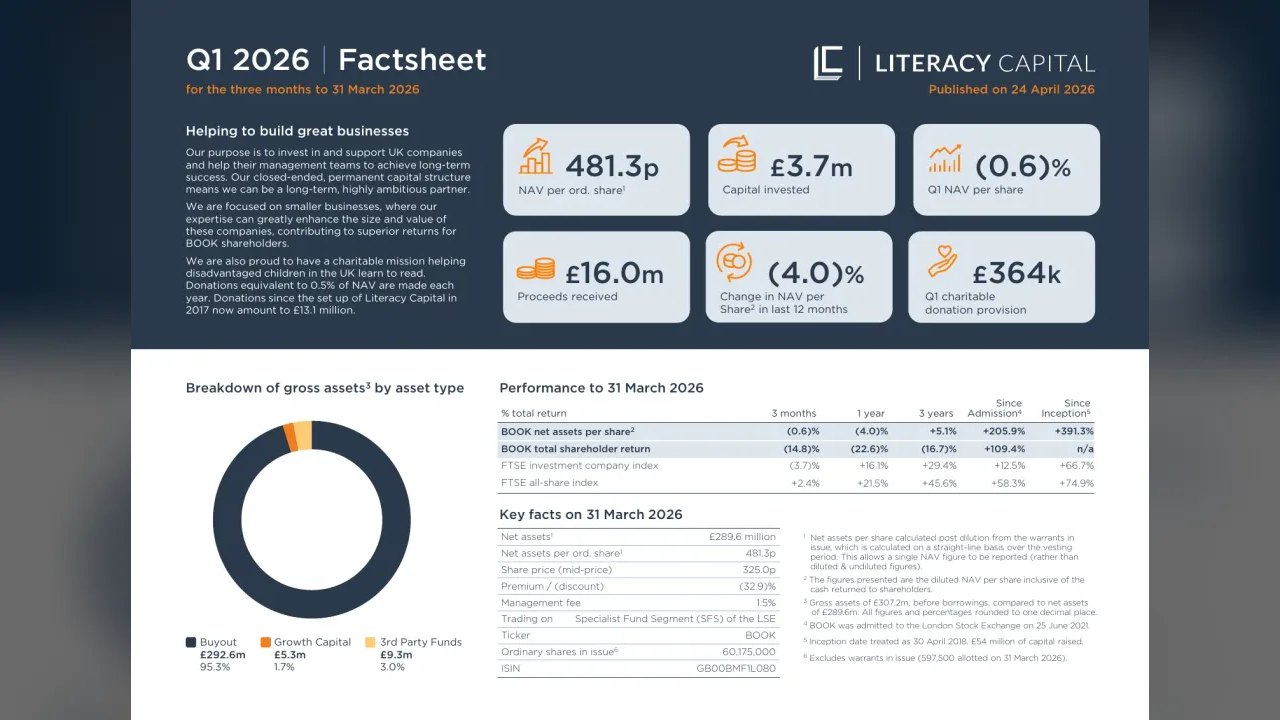
8:58 So, yeah, that's one final benefit just on this slide. If we just touch on briefly historical performance, The long term track record of the Trust has been has been very strong. As Paul mentioned, NAV has increased over five fold, since creation in 2017. NAV, at the most recent quarter end was just shy of £290,000,000 There was on top of that, just over £6,000,000 that was returned in November to shareholders, which was the first capital return and the shareholder return since listing is, 109%, since June 2021. There's a graph there which shows that the performance that NAV growth in '24 and '25 was effectively flat over the two periods, much more muted performance than was achieved in 2020, 2021, 2022 and 2023.
9:59 And the primary reason for that has been very strong contributors in those earlier periods where performance was very strong, ended up going against us in '24 and '25 despite some stronger contributions elsewhere. As a result of that and kind of several other factors, the share price at the most recent quarter end date at 03/31/2026 widened out to the highest level that it's been at since we listed for the first three years or so post listing. We were at par or a premium for almost all of that that period and since the beginning of this year, particularly given the the sell off in the investment trust segments with AI fears in January which are not really applicable to us and then also the Iranian conflicts in February.
10:54 We've seen that widen out to its widest level yet.
11:01 We'd just like to touch also on the kind of businesses that we invest in. So, this slide kind of shows you we've got 18 businesses in the portfolio as a whole and this slide shows greater detail around the top 10 of those. As you'll see when you read the descriptions of the various businesses, it's a pretty wide mix in terms of business activities. So, as a fund, we're not focused specifically on one area of the market. What we tend to look at instead really are the questions of, first and foremost, do we actually understand the business opportunity that's put in front of us? We're generally much more interested in the shareholder situation, the shareholder dynamic, than the specific industry that the business is in. But it needs to be a business that we can understand. It needs to be a business that we believe that we have some specific things we can bring to the party to add value to them. So that might be can we improve or upgrade management, can we help with coaching the teams to be better, can we help with things like M and A to help the businesses scale more quickly. So those are the kind of ingredients that we look for.
12:13 The other thing which is also a very important element, which may seem obvious but I think is often underestimated by the private equity market, the easiest way to make strong returns is to pay an attractive price in the first place. And so, again, from a situational perspective,
12:29 the most common reason why we don't progress with an acquisition opportunity is that we simply don't like the entry price. So, at the point of investing, we have to believe that we're buying assets for a very attractive price. You'll see from the mix that we run a pretty concentrated portfolio. So, 10 investments are 84% of the fund and indeed the largest investment is 25% of the fund. We're actually very comfortable with that and the reason for that is we'd rather do fewer things well than spread ourselves too thinly. By virtue of what we do, we get a huge amount of information from each of those companies on at least a monthly basis and in some instances on a weekly basis. So, we don't tend to get very many surprises and we get a lot of transparency.
13:14 And the other thing that I would also say is we have a high degree of influence or a high degree of control. So, again, if you look at that list of 10 companies in front of you, in every single instance we have appointed either the CEO or the CFO. And actually, in six instances out of that 10, we've appointed both the CEO and the CFO. So by definition, you'll see that, compared with what I would call a typical fund that's investing in listed equities, we've got a much greater degree of influence in terms of what the eventual outcome might be. One of the questions that we frequently get asked is how do we value our investments? And so, therefore, I kind of thought it was worth just touching on this slide. I mean, first thing that I would say is if you look across the whole range of listed private equity funds, at the moment the average multiple of EBITDA that's used from a valuation perspective is anything ranging from roughly nine times EBITDA all the way through to around 25 times EBITDA.
14:19 LITERACY CAPITAL is at the nine times end of that spectrum. So, of all of the listed funds, we actually have adopted the most conservative
14:28 valuation methodology of any. I think that's quite nicely illustrated in the slide that you've got in front of you. This slide actually illustrates all of the material exits that we've had since listening. So any exit that was greater than £1,000,000, we put on this slide in front of you. And the three that are within the nice orange circle have actually all been achieved in the last nine months. And what you'll see, again, which I think kind of underpins our comments around valuation, is that if you look at the premium that have been achieved, with the exception of just one deal, all of them have been achieved at a very, very material premium to NAV. And indeed, the last three that have been completed are at 39% premium to carrying value. But the other interesting point as well, which kind of highlights our slightly different approach to traditional private equity, is we tend to take a longer term view of our investments. So, our approach is not to try and invest in something for two to four years and try and make two or three times our money. We're happy to take a longer term view, but we're greedier about the level of return. So again, very broadly speaking, if you look at the five investments we've exited, it's roughly 10 times, 10 times, 15 times, five times and two and a half times.
15:43 So, a kind of investing. And, again, the three investments that we've exited in the last nine months, we've made an accurate of 6.7 times return on our original investment.
15:58 If I just touch on recent new investments as opposed to sales, this may be new news to certain listeners. So, the two investments platform investments that we completed in 2025 are mentioned on this slide. So, only only a small number of weeks apart but Trinitarian in March 25 and then a new holding company called Red Sky that we set up in April that's completed its first acquisition simultaneously with with that creation of that of that entity. Despite the fact that Trinidad is a software business and Red Sky is a manufacturer of sausages, kind of beyond the sectors that they might sit in, they have, I guess, stronger parallels between the two shareholder dynamics than might initially be obvious.
16:52 And I guess help to bring to light the types of situations and the types of investments that we like to make. As Paul alluded to, of the three recent exits, we'd appointed two of the CEOs during the period of our ownership and we'd appointed CFOs in all three of those cases. Similarly with Trinitatum, we invested in that business. It had two founders both earning 50% of the business.
17:18 But they one of them in particular was looking for a retirement and was looking for some assistance with succession planning to take what was a fundamentally strong business, but had been treated by the two founders as a kind of steady cash generative, sort of dividend paying lifestyle business onto something that could be scaled more aggressively and have the management team with the ability to take that forwards. So, as part of the package of our investment with Trinitatum, we also brought in a new exec chair, a new CEO, a new CFO, a new chief marketing officer, several new sales people and also multiple people in The US where the business had never hired people previously. So, there's quite a lot of investment and quite a lot of change in a business that when we invested only had 15 heads.
18:07 And today, it's nearly troubled that and also signed up many new customers. So, it's got multiples of the number of customers that the business had at the point that we invested. So, it's got off to a very good start. Despite the level of change in investment and potential disruption that the business went through in the in the early stages. Red Sky relatively maybe not similar but had some certain parallels. So, again, 250% shareholders, two founders that had set the business up decades earlier in this instance,
18:44 Both were looking for a retirement. So both ideally were not looking to do another day of work in the business after selling it, which is exactly what happened. One of the two founders had brought their son into the business. It was a family run business. A lot went through him. There was a significant amount of dependency on Josh. He was relatively young and we wanted to bring in an experienced team to help make the business less dependent, and more resilient. So, it had, you know, just a greater depth of senior talent within the business. So that's what we did. So, the other thing that we did with Red Sky, aside from bringing in a new exec chair, an individual called Mark Chartner who had success in the food industry previously, we also brought in a new group CFO, who joined in November.
19:39 So a few months after we did the deal, but he also joined about a week before we completed quite a significant acquisition for Red Sky. So, the initial acquisition was of a business called Langford's and then we subsequently bought in November another sausage manufacturing business called Delanco which again was a founder owned business with the owner looking at retirement in due course. And again, similarly with that business, we've been looking at how we can increase capacity, how we can mitigate and remove constraints within the business and how we can kind of improve how things are done operationally within the sites. Both businesses, we were quite attracted by the quality of what they provided to their customers and also the fact that both businesses generated a very attractive level of revenue and profit per employee and also generated very strong margins and also cash generation on the profits that they generated.
20:42 So, both businesses, particularly in the current environment, we felt were well placed to generate strong profits, cash flow and bearing in mind there are always challenges and changes within the macro environment that we have to take into account. We felt these two businesses were very defensively placed in order to not experience some of the issues that smaller UK businesses have been suffering from, and thankfully we're reasonably well protected against those.
21:10 And if I then just touch on the performance of those two businesses, and again it goes back to comments we've historically made, where when market conditions are less favourable, when there are founders that are less optimistic about future periods. It does then translate to more sensible deal terms and more sensible pricing on entry to those investments. So, you know, there's there's also at the moment a lot of difficulties within the private equity sector where exits have been relatively challenging for certain managers to achieve. Thankfully, we've had three in the last nine months and we're also sat on net cash for the first time since 2021.
21:57 But in the current environment, there are more opportunities to deploy capital more favorably and we have seen the fundraising environment become quite challenging for private equity. So, it's very helpful that we do have this capital that we can deploy as and when we want to and in the current environment, we do think that there are opportunities to deploy that well and I guess specifically if you look at Trinidad within a year for just over a year of doing that deal where we've marked up the multiple of money on our investment to just over four times. Importantly, we've actually had the vast majority of the capital we invested back. And we got that back within four months of doing the original deal. So, it's a good way of kind of de risking the deal, improving the IRR, and then also being able to deploy that capital into other investment opportunities.
22:46 And then Red Sky, as I mentioned, we completed an acquisition of Delenco in November, which also saw us invest slightly more capital into that group. And despite investing incremental capital in Q4 of last year, on the combined investment we've made over 5.5 times in less than a year in that group.
23:07 As a result of very strong cash flows from that group, the two trading entities, good good performance within within the two businesses and just sensible deal structuring on entry. So again, for anyone with any kind of major concerns about outlook for The UK. I think, you know, despite that actually it becomes to our advantage when deploying capital and looking at new investment opportunities. Just to conclude, and we won't go through these in great detail again with you, but I think there are a number of elements of LITERACY CAPITAL that make this genuinely unusual in the market. So, as an example, we are the only listed private equity firm that focuses on businesses with an EV of sub 25,000,000 £30,000,000 because that's where we believe the value is.
23:58 We are also looking at exiting a very material premium to that. So, if you look at the five exits that we have made since listing, the average EV at the point of exit has been comfortably ahead of £150,000,000 So you'll see that the multiples of money that we're looking to make are very strong and that translates into the multiple that you can see in front of you in terms of the growth in net assets. In terms of valuation policy, we would argue that we're the most cautious that's listed on the market. And in terms of personal skin in the game, we would also say that we're probably the most heavily committed of any of the listed private equity funds. As Richard mentioned, between the two of us, we own nearly 40% of the fund. If we do well, shareholders do well and the converse is also true. We also believe we're the only listed fund that does not charge any carried interest, and again, for those of you who follow the private equity sector, you'll know that carried interest is a significant drag on returns, and that is a drag on returns that we didn't want to inflict on either ourselves or others. And finally, we're the only listed trust that also has a part charitable purpose. So far, we've helped somewhere in the region of 180,000 children and we're hoping to help another half million over the next three years. So, we hope you found the presentation interesting. We think the proposition is really interesting.
25:15 And now we're very happy to help with any of the questions that have been submitted. That's great. Thank you very much for your presentation this afternoon. Ladies and gentlemen, please do continue to submit your questions just by using the Q and A tab situated on the right hand corner of your screen. Just while the company take a few moments to review those questions submitted today, I'll remind you that a recording of this presentation along with a copy of the slides and the published Q and A can be accessed via investor dashboard. Can I please ask you to read out the questions and give responses where appropriate to do so and I'll pick up from you at the end? So there's a question specifically on Antler just regarding its inclusion in Q1 and questioning how that has occurred in terms of its re entry back into the top 10 given the performance of listed house builders during the same period.
26:09 The individual who asked whether or not we'd inject further capital in that business as the reason for that, that is correct. We did invest further capital in to Antler in Q1 in order to acquire more land in a market that we think is reasonably favorable at the moment given again a lot of the public house builders have also talked about not investing in new land for the time being. So, are some benefits in pricing at the moment that we're seeing. A couple of questions. One asking about the discount to NAV and someone else asking something similar and asking about capital allocation policies with that in mind.
26:56 As mentioned, we did return some cash to shareholders in November by way of utilising the BSHARE scheme. So, an obvious alternative way of returning cash to shareholders is by way of a share buyback scheme, albeit obviously that only does it to shareholders that wish to sell shares rather than sort of treating all shareholders equally. Mean share buybacks are something that we do discuss and may be open to. However, as Paul mentioned, we already do have a very concentrated portfolio and the reality is if we bought back shares, we'd be buying back or effectively be buying more of the same number of small holdings and mature holdings that we've already got.
27:44 We also the only pushback we get from institutional shareholders typically is our size and liquidity. If we end up buying back shares, then we'd only be making those factors worse and aggravating them by reducing the size of the fund and not doing anything beneficial for liquidity. And as a result, what we would prefer to do is to generate more demand for shares, which we have been trying to do, but sort of this is a good example of that, and also other events that we've done in recent times and plan to do. And so, rather than shrinking the fund and buying more of what we've already got, as demonstrated by the returns on the two new investments we made in 2025, by finding some highly attractive and favourable new deals, we think actually that is a better that can provide a better return on capital.
28:42 Mean, two deals, Trinidad and Red Sky have produced in excess of a 5x in less than a year. That's quite clearly a stronger return than we could by purchasing our own shares. So, we're certainly not close to it. We are obviously want to do everything we can to revert the discount back to where it previously was trading. There isn't a guarantee that share buybacks will work. And actually, I think in some aspects, it probably would be detrimental rather than positive. And so our primary objective is to increase awareness and increase demands for LITCAP shares rather than using our capital in the first instance to buy back equity.
29:34 There's a question specifically again on Antler as to why its metrics are excluded from the top 10 holdings KPIs that we produce on a quarterly basis. The principal reason for that is
29:50 is the only meaningful holding we've got that is not valued on an EBITDA basis. It's valued on effectively a multiple of its assets, which is quite typical for many house builders, particularly those that are asset heavy. And so it doesn't really make sense. It would kind of meaningfully skew the numbers if we ended up including Antler within those metrics. So again, as and when Antler is of a kind of sufficient scale maturity size, we may end up revisiting that. For the time being, we don't think it makes sense and actually just misleads readers rather than helps.
30:35 I mean, there's a question here about, and this is probably the last actual question we've got for the time, if anyone else has got any more, please chip in whilst I'm responding to this one. Regarding our size and whether it makes sense to sell or merge with another fund. I mean, that might make sense if we were thinking of LITCAP through the lens of a normal fund manager. You know, a normal fund manager looks at funds and thinks how much can I charge by way of fees on managing AUM? That isn't how we think of it. You know, we, as both of us have mentioned, we are very significant shareholders in the funds. The primary driver for us financially and what we do day to day is how can we maximize NAV, which bizarrely is not probably the main question that most fund managers of CAPITAL would be thinking of, which again is why we focus on the parts of the market that we do focus on.
31:36 If we ended up merging the funds, the investment strategy, we'd end up inevitably having to change. And it's also why we've not issued more shares even when we were trading on a 30, 40 or even 50% premium. Because if we have more capital, then it makes it harder for us to follow the investment strategy that we think can create the best outperformance. So, it's something that we'll be looking to do. I think another way of looking at it also is taking a view on what you think the genuine underlying value of the portfolio is. Rich has given you a lot of reasons as to why we wouldn't want to merge with someone else. But we've obviously been involved with a number of these businesses for quite a while now and one of the nice aspects of investing in the kind of businesses that we do is when you're successful they can compound quite quickly.
32:27 So if we give you an example, if you look for example at RCI, we've been involved with RCI now for nearly eight years. It will be clear for those people who followed us that for the last year or so RCI has had a few more headwinds where contracts have been harder to secure, not least because of some of the current government's policies. But if you look at RCI over the long term, we originally invested £3,000,000 into that business. We've actually had somewhere in the region of six or seven times that investment returned to us in cash and we're sitting on a residual stake in that business that's something like 23, 24 times what we invested. I think that's an interesting case study, if you like, in the power of compounding that you can get from some of these companies. Therefore, when we look down the list of certainly our top 10 investments and equally one or two of the investments outside of the top 10, we believe there are other investments that if we're prepared to be patient over the next two, three, four years, where we can get very significant compounding.
33:28 So, we'll give you another example, is TechPoint,
33:30 which is currently our second largest investment. An awful lot of hard work has been done with TechPoint, starting with an original platform investment. We've then made four subsequent pieces of M and A, so five separate electronics business. We then recruited an entirely new and very professional management team over the last eighteen months or so. And that team spent a lot of effort bringing together those five businesses onto one side. And we're now and only now beginning to start to see some of the benefits of one, having a unified operation to a desperately impressive factory where we're now taking customers round and securing some quite large pieces of work, three, some quite material cost synergies. And so, I'll give you that as an example that says, if we were just to sell LITERACY CAPITAL today, for example, with TechPoints and its underlying NAV, our sense is we're actually underselling the value of that business and underselling the value of that fund quite materially.
34:27 And therefore, for us, as 40% shareholders, we would rather be patient and see some of the benefit the hard work that's been invested coming through. It's why we're not in a and we fully understand and appreciate the frustration for shareholders of seeing the size of the discount and we are really frustrated as well. But the reality is it's up to us and it's our responsibility to make sure that we take the actions to get rid of that discount. And so the two things that we can do to get rid of it. One is to spend more time making investors aware of LITERACY CAPITAL. And as Richard has said, we're taking active steps to do that. So, I'll give you an example. On Saturday, we spent the entire day at an investor conference. Today, we're doing this. On Wednesday, we're doing a roadshow in a specific location in The UK.
35:15 So, we're putting more of our effort, if you like, into that effort. And then the other thing that we need to do is we need to get back to a growth in NAV of the kind of size that you saw two or three years ago, whereas we're completely conscious of the fact that NAV performance in the last couple of years has been less stellar than it was in the early years. And if we get back to the previous levels of NAV growth, I suspect that the debate and dialogue around the discount to NAV will disappear.
35:52 There's a question just on the KPIs at the end of Q1, which returned to modest double digit growth year on year. So sales growth of 14%, EBITDA growth of 16%. The prior quarter, they were the weakest set of numbers that had been included in any of our quarterlies. So I mean kind of the numbers speak for themselves, but as given it's an aggregation across those top 10 companies, it kind of just there's not that much more to say other than it just kind of reflects reflects where those companies are performing. As we've kind of alluded to I think the kind of back towards the back end of last year macro conditions were relatively weak and quite challenging.
36:39 Some of the the factors that Paul touched on and also we were towards that time towards the end of last year coming out kind of seeing that the back of some reasonably tough to match comparators year on year but I think as we've kind of alluded to I think there are some businesses that had been marked down. So, checkpoint is a good example where it was one of probably the principal or one of the top two negative contributors in 2024,
37:13 meaning that NAV didn't grow. I think it was down 1% for the fund as a whole. But TechPoint in the first quarter of this year was one of the strongest performers. And as Paul mentioned, the fact that they had we had been able to, I guess, make the choice of opening a new factory in August last year, which obviously was not a small endeavour, and has cost many millions of pounds, but also inevitably causes some disruption internally. And when you're opening a factory and shutting others, it's not going to be a period when you're maximizing profitability. But as of the end of January of this year, the business now has one manufacturing site with one one separate distribution site.
38:01 There's a separate question in terms of current trading and and kind of anything that that kind of stands out. I think I think checkpoint is is one that is certainly worthy of keeping an eye on and the fact that that's now already back into our second spot as at the end of Q one. I think the only question for checkpoint is how quickly they can continue to grow and how much they can contribute over the rest of this year. Because the scale of this manufacturing site that they've now got and the amount of efficiencies that they'll be able to generate from that. Yeah, that it will be a drastically different business compared to where it was two or three years ago and significantly more profitable as a result.
38:47 And then other businesses that are just worth calling out. I mean, they're the same business that we called out in the fact sheet, that was published on Friday, and we've discussed at reasonable length during this presentation, is both Red Sky and Trinitatum. And as Paul mentioned, when businesses, are trading well, the J curve on the returns can be relatively steep. We've already got a relatively steep J curve on Red Sky and Trinidad and they're certainly contributing more strongly, more quickly than we would have anticipated when we completed those investments. But I think that's twofold. One is trading has been better than we would have reasonably anticipated. But also going back again, like a broken record, the quality and the favorable nature of the deal structure and the pricing on the way in helps us to generate a really steep upward trajectory on our multiple of money.
39:45 And so I would expect both of those businesses to contribute strongly over the next twelve or eighteen months. So yeah, there's I think there's there's certainly more positives than there are negatives in terms of trading performance across the portfolio for the time being and and certainly much much much more optimism than there was twelve or eighteen months ago. That's great. Thank you for answering all those questions you can from investors and of course, the company can review your questions submitted today and we'll publish those responses on the investor company platform Just before redirecting investors to provide you with their feedback, which I know is particularly important to the company, Paul, could I please just ask you for a few closing comments? Of course. Just as you were closing, Lily, one more question popped up, which I can't resist answering, which is a question about the charity and have we been surprised by its impact.
40:43 I guess I'd make a couple of comments. One, we're not surprised by the impact with children. And part of the reason for saying that is because we actually also run the charity. So anyone who wants to come and visit us at our offices on Regent Street, the investment team and the charity team actually coexist on one floor. So we've had a really direct control over what we've been able to do with children and schools. And we're kind of really proud of it and they have done a remarkably good job. The second comment that I was going to make, when I concluded the presentation, I gave you a list of all the reasons as to why LITERACY CAPITAL was different. And one of the most important reasons is the charity. The reason that I say that, and we never really intended this when we set LITERACY CAPITAL up, we just kind of got lucky, But when we are in a situation where we're trying to buy a business from a retiring founder, if you're a founder and you're 65 or 70, actually, whether you get £10,000,000 or £15,000,000 for your business, it's often less important than the kind of organisation that you're selling to. And so if we are in a situation where we're competing with what I would call traditional private equity, who are always known for their kindness to others, should we say, the fact that we're able to say that we are a fund where part of the profits that we make effectively get channelled into, bookmark, it gives us a softness and a competitive edge that has ended up being immensely valuable to Literacy Capital.
42:13 So I know Richard, asked the question, was probably asking the question from a perspective of impact on the children, but the charity has also had an incredibly positive impact on Literacy Capital to the benefit of shareholders as well. I So just wanted to say that one, so I answered the question, but two, just to give a bit more perspective. The final comments, I think you'll have gathered from the tone from both Richard and me. We're conscious that we still have work to do. We're conscious that the discount to NAV is very frustrating. We are taking active steps to put that right, but the most important active step that we can take is that both ourselves and the rest of what we think is an excellent and highly capable investment team that we have are working very hard to make sure that the NAV at the end of the year is somewhat ahead of the NAV as it is today. And the better the Fund performs, I think you will see the double benefit of NAV going up, but also hopefully the discount will narrow as well, which will be to the benefit of all of us.
43:13 That's great. Thank you both for updating investors today. Can I please ask investors not to close the session as you now be automatically redirected to provide your feedback in order that the management team can better understand your views and expectations?
43:24 This will only take few moments to complete, and I'm sure will be greatly valued by the company. On behalf of the management team, we'd like to thank you for attending today's presentation, and good afternoon to you all.
Follow Literacy Capital PLC into a list and get an email when it puts out news.
Chairman at LITERACY CAPITAL PLC
CEO at LITERACY CAPITAL PLC