Patanjali Keswani
executive chairman at Lemon Tree Hotels
Replay available
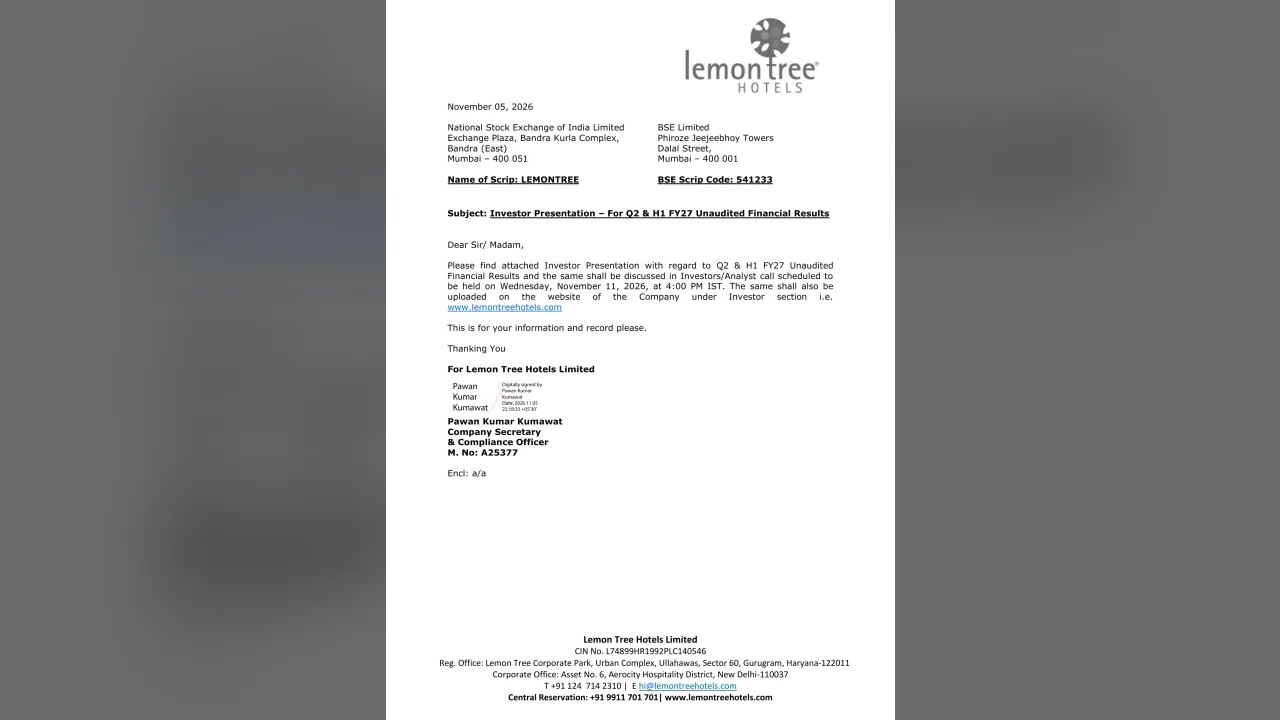
Lemon Tree Hotels (NSE:LEMONTREE) Q2 2027 earnings call, held 2026-11-11. Watch the replay and read the transcript on 6ix.
On 6ix: 6ix.com/event/lemon-tree-hotels-limited-lemontree-q2-2027-earnings-call
Automated transcript · Written by software from the replay's audio. It can mishear names and figures; the replay is the record.
0:00 Ladies and gentlemen, good day, and welcome to the Lemon Tree Hotels Limited earning conference call. As a reminder, all participant lines will be in the listen only mode, and there will be an opportunity for you to ask questions after the presentation concludes. Please note that this call is being recorded. I now hand the conference over to mister from CTR India. Thank you, and over to you, sir. Thank you. Good evening, everyone, and thank you for joining us on Lemon Tree Hotels q two FY twenty seven earnings conference call. We have with us mister Patanjali Keswani, executive chairman, Lemon Tree Hotels, mister Nilendra Singh, managing director, Lemon Tree Hotels, mister Kapil Sharma, executive director and CFO of Lemon Tree Hotels, mister Saurabh Shantal, managing director and CEO of LEMONTREE Hotels, mister Mayank Sharma, CFO of LEMONTREEE Hotels, Vishwapreet Singh, Chima, president, Lemon Tree Hotels, and Vaibhav Jay, senior vice president, sales, Lemon Tree Hotels.
1:14 I would like to begin the call with opening remarks from the management, following which we have the forum open for an interactive question and answer session. Before we start, I would like to point out that some statements made in today's call
1:27 may be forward looking in nature, and a disclaimer to this effect has been included in the earnings presentation that was shared with you all earlier. I would now request Mr. Kiswani to make his opening remarks. Thank you. Good afternoon, everyone, and thank you for joining us today. Neel, our Managing Director, will cover the business highlights and financial performance for Q2 twenty twenty seven. Post that, Saurabh, the Managing Director of Fluor, will share an update on Fluor's own portfolio and hotels under development. Lastly, Kapil Sharma, our CFO, and I will share an update on the demerger scheme.
2:05 We will then open the forum for your questions and suggestions. Over to you, Neel. Thanks, Patu. Hi, good afternoon, everyone. Let me take you through the key highlights of the quarter. Q2 FY 'twenty seven was our best ever second quarter with the highest Q2 ARR, revenue, EBITDA, PBT, PAT and cash profit. For the quarter, our gross ARR stood at INR6751, up 8% year on year and occupancy was at INR76.1, up six thirty three basis points year on year. As a result, RevPAR grew at 18% to Rs. $5,001.37. Total revenue stood at INR363.8 crores, up 18% Y o Y. Net EBITDA stood at INR162.2 crores, up 22%. FAT grew at 90% to INR79.8 crores. Cash profit grew at 28% to INR97.2 crores.
2:57 Our net EBITDA margin for Q2 FY 'twenty seven stood at 44.6%, 157 basis points higher than 43%, which we achieved last quarter in Q2 last year. We delivered this despite the provision for SAR and GST impact, which together increased our expenses by 3.2% of total revenue in this quarter. On a like to like basis, our margins, therefore, was at 77.7% yes, 47.7%, up four four basis points. Our gross debt as on 09/30/2026 stood at
3:37 crores, down 11% from INR1610.2 crores a year ago. Our cost of debt reduced to 7.44%, down 28 basis points versus a year ago. Fees from management and franchise contracts for third party owned hotels increased 30% year on year. Total management fees from Lemon Tree stood at 40.8 crores, an increase of 19% year on year. In Q2 FY 'twenty seven, on the asset light side, we opened eight managed and franchised hotels with five twenty three rooms. We also signed 11 managed and franchised hotels with eight twenty five rooms, about 1.6x of the inventory we opened during the quarter. Our combined operational and pipeline inventory now stands at 24,061 rooms across two eighty five hotels in 170 plus cities, of which 130 hotels with 12,131 rooms across 80 plus cities are already operational.
4:36 Now I hand over the forum to Saurabh to give us an update on Flow. Thank you, everyone, for joining us on the call. Our owned hotels grew Q2 FY twenty twenty seven revenue by 15% Y o Y to INR337 crores and their hotel EBITDA margin percentage rose 112 basis points to 53%. RevPAR grew in double digits across every brand and every region, ranging from 11% in Mumbai to 25% in Delhi. Orica and Lemon Tree Premier together earned 63% of hotel EBITDA on 58 of revenue. Our Key's portfolio continues to improve.
5:20 Key's RevPAR in Q2 FY twenty twenty seven was up 29% Y o Y to Rs. 3,109 on the back of a nine seventy six basis point improvement in occupancy to sixty nine point seven percent and eleven percent growth in ARR to Rs. 4,460. Key's hotel EBITDA margin rose seven forty eight basis points to 50%. Now on our hotels under development. This quarter, we acquired land in Bandrais, Mumbai adjoining BKC for about INR120 crores to develop Lemon Tree Premier Bandra an own upscale hotel with approximately 172 rooms expected to open in FY 'thirty.
6:10 It will be our seventh hotel in Mumbai and our first in Bandra. Our own 90 room hotel, Orika Shimla is scheduled to open in Q3 this year. Orika Shillong, our 165 room leased hotel is progressing well and is expected to open in FY 2028. At Orica Varnasi, our 47 room leased heritage hotel, piling work has begun and is expected to open in FY 2029.
6:42 Lastly, for Aurica Nehru Place, DDA has extended the letter of award till August 2027, which gives us ample time to secure all approvals and we expect to open the hotel in calendar year '31. Now I hand over the forum back to Patu. Thank you, Saurabh. This quarter also we have shared pro form a financials in the earnings presentation for the first half of FY twenty twenty seven for both Lemon Tree and Fleop as they would appear upon the scheme becoming effective. Kasul, would you like to speak on the scheduled time line of Yes. The Thank you. So as you are aware, we got the CCI approval earlier and post which we have also received the share the stock exchange and the SEBI approval. After receiving that last month, we have filed the scheme of arrangement with MCLT and for which the first hearing has already happened.
7:35 And now we are looking at proceedings to go on further. And then we reach a stage where we seek the shareholders' approval for the scheme. And we expect, as we discussed earlier, that within next calendar year, which is calendar year 2027, we list fewer hotels on the stock exchanges.
7:59 With this, we come to the end of our opening remarks, and I'll ask the moderator to open the forum for any questions and suggestions that you may have. Thank you, sir. We will now begin with a question and answer session.
8:21 If you wish to remove yourself for the question queue, you may press star and then 2. Participants are requested to please use handsets while asking a question. Ladies and gentlemen, we will wait for a moment while the question queue is ended. A reminder to all the participants, you may press star and one to ask a question. We have the first question from the line of Karan Karna from Ambient Capital. Please go ahead. Thanks team and congrats on the sharp rebound in RevPAR growth after four or five quarters. First question, Patu, with the global geopolitical situation hopefully easing out, how should we think about early signs of FIT demand arrival that you are picking up?
9:03 Any notable changes in booking behaviors or travel trends that you're seeing? And as a follow-up, how should we think about 2H, which typically accounts for about 55% of your full year revenue and 60% of your EBITDA? What sort of an upside risk do you see to your numbers if FID comes back in a meaningful manner, especially for your Qualica portfolio? Karan, we will stick to that, that it should be 50 five-forty five and sixty-forty. Now the point is that this we are sanguine that this war will get over or at least the impact of the war if it goes into status
9:50 will be positive for us. But I'm still not 100% sure that there will be a meaningful jump in demand. And really, the impact we are hoping for, see, what is affecting India is oil prices, inflation and the current account deficit. And all this uncertainty is leading to a drop in discretionary demand in the corporate side, okay? Surprisingly, the nonnegotiated side of the business, as you will see in one of our slides, has gone But the corporate demand is still muted. And within corporate demand, one of the main segments we depend on in certain cities like Gurgaon is new hirings, joinees from and this is very large business from the IT sector.
10:39 And that has not, frankly, yet picked up. So I would say there is compensation through nonnegotiated business, but those are all not well, let me say that the corporate side has not picked up as much as it would if the uncertainty of the war and inflation reduced and the uncertainty of the war actually disappeared. So that would still be a conversation we will probably have after Q3 results. Sure. Second question to you, O'Neill, is on the hotel openings. Last quarter you mentioned about 2,000 queues will be opened this year, but if I look at last quarter number of three thirty four keys and this quarter's net addition of one
11:22 eighty five, you're still at about five fifty odd keys net addition during one h. And then on slide number 88, you're guiding about 900 plus keys opening into March. So effectively, net addition will be closer to 1,500 keys this year. Given this, how should we think about risk to the net additions of about 2,500 plus pipeline starting from FY 'twenty onwards?
11:46 Karan. So typically, the net additions are an interesting one. It happened largely in Q1 and Q2 this year. It's not an ongoing phenomenon. We had challenges with some hotels where compliance was challenges, and therefore, we had to resort to deflying them. But from a cross opening of 2,000, which is what I had mentioned last time, we are absolutely on track. And I'll go back to what I had mentioned again, let's say, mentioned to you earlier that our signing acceleration started somehow sometime, let's say, twenty four calendar year last year, and that starts showing up in the rate of opening as well. So if you reckon last year, we opened about fifteen twenty three rooms odd. This will this year, gross, we will end up opening 2,000 ish. You will not de flag anything, will you? No. Doesn't and there's nothing on the paper for de flagging in Q3 and Q4.
12:43 And therefore,
12:47 our opening rate will also accelerate going at almost at the same rate as we started accelerating the openings next year onwards. Sure. And then last question sort of around Orica Nehru place. Is there a change of plan here? Because until last quarter, this was five seventy two keys and now it's six ten keys. And also in terms of time lines, earlier, you're looking at FY thirty, but now it's CY thirty one at end. So what can you help explain what's driving these delays from DDS side? And on Bandra
13:18 East, how are you thinking about DRRs for this asset? Will it be similar to the Lemon Tree Premier at Azeri? That will be my last question. Okay. Thanks, Karan. So on Orika Nehru Place, as you know, we are taking the land from DDA. DDA has certain approvals to provide it to us, which is basically getting approval from the management board and the CAC, which is the empowered committee. And once that is done, then
13:50 DD has to get the tree filling approval and actually removing the trees from that site. So depending on their performance, the delay is happening from there because of those two processes not yet completed. However, we have got one more year extension from August 26 to August 27 now, purely from the fact that we have readied the billing plans and everything. However, we are waiting for the approvals, which is a condition precedent in our bid with DDA. See, what's happened, Karan, is a very interesting thing. Obviously, DDA is very keen to do this. It's a big deal for them. It is the first time last year, they started leasing land rather than selling land.
14:39 And they were very happy with our bid and were very keen to execute it. However, this being Delhi and this being specifically within the reach of the Harawalis, it requires specific approvals. So the specific approvals required relate to the tree cutting basically, and the fact that it is, as I said, part of the Ravali's reach. Now the process is fairly lengthy. It has been going back and forth. A couple of meetings have happened. We are now told that there will be another meeting this month and then there will be perhaps another meeting next month, after which they will take two to three months to remove the trees.
15:29 Now this is unfortunately not in our hands, but we are given to understand that
15:36 this will occur in the next few months. Once it happens, then the FSI available and the height available, we have got greater clarity on it, and we feel we can build about six ten rooms, not five seventy as we had earlier planned. So those drawings are ready. We are simply waiting for the following that the minute the Ridge Management Board gives the formal go ahead,
16:02 we will immediately submit the plans. And concurrently, Delhi development authority has identified the land where they will plant 10x the number of trees. So they have to basically plant 3,500 trees to remove these three fifty trees. That will take three months. So in that time, we hope to get the approval. So one, these things will happen concurrently. And hopefully, and I'm again, of course, not clear when this will happen, but hopefully in the next few months, we should be able to start construction. Great. Thank you, team and all the best. Yes. But we will construct very fast. We've worked out the entire process. We are growing B1, flow plating, so on and so forth.
16:48 So we hope that once we get approvals, the loss of time will be a little made up, at least half made up in the speed rate which we constructed.
17:00 And I think Karan had a question regarding Bandra East from an ARR underwriting. I'm sure Karan Bandra East is next to BKC. So our focus would be a deep demand market of Bandarakula Complex and get the clients coming from Bandarakula Complex rather than being dependent on there. So our view is currently when the hotel opens, which is FY 'thirty, we are looking at around INR 12,000 as an ARR to start with and then we build it up from there. Great. Thanks, Saurabh. Thank you. Thank you. We have the next question from the line of Achal Kumar from HSBC.
17:46 Please go ahead. Yes. Hi. Thanks for taking my question.
17:51 So and kindly excuse me if the previous guy has asked this question, I just dropped off. I mean it's regarding the land acquisition at BKC, where you plan to build the hotel. So I just want to understand. I mean, would you be able to sort of, you know, justify this investment in terms of ARR? And why I'm asking is because, you know, so your Orika Mumbai Hotel, which is the which is the very posh hotel, it's a great hotel, and and I met back there a few months back. Still, was checking, it is selling for, like, 8,900 for November, December, while many other hotels are selling for 25,000, 30,000 and even Ginger is selling for 8,000.
18:39 So I mean, if that kind of rate is there, and I believe Lemon Tree is going to manage the BKC property, and you're not thinking about in fancy names like Mary's and all. So my question, I just want to understand what are your thought process behind opening hotel at such an expensive place and BKC is very expensive and so any color on that would be helpful please?
19:01 I'll answer that. It is basically forget for a moment the ARR and occupancy. The average EBITDA that we do in Bombay is about INR 22 lakhs to 25 lakhs a key. Make it very simple. Our investment,
19:22 which will fructify two years three years later, will be at roughly INR 2 crores a key. Now BKC is a very, very, very different market to Andheri. We are very, very confident that we will let me give you an example. We have a very small hotel there with rooms at an average of 120 square feet a room, okay, which is like the smallest rooms in India. That hotel does 7,005 to 8,000 ARR today at 80% occupancy. And it is in Kalina, quite close to where we are building this hotel. I think we can say with great certainty that we will achieve 12%, 13% ROCE immediately in this hotel. And if we are lucky, it could be significantly more.
20:09 If we hit this target of 12,000, which I think will happen, it will be much higher. So I would not be,
20:17 I think, optimistic by saying we will achieve 12% to 13% definitely and better, hopefully.
20:27 Okay. Understood. Perfect. Then my second question is about the ARR growth of 8%. I think previously, we've been saying that because of the renovations, we are getting some boost for ARR. Now 8%, we think it's quite a lot is because of the renovation. Would be really helpful if you can break this 8% into how much was because of underlying growth in the underlying greens ARRs or how much was because of the renovations at all? That would be very helpful, please. So very fundamentally difficult to isolate how much of that is, let's say, a renovation and what is not. I'll answer this differently for you, Achal. In the last quarter, we had said we'll start
21:19 we'll balance out the RevPAR growth between ARR and occupancy. And if you see Q1 because of the West Asia conflict, our RevPAR growth was skewed more towards occupancy. We had a stronger retail play, so our ARR growth was muted this quarter, where demand was better emerging out of Q1. We did you can see the Slide 24 on the sorry, Slide I'll just rename the number. Give me a second. Slide 24 it is. You will see that the RevPAR growth is quite consistent across all our brands and most of our cities. And that is driven largely through the 8% on an average HAR growth and occupancy growth, which is six thirty three basis points. So there is an element of certainly, there's an element of renovation here for our some of our key properties.
22:17 The biggest example of which is Quay's, where 80% of our renovation is now complete and you can see the development of ARR and occupancy because we're not only able to fill the hotels better, but we're also able to drive higher ARR. And the other example is our hotel like the hotel in Delhi, where again, after having now been renovated, you see a significant increase in can see a significant increase in ARR and occupancy. So I can isolate it from a property to property perspective, but it's difficult to aggregate or disaggregate the 8%, let's say, ARR growth. All I would say is, it's a healthy balance between occupancy and ARR, and hence,
23:04 18% is a very strong result coming out of Q1. And then I remember last quarter, I think you said that you have been sort of following a bit of ARR active load occupancy level passive strategy, so where you are keeping your ARR low to boost your occupancy. So was that also a factor in your sort of 8% ARR growth, but the occupancy was so high? Not as much, Jalal. I think that was a tactical move in Q1, and therefore occupancy was significantly occupancy growth was significantly higher than ARR growth. You will see that Q2 is far more balanced in that sense. So I think there's another point. If you look at the slide that was referenced to you, you see where did we not do much renovation, where we did not see much upside was in the Red Fox portfolio.
24:04 So if you notice there, the focus was refurbishment, not high cost and drive occupancy because we did not see a significant improvement in pricing there. So you will notice in Red Fox, there was an occupancy growth, but not a significant ARR growth. But the RevPAR grew because of occupancy. Whereas if you look at, say, Keys, the RevPAR grew because both the occupancy and the ADR grew in certain of the Keys that were completely renovated. So it's a combination. By uplifting a hotel, basically, you try to get a more demand. If it's a price sensitive market, then the focus is more demand, less pricing.
24:51 And if it is a deep market like Delhi, where we I mean, BRICS occur, but BRICS didn't matter to the airport side, it mattered to the Central Delhi side. But in BRICS without BRICS also, Lemon Tree Premier Delhi and Red Fox, which has now become Lemon Tree Hotel Delhi, These have grown north of 30%, and that's because we've been able to reprice the completely renovated portfolio. So it's a combo. Where you can, you will reprice significantly, but the purpose of renovation was to come up to standards, which led to an improvement in priceoccupancyboth. Does it kind of make sense?
25:34 Yes, absolutely. Understood. Fair enough. And my final question is the color on the second half. I guess, especially we are in the middle of November. So I guess you must have been you must have got a very good visibility, especially in the third quarter. So would really appreciate if you could give us a bit of a color in terms of how the drilling has been in terms of ARR occupancy and sort of EBITDA. And definitely, any color, I think it's too early, but any color on Q4 would also be helpful. Thank you. Yes, great. This is where it gets difficult because this is the big the next two big quarters. However, I would say that, I mean, we're yet not in the middle of Q3 and the effect of Diwali between October and November is still getting played out. We're just coming out of Diwali, so we're measuring how Diwali impact has been. So difficult for us to explain how will the X2 go from here. All I can say is that the momentum that we built up in Q2, we see that momentum on the retail side for sure.
26:42 Like Patu said right in the beginning of the call, corporates are slightly tepid to pick up. But generally speaking, this is a time when corporate and retail demand starts picking up anyway. So I guess the real, let's say, gauge will be after this week when Diwali, Bayadood, Chhattpucha, all of that gets over, then we'll get to figure out how H2 plays out. However, we believe fully from a delivery perspective, we will still be in the 55%, 45% share between H2 and H1, like we've broadly been on that frame every year. So given that H1 is over, you can almost estimate how H2 will go given the ratios are in that order of 55%, 45%.
27:31 Thank you. We have the next question from the line of Babur Mule from Haitong Securities. Please go ahead. Hi. Thanks for the opportunity. My first question was on our F and D revenue growth. Given RevPAR growth has been in the range of 18% and the top line growth is also in the range of 18%. That implies that F and D revenue growth has also been very strong in this quarter. So just wanted to understand what has led to this growth? And would this be a sustainable growth rate going forward as well? Hi, Bhagav. I mean simple answer, yes, it is similar to the overall RevPAR growth, largely driven by MACE and Banqueting. These are critical businesses for us in many of our properties. And as this season starts, we generally start seeing around the middle of Q2 sometimes, the uptake in MICE activity, group activity and sometimes wedding as well. Those wedding starts peaking usually, weddings start peaking in Q3 and Q4.
28:42 So I would say nothing extraordinary, but expecting mice, vetting and just the, let's say, buoyancy of Q3, Q4 take us take place this quarter as well this quarter and the next quarter as Understood. Secondly, on our management fee income, our pure hotels revenue has grown by 15% in Q2, but pure fee income has grown by 11%. So just wanted to understand why is there a divergence in the fee income that's being received by Lemon Tree So with respect to the revenue growth reported back it's very simple. While Fluor as a portfolio has grown at 53%, I think in the portfolio of Fluor has a 53% GOP.
29:34 Our management fee income about one third of it to 40% is a function of GOP margins. And if the margin is affected by 2%, 3% as it has this year because of the renovation beyond normal, then the fees come down proportionately. Think of it this way that when you look at FLEO portfolio, there are two things that are impacting our margins is GST, which was not there last year in H1 and the renovation, which anyway affected the margins. Both of now GST is, of course, an ongoing thing, but renovation will drop to 1.2% of revenue next year.
30:26 And that will itself improve the margins by about 1.5%. So we expect that the management fee income in FLIR will start accelerating with the rate of growth of FLIR as EBITDA margins start paying us incentive fees. Is that clear? Yes, understood. My last question was on our ADR. So for the quarter, we have reported 8% on ADR growth. On the Aurica, again, the ADR growth has been at around 9%. Just wanted to get a sense of our revenue management strategy since there is a GST impact below 7,500 ADR. So are we not strategically trying to raise the ADR rather than focusing on the occupancy?
31:12 And secondly, to Orifas Hospital, now again occupancy has stabilized in the range of 75%. So can we expect ADR growth to be higher from H2 onwards? Good point, Mahbodh. And I'll answer your second question first. Yes, Orica, we I did say last time as well that I do feel we all feel that Orica is now mature and occupancy is relatively stable. It's a well known brand now across the board. And therefore, going forward, we will certainly want to take the Era route to improve Orkat performance. That is also visible in Q1 versus Q2. Mean at 9%
31:57 AR growth, this is the highest Orica's highest ARR growth in the Orica portfolio in many quarters in the past. So you can start seeing this already that we are pricing Vorika to its potential and to positioning. Coming back on your first question around revenue management and GST, I mean, exactly was the point, Weber? So I was trying to understand, are we not trying to focus on increasing the ADR above 7,500 threshold in order to reduce the GST rather than focusing on it? So there are two ways, I want to look at it. First, I think the real performance is RevPAR. And therefore, depending on how the season goes, where we are, which month we are in and how the demand plays out, we, of course, use both the levers, occupancy and RevPAR to be able to drive occupancy and ARR to drive the RevPAR. So that's principle number one, that RevPAR is the major metric. And as with our kind of volume, we use both levers, occupancy. The other thing I think on GST or the 7,500 mark is interesting that if you many of our hotels are significantly above 7,500 mark and therefore, the question on GST doesn't arise.
33:20 Similarly, a bunch of our portfolio is, let's say, significantly below 7,500 where it will not be possible to raise the price to cross the 7,500 mark because the product is not like that, aka, let's say, a Red Fox or a Key hotel. So this so the logic of getting past the 7,500 mark applies to all those hotels, which are ballpark in that ARR range, which are few. And then on those hotels, of course, through a combination of, let's say, strategies, segment strategies, we've been trying to get over the 7,500 mark. And that plays out every day actually. And so therefore, from a revenue management perspective, to your point, it is important for us as a chain to make sure that anybody with that any hotel which is potentially on that, let's say, line of 7,500 over a period of time goes past it, so that we are able to we don't have the impact like we had in the previous times. Anybody who's way above 7,500 doesn't apply. Any hotel that is way below 7,500, we can't reprice them overnight to be over 7,500.
34:32 No, but I think you will see a slight change that I think last year our percentage of revenue over 7.5% was 48% or something. Is that correct? And this year, it is 50%. So I think we mentioned this in some earlier earnings calls that gradually, this percentage of revenue, which is over INR75 crores will keep increasing as we reprice. But remember that repricing of INR5000 hotel is will not lead to a reduction in GST because it will go to INR5000 INR55 crores. But repricing a 7,000 hotel will lead to a reduction in GST. So within a INR 7,000 hotel, again, there is a percentage of the business over INR 7,005 and a percentage of the business below INR 7,500. So this is very specific to very some hotels, but we are generally sure that over time, this percentage, which is now 50% of the revenue, will start inching up and the impact of GST, therefore,
35:34 will keep reducing as a percentage of revenue. Understood. That is perfect. You and all the best. Thank you. You. We have the next question from the line of Janesh Joshi from PL Capital. Please go ahead. Yes, sir. Thanks for the opportunity. Sir, my first question is the reduction in our own key count to about 5,600 odd rooms that we have seen in this quarter. I believe it is predominantly due to the lease termination contract act, Gurgaon.
36:14 So any reason for discontinuation of the lease? That is question one. And the related follow-up is that even on the management contract side, I think there were about two fifty odd keys that got deflagged in the quarter. And I think in the opening remarks, you mentioned that there were some compliance led challenges. If you can maybe elaborate a bit on that and the related follow-up will also be that the guidance of 2,500 odd keys that we are giving from FY 'twenty eight and beyond, is it a gross number or a net number?
36:51 Okay. So I'll answer this. This is Batu here. So what happened in Gurgaon was that it had two basements. Earlier, one basement was approved for banquets. Then recently, after a fire somewhere, they withdrew that approval. And they said you cannot any longer have banquets there. As a result, it significantly affected the performance of that hotel because about 30% of the business that hotel got came from either banquet income or the conferences that it used to get. This was a large banquet. So this was a force majeure clause. We asked the owner of the asset to try and get this approval.
37:37 They tried for two, three months and after which we terminated it, if I remember right, on September 30 or October. August.
37:47 So we terminated it in August and it was shut down from when? From our Others were the last month of operation. So was the last apple to apple, that income disappeared actually from our own portfolio. And the reason that there are some I will ask Kapil, will you explain why there is that exceptional item of profit, which I'm sure would be a question. Yes, sure. So there are three elements to it. So one is, as Mr. Geswani has just explained that there is a termination of the lease agreement. So due to this termination, there is reversal of lease liability and right to use asset, which are accounted for a lease asset. So due to that reversal, there is a result of a revenue actually, which is an exceptional revenue in the P and L account, which is one of the major exceptional item, which is roughly 41 crore. Then there are two exceptional items, which is relating to expenses.
38:42 One is the provision for which we have made as a conservative accounting based on outcome of a similar case relating to property tax for some other hotel chain. So we have provided around INR 16 crore towards that liability. And then there is a small INR 3 crore adjustment, which is diminution in the value of investment in one of the associates company of Lemon Tree. So net net, it is coming INR 41 crores is the revenue, 16 crores plus 3 crores is the expense, so net INR 22 crore positive impact, which is exceptional revenue coming in the P and L this quarter. Now I want to also add one thing. On and off, I think one thing we have to recognize is that various agencies in India raise various demands on us, okay? At any given time, there is always some pending demand on GST or on property tax, so on and so forth. And these are often, by nature, arbitrary.
39:44 It is impossible for us to actually anticipate who which state will suddenly make a demand on property tax or X, Y, Z. So while we report it as an exceptional thing, it is actually that. We do not know who will raise what demand when. So I just want to alert those who are listening that it is when we make that is why we try and clarify these are exceptional. What happened in Delhi last year was an exceptional demand. Again, it came with back effect. It went to court. Other hotels who went through this demand took this matter to court. The court then struck it down, then they appealed, so on and so forth. So in our case, what we always try and do is we are conservative, we try and provision for it.
40:32 And if it does not happen, of course, but if it happens, as Kapil said, this is in Pune, this property taxation in Bangalore. So this in Bangalore, we have accounted for it. But what I want to say is that this entire INR 45 crores? INR 41 crores. INR 41 crores is noncash. So we have also clarified this in our presentation that it is not part of our cash profit, so on and so forth. And it is just on account of this accounting thing, which is where the exceptional came in. Sure, sir. And the second part of the question, deflagging issue, the compliance argument that So that is why we deflagged that 80 room hotel, which is from the own portfolio.
41:23 Now as far as other hotels go, these are again these issues come because suddenly the authorities will raise a compliance issue. And if we feel it is relevant in any form, we give a notice, we give a cure period. And if the owner is unable to get the relevant approvals, then we deflag. Your question was, will this continue? By and large, no, because in our business development assessment, before we sign a hotel operating agreement, we have a list of condition precedents, which include all necessary compliances. But it is possible that going forward in some hotel at some time, like happened in Gurgaon, there could be a sudden event that makes it noncompliant.
42:15 Now the five thirty rooms that we deflagged, if I exclude the Gurgaon one, the four fifty rooms, these were an ongoing thing, by the way. It was not that it was deflagged just in one quarter. We had given various time periods based on the requirements to various asset owners, and then we took a call that we would deflag these. It is possible, however, and not that we have line of sight on it, that some owner may actually get it corrected and come back to us as has happened in one case. We will be very conservative in this matter because as you know, compliance relating to fire, life safety, these are issues which have very grave consequences.
43:02 We deflag where required. But next year, the $2,500 which Neil has committed to you, please note, not me, I do not expect, Neel, that there will be any deflagging or if it will be, it will be very not material. Yes. I was about to say that, Janesh. These hotels, of course, because they're concentrated across Q1 and Q2, it looks like we should start reporting net of deflagging, but there's no line of sight of any significant deflagging. Therefore, and if there were to be any, we'll, of course, announce that at the right time, but these are exceptional moves. Understood.
43:48 One last question from my side. Sir, I think we have also formed a wholly owned subsidiary in Mondi. So just wanted to get some sense. Are we kind of looking out for an operating asset over there? Or are kind of willing to take the construction risk? Also any color on ticket size or indicative inventory that we are targeting over here? So we were looking at some acquisitions there too. These were operating assets. This was not construction. We do not feel we want to construct anything. So this was purely a play to acquire an asset, which we felt was underperforming and where we could push more Indian customers, which was it was a specific asset. However, it was a large ticket size and a large EBITDA acquisition.
44:41 But recently, the Moldavian government has said that 40% of the revenue of hotel must be kept in Moldavian rupees. So this has made this project completely unviable in our opinion because everything is paid for in U. S. Dollar. But if we are forced to keep 40% of the revenue in Maldivian rupees, then the project absolutely does not make sense nor does any debt on it makes sense. So it is right now in cold storage, but we are very interested in Maldives as and if this government policy changes, which may happen, then we will evaluate this again. Understood. Thank you so much, sir. And all the best.
45:27 Thank you. Thank you. We have the next question from the line of Samit Sena from Macquarie. Please go ahead. Yes. Thank you very much. I apologize for the background noise. Of questions. So Patu, we've discussed several times, we look at airline data, look at air traffic data, number of passengers. That number continues to weaken, but you did have a good quarter. So any learnings from that? Are you seeing this sort of divergence? And the second thing is, the last few years have been quite tumultuous between renovations and things coming from left field awards, etcetera. Just wanted to understand, what sort of learnings have you as management team got over the last two years that will feed into your strategy or your tactical approach over the next few years, right?
46:25 So let me first talk about revenue. Revenue is in the hands of God, okay? There are what affects a hotel starts from supply demand in a micro market, then the segments it gets business from, then the impact in each of those segments with external factors like we all know what happened with hiring in the IT sector. Then it continues on to at the national level into how the economy is doing. And even the airline sector is a proxy for travel, but it is not a direct proxy, it is an indirect proxy for hotel demand because, for example, an interesting statistic would be, Samit, to look at how many same day air trips happen. So if airline traffic grows 10%, but 4% of that is same day trips, then really overnight stay is only the 6%.
47:27 Then the second thing is how much of that is double occupancy. So if it is a couple traveling, it requires one room, but it is actually shown as growth of two airlines. So there are multiple factors is what I'm trying to say. What have we learned? Airline travel is a proxy. We continue to track it. But what we have seen is the impact of other stuff, geopolitical conflict, as I said earlier, inflation, companies cutting down on discretionary travel out of a desire to control their costs, all these play out into our sector. The other thing is that we are in the mid market. So we get demand from companies, which is a, more discretionary because the CEO may continue to travel and stay in a five star or the Senior Vice President, but the manager, well, which is a larger volume, may stop traveling or may reduce traveling.
48:22 What we have seen is that our plan was very clear, renovation was a catch up. It had nothing to do initially with anything other than the fact that for over three years, we had not done any renovation and the Keyes portfolio was languishing because it was an extremely old worn down portfolio. So the entire renovation catch up, think of it that we spent 1.2%, 1.3% a year in renovation. For three years, we had not spent that, that was 4%. And then there was an improvement that we wanted to achieve in the high priced hotels, which we felt we could reprice. So all these factors led to our investment in renovation, and we will, by next year, go back to 1.2% of revenue as our ongoing renovation, and that will go on forever.
49:14 The war had an impact linked to what I had said earlier. What is our learning? Our learning is that at all times, we must be cost warriors. So our biggest moat is that we have built nearly 6,000 rooms, built or we leased 6,000 rooms. They are in very high demand markets. I know supply is growing in India, but it is not growing in these high demand market. It is actually growing in the Tier two, Tier three, Tier four, where we are absolutely asset light. Our intent is that we at the end of this year, we will have more or less fully upgraded our portfolio. We should be able to repricencrease occupancy. We should be best in class in pricing and cost so that operating leverage plays out for us.
50:04 Now the rest, of course, is in the hands of God. When will this war get over? When will oil prices come to $70 These are things we cannot answer, but we want to be future ready. And I think I can say with some degree of confidence, we are there. And you will start seeing this play out now quarter by quarter. Do you have any further questions? Sumit was in seems like he was calling from an airport. Yes, I think he was saying to some background. Yes, Sumit? Okay, I think we can go to the next person in line. Sure, sir. We have the next question from the line of Rajiv Gargwal from Axis Capital.
50:52 Please go ahead. Hi, team. Thank you for the opportunity. So my question is the... I mean, the overall supply which is coming in the next few segments. We are seeing players like IH and ITC aggressively expanding in the next few segments. This is also accompanied by multiple international brands as well. So taking this into consideration, do you see a supply risk, you know, supply outpacing demand, which could potentially impact the RevPAR growth? Well, answer, no. Structurally, what's happening to India is there's a clear deficit between supply and demand. And while like this Patu said, in the deep demand, let's say, districts of the country, there's little supply coming up, most of the supply is coming in Tier two, Tier three markets, where while there is competition, but I guess there's enough demand. Also, one, because of the structural reasons. Secondly, the new destinations getting developed, there are new reasons to go to these destinations, there are more highways getting developed.
52:05 So demand generally is on a structural high and given where India is heading with all this development, we believe that demand will continue like this. So it is difficult to believe at this point of time that supply will outstrip demand. We might get in certain areas and we might get competitive, but that is bound to happen practically as Tier two cities get lucrative for hotel brands as it happens in consumer brands as well. So competition is okay. Will supply outstrip demand? We don't think. But even if it does, it's not a Prachi, this is not a winner take all game. So when we said supply is growing in Tier two, Tier three, Tier four markets, the supply growth is actually an opportunity for us to increase our network.
52:57 And surely, ITC is a reputable brand, Marriott is a reputable brand, Taj and so on, all these guys will increase their footprint, but so will we. And that is visible because 50% of our portfolio is not open yet. And I would not worry about it. If I was a capital allocator, I would question it. But we are not allocating capital to these markets. We are simply going after building our network there, which is the fee income side. So does that answer your question? Yes, that's very helpful. Thank you. Thanks. Thank you. We have the next question from the line of Dixie Jain from Incred Research. Please go ahead. Question. My first question is regarding the OMAX deal that we signed during this quarter.
53:49 Can you give us a little more information about the investment that we are about to do and also when will this be operational? Also for hotel, the total 2,500 rooms that are expected to be operational by FY thirty, what is the timeline looking like for that? Dixie. This is Nilendra. I'll answer the Omak's part and I'll invite Saurabh to do the flow parts. So the Omak's the partnership with Omak or the MOU with Omak's exceeds asset light. So they, as developers, are developing townships and hotels and remodeling bus transit points or bus stations. So we don't have any investment. We will be managers and brand owners for properties. So from our perspective, this is in line with our asset light strategy as we go into, let's say, deeper markets.
54:45 The reason it is an interesting, let's say, partnership is because there are two kinds of development Omak is doing. One is clearly their townships, which are very well located and very large. Are over hundreds of acres, and therefore, there's a fair amount of both resident and transit demand in those areas because of their location and the density of population where they come from. And the other, let's say, kind of development that they're doing is through PPP route with the government where they're remodeling bus stations in some in certain few Tier two, Tier three cities. As you know, many of these busadas are very well located at the center of the heart of the city. Usually, the cities come around the busadas. And then therefore, as a part of that development, when a hotel comes up next to a bus transit point, it is right in the thick of demand. We thought going to Lucknow, Varasi, Khajabad, Greater Noida and such cities is in line with where their development is happening, and hence, the MOU with them.
55:53 Most of these, therefore, they have 4,000 rooms ballpark in 10 properties. Nine out of these 10 properties, Dixie, are greenfield. So expect the same time line around three years, three point five years to fortify. And these are large townships, so it might take slightly longer, if you will. So one of them, which is in Greater Noida, might come in the next twelve to eighteen months. The others will take the usual three years plus. That's on Omag, and Saurabh can help you to update floor. Hi, Dixie. So on 2500 rooms operational by FY 'thirty, FY 'thirty one, we are working towards this. We said that by the time we list, we should have a site of these 2,500 rooms.
56:40 We are working towards this, but given that these are all acquisitions and because of diligence of legal, technical, soil testing, plus if there is an operational hotel, the financial diligence, all that because we are dependent on various consultants and the client, it might takes time more than what we might envisage at those point of view. So long story short, 2,500 rooms, we are still very hopeful that we should be able to achieve that between operational brownfield and greenfield assets in the next nine to twelve months by the time we get listed. And FY 'thirty, 'thirty one, we are quite hopeful that we should be able to do that given the construction timelines and challenges like in Delhi during winter time now you get the grab.
57:31 So it might shift the construction timelines or depending which city or which country we are taking this asset in, we will abide by those laws and sometime here and there might happen and otherwise we'll keep the group posted. So currently, are no additions planned in FY twenty twenty seven, twenty eight? There are some acquisitions we are looking at and they are going through due diligence. Mean, somebody earlier asked about Maldives. So there are always ups and downs. But as Saurabh said, we will hopefully achieve this 2,500 rooms and part of it is acquisition, so that will have a direct and immediate impact on the EBITDA of LEMONTREE.
58:19 Okay. Thank you for taking the question. Thanks, Yusi. Thank you. We have the next question from the line of Murtusa Arciwala from Kotak. Please go ahead. Hi. Just an extension to those additional fees question. Other words, Pincus investment of INR $9.60 crores, is there a timing or a contingency to it? Will it happen before Flare is listed? Will it happen after? Are there any milestones? Do we have any time line for all that investment? No. This is a it is entirely dependent on acquisitionsdevelopments. There is no restriction. We can call for it. They said they need two weeks.
59:04 Obviously, we will take the money if and only if we can deploy it. But based on what we are seeing right now, we are nearly 100% sure that we will take the entire amount. For example, Bombay, we didn't take any money because we had it in cash with us. But some of the new projects we are looking at and it's on call. Let's put it this way, it's on call, there is no restriction. Okay, fantastic. Thanks so much. Thank you. We have the next question from the line of Rahul M from an individual investor. Please go ahead. Hi. Thanks for taking my question. So we we frequently talk about the growth in our loyalty member deals.
59:53 I want to look past our enrollment numbers and look at utilization. What percentage of our rough room nights in Q2 were booked by active loyalty members? And when we account for the direct discount given to the loyalty members, what is the net EBIT margin differential of our loyalty member booking versus an OTA booking after factoring in the commissions? So Rahul, there is no discount given to loyalty members. What loyalty members get is whichever channel or segment they book from, they have pricing there, whether it is through our website, whether it is through the call center, whether through it's an OTA, whether it's through a company.
1:00:37 Typically, I don't have the numbers offhand of Q2, you should get that in future. But about 45% of our business, when we last checked, which is about a few months ago, we found was repeat guests. And of them, so out of every 100 customers we get, 45 are repeat, but only 25 are loyalty members.
1:01:03 So today, 25% of our total business is loyalty, 45% is repeat. So the runway for us is actually another 90% or 80%. We should definitely enroll the other 20%, which we are trying to do as quickly as possible. And as far as pricing goes, there is no impact. But typically, our loyalty payout is about 4%. So when a customer uses the loyalty points, it is 4% of revenue, but that 4% gets absorbed within the network. So somebody who books a hotel in, I don't know, in Delhi and spends INR 30,000, of which INR 20,000 for two nights is a room, he will get a benefit or she will get a benefit of INR 800.
1:01:53 And this INR 800 can go and they can spend this in another hotel of our network. So really, it's a self supporting kind of internal system. And not only that, there is something called breakage. So we for every INR 1 lakh that are benefits given to members, typical breakage is anywhere from 30% to 40%. So actual consumption is only about 6070%. Does that broadly answer the question?
1:02:25 Yes, that's very helpful. My second question is in a totally different direction. So regarding franchisee fee structure, to what extent are our modern franchisee fee structures linked to performance milestones? For instance, like do our contracts include any escalator clauses that increase our fee percentage once our centralized brand distribution crosses certain threshold? Conversely, do owner demand some deescalators or free cash if there's some macroeconomic headwinds or some other reasons that compressed their local RevPAR below some agreed upon baseline? Actually franchise is where we have dipped our toes because there is an implication of lack of control over the asset and therefore a potential impact on the brand.
1:03:14 But franchise is 100% it's basically pre COVID as a brandsales and distribution agreement. We are not involved in the running of the hotel, though we use technology to monitor the customer feedback and therefore the Net Promoter Score. Our fees are entirely a function of the typically the room revenue and a smaller percentage of the F and B revenue. It has nothing to do with the performance in terms of the agreement. However, what is super important is that we perform for that owner, which is why he or she is giving us their asset. So it's actually a moral responsibility for us to improve their performance.
1:03:56 And as long as we improve the performance, I don't think they have any issue because we share with them local what the local market has performed in and how we are standing relative to the local market. And I can say, by and large, I would say over 90% of our owners are very happy with the performance that we are providing for them. There are, of course, owners who are who feel we could do better, and we are making efforts there. But there is no termination in these matters. Frankly, once you tie us up, we tie you up. And it continues, and therefore, you can treat it as a little bit like annuity fees, though it varies based on performance. Does that answer it?
1:04:41 Yes. Just a last inquiry on this. What is the rough A and P spend percentage like from the franchisees as part of our consolidated ad spend or promotional spend? What do you mean? Can you read the system? I didn't understand. Do the franchisees do the franchisees contribute to our overall consolidated A and P spend? And if yes, what percentage would it be?
1:05:09 So it is an indirect spend. So there'll be some sales and marketing spend. There'll be some local search engine. Now of course, generative optimization, but it is not significant. As far as possible, we want to chart a flat percentage, whatever it is, 5% of revenue or room revenue, 6% of room revenue. And that is aspirational, know, it starts at 4%, goes up to six And that should include all the spend that we do, because ultimately he is buying into our brand. And it is our responsibility to deliver revenue for that owner. Yes, that's very helpful. Just a comment on the Horika properties.
1:05:57 I have stated some of them and they are fantastic brands and really well curated. So all the best for the future quarters and I love the experience there. Thank you. Actually, it's a long haul for us because this is the first time you can say we compete with very established brands. And but we are opening going to open so many oricas in so many key markets that something like what happened with Lemon Tree over ten, twelve years will happen with Orica. I understand the impatience with certain investors, but I think Orica will be a pleasant surprise for investors over the medium term. Thank you. We have the next follow-up question from the line of Babaf Mude from Highton Securities.
1:06:52 Please go ahead. Hi. Thanks for the follow-up. A quick bookkeeping question from my side. What is our CapEx done in FY 'twenty seven till now? And if you can also share that CapEx plan over the next two to three years for each year. And regarding the renovation expense, I think we were entering around $1.20 to $130 of OpEx towards renovation last year. So what would be that number now?
1:07:20 About INR60-forty crores? It includes the projects under construction also. No, exclude the projects. First, let's talk about renovation. Renovation, it would be about 60%, 65% will be OpEx and the balance CapEx. So CapEx would be basically when we replace some equipment or do some major capital asset investment in our hotels. As far as investments in our ongoing portfolio goes, as you know, we've just invested INR120 crores plus INR130 crores, about INR130 crores in the buyout of Bombay. We must have spent INR20 crores, INR30 crores in maybe another INR 50 crores, 70 crores in Shimla and... Shillong. Shillong. We have not really started any major expense in Varanasi nor in Nehru Place. So you can say put together, we have including a CapEx renovation and that would be about INR 180 crores to 200 Okay.
1:08:19 So renovation expense in CapEx should be around INR 30 crores for this? Well, yes, INR 40 crores and then you assume another so about we have spent INR 200 crores, you assume including in the projects, and we have also paid off our debt. So you can work backwards to see the cash flow generated. Actually, the way to look at it, Vaibhav, is when we you should look at, as I think in the I've told you, in The U. S, it happens, look at our free cash, okay, and then account for all the expenditure on CapEx, whether it is in projects or whether it is in CapEx of existing hotels. Understood. And what will be the CapEx for next two years, '28 and '29?
1:09:06 Difficult because if we do the acquisitions we are hoping for and the new properties and so on, then we reckon that it will total to about 3,000 crores over the next three point five years. Understood. Lastly, on the Bandura Land acquisition, you mentioned the time line for operationalization FY 'fifty, given we have just completed the acquisition now and tools and design are still pending. So are you confident that asset could be operational by effective or would there be a possibility to delay to '31? Okay. So basically, when we start, we reach a certain stage in due diligence.
1:09:53 You see, Bombay has been going on for one year. Let me explain. Because this was a slightly complex acquisition, there were multiple owners in it. I think 19 owners or something. So there was a society that had to be bought out all that. So I don't want to get into the details, but it took a year. Now we started design once we were pretty clear that it was happening, which was about six months ago, we started designing the hotel and as it happens, the design is complete. The architect we have selected is a very competent, well known architect and he is now, as we speak, drawing the hotel making these drawings for approval. At the same time, the hotel has that property has approvals to excavate, which we will start hopefully in the next two, three weeks. And we will simultaneously submit the drawings for approval.
1:10:56 And as it happens in Bombay, thankfully, we can do the excavation at the same time as we have submitted drawings. So we reckon that in the next three to five months, we should be out of the basement, the drawing should be fully approved and we can start building the superstructure. Typically, in a development case, you try to avoid the monsoons for digging. So in our case, like in Delhi, you try to avoid graft and in Bombay, you try to avoid monsoons. So we hope that the shell will be under construction in the next three to five months. And we are out of the basement and then we reckon it's 22 floors. Is that right, Saurabh? 21. 21 floors. So in twenty months, we should finish it.
1:11:42 And of course, there'll be six months for approval and interiors and so on. So it's not an unreasonable expectation. Six months plus twenty one months plus six months is thirty three months, say, three years. And three years is what we have actually said, FY 'twenty seven to FY 'thirty. Does that answer? Understood. Yes. But don't hold me to it because tomorrow, the government might say we'll take six months more. And we will always be transparent and tell you where we got delayed and why. But I think people should also understand that there is so much in development in real estate that is out of our control. Understood. Thanks. Thank you. We have the next question from the line of Zahara Patel from Solidarity Advisors.
1:12:30 Please go ahead. Opportunity. My question is on the pro form a number for one to three. So the EBITDA margin with the asset light has reduced, like, it is shorter. It's not provision of cost. It's about 56%. So are there reasons again the corporate over the current acquisition? And by then, do you see is it going to the expected number of 70% plus? So very simple. Our expenses are fixed, more or less. They may escalate at 4% a year in the Lemon Tree stand alone. Why we feel it is the right time for us to demerge the two entities is that Lemon Tree, as Neel had said earlier, the hotels we signed three years ago will start opening up going forward.
1:13:24 And what will happen is that it will be mostly flowing for operating leverage. There will be hardly any impact on the expenses. So we do feel that in the medium term, in the next few years, we will definitely hit 80% flow through. So what does that mean if our operating expenses are if you work backwards, our operating expenses are INR 100 crores, say,
1:13:52 for Lemon Tree standalone, we would like to target INR 500 crores fee income and therefore have a INR 400 crores EBITDA. Of course, the INR 100 crores will go up by 4% a year. Therefore, that INR 500 crores will also be automatically I mean, has to be adjusted for. But it's not unreasonable, and it is very common worldwide that as the fee income grows, obviously, the operating leverage starts playing out. So we have to look at it from that perspective. Got it. Secondly Sorry, sorry, I want to add one thing. What you need to see is every year, what is the net EBITDA margin of Lemon Tree. And you can track it. Actually, the way to look at it is every quarter or half year, year on year, how is it changing?
1:14:46 Okay. Yeah. On the OMAT deal, so given... I think about 4,000 rooms with 10 projects, so this is much larger properties that we're working on. So we are, like, approximately to take 400 rooms per project. So this will be under this brand are the greenfield out of the 10. Nine are greenfield. It's the land acquired over here, and we work with much larger property, which is usually in the tier two, three cities we work with model property. So this is mainly because of the massive project size. So... Okay. So, Zara, your voice is not very clear, but I'll I'll I'll answer from what I what I understood. Did you say are they large for Tier two, Tier three cities? Is that what you meant?
1:15:36 Yes. No, sorry. First question was in terms of the greenfield of CapEx, greenfield acquisition. So the is the land acquired over there from home access side already? Yes. Yes. May I ask, secondly? Secondly, in terms of the project size, if we did 4,000 rooms for 10 projects, which is one project of approximately 400 rooms. So we usually work with much lower sized properties in the tier two, three cities. So is it only because of the project size of Omak's or are we changing or something? Yes. No. So I'll answer this. Fair point. Fair. So yes, this is according to the project size That's how the hotels are. They are larger inventory.
1:16:28 And the other way to look at this is that there are cities like Zara, there are cities like Lucknow and Ghaziabad and Gatornoyda. Typically, if you aggregate our inventory across different brands, we still might have so many rooms. If we are able to aggregate, let's say, an average 400 rooms, that actually works in our favor. There is better leverage. There is better concentration on demand. And we can service and cost of cost, and we are able to service demand in a much more efficient way. So concentrated inventory in our Tier two town or anywhere actually is a good thing. Did you also ask which brands will this be? Brands come last. This land is all owned by Omak. This is all their master planning. So they have not come to us with some future expectation.
1:17:16 These are all land banks, larger developers owned by them. They have already designed the areas for the hotels in each of these markets, which is why it is so specific. And what Neil had said earlier is other than, I think the Greater Noida hotel, these will take three to four years out. So the fee income will not come for four years. Let us assume that. And the inventory design is all that Omak has done, okay? Now the brands, you can answer. So that is the brand will be Lemon Tree. Okay. That's all I have. Thank you. Thank you very much. Ladies and gentlemen, that was the last question.
1:18:01 And with that, we conclude the question and answer session. I now hand the conference back to the management for their closing comments. Thank you, and over to you, sir. Okay. Thank you once again for your interest and support. We'll continue to stay engaged. Please be in touch with our Investor Relations team for any further details or discussion, and we look forward to interacting with you soon. Thank you. Thank you, members of the management. On behalf of Lemon Tree Hotels Limited, we conclude this conference. Thank you, everyone, for joining with us today, and you may now disconnect your lines. Thank you.
Follow Lemon Tree Hotels Ltd. into a list and get an email when it puts out news.
executive chairman at Lemon Tree Hotels
managing director at Lemon Tree Hotels
executive director and CFO at Lemon Tree Hotels
managing director and CEO at LEMONTREE Hotels
CFO at LEMONTREEE Hotels
senior vice president, sales at Lemon Tree Hotels
at Ambient Capital
at HSBC
at Haitong Securities
at PL Capital
at Macquarie
at Axis Capital
at Incred Research
at Kotak
individual investor