Tom Hickey
Managing Director at KENMARE RESOURCES PLC
Replay available
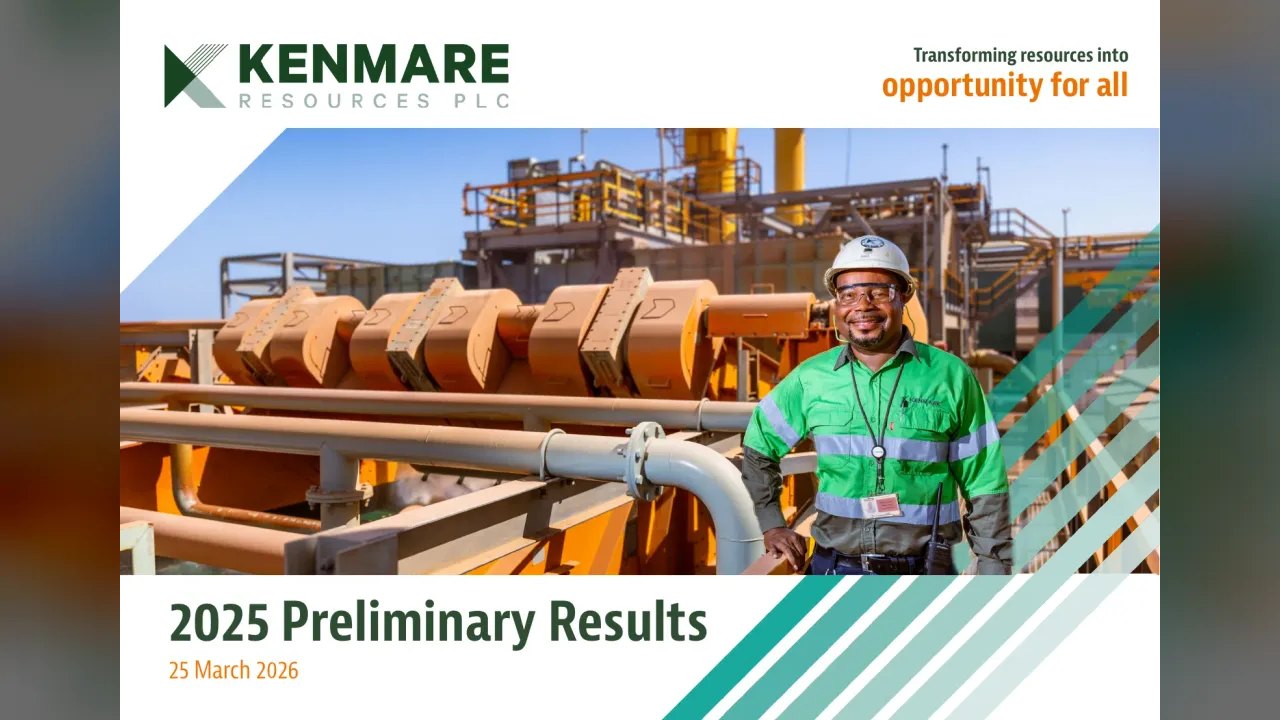
2025 Preliminary Results hosted by Kenmare Resources (LSE:KMR) on Investor Meet Company, held 2026-03-25.
On 6ix: 6ix.com/event/kenmare-resources-plc-kmr-2025-preliminary-results
Automated transcript · Written by software from the replay's audio. It can mishear names and figures; the replay is the record.
0:01 Good morning, ladies and gentlemen, and welcome to the KENMARE RESOURCES PLC investor presentation. Questions are encouraged. They can be submitted at any time via the Q and A tab that's just situated on the right hand corner of your screen. Please just simply type in your questions and press send. The company may not be in a position to answer every question it receives during the meeting itself. However, the company can review all questions submitted today and will publish those responses where it's appropriate to do so on the Investor Meet company platform. Before we begin, we would just like to submit the following poll. And if could give that your kind attention, I'm sure the company would be most grateful. And I'd now like to hand you over to the executive management team from KMR Resources PLC. Tom, good morning, sir. Thank you very much, Jake, and thank you all for taking the time to join us today. I'm joined by James McCullough, CFO Ben Baxter, our COO Killion Murphy, our general manager of marketing and Catherine Sutton, our head of IR.
0:51 So hopefully, we can cover all your questions and requests today. Look. We put out our final results today. I mean, I think it's it's clear that from the results and the commentary that, you know, these are uncertain and volatile times in our markets and geopolitically. We're seeing some of the impacts of that. They're reflected in the numbers on the commentary. And I suppose against that background, it is important to control what we can, and we have a very strong focus over the course of this year on our liquidity and our balance sheet. And and I suppose that's because we operate in a in a very we're operating a very long term project. The MoMA mine is a world class asset. It's got a hundred years of mineral resources. You know? While our business can be cyclical, we need to think about the long term. We think about that in terms of our investments, such as the WCPA investment that took up a lot of our attention and time in 2025 and and and we continue to work on in '26, our partnerships, such as those with our communities and the government in Mozambique, and I'll talk about our agreement with the government in Mozambique shortly, and our customers. And, you know, serving our customers as as we move through the ups and downs of the market is is very important to us. Many of our customers have been with us for twenty years plus. So all all of those circumstances mean that we're important to Mozambique, we're important to our customers. We try and do business properly. We were happy to join the FTSE for Good Index in June 2025.
2:11 We believe that we're an important player in the titanium minerals market. And while, you know, the market for ilmenite has been has been weak over recent years or falling over recent years, the market for zircon, while it fell in '25, we are seeing some signs of stabilization, and Kalyan will talk a little bit about that later. And indeed, one of the industry commentators, commented last week that because of some of the curtailments and and and management efforts that companies are putting in, there should be a supply deficit for ilmenite this year, albeit it will be met by inventories. We're 6% of global supply. We're an important player. And just a reminder that detaining was on the critical mineral list for Europe, UK and The US. Looking back at '25, you know, we had a very significant investment in our WCPA project, That's reflected in our CapEx. It's reflected in our elevated net debt.
3:01 And Ben will give us an overview on recent progress on WCPA when we speak shortly. If we can move to the next slide. You know, I talked about our position in the market, and and, look, I think our position in the market and our our importance to Mozambique is built on a number of foundations. You know, a a good relationship with the community, which served us very well in late twenty four and early twenty five when there was this significant disturbance in Mozambique, and it really supported our license to operate. We've invested over 25,000,000 into the community, into health, into small business, into education, into infrastructure. And and you can see that those of you who've been to MoMA can see those signs on the ground. We also aim to operate safely. We had our lowest ever all injury frequency wage in 2025. We conducted a development project over nearly five years without a single lost time in injury, and that was a phenomenal achievement by that team, which at one point numbered over 500 people.
3:55 And and we're focused, the investments we're making are are are are to ensure we can operate consistently and and at low cost for the next decades to come, and and that's why we take such a long term focus. You know? Having said that, you know, in the short term, day to day, week to week, year to year, we need to allocate our capital efficiently. And and I think as you've heard us say over the course of the last number of of discussions and calls, you know, over 2025, our net debt elevated significantly following our due due to our capital program. Illinois pricing was a shade weaker. And and as a consequence, we're very focused on managing our costs, managing our cash, managing our balance sheet. Regrettably, we undertook a retrenchment of 15% of our colleagues at site. We highlighted in our guidance our efforts to to manage our OpEx and reduce our OpEx in 2026.
4:45 We're deferring, where safe to do so, nonessential CapEx. Our CapEx in '26 will be 70¢ 70% lower than it was in in in 2025. And, unfortunately, it also means that we've had to pause our dividend. You know, we regret this. We appreciate it's it's important for shareholders, both institutional and retail. It's it's a key focus for us to restore it as soon as possible. But our first priority is to the business, to the balance sheet, to stability, and to trying to navigate the current challenging circumstances that our markets and the wider world finds itself in, and and I think that's what caused us to to to make that call. And, you know, as as as we go through the presentation, you'll hear quite a bit about our value over volume strategy. It's it's already in action. We've already started selling down some of the stocks we held at year end. We've already shipped more of our Zyrtec product the first three months than we did in all of last year. So, you know, we're taking the necessary self help measures that we can to protect our business and and ensure we're well positioned for any recovery. If we move to the next slide.
5:43 Just to talk a little bit about the implementation agreement. Many of you will have joined us last week, when when we put out an announcement about the status of the implementation agreement and in particular, a move by the tax authorities to impose a two and a half percent royalty on us, prematurely in our view because we hadn't completed negotiations around the full agreement. It's worth recalling, however, that that two and a half percent is is consistent with a proposal that KMR made last year. So this wasn't an additional cost to us, and it is accrued in our in our financial statements. It was more the consequences of of of what additional or further implementation might might might impose that, cause us to put out the announcement. I should say that there's been no other moves towards implementation.
6:35 Discussions with the government are ongoing. The president indeed, both on the two occasions I met him last year and when he was in Brussels last week with the EU, positively about KMR, positively about our contribution to the country, positively about their intention to renew the license. And and indeed, while with the EU and while facing quite direct questioning on this this issue, commented that he he expected the issues to be resolved soon without reference to arbitration. That would certainly be our hope too. We've made progress since our meeting in in February. We've made progress over recent weeks. We believe both sides are still focused on a negotiated outcome, and, obviously, there as we go through those discussions, there are some adjustments and and amendments to proposals that are, you know, as as our normal in ongoing negotiation.
7:25 And, you know, while we have energy and focus on it, we were very would very much would like to conclude it, because, obviously, this has been going on for quite some time. And and that in itself creates concern, creates uncertainty, and creates challenges for all our stakeholders, whether they be shareholders, lenders, or government themselves. It look. We've talked quite a bit about about what our remedies are should we not reach an agreement. Arbitration is is still on the table if we can't reach agreement, but we're very much focused on avoiding that, very much focused on harnessing the energy that we've generated over the last couple of weeks and and hopefully getting to an agreement, but, you know, we're still not there. So with that, I'll I'll hand over to James, who will run through, the financial performance of '25 and and some of the wider themes that will have been reflected in the, numbers, over lunch.
8:18 Thanks, Tom, and good morning, everyone. Thanks very much for joining. And starting off just looking at, pricing. So, you'll see the sort of the downward trend in pricing of recent years continued into 2025. Ilmenite pricing was down 6% on average and zircon pricing down 15% on average, which led to a a 6%, reduction in our average price received with a slight improvement in product mix. We sold a little bit more, zircon last year than than than the year before. As that translates through to to revenue, our sales volumes declined by 13% went through some of the the rationale for that shortly, but that was mainly in the ilmenite space. So we were down 17 on ilmenite volumes. Zircon, the higher value product, was was roughly flat year on year. But the combination of those lower ilmenite sales and and lower prices contributed to a 20% drop in revenue versus 2024.
9:22 That feeds through then to EBITDA. Look, our our unit costs increased by 11% during the year, and there was also some, some other sort of noncash items provision for, sales to a customer who who didn't, who was in financial distress last year and some other noncash items. And that contributed to EBITDA of 58,000,000 in the year versus 157,000,000 the year before. Looking and then look the the ultimately resulting in a in a loss after tax of of $24,000,000. Looking through on CapEx, a big year for KMR on CapEx. So the 205,000,000 was split between development CapEx for around 156,000,000 and sustaining at 49.
10:16 156,000,000 was on the WCPA project, and 49,000,000 sustaining was a relatively high year for sustaining capital. That included around 8,000,000 on, dry dock of one of our transshipment vessels as well as costs related to the SMO, the selected mining operation, and some, electrical, installations. So, a reasonably big year for sustaining capital. Look. The the impairment charge for the year, 301,000,000, just over the 300,000,000 that we had we had guided back in January. And this was majorly market driven and, driven by sort of weakening price outlook as we shared at the time.
11:01 There's also been some adjustments to costs, and, Tom referenced some of the sort of, anticipated changes in the IA terms that are reflected in that number as well. But the the vast majority of that number is is really related to weakening pricing expectations versus where we were last year. Net debts, looked at CapEx peak and the weak market contributes to net debt of 159,000,000. There was around 49,000,000 of cash that that offsets around 206,000,000 or 205,000,000 of of total debt including accrued interest. We expect net debt probably to to stay around these sorts of levels, for the year given the the weak pricing outlook.
11:49 And we did, as disclosed previously, secure a waiver with the lender for covenant levels, so from two times to three times. So we're, comfortably within that level for for 2025. And as discussed in the or as disclosed in the statement this morning, we're in ongoing discussions with the the lender group around appropriate covenant levels for for 2026. I'll touch on that again shortly. As Tom mentioned, we've made the the tough call to to pause the dividend for 2026 or 2025 full year rather. Go to the next slide, please. Just looking briefly at the the income statement, and you can see the drop in revenue, as as discussed, and cost of sales, broadly flat.
12:43 That finance costs, I suppose, and and tax are probably the key things to touch on here. The finance costs are obviously higher given the higher debt that we're carrying. And, like, the tax in in the income statement relates to tax that we pay at our mining company, KML, where our profits are are based on a cost plus basis. So notwithstanding the loss of the company level, there's still a tax charge at the sub level. And just the the chart on the right gives some indication there of the product mix change, 2025 to '20 versus versus the prior year. So you can see a slight increase in zircon content and a a decrease in the online item.
13:28 That's what's given a little bit of support from a mix perspective. So just a little bit deeper dive on some of the individual line items. So on the revenue side, shipments were down 13% in 2025 versus '24. The main contributors to that were the dry dock for one of our transshipment vessels, which which took one of those out of action in the middle of the year. That was anticipated. Weather was worse than anticipated, particularly in h one. And and then we had a customer who wasn't able to take its volumes in in q four. So that all contributed to a 13% drop in shipments. As I said, that was really in the overnight space that that we felt that. That's contributed to higher inventories, so I'll touch on that when we get to the balance sheet. But we are actively working those inventories down at the moment.
14:27 And then pricing, as I mentioned, ilmenite average of $276 per ton, so that was down 6% year on year, and zircon down to $11.73, then 15%. But with that slightly higher zircon content, the average price was down 6% to $338 per ton. Looking at the cost side, so cost of sales, broadly flat, a little bit down at the at the top of the chart. Administration expenses were up. There's a couple of things just to note in there. One is that the the charge this year or for 2025 includes that provision for for sales to the company that went into financial distress as well as some other some other noncash items.
15:16 And and the comparator year, the the 6.2 there, was reduced by the proceeds of an insurance claim of around $3,300,000. So, adjusting for those things, it it kind of it it was broadly flat year on year. And looking at the total cash operating cost line, again, pretty flat year on year. In terms of direct costs, we saw an increase in in labor costs around $6,000,000 a year, driven by part part of that was the retrenchment program that Tom mentioned, but also higher wage rates and, some some other, factors feeding through there.
16:01 That was offset largely by lower fuel costs, so and lower consumption of fuel and, lower fuel prices. And and there were some minor adjustments in or minor changes year on year in the other areas, but but but broadly sort of flat in terms of direct costs. Indirect costs were up slightly. The IFCID royalty that we've been paying, so historically, that's been at 1%. And in twenty twenty twenty four, rather, was at 1%. We've been accruing at two and a half percent as as we disclosed previously, in light of our expectation that that is the the royalty that will be applied when the IA agreement is is finalized. And and that contributed around 4,900,000 to indirect costs.
16:49 There were some other areas of indirect costs where we managed to to make some savings to keep keep indirect costs up around $3,000,000. And looking at that at a at unit level, obviously, the lower production volumes 10 lower production volumes year on year, notwithstanding the flash cost at an absolute level led to an 11% increase at the unit cost level. And and then adjusting for co product revenue and looking at it just on an ilmenite unit cost basis, there was a a larger increase, up 32%, and that's really driven by both the lower co product pricing, but also the the lower ilmenite ilmenite production. So, look, at at the at the total level, we have at least addressed the rising trend of costs over recent years.
17:43 And I think we've we've started to see some of the act actions that we're taking on costs coming through, and we've guided for 2026 on an approximate 10% reduction in costs. We look just at the cash bridge and really sort of seeing capital, CapEx, and and dividends being funded by operating cash flow plus, working capital, and and obviously the debt facility that we have. And and CapEx really is the main feature here. 205,000,000 last year. Our our guidance for this year, in total is 60,000,000, so expect to see that orange bar shrinking very rapidly.
18:29 And that 60,000,000 is split between kinda h, or rather development capital CapEx of 30,000,000 and sustaining capital of 30,000,000, and that development CapEx is is very much sort of front end weighted. We've made sort of good good inroads in that, through through q one. And so, kind of, obviously, continuing to focus on sustaining capital and and, where we can where we can optimize that as well. End of the year, as I said earlier, with a net debt position of 159,000,000. We move just onto the balance sheet. You'll see the reduction in in PP and E, property, plant, and equipment. That reflects the impairment, obviously, you know, CapEx spend as well. So, you know, the the CapEx additions, less depreciation, less the impairment, ultimately reducing in or resulting in that in that reduction to $877,000,000.
19:29 Inventory is very flat, and inventory volumes were up actually up about 20% year on year in terms of finished product, but the value of those tons was down about 20%. And so overall, a flat inventory line. Trade and receivables down considerably from from last year. Again, there's there's a a kind of a portion of that that's related to price. Volumes in terms of sales included in receivables has dropped from around 205,000 tons down to a 109,000 tons. So part of that is related just to lower volumes overall. And then the the the value of each of those tons have have dropped from sort of $4,455 a ton down to 399, so resulting in that in that, outflow from from receivables.
20:21 And then in the creditors and provision line, look, the the increase there from 2024 is mainly related to CapEx accruals and and and and payables. So closing cash balance around $49,000,000. And the net current assets piece in there is is quite important, net current asset position when you you take account of the receivables and the inventory. We're we're in a a strong position from that perspective, so more than a $150,000,000 of of net current assets. And the covenant levels touched on on that earlier. So we secured with the lender group a covenant reset for a net debt to EBITDA from two times to three times for for 2025. And and, look, we're in discussions with lenders at the moment on what appropriate levels for 2026 will be.
21:14 As we've said previously, we we are very closely engaged with our lenders. They've been very constructive and supportive to date, and we have no reason to think that's going to change. But with the uncertainties that Tom referenced in terms of, what's happening in with with the IA, as as well as what's happening in the market, And it does, lead to some uncertainties in terms of the the financial projections for the for the business over the course of the next twelve months. And we don't we don't know yet to what extent the terms of the internal resolution, will be imposed. And and depending on on whether there is any further imposition of that, that could have an impact on our financial position, during the year.
22:04 That's reflected in our going concern statement, which is included in the the release the prelims released today. The going concern statement, reflects that through a a statement of material uncertainty, which is really recognizing what we as as as management has disclosed and the auditor understanding that to say that, you know, subject to the outcome of those discussions on the IA as well as other, you know, general risks around market and and geopolitics, etcetera, that that we're facing and other companies are facing, subject to successful outcomes on on on these things and the, you know, the the going concern statement is is signed off. Moving on just to the the the final slide in that pack.
22:58 The look. Tom Tom has already referenced the the pause in the dividend, a very sort of tough decision to to cut the dividend, not taken lightly. Obviously, in the context of the levers that we have to manage liquidity, this is one. We we pulled many, and and we we pulled this one reluctantly. We do have confidence in the long term cash generating capability of the business. And as Tom says, we'll look to to resume that as and when we can do so. With that, I think I'll pass back over to Ben. Morning, everybody. I'm going to take us through the operations update, and I'll start off with explaining some of the meaningful achievements that we had during the year around sustainability.
23:46 Firstly, on health and safety, it was a a very good year. Overall, we've reduced our lost time injury frequency rate by thirty percent over the past, three years. And, in fact, in 2025, this was our best ever year around all injury frequency rates. And as Tom referenced, that is remarkable, particularly in light of the fact that we had a a development project with more than 500 contractor workers on-site at one point, and that whole project was delivered without any lost time injuries. On communities, we have now 80% completed the development of a of hospital, a a regional hospital to support the the clinics, which we have three clinics that we have in and around the mining areas.
24:37 And we're also now seeing the benefits of the Tyson the Topeeto Technical College, which is now delivering graduates that are available for recruitment into the business. On the environment side, a major initiative for the year was to focus on recycling and composting, and more than 60% of the waste that we generate at mine was recycled. This is expected to continue to improve through 2026, and that's giving us a lot of advantages not only from an environmental perspective, but also the capital profile means that we don't we will not need to extend our landfills in the years to come. Organic waste is is being successfully taken through to the rehabilitation process as well.
25:26 We remain a trusted business in Mozambique. We have, again, remained the most transparent extractive industry in Mozambique, and also we entered the FTSE4Good index, in June of last year. Moving on to the production side, 2025 was largely impacted by the WCPA upgrade, and and that meant that HMC production was 15% down year on year due to the lower mining rates. The good side of the mining side was that we introduced the selective mining operation, and, that that was commissioned through the first half of the year and, delivered very well in the second half of the year and met its 50,000 ton heavy mineral concentrate, call.
26:21 And we we see that positively and, developing SMOs this year for the future as well. On to finished products, the ilmenite and rutile were impacted particularly by the heavy mineral concentrate production being down, and we achieved a revised guidance level on those products. However, on zircon, we were able to maintain our original guidance level, and this came because of very good recoveries in the mineral separation plant as well as the drawdown of some intermediate stocks. And then particularly on good news around guidance was that we materially exceeded the guidance on concentrates after we successfully introduced a new product called Zirti into our into our sales mix.
27:10 And the and and this this material has been well received by the market, and I'll talk some more about that in a few moments. The the ability to draw more from the HMC that we had and the stockpiles meant that whilst the HMC processed was 16% down, the actual finished products was only 10% down year on year. If we look at shipments, as James mentioned, we were 13% down year on year due to poor weather conditions in the first half of the year, and then our PEG transshipment vessel was required to go for its five yearly class certification recertification process in a dry dock, and that that took place between June and September.
27:57 This meant that we had finished product stocks rising in the second half of the year, and that means that we start this year with a guidance level of exceeding more than 1,100,000 tonnes of of shipping, which was 15% increase expected this year compared to last. Maybe to discuss a little bit of of the year to date 2026 performance and our value over volume strategy is being prioritized. The first area of that is the destocking of the finished products that we have. And year to date, our shipping is consistent with that run rate of 1,100,000 tonnes, and so we are unlocking the value of those finished product stockpiles.
28:43 Some customers though are struggling to coordinate both their shipments due to the market or to the geopolitical volatility that we're experiencing and this is where the flexibility of Zurtai is helping us. We're able to sell more of that material and offset the effect of the of of of that volatility. And in fact, as Tom mentioned, we our our Zurtai sales so far this year are in excess of all of what we did last year in in 2025. The other aspect of value over volume is around focusing on the product mix to extract the higher value products. And, you know, with production being lower due to the WCPA commissioning process and at a time when ilmenite markets are weak, we've been focusing on getting the most zircon products out that we can.
29:42 This is is this is helping us to offset that weaker ilmenite pricing environment. And so during the year so far this year, we've been reprocessing former tailings and intermediate stocks to increase the high value, high margin zircon products. On the non on the ilmenite side of the business, we've we have spare we have spare capacity, And so we've been using that time in the ilmenite circuits to dry zurtai. This means this allows us to ship more of it, because the loading rates traditionally, so far with zurtai have been slower than on other products because the material is and it's stored outside and is moist.
30:28 By drying it, we can get the efficiencies up and get more zurtai transshipped. And that means that overall, we're on track to achieve our 2026 guidance on all of the metrics. I'll move now onto the capital projects update, and that's on slide 20. And and really, the the year has been was about was about WCPA upgrade, and right now, we're focused on consistent delivery at WCPA. You'll recall that the majority of the, of the plant at WCPA has been replaced, and so we have new high capacity dredgers, new a new feed preparation unit, including the slimeing, and the tail storage facility that's, fully in place.
31:20 And all the major construction and installation work is now complete and is fully handed over to the operations team. This means that now what what's happened over the since that commissioning started in q four last year, we've we have experienced some commissioning challenges, and that took place last year, and we've had some that rolled off into this into the first quarter of this year. However, what we can say now is is that WCPA is regularly operating at the nameplate of 3,500 tonnes an hour. There have been a set of low cost rectifications completed using the budget, the existing budget, for the project, and the contingencies that they're in. And, and and we now expect to see consistency in the short term. Things that have been taking place are around winch brakes.
32:13 We've had software changes, cooling improvements. We've done pumping improvements both in the desliming circuit, which are will be taking effect at the next planned maintenance in in April. And on the on the tailing side, pump upgrades, of gearboxes particularly to increase the capacity, of removing the tails, to the tail storage facilities and and coarse tails features. On the outside, the densification challenges that we had previously discussed have been resolved, and we've had a stable outside slimes management situation throughout q one with no impacts on production. We did have a walkway event during the first quarter of this year where we lost some production time due to the turning of the of one of the walkways.
33:10 This this work, we decided to do some long term fixes on that rather than a temporary fix, and so we did lose some production time, But the stability of those warp ways has now been rectified and that sets us up well for the future. On to slide 21 and to look at the project costings. The project is materially de risked now and yet we spent more than 80% of the project capital during 2025. The budget remains $341,000,000 and we're inside of that with unallocated contingency and as I said all of the rectification measures that have been undertaken through this commissioning process have been captured within that capital cost estimate.
34:01 By the end of the year 2025, we'd spent $270,000,000 cashed with 12,000,000 incurred and that 12,000,000 is included in the $30,000,000 that we expect to spend in 2026. The tail of the project is in total is $70,000,000. So 30 of that this year, 40 of it thereafter. And and and it's quite a tail because it reflects the fact that we will only purchase the infrastructure requirements for Netaka orebody at the time when we need them down the track. And and so so this tail is is is quite long. As I said before though, the project is fully the project team is fully demobilized.
34:49 All the further works will be handled internally by our in house projects team. And so the main project is essentially now being closed, and it's being closed on budget. The effect overall on CapEx, as you see, is as we come off that large spend of last year, it was $205,000,000 all in including sustaining CapEx last year. So 205 is being reduced to $60,000,000 this year, and so you'll see that the intensity of our capital spend is significantly rolling off. And with that, I'm going to pass over to Killion, who's going to give us the market update. Thanks, Ben. Morning, everyone. So start on slide 23.
35:36 And, look, what you can see clearly is that 2025 was a challenging year in in our product markets. And while demand for KMRCES products and our volumes remained relatively robust, the overall market did weaken really for a combination of reasons. On the demand side, we saw slow markets, slow housing markets in really major economies and no recovery there. And on the supply side, we saw the continued growth of, concentrates and supply in, China domestic material, which led to an oversupply, particularly on the omelite, but across all the markets. This flowed through to a 6% decrease in our, average price received that you can see in the graph at the top left.
36:27 Through twenty twenty twenty five and really in the second half of twenty twenty five, we started to see a supply response, and this has had initial impact on zircon. So towards the end of the year, we did see zircon prices stabling, and I'll talk more towards what we're seeing in early twenty six on that one. I think James touched on one of our customers entering financial distress. So I think on a positive note, we have seen good progress towards recovering. I suppose some of the value, we had two shipments outstanding, but the shipments hadn't been touched and we retained title. So we've now, I think, received payment for one of those shipments, which for a value of $4,600,000, and we're in the process of arranging to retake control of the second stockpile, which again has not been touched.
37:16 Let's move to slide twenty twenty or to slide 24, please. So just going a bit more into the detail of what we saw in 2025, particularly in the online market. It was a continuation of the shift we see towards China in our markets, both on the supply and then on demand side. So on the supply side, we're seeing it in two places. We're seeing concentrates produced in Africa, Australia shipped into China for to produce finished products there. And we're also seeing ilmenite produced out of, I suppose, iron ore mines in China, both growing, both remaining cap mostly captive in China, but impacting the global market. So we're seeing sort of strong growth there.
38:05 I think on a positive sign, we have seen a response from the western producers I mentioned on the zircon, but all of those mines carry with it. Thulmonite as well, and, you know, KENMARE has has been doing similar too. And then we see unplanned curtailments to as a result of, I think, couple of disruptions through operations, and that is having an impact on the market. On the demand side, I suppose the structural shifts, really, you can see it in the graph on the bottom right. Pigment growth in China is the pigment production growth in China is the green columns, and it's growing significantly faster or it's growing and the orange is depleting. So we're seeing that shift towards China. And, you know, when we look at where the new capacity is still being built, it's still in China at the moment. So we expect that to continue.
38:54 But that's not necessarily a negative thing because chloride is taking larger market share market share there, and that domestic ilmenite can't be used there. So it's a big market for KENMARE, and chloride is taking a bigger market share, which is a positive for KENMARE. Finally, if we look to '25 and an outlook for the year 2026, I think the market has started the year on a soft footing, and we expect, I think, prices in '26 to be lower than '25, particularly on the ilmenite side. And we've seen that in q one, a significant decrease compared to what we saw in the second half of last year. That's partially a result of cancellations or postponements to shipments that we saw in the first quarter, which resulted in us having to go, I spoke to the spot market with late notice, and therefore, it didn't achieve the same prices we were expecting.
39:55 Despite that, you know, we did find markets for that. We continue to see strong demand for our products, and I think the two graphs show why. For our pigments continues to grow. Last year was a record, and we've seen more capacity being added already this year. Anti titanium metals see continues to be a strong part, where we actually grew our sales there on a percentage basis, despite slight pullback in overall demand there, last year, and we see that continuing this year too. On the zircon, I think we are starting to see the impact of, I think, control responses from producers and outages as a result of production issues. We have seen the prices stabilize since the second half of last year, particularly q four, and now we are seeing price increases announced in q two for our zircon products.
40:50 We've already agreed, a price increase on one of our products for q two, so that's a more positive out there. Finally, to touch on Zerta, I think Ben mentioned it. We are seeing a strong market for that. In q one, we sold more than we sold full year last year, and we are seeing strong inquiries for q two already. This is linked to the, I suppose, high tier two ilmenite that's contained in it, but also the rare earths that are contained in that product as well. So that's leading to, I think, an encouraging outlook for that product. With that, I'll pass back to you, Dominic. Thanks very much, Kylene. And maybe just to to summarize quickly, mean, obviously, we've gone through quite a lot of detail today and kind of highlighted the actions we're taking to address where the market is now and position ourselves for the future. Our guidance reflects that too.
41:49 As James Killian said, we're on track from in our shipments in the first quarter to achieve the guidance level. We're working hard to control our operating costs and and and manage our day to day exposures and and optimize our balance sheet. We will we're we're seeing, you know, some some positive developments around Zurichide demand, which I think we kind of anticipated last year, and we're already seeing it in q one this year. And and Kilian just touched on where the Zircon market is early days, but but certainly some green shoots there too. If we move to the next slide, I'm I mean, I've probably talked to this at the outset, but it it bears repeating. Like many in the industry, KMR is taking all the self help measures that it can to ensure that it retains financial flexibility, that it it retains a strong balance sheet, that it achieves its objectives to sell down inventory, that it keeps positive customer demand, and relationships, and that it can adjust to, you know, whatever the recent volatility throws at us. You know, for example, we have one customer in in The Middle East who's who, you know, has challenges operate you know, accessing their port at the moment. You know, we'd like to make sure we can supply them, and we'll try and be flexible to ensure we do that. But, you know, there probably will be one or two surprises arising from the current geopolitical uncertainty, and we're trying to position ourselves to adapt to that. You know, we're reducing operating costs. We're managing our CapEx.
43:17 You know, we regrettably undertook a retrenchment and equally regrettably have had to suspend the dividend, albeit hopefully not for too long. You know, we're we're working very hard to make sure that we can operate you know, that we're operating in a stable manner in an orderly fashion and making the best use of the resources that we have. And and I suppose, why are we doing that? If we go to the next slide, because we've got a world class asset. We've got, you know, something that's gonna be here producing into the global t I o two market for decades to come. You know, our investments are intended to support KMR to do that. Our investments are intended to support KMR to do it in a in a cost effective manner. You know? And, you know, while the best cure for low prices is low prices, we are seeing you know, starting to see some some producer stress. We are seeing some curtailments, some voluntary, some unfortunately involuntary.
44:08 And and and, hopefully, we'll we'll start to see the effects of of all that pain reflected in a in a more stable market before too long. You know, gratifyingly, you know, our customer base has stayed stable. The demand for our product is strong because of the quality and diversity of them. And and Killion and his team are working hard to make sure that we're that we're taking advantage of all the shipping opportunities that are available to sell down our stocks. We're working hard with our local community to maintain our license to operate, and and I think that's been one of the things that that distinguishes KENMARE. And, you know, as we have been for quite some time, we're working with the government to try and ensure a a positive and negotiated outcome to the implementation agreement. You know, just to stress that, you know, while we have had some announcements on that in recent weeks and we are making some progress, there is no firm timeline for that.
44:58 So so, you know, we can't give a specific timeline on it, but we do hope, like the president, that we can do it quite soon. So with that, we will turn over to q and a. Catherine will run us through the q and a, and thanks for your time and attention. Perfect, guys. If I may just jump back in there, thank you very much indeed for your presentation this morning. Ladies and gentlemen, please do continue to submit your questions just by using the q and a tab that's situated on the right hand corner of your screen. But just while the team take a few moments to review those questions that have been submitted already, just like to remind you that a recording of this presentation, along with a copy of the slides and a published Q and A, can all be accessed via your investor dashboards. As you can see, guys, we have received a number questions throughout your presentation. And thank you to all of those on the call for taking the time to submit their questions.
45:45 But Catherine, at this stage, if I may just hand over to you to chair the Q and A with the team. And if I pick up from you at the end, that would be great. Thank you. Thanks, Jake. So the first question comes from Colin Grant of Davy. What percentage of global ilmenite production has now come off stream following production cuts and other issues experienced by producers? And how do you expect this to evolve in 2026? I think maybe, Killion, if you wanna talk to what you're seeing in the market in terms of of of reactions or behaviors to to manage production, and we can take it from there. Yep. Thanks, Colin. I think I think probably at the moment, it's somewhere in the five to 10% range that has come off and or towards the upper end of that. And, look, I don't think we see any any of that supply coming back on in the short term.
46:37 So, you know, we don't think the full impact has come through yet. We don't think the market has fully accepted all of the the recent issues either. So we do think that is going to really firm up the market because it's a lot of supply coming out, and we'll see that develop through 2026. And that's, I suppose, aligned with what we're seeing in Zircon. Next question also from Colin Grant at Davy. What do you believe is the cash flow breakeven ilmenite price for the market in aggregate today? And how has this grown over the last several years given inflation? James, do want to chat through that? I mean, it's obviously a movable feast, and it depends on the actions of others as much as ours, but it's probably worth just talking through what we've done.
47:27 Well so, look, I think the question specifically is around what's the breakeven price for the market. And north of here, I think, Colin, would be would be clear based on the demand capacity that we're seeing coming out of the market. Look. I know is sort of the the author of record in this space. I I think their latest cost curve, which is based on 2024, which showed the, you know, the sort of the last 20% of that being up north of $250 per ton, certainly. And and if I look at that cost curve, and again, this is based on on old prices or old costs rather, which have which have probably gone up.
48:13 Certainly, a good chunk of the of the market would be underwater at the moment. And how how has that gone over recent years? I think it's I think the cost curve has steepened a bit. And if I look back over over historical versions of that, the, you know, the the right hand 20% of the cost curve probably still in that range of, you know, high high two hundreds into into low three hundreds. And but more of the middle of the cost curve probably, you know, increasing as well to give a an overall steeper cost curve and reflecting, I suppose, just cost escalations. Now I have a few questions from Richard Hatch of Berenberg. First question, you could have paid a very modest dividend rather than rather than fully halting dividends.
49:02 Are you restricted by paying dividends under your debt covenants or other covenants? Maybe I'll just it's a a big step to to pause the dividend. I think, you know, we do have distributable reserves. So, technically, it would be possible for us to pay a dividend, but I think we're very conscious that with the level of uncertainty out there at the moment around market pricing, around the implementation agreement, albeit we're making progress and around, you know, the impacts of, you know, the current geopolitical environment are and for how long we might be feeling them, we felt that it was necessary for us to be pulling every lever to preserve cash and to manage our liquidity. And so the the you know, and and but to be frank, we're also, as James will will run through, we're we're talking very regularly to our lenders about what the best path forward is. We gotta give it we got a a covenant waiver for 2025.
49:56 And, certainly, their opinions are important for us to us for 2026 as well. You know, what I'll say on before handing over to James is we do want to resume dividends as soon as possible. That has been something that we've been, you know, very committed to and very proud of in the last five or six years. So this is you know, while we recognize it's a big decision, it is one we took with reluctance. Yeah. Thanks, Tom, and hi, Richard. Yeah. I think Tom has covered most of us. Look. The very specific answer to your specific question is, yes. There are distribution covenants within the within the the RCF that we have. And like all parts of of an agreement, they're they're subject to discussion and subject to to waivers and consents and that sort of thing. So, you know, it it it's it's not as black and white as just it's it's written down, so it can't happen. But I think in the context of where we are with, you know, with already having had covenant relaxation in into the year end all the other levers that Tom has talked about, I think it was prudent to take this approach.
51:04 Next question from Richard Hatch. I back out a concentrates price of around $230 a tonne. Is that a fair assumption to use for 2026? Julian, do you wanna touch on that? Not sure I fully understand the question. If that's a question towards what price you think the concentrate producers are shipping to China? Or yes. No. Our our our concentrate revenues as a whole, I think, is the question. Okay. So when we talk about concentrates, so there are a few different things in there. Zertai will become dominant just purely because of the value the volumes of it. So I think that would be in the right ballpark for Azertai, but the other, I suppose, two concentrate products we produce would be higher than that.
51:59 Next question from Richard Hatch. Can you comment on the scale of artisanal mining by MoMA and how this is impacting the broader market? Maybe I'll I'll start with that, Kylene, you can jump in because it's you know, the the the impact of concentrates mining in Mozambique and elsewhere is something that we spent a lot of time looking at. Those of you who visited site in recent years or indeed in recent weeks will have seen will have just seen with your own eyes the many plants that are there. And and and we know that that that the aggregate concentrate production in in Mozambique is equal to or potentially marginally even ahead of what are doing. I think the point is more, you know, the trends of those of that production and and and, you know, what type of ore they can mine and how and by consequence, how long that production will will will stay on for. Killion, anything else you wanna add?
52:45 No. I think you're exactly right on scale. I think when we look at last year, Mozambique as a whole, in terms of finished OMALET product, it was probably very similar to KMR. And how it's impacting on the market, you know, it's because there's no MSPs with their operations, it's all in China. It's all in the spot market, and it's sitting there. So that's what I suppose is weighing particularly on on price at the moment. So they do have a an outweighed impact on the pricing in the market at the moment. Next question from Richard Hatch. Slide 13 says $10,000,000 of PP and E accruals for 2025. So is cash CapEx for 2026 $70,000,000 60,000,000 plus 10,000,000? Hi again, Richard. No. So the the guidance on debt CapEx of 30,000,000 includes the rollover of actually 12,000,000 from from 2025.
53:39 So so the new spend to be incurred is closer to 20,000,000 on the the DevEx side. Sustaining capital of 30,000,000, so total cash capital guidance of 60,000,000 for the year. Can you guide us on the cost of your covenant amendment, I. E, the fee you have to pay to your lenders? Yeah. So, look, we've had one covenant amendment so far, and and there's been no fee. The lenders, while we do get on, you know, well with them and are very constructive, they do take their pound of flesh. We we we pay them a not insignificant amount in terms of interest and other fees. That remains to be seen as we continue the discussions over the course of this year, what that might have come out of. And but to date, it's been immaterial.
54:29 Next question from Rich Hatch. Can you give us a steer on year to date moves down in ilmenite prices and what kind of price increase you're expecting in zircon in q two? Yep. So I don't think we can fully guide on on the price, but I think it's linked to the last question I answered on on concentrates and the fact that we've had those cancellations, and postponements of shipments has led us more into that spot market. That spot market is at lower price than I suppose that spot market in China is at lower prices than the Western market. So it's kind of the double double effect there. But I suppose it would be a bigger move than we would have seen from h two to h one last year for some context. And then on on Zircon, you know, there's there's price increase announcements being put out in the range of five to 10%, but we see it different in different markets, but closer to the to the 5% range.
55:34 Final question from Richard Hatch for now. What is your understanding of global stock slash inventories of ilmenite? And he says thank you for taking my questions. Yep. On that because I think talked exactly about that last week. Yeah. I think we don't think ilmenite inventories are high throughout the world as a whole, but they are there are stocks of either HMC or ilmenite in China, I think, would be where we could see some stocks. When you look at the the impact of the reductions in supply, whether intentional or not, we think that would like, suppose, might talk to it, and we would agree that it would take down the majority of those stocks through the year. So we don't see it with a lot of our customers, but where we do see it, we think it'll come down significantly as a result of these stoppages this year.
56:32 Next question. What is the outlook for the pricing of ilmenite over the next one to five years? Jeez. If we knew that. Yeah. I can start that and maybe Tom jump in when you want. But, like, I think we said '26, we expect to be lower. I think maybe to the question James answered earlier about costs, we think a a large portion, know, 25, 30% of the market, of the supply in the market is at or below cost at the moment, which, you know, we don't think sustainable. So we don't see the current prices as sustainable. And as a result, we are seeing suppliers respond at the moment. I think that that points really to that. So we would expect to see improvement in prices as a result of that. And then on the demand side, I think we do expect to see a demand pull. You know, we haven't seen growth from the major economies, major housing markets in, I believe, four or five years at this stage.
57:31 We don't think that can continue for the next, I think, one to five years, you know, in that period. And India continues to be a strong growth market. Metal continues to be a really good market for KENMARE, but also for the market as a whole. It's growing very strongly. So we do see reasons for demand pull. We don't think supply can continue at these levels, so we would expect to see prices increase following, I think, a week of '26. Yeah. Maybe the only thing I'd add to that, thank you, Killion, is is if if if prices are too low for existing producers, then they're certainly too low for new for new projects as well. I mean, we're we're nowhere near incentive pricing for new projects. So, you know, the the the prospect of material incremental supply from from non Chinese projects is is is certainly likely lessened.
58:23 And I looked at one point we perhaps didn't make earlier on the artisanal mining in response to Richard's question is, you know, it's very clear from the nature of the equipment and the nature of the processes that they use that they can only mine that the the simplest, least complicated, free flowing sands, which is not every ore body. And at some point, you know you know, I don't think it'll it'll fall off a cliff, but I think at some point, that that production will top out top out, start to stabilize, and fall as as as those simple ore bodies are exhausted. Next question. In the event that there is a need to go to arbitration, how long will that process take? And is the arbitration immediately binding, or is there an appeal process? In essence, in a worst case scenario, over what period of time could the uncertainty over the implementation agreement continue until the final resolution is reached? Thanks. I'll take that. Look. If there is an ETO arbitration, and as we said, we hope there isn't, but, you know, we we have to be open to the possibility.
59:18 The arbitration process itself could take, you know, up to two years. It would take a couple of months to to constitute the arbitral panel. And at that point in time, we could apply for what's called interim measures, which effectively, if granted, would would bring us back to the status quo of of operating under the old terms. That would be our application. And then you'd then you would go through the the the arbitral process in the normal course. And and look. We think this would be a conventional commercial dispute. We, you know, we certainly at no point in any of our discussions with the Mozambican authorities would have we discussed anything other than, you know, continuing to operate in the normal course. So when we get to the the arbitral outcome, the parties have agreed that arbitration is the route that they they will they use for dispute settlement, that arbitration will be in Washington under exit rules, and and the outcomes will be binding.
1:00:10 And and so, obviously, we believe, because what our agreement says, that we have a very strong right to renewal on the same terms. We voluntarily offered significantly better terms. We believe the government's aware of of that position, and we're hopeful that arbitration is is is a consideration, but no more than that. But but that's likely what would happen if if we do have to go that route. Next question. You say zehrtai is higher value, and you imply those concentrates contain REEs, rare earth elements. Is that true, and is that rare earth element monazite? Kylene, do you wanna touch on that? Yep. Or just So you separate out that monazite, leach it, and then you get your rare earth concentrates effectively.
1:01:10 So is sold gaining value from those rare earths. But just to say it's not higher value, you know, it's not a higher priced product just to to correct that. Yeah. But may maybe the thing to say, it it is it's it's a value to us because previously, it was a waste stream, which we didn't sell at all to generate revenue from and had to incur cost to dispose of. So so that's probably what we talk about is high value. It's it's it's margin enhancement that we haven't previously pursued. Thank you. That was the final question. So handing back to you, Tom. Thanks very much, everybody. Thanks for your time. We appreciate. It's been quite a long call. If you have any follow-up questions, please feel free to to contact the team. We will be doing our q one production update mid to late April, and look forward to seeing many of you over the coming days as part of our roadshow. If anybody would like a meeting, please reach out. Of course, thank you, and good good day, everyone.
1:02:09 Perfect, guys. That's great. And thank you for updating investors this morning. Could I please ask investors not to close this session as you will now be automatically redirected to provide your feedback? On behalf of the management team of KMR Resources PLC, we would like to thank you for attending today's presentation. That now concludes today's session. So good morning to you all.
Follow Kenmare Resources PLC into a list and get an email when it puts out news.
Managing Director at KENMARE RESOURCES PLC
Chief Financial Officer at KENMARE RESOURCES PLC
Chief Operations Officer at KENMARE RESOURCES PLC
Head of Investor Relations at KENMARE RESOURCES PLC
Group General Manager – Sales & Marketing at KENMARE RESOURCES PLC