Replay available
Jupiter Life Line Hospitals (NSE:JLHL) Q2 2027 Earnings Call
Jupiter Life Line Hospitals (NSE:JLHL) Q2 2027 earnings call, held 2026-10-26. Watch the replay and read the transcript on 6ix.
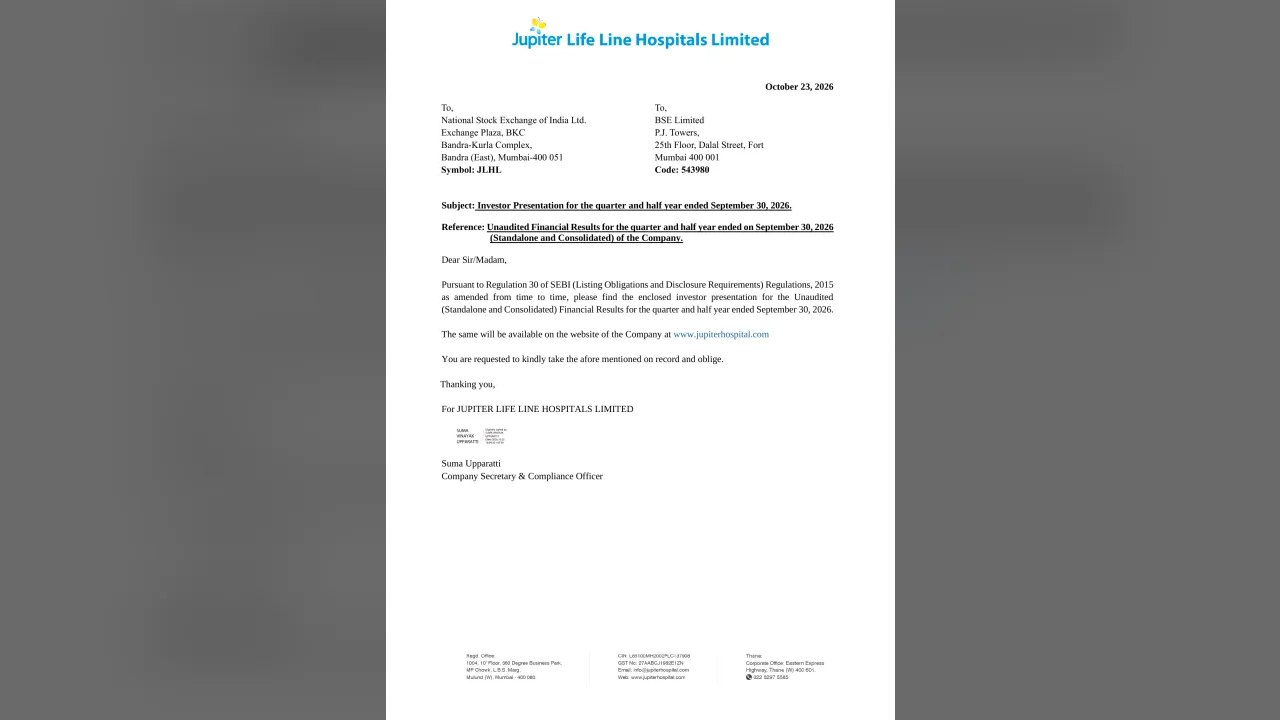
- Company
- Jupiter Life Line Hospitals Ltd. (NSE:JLHL)
- Period
- Q2 2027 earnings call
- Date
- Mon, Oct 26, 2026, 5:22 AM ET
- Replay
- Watch the replay on this page · 38 min
On 6ix: 6ix.com/event/jupiter-life-line-hospitals-limited-jlhl-q2-2027-earnings-call
Replay
Transcript
Automated transcript · Written by software from the replay's audio. It can mishear names and figures; the replay is the record.
0:00 Ladies and gentlemen, good day, and welcome to Jupiter Life Line Hospitals Limited Q2 and H1 FY 'twenty seven Earnings Conference Call. This conference call may contain forward looking statements about the company, which are based on the beliefs, opinions, and expectations expectations of the company as on the date of this call. These statements are not the guarantees of future performance and involve risks and uncertainties that are difficult to predict. As a reminder, all participants' line will be in the listen only mode, and there will be an opportunity for you to ask questions after the presentation concludes. Please note that this conference is being recorded.
0:46 I now hand the conference over to Doctor. Ankit Thakkar, Managing Director and CEO. Thank you and over to you, sir. Good morning, everyone. I thank you for joining us on our earnings call to discuss the business and financial performance of Q2 and H1 FY twenty twenty seven. I hope everyone had a chance to view our financial results and investor presentation, which were posted on our website and the stock exchanges. I am joined this morning by Mr. Anand Apte, our Chief of Business and Strategy Mr. Arithya Gupta, our Senior VP, Corporate Affairs Mr. Nitin Patolia, Head of Finance Ms. Suma Uparathy, our Company Secretary and Compliance Officer and, our Investor Relations Advisors on the call from SGA.
1:33 I'm pleased to share with all of you that following successful negotiations with the landowner, the Board has approved the acquisition of the land currently leased for our Pune South Hospital. The land measures INR 11,000 four hundred 52 square meters and the total agreed consideration for the land is INR 150 crores. The INR 50 crores of deposit that was already paid earlier will be adjusted against this, so the incremental cash outflow for the company is limited to INR 100 crores. The land is expected to be registered in our name in the coming few days. We've always said that we prefer to own the land on which our hospitals are built as it gives us control, certainty and better long term financial value.
2:20 The Pune South project is also progressing well and remains on schedule. At Meera Bayanza, the project is currently in the regulatory stage, and we expect to commence the next phase of activities before the end of this financial year. BKC is in the planning stage and will soon go into the regulatory clearance process. Coming to our operating hospitals, our existing hospitals continue to perform in line with expectations with Thane, Pune and Indore all staying on course. At Dongmuili, the ramp up is continuing well. The EBITDA impact from the hospital was INR 20 lakhs in Q2 compared to INR 9.5 crores in Q1. Part of this improvement reflects higher medical admissions during the quarter, driven by a seasonally higher infectious disease burden in this region.
3:14 This has traditionally been the case with all of our existing hospitals as well, where Q2 occupancy has been higher than Q1 and Q3. The overall ramp up trajectory of Dongvioli, however, remains intact. Moving to the financial performance. Q2 numbers, the income stood at INR 4 and 56.5 crores in this quarter. The EBITDA stood at INR106.9 crores in this quarter with a PAT of INR56.4 crores. Half yearly numbers, the income is 67.5 crores with an EBITDA of INR 186.2 crores and a PAT of INR 93.9 crores. The ARPOP is INR 71,800 the IP as per was 58,700, the A loss is three point seven nine days and the occupancy for first half is 59.5 for all the hospitals, but excluding Rumbivili, the occupancy is 64.8.
4:20 So with this, I'm happy to take your questions. Thank you. Thank you very much. We will now begin with the question and answer session. If you wish to remove yourself from the question queue, you may press star and two. Participants are requested to use handsets while asking a question. Ladies and gentlemen, we'll wait for a moment while the question queue assembles. The first question is from the line of from JM Financial. Please go ahead. Thank you. Hope I'm audible. Yes. Congratulations to the management to the great set of numbers. So my first question, if you could indicatively help us understand what kind of revenues did Omdalil drop in the quarter and the kind of occupancy levels we exited for the hospital?
5:15 So currently, we have not been giving unit wise revenue numbers, so I would not have that accessible with me. Sure, But in terms of metrics, kind of occupancy levels that we are seeing right now And given this higher infectious diseases that are there, what kind of metrics evolution are we seeing right now? So currently, should be in mid-30s. 30%, right. Sure. And my second question regarding the mature assets, especially Pune and Thane that is there. Any brownfield bed expansion opportunities that we might have here, any kind of bed increases that we can see? And second, growth here, indicating as you earlier also mentioned that is much linked to inflation. Apart from that occupancy wise, any levers that we can probably see in future?
6:14 So Pune, there is no further scope of expansion. Thane has said that we may have a possibility to add some beds subject to regulatory clearance. We have not got the clearance yet, but we remain hopeful to get it soon. If and when that happens, I'll update everybody about that. And on Kane front, occupancy is already high 70%. So unless the new beds do come in, inflation remains the only lever. Pune occupancy is close to 70%, so it still has a little more headroom of growth in terms of occupancy as well besides inflation. Sure, sir. Thank you. I will join back to the queue. Thank you. The next question is from the line of Kalkesh Jain from Jain Securities. Please go ahead.
7:04 Yes. Hi. Thanks for the opportunity. So one question I have. So the only way EBITDA loss narrowed sharply from 9.5 growth in Q1 to 0.2 growth in Q2, partly due to the higher impact of the decrease and what would be the Q2 losses have been excluding the seasonal benefit? And what loss should we expect in Q3 as a result? So I... We... I mean, it's hard to segregate and label each patient and say what if this person had not come in and what would be the losses with that and without that. So it is difficult to do analysis at that level and therefore, I can't answer that question. Q3, again, I wish I had a crystal ball into the future, which I don't broadly speaking, as I said, trajectory is positive.
8:00 Q3 occupancy is traditionally in all units are lower than Q2. So in that sense, you must expect a little moderation, but how it will offset with the growth, etcetera, remains to be seen. The next question is from the line of Jainar Jain from JF Securities. Recently, the Supreme Court has raised concerns regarding the commercialization of private healthcare, particularly the markups on medicines and the pricing of medical consumables.
8:51 From Jupiter Life Line Hospitals' perspective, how do you see these developments translating into potential regulatory changes, more specifically if the government introduces restrictions on medicine margins, pharmacy pricing or hospital billing practices? What could be the potential impact on Jupiter's revenue mix, EBITDA margins and overall profitability? How much of the company's operating economics could be affected? And what majors would management take to mitigate that impact? And the second question is, I want to know the economic moat and sustainable competitive advantage. So if we look at Jupiter Life Line Hospitals in the context of its peers, what are the structural advantages that allow the company to build and sustain its competitive position over the longer term.
9:58 For instance, considering clinical expertise, doctor relationships, patient trust that we have built up, case complexity, occupancy, payer mix, and capital efficiency, which of these factors genuinely different... Differentiate Jupiter from competing hospital chains? More importantly, which of these advantages become stronger as the business scales and how do they translate into sustainable pricing power, superior returns on invested capital, and long term shareholder value? So these were the two questions. Thank you. So there are long questions, but unfortunately, don't have a very long answer. The first part of the question pertains to Supreme Court.
10:53 I don't want to make comments on issues that Supreme Court is still deliberating on at this point in time. Whatever happens will be law of the land and like all other hospitals in the country, we will abide by law of the land. How that will play out depends on what the law becomes. So I don't want to venture a guess into that. As far as the Jupiter's position is concerned, we have a strong position in each of the communities that we operate with strong infrastructure, medical team and clinical services, all of that together. So I don't have anything new to say than what I have already said in the past.
11:43 All right. Thank you. Thank you so much, sir. Thank you. Thank you. The next question is from the line of Duanis Shah from DSP Mutual Fund. Please go ahead. Yes. Hi. Thank you for this opportunity, and congrats on a good number. Firstly, wanted to understand a little bit more on indoor facilities. So we can see that the top line has grown by almost around 18%, but the EBITDA number has remained flat. So if you can just explain how this kind of turned out in the quarter and what is the trajectory you're expecting? So Enlore, as I said a couple of months back, is kind of in a growth phase, and this is a phase where we are investing more into the team.
12:37 And till this matures, you will keep seeing for the next several quarters in my mind, a little bit of fluctuation in all numbers, top line EBITDA, even occupancy because if once we add some more beds, once these beds get occupied, we have a chance to add one more round of expansion of beds. And then the percentage occupancy will also drop and then we'll add more medical team. So EBITDA will go up and go down and that. So generally, we wish that the journey was more linear, but it is not. So broadly, the trajectory is positive, and you will see bumps along the way.
13:26 Understood. But until the next set of beds come into play, the medical hiring almost near completion? Or do you expect this to continue for at least the next two to three quarters? Ongoing. We expect it to continue for some more time. Fair. Also, slightly on the bookkeeping number, you say that there's a goodwill number which has been reported at INR 5 crores, And this is mainly for the IV fluid or I think manufacturing facility near Ujjen, which we have acquired. But the cost of acquisition is around INR 3.8 crores. So just trying to understand what is it that led to a goodwill creation on this. So this was a historical land which was bought and it has been transferred at the current ready recognized land value. 3.8 was the equity value. There was debt in the company of about INR 7 crores, INR 8 INR crores or something of that sort.
14:26 So that is the difference or INR 10 crores of debt, I don't know. Understood. And just one more thing. Like last quarter, we did try and understand that Roomba really runs at our fixed cost around INR 6 to 7 crore per quarter. And at that time, the losses were around per month and the losses were around INR 3 crore per month and occupancies of 25% to 30%. If I just forward that math into this quarter, wherein the EBITDA losses have almost broken even and but occupancies are still at 35%. So would it be fair to understand that the balance impact is the seasonal incidence benefit that we've got in the quarter?
15:13 It is a combination of general organic growth and a little extra seasonal padding that you get in this quarter. What would have happened if this quarter was Q1 instead of Q2? And how much growth would you have gotten anyway? I really don't know. So we'll find out in the next one or two quarters how it goes. Fair enough. Thank you so much. Okay. Thank you. The next question is from the line of Arjun Jain from Glo Mutual Fund. Please go ahead. Yeah. Hi. Thank you for the opportunity. I hope I'm audible. Yes. Yeah. So, sir, my question was a follow-up on the... On a previous participant's question.
16:02 So the margin cap on OncoDrug has already, I think, come out and will be effective from post November if I'm not wrong. Since we don't give out, you know, case mix for our revenue, just wanted to understand ballpark what would be the impact of this 30% margin gap on our revenue, but this ballpark would be fine. So, Arjun, very honestly, have not done that modeling because whatever happens, we can't we don't have any way of influencing the margin. It is what it is now. We'll find out how it plays out in this quarter and maybe end of this quarter, we'll be happy to tell you what has been the ballpark impact.
16:49 Okay. Understood. And sir, on Dongbivoli, since this quarter, we were almost breakeven. I know it may sound a little repetitive, but still, I just wanted to understand your earlier guidance was achieving breakeven close to end of second year operation. So would you be revising that guidance right now? Or would you wait a bit maybe couple of quarters for that or the division of that guidance? Let's see how it plays out. I mean, I've said that typically in your hospitals you should expect two years for EBITDA breakeven, whether that means each and every hospital will breakeven exactly in the second year or some will take one point five years, some will take two, some will take something different.
17:35 I mean, predictions of that accuracy are hard to do. But broadly speaking, that is the budgetary model that we make when we start any new hospital that we will face a drag for two years. Positive surprises are welcome, but one must kind of, in our view, be conservative in estimates. Let us see how it plays out over the next one or two quarters, and then maybe we can see if we want to revise anything. Okay. And just one last thing. How much debt levels would we comfortable know, really comfortable with with the expand, like doubling our rig capacity? So the Board has currently mandated self imposed ceiling of 3x of EBITDA.
18:27 We will not increase debt above that. Currently, we are within the number. But yes, that is the thought that we don't want to go more than three times EBITDA. Okay, understood. Those are my questions. Thank you. Thank you, The next question is from the line of Mohit Mitel from JH Investment. Please go ahead. Yes. Hi. Thank you for the opportunity. Hopefully, I'm audible. Yes. Okay. Thank you. So sir, can you please share the RCOP details excluding DomeViti for this quarter and the first half? Interesting question. Let me see if I have those numbers.
19:16 Mohit, I just have the blended numbers with me currently, sorry. Okay, sure. Yes, that was the question from my side. Okay. Thank you. Thank you. Thank you. The next question is from the line of Ahmed Madhav from Unifi Capital. Please go ahead. Yes. Thank you so much for the opportunity. Two, three very brief questions. Firstly, in your presentation, you provide occupancy details excluding Dumbi Valley. Can you give a brief sense how should how is that number being calculated? Just trying to reconcile the numbers better. Should one assume like 200 operating beds and into, say, 35% occupancy or 70 beds operating in Q2.
20:07 That's how one should look at it. Can you give some sense on it, please? Well, I'll tell you the logic is that when you do excluding Dombeyalli, you will exclude the number of occupied bed days and the bed from the numerator and the capacity from the denominator and whatever remains as a performance of the other three hospitals will be reported as excluding Dongvio. Sure. And also for just I don't know. I don't I have access to your sheet, but occupancy is related on census beds and not total beds. 200 is a total bed, which would include some day care beds, dialysis, ER, all of those on which occupancy is not calculated. So probably you have a higher denominator.
20:56 Okay. So what denominator, I should answer? Is it? Three fifty, something like that. Okay. Okay. Got it. And in terms of overall monthly fixed cost, insurance, all those stuff, how are things progressing? Obviously, there have been a lot of questions on this same topic, and everyone is trying to make a judgment. Where do we move? But just some more granular understanding, if you can provide. Yes. So insurance process typically takes about a year. You need your NMBH accreditation in place, which cannot be applied for before you have finished six months of operations.
21:42 So we have applied for that, not yet received it. And then you have to start liaising with all the insurance companies. So the process is ongoing. Again, I have really no way to predict which day it will happen, but the process is ongoing. Typically, it takes around a year also for all the entitlements to get concluded. Once that happens, definitely, the people of that region will be able to access care here a little more seamlessly, which should help. And your fixed cost numbers, yes, as we said, I think last time INR 6 to 8 odd crore is the number. Again, once we keep adding beds or hiring more doctors, the numbers could move a little north, but currently that is what it is.
22:36 And just to understand on the Thane side, what will the current occupancy be close to? And is it that things will be steady state in the hospital and we can assume certain rate of ARPU growth and the volumes will be more or less steady? Is that fair way to look at it? Yes. Broadly speaking, they have been steady for the last couple of years because capacity is near saturation. So in the current scheme of things, I think the occupancy number should be quite steady. The ARPU will only grow with inflation and not beyond that. And the occupancy will be closer to 75% on the... Yes, it is around 75% now.
23:24 Okay. Sure. Thank you so much. That is my question. Thank you. Thank you. The next question is from the line of Abdulgadir Puranwala from ICICI Securities. Please go ahead. Congrats on that early EBITDA breakeven for or on year EBITDA breakeven for Dumbivri. Sir, I have a couple of questions on Dumbivri, starting with and if I look at your sequential numbers, that is in Q2 over Q1, it more looks like the Domivri revenue would have been a little flattish. And despite that, there is an EBITDA breakeven. So wanted to hear your comments as how has the revenue played out?
24:10 And I know you talked about some increased investments to happen in Domnivoli in terms of doctor hiring. So is that something which is supposed to happen maybe by Q3 or something what are you planning towards next year, that is fiscal twenty eight? Abdul, the doctor hiring will be ongoing process for the next year, year and half as and conversations materialize with the doctors of different branches. So this will be an ongoing process. There is no target date by which something needs to be done or must be done because discussions with doctors go the way they go, and it can't be very targeted.
24:56 Besides that, yes, the revenue and occupancy typically will follow hand in hand. Again, as we have discussed in the previous years or quarters, when Q2 has higher medical occupancy, typically, the ARPUs of medical admissions tend to be lower than surgical admissions. So the ratio when it is skewed towards medical, you will see a dilution of ARPU in Q2, which is all historically been reported even with the other units. So similar story spanning out with Ogivili as well. Got it. And next one, so you talked about adding new bids at Indore. So any timeline to that? Is that something what will happen, say, maybe in the next six months or beyond that?
25:53 Not in six months, think, because we are still, I think, mid to high 50s. We would like to be in mid 60s before we add another bet and another bet. So not for the next couple of quarters is my guess. Okay. And last one, if I may. So you secured 500 crore of term loan. Out of that, I think in the presentation, you talked about INR 100 crores going towards purchase of land for the Pune new Pune facility. So how do we see the balance INR 400 crores getting utilized? We see. So basically, there is no new project that I have to announce today, but so there are three projects, which are live, Puna, South, Meera Road and BKC.
26:42 So the CapEx outlay for the three also we have spelled out. So essentially, these will be the projects towards which the money should be used. Got it, sir. Thank you for answering my questions. Thank you. Thank you. Next, we have a follow-up question from Janerjin from JF Securities. Please go ahead. Thank you for the opportunity. As Jupiter continues investing in expansion, how should we assess the conversion of EBITDA into operating cash flow after working capital requirements? I just wanted to understand when would probably the operating leverage would kick in for our company and what level of annual maintenance and growth CapEx should investors factor in? And over the medium term, how does management expect free cash flow and return on invested capital to evolve as the new facilities mature?
27:49 And the second question is, what's the current gross debt and cash we have as of today on the balance sheet? And the third one would be any guidance that you want to give over a medium term regarding the revenue profit, EBITDA growth and the EBITDA margin? Thank you. So the as we had said that in the last couple of years, our EBITDA to net cash has averaged around 70%. If the net debt levels go up, that 70% could get tempered to some 60 something, but that should still be the cash that we will generate from operations every year, which we plan to reinvest into the three projects that we just spoke about.
28:44 So we believe that the internal accruals and the cash flow from internal accruals will remain a key contributor towards the next round of CapEx. The debt on I think we had a cash on hand at the end of six months of around INR 400 plus crores and a debt of INR 600 on a consolidated level, so about net debt of 170 odd crores at the end of Q2. As these projects come along, again, the net debt numbers might go up a little bit. Anything on the annual maintenance and the growth, revenue profitability?
29:34 So we have never given financial guidance. So I'll continue to explain on that. But on the what was your first question? It was just about the medium term guidance. Yes, any ballpark number would be perfectly helpful. The CapEx would be about, say, to 20 crores per unit, maybe, that you can assume that. It would fluctuate from year to year. So when I give this number, it is average number, which you should plug in for four or five years because there are some expensive biomedical equipment and you don't replace all of them every year. But if you replace one in one year, the next year, it may be a low CapEx and one year, it may be a high CapEx. So it can't be an exact number.
30:35 But this is a number which is good for an average projection for the next four to five So from here on, we I don't think we have more huge CapEx lined up, but it's just that we would probably go for annual maintenance and just the minuscule number of that. Yeah. The thing which is pending, which needs to be done in terms of CapEx for the current units besides the addition of beds if and when that happens. When I say equipment and which I call as maintenance CapEx, because in healthcare, your depreciation of biomedical equipment especially is a very real phenomenon.
31:25 On an average of ten years, you will have to replace all the biomedical technology. So that has to come in and that is a real cash expense, which will come in from time to time. But besides that, there is no specific addition, which is needed. Thank you. Thank you so much sir for patiently answering all my questions. Thank you so much. Thank you, Janavir. Thank you. The next question is from the line of Malik Walia from three sixty one Capital. Please go ahead. Hi, sir. Thank you for the opportunity. I hope I'm audible.
32:14 Yes. So just wanted to understand, have we started all specialties at our facility or we've not yet started all of it? So pretty much all transplants have not yet started, should start in the next couple of quarters. Oncology basic services have been started. The radiation oncology is under commissioning, which will start in the next quarter. Besides that, pretty much everything is done. Understood. Okay. So with the addition of, let's say, transplant and the oncology specialty, how much ARPU increase are we expecting? Any broad understanding on that?
33:02 Or will that be significant? Or are existing specialties will be the key driver there? So I actually, I don't know. We have not specifically modeled out how these two specialties will contribute to our pulp, etcetera. But qualitatively, what I will tell you is that over the first three years, the case mix kind of becomes more and more mature. And there are in the early days of the hospital, the case mix is more skewed towards secondary care, which was the next couple of years becomes more of tertiary and quaternary.
33:52 So along with that, the ARPUs do tend to mature and improve a little bit, and we should see that playing out for the next two or three years. Specifically, on quarter variations, I have to comment on. But as far as the trajectory for three years is concerned, you should see occupancy going up and ARPAW pricing faster than inflation in a new hospital, mainly because of maturing of case. Understood, sir. Thank you. And one last question on insurance. So is it generally observed that the GIPSA insurance impanelment is done earlier than the private ones? That's right.
34:38 Okay. So can we expect that within that one year period, which you mentioned, six to eight months GIPSA will be done? And then within a year's period, the private insurers will be done. Is my understanding correct? Well, that is a hope. Let us see how it plays out because insurance companies have a mind of their own. And let us see how that plays out. We hope that it gets done sooner rather than later. Okay. Okay. Thanks a lot, sir. Thank you. Thank you. Thank you. The next question is from the line of Mihir from MB Securities. Please go ahead. Yes. So sir, I had a few questions regarding from the data point perspective.
35:23 So I wanted to know how much CapEx we have incurred in the Pune to hospital and the Meera Road so far? The Pune so far we have spent around $2.20 crores. Now we spend another 100 on the land. Mirador, currently, we have bought the land and spent very little more around INR 75 crores, INR 80 crores has been spent on Mirador because currently, as I said, it is still in the regulatory phase. Once the construction starts, then the CapEx will be allocated. Okay. Understood. So INR $3.20 crores in the Pune one. And sir, could you also share payer mix of the Dongvi Valley Hospitals for this quarter, Q2?
36:10 Again, I have a blended number, which is 55 odd percent of insurance for the whole group. But considering that Dongviwali does not have cashless impanelment, the number is going to be skewed more towards self pay out of pocket. The insurance that does happen in Dommuelli would either be a few small insurance companies or some IRDA specific schemes of anywhere cashless, etcetera. But the number would be lower than everywhere else. Once the empanelment happens, then the number should pick up and then should the number should have more need.
36:56 Increase. Okay. Yes. Understood, sir. Thank you. That's all from my side. Thank you. Ladies and gentlemen, that was the last question for today. I would now like to hand the conference over to the management for closing comments. Over to you, sir. So thank you, everyone. I hope the questions were answered satisfactorily. However, if there are any more questions or you need any clarifications, please feel free to contact the SG and team, and they'll be happy to put you in touch with us. Wishing all of you a happy Diwali and good day. Thank you. Thank you. On behalf of Jupiter Life Line Hospitals Limited, that concludes this conference.
37:41 Thank you for joining us, and you may now disconnect your lines.
Follow Jupiter Life Line Hospitals Ltd. into a list and get an email when it puts out news.
Latest news releases
- NSE:JLHL — Buy Jupiter Hospitals; target of Rs 1560 Anand Rathi · Tue, May 19, 2026
- NSE:JLHL — JLHL: Revenue rose 15% to ₹14,997.87 million, driven by expansion and strong operational performance · Mon, May 18, 2026