Leon Coetzer
CEO at JUBILEE METALS GROUP PLC
Replay available
Full Year Results hosted by Jubilee Metals Group (LSE:JLP) on Investor Meet Company, held 2024-10-09.
On 6ix: 6ix.com/event/jubilee-metals-group-plc-jlp-full-year-results
Automated transcript · Written by software from the replay's audio. It can mishear names and figures; the replay is the record.
0:00 Good morning. Good morning, ladies and gentlemen. Welcome to the JUBILEE METALS GROUP PLC Full Year Results Investor Presentation. Throughout this recorded presentation, investors will be in listen only mode. Questions are encouraged. They can be submitted at any time via the q and a tab that's just situated on the right hand corner of your screen. Please just simply type in your questions and press send. The company may not be in a position to answer every question it receives during the meeting itself. However, the company can review all questions submitted today and we'll publish those responses where it is appropriate to do so.
0:32 Before we begin, we would just like to submit the following poll, and if you could give that your kind attention, I'm sure the company would be most grateful. And I would now like to hand you over to CEO, Leon Kutzer. Good morning, sir. Good morning and welcome everybody for joining this presentation. Thank you for taking the time to dial in and giving us the opportunity to talk you through our financial results for the period ending June 2024 and also reflecting on the year that lies ahead for our company. I'm joined this morning on the right hand side by Batisman Omanema, who is our managing director of our South African operation and the driving force behind another year of exceptional operational results. On my left, I'm joined by our acting CFO for our group, Rianne Smith, who will talk us through some of the financial numbers and also discuss what lies ahead for our group.
1:28 Have on standby, we have Rikus Krumby, who's our managing director from Zambia, dialing in from Osaka. And I trust the signal from Osaka will align to dial in at the start of the COPPA review. How we're going to run this morning is we're going to run through a slide four presentation and try and keep it as short and precise as possible so we can really spend some time on the quality questions we've received from so many of you that have dialed in. I see we have an exceptionally large number of people that have taken the time this morning and are really looking forward to the debate and answering the questions that you have sent to us. In this presentation, I hope that if nothing else, following this presentation, what you'll see is a company that has come through a capitalization phase to deliver in South Africa over the past four years, a company that's grown from 40,000 tons of chrome where today, Bathurst and his team speaks of north of 1.5 to 1,600,000 tons of product per year as they march towards that 2,000,000 tons target we set ourselves to achieve.
2:39 On the other hand, in our copper business, which we ended in our copper on the back of the success of our South African operations, to replicate that strategy, which is a strategy driven by processing excellence where we implement a processing capability in Zambia, overcoming the challenges which there have been numerous in Zambia to deliver a world class processing capability, allowing us to operationalize the resources we have secured in Zambia. And without wasting any further time, I'm gonna hand over to Rian and maybe just allow Rian to reflect on the results that we delivered and announced. And then after the presentation, we'll delve into some of the questions we received specifically on these results.
3:31 Rian, over to you. Thank you. I think we can dial one slide further there. Good. Thank you very much, Leon. I think Leon has actually given us a good introduction of our current business. And I think for me, it's just to report on the financial numbers. Good revenue of $2.00 $5,000,000 the EBITDA, solid on '27, and then capital investment. Think if you can go to the next slide, I can back that out in a little more detail. Again, you look at the group revenue, a very solid 20% increase on last year, driven by the good growth in especially chrome revenue.
4:20 On the copper side, we did increase volumes, but most of that was more on the concentrate side, which had a smaller viability, and that led to the slight decrease in volumes there. On the PJM side, it's very much a pricing side where prices drop significantly from 1,700 an ounce to around threes an ounce. So that hit that revenue quite hard. Again, a solid EBITDA performance in line with the growth in revenues there. And on the capital side, you'll see the capital has actually matured from going down 65% from the previous year.
5:09 And then we've further capitalized on the copper side to make sure we have the capacity there
5:20 for the production as well as the mining side there. On the GROUP side, we've expanded on most of the South African operations the production capacity to ensure further sustainability in enough reduction markets. Oh, thank you, Rian. I mean, maybe just to add to Rian's points, what these numbers really are demonstrating is, as we informed the market, very mature South African business organically growing its business. Its capitalization of the business coming to fruition, as Riyadh says, over the past year and past two years, we've not only expanded our PGM operations to take up the additional PGMs. Bantas and his team have driven hard as we continuously run out our modular chrome plants to expand and take up an opportunity. And maybe interesting fact that Bantas, doubt, will address on his side is the fact that this chrome business that has grown to this number north of 1,500,000 tons being one of the world's biggest chrome construct producers is producing chrome from reefs which the industry had thought was either too low, too complex, or not viable to process.
6:36 The operational efficiencies and the partnerships, that is driven in that business. On the copper side, also nice to look at the balance of our revenues and our earnings coming through. We are a company now with three metal classes are adding positive earnings to our group during volatile markets. On the right, you can see a little wheel of revenues. Chrome absolutely dominating revenues with its constant significant growth coming through. More importantly, also as that growth comes through from Chrome products, that more and more are market facing rather than fixed toll agreements, which is where we started our business at the time. And copper is starting to play a role even with the sharp increase in chrome still showing its 9% component, which competitive to the growth in chrome shows how copper is starting to also count within our company.
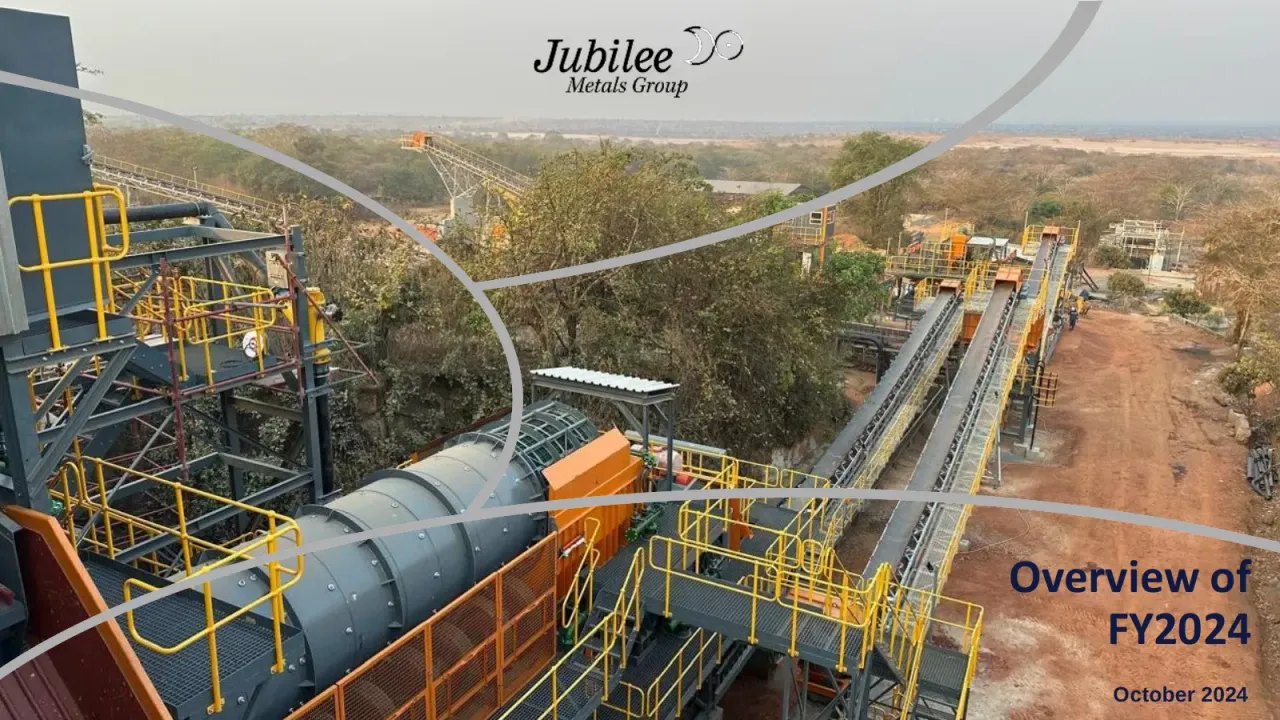
7:42 Maybe just there, as Rian said, on the operational side, copper increasing. I totally understand that many shareholders was hoping that that number would be much higher in Zambia. But I think still what Rickus and the team has delivered facing the challenges they had to face in Zambia, which we'll speak of during the copper presentation, exceptional to yet again show growth while we are building, implementing and commissioning our processing capacity. Batters aside, impressive where we now speak of a company north of 1,500,000 tons and seeking to exceed that into 1,600,000 tons for the coming year. Of course, with the operational capacities that is currently in construction and coming online and Batis will share a quick video for people to see that construction of this capacity coming online towards the end of this year just for people to get the sense of the sheer magnitude of this operation that has been built by the team.
8:51 PGMs coming down, which is an intentional decision as we prioritize Chrome during this year to rather focus on the increased market valuation of Chrome. PGM, as Rian spoke of, decreased significantly in the basket values. And we had the flexibility within our process because Baptist drove the modular approach for our facilities. So it's not one large big facility where we have no flexibility as some other of our competitors might face. We have a modular approach allowing us to accelerate chrome production, to react to the market in some of our modules, to prioritize chrome earnings to PGM earnings. And that is why we were able as a group to still deliver nearly touching $28,000,000 of EBITDA, showing a very marginal drop in overall EBITDA when PGM crashed by nearly 17% during the year. Great ability to buffer these volatile markets by having that flexibility within our processing design and partnership agreements.
10:03 Looking at the operational review of Zambia, and while we wait for Zambia's link to be established, I'll talk us through that until Rikus can join. And maybe I thought just to start off with, Zambia has gone through an evolution, education in Zambia. As we entered Zambia end of twenty nineteen to acquire an old decommissioned refinery that we set out to recapitalize and bring into operation. What this slide unpacks for us and we'll talk through is just the simplicity of that strategy and maturity of the Zambian strategy that we are now rolling out to ensure there's clarity in the market. The top three blocks on that slide speaks to the key resources, the that we went and secure.
10:57 And as I start this slide, Rikus GROUP PLC has just joined from Lusaka. Rikus, we've just started the discussion on the strategy of how we are pursuing Zambia and the maturity of it. I'm so glad that I can hand over to Rikus, who's our managing director of Zambia, dialing in from ODA, from the Rowan Concentrator. Rikus, over to you. Yeah. Thanks. Thanks, man. Can you guys hear me? Yes. Okay. Cool. No. That's good. Yeah. Sorry I'm a bit late, but, yeah, we had some some more than normal issues in Zambia. But we are back online. Yes. So I'll jump in with a strategy, Leon. As you can see on the screen, you know, we've we've pivoted our business a bit, and the main thing is that, you know, we've got amazing operational plants in Cobwe and in Andola, the key is how do we fill those plants with material that will produce us the most cost effective and most revenue accretive copper. So if you if you look at what we've landed on is that we'll be feeding these two operations that we currently have with open pit mining material, and I'll talk about that a little bit in more depth.
12:19 And then also the other part that we'll be filling this with is previously mined material, and then also previously processed material. So in terms of open pit mining, you would have seen that we bought the Mongkoy Mine. That is it is now 42 kilometers away from Kafue, from our Sable refinery, because we are in the refinery completing the road, the direct road from the mine to the refinery. It is it was the previously mined operation that we've been able to take over and turn into a more of a world class type of open pit mine. We're currently at about 12 to 15 meters deep, and we've got about a 100 we are working on opening up about 100 meters of of strike.
13:11 The the total mine currently is about 300 meters of strike that can be accessed pretty quickly. And so that is the key focus now. And then also, we've announced that we have acquired Project G. That is in the Mumbai area, and that also open pit mine, currently being mined with a shaking table and also
13:38 another plant that we can get into operation pretty quickly. The slaking table plant is currently up and running. I think I'll just step in there. Seems like unfortunately, Rick, as were going through it, your signal were lost. Rick, so I'll just hand over back to you to see if the signal lasts, and then please continue. You. Rico, sorry, I'll step in. Unfortunately, it seems like from Zambia, our signal is just too weak. What Rico is really going through for everybody is, of course, on the open pit mining resource strategy. We've announced our exciting acquisition of Project Mokoy that Rick has touched on and that followed with Project G which we announced earlier this week, another exciting open pit operation that Rick has spoke of. We'll show a quick video clip in the next two, three slides just so people have a sense of the sheer size of these operations that Rick has and his team is bringing on stream.
14:55 And I think the fundamental components, we look at these three classes. You'll see under the heading of each of the three classes, it also gives you a sense of the copper content or the copper grade per group. And therefore, one can understand why the priority to secure such a large portion of this
15:14 opportunity on offer in Zambia is in that open pit area. It contains reefs that are particularly complex. It speaks to the processing capability of our team to unlock that copper. And at 3% copper, clearly, that's something that we should pursue. As we discussed on the Sunday broadcast, if you look at the sheer number of licenses in Zambia, it is estimated by the department that this area of Zambia has the potential to carry up to 300,000 tons of copper per annum. Now clearly, that's not all going to be secured by Jubilee. We don't have that kind of ability. But that gives a sense of the size of the prize and the reason why we are so aggressively pursuing, with Rickersley's team, more and more of these opportunities.
16:01 The exciting part is that both Munkoi, that has been acquired in June, is already operational and delivering material to stable making capital. It is currently being expanded, as Rick has explained, where the strike area or that's the area of the reef that is exposed that can be reclaimed and sends to our refinery is being increased as the Munkoe goes through that phase. Project G, following the decision to acquire it and through the intervention of the team, negotiating a better transaction where we're taking 65% of that project by JUBILEE. That project will come into operation this year. So it means that within this period, both Mankoye and Project G will be processing, material will be processed at Sable.
16:51 The next group of material which we call previously mined material, it's typically low grade copper stockpiles that have been discarded by mining activities at the time because of its complexity or because of its grading. Roughly, runs at half the grade to slightly less of the of the open pit operations. And this is the material currently targeted towards our Rowan plant where the new front end had been commissioned. And that material is currently being processed through Rowan where it takes that low grade material, upgrades it significantly north of 10% copper, which allows us to then directly refine that material. Rolling, of course, we'll speak of later, has got two components to it because there's the third material group, which is the lowest containing copper value. This is material that's been mined and previously processed and discarded, either because of the type of process that was run or the type of material that was fed.
17:52 GROUP currently processes through its float and milling circuit, which are two separate circuits at Rowan. It's very unique. The Rowan concentrator, it's got both the ability to process simultaneously previously mined material through its front end, which then produces products, which is directly refined or further processed. And then you've got the previously processed material tailings that is coming through. What we're working towards is that as the Mokhoes and the Project Gs are expanding, it rapidly gets to a position where SABL is fully occupied or utilized by open pit material. We've been able to step up We have completed the Rowan construction as the Rowan construction of the two components, the front end and the back end, as we've discussed, where we've delivered 13,000 tons of copper capacity, which we are now filling with both the previously mined material, the low grade stockpiles, as well as the tailings component of Rowan.
19:04 A very exciting plant to have available to us. Our last component of our processing upgrade to reach that initial target of 25,000 tons per annum of copper capacity is Sable. Sable's expansion very simplistically means that we're adding a second tank house to Sable so that Sable can consistently refine and produce north of 15,000 to 16,000 tons of copper per annum. So we have the combination of both RONAL at 13,000 and SABEL at 16,000 as a processing footprint and capability in Zambia. Taking up that capacity now comes through with the commissioning of Mongkoe, Project G, set to commission within this calendar year before December.
19:58 And of course, Rowan stepping up its operation by processing both its previously mined material and waste. On the safety side, even though all of this construction activity was happening and we were running and constructing on the plants, The team delivered an exceptional safety performance and congratulations to them. As we discussed, the third component of project, which is very exciting that the team is unpacking with Rickus and his team is this large waste rock project we told the market about. It's a project where we secured an exclusive right to it. It consists of nearly two sixty million tons of copper. And that two sixty million tons of copper is what we seek to bring into operation.
20:47 How are we doing it? The front end
20:49 of Rowan is an example of the modules that will be placed onto this material. And we are currently commencing with that trial where we're looking to process 15,000 tons of material through Rowan of this material as that final review of the design of those facilities to ensure that the upgrade from our labs to our pilot facilities into commercial is accurate. It needs that accuracy because this is a massive mountain of material that's been created over time. It therefore has enormous variability in that two sixty million tons. It contains all of the history of that area of mining which consists of waste rock, low grade rock, oxide, copper, sulfide, copper, all mixed together in that. And therefore, this trial is a great opportunity for us to model out that variability as part of our design.
21:53 As we said, very short, if I therefore summarize our strategy in Zambia and what you can look forward to seeing coming out of Zambia as we now roll it out is on the one hand, to expand SABL to be able to operate consistently at a 16,000 ton per annum of copper refinery by adding that second tank house. It takes roughly about ten months to bring in all the various components into Sable to be able to do that. It does mean we are continuing to run Sable during this process while we integrate these components into the integrated refinery. Sable is an old refinery and it was part of this upgrade to the 16,000 tons. We're also replacing certain of the older technologies with more modern processing solutions.
22:46 And in Rowan's side, as we discussed, Rowan, the 10,000 tons of copper capacity, key driver now is fully utilizing both components of Rowan, both this front end part of Rowan able to process those low grade waste rock stockpiles, which there is mountains of in Zambia, together with simultaneously running its flotation circuits to process the previous process of tailings material. And at the same time, what you can expect to see coming out of our company is how we progress with our open pit mining operations. We've got two under our belt. We certainly look forward to adding far more than two to our operational strategy.
23:31 I think, JLP, if I can chip in there, I'm excited to see that the focus is in the right place. We're looking at previous sheets where we're using the point three is the 1.5 and the 3%. That's upstream feed grade. So if you look at it, when the point three is you'd have to have six to seven times the feed. A 1.5, you need to have two to four times the feed. And on the open pit, you have one times the feed to make the same amount of tasks, which is exactly what we're driving in South Africa as well, which your primary cost, your biggest expense is your primary feed, but you're goal number one. And that's great to see that Zambia is able to go upwards. And the reason I think that upwards is processing ability and then proper drive by management to look at the primary feed, which is in all these instances, we all know that the good feeds are gone. The bigger companies have got all the good feeds and this is where JUBILEE demonstrates its
24:16 expertise in processing ability to go after the inferior feeds and work its way up to the better feeds. Very good point about this. When putting it in perspective, if you were to process 0.3% copper versus 3% copper, it means that you have to process 10 times more material to make the same amount of copper. And that of course is a massive cost driver. Then your ability to get more cathodes out will open, that mining will come forth and then your graph starts feeding out that first graph we showed you on the copper cathode, which eventually will keep forward with the same amount of effort, you can make more tons. Absolutely correct. In short, we've touched on this. Maybe the pictures there just gives you a sense of the sheer upgradability that the team is securing. On that little picture in that block, you'll see the little blue blocks.
25:04 All those blue blocks are what we call open cast or potential open castable opportunities. Just give the sheer sense of the magnitude of this overlooked opportunity within a Zambian copper space. Outlooks going forward for Zambia, we've given a guidance of ranging between 5,800 to 7,500 tons. Why didn't we give a range? Well, because our guidance links into the delivery of projects. This is not a company that's organically expanding. This is a company delivering on a strategy, which is a bit like a Lego set where the various components now come together. The processing capacity coming to its fruition, the resource being brought
25:50 into operation. There are, as we've seen in Zambia, a number of factors that impact directly Rikus's ability and his team's ability to deliver. Power has been a potential significant threat to our operations in Zambia as Zambia faces and continuing to face a significant power crisis and the availability of power. We are very fortunate in that Rickus and the team was able to negotiate fully privatized power supply agreements to ensure that as of the middle end of September and going into October, we have uninterrupted power to all of our operations in Zambia. It is a fundamental de risking factor that JUBILEE was able to successfully negotiate and implement. It means that 100% of our current power demands are not only met by renewable power sources in hydropower and solar, but it also means that we are now not exposed to the current power instabilities within Zambia, which makes it impossible to run a refinery where the quality of your copper cathode determines the saleability of your copper cathode.
27:10 So that range really gives that ability on how those projects are slotted in. As those projects come into fruition, we, of course, will provide the update to our guidance going forward. That gives you hopefully a better sense of what's happening in Zambia, how we're reacting to the challenges, and how we are driving forward the strategy in Zambia. With that, it's nice to now shift into our South African business because as we said in the beginning, JUBILEE is two parts. One, copper, which is emerging and evolving and a mature growing force in South Africa. With that, let me hand over to Bartus as Managing Director of South Africa.
28:01 Thank you very much. Think you could go to the next slide, Leon. You can see that it's a very simplistic approach like similar to the biggest thing is feed. Mean, feed you can't process. We call it one in South Africa, all our own feed or the PGM feed. Interesting thing to note on the initial slides, in the last three years, we've seen our feed regressing. We had an average of 30% and now we're living with an average of 27% to 28%. So our initial figures looking at 1,540,000 could have been up by another five percent that our feed stayed the same in the last two, three years. Again, demonstrating the processing ability that we need to look at. We've also been looking at that and we've been adding capabilities to make sure that whether feed slower or lower, we're from a 30 to a 25 range, we initially would have liked to feed 30% grams, was previously seen as unprocessable.
28:48 We are now able to look at 25%. So in that essence, our processing ability and the ability to look at this basically secures more feed going forward. Because everybody asks us, where do we get the feed? Because if look at the significance of this, last year on average, we fed 260,000 tonnes per month through these processing facilities. Basically we are running now 10 individual plants and all these plants except the newest two we're adding are running at capacity, which is a nice thing we see until now at the end of last year, end of 'twenty four, beginning of this year, we've pushed them to maximum capabilities, which also told us it's time to step up and add the extra plants. So the process ability is there and like we would like to call it, I mean, the ability to have a reef available and then looking at what we can extract from that reef
29:34 through the JUBILEE processability in that sense. That's been able to take us forward. And I can see that we historically we had more contracted tons, less stable tons from our primary feeder where we secured feed. We dealt with it and we supplied that. That's given us a very stable operation and we've managed to basically up that significantly as well. We initially started with 60,000 tonnes a few years ago. We do 140,000 tons. Looking forward to looking at pushing that up to 180,000 tons. So that at least feeds the first 180,000 tons. And the next 200,000 tons we're embarking upon now is the, I don't know, contracted, which gets us pretty close to a fiftyfifty split with regards to where we're running, which was the initial idea. So make sure we can operate, make sure we can sustain it, run with a fixed margin, optimize the fixed margin, and then add the market value.
30:27 Fundamentals are showing that this year China will end up having more than 60 or the world will end up producing more than 60,000,000 tons of stainless, which to put it in perspective, at the end of two thousand, the world will be doing 20,000,000 tons of stainless. Basically, steel has doubled in the last twenty years. It's exciting to look at that. The fundamentals show us that stainless steel growth will be sustained. And basically, chrome ore which we produce goes into ferrochrome and ferrochrome makes stainless steel stainless. The chrome bone component makes stainless. We need a little slide. LDAFR, one or two smaller entries that we looked at there. I mean, one of the areas we need to focus on, I think the same with Rick, the same on our side, it's always about management optimization and people optimization. Safety always part of it to make sure that with our people, we safely perform. Very proud about the fact that we were able to surpass that 1,540,000 tonne of GROUP concentrates, which is that 20% year on year increase.
31:20 And with the target going forward to see how quickly we can get to 2,000,000 tons of concentrate. As well, coupled to that, in the process of extracting the chrome, we do create PGM feed material and then NICE and T we are now seeing this financially going forward. We actually have for the first time, we are long on PGM feed material. So this allows us now to optimize the PGM feed material we would like to put into a plant. And the way of optimizing that is by taking the direct feed, which is produced at our OBB plant directly into our PGM plant and then looking at which other material gives us the best tonne per ounce. And that will allow us then to optimise that. And then also why we believe in the 36,000 to 40,000 ounces guidance, we'll optimise that. So the aim would be because PGM market is deflated to make the same amount of PGMs worth less feed because that would have a cost implication and would create a margin for us. That's where the focus is with the long PGM feed we're creating.
32:17 The next two modules, like I said, we'd be proud to say that we embark on that. I mean, like we call it the B50, a 50,000 ton module. That's been spec to do 50,000 tons depending on what port type we've got. A lot of investigation, a lot of knowledge has been going into understanding the groundwater types. And in our instance, like I said, we have found various ways to extract the chrome that previously wasn't extractable or previously went too far and became un extractable because it was overmulked, for instance. So in that instance, we feel very comfortable with the work that's been done the last eighteen months, year on GROUP side as well as PGM side, that we really understand the fundamentals to extract this material and to enable us to go to the next step. As Ljorn has it up there, 1.6 in excess of 1,600,000 tonnes of metallurgical grade, which we hopefully will exceed. But I mean, the important thing is to build on the basics and have a steady climb going forward. Absolutely, thank you, Balthus. I think as Balthus educated and showed, fundamental point that he mentioned that maybe not quite people understanding is that what drives this continuous growth in Chrome when so many companies believe that to grow in Chrome is so difficult because of the availability of resources is the fact that the team consistently and continuously unlocks chrome reefs that people classify as too difficult or too low grade. Perhaps this threw out a number where if we dial
33:47 back the clock for two, three, four years, we would not have processed chrome below a 32% or 33% chrome content. Today, it is normal for Baptist and the team to process chromes at 25% to 26% content. These are reefs that would have been discarded into waste dumps previously. It is what they process at the same efficiencies as what the industry thinks the norm is for the high grade chromes. Maybe just to demonstrate the sheer magnitude of what is being built and when we speak of modules, can I ask in the video being played? Thank you. I hope that those
37:09 videos, if not the case, gave perspective to the main the first video, which was just a very quick sense of Mogwai, Project Mogwai, which shows the development and exposure of the reef as we're stepping up that production or mining rate. The second video showing and touching on two new modules being constructed. And although we give the name modules, it doesn't mean that they're not large. That is being implemented. These modules, as we have informed the market, are looking to be brought into full operational state within this period before here in December. And then maybe just as a last slide, as we conclude the presentation and then get into the various Q and As and the questions that are there, which I think we're really excited to get into.
37:58 What we've looked at our company and what we presented really is the fact that our growth strategy, both on Baptist and South Africa as well as RICUS in Zambia. It's driven by innovation. It's driven by innovation and processing, looking at materials, questioning why certain reefs and materials are not being mined or recovered the industry and then solving those problems as so clearly demonstrated by Vatus and the team. In all cases, as you've seen, our strategy is always led by the implementation of our processing capacity, which we then, following that, bring into operation the various resources through partnerships or ownership to bring those resources into operation. I think just a point to highlight, bottom point, is the ability and the absolute achievement by the team to overcome which was one of the biggest threats to our Zambian strategy and business and that was power security.
39:04 Without the availability of power, we cannot run processes that are critically dependent on stability to be able to extract copper or chrome for that matter. And therefore, the ability to have now placed all of our operations onto a private power supply agreement, which kicked in towards the end of September. And this week announced the market that we've extended that agreement so that Rowan can run both of its sections at full capacity on the private power agreement is a fundamental
39:38 important step taken in Zambia. And of course, looking forward, we're looking at the waste rock project and going into its commercial trial this month that lies ahead for that 15,000 tons of material that are be processed through that facility. And we're looking at delivering on those two operational modules through Batters and his team as we march towards that 2,000,000 tons of chrome concentrate that we look to produce. That concludes the formal presentation style. And really thank you for taking the time to listen to that. I'll throw it over now so we can go through the Q and A, the questions, and especially while I have the team around me, let's delve into the questions that we have received from so many people.
40:28 Thanks very much, Leon. Just to say that we've received quite a few questions during the presentation. We'll try and get through as many as we can, but any questions that we don't answer, we'll provide written answers to and post them on the platform after the call. Turning to our first question, what is the commercial arrangement on Jubilee's chrome processing partnerships? Are they JVs? And if so, what is the weighted JV ownership? I'm going hand it over to Batis as MD of South Africa to answer that specifically. We've got a very big drive on our side through partnerships, like I said. And also in that partnerships, same as you see with Bricas in Zambia and South Africa, is important because partnership means we're engaging. And because we engage, we actually, a lot of the time, get the local communities involved. We get our real partners involved.
41:19 So our partnership entail that is pretty much a cost driven exercise. So we are a partner and we mine with the partner. They mine at cost, we transport at cost and we process at cost. And that gives us a common vision to make sure that we optimize the cost. And then we look at the market and see where is that margin. And then indefinitely, it becomes a type of a JV where there's a profit split that comes to it as the scheme comes to fruition. So it's a very much common goal, common drive. One is ROM, two is transport, three is operational cost. Our fourth one is our mass yield and the GRIM size, so how much GRIM can we extract? And that is transparent. Then all the partners, wherever you fit into this partnership, tries to have a cost
42:00 awareness, which gives us the lowest possible cost. And when we are on that lowest possible cost, that should give us a margin. And maybe just to add to that question, when we speak of JV ownership side, So our JVs in South Africa are typically structured more on an earnings share model rather than ownership of the resource. We typically do provide the processing plant and facility and the resource owner provides the resources, and that then calculates to a resource and earnings allocation. Over to you, Karen. Great. So sticking with the chrome operations, what is the mechanism used to set the price of the ROM purchase by JUBILEE? As the ROM, we've got a partner, we've got a partner that we're mining with. We typically look at the fundamentals of mining as with the rigors do, look at strip ratios.
42:53 And then because of the strip ratios, we didn't see what is normal cutoff, not just the cutoff grade, but the cutoff cost. Because of extractability, we are able to push the cutoff cost because we look at a longer term view and say, mining a bit more, maybe slightly more expensive, but our processability allows us to do that. Then we've also got an alternative model because the market and because of the environment we play in. And since the MBRDA, the Middle East Soft Control Development Act in South Africa is playing a bigger role, we have got multiple smaller partners. We end up buying thousand tons, 5,000 tons, 10,000 tons from smaller partners as well. And as you already elaborated to that, that's very much GROUP dependent. And in some instances, we find that there's no market for this. So we create the market and because we create the market, we then utilize our FERF, which is our fairness aspect. We do basically a calculation and say, okay, you are mining at a cost.
43:44 We are going to sustain you. We do get this material cheaper, but it also a partnership where we basically can sustain the smaller enterprises to go forward. But then the cost is determined by what we can process. So we utilize the fundamentals of strip ratio, we utilize the fundamentals of where the market is. And in essence, I don't want to use the word opportunistic, but we are opportunistic in saying what order is available And with the right amount of cash available, we are then able to buy some of these ores at lower prices just because we're sustaining the production. So sticking with that, has the company given consideration to end in toll agreements in favor of wrong partnerships? We see the company as a bit of both. We must never forget where we came from. The reason we shared an embark on this five years ago, we partnered with the world's biggest groundwater resource owner.
44:35 There's a reason why you partnered with the world's biggest groundwater resource owner because they are the world's biggest groundwater resource owner and you provided service to them. And I mean, that we've grown and optimized the way we can. But we've also seen them through optimizing our own processing ability and having an ability, Our vision would be more towards own processing and not necessarily tail treatment, but we will not let the other one go unless marketed data or something else from that side. So it's a bit of a joint approach, like I said previously as well, where we were pushing to go to fifty-fifty. It be a year or two from now, hopefully sixtyforty, seventyfifty, time will tell. About this point, one mustn't forget the strength of having both where you have a fixed marginal agreement, which is not market facing and they're very conservative in the approach, together with a more market facing chrome contract that takes the full exposure to the chrome market. The balance between the two offers strength in our earnings.
45:39 Turning to Zambia, is the Rowan front end linked to the existing mill and flotation circuit? And if so, how are they linked? So a bit of a technical question and I'll break it down for the listeners. If Rowan's front end module and its milling and flotation circuit are two fully independent circuits, in fact, what you're looking at on the screen is the Rowan front end module. They are independent circuits but since that front end module produces two products, one of its products can be directly fed into the Rowan float and milling circuit. So we currently run it as independent circuits, but we have the ability to send one of the products of the front end module directly to the mill and float circuit.
46:27 And has the mill and floatation circuit been operating at full capacity since the beginning of this financial year? So the biggest challenge, no, has been doing the commissioning. Post commissioning, of course, it is very difficult to run both. So, definitely was impact on the floating billing circuit and the commissioning of the front end. And of course, the key factor that's coming during September was the availability of consistent electricity and power. So that was the key criteria to be able to ramp up Rowan to its full capacity. Staying with Zambia, instead of physically concentrating the copper ores, has Jubilee given consideration to concentrating the ores chemically using heap leaching and transporting that solution to SABL for refining?
47:19 We've looked at all of that. Clearly, thing that JUBILEE has is we have the luxury of an exceptional in house technical team to look at technical. And part of that review, as we've informed the market of the various tests, includes leaching. It includes various to leach copper. It includes various physical upgrade techniques. We really look at the full range of upgradability and it's very ore specific. Unlike many companies who apply particular technique to all of what they have, we, because of our modular approach, for example, MONKOYA. MONKOYA gets a very specific solution compared to the design, for example, for Project G. There are commonalities in the process, but they are designed specific to the reef type. So in short, yes, we look at the full of what is available technologically.
48:18 Will Jubilee be sharing the outcomes of the resource drilling program at Munkoyo project tree and the waste rock project? We certainly will. The reason for the drill program is twofold. One is because we're constantly looking at how big can these projects become. That's the driver and that is driven by the continuity of the reef. So, it's more on the operational side. But also equally, the fact that we have opportunistically secured exceptional opportunities in Mwongkwae and Project G. And therefore, we will certainly bring that out to the investment market. What is the outcome of that little program being run at these two, and of course, at the large waste rock project.
49:06 Leon, on a recent podcast, you suggested the copper output of 300,000 tonnes, which is 50 times this year's guidance. Can you expand on this suggestion and what needs to happen to reach such Yeah, sure. Mean, I wish we did say that we don't target 300,000 tonnes. Certainly not. 300,000 tonnes refers to the size of the opportunity of all of Zambia. As the department look at the full ambit of what they have under the open pit initiative. To put that in perspective, the open pit initiative was driven by Zambia, clearly progressive law, a legal framework to allow the rapid implementation of opportunities to accelerate copper into production in Zambia as the president had stated.
49:53 There's 3,000,000 tons of copper target. That 300,000 tons, clearly, are looking to take a significant position within that opportunity. How big that opportunity will be is dependent on speed of transaction, our ability and funding secure these transactions and bring them into operations. Turning to a more corporate question. Will Jubilee declare a dividend in the future? Or is the long term strategy purely capital growth at this stage? It's a topic that the board often debates, and it's a balanced view between the growth the capital will deliver versus the sharing of the dividends from our earnings generated out of that capital.
50:41 Certainly over the immediate future, our drive to expand on South Africa, our drive to bring into operation our copper resources to take up our processing capacity is the priority. To get into that position where this can be reviewed again. Well, quite a few questions relating to the share price. So with all the good news that we put out recently, the share price has not moved as expected. Is there any reason for this? Well, as a shareholder myself, I fully see the disappointment in the share price. And markets are driven by buying and selling. So one would suspect that the selling is higher than the buying at the moment and there's lot of speculation around that. Ultimately, the market must reflect the company's fundamentals.
51:32 And therefore, what is in our control is delivery. Delivery onto what you said the strategy is in both South Africa and in Coffin. And that has to come through in recognition and within the market. And that is our focus right now, to address what is, as you said, a big leadership advice. Turning back to Zambia, can you further expand on Monday's RNS where we referenced a targeted regional processing hub? Can you just elaborate on what this would entail and what that means? Yeah, sure. So, as we explained in our strategy, when we look at our various copper resources, we look at clustering those resources. So for example, Monkoy, which is now in operation, we are looking at a few further opportunities around that region, which combined would justify upgrading the reef further at source before transporting that reef to our refinery, equally with the Project G. So when we look at a local upgrade hub, it really speaks to what you see on the screen, which is the front end module of Rowan, is where you're looking at physically upgrading or, as previously asked by one of the participants around maybe more of a chemical upgrade of the material before you transport it through the refinery.
53:00 It is driven by your success to cluster the area and bring in two or three opportunities who combine, therefore justifies the module that is implemented within that region and draws in, of course, further opportunities in that region. When do you expect to achieve 25,000 tonnes per annum of copper in Zambia? As quickly as possible. The biggest drive to achieve that is the completion of the SABL upgrade. That has to be completed to be able to consistently deliver the tonnages at SABL and that is driven, as we said, that project is running over the next ten months. Parallel to that, definitely keep the market abreast of the resources coming into operation as we take up that capacity.
53:49 And market can expect that kind of news flow coming out of Zambia as the resources in the project G, the large waste rock project, Rowan steps up to take up that capacity. Going back to South Africa, why run Nyony at 80% and not 90%? I'll throw that to Baptist, which really links into what he discussed earlier. And just maybe just technically to explain when Baptist gives his PGM ounce target, And Joni's capacity as a refinery's capacity is dictated to by the amount of material that flows through it. It's not dictated by how much it produces.
54:36 And therefore, if you are going to put in a 3% copper feed into the same capacity as a 0% copper feed, as an example, you are likely to make 10 times less in that. And that is the driver on that as a side. You only feed 75,000 to 80,000 tons a month every month. And that's the primary that I have to make sure it's full. But then what we work on is depending on the feeds we have, the tonne per ounce. So do we utilize in our array of feeds where feeds that can go as low as 15 tonne an ounce and feeds that goes as high as 55 tonne an ounce. Of course, we've got the varying ores. And as we explained previously, as the current ores, so does the PGM component and the PDM extractability varies. With us now being longer on current ores, we can push back and say, run full out and feeding only full. And the target is for us to get to 25 ton an ounce, which gives us a typical 36,000 ounces and then go to 20 ton an ounce, which would then give us 40,000 ounces and even may see if we can exceed that. But again, that comes back to the pump per ounce of the typical ore we are processing. So the front end of the current dictates what the tail would look like that goes into a julie. And depending on that, that's why we're running somewhere 80%, 90%, and sometimes might even be 100% if you look at it, just depending on how many tonnes is required to make one house.
55:58 Turning to more of a corporate question. What consideration has been given to gearing up the balance sheet with long term debt? To answer that question, but just maybe as an introduction, we have very intentionally kept the Xanomilian balance sheet free of gearing it to allow it to be ready for the capitalization and expansion as we discussed. But really, Rian, let me hand it over to you. Thank you, Jorn. As I explained when I went through the numbers, I think the maturity of performance in terms of EBITDAS and the sort of merger actually bring us to that point where we now have the sustainable income from our operations to actually sustain funding facilities over a longer period of time, and that's exactly what we are working on. We all need this.
57:00 And there is discussions to work on funding to give us the capacity also on the three areas. One, to create a capacity for growth. Secondly, to give the facilities for the working capital, both in in Zambia and South Africa. The buying, of course, there's there's quite a large amount of working capital associated with our business. And and and thirdly, it it it will also give us the capacity to run our business on the short term and the longer term facilities that we we have for the business.
57:45 And I think the uniqueness of the business, fact that someone, tell someone you've got processing ability, you've got to prove it. So you're as good as your track record. And what we've seen in the few discussions I've been involved with Leon and Leon is that now the institutions are setting up and listing because they said repeatability. You're quite correct. I mean, absolutely. I mean, maybe just in simplistic terms for some people, it does mean that you can gear something when people believe there's value And to get to the point where people believe there's value in it comes through repeatability as Baptist says, proof of concept where we don't speak of our processing capability but we're actually delivering on that capability. And that's the evolution outcome is going through the material that you're going through at the moment. Regarding the IAH deal or the large waste rock project, when do you see this going ahead?
58:41 Thank you for that. I mean, for us, the November 6, as we told them, is a critical date we're chasing down. The large scale trial is a fundamental step in that transaction and in that project to demonstrate for many people which are, for us, it's what we do day in, day out. We work with these kind of materials. But for many new investors and then people getting involved in the operation that we do, this is an unknown factor and therefore, to demonstrate at a scale that the trial is gonna run at 15,000 tons is a very big step in de risking that opportunity and actually factually processing and showing the results of the potential variability in that material.
59:31 So the next step is critical in concluding the transaction to GFRD. And is it possible for Sable and Roan to be further expanded or are they now maxed out? And if so, how urgent is it that Jubilee sources additional processing and refining capacity? Yeah, excellent question. Absolutely. I mean, Rowan clearly offers the potential at Rowan to expand it by implementing more of a refining component at Rowan. Instead of just concentrating, it's to actually step up concentrating into partially refined material as a natural expansion.
1:00:17 We're fortunate that Rowan has got a vast expanse of property to expand. So Rowan certainly offers significant potential for expansion. SABL runs into a constraint on its footprint to really be able to expand past the 20 odd thousand tons of copper. And we need to then look elsewhere. The urgency at which we look is driven by the resources coming into operation. And I'll pass it over to our shareholders and investors to ask that questions for themselves as you see our operations step up in their production. We're fortunate in that Zambia, of course, offers this unique situation where there are quite a bit of refining capacity underutilized in Zambia for various reasons.
1:01:08 And therefore, there are solutions potentially one can pursue to address your shortfall in refining capacity. Thanks, Leon. I think we'll answer one more question. I'm conscious of time. The rest of the questions we'll provide a written answer for, as I mentioned earlier. Just one last question on Zambia. For the copper production guidance that we've given for this coming year, please clarify how many tonnes will be cathode and how many will be concentrate? Yeah, so what you can expect from the operations as Mopoi now expands and GROUP PLC comes in, the delivery of that material, which is of course all destined to Sable, not Rowan, one could expect the ratio of cathode to increase compared to the previous year as the cathode component of the production steps up.
1:02:08 And also because the oxide copper, which is soluble and therefore can be refined at Sable from Rowan, will be sent to Sable up until the full capacity of Sable is reached. And if one can expect the cathode production to dominate the production for this period. Guys, if I may just jump back in there, and thank you very much indeed for being so generous of your time there and addressing all of those questions that came in from investors. And, of course, we will give you back all of the questions that came in. We'll give you these back immediately after the presentation has ended just for you to review to then add any additional responses, of course, where it's appropriate to do so, and we'll publish all those responses out on the platform for investors to access. But, Leon, perhaps before really just looking to redirect those on the call to provide you with their feedback, which I know is particularly important to yourself and the company, if I could please just ask you for a few closing comments just to wrap up with, that'd be great.
1:03:07 Well, thank you everybody for dialing in and taking the time to listen to us. I'm so glad that I introduced our senior leadership team to you as well. And I think with this presentation, I hope we've clarified your view. On the one hand, to get the sense of the magnitude of what Batters and the team is delivering, the maturity of that business that is being operated. And on the other hand is the maturity and clarity of the strategic focus that Zambia has in delivering now its operational targets and the manner in which that team has overcome those challenges to be able to evolve and develop a strategy that is that clear path to now implement and deliver on what is so exciting under that copper side. I hope that message came soon. Of course, also the quality in the leadership and the people around me that is actually making this a reality.
1:04:12 Thank you. Perfect. You. Perfect, Leon. That's great. And thank you all once again for updating investors this morning. Could I please ask investors not to close this session as you'll now be automatically redirected for the opportunity to provide your feedback in order the management team can really better understand your views and expectations. This will only take a few moments to complete, but I'm sure it'll be greatly valued by the company. On behalf of the management team of JUBILEE METALS GROUP PLC, we would like to thank you for attending today's presentation. That now concludes today's session. So good morning to you all.
Follow Jubilee Metals Group PLC into a list and get an email when it puts out news.
CEO at JUBILEE METALS GROUP PLC