Replay available
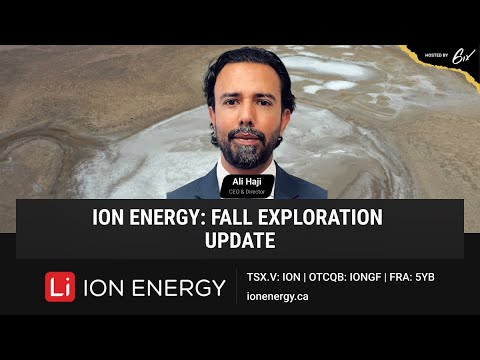
ION Energy: Fall Exploration Update
Join us for a great event!
- Company
- Osiris One Metals Ltd. (TSXV:OSM)
- Date
- Thu, Sep 22, 2022, 12:00 PM ET
- Replay
- Watch the replay on this page · 34 min
Replay
Transcript
Automated transcript · Written by software from the replay's audio. It can mishear names and figures; the replay is the record.
0:07 Hello, everyone, and welcome to Ion Energy's Live Investment Summit today, hosted by 6. I'm pleased to introduce their CEO, Ali Haji. He is joining us today and he's going to be going through a presentation after which of course we'll be entering into a live Q&A. I'd like to remind the audience members that you can ask any questions you like using the Q&A tab found on the right hand side of your screen and of course today's video is going to be recorded and available on demand on six.com in the coming days. But without further ado, Ali, I'd like to hand things over to you. Have a good talk. Thank you, Cam. And thanks to everybody that's taking the time out of their day to dial in today. I'm going to treat this presentation very much as a sort of soup to nuts. So starting from the beginning of the story, I know some of you are existing shareholders and we appreciate your support. But I'd like the presentation to flow. Excuse me. As if you're new to the story.
0:53 Ion Energy is a company that I co-founded in August 2017 to look for lithium in Mongolia. We are now considered Mongolia's 1st lithium-brine explorer and developer. We trade on 3 different exchanges on the venture under ticker ION, Frankfurt under 5YB and on the OTCQB under IONGF. The company is co-founded by myself, Matthew Wood, my chairman. A bit about my background, about 13 years of asset management experience in multiple capacities including M&A. I sit on the board of another mining company, another 2 mining companies, and I have had sort of, my father's been in mining for the last 4 decades and so it sort of runs in the blood. Matthew Wood, our chairman, is also the chairman of Step Gold, a leading gold producer in Mongolia.
1:41 He is a founding chairman of Avanko Resources that sold to Oz minerals in 2018 for $440 million. And one of his biggest successes was the sale of Hunu coal to Banbu of Thailand in 2011 for 500 million dollars back then. Wendy Lee is an individual that resides just outside of Beijing. She used to work for the Noble Group, so she is very seasoned in terms of commodities trading in that region. And she's tasked primarily with building strategic relationships with the various consumers and supply chain individuals and organizations in South Asia. Batatuma Rocha is one of our 2 Mongolian directors. We believe it's important to have Mongolian presence on your board, irrespective of the jurisdiction that you operate in or local presence on your board. Bata is the chief executive of Stepgold. He is also an advisor to the Ministry of mining. He was with the prior government and reappointed with the new government, so we are politically agnostic in country.
2:37 Anil Varach is an investment banking professional based here in Toronto, also an executive vice president at Stepgold. Enki or Ektushen Kishig Surin is an exploration geologist in Mongolia, has had over 30 years of experience there and ensured that we have access to the necessary equipment and personnel for exploration activities. John McVicker, ex partner at EY, our current CFO, so happy to have him. And then the next 5 individuals is really where the lithium experience should speak to you. Paul Fornazzari was the original chairman of Lithium Americas. He was also a founding director at Neolithium and being a senior partner at BASC. And He was the lawyer on file that sold neolithic to Zijin last year for 960 million dollars. Very much considered a pioneer in the brine space in the Americas, having written one of the first 43-101s for a lithium brine company on the TSX here in Canada.
3:30 Don Haynes is my technical advisor, or one of my technical advisors, I should say. He designs our exploration programs, reviews the exploration work. He's been on site with me in April of this year alongside Dr. Mark King. And he's worked on a number of assets around the world, including brine, hard rock, and clays and evaporites. So he understands all 3 mediums that you would expect to find lithium in. Dr. Hashbat Dasht-Etserin is a PhD lithium hydrogeologist in country. He ensures that Don's instructions and Mark's instructions are carried out, but He's an individual that has spent a fair bit of time in Akita University in Japan, studying the various extraction methodologies for the resource types in Mongolia. And then Dr. Mark King, he is a PhD. He is a hydrogeologist. He's worked on companies such as Albemarle, Lithium Americas, Neo Lithium.
4:19 He wrote the very first 43-101 at Lithium Americas, but more recently was the qualified person on file when Neo Lithium sold to Zidigit last year. And then Dr. David Deak is an entrepreneur, but he's also a previous Lithium Americas alumni, where he was CTO, SVP. And prior to that, he was at Tesla, where he helped build the supply chain necessary for Gigafactory 1 in Nevada. So we started the company in 2017, sort of at the tail end of the last cycle, with the intent of looking for lithium in a jurisdiction that is rather close to the largest consumer, that being China, we saw lithium as being cyclical in nature. Of course, the pandemic has spurned a clean green energy revolution, so we don't see it as cyclical anymore. And we, since 2017, have done a number of things that we're going to talk about today.
5:10 Mongolia as a nation, it's 1.5 million square kilometers, so it's rather 1.5 times the size of Ontario for a sense of perspective, population about 3.5 million people. The economy continues to be vastly driven by mining. Mining accounts for 80% of the exports in country. We're seeing it sort of rapidly grow here. They recently just increased their ability to attract investment from foreigners. I think Rio Tinto, if you guys are following the news in the region, has recently tried to purchase the equity side from Turquoise Hill, so ultimately putting between 5 and 8 billion dollars back into Mongolia. That's validation of the jurisdiction, it clears it for international investors and in fact we believe that more and more, in fact we know based on being on site and having a team in country, that more and more majors are now looking at the potential of Mongolia and its proximity to the largest consumer on the planet, but also the fact that it is vastly underexplored and has great potential to be a very resource-rich nation. If you're familiar with Uyghur Tolgoi, it's the third largest copper-gold deposit in the world and that's the Rio Tinto asset down there. So it is, in fact, very well endowed and it is sort of on the cusp of additional discoveries.
6:28 We've been in Mongolia as a team for over 15 years. My management team and myself have about 150 years of combined mining experience. As illustrated from the team, we do have a number of Mongolian individuals on our board. We continue to practice ESG policies and procedures. But I will say that with us as a group, ESG was a buzzword and an ethos before it became 1 such thing in the current investment environment. So we do work with the local community to help develop them. We have quarterly meetings with the local community as well. We talk about the environmental impacts of what we're trying to achieve. And I think from a lithium perspective, you know, it allows the country, a country that's been burning coal since the industrial revolution, to move towards this cleaner, greener future. And that's exciting for us to be a part of that.
7:21 When Matt Wood went to Mongolia in 2010, he started a company called Hunu Coal, 20 million dollar IPO, and it's ironic that we're now looking at lithium, but 20 million dollar IPO. He built a resource and then ultimately exited the bank of Thailand for 500 million dollars in cash. When he did so, he had 300 employees, 3 of which were expats. StepGold, a company that I was affiliated with before I started Ion Energy, is a success story. It's a current producer putting out 50,000 ounces per annum. It went to commercial production last year, using 100% Mongolian staff. Today, only has 2 expats in country with about 300 people as well. And so that shows you that you have skilled labor in country, but you can also operate as a Mongolian company listed on a foreign exchange, and that's what we pride ourselves in. Ion Energy went public in 2020.
8:10 We raised 2.7 million dollars in August of 2020, sort of at the height of the pandemic, and since then we've been able to accomplish a fair bit. We went public on the back of our flagship license, our first license, and that's Ba Bai O. It's 81,000 hectares. It's 23 kilometers from the Chinese border. For a sense of scale, consider 60 kilometers wide by 20 kilometers tall. So it is roughly 5 times the size of the city of Vancouver. It's a significant piece of land. In fact, it is the largest land package ever granted to a public or private entity by the government of Mongolia. The work done historically on that asset was primarily done by the University of Science and Technology, where Dr. Hashpat is a PhD. They did some very shallow holes early days and found an average rate of 426 ppm, maximum rate of 811 ppm, low impurity ratios for the potassium, magnesium, sodium, calcium and boron. We know the aquifers exist about 20 meters below surface. But as I mentioned, we went public in August 2020 when we had no access to country.
9:11 Given the fact that we are first movers in the lithium space in Mongolia, We did a very rudimentary surface auger program that ran across 70% of this asset, looking for anomalies for lithium in the various regions that were sampled historically. So we did not have the luxury, I would say, of many other lithium companies that operate in jurisdictions that have the necessary skilled labour in lithium. So we weren't able to advance Babayol as quickly as we'd like last year, but I think you'll see that we've more than made up for that with Urgak, Naran and our plans for Babayol next year. So very exciting stuff on Babayol. We also found some copper nickel and I did see a question pop up here about our JV with a copper company and I'll speak to that sort of towards the end of the presentation. But during the course of this drilling on this vast license, we were able to find very good copper and nickel discoveries as well, which we'll chat about in just a second.
10:05 Our secondary asset is the Urgak-Narren license. We bought that last year, or we went to tender for it last year, I should say, and we were awarded the license in Q1 of last year. It is 29,000 hectares. It is in Dongouvi province, which is essentially the province that the major arteries into the Chinese corridor run into from Erlian, which is the border crossing. So you have rail and road. It's located about 5 kilometers from the closest town which is Delgeray, which is connected to the grid. So should we require access, the infrastructure necessary for developing this further exists and exists rather well. We were able to get out to site this year after, of course, almost A22 and 0.5 year hiatus as a result of the pandemic.
10:54 Myself, Don Haynes, and Dr. Mark King were able to get out there in April and visit Raghat Nairn as well as Baba Ayog. All the images that you see here are in fact from our sites. We collected brine on surface from one of the pools on surface and found a grade of up to 918 milligrams per liter with low impurities. And you know we say this is the highest grade lithium brine known to have ever been collected in Mongolia, that is correct. But at 918 it is very encouraging and it does sit among sort of the top 10% of brine sampled around the world. Now we recognize that this is on surface and it may have evaporated and as a result you have some natural concentration happening there. But it is indicative of what we believe is a strong aquifer beneath surface. So since that site visit, we managed to complete 8 TEM lines, or geophysics lines. The resistivity along those lines have been rather encouraging, starting as low as 0.2 up to 500 ohm and drawing a lot of similarities to what you would expect to see in the lithium triangles, so Bolivia, Chile and Argentina.
11:58 That low resistivity zone is identified there by that pink zone. We then used 0.111 line to go across it to essentially understand the cross-section across the entire thing. And this is sort of – I'll pause here for a second. This was our exploration camp, and that's us on site and some commentary from Dr. Mark King, pulling or drawing parallels to what you would expect to see in LATAM or in the Plains of Nevada. So beyond those 8 lines, we did 0.111 line, as I said, to understand using a cross-section across those 8 lines and get a more 3D visual representation of the Orion body beneath surface. We were extremely encouraged to find that at a cutoff of 6.5 ohm, we're seeing about a 22.7 billion cubic meter body beneath surface.
12:46 At 0.5 ohm cutoff, which is as conservative as you can get, we're seeing 9.9 billion cubic meters. And that's exciting because if you look at some of our peers that have very recently announced inferred resources on their assets, they've been able to do so with, call it anywhere between 1.5 and 2.5 billion cubic meters where they've stipulated that it's only a percentage of their aquifer. We're extremely encouraged by this. So encouraged in fact that we started to drill shortly thereafter. And the drilling was announced last week, I believe. This drilling that we're conducting now will allow us to determine the porosity as well as the lithology of the Urgot Naran acid. That's our rig on site as of last week. Those are the core samples being collected.
13:34 Alongside the diamond core drill rig, we will have a tricone drill, which is a monitoring well that goes down to the depths and then ultimately allows us to measure the flow rates, as well as collect those brine samples for assaying, as well as the average grade calculation. Once we have our average grade calculation, Don Haynes, who is on our technical team and technical side, I introduced him earlier, will be on site alongside the exploration teams working to calculate our maiden inferred resource on the asset before the end of the year. With respect to the joint venture or reciprocal mining rights agreement with Arangin Resources, it made sense for us to consider copper, nickel, and lithium as battery metals, and so bring them under 1 umbrella and look to, 1, monetize, but 2, to build synergies amongst the 2 companies.
14:26 And so the reciprocal mining rights agreement allows Ion to have a 20% interest on any base metals found on ions licenses and on the flip side it provides a ranjin 20% interest or carry on any lithium found on oranges resources so ranjins obligated to spend a bit more money than ion is fairly because we have more landmass than Ranjin does, but importantly there's a fair bit there to de-risk from a copper-nickel perspective. And we believe this is a significant upside for Ion Energy as we will have a 20% free carry on what's looking to or shaping up to be a rather credible Gabbro type deposits on Babayot. From a cap table perspective, relatively tight, 60 million shares outstanding today, management insiders own 25% of the company. We continue to participate in every finance at every round.
15:20 And we do continue to buy on market as well. We did a bought deal last year with PI Financial and Stiefel GMP at 50 cents with a 70 cent warrant. Those warrants will expire in 2024. Options in every instrument issued or any placement done by the company has always been at a price higher than the previous placement or issue. And we can continue to do that because we are funded. We have sufficient capital to keep us going for at least the next 12 to 14 months. And we would not do an equity placement unless it was at a premium to the last raise at 50 cents. Mongolian investors hold about 8% of the company. That's folks that are physically invested into the company. We've had them come in for equity positions. Family offices, London and Zurich, own about 7%.
16:06 Delbruck Capital out of Vancouver was our lead order in the last bought deal, they hold about 5%. And then some of the other funds are Spartan, Alpha North, Magsit, Ixios, US Global, and Palos that came into the bought deal as well last year. So a lot of institutional holders, a lot of management inside holders, but a fair number of retail or a good enough ratio of a retail float to allow some liquidity in the marketplace. Our market cap today, 9.9 million US and 13 million Canadian. We tend to be one of the cheaper lithium companies out there, but we'll talk about that in a second. So we've been rather aggressive with our growth trajectory here. In 2017, we started the company. Of course, 2019, we acquired our first license. 2020, we went public.
16:52 And now, at the end of 2022, we're on the brink of announcing an inferred resource on Urgatnur, which is our asset vastly more advanced. We're also currently speaking with strategics at a very high level. I think one of the factors with respect to Mongolia is the Mongolia discount, which we continue to hear about from our investors. But the other is of course, we did not have access to country for 2 years and as a result we weren't able to advance things. Now that we do have access and we have been able to advance things, the goal of the company would be to allow a strategic to come in at a premium to the last raise, thereby validating the work that we've done to show that in fact, what we believe to be sitting on is rather significant. But it also allows us to leverage their skill sets in terms of understanding how to develop the asset further. From an exploration perspective, we've got that covered.
17:45 We do need specific skill sets to understand development and ultimate production. Some of our paid research here, we are in the midst of working with 3 banks here in Toronto that will ultimately start coverage when we have that inferred resource. But we do have paid coverage for now, and that's Kuluar Capital, $1.12. Fundamental Research, $1.18. Zacks about 48 cents US on the OTC. And then Stonegate, if you crunch the numbers in and around that as well. This slide here was prepared for our bought deal by PI Financial and what it shows is a company that has a proximity play if you will in Chile located beside SQM has not drilled yet but yet has a market cap of 120 million and one thing I'd like to draw your attention to is you know we talk about ESG and we talk about doing things the right way in terms of lithium today given China consumes 53% of the world's lithium, it ends up sitting on the back of a bunker ship that has to sail 15,000 miles to China where it's ultimately refined and then put in the batteries of everyday items, including the cell phones that you and I probably carry around.
19:03 What better way to cut that carbon footprint than be immediately beside the largest consumer? And that's where ION is situated, a mere 30 kilometers from the Chinese border. We've drilled over 1,000 holes today. We've done over 100 line kilometers of geophysics. We've just completed our first diamond hole. We will start on monitoring well in other holes as of tomorrow. And yet our market cap is US $9 million. So this is a bit dated. We were 23 last year. So when we did the bot deal, we had accomplished far less than we have this year and yet we see a bit of a valuation gap. So that's a comp table prepared by one of those research companies. We tend to sit at the bottom of most and I think that's on the cusp of change should we find something that or should we announce an inferred resource that is that is significant. So hopefully from the presentation you get that we are fully funded we're not looking for equity at this time unless it's at a premium and from a strategic.
19:58 Our location speaks for itself given its proximity to those large consumers. And let's not forget the Koreans, the Japanese, and the Taiwanese that also require lithium for the various battery manufacturing facilities that they have. Hopefully, we've shown you that we are experienced and we have a strong track record in country. We know lithium is trading at record levels today. I think China just broke its barrier on Monday. It was 71,800 per ton. So there is a massive rise in demand, but there is a shortage in supply. And that's why the prices keep going up. Mongolia, a nation that we worked in for quite some time, we know that we are able to work there with a low cost production profile, allowing us to have bigger margins for our shareholders. And we think we're well positioned to provide shareholder value. So With that, my contact details are on the screen, but Cam, I'll open up to questions. Yeah, absolutely. Thank you so much, Ali, for the great presentation.
20:52 To everyone in the audience, you can ask questions using the Q&A tab found on the right-hand side of your screen, but to dive into it, can you speak to Oranje's land acquisition strategy going forward? You mentioned that they're in the process of acquiring a land package. Does the holding the JV in any way indicate the potential for endorphic basins being present? What are Ion's plans in respects to the exploration of these properties? Where exactly are you in respects to Lithium geology exploratives? In terms of the Aranjin land acquisition strategy, Aranjin currently has 2 assets, the Sharga and the Bayan Under. Sharga has had a fair bit of drilling on it, about 2200m, and then on Bayan Under there's about 57,000m with a mining licence. The goal for Aranjin would be to look at currently exploring 1, the Big Tree deposit that we've just found or the Big Tree discovery.
21:42 That would be the primary sort of focus for Aranjin. And in terms of where the assets sit in Arangent's portfolio, yes, in fact, there is 1 asset that does show signs of potentially having hard rock lithium. So not brine, but hard rock. And so that's something that we will look to explore in the coming years. We're not in a rush to do so just yet. Our focus is Urgak-Naram to make sure that we have our inferred resource, our maiden and indicated next year. And then we use the same technology and methodology to explore Babayul, the asset that we didn't have a chance to advance as quickly and as well as we did Urgatnar. So hopefully that answers your question. Great. Steven wants to know what you can say about Orangen Resources' timetable for pursuing the Copper-Nickel anomalies at the Babayul.
22:31 That is going to take, we'll probably start, Arangel will probably start drilling there before the end of the year. The company does require funding and so there will be an equity raise in due course and that'll help fund the exploration on Victory. Great. And Victor is wondering if you can review other elements in the brine, what their grade is, what their content is. Yeah, sure. So as I mentioned, you know, 918 milligrams per liter on surface, in terms of impurities, magnesium, calcium, sodium, potassium, and boron, those ratios are favorable. I don't know them off the top of my head. That's more of a Don or a Mark question, given they are the geologists, but I'd be happy to send that across to you, Victor. So here's my contact details are on screen there. If you wanna send me an email, I'll get Don or Mark to send that information over to you.
23:19 Absolutely. This question came in just from a reference to a slide in this presentation, highlighting a bit of a discrepancy potentially. But showing Aeroengin holding 30,000 hectares when the site itself only shows Chagra at 9,000 and Bennion at about less than 3,000. So is that if you can speak to that? Yeah, there's Bainunder, Sharga And the other one that we were looking at is Barontal. So thanks for picking that up. And we will correct that. Barontal is no longer part of our engine asset. Jason wants to know, from a previous interview, you said that you wouldn't take the company into production. So what's the end goal? Would you JV with a major and free carry to production? Or would you be looking to sell the asset and move on to more exploration? Yes, that continues to be our trajectory. I think you look at the team, right? You look at the team and it consists of Paul, Mark, Don, myself and David of Lithium Americas and Neolithium. Those came to resource and then were ultimately acquired by those that would have taken them public or in Lithium America's case, a private equity firm out of Boston.
24:25 So we recognize that our skill set lies in exploration and we've been able to do so or show so with Lithium Americas and Neolithium and with Don's experience having worked on multiple different assets. So we have a gap in our skill set with respect to production. And this is why we want a strategic to come in for a chunk of the company and we're currently, you know, determining what that may be and at what price. But that not only validates the work that we've done, but as I said in the presentation, it gives us the means and ability to understand how we further develop this. When you do that, you start to have an equity run, because you have validation from third party, but you also have a partner with a technical know-how to bring something like this to production. And then ultimately, at the right price, we would look at either a complete exit or a royalty, as mentioned by the individual asking the question. So it's still a decision that has to be made. The exit has always been our focus.
25:21 And that's why we were accelerating our exploration programs but that could change as to whether or not we partner with somebody and they're doing the vast majority of the work or we ultimately exit. Great, And the only tail end question of that is just a reference of the timeframe that you're looking at to achieve these goals. Sure. I think with respect to a strategic investment that validates the work that we've done, I would very much like to announce something of that nature before we have our inferred resource. And I think that will be, it will put us in a position of an advantage. You know, we wouldn't give up too much of the company at these levels, even though, as I stated, we would not take any equity unless it's at a premium to the last placement. So the last placement was at 50 cents. If we were to bring in a strategic today, they would have to come in at a price above that and we would not give up too much of the company just yet. We would just use this as a means to validate but also allow them to take a toehold in the organization.
26:15 Absolutely. Can you talk to us more about the upcoming site visit? What shareholders can expect to hear coming out of this strategic visit? Absolutely. I'm off Sunday morning to Mongolia. I arrive on Tuesday. We have a couple of meetings in Mongolia in Ulaanbaatar with our technical team on the Tuesday that I arrived. And then Wednesday morning we're off to Urgach Naran to review the drilling program as well as have some folks take a look at the site to get a better sense of it and the work that we're doing there. And then we expect and I'm hoping, fingers crossed, we sent some some samples from our current drilling program to the labs in country so I'm hoping to be able to provide an assay update to the market next week while I am there, if not then then perhaps the week after when we are marketing in Singapore.
27:05 So it's going to be a busy few weeks ahead, but you can expect to see a press release from the company every 2 to 3 weeks going forward as we progress towards this inferred resource. Great. OK. With the government of Mongolia opening up so many more mining licenses and ION already being a first mover with the largest exploration license ever granted in Mongolia, as you've said, does this move by the government impact ION's growth strategy? Are you planning to acquire additional licenses or continue to focus on your exploration programs? You know, we'll continue to focus on what we have. But that said, having spent a fair bit of time in country in April with experts such as Don, Mark and Enki, who's my exploration individual and country. We managed to sort of take a deep dive at the country of Mongolia and determine where we think the highest probability of lithium would exist.
27:58 And so we've earmarked those areas as areas of interest. The government, I believe, is announcing a 400 tenement license issue at some point this year. It was supposed to happen in the spring, but it hasn't happened yet. And if any of those licenses fall within the regions of interest that we've identified, then yes, absolutely, we would go after them. Great, okay. How is Mongolia and Ion, for that matter, impacted by the current geopolitical situation, and does that impact Catalyst Times? Mongolia is fairly well insulated to the issue that's happening in Ukraine. I think as a result of it being a very important buffer state between 2 eastern powers, the western powers that be ensure that it remains that way. So we haven't seen any spillover in terms of what's happening in that conflict.
28:45 Primarily, I would say that ION has not been affected. We have all the equipment in country, we have the team in country, we're able to fly into the country for any strategic type visits or any technical visits. So ION has been unaffected by the crisis in the region. Oh, fair enough. And that's good to hear. Do you think that the current economic and inflationary climate impacts the potential for EV demand and battery metals demand? Absolutely. I mean, interest rates are going up across the world. And we know that that's going to continue but with the cost of inflation driving up our cost of living, you know, governments continue to incentivize folks to buy electric vehicles, right, so they're providing a subsidy which sort of offsets a little bit of that inflation But I think demand for now will continue at record levels.
29:37 The prices, the price of lithium does have to come down and that's why we need to bring more supply online. At today's current prices, you know, If you continue to trade at 71,000 or whatever it may be, eventually the equivalent of a mini Cooper being electric will cost you upwards of $100,000. And that's not going to be affordable, feasible, nor subsidized by any government on the planet. So bringing resources like this will help bring those costs down and ultimately allow us to continue. And, you know, tough to say. There's no crystal ball. I don't know where the markets are going and how long we're going to be in this sort of downturn that we're seeing currently. But ultimately, I think the demand for Lithium is here to stay for quite some time. All right then. And you being, of course, the CEO of 2 companies, both battery metals emerging explorers with the strategic alliance that you've highlighted.
30:27 You know, that must be interesting, of course, but is there some element that you're concerned with or something that keeps you up at night? I would say what keeps me up at night would have been that we were drilling Urgach Naran or we received Urgach Naran and it was completely made, you know, it was Greenfield when we acquired that license. So I had very many sleepless nights before we started to de-risk the asset and get a better sense of it. And on the Orangin front, I think there's a vast amount of potential there with respect to what we can and cannot do. On the Orangin sort of current status, given the fact that the country is extremely, or the company rather, is extremely undervalued, I think there's a potential for us to do a capital raise and then ultimately rebate. So on the Iranian front, that's keeping me up a bit. I need to close this placement so that we can explore in these horrible markets.
31:18 And on the ION front, I'm just very excited to press on and get to this inferred resource before the end of the year. That's great to hear. Well, actually, question has just come in. Jeremy, how are you, Jeremy? Why is ION so undervalued? It's a good question and I think I touched on it a bit during the presentation but the first reason in my view is the fact that we didn't have the skill set in Mongolia that you would find in Latam or in Nevada for instance where the skill set where people have been exploring for lithium for quite some time being first movers in Mongolia, we didn't have the necessary skill set in country. And through the pandemic, the country was closed off to everybody's, to anybody traveling into country.
32:06 And as a result of that, we weren't able to advance as quickly as say our peers who are now trading in multiples of us. But given the fact that we have access to the country now, we are accelerating our programs. That's sort of half of that question or a third of that question. The second bit of that would be the fact that as first movers, you know, people are waiting to show me story, show us that lithium exists in this jurisdiction that nobody's ever found it. And then last but not least, our current markets globally have caused a downward pressure on multiple stocks, even those that ran up significantly last year. And we believe that getting validation from one of these strategics will be sort of that pivotal point that allows us to re-rate and come back to where we believe we should be.
32:52 No, absolutely. And he has a follow-up question just about what catalysts would lead to more interest in ION, but unless you've just covered that. Yeah, I mean, the catalyst would be the inferred resource, a strategic investment, and then Maiden indicated next year. Those catalysts will ultimately allow you to re-rate. Now, I'm not going to say we know what that is, but if you look at precedent transactions or precedent press releases from companies that are in a similar stage as us, It could be anywhere from 25 to 60x if the results are good. If they're not, then we keep pressing on. No, fair enough. Ali, that looks like all the questions we've received for today. So I wanna thank you and everyone else who's participated and joined us today. Before we wrap up though, I'd like to pass things over to you for some final words. Yeah, just thank you to everybody that dialed in. Thank you for those very interesting questions. It's always good to have a dialogue. I think they get tired of sort of presenting, so it's nice to have a chat with folks that are engaged and really want to know more about the company.
33:44 Of course, we're excited, as I mentioned. I will be there next week, so we will try and share some information from the ground while I'm over there. If not then, then obviously in the coming weeks thereafter. But we're excited about the Inferred Resource. We're excited about our potential to do a transaction with the strategic. And given we are funded, we will just continue to execute. And so that's pretty much where we're at. And thanks again for your time.
Follow Osiris One Metals Ltd. into a list and get an email when it puts out news.
Latest news releases
- TSXV:OSM — Osiris One Metals Ltd Announces Name Change to Osiris Copper Corp · Mon, Nov 2, 2026
- TSXV:OSM — Osiris One Metals to Acquire Island Range Copper Gold Project · Mon, Oct 19, 2026
Companies on this call
More from Osiris One Metals Ltd.
- Nov 22, 2023 Powering Tomorrow: The Lithium Triangle – Extraction, Processing, Recycling
- Aug 25, 2023 Lithium Trade: Understanding Market Dynamics in China, US, EU and Canada
- Jun 08, 2023 Technology in Mining
- Jun 01, 2023 EV Projections and Critical Minerals Strategy
- May 24, 2023 ION Energy: A Diversified, Global Lithium Story
- Feb 01, 2023 The Digital Conference Experience