Replay available
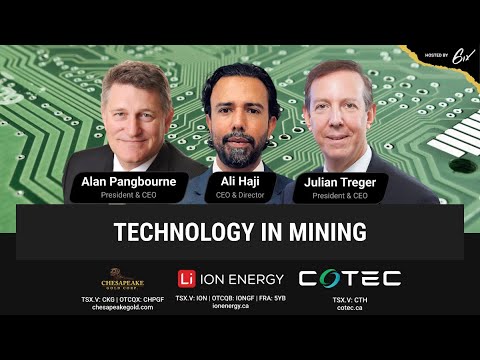
Technology in Mining
Join us for a great event!
- Company
- Chesapeake Gold Corp. (TSXV:CKG), Cotec Holdings Corp (TSXV:CTH), Osiris One Metals Ltd. (TSXV:OSM)
- Date
- Thu, Jun 8, 2023, 11:00 AM ET
- Replay
- Watch the replay on this page · 58 min
- Results news release
- Chesapeake Gold Announces AGM Results · Tue, Jun 6, 2023
Replay
Transcript
Automated transcript · Written by software from the replay's audio. It can mishear names and figures; the replay is the record.
0:08 Hello everyone and welcome to today's event, Technology and Mining, hosted by 6. Today we'll be talking to these gentlemen about innovative technologies, current and future role in the mining space. Alan, Ali, my apologies from Ion Energy might pop in, so don't be surprised there if he comes in. But this is more of a broad discussion and I encourage you to ask questions in the Q&A tab on the right hand side of your screen. That being said, just keep the questions related to the conversation at hand. If you have company-specific questions, please just state them in the chat that you would like to speak with management, and I'll be more than happy to help facilitate that. So to get the discussion started today, gentlemen, why don't we just briefly describe the specific technologies your company is currently exploring or implementing that is significant to your story. I'm going to start with you, Alan.
0:54 Good morning, Kyle. Good morning, Julian. Good morning, everybody. Yeah, At Chesapeake, we are developing or implementing, plan to implement a technology that allows us to heap leach sulphides in an alkali environment and oxidise them so that we can treat sulphide refractory Gold ores. The concepts have been borrowed from the Copper industry. The Copper industry has been leaching sulphides in a heap leach environment for over 30 years. There are a few tank-based leaches in the Gold sector as well with similar chemistries. So we know it works in a very fine basis. But we'll be one of the first to do this in a heap leach environment.
1:44 And that has multiple advantages. Significantly less capital. The alternative, a northern clade plant, it's probably about 90% less capital. It uses significantly less energy. Again, compared to a northern clade plant, 90% less energy, 90% less water. And then there's no tailings dam. So you don't have to contend with the environmental and social resistance around tailings dams because there isn't 1. So great strides forward, environmentally more friendly and less energy, less water, less capital. It's almost Nirvana, but it's something we've been copying across from another part of the industry.
2:33 Thank you. And for yourself, Julian? Sure. Well, yeah, lovely to be here with you, Kyle and Alan. So my business, Kotech, is trying to solve the problem of, you know, why isn't there an eBay or a Amazon in the mining sector. So our business is based upon technology. We look for extreme disruptive technologies, which are market leaders and which can transform the industry. And then we take those technologies or the rights to those technologies and apply them to effectively othered assets, assets which aren't valued by the sector. So those could be marginal mines, mines with short lives, mines with big rehabilitation liabilities, brownfield restarts, and of course waste.
3:22 So waste and recycling are a major part of what we do. And we so far have 4 technologies. We have 1 technology that can pelletize without heat for iron ore. We have another technology that can concentrate hematite in a novel way. We have a technology that can recycle magnets and extract the processed rare earths from them. And we have a technology to extract copper from heap leeches, which can do so faster and get higher recoveries than the alternative technologies. And like Alan, you know, we see this commonality in the technologies of much less heat, much less water, much lower capex costs.
4:09 And also, which is very exciting for us, is that the new technologies are much more modular than the ways things used to be. So that allows nimble startups to create economies of flexibility to overcome the barriers to entry created by the economies of scale of the existing incumbent majors. So we're super excited about, you know, the opportunities that we are seeing to really extract inherent metallic content from other assets, which aren't considered economic using technology. Using technology. Thank you Julian. And we'll stick on with you for Cotech because you are looking at so many different technologies in the space. I'm just wondering what emerging tech do you believe has the most significant impact on the resource extraction industry in the next say 5 to 10 years.
5:03 I'm not sure it's like 1. I think there's gonna be an enormous wave of technologies. I think we are at the stage of mining technology or commodity technology, as you call it, where FinTech was 20, 25 years ago. And I think the combined effect of all these technologies finally being implemented and rolled out will be to help bridge in a major way, the gap between the commodities that are necessary for the climate targets and the existing capability globally to produce those. So I think it's going to be a major impact and I think it's going to be a collective thing. It's going to be many, many technologies, but hello, Ali.
5:50 Hello, Julian and Alan and Kyle. Apologies for being late there. I was just wrapping up something. So I know you've gotten started. I won't interrupt you while you carry your train of thought. No, no, it's okay. We'll kick it off to you here, Ali. We just were doing introductions and just stayed in how how binding technology plays a big factor in your company's story. So why don't you talk about that in terms of ion energy. Thank you and again apologies for being tardy with my appearance here today. But Ion Energy is a company focused on lithium exploration in Mongolia. That's sort of where we started our vision. We have 1 brine acid and 1 acid that looks very much like saccharoplast or a clay evaporite project that of course has a bit of work to be done on it.
6:36 Our other acid that we acquired in Canada in the Northwest Territories is very much a pegmatite project, so we do have lithium in all its mediums so to speak, unless there's 0.25 1 that I'm unfamiliar with. In terms of technology, I think DLE is gaining a significant amount of traction with respect to brine specifically. The reason for that is, of course, that it is less environmentally impactful. It does tend to leave the water table somewhat intact. It does allow you to really have a smaller footprint without disturbing the ecosystem of that local community or landscape. DLE is a technology that us as a company are truly pursuing in great detail. We are in conversation with various providers. And we believe that that will ultimately allow the brine industry in particular to be one that is less environmentally impactful.
7:27 And then of course, you have the ability to look at technology in the sense of renewable power sources, given the fact that we are in the Gobi Desert where the sun shines for 250 days per year. And you've got very high winds, the ability to be a carbon neutral or net 0, of course, is something that we're looking to explore as well. Thank you. And when you were just joining in, Julian was just talking about what emerging technologies he's looking forward to in the next 5 to 10 years. And I'm wondering, is DLE, you think, the most transformational technology? Or what do you think is interesting that could really change the industry? It's certainly transformational in the lithium brine space and I think the reason I say that is you know DLE can be used for concentrations that are rather minimal so you know all the way down to 20 milligrams per liter, which of course, in the traditional or conventional sense, when you are using evaporation for extraction techniques, you need a percentage or a grade that's significantly higher.
8:27 What that's meant is the vast majority of the world's lithium that comes from brines currently comes from Latin America and it's shipped 15,000 nautical miles to China or any other such jurisdiction that requires it. But given the fact that we're finding petroleum brines here in Canada with E3 metals and others, We're also finding brines in Nevada that are of a lesser grade. That allows you to have production centers in local jurisdictions, thereby serving the local market that will be the consumer in the future. So absolutely, I think that's going to be pivotal. Thank you. And for you, Alan, you were mentioning prior that the heap leach of sulfides in the copper industry has been around for a couple of decades now. What about in the gold industry? Do you see this being as one of the most transformational things that could happen?
9:19 I think it's one of many. You know, there's a whole raft of technologies out there across the mining industry as a whole that can be applied in other parts of the mining industry. So I think, you know, as more and more information becomes available openly on the internet and everywhere else, you can start, you'll start to see they're doing it here in, out of Mongolia somewhere and you go, well, why can't I do it over here, or something similar? I think the industry in the past has, despite what people say about it being very conservative, it can be. But there has been some massive technology improvements.
10:04 You know, you're seeing now remote operating centers around the world that are handling assets that are thousands and thousands of kilometers away. We might not be doing that yet, and a lot of the mining industry might not be, but the majors have already done that, and they're working their way down. You see things like Apple's recent announcement with its goggle things again. There's a very clear application on site with maintenance people or doing inspections where that ability to have the information off on one side of your eye and see what you're looking at and it recognizing what you're looking at and telling you what you've got to do with it.
10:54 Those little dog robot things they've started using for inspections. There's a raft of things that are coming that will have huge impacts on the industry and are having huge impacts on the industry. So, it's not just one thing. It will be the aggregate of all of those. Rio has had a mine of the future project for, again, decades. And they're getting there. Piece by piece, they're putting the jigsaw together to get that mind of the future. And the advances in IT and computing and Wi-Fi systems are all aiding that and allowing us to get remote centers and not have to be on site and all the rest of it.
11:44 So I think there's hundreds of things coming. It's not just one thing. Yeah. And, you know, Karl, we've looked at 250 technologies so far. So there are literally hundreds of them. But the ones that we'd love to find are like technologies which can de-radiate radioactive material very quickly. And we have seen some of those starting. We're looking at technologies which can take sequestered carbon and do something really useful for the world with that. Those would be major breakthroughs that I think could really make enormous difference to the planet. I think you'll also see, as people see the cost and the impact of carbon emissions and how do you avoid them, it's a lot cheaper to find a process that doesn't use carbon inputs to start with, you don't have to mitigate something you don't use.
12:57 So that way, if you can get away from carbon-based energies, Or even better, just use less energy. 90% energy reduction if you can do it in a heat leach environment instead of a high pressure or the clay environment. It's huge. Definitely. It's huge. Yeah. So, do you see the renewable energy tech playing a pivotal role for giving more eyes to the mining industry? I can leave this open to the group, but do you think people have this perception that it's a rather high carbon emitting type of industry that people aren't that interested in right now?
13:47 I'd say that the likes of Caterpillar with their 993, for instance, that being fully electric and being piloted in terms of prototype across the world for the various mines and their transportation needs is helping to pivot away from carbon-fueled transportation methodologies. Of course, you have in mind, and I forget the name, I have it somewhere. But that's running an electrical train conveyor system as opposed to a traditional sort of trucking system. And that, of course, now moves you away from diesel, which, of course, can be, 1, a massive cost to any operation, but 2, is highly detrimental to the environment. So electrification is sort of the wave of the future. We're seeing that come on board with various majors currently. And of course, that will trickle down to us juniors eventually.
14:36 But electrification is absolutely a path to reducing our dependence on carbon fuels. I mean, I would say that obviously there's electrification of the production of the materials, but I do believe that over the next decade, the global perception of our industry will improve markedly as people appreciate that the products are necessary to electrify the world. And we will not meet our targets without getting more of these materials. So mining is necessary for survival. And secondly, obviously the weaponization of commodities globally has meant that people are generally more appreciative of the strategic impact of our sector and importance for their security.
15:30 I'd like to touch on what Ali brought up actually with the EV fleet of machines. Is that something that can happen fast or is it a trial thing? Like I'm not too well versed in this space. I'd really appreciate some further insight on what the big players are thinking about EV fleets and can you actually replace diesel machines? Yeah, yeah, absolutely. I can touch on that for a bit. You know, you look at technology and I think Alan brought up the point of Apple's new headset that you essentially wear on your face. And you can see things in real time that help you assist solve problems. Google Glass had that technology, call it 10 years ago, that didn't do very well, purely because of its limitations.
16:17 But just about 30 years ago, 1 would have never imagined we'd be sitting around the world here on our computers, talking to individuals from around the world at a bandwidth that replicates being with somebody in real life. So technology does tend to increase exponentially in terms of electric vehicles. Tesla sort of brought that on board to the mass market. And ultimately now you have Hyundai, BYD, Geely, various brands, Mercedes, BMW included, that are touting electric vehicles as their sort of primary offering. Hyundai outsells Tesla today around the world for EVs. And as a result of this exponential growth ability the technology has, a number of major mining companies have taken on the path of using electrification for their modes of transport.
17:05 As I mentioned, that Caterpillar truck that is currently in prototype, this is a significant machine. It's the size of a home, a small home. Yet it is fully electrified, and it is running these massive mines that Rio Tinto and others are currently operating around the world. So to answer that question, can it be done? Absolutely. Has it been completely adopted and is it fully rolled out? Not just yet, but I think we'll get there. I think one of the things going forward the society and the industry is going to struggle with is we can build all the batteries we like, But you've got to be able to charge them. And so, you know, batteries are an intermediary.
17:53 They're not a solution. They give you a solution to replace diesel, but you replace it with electricity. The electricity has to come from somewhere. Right? Now, whether that's solar, wind, hydro, or unfortunately in the northeast of the US, it's carbon still. So, there's a massive build required around generating capacity, whether that's nuclear or the renewables or whichever 1 you want to pick. And then transmission. All of that, all of that implies significant changes in the supply chain and the initial materials to be able to build that transmission system or upgrade it and build the generating capacity that's not carbon based.
18:46 And that requires a bunch of other metals that aren't directly related to batteries. Everybody's focusing on batteries and seems to think, I've got a battery, therefore I'm now green. There's, you've got to get to the battery. You've got to feed the battery. And then you've got to dispose of the battery. And that's going to lead to a massive increase in copper, iron, steel. You have to build all this stuff. And I think that's currently one of the things that the society hasn't quite caught onto. You go buy an electric car. If we put electric cars on the street where I live, there's absolutely no way the transformer can charge them all at the same time.
19:37 It's not going to happen until you upgrade it. So there's a knock-on effect beyond that where the industry has to be able to deliver a significant increase in all of those base metals that you require for the construction of civilization. Yeah, I mean, I'm also more interested rather than trying to pick the next electric vehicle, which has lots of competition, trying to pick technologies which require less logistics. Because that's another way in which technology, I think, can transform things. And you're going to have much smarter mining, where there's going to be much less waste, where you have intelligent, you know, drill bits, where you have automated mining, And the result will be less need for electric vehicles, actually, I think, for our industry over time, which I think would also help the case for the sector.
20:43 Yeah, and if I can touch on that Very quickly, Kyle, and my fellow panelists, I think, yes, absolutely. Where batteries are sort of shown in the view of your general consumer or your generalist, absolutely, that power does need to come from a renewable source. And the fact that we're using non-renewables to charge these things and of course the infrastructure doesn't allow for them to be done so in a renewable way. A start would be for the renewable energy to come online and then of course those trucks that are ultimately moving or for us to consume would have to have been produced using renewable means given, you know, sources of energy that we are requiring for this transition. But the logistical thing, Julian, I think really hits home.
21:29 It's when you look at where consumption is around the world today and where we are mining for these various commodities, we tend to look at the far reaches of the world for the consumption by a very few sort of communities or jurisdictions around the world. And so technology allows us to identify ore bodies that perhaps were not relevant 20, 50, 70 years ago, and we didn't have the technology to really go out there and explore them or ultimately extract those resources. So you now have the ability through technology, be it spatial radar, TEM geophysics, things that have come to real prominence in the last little while to allow us to identify these ore bodies that allow us to bring them to production, shortening that logistical lifecycle for the local consumers.
22:15 So I agree with both Alan and Julian on this. Yeah, maybe we could continue on with these inefficiencies in the industry. Is there any ones that you see that are inefficient that we really need to get a wrap on this. It's not keeping up with the times. Is there anything, whether it's exploration or operations or production in that regard? I think it's, if you look at the fundamentals behind of where a lot of the technologies end up going Anybody can come up with something that uses less energy to produce the same product is Going to win Because at the end of the day, whether it's diesel, whether it's electricity, whatever the energy source is, if you can use less to produce the same or more, the cost has to go down.
23:16 And If the cost goes down, it will be economically attractive. If it's economically attractive, it will get done. I'll give you another instance. I keep coming back to heap leach because the difference in energy consumption between a mill and a crusher is order of magnitude. The nickel industry, the laterite nickel industry, started off using electric arc furnaces, converting it into sulfides, then refining it to go back to pure nickel. They worked out they could skip that last piece and go straight from laterite nickel to ferronickel, not take the iron out and make stainless steel from it because most of the nickel actually still, even today, goes into stainless steel.
24:03 Huge energy saving because you didn't go to sulfide refinery. They then started using H-PAL plants to get rid of the electrical energy they were using. A large electric arc furnace uses 80 megawatts of power. Yeah, it's enough to power a small town, or even a decent sized town in some countries. The next step, and there are 2 operating now, they're starting to use heat bleaching for nickel. So you've got rid of all of that energy input, and they're using sulfuric acid as their energy source. Right? And so you're seeing this continuum of using less and less and less and less energy.
24:48 To give you another silly example, this thing, it contains half a dozen different machines that we used to have separately, a phone, a GPS, a music player, they all use more energy than this thing does combined, right? So you go back to the fundamentals, use less energy, produce more, it becomes more attractive. And that's where the industry will eventually go. Yeah, I think we'll see the end of smelting over a period of decades, because that uses a lot of energy. But just turning to inefficiencies, I think the greatest inefficiency today is the capital markets.
25:37 Because the combination of decades of indexation and a focus on short-term quarterly reporting has meant that the capital markets are failing to fund the next generation of mines which are crucial to cool the planet. And we are going to miss our targets because the capital markets, for all the sort of lofty words, are not there to actually provide the capital to build the 500 new minds that are necessary. And this represents in my view the biggest own goal for the ESG movement in history. That they've somehow created a situation where the solution to their problems, they've basically sabotaged. And that is an enormous problem which, you know, technology, I don't think can, can absorb. That's really something that's really got to be fixed urgently.
26:36 Preston, anyone else have any thoughts on the capital markets? I couldn't agree with Julian more. It's insane what the capital markets say they want when the industry then delivers it they can't fund it. And it's all been driven by short-termism. You want growth, then you don't want growth. You want capital return, then you don't want capital return. It's a yo-yo. And you need to be able to bring online 50,100-year mines. And they exist. Escondido's been going since the early 90s. Bingham Panyon, I don't even know where that one started.
27:23 The Arizona copper mines. But you need those deposits to be found and developed quickly. But when you're based on PNAV, ain't going to happen. When you want to use an internal rate of return of 15%, ain't going to happen. I echo both those sentiments. I think capital markets are certainly failing us to a degree, but I think it's time that government sort of steps in here in certain locations and jurisdictions to help alleviate these issues. And one way to do that is recognizing value depending on your shareholder base as opposed to where the commodity actually lies and where you're listed. And I say that because us having assets in Mongolia of course, yet listed on a TSX, we had some inability to transact with capital providers that would have allowed us to advance purely because the element that we are exploring is deemed critical.
28:23 And as a result of that, I think governments need to work together to come past that. If your asset is located in a different domicile, for instance, then funding should be able to come from wherever it comes from. But the capital market space, absolutely. I think it's that quarterly report. It's that how well is your stock doing? Where do the bankers come in to support you? And is that truly a case of support as opposed to a short-term win that ultimately goes away. So it's tough out there, it's getting tougher and if it does not correct itself as Julian said, the ability for us as an industry to continue to provide these very required and essential resources will start to deplete. That's interesting and governments around the world, because this is a global industry, the mining industry, governments around the world, do you see that the ones that are willing to put investments into the mining industry and this technology or the ones that are going to get out ahead?
29:25 It's absolutely possible. I think you look at, you know, so the Middle East here where historically the money was very much focused on petroleum. In the last 2 years, they've had what's called a future-facing conference in Riyadh in Saudi Arabia. They've announced deals with Ivanhoe Electric, Barrick, majors that we know around the world. They've, as of I think yesterday or this morning, announced a deal with European lithium. So you are seeing a lot of interest from the Middle East, which is historically oil-driven, now deploying capital for mining projects around the world to either look for feedstock or generate profit. And if our governments in the western hemisphere or in Europe for instance are unable to match their prowess, then they will fall back.
30:11 So yes, we are seeing governments absolutely invest. Yeah, Yeah, the whole funding dynamic has changed. I mean, the Japanese have been doing it for some time, obviously the Chinese as well. The US is now really trying to play catch up. Europe has a bit of money, the UK doesn't have any money, and so on. So there'll be a different response. But the financing function is private finance or the capital, but stock market is going to be squeezed up by, you know, governments and OEMs who are just desperate for the product. And if the public markets won't finance them, they'll have to just finance it directly. I think one of them, this is probably a little off topic, but when you start putting the entire picture together, you've got to be able to find it.
31:07 You've got to be able to permit it. And that historically has been coming more and more complicated. Permitting timelines have not got shorter. There's rhetoric about we're going to try and speed it up, but at the moment it seems to be rhetoric. The only exception I'm aware of is Thacker Pass in the US. They've got their permits in record time. But you're also, it's not just government and the industry that have got to work together. You've got to decide how you're going to address the social side of it and the NGOs. The NGOs have changed their tactics. You better be aware of it, otherwise you're going to go run the entire race, even cross the finish line, get your permits, and then the NGO is going to sue the local government, and you're going to lose your permits again.
32:06 And that has happened. It's happened multiple times in multiple jurisdictions. Because there are NGOs out there that want the world to stay the same, whatever that actually means. And they're not supportive of mining anywhere. There's quite a few questions actually which is great to see so I'm going to try and weave them into the conversation here. Uthela has a question here. If technological development is top-down driven, is the primary motivator usually cost management? Alternatively, when driven bottom up, is the primary motivator practical? If so, how does 1 reconcile both needs to ensure effective implementation?
33:01 So top down, cost driven and bottom up? Alternately, when driven bottom up is the primary motivator. So top-down, cost-driven and bottom-up? Alternately driven, bottom-up is the primary motivator. Essentially, is technology driven top-down or bottom-up? We'll take it from there. I think it's actually both. I mean, you can have a vision from the top of this is something we want to try and do technology wise. You know, Apple is a classic example of we produce a product, the market doesn't even know it needs yet. But then you have to have the practicality at the bottom end for people to buy into that and use it. Yeah, there's no point putting an all seeing all dancing technology into a mind sight if the guy's wearing gloves and safety glasses the whole time and the touchscreen doesn't work he won't use it because he won't take his gloves on and put them on take them off put them on or he'll just leave them off, which you don't want from a safety point of view.
34:05 So, I think it's driven from both ends. It has to be practical. It has to be usable. It has to be inherently, not logical, but intuitive to use, which is what a lot of the engineers, when they design things, aren't very good at doing. And some of the other people are way better at it, and it's intuitive in how you use it. But you also need the vision at the top, that we need a solution like this. Yeah, spot on, Alan, it's got to be symbiotic. If management wants to reduce costs, they have to provide the tools that have that practicality and ease of use.
34:51 And the only way they get used is if they are practical. And so it's truly something that's sort of a symbiotic relationship that's not mutually exclusive. And I think, you know, just in terms of practicality, we think of it differently, but are there applications for the technology and are those scalable? Are those going to move the needle for the world? It's no use having the best solution, but it only works in 1 plant somewhere in the world. That doesn't really make a difference. So I think there's another practical aspect to having a great technology, which can really move the dialogue forward. This is an interesting comment and I'm interested to see how this conversation unfolds here but he says, the South African mining industry is characterized by an array of cultures, languages and backgrounds.
35:48 Implementation of technology is sometimes hindered by the language barrier. What options are available to bridge the language gap and ensure that multitude of people are on par with the main concepts of technology? I mean, now with computers, language should not be a barrier. You know, translation apps are widespread. I think the broader issue in South Africa is the cost of labour has been going up and the workforce is part of the culture there of not necessarily being always very happy. And the risk is that technology comes and makes a lot of those jobs obsolete.
36:39 That I think is a major risk rather than language translation. Okay, fair enough. I'll pose this question to the group. Do we have the best minds in the mining sector? How can the mining industry attract and retain top talent in the field of technology and innovation to drive this change? I think, if I may, I'll start with that one. And I think, Alan, you touched on this earlier in the conversation, is everything that we have around us is generally mined. And that's how you build your truck that ultimately moves your ore through mining. That's how the steel is manufactured. One of the concepts that I think needs to be introduced in education today across all levels of education, and primarily, you know, if it starts at elementary school, all the better, is the education piece that tells individuals that if it's not mined, it's grown. And when I say it's not mined, petroleum comes out of the ground and it is ultimately mined. So one can look at petroleum as very much part of the mining industry.
37:44 So If you look around your house and you see a window and you think, oh, wow, that's a nice piece of glass, well, that was mine. The paint on your wall came from petroleum. That was mine. What you're eating is perhaps grown depending on where you got it, a lab or otherwise. And these are things that need to be introduced to society at large. The vast majority of individuals that you bump into on the street have no idea where a lot of things come from, including their cell phone. Yet the NGOs that Alan spoke about that are looking to disrupt your operations are also using this very same technology that was mined to essentially forward their cause. So I think the introduction of mining as a subject matter in our education system will help draw and attract the most talented individuals in mining. Now, I'm not saying that we have a general lack of intellectuals in the mining industry. But I think if we introduce the concept of mining at a very early age to the population, we will get brighter minds in mining that will allow us to use more technology that moves us to a more sustainable mining practice globally.
38:50 Yeah, I'd like to add to that. I think as if the industry could do, improve its image and show some of the tech that we're doing, that we're using, even today. The use of remote control centers. You know, one of the issues you always struggle with, and in a previous role I was COO for a mining company, we had mines in all sorts of wonderful remote places, is getting people to come to remote environments. Well, if you can't get Mohammed to come to the mountain, maybe you move Mount Mohammed. And so you. The remote control centers and all of that technology that's behind it. For some of the kids, it's incredibly interesting. And so, we've got to get that message out there that you don't necessarily have to go and live in the middle of nowhere.
39:45 Maybe it's FIFO, maybe it isn't, maybe it's a remote control center. But the mining industry these days has so many facets across so many different career paths. There's something for everybody if they knew about it. And I think that's where we've got to improve explaining. It's not just geology, mining engineers and metallurgists that make the mines work. Yeah. I mean, I think there is a historic opportunity for the sector to recast itself as integral to the future and integral to the cooling of the planet. But the sector itself does no favors to itself because, you know, pictures of diggers, you know, ploughing up the earth is not what we should be advertising. You know, Mr Arnault does not show the crocodiles being skinned when he sells his handbags.
40:49 I also think the sector analysts who generally price commodities going forward, moving to their marginal cost of production, are always wrong and does no favor to the sector, but it leads growth investors not to come into the sector and the ratings to be very low. The fact that our sector as a whole was valued at, I don't know, $300 billion or $500 billion, which is like 0.167 of Apple, is ridiculous and disgraceful. I think if people really understood the value and valued the sector appropriately, you'd start to get people who are more ambitious to come into the sector. So there's a lot of work to be done around messaging. I also think, you know, every time some drunken guy, you know, has a car accident driving away from a mine, it's reported almost internationally as a sort of evidence of the danger of the sector. Whereas I'm not sure the sector is. They've cleaned up their act amazingly over the last couple of decades.
41:51 I don't know how many people die every year making Coca-Cola and nobody really cares, particularly. And we need to be better at advertising the virtues of our sector. Actually, Julian, it's interesting you say that about safety. Some years ago, when I worked in South America, the banking industry had a higher accident rate than the mining industry. Banking industry, paper cuts and staplers. Yeah. Yet you never hear it. Do you think it's the cyclicality of the industry that is having the struggle with? Because Apple every year, they're coming out with a new version, whereas the mining industry is rather cyclical, right?
42:43 Maybe that's why we are getting held back on valuations. I think you're seeing the cyclicality now impacting other businesses. The mining industry has lived with it forever and it does impact us and it does force some people out of the industry. I mean, the number of geologists that are teachers is phenomenal. And it's because of that cyclicality in the exploration side of the industry and the capital markets, again, not supporting you over the longer term. But you're seeing it now with all, look at all the layoffs. Was it Twitter laid off 70% of its workers? Facebook's laid off tens of thousands, Google has. So the tech industry has now had its first taste of what happens when the market turns against you and what the businesses end up doing.
43:39 I don't think it's just the mining industry that's going to see that cyclicality. It's the whole world. As things change, you see these cycles go through industries. I mean, how many people work on farms these days compared to 100 years ago? How many people work in manufacturing? Then it's not robots. I recently saw an ad, you can do a virtual tour of an Amazon fulfillment center. It's all robots. I don't think there's a person in there. Or at least that's what they portray. I think this cyclical nature of people moving across industries is going to continue forever.
44:28 It's nothing new. Okay, and Alan, maybe I'll start with you on this question then. When some big innovative tech happens and is adopted in the industry, what typically happens to the sector overall? Or is it just a select few companies that benefit? Generally, it isn't a select few companies. They may be a few companies at the edge. But if you look back at when they brought SXCW technology into the copper industry, it took a little while to get going. And then like a lot of techs, there was this explosion of uptake for the right deposits, and then it steadied out. And you saw companies be able to get quite impressive margins if they were at the front of that and Then margins compressed as more and more and more people came in and they actually drove the cost curve down which is what most of the technologies do. And if I had to stay, I had to guess at the next one that's very topical at the moment, it's actually what Ali was talking about with direct lithium extraction.
45:45 That will change the lithium industry because it does everything that people have been talking about this morning. Allows you to treat deposits that are closer to the end user. Allows you to treat lower grade deposits. Reduces the impact of pumping billions of gallons of water out of the ground and evaporating them. Yeah, which is the ugly side of this, the, the industry, the LeBron industry that people never talk about. It will change all of that. And once 2 or 3 get going, the uptake will be very quick. So, yeah, I think there's like a year or 2 where you can get an advantage if you're an early adopter, and then that advantage erodes. But I don't think that's a bad thing. I think our sector should adopt more Silicon Valley type practices with open architecture.
46:40 We're all in this together to solve the problems of the planet. And more collaboration, more joint ventures, less 0 sum game thinking. So I think it's a good thing and it will spur more innovation. Yeah, couldn't agree more. I think getting out there, you know, like the old days of being the prospector that finds a patch of gold and tries to keep it to yourself. Those are days of the past, specifically where our industry is concerned. If you're operating in a jurisdiction and you have peers, it's imperative that you work with your peers, be it for a JV or a consolidation opportunity or sharing knowledge with respect to how to advance your assets in that region, building social license and what have you, it's imperative that we do that. We've got to stick together in this in order for this industry to advance and of course for it to be viewed as something that's not evil across the world and I think we are definitely shifting in that direction.
47:38 I'd add to that in my experience having mainly worked in the operating end of the business for my entire career, Within the small pieces of the mining, so the gold mining guys or the copper mining guys or whoever, apart from maybe aluminium, there are no secrets. There really aren't. I mean, you want to go see how Morenci's doing what they're doing or you want to go see what they're doing at Bingham Canyon It is very easy as a professional in the industry to pick up the phone and say hey, I'm in Salt Lake What's the chance I come and see what you're doing about this? I mentioned we did some stuff with technology earlier before the call.
48:26 We visited 8 different sites around the world who were doing something similar and got a list of all the things that went wrong so that we didn't make the same mistakes. So I've actually experienced a very open sharing industry, certainly at the operational level. Yeah? And even stuff that is patented doesn't stay patented for long, because most patents in the mining industry aren't strong enough to protect you. Yeah? So I'm hearing a lot of comments about change needs to happen in the industry, and it is happening. I want to get your individual opinions on the men and women coming into the industry, this new generation.
49:17 Are you optimistic? Are you happy seeing these men and women coming into the industry? What are your thoughts on the new next generation? Well, I mean, I would hope that is a different generation which has different, you know, mindsets, much more, you know, varied in terms of backgrounds, but still super competent. And as the sector's image improves, I think we'll be able to attract more of the best and the brightest. And people will see this as a place where, you know, they can both make a good living and have good lives and really impact the world in a positive way. And that is what our sector can do. So the messaging needs to get out there and then the people will come.
50:17 Go on Alan. I was saying I agree with what Julian's saying. I think it's an image thing. We've got to get away from, despite how many of us may actually like sitting there and looking at this great hole in the ground and these massive pieces of machinery and whatever, we've got to change the image of what are we doing, how are we supporting civilization. Yeah. You cannot live the way you live today, unfortunately or fortunately, without digging stuff out of the ground. Yeah? It's just not possible. You know, Many of the young people sit there and say, well, we can recycle it all.
51:06 Not if you want to keep growing, because growth by definition means that you've used more of than you have previously used. And So, even if you 100% recycled everything that you previously used, that's still enough to meet the demand on the other side. The other issue with recycling, which some people don't seem to figure out or understand, Primary ores are clean. We know exactly what we're getting. We're getting rock and the minerals that we're interested in. Recycling, And I've seen this in a lab we work with who do a lot of lithium recycling work. Some of the rubbish that's mixed in with the recycled batteries makes it almost impossible to recycle them.
52:03 And then I'd add to that some of the things we make out of mixing all those materials together are extremely difficult to reseparate and extremely expensive to re-separate. And so recycling isn't the panacea. There will be solutions, we will find them, and there is a way to get where we need to get. But society needs to understand you've got to have mining going forward. There isn't a simple solution. You know, to touch on what are the young people that I'm seeing in the field today, and of course I haven't been in the field as long as Alan and Julian here. But what I've seen in the last little while, I'll give you a prime example.
52:53 University of Toronto, third year student that had been sort of trying to get in touch with me since December of last year, kept going, you know, he's rather aggressive and said, hey, I'd just like to meet with you. And I finally met with him in March. And he said, listen, I'm doing my third year. It's in business marketing. And just so you know, I've been an investor in your company because I've been following what you've been doing and it's extremely inspiring. That said, would you like to take me on as a summer intern? And he joined us here, call it a month or so ago, and he's learned a fair bit about mining since then. And his sort of response to not knowing all of these things, having gone through an education now in sort of university, was that it was not only the light bulb moment that I think I've been saying for the last 3 years, it reiterated what I have been saying for the last 3 years, is we need to introduce this to the education system so that we're bringing in the best and brightest. And that is evident now when you're finding folks that are out there trying to find their information for themselves and are now gaining traction or a bit of interest in the mining space. So we've got a long way to go. I think we've got to be very, very succinct in our communication when we speak to the younger generation.
54:08 My nephew, he's 9 years old, and he plays Minecraft. And I sat down and I said, do you know what you're doing? You're mining. He's like, well, what's that? I'm like, So I show him images of our site visits and I say, this is what mining is. So we've got to be very, very open to the idea of educating the younger generation so that we are bringing in the best and brightest. And I think it's being evidenced by those that I'm interacting with today that are keen on sort of the industry. So I think the young entrants or the new entrants in the industry are certainly of value and have the necessary education to advance us both technologically and of course operationally to a better mining environment for the world. And just cycling back, Kyle, I mean, I think a lot of the technologies we're looking at at Kotech can be used to retreat dumps because waste dumps, I think, don't help the sector and to the extent retreating of those dumps can shrink the footprint and make them look like we've been a responsible industry, which we are. I think that will help as well over the next decades in changing the image of the sector.
55:16 Thank you, Claude. So we are running out of time here so we will leave it on that note. I appreciate this panel discussion gentlemen, it was a pleasure, I really enjoyed the conversation. I hope you enjoyed it as well. Maybe we with a few minutes we have left you guys could just do a little plug about your company, what's the catalyst for 2023 and what people can look forward to. And why don't we start with you, Julian, and we'll go around. Sure, I mean, we are investing in some new technologies, but we're also super excited about rolling out those technologies into asset opportunities, building recycling plants for spent magnets, retreating metallic waste deposits. And we think in that way, we can use technology to build a super profitable business out of assets which aren't valued.
56:10 And Ali? Certainly. We've got, as I mentioned at the onset of this call, and again, I'm sorry that I was late, one of our assets in Mongolia, Urgakh Naran, has seen volumes that are rather significant in terms of the underlying brine body. We've completed some of our lithological as well as water wells. DLE is sort of where we're headed. That's our primary sort of technological partner or methodology that we will be pursuing in great detail. We have about 10 DLE partners that we will be sending brine to over the course of this summer. And as far as catalysts are concerned, we have an inferred resource estimate coming out on Uruguay this month. And of course, we will be starting to drill in the Northwest Territory, or rather explore, I should say, in the Northwest Territories over the course of this summer as well. So a fair number of catalysts coming in the near term here for us.
57:02 Thank you. So Chesapeake Gold, we have a large gold-silver deposit in Mexico that is refractory, but we have a solution. We have a technological solution where we can heat bleach sulfides and break down that refractory nature and then get the gold and silver out. We put out our proof of concept in September last year. We've spent most of this year and hopefully by the end of the year, our next significant milestone will be to get the optimization test work complete, that we can show what variables do what to the oxidation rate. And that will allow us to start moving forward into a PFS and beyond to develop it. The technology in itself will change the Gold industry because the future of Gold deposits are becoming more and more sulphide refractory based.
57:55 And as I said earlier, 90% less capital, 90% less power, 90% less water and no tailings dam is a winner. You can't do better than that. So, we're really excited about where this technology will go and how we'll be able to develop and realize the value in the Matatus deposit in Mexico. So, that's what we're looking forward to. Thank you. Thank you, gentlemen, for your time. I appreciate it.
Follow Chesapeake Gold Corp. into a list and get an email when it puts out news.
Follow Cotec Holdings Corp into a list and get an email when it puts out news.
Follow Osiris One Metals Ltd. into a list and get an email when it puts out news.
Latest news releases
- TSXV:CTH — CoTec Holdings Corp. Comments on Share Trading · Fri, Oct 30, 2026
- TSXV:OSM — Osiris One Metals to Acquire Island Range Copper Gold Project · Mon, Oct 19, 2026
- TSXV:CKG — Chesapeake Announces Proprietary Heap Oxidation Technology Updates · Tue, Sep 22, 2026
Companies on this call
More from Chesapeake Gold Corp.
- Oct 01, 2026 Chesapeake Announces Proprietary Heap Oxidation Technology Updates
- Jul 31, 2026 Silver's Next Chapter: Scarcity Meets a Shifting Market
- Apr 16, 2026 Beneath the Surface: The People of Chesapeake Gold
- Oct 21, 2025 Chesapeake Gold Update Call
- May 28, 2025 Introducing Justin Black, Chief Metallurgical Officer
- Feb 19, 2025 Exploring Mexico: From Discovery to Development