Par Patel
at MUFG End Time
Replay available
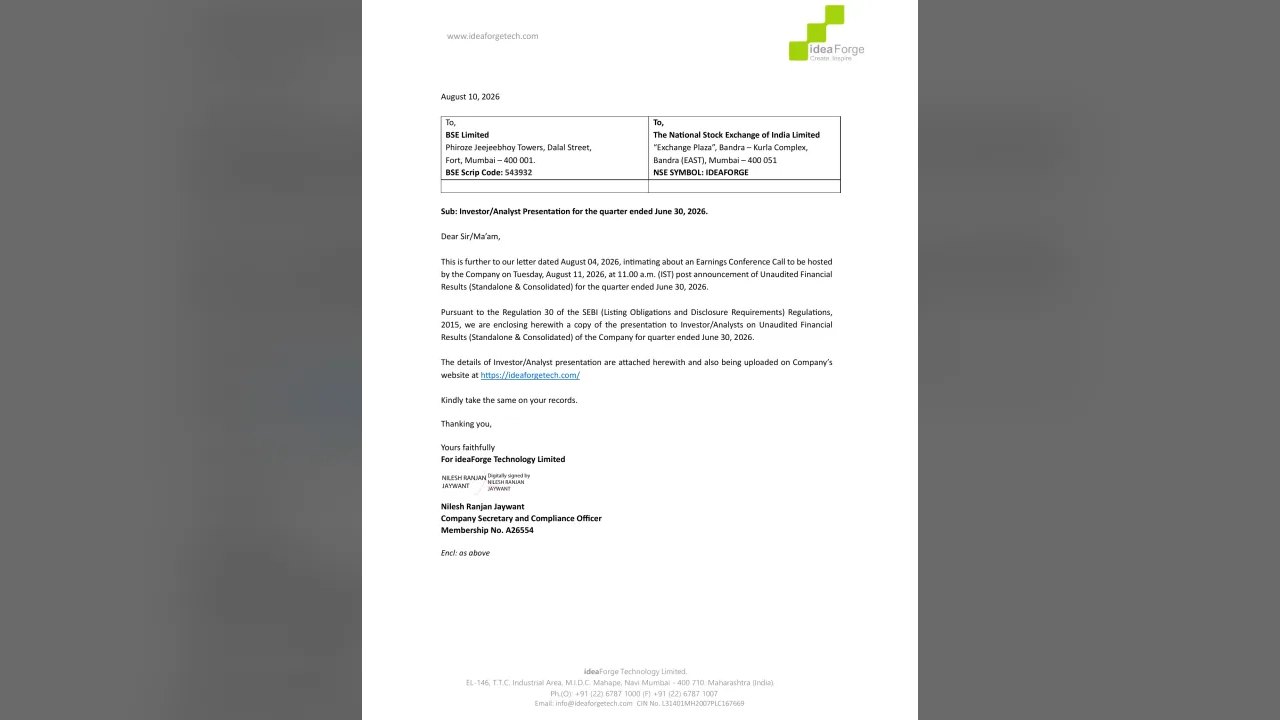
Ideaforge Technology (NSE:IDEAFORGE) Q1 2027 earnings call, held 2026-08-11. Watch the replay and read the transcript on 6ix.
On 6ix: 6ix.com/event/ideaforge-technology-limited-ideaforge-q1-2027-earnings-call
Automated transcript · Written by software from the replay's audio. It can mishear names and figures; the replay is the record.
0:00 Ladies and gentlemen, good day, and welcome to the Ideaforge Technology Limited Q1 FY 'twenty seven Earnings Conference Call. As a reminder, all participant lines will be in the listen only mode, and there will be an opportunity for you to ask questions after presentation concludes. Please note that this conference is being recorded. I now hand the conference over to Mr. Par Patel from MUFG End Time. Thank you, and over to you. Thank you, and good morning. On behalf of MUFG End Time, I welcome you all to Ideaforge Technology Limited Q1 FY 'twenty seven Earnings Conference Call. From the management side, we have Mr. Ankit Mehta, Chief Executive Officer and Hold Time Director Mr. Vipul Joshi, Chief Financial Officer and Hold Time Director.
0:56 I hope everyone had an opportunity to go through our investor deck and press release that we have uploaded on our Exchange and Company's website. A short disclaimer I would like to say before we begin the call, this call may contain some of the forward looking statements, which are completely based upon our belief, opinion and expectations as of today. These statements are not a guarantee of our future performance and may involve unforeseen risks and uncertainties. With this, now I hand over the call to Mr. Ankit Mehta. Over to you, sir. Thank you. Good morning, everyone, and thank you for joining us for Ideaforge's Q1 FY 'twenty seven earnings conference call. I'm joined today by our CFO, Mr. Vipul Joshi and our Investor Relations team. I will begin with the highlights of the quarter, progress on our key developmental programs and how we are positioned for the year.
1:48 After a muted FY 2025, the Indian drone industry witnessed demand revival in FY 2026, and many of our long term bets and investments were materialized into our order book and financial performance. While FY 2026 was a turnaround year after a short blip in FY 2025, FY '27 so far has been about building on that foundation that we have created over the years. Quarter one marked a steady start to the year supported by continued execution and advancement across key strategic developmental programs. Let me start with a few highlights. First, we delivered more than 20% of our FY 'twenty seven opening order book, recording revenue from operations of INR68.6 crores and closed the quarter with a positive EBITDA.
2:41 Second, we have made significant progress on our key developmental programs, advancement on combat capabilities like air launch effects and fuel hybrid long endurance capability for ZOLT, the first technical demonstrator of YETI completing the third hover test, multiple market ready developments on Flight Cloud, improvements on PW Resilience Stack, and DGCA type certification for our q six v two GEO UAV. Third, our deployed UAV fleet crossed 1,000,000 customer missions. These missions were carried out in some of the most challenging terrains and conditions, providing us with learnings that help us drive our product and technology development efforts.
3:31 Fourth, we secured the capital required to fuel our next phase of growth, raising INR500 crores through a qualified institutional placement and receiving a letter of intent for financial assistance of up to $1.51 crores for our middle mile logistics UAV jetty under the government of India's RDI scheme. Fifth, the demand environment moved in a positive direction with an announcement of 20,000 crore worth of drone procurements through fast track mode and substantial expanded delegation of financial powers to defense forces field commanders, signaling towards increased procurement activities in FY 'twenty seven and onwards.
4:18 Let me take each of these forward. On the execution and order book front, we entered FY 'twenty seven with an opening order book of more than INR300 crores, and our priority for the year is conversion of the opening order book into revenue. We delivered more than 20% of the same in the first quarter. We also reported a positive EBITDA, marking another quarter of improving financial performance. While global supply chain disruptions and component availability continue to pose challenges, we remain focused on completing delivery of the remaining order book of INR 2 and 56.8 crores by Q3 as per customer time lines. Coming to the technology and product side, our approach to new product and technology development has been to own the consequential technologies and deliver a complete solution to our customers.
5:14 At Ideaforge, we've always focused on engineering ownership on the layers that are most difficult and replicate and also turn out to be the most consequential for real missions and business health. The consequential technologies in the present context include resilient communication systems that can withstand jamming, resilient navigation systems that can operate despite jamming and spoofing attempts, secure command and control software, edge compute for intelligence, and specialized mission payloads. This approach provides a significant cost advantage as compared to the competition's need to use state of the art imported technology. It gives us technology sovereignty and reduces exposure to denial or withdrawal of technology and sabotage threats.
6:06 It allows us to adapt faster when customer requirements evolve rapidly and retail control over the security and performance of the system. Along with this, we have built several layers of technology, like BlueFire Touch ground control software for real time mission control, FlightApp and FlightWeb for remote drone flight requests and real time monitoring, and FlightCloud for data storage, post processing, AI analytics, reports, and automation to provide complete solutions to our customers. This enables customers to adopt secure and resilient mission critical UAV platforms that can also deliver final outcomes without needing the customer to orchestrate between multiple providers for all of these necessary but complex layers.
7:03 In Q1, we made significant progress in the development of combat drone capabilities like air launch defects and fuel hybrid long endurance capability for ZOLD. We are also in advanced stages of developing combat capabilities like long range strike platforms and loitering munitions along with our partners. With these new capabilities and our in house strength around resilience communication infrastructure for collaborative autonomy, we would be targeting to participate in the upcoming large opportunities from Indian defense forces. ESE achieved its first technical demonstrator milestone completing a test... Third hover test with all subsystems integrated, with the second technology demonstrator already in the design phase.
7:55 Our q six v two geo received DGCA type certification, opening up advanced GIS use cases across large scale mapping, urban planning, and digital twin applications. Six of our UAV platforms are now type certified by DGCA. Furthermore, we developed and released market relief capabilities on Flight Cloud, including automated video summaries, AI enabled event annotation and event search, and workflow automation for several use cases. This intelligence layer from Flight Cloud helps turn raw aerial data from hours of drone flights into insights that our customers can act on.
8:41 In q one, we also strengthened our electronic warfare resilience technology stack, extending our advantage in the ecosystem as more procurement programs make EW resilience and ENSS denied navigation mandatory. Our continuous development efforts on this front convert into a stronger competitive position. Many of these developments start as an experiment, which we have started to showcase to Ideaforge Labs. In Q1, we showcased multi UAV operations across mixed platform and air launch effects where one platform deploys another mid flight munition drop and tactical deployment trials.
9:30 These are experiments rather than release capabilities, and that is precisely their purpose. Labs is our way to share that experimentation never stops at Ideaforge. I'm elated to share that during the quarter, our deployed fleet crossed the milestone of 1,000,000 customer missions. Across our fleet today, an Ideaforge drone takes off somewhere in the world every two minutes. These are real missions flown by real operators in challenging conditions from altitudes higher than the Siachen Glacier, temperature as low as those found near both the poles to the high temperatures of Middle East and the Thai Desert to operating in the coastal environments in the open sea.
10:20 And now even in EW contested environments, each one has fed something back to our engineering and the choices we make in product development. With this field experience and a global patent portfolio of 112 patents filed, we continue to push the frontiers of UAV technology. To fuel all of these developmental efforts and our working capital needs, we have also strengthened the financial foundation of Ideaforge. We completed a qualified institutional placement raising INR500 crores with participation from marquee domestic and global institutional investors. The proceeds are directed towards product development, working capital and capability building. Separately, we received a letter of intent for assistance of up to INR 151 crore from the Technology Development Board for the advancement of our YERTI program under the Government of India's RDI scheme.
11:20 It is a low cost long term debt funding released against developmental milestones. We are among the first companies to be supported under this framework, which we read as a statement of where the companies or the country intends its data capability to be built. The environment around us is becoming structurally more favorable, and the procurement frameworks are also now aligned to faster and broader adoption of drones more than ever in our nearly two decade journey. On the capital procurement side, the reported opportunity pipeline is the largest our industry has seen. Public reports of INR 20,000 crores of drone procurement under the fast track procurement route from the Indian Army are now seeing the light of the day. With one opportunity in the RFP stage, others remain in the approval pipeline with the expectation of RFPs in the second half of the year.
12:19 Further, the Defense Acquisition Council has cleared capital acquisition proposals worth INR52000 crores, including a jet based Kamikaze drone system and a naval shipborne unmanned aerial system underscoring increasing importance of drones in the Armed Forces plans. On the revenue procurement front, the Indian Ministry of Defense has nearly doubled the operational procurement limits for field commanders of Indian Defense Forces through revision of the delegation of financial powers to Defense Services twenty '26. We are also getting positive signals from the field and we believe that this development would accelerate procurement activities in Q3 and Q4. We continue to see regular cycles on the civil side of the business that lean towards increased procurement activities in Q3 and Q4.
13:12 Let me now take you through the financial performance for the quarter. Revenue for the quarter stood at INR68.6 crores compared to INR12.8 crores in Q1 FY 'twenty six. Gross profit stood at INR33.6 crores compared to INR7.9 crores in Q1 FY 'twenty six, with a gross margin of 49% in the quarter and 61.7% in Q1 last year. EBITDA stood at INR 4.3 crores compared to INR 15.1 crores in Q1 FY twenty twenty six. Patch stood at INR negative INR22.6 crores compared to negative INR23.6 crores in Q1 FY twenty twenty six. Our order book as of 06/30/2026 stood at approximately INR256.8 crores.
14:05 We plan to execute and deliver this order book by Q3. Our focus for the rest of the year centers around a few key areas. We continue to focus on executing the open order book aligned with customer timelines. We will deepen ownership of critical technologies while further strengthening our ability to deliver complete solutions to customers across platforms, payloads, software, analytics, services, and lifecycle support. And lastly, we will expand them to combat drones, enterprise applications, and international markets where our technology and operational experience provide a meaningful advantage. Thank you. We can now move to the q and a.
14:55 Thank you very much. We will now begin the question answer session. Anyone who wishes to ask a question may press star and one on the touch tone telephone. If you wish to remove yourself from the question queue, you may press star and 2. Ladies and gentlemen, we will wait for a moment while the question queue assembles. The first question is from the line of from Philip Capital. Please go ahead. Thank you for this opportunity, sir. So my first question is... So first of all, very elaborate to opening remarks, so thank you for that. And also one thing that I felt was missing was a commentary on your U. S. Operations. So if you can help us with the scale up that is happening in your export and U. S.
15:42 Operation, And what kind of market and opportunity size can we expect from from your US operations? And if you can give us some number around it. Thanks, Deepin. So from The US operations side, our focus for the present time has been shifting to two areas. One is that we are working with our partner to operationalize the JV that we have signed up over there. And secondly, we have a couple of regulatory approvals that we need to get, particularly around the BlueSUA certification, which is the work in progress because it's only after we get the certification, which has now become or open an application process as compared to earlier, that we will be able to gain substantial progress on the defense and federal side of house in US. So that's work in progress for us, and therefore, we are taking a little bit of time to fuel both the...
16:42 And work towards operationalizing the JV and the new certification. With respect to rest of the international market, we continue to look at partnership opportunities in Europe and Middle East, whereas in the South America and Africa, we have live opportunities. We have our partners now looking to buy our, what is known as mark for resale units, NFR units. We have orders in for those as well now, but we are working towards increasing our presence in some of these geographies where we believe we can get more traction without the need for joint ventures alone. Got it. So, sir, any any idea on the market size for The US state? What kind of market and opportunities can we expect once we get those approvals and all these qualifications?
17:33 See, many US programs that are coming up right now, like the contract programs around drone dominance, etcetera, most of them run into several tens of thousands of crores... Tens of thousands of dollars at this point in time. In fact, I feel like at least one of the programs that is live right now is about $30,000,000 program, where they have many players who will be participating. So there are many such programs that are coming up again and again. There is a very rapid pace of adoption in defense right now that's happening there, and we are exploring towards participating in those once these certifications, which do take time, come through as well. Got it, sir. So my second question is on the lines of the order inflow that we expect in going ahead, sir. So while we have capabilities, we are being tested and at the same time we are getting funding from the government side of it also. But still from the government side, while there is a requirement, orders are not coming in. So whether it's a disconnect or whether it's cash from the government expectations or from some criticality, that order moment is slow, not only for you, but the entire loan space as a whole.
18:45 So can you help us understand that a little bit? It's been like I mentioned, there are some opportunities that are already in the RFP stage. These are the large FTP opportunities, which have a specific cycle of conversion from approval at the TPB to final order placement. Whereas those large opportunities are in progress at various stages of approval within the armed forces. With respect to the run rate business on the revenue side, where the army commander's power have been enhanced, typical cycle of that business when there is no EP linked timeline is roughly that they start rectifying around q three and q four timeline itself. So that's that's typical unless and until there is a EP program running.
19:36 So we'll expect about bunch of that at that time. Mister, we request you to rejoin the queue for a follow-up question. Ladies and gentlemen, in order to ensure that the management is able to address questions from all participants in the conference, Please limit your questions to two per participant. Should you have a follow-up question, we request you to rejoin the queue. The next question is in the line of from. Please go ahead. Hi. Thank you for the opportunity. Sir, my first question is regarding the... There was a article recently that I was reading that Indian armed forces have released the RFI for 2,715 logistic drones.
20:21 And as I understand, there is another company by the name of Bluejay Aero, which has also already very recently tested... Flight tested their logistic drone. So I want to understand how Jetty is placed in this RFI that has been released by Indian Army, and how different or similar is Bluejay AeroLogistics drone with Jetty, if you can add some comment on that? So this RFP that has come out that has largely focused on the altitude at which they want to operate these systems, as I understand, they have not yet looked at or specified. They're seeking information from the market as to what capabilities are available in the market to serve at these altitudes.
21:11 So, obviously, we will be responding to the RFI. However, in terms of your question around BlueJ, in my opinion, you know, there are not just BlueJ, but there are a lot of people who have been delivering and demonstrating logistics drones across the Indian ecosystem. I think what will matter is that at what altitude can people operate these systems at and what is the max payload that they can carry and at... Up to what distance can that payload be carried. For example, Yeti, in my opinion, is the only platform in the world from whatever we have searched that is designed to take off at a 6,500 meters takeoff.
21:58 Other platform that we are aware of has an ambition of this scale, neither has neither have we seen too many efforts that look at at that altitude carrying up to 200 kgs. Now depending on the payload, the range of operation at 200 k g's might be restricted to 50 kilometers. At a payload of 50 k g's might extend up to even 200 kilometers. So that is the kind of challenge that we have taken on Yeti. So it is slated to be the most challenging, yet the most, you can say, required platform because logistics in those altitudes is the hardest problem that our forces have to face every day.
22:46 Our vision with YETI is to make the world flat, and whatever high altitude areas that exist in our country, if we can serve them from the at the fastest possible pace with high capability like this, I think we would have really changed the ecosystem and the game. That that... That's great to hear. So just to follow-up on this, so how how big opportunity size can this be for us? It says RFI, which has been released for 2700 just to begin with. So what would be the opportunity type for us in this case for ST? See, Tushar, the thing is that right now it is at an RFI stage. We are not aware of what is the final specifications at what altitude that the customers have finalized.
23:36 All of it being required in the YETI domain may also not happen. Therefore, it may be too early to comment on that. I just know that if this converts into a fast track procurement case, budget for each fast track procurement case is up to 2,000 crores. That's what happens in a fast track procurement case, and capital procurement does not have a budget limit. So it will depend on which more this comes through, and that will define the budget for the opportunity. Okay. Okay. And then my second question is regarding this r... First RFP line has already been on, like you, yeah, like you mentioned in your presentation. So so which... For which category of the drones is this RFP for, and have we also bid for it? And are we going to bid for all the combat drones RFPs as well?
24:29 So this one particularly is centered around the hybrid variant of our ZOLT platform. And, yes, we have participated in it, and we are also going to continue to put efforts towards participating in any combat related platforms as well that come through. Within the category of systems that we build presently, we don't build for each and every category, so some we will have to let go for sure. And what is the price of the RFP which which has been on? I think, again, it's an FTP opportunity. So my assumption is that the budget would be up to the value that I had mentioned. In terms of the opportunity itself, it's an ISR opportunity presently, this one.
25:16 Okay. And, sir, it's it's heartening to see our current order book is 60% defense and 40% civil. So can you just help me understand the customers or whether it is government or private for the civil and in which segment are these civil orders for? That's my last question. So this was not the split of our order book. This was the split of the revenue we delivered. And in terms of customers, it is split between few customers on the homeland security side on the civil side and some private customers as well. And the current order book is is how much difference and how much civil? That we don't disclose at this point in time,, typically, but it's heavier towards defense.
26:05 Okay. Okay. Thank you. Thank you so much, Pankaj. Thank you so much. All the best. Thank you. Thank you. Ladies and gentlemen, I request you to limit your questions to two per participant. The next question is from the line of from Vayu Capital. Please go ahead. Thank you for the opportunity. Hi, Ankit. As always, it's nice speaking to you. My first question is on our combat capabilities. So I just... It's still not clear to me that are we still focusing on air launching another combat from our existing platforms or adding missiles or munitions to our as a payload to our existing platforms or we are also working on increasing our capabilities towards developing airframes, which are are which are variant of existing platforms like Zolt and Switch?
27:04 Both, Nikhil. Both. We're doing both. There are variants that we are creating of our quadcopter platforms that can act as kamikaze systems as well as we are doing the evolution on the air launch defects. So if you look at the air launch defects, it's another drone only carrying a position which will go around to the mission. So, essentially, when we do that, we are developing an airplane that can actually go and act like a kamikaze system as well. So, I mean, when we do one, we do both as well. That's that's what happens. Right. So the last question is on our inorganic growth. So now we have, like, done the QIP, and also we can see that there there there is a lot of tailwind in the industry, and there's a lot of participation.
27:56 So are we looking on any inorganic growth? I mean, are few companies which may have similar DNA as ours, and we may lack some capabilities. So I think we should go for some inorganic growth in that segment so that we can add our capabilities. So just wanted to know your opinion and your thoughts on the broader sense. We are open, Nikhil. If we find a partner with the right mindset, the right capability depth as well as the right value for the market, we are open. As you can see, the combination of the three is harder to find. And, therefore, we continue to evaluate, but there is no specific target that we have in mind that fits both of... All three of these because, see, we build from first principles.
28:48 And to build from first principles is a slightly harder problem than to system integrate capabilities that others have built. Alright. Thank you so much for your answers. Good luck. Thank you. Thank you. The next question is from the line of Rajvir Singh from Vivek Investment Managers. Please go ahead. Hi, Idea. Thanks for the opportunity. My first question is on the combat drones and the loitering munitions and long range strike platforms that you've spoken about. Can you help us understand whether these are still primary R and D and development programs or whether you are already seeing identifiable procurement opportunities and customer requirements?
29:40 That is my first question. And my second question is is that can you build a software plus autonomy mode? I mean, hardware can potentially become commoditized. So where do you believe Ideaforge's strongest long term mode will reside? Whether it will be in... Either new resilience, autonomy, communication, software, system integration. So your thoughts on this? Thanks, Rajiv. You know, Ideaforge, we decide to go after a domain. And once we decide to go after a domain, there are some experiments that you do to build foundational capability of that domain. And there are specific projects and programs that you deliver that will basically meet some of the customer requirements that are visible to us in the domain.
30:36 So you will see that our development is mix of both. The platform that we intend to really develop need to be ones that we are aware of our customers wanting to deploy, and therefore, they have to that developmental effort. However, to initiate the development of a domain, you run some experiments which allow you to develop familiarity with the domain, and that you choose to do in the fastest possible way. So that's a mix of how development typically happens in any new domain for us. In terms of our moat, like I very clearly articulated during the call as well, my speech as well that Ideaforge looks at moat in two domains. Right?
31:23 One domain is in terms of hardware, what are the technologies that are not yet commoditized, and do we have control over those technologies or not? Are we going to pay a disproportionate premium to the market for acquiring those capabilities, or can we build them ourselves? Today, I'm glad to report that we own most of the consequential technologies along with the along with having spent years building the technologies that were consequential at that point in time. For example, when we started Ideaforge, there was no autopilot company that could give us an autopilot that we could use, and nothing was available to source. So we did our own autopilot.
32:11 We based our own regular communications in science. We we started to build up from the science stack around GNSS and communication. So today, we own communication, which is noncommoditized. We own GNSS and our navigation, which is noncommoditized, and we own payloads. It's like a specialized domain as the class of the platforms goes up. So we own the consequential parts of what is going inside the drone, so we continue to keep a tap on what else could come up go ahead with drone, which is not yet commoditized. Secondly, with respect to intelligence, there is no debate in my mind that, ultimately, we need to deliver an outcome to the customer. The customer is not getting their outcome merely by operating a drone.
33:01 And therefore, the intelligence that enables and the orchestration that delivers a mission to the end customer, the mission outcome to the end customer is another stack that we work progressively on, and we now have a pretty robust stack for a few use cases that is also delivered. Now because we have that stack, we deliver it as a drone as a service as well in many places. So we are a mix of both, and I think both are important for a business like ours because while the technology will get commoditized in pieces, we will always continue to look at where the fuck is going rather than where the fuck has been to try and contain and retain more that is necessary for the market.
33:48 It helps us in building tightly integrated, better performing, more reliable solutions for our end customers. Perfect. Thanks for answering my questions. You. Thank you. Ladies and gentlemen, I request you to limit your questions to two per participant as there are several participants waiting for their turn. The next question is from the line of Nidotpal Sahoo from GM Financial. Go ahead. Hi, sir. Good morning. Am I audible? Yes. Congratulations on the strong execution. I just wanted your thoughts on the ordering prospects. So how much of these prospects do you see converting like in the near term in 'twenty seven, FY 'twenty seven? Or do you see most of them getting pushed out to 'twenty '8 and 'twenty nine given that they are still at the approval stage?
34:48 And if you can quantify some of it? See, we are expecting a lot more outcome from the revenue programs and the run rate programs in the present year. There are certain other opportunities which are not linked to any specific opportunities that again have visibility for the year. In terms of the programs around fast track procurement, some of them as they get to RFP towards the end of the year, we will see a slip into FY '28 for some of them. For at least a couple of them, we expect that the outcomes may happen within this year itself. So what in your assessment could be a ballpark quantum of inflows that you are being convert to orders for the year?
35:41 That we are not presently projecting,. Understood, sir. Understood. Also, I just wanted to understand since we did deliver a very strong execution and challenging environment, are we seeing any major supply chain constraint in executing our sort of order book by Q3? Or those are largely procured? Also due to the current ongoing geopolitical conflicts, there is a pressure on the supply chain of thermal cameras, and the electronic supply chain also is seeing a certain pressure where the timeline delays are happening. We are reviewing them very closely and getting prepared for deliveries on time for our customer timelines.
36:31 Got it. Got And also, just one last question. Anything on exports that we see materializing in this year? Aside of the aside of the opportunities in The US, we are still working on the certification? Yeah. So like I said, we have seen good interest from partners across the world right now. Many of them are investing in our NFR systems as well. And therefore, as we do more and more demonstrations and some of our live opportunities come to fruition as the year progresses, we should see some conversion. But, I mean, we will continue to report as we get those orders in hand. I request you to rejoin the queue for a follow-up question. The next question is from the line of Gaurav Chaudhry from Systematics Group.
37:23 Please go ahead. Yeah. Am I audible? Yes, sir. Yeah. Thank you for the opportunity. I'm Abhijit Singh from Systematics. And, sir, first question is, so versus having more and more capabilities in house in terms of a drone, like you mentioned in the previous comment about having communication and certain payloads now that we are doing in house versus, let's say, five years back, we might have been outsourcing them. So versus, you know, these... Comparing these two scenarios wherein we have more and more capabilities in house and have more of an integrated manufacturing, How do you see the competitive advantage in terms of bidding in both domestic and international markets from this perspective? You're having more and more your manufacturing capability for a drone.
38:14 So if you can, you know, please throw some color on how you think about this particular aspect. So in terms of having more and more of our own capability, it is very important to understand that we essentially do that for reasons that we find that the capability that we are trying to acquire from our partners or other providers in the market is available at a very high premium that we believe our customers cannot afford in the long term, and therefore we invest behind those capabilities. Number two, in terms of manufacturing and partnering with other partners across the globe, we are continuing to build a more open ecosystem around us.
39:05 For example, we support third party payloads on our platforms. We are... In order to participate in a collaborative manner, we have a lot of variants we can create because we are happy to have our partners and their systems integrated into our systems if there are opportunities that require us to do that kind of a partnership. So we are not as concerned about it being a bottleneck for any of the expansion of the other areas because we are open. We will partner with people with the right capabilities for the right applications. At the same time, having control over some of these things as a core part of what we do gets the benefits like we mentioned.
39:51 We can be more competitive as well as we don't have dependencies that can cause denial or risk that usually some of these platforms have started to show up as in the global ecosystem and environment. Yeah. So understood. So what is the current level of indigenization that we have? Let's say, we do 100 rupee product. What is the kind of value that gets imported for the components there? And how do we... How much do we do in house versus that? Last year's number. So roughly about, you can say, 20%, 22% of our revenue is an important... A substitute.
40:38 And you can say our international content across our product line is roughly about 60 to 65%. 65% is the imported? No. Individized content. Okay. Alright. Alright. Thank you, sir. I'll get back in queue. Thank you. The next question is from the line of Alicia Mahavala from Trust Mutual Funds. Please go ahead. Hi, sir. Good morning. I have my earlier participant, but I don't really want to scale. Could you please be challenges to see Alicia, apologies. Alicia, Your voice is not very clear. I hope I'm audible now.
41:24 Yes. Yeah. So my question was that the challenges or the pressure we've seen in Q1 with respect to gross margin and the fact that we're looking at executing, you know, the order that we have over the next two quarters and geopolitical issues or the supply chain constraints are not resolving anytime, would we expect this pressure to continue while we execute this order book? No. So, Alicia, if you see the product mix was more... It was, see, our usual product mix, like, for example, last year was seventy thirty. And this quarter, it was sixty forty, which is which is the kind of variation that happens in our business because of what we deliver in a specific quarter.
42:10 Today, because EW resilience is a necessity on the defense side, that business has more margin contribution than the civil business, which is not delivering an EW resilient product. And therefore, you see a little bit of gross margin movement there, but it is not going to substantially move us away like we had mentioned from the 5055% odd number that we had given for the year as a blended expectation. So we do not expect that number to be shifting on an overall basis. Quarter on quarter, like a... Like in our business, it depends on the deliveries and stuff that we're doing. So a little bit of color on that hopefully helps resolve that. So there is no pressure in that one sense on the overall GM expectation because of the challenges. It's just just timeline of supply that we are struggling with sometimes.
43:13 Sure. And all the details that is required to execute this order book over the next two quarters, that is in place. We don't see any delays because of the supply chain disruption. We are not anticipating delivery delays as of now. As I also answered in the previous question that there are challenges in terms of thermal supply chain and some of the electronic supply chains, overall timelines are shifting. But as of now, it is not impacting our overall time commitments to the customers. Okay. Thank you. Thank you. The next question is from the line of Madhun James from PMS. Please go ahead.
43:59 Hi. Thanks for the opportunity. I believe reading the reports and all that, we are actually in a kind of an opportunity in terms of drones and anti drone systems where we are seeing lot of demand across armed forces world over. And Ideaforge has got a right to win based on the pedigree, lineage and the vintage. But are we moving fast enough? For example, do we have capabilities in the ale and mail category and all that. So can you put some more color on the defense capabilities that we are trying to start off and which are the new segments, especially I'm talking more from the defense perspective, which are the new areas, opportunities that we are pursuing currently?
44:57 It's a great observation that we are at that inflection point that seems to be very imminent and very you know, opportune moment for the industry in terms of how much we can do. We have purposefully presently stayed away from runway dependent systems because we believe that there are certain challenges with respect to the nature of those systems, the quantities that can be procured, and overall developmental time frame for those systems. If you look at most of the players in the ecosystem are able to get to the market with this particular class of systems with partnerships of... With somebody who's already done it presently because building it grounds up will take longer.
45:56 And therefore, you know, we won't enter that category for sure. Apart from that capabilities that require operations from a backpack, from a rucksack, from a pickup truck or a container portable system. In these four broad categories, we continue to develop capabilities. And and, yes, I think given that we own the subsystem layer as well, we are accelerating our deployment and development journey on many programs at this point in time. Right? One of the capabilities, we mentioned, is the capability around combat drones. We are working towards hybrid propulsion for some of our systems.
46:42 And like we also mentioned, we are looking at one way attack systems as well as on the software side, we have multi review operations, warming, and many other facets that we have the entire hardware interface around. We have the work that is on in terms of evolving it towards more intelligent operations. So edge compute, edge AI, there are many, many facets that we have built over the last few years, which we are now bringing together to deliver advanced capabilities to end customers. Sure. I understand your point. Another second question would be that since you have a lot of capabilities in terms of what I mean is your in house capabilities in autopilot, payloads, JMS rigid night applications, software stack and all that.
47:42 Are we looking at not only being an OEM, but also being a Tier one supplier to some of the OEMs, which are we see a lot of companies getting into the drone business, especially looking at the defense procurement and all that. So since you have this capability and traditionally what we have seen is that most of the money is made by the Tier one suppliers rather than the OEMs and platforms. So do you have any thoughts related to that? So one of the things that we're doing is that when we partner with certain, you know, collaborators of ours, we enable them by taking their airframes and populating them with our subsystems and building capability, which is a mix of that hardware capability and our entire avionics and GNSS denied and resilient navigation stack.
48:42 So those are the kind of things that we are presently working towards because it's more convenient to handle that when we look at it. Supplying a subsystem is an area that, again, is under exploration, but we haven't yet arrived at the final configuration that is explorable there. It takes a lot of effort actually to support other people in their development. So we are we are exploring what is the right way of doing it while we have to balance everything that we need to do for the opportunities today. Sure. And last one, if I can speak to one more. Yeah. Sure. I'll get back on it. Thank you. Ladies and gentlemen, I request you to rejoin the queue for a follow-up question and to limit your questions to two per participant as we have several participants in the queue.
49:36 The next question is from the line of from Sapphire Capital. Please go ahead. Hi, sir. Thank you for the opportunity. So how do we look at revenue and gross margins for FY 'twenty seven and for the coming years? So, Idea, while we do not disclose or give forward looking projections on the numbers of top line, as we have also that for this year, our blended gross margin would likely hover between a 50%, 55% range. Subsequent years, as Ankit has enumerated that right now, the opportunity sizes and the shift with all the fast track procurements also coming in foray as well as the Army Commander's Power's enhancement is bringing in the sizable opportunities for our size of drones. And hopefully, that will start to show up in the order book from Q1 of and I was into delivery in the subsequent eighteen months.
50:46 Okay, sir. And in terms of CapEx, how much are we targeting in the coming years? Right now, we do not have a a CapEx plan other than our regular product development efforts that will continue in pushing the boundaries for our continued programs that are already there. But there's no plan on setting up any factory setup for enhancing our capabilities because right now, we're only using a single shift model or we can enhance and go to both three shifts in the same space. Okay, sir. Thank you, all the best. Thank you. The next question is from the line of Prateek Singh from Hillars Capital. Please go ahead. Yeah. Thank you for the opportunity.
51:34 Ankit, just to understand, what is the kind of opportunity in the nonorder book space? You said your FY twenty seven pipeline of regular revenues and repeated orders is pretty strong. So can you just give a sense or some ballpark numbers around that would be helpful? So Prateek, what you're saying is beyond the FTP and the revenue opportunities, you're saying? Yeah. Correct. Yeah. I won't be able to share to get more sense, like like, since your current order book is executable till 3Q FY 'twenty seven, so I'm just trying to understand how do you bridge that remaining three months of FY 'twenty seven. Is there any nonorder book related revenues which usually flows through throughout the year?
52:30 Yeah. Yeah. So we have our... One is our run rate business where on the service side and the defense side also command level procurement happen. So that that continues to happen through the year. So that... Those powers have been enhanced for the armed forces. So that's something which is what we are, you know, excited about, and we should see that rectify in q three, q four time frame, outcomes of that. And in terms of other opportunities, there are some other opportunities as well that we are pursuing, which we can't necessarily speak about right now. Got it. Fair enough. All the best. Thank you. The next question is from the line of from Growth Spear Ventures. Please go ahead.
53:21 Yeah. Am I audible? Yes, sir. You're audible. Thanks for the opportunity. I just want to know, like, there is some circulation of RFP regarding the 100 kilometer and 50 kilometer ISR drone. And the paid trial was supposed to happen in last July sorry, this July. So has Ideaforge performed in this technical trial for 100 kilometer? Those are the opportunities that are under evaluation right now. Trials have not happened yet. Okay. And for the 50 kilometers, any idea? I don't think there was anything for 50 kilometers right now. All over at RFI stage only. RFPs are only converted at 100 kilometers.
54:14 The remaining RFPs are in progress at the moment. Okay. Sure. And for The US retail market, given the... There was a strong presence of Skydio and DGI in US market. So what white space is being targeted by Ideaforge, like, where we can make a differentiation against the idea and DTI for US market? See, our specialization is around being able to operate in extreme cold environments and extreme hot environments. And secondly, we are one of the best assets globally for persistent surveillance operations. So these are the two areas that we focus on, and customers appreciate our platforms due to the long flight time that we offer while being able to operate in these challenging environments and also high altitude capability.
55:14 I request you to rejoin the queue for a follow-up question. Ladies and gentlemen, please limit your questions to per participant. The next question is from the line of Sachin Jha from SB Capital. Please go ahead. Am I audible? Yes. Yes, sir. Audible. So, basically, sir, I am more interested in looking at markets where you can capture. Suppose Indian government got a tender of 10,000 crores, so how much of it can come to you? Because there are many bigger players, defense players like Adani is also going, Tata is also going to show how much market share you can capture? Shashank, in terms of market share, I think what remains to be seen is in what shape and form these opportunities come and whether there is a ready product that can be pitched or near ready product that can be pitched for these opportunities or not.
56:16 Since some of those details are not yet frozen, I cannot suggest specifically a market share, but what I can say is that our attempt is to participate in maximum opportunities of whatever is going to come. So we are geared up for maximum participation at this point in time. And once the opportunities become real and come for bidding, we will be able to address what's possible from what is coming up from our segment. And so that is a follow-up question. So what is the success rate? Suppose you participate in 100% of the tenders, so how how much success is you you expect from there?
57:06 Big success is That, I think, is entirely dependent on the final requirements that the customers have for that particular product because competition is determined by the depth of the specifications that the customer asks. So I'll probably be able to comment only on a case by case basis. Wherever the specifications are challenging, participation is usually low and less output... Less products exist that can clear such tough challenges. Wherever the requirement is slightly more lenient, you end up having more competition. So it will entirely depend on the color of what comes up. So it can be the case by case basis.
57:53 And, Shashank, since the opportunity are distributed between an ISR plus combat, some of the combat opportunities will also see how our partner readiness will be for those opportunities. So it is not just the ISR readiness of IDEAFORGE, but also the combat readiness of some of our partners and related to specifications coming in these RFPs will determine the success ratio on outcomes. However, just want to reiterate that our effort to participate in maximum at this point in time. Thank you. Ladies and gentlemen, we take that as a last question due to the interest of time. And now I would like to hand the conference over to the management for the closing comments.
58:44 Thank you, everyone, for your questions and for your continued engagement. I would want to reiterate that opportunity cycles, product mix, delivery schedules, supply disruptions, working capital requirements and customer acceptance can vary our quarterly results. However, we are focused on managing these variables and building a strong and resilient business to create long term value. Thank you once again for your support and confidence in Ideaforge. Jahin. On behalf of MFG InTime, that concludes this conference. Thank you for joining us, and you may now disconnect your lines.
Follow Ideaforge Technology Limited into a list and get an email when it puts out news.
at MUFG End Time
Chief Executive Officer and Hold Time Director at Ideaforge Technology Limited
Chief Financial Officer and Hold Time Director at Ideaforge Technology Limited
at Vivek Investment Managers
at GM Financial
at Systematics Group
at Trust Mutual Funds
at PMS
at Hillars Capital