Gautam Seth
joint managing director and CFO at HPL Electric and Power Limited
Replay available
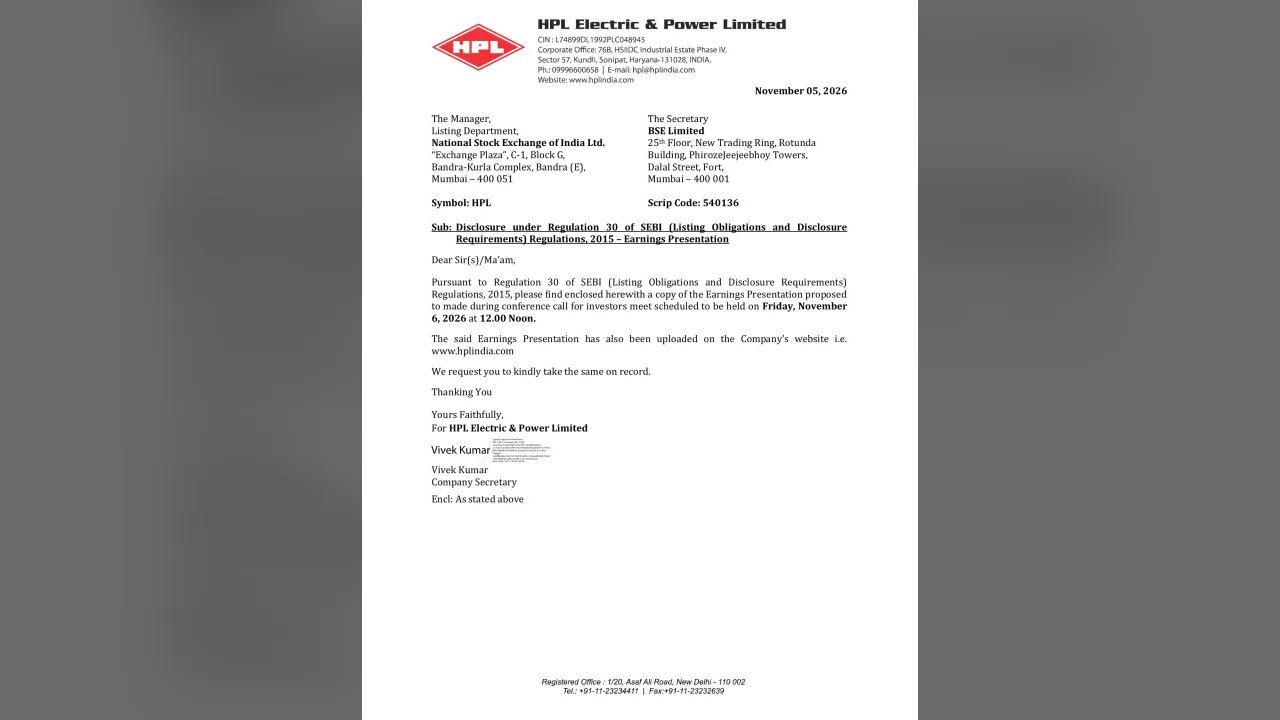
HPL Electric & Power (NSE:HPL) Q2 2027 earnings call, held 2026-11-06. Watch the replay and read the transcript on 6ix.
On 6ix: 6ix.com/event/hpl-electric-and-power-limited-hpl-q2-2027-earnings-call
Automated transcript · Written by software from the replay's audio. It can mishear names and figures; the replay is the record.
0:00 Good afternoon, ladies and gentlemen. A very warm welcome to you all to HPL Electric and Power Limited's q two and h one f y twenty seven earnings webinar produced by LOVs. So I'm Shankini. I'm the director of investor relations at Dickinson, and I'll be moderating our call today. So joining us from the HPL management team is mister Gautam Seth. He's the joint managing director and CFO. Just a quick note to all our participants. This conference is being recorded, and some statements in this call may be forward looking based on current expectations and subject to risks that could cause results to differ materially. You can all download HPL's investor deck and press release from the company website or the NSC.
0:46 We'll get started. I'll hand over to Gautam to begin with some opening remarks. Yeah. Thank you, Shankini. Good afternoon, everyone, and thank you for joining us today. Q two f y twenty seven builds on a strong start of the year. Revenue from operations grew 40% year on year to $60.08 crores, our highest ever quarterly revenue. And the first time, we have crossed 600 crore level. This takes first half revenue to 1,124 crores, up 37%. EBITDA grew 8% to 71 crores during the quarter, and PAT increased to 23 crores.
1:34 More importantly, the first half further strengthens the two engine growth model we have been discussing. Consumer and industrial is becoming a larger, more diversified product and channel led pro... Platform, while metering and systems continues to provide long cycle growth and execution visibility. Both businesses are growing, giving HPL Electric a broader base for which to build. Consumer and industrial delivered another record quarter with revenue growing 64 year on year to $3.37 crores. It contributed approximately 55% of the quarterly revenue. First half revenue grew 60% to $61.05 crores.
2:22 This reflects the increasing scale of the business and wider participation across our product basket. Wire and cables continued to lead this growth with quarterly revenue increasing 159% to $1.78 crores. First half revenue reached $3.24 crores, to approximately 95% of the revenue achieved in the whole of FY twenty six. Demand continues to grow from a diversified customer base, including builders, industrial and solar OEMs, telecom, and institutional customers. As this business scales, our focus remains on strengthening volumes, customer relationships, and the capacity to support sustained growth.
3:16 The participation of other C and I categories is also encouraging. Lighting grew 59% year on year with domestic switchgear growing 43%. Industrial switchgear recorded 29% sequential growth. Our objective remains to build a diversified electrical platform with a wider range of categories contributing meaningfully to growth. Our distribution network remains central to this strategy. With more than 900 authorized dealers and 90,000 retailers, we have an established platform through which to deepen market reach and strengthen the channel productivity. A broader product offering gives us a greater scope to build these relationships while continue to invest in products, brand, and service.
4:09 At the same time, metering and systems maintained steady growth. Quarterly revenue grew 18% year on year to $2.71 crores with a 14% sequential improvement. First half revenue grew 17% to $55.09 crores. As the smart metering market moves towards a more matured execution phase, our focus remains on reliable delivery, technology, and close coordination with AM ISP deployment schedules. Our order book stood at 2,700 crores as on 11/02/2026 with metering and systems accounting for more than 96% of the total order book. This provides visibility beyond the current year, although the pace of quarterly conversion will continue to depend on customer requirements and execution schedules.
5:06 On profitability, first half EBITDA increased 9% to $1.35 crores. Q two EBITDA margin stood at 11.74% compared to 12.26 in in the first quarter. Input cost volatility and changing revenue mix continue to affect profitability. Pricing and product mix actions are underway, but the benefits are yet to translate into the recovery in reported margins. We remain focused on improving profitability with both businesses as we build scale. Before I conclude, I would also like to address the board's in principle approval for a proposal of restructuring the company. This includes evaluating the segregation of one or more of these business into separate entities through a scheme of arrangement with the objective of increasing focus across our product verticals and unlocking shareholder value.
6:16 As we discussed in the recent quarters, HPL growth profile has broadened with consumer and industrial developing alongside our metering business. This creates a relevant context for examining how our organization structure can best support the requirements and opportunities of our different businesses. The proposal is at the evaluation stage. Looking forward, the direction of the second half... Yeah. So on that note, I think let's open the floor for the question and answer. Thank you very much. Yeah. Thanks, Gautam. We'll get started with the q and a section now.
7:02 As a reminder to all our participants, to raise your hand to pass it... To participate in the q and a session, This is a quick reminder on how to do so on this platform. If you're on desktop or laptop, look for the reactions button at the bottom of your Zoom window. Click on it, then select raise hand from the options. Your name will appear on the queue, and I can call on you. If you're on mobile or tablet, tap on the more dot dot dot button at the bottom right of your screen, then select raise hand from the menu. Great. We'll start with the first question. Our first participant asking a question is from Sahil Patani. Hi, Sahil. You can go ahead and unmute your line and ask your questions. Hi. Thanks for the opportunity. Hi, Gautam. Congrats on a on a good set. Yep.
7:52 Thank you. Yeah. Wanted to understand, obviously, there's been a drop in margins due to the commodities and global price variability. But, how do you see the margins normalizing in the second half of the year? Yeah. So as you said it, the, the the margins... So we have seen the cost of materials increase, and, this is, mainly because of the geopolitical situation what we have seen from, March onwards. Now we, like, looking at the two businesses in metering since we have the fixed contact, the contracts what we have, so, the the cost increases, which is primarily on the metals, on, industrial plastics, on electronics.
8:40 So these are, these we are not able to pass on. But although there are a lot of r and d efforts to make sure that the costs are somehow compensated through better design, a better way of, manufacturing. In consumer and industrial, we have, to some extent, already passed on certain increases, which have happened in the second quarter. There are some more increases which are lined up, post Diwali. So in all, I would say by by by the time we are, coming to the close of, q three, the the increased cost, to a large extent would have been passed on to the consumer. And, so, like, the the way the consumer business is, the increases... We have an opportunity to pass the increases, but always it's with a time lag. It may be one month. It may be two two months, but generally, they get passed on.
9:30 And that is how the industry also have been working. So so it should happen. So hereafter, I I see that, maybe the margins at these levels may may... Maybe the EBITDA around 12 should stabilize here. And, with... Hopefully, with the geopolitical situation improving, I think we should... Could see a a reversal in the in the margins in a positive directions in the future. But right now, I think we should stabilize. I don't see the margins going down further from here, but, at least in the C and I part, it should start coming up. And even on the metering front, there have been lot of, workings, but they are more r and d related working, which should, help us. Also, the increased volume is going to help us to some extent because if you look at the... Especially the C and I segment across all the segments, whether it is wire and cable, whether it's lighting, fans, industrial switchgear, domestic switchgear, all have seen a very high increase in volumes.
10:35 So that has also going to help us in some way getting certain cost differential, know, in... Based on the volumes. So some way we are looking at it, definitely, we are very well aware and committed to, you know, bring back those margins because... Especially when we are seeing a very good demand coming in, even going forward, and the volumes and sales are in front of you, and that's also going up here. Okay. Okay. So, for the full year, we should be looking at stabilizing around 12, 12 and a half percent. Is that right? Yes. Yeah. Okay. Okay. My second question is, I think in the previous con call, you had mentioned, or I'm not sure if you did, that We are doing some sort of r and d, for cables and wires, that are used in the data centers as well. So can you provide an update on that?
11:28 Yeah. So we so we have a wide range of, products. But right now, our products are all in the domestic wire and flexible segment. But there is a lot of work what we have done on coming out with, different new types of cable, new types of specialty cables. And, but those products, I believe, will be out by... Only by, end of first quarter. So it should be somewhere in the June when we should be out with those products. And, I'm talking about the commercial production. Yeah. And, so as and when that is happening because you you should hear that, you know, once the whole business plan is in place, then I think we should... We will be, coming back that on on what the plan would be, what kind of investments would be there. And...
12:16 But it's a whole range of products what we are looking at, not just the, the data center products or something like that. But they would definitely go into data center. They would be more, you you know, know, going into infra... Into EVs. So today, there are a lot of areas which are of high growth, in the next five, ten years. And I think our product range in future is going to address those segments as well. Right now, I've said it multiple times, we are, doing a lot of cables for the telecom sector, but there are a couple of other seg... Segments as well which we are looking to pick up in in the next three to five years, you know, on on how we can dominate those areas as well. Okay. Okay. So the r and d that, is going on right now, I think the complete fruition of that we should see in, let's say, f y twenty nine, f y thirty, or even beyond that. No. Even, yeah, even before. We we should start seeing before. Those are those are two long term plans, but Yeah. You you should start seeing it by maybe some part in FY '28 itself and then '29. Yeah. Alright. Okay. Great. That's all I had. Thank you, Gautam. Yeah. Thank you, Sai. Thanks, Sai. We'll take a question that's written in.
13:35 So question is, we are seeing good momentum in wires and cables for q two f y twenty seven. Can you give more visibility on how we see wires and cables growing for rest of year? So so the demand has been good. So some, like, a large part part of our current growth is now all volume led growth. So initially, because of the pricing of, you know, copper going up, so there was certain value growth happening. But, now, most of the growth you see is all on the volume growth which are coming in. So we, looking at different segments, we are seeing growth happening in the real estate part, in a good way.
14:27 Telecom is good for us. Retail part is picking up now largely. So there are various segments, like, including even if you look at the panel builder and the OEM segments. So those... So multiple areas we are seeing the growth. As we go forward, even the next half, we are quite bullish, based on, the demand what is there. And, I would say the growth, in absolute terms, in in terms of values that would happen. But since, from last year, the q three and q four was a higher base, like that. So the per... The percentage growth would definitely taper down, but, the the business, overall is set to grow for us. So as a... As HPL Electric now post looking at... After the smart meter, now we look at wire and cable as a very strategic, like, a business unit where we look at it in the next three to five years to be real growth drivers, in terms of sales growth, market expansion, and also on the margin front. So there's a lot of effort going to happen, and you should see...
15:35 Because now we are seeing certain scales happening. The the the size has come up. And, so I I think in the next three to five years, this is going to be a very, very big segment, for HPL Electric. Thanks, Gautam. We'll take questions from the next participant. Our next participant asking a question will be from the line of Pranjal Mukhija. Hi, Pranjal. You can go ahead and unmute your line and ask your questions. Yeah. Hi. I'm audible? Yes, Pranjal. Go ahead. Yeah. Hi. Thank you for giving me this opportunity. I have a couple of questions on the smart metering business. So, sir, initially, like, just wanted some market sense on the supply side of things as to, like, what is actually happening in the market.
16:26 Now we've seen that Adani has, like, taken over in Telesmart, and I think we're also hearing news of, you know, Polaris getting acquired by... You know, a couple of parties are contesting that that acquisition as well. So just wanted to understand, like, HPL, being a meter manufacturer, like, how how does it it impact us, this this bigger acquisition of Adani acquiring Intelie? Because these two are, like, probably the... One of the biggest AMIs piece in in the in the country right now. Yeah. So we, for us, it is, a very positive news, I would say, because, we were approved in both of them. Like, we are a preferred, approved vendor with, Dani, and also we've been approved with double ESL, and we've been supplying to them.
17:13 So I think that coming together, with major quantities now coming to the leading EMISP, I think that, that that definitely helps us a lot. And, we we would see, you know, the quantities flowing to us, through Adani now, including the, extra quantities what are, WESL has. So I think it's a very positive thing for us. Right. And, yeah, if you could also, like, give some, understanding of the near term pipeline, because I think, in some of the few states, you know, some, new tenders have come out, for example, Maharashtra and Gujarat. In Delhi also has, like, come out with some some, you know, meter quantities.
17:58 So just wanted to understand how are we positioned to, you know, capture some of that opportunities, and, like, what kind of market share are we targeting in in some of these newer opportunities? Yeah. So, so if you see the quantity and the demand as we look forward, it is very high because, when we look at... Right now, as per the government data, I think by end of September or something, almost seven crore meters were installed. And I think that figure should have, right now, gone up, because every month, we are seeing more and more installations happening. Out of the 22 and a half crore meters, I think 17 crore were given out to the AM ISPs. So a lot of pipeline is still sitting with the AM ISPs, including Adani and others, which they have been giving to the various meter manufacturers. So we are sitting on a good order book.
18:53 We... All independent AMIs, please, are working with us. We are approved with them. In fact, we, we are a preferred vendor with each of them. Now there is a lot of change. I... The the way I look at it, there is a lot of change on the... In the landscape. And if you look at the competitive... The the way the meter the meter industry is structured, that, although there are a lot of new players who have come in, but on a longer, you know, when we look at going forward, I I see some kind of a preference by the AMISPs on the more established players who are able to give the, you know, the kind of quality delivery on a long term basis. So when we look at HPL Electric, we are very strong on the r and d, on our manufacturing, including the capacity.
19:45 And our meter, what we guarantee would work for ten years based on the design, the technology, and, even the the components which are used. So I think that gives the confidence to the AMISPs to come to an established player and, you know, do their procurement. Because they themselves are giving those kind of warranties. Their payments are dependent on... It is deferred on a long term basis. So I think, definitely, we, as HPL, have a strong, know, edge over a lot of our competition. And, if you look at the the pipeline, it is still huge. So, right now, if you look at it, okay, there have been challenges of installation over in the last year and things like that. And that will... Some way, will keep continuing to happen because we are in India. We have... We know how the things work. The utilities are there.
20:41 But... And here, we are talking about actual households where the, the change is happening. But this is, you know, probably the world's biggest, smart meter, program being implemented by the government. So the challenges will keep coming, but I think the basic, the policy clarity is there now. The, when one looks at the implementation also, that is also happening, and it is happening all around in various, this thing. Now a lot of states have, again, come out with new tenders, which will add to the pipeline of the AMISP. So we, on a secondary basis, are set to receive more orders. And the next level of orders, and I've said this many times in our calls or even, on certain interviews on, TVs that the, performance of the smart meter, the the delivery, compliances, and, that is going to determine the next orders to whom that would go. Yeah. And that is where HPL Electric definitely has an edge over a lot of the competition here. So I think this will happen, but it's going to be a more matured way. This... I think the 15, 20% growths, we would continue to see. The volumes would continue to happen, and it's a long term story. It's a three, five, ten year story.
21:56 Again, the the two point o will also come in. The next level of, technology and volume growth will definitely come in in the future for the smart meters. So one question I wanted to... You know, I wanted some understanding on is the ongoing pricing in the market. If you just look at the... This that came out, the l one party versus, let's say, an HPL or let's say, you know, very established AMIs piece like Adani and, like, established companies like Secure. The pricing difference between the l one and, let's say, an HPL was 50%, and let's say, Adani was almost close to 100 to 100%. So just wanted to understand, you know, how how much of it this is sustainable because from my understanding, this is a scrimical, you know, entity that is, you know, bidding some projects. But, again, like, how much is this sustainable? Because I was just speaking to, you know, the other listed company, people from there. They said that, like, this this is not sustainable at all, and, you know, they will see... Definitely see a lot of players moving out. This is just aggressive pricing and not sustainable over our ten year horizon.
23:08 Yeah. I think I think you you said it for me, but, you know, even, like, of course, what we are... What you're talking about is an AMISP, tender what what was there. But, you know, just because, you know, the challenges, the the time period, the financing cost, the cost of, you know... Plus, all these models, when we are also bidding for anything. We are looking at the time schedule. We are building in the increased cost what would probably happen, you know, looking at unforeseen circumstances. So I think, you know, in these type of things, at the AMSP level or even at the meter manufacturer level where we are actively competing, anybody who tried to disrupt based on pricing has not grown or not survived. It's not easy.
23:57 The meter has to work for ten years. The, technology has to be there. There needs to be a support. It's backed up by warranties. You know, like... So in the sense, just somebody coming in and trying to, you you know, disrupt it by pricing is not not sustainable at all. And not only in, this industry, even in all the other... Any other industry. But for this industry, because it's high on technology, and we have seen it earlier also, right, from '96 till, about, you know, 2000, even 20 when the regular meters were there. So out of almost 45 meter manufacturers, there were only five which were there, and others could not survive the technological change. And at each time when any company exited, they did disrupt the market to some extent.
24:45 They... Or they tried to disrupt it, but it was never a long lasting thing. So I don't... We don't believe in that. We are doing, we have the resources. We are doing r and d. We are, very upbeat on this industry. So... And you will see there will be, certain changes happening in the, in the industrial scenario as we go forward. There'll be fewer players. There'll be, again, the the rely... The reliability or reliance will be on the few established players who would be really, taking it forward. Right. And, sir, just understanding from a trend point of view, I mean, the pricing trend in the industry is, like, going downwards. And at the same time, you know, the the costing because of the inflationary impact of things, I mean, it's difficult. It's adding a pressure to to your cost as well. So just wanted to understand, I mean, for the metering business, at what level of sales would be able to, you know, absorb the fixed cost in our business and sort of breakeven and post that number? I think all of that will be the profitability which will get added.
25:51 Yeah. So, you know, when... If you look at three to four years back, it was well known and especially in an electronic industry that as the volumes go up, the cost also come down. So when we started on the smart meter, whatever cost was there, as we moved into higher volumes, the cost also came down and certain price levels are also there because there are repeat buyers. They are all big companies, so they also know what what is going on in the market. What is interesting is that even at the current level of business what we are doing, the margins, I would say, decent margins of, let's say, 15% plus are sustainable. What we are seeing in this... The last two quarters has been quite an unusual trend, is on the geopolitical, part.
26:37 So that has caused the extra, let's say, certain material inflation to happen and certain supply chain, let's say, cost going up and even the lead times increasing on the electronics. So I think that probably is, more of a one off event, which would, get sorted out. But, looking at the volumes, what we are there right now, so they are all good margin, volumes right now. So I don't see volumes really jump up so much, although the industry scenario is changing now, until the really government starts pushing it. But we are at a good level right now, in in terms of implementation of the metering... Smart metering. And so finally, one small question. Are we anywhere close in terms of, like, hearing from the HPL team coming out with some new products on the analytics and software side of things, because increasingly, this market will become, much more, based on analytics. Right? The data, we'll have to analyze and provide solutions.
27:38 So anything, which you guys are working on that side of the business, which might come up done it. We we have some solutions, which we have done it, I think, in Orissa and one or two places, which, or probably in West Bengal. But I think you should hear from us, definitely. I can, update you, on the side later on that. But, yes, definitely, some works are going on for that. Sure, sir. Thank you for giving me this opportunity and, new festival's meeting to both of you. Thank you. Yeah. Thank you. Thanks, Pranjal. We have received some more questions that are written in. In the meantime, if you're trying to raise your hand on the platform, as a quick reminder, look for the reactions button at the bottom of the Zoom window.
28:26 Click on it, then select raise hand. Your name will appear on the queue, and I'll call on you. So the written question, Gautam, is from Yash Agarwal. It's regarding capacity utilization. So what is the current utilization across wires and cables and metering? Is there any further investment needed to support our growth? You're on mute, Gautam. Yeah. So so on the metering part, know, we have done a lot of CapEx in the last two and a half years. And there, our utilization is probably, you can say, around 70% right now. But these are, again, as I say, sometimes on, when you look at... Because these are, you know, multiple processes, capacity what we are judging. So they're pretty flexible. So we have an upside what we can easily go ahead if, if the government really pushes for the implementation, which they would do because they have given the new deadline, I think, somewhere in 2028, where the government is mandated to, finish up with the implementation of the first phase of smart metering. So I think from a capacity point of view, we are, we we don't see any issue, especially on the smart metering front.
29:47 On, When you look at the wire and cables, there, I think we are probably around 80% of our current capacity when we look at the flexible manufacturing capacity. So in the last six months, we have added about seven to eight new machines. There are some more machines which are ordered on a staggered way. Yeah. So I think the... This is one part which... No. Are you on mute? Yeah. So this is one part where we... Yeah. This is one part where we see a good growth coming in. And now, the next plan is for, for evaluating our capacity, including certain new products for the next three years. So I think that would entail certain CapEx, but which is currently under evaluation.
30:38 So the next question is a follow-up on the wires and cables again. So with wires and cables, is there any new innovation we are doing to add more products to this segment, since this is such a high growth driver within the C and I basket? Yes. As I said earlier, we are, looking at couple of new products, couple of new categories within the wire and cable. Yeah. But as as we have the, the complete, let's say, complete plan, which I would say would take about two to three years to put in, I I think then we will probably, update, in a more public way on, what the company plans to do and what kind of revenue we would look at.
31:26 But, yes, definitely, as I said earlier, we are upbeat on this category, and we see this, category to be a big growth driver, for for us, as HPL Electric. So within the C and I segment, lighting and fans are relatively newer additions, fans especially. Can you give us more insight on how you're seeing fans picking up and lighting? And how are we also thinking of growing the basket, in the C and I segment? Yeah. So so when you look at the C and I segment, we, did see in the last two and a half years the the sales of wire and cable pickup.
32:12 But now, when we look at, like, internally, now we are looking at each and every segment. So, the domestic switchgear has seen a good growth, I I think at 43% in the last quarter. But even going forward, we will see a strong growth within... In modular switch segment, we see that as a big future growth driver, which would grow immediately on that. We've recently launched the new KYRO switches. Now when we look at the lighting segment, this is one segment which, know, is, has a different, you know, way when we look at it, the last five years... Or rather in the last five years, almost four years, we have seen the prices coming down.
32:59 The last one year, one and a half years, the prices have stabilized. In fact, the prices have started going up. And there is another price increase, which we have already intimated, but most of the industry players have also intimated because the costs have been also going up, which would happen post Diwali. And so this is one segment where we are revamping ourselves in terms of the product portfolio and really looking at how how to come back on the lighting in a bigger way. So we are hopeful that by February... Because February, there is Elekroma, which is a very big exhibition platform. So I think we're just trying to time it with that that that is a time when we launch the new lighting range. It totally revamped one, where we have the smart lighting with us. We have lot of new products, new categories within the lighting.
33:51 And next year, or the next two to three years, we see lighting as a big growth driver also. So right now, we are working within the CNI on each of the component, and, you know, trying to make it much stronger because wire and cable has picked up. We see a big growth going forward. Switchgear is another one where, especially on the modular switch side, we have done a lot of work. Even in the factories, we have done a lot of automation work, which is now proving the result because as we talk right now, we are sitting on our highest level of volume, productions, if you look at the MCBs and the switches. So that has been positive for us. When we look at, lighting, that is something where, although we've had a very good growth in this quarter.
34:36 But when we look at the next year and a more sustainable growth with better margins, I think that is a plan we... One part of our team is already working on that. And when we look at fans, fans is relatively new, although the highest sales happened last month on that. But still, that's a very low base right now. But when we are approaching the summer of, let's say, '27, that would be the first summer season where we would be addressing on a pan India basis. And, definitely, I think that is a time when the the sales number would become much more meaningful. We have a good range. We... To be presented in the market, but, yes, the volumes have to pick up. So right now, growing at a high, double digit growth doesn't make so much sense because the bases are very low. But next year, from next year, you should see certain, meaningful figures, coming out here.
35:29 So overall, just to sum it up, like, in the consumer segment, we see a strong leverage on, you know, pushing through the channel, through big distributors, dealers, retailers, the the complete, range as a basket here. And I think that is now picking up, although we have been talking of it for a pretty long time. But, the last, I think, the six quarters, we have started seeing that happen. And, looking at the results, we also feel quite enthusiastic to push it further and, you know, you know, push it in a different way. Yeah. For sure. Thanks, Gautam. We have a written in question on this, subject from Amanda Mishra. So Amanda is asking, how are we investing in growing channel network and dealer partnerships?
36:25 Yeah. So, so when you look at it, we have, right now, 900 dealers. So our focus since last couple of years has been not to just have, dealers in, real numbers because this figure has more or less been constant, but there is certain amount of churning what is happening. So at any time now, when we are looking for a, distributor and a big dealer, in lot of unrepresented areas and others, so we are looking at a high quality dealer who can, you know, really push in the product in a different level. So I think the quality plays over the quantity when we look at the, the dealer appointment. But, there is a very strong focus on the retail part right now when we look at the wire and cable going in, the switches, lighting, and others. And, that is going to happen in you know, across the rest. So what you will see is the retail network really expanding.
37:22 So about three years back or, you know, sometimes at that time, we did say that we will look at a 100,000, retailers, and we were probably around 30, 35,000 at that time. But, I think by March, we are targeting to reach a 100,000, retail outlets. And these are all authorized, retail outlets who are our system. So there are a couple of them who are not, let's say, active. So they fall out from the, figure, and then... So this is the net figure what we have. So that is going to help us. And then I'm sure as we reach that, we will look to double it in maybe the next three years and how we do that. So we will be putting in a much more aggressive strategy. So, for the C and I business, channel plays a very important role. It's the, you know, the the center of all the activities on how we plan it out. So, I think a lot of effort with our, sales team. Also, we have special teams which are, what we call, like, a long arm salesman who are doing the daily beat plan, on the... On, you know, having the team on the street visiting 20, 30 counters per day. So a lot of...
38:33 But that part of the team is also getting enhanced in a bigger way and who are all geotagged and who can be, you know, monitored from our offices as well. So I think a lot of efforts have happened into that. And for us to, really... Let's say, we are looking at doubling the CNI in the next three years, the... A lot of it will happen through the efforts of the channel. Yeah. Thanks, Gautam. We'll take, some follow ups from Sahil Patani. Hi, Sahil. You can go ahead and ask your follow-up questions. Yeah, Gautam. I I missed it. I think in your opening remarks, you mentioned, that you were looking at restructuring. So are we are we expecting some sort of a demerger or something like that? And when when do we expect, you know, any any progress, any announcements on that?
39:23 Yeah. So, so I think what, what you see, what the board discussed is it's more often enabling, you know, provision what has been now given to the board to evaluate and work out on how, how a restructuring would be done. So, typically, it may be, it's more of, let... Let's say, demerging it. But into... Because, if you look at HPL Electric over the last two decades, we've been one company which have been focused on the b to b and b to c, and we've been able to grow both the businesses. And, we've been able to, I believe, bring in value in each of them. So I think with this, whatever it happens... Because it's too early to even comment on, how it would be done or this. It's it's now the the board and the teams, would now, evaluate it, and I'm sure, as we come out with that. But, yes, whatever happens, it will be good for the shareholders, and it would, definitely unlock a good amount of value for them. For...
40:27 So that's how it would be. But it will also bring in, a lot of focus on different areas, different products, different... The the way the... Because the... Now with so many products... So there are definitely a b to b and a b to c both... Definitely, we see a big, you know, grow... Growth potential. The the way consumer is, you know, the consumer products are pitched in. And when you look at the institutional ones, so that is it. So I think, it's it's in this thing where the board would, know, start working on it. And, they definitely will evaluate and come out with the best options here. I I think that's all. So, yeah, I have nothing more to share on that, but it's an enabling provision right now.
41:12 Okay. Alright. Yeah. That's that's all I had as a follow-up. Thank you. Thank you. Thanks, Sahil. We'll take another written in question from Jatin Patel. So, Gautam, Jatin is asking, we mentioned announcement of smart water meter. How is this opportunity shaping up, and how can it add to metering segment? Yeah. So, so right now, we have, we have done couple of pilots, with lot of our customers. We are... Our teams are approaching for, you know, testing and approval of the products. So so I think the... This... That process is there. It's a it's a time taking process, but, typically, that work is happening. So, hopefully, by next year, we should start seeing some meaningful numbers coming into that.
42:04 As... If you look at any global company in metering, there is, you know, definitely an integration of electricity, water, and then even the gas meters. So I think, as a leading, metering company, we also need to see those, type of opportunities going forward. Yeah. So I think a lot of work is happening, right now, but you you should see the numbers sometimes, next year. I'm sure the the sales would, start start growing then. Thanks, Gautam. We'll take another return in question. This question is from Dhruv Jen. So Gautam, Dhruv is asking, with the current geopolitical situation and global supply chain disruptions, how are we derisking from rise of cost of materials and other disruptions?
42:59 There's a two ways. You know, we... When we look at it in in the C and I segment, we are able to pass on the increase. As I said earlier, we have passed on some, some part of it within q two, and some part will get passed on within the q three. So there is always a time lag between the, cost which have gone up and, how it gets passed on in the market because market is fairly competitive. One has to look at, you know, what, the competition is offering, what the, choices customers have, but definitely it's getting passed on for sure. Now when we, apart from that, there are a lot of design, r and d efforts also in C and I and in metering also where we, are working on reducing certain costs, more by design.
43:49 The good thing for us is that since most of our products are right now, playing on higher volumes, so we have some leverage to negotiate, our cost, according to contracts from these based on this. So some benefit we are trying to do with that. And I think based on these, we are moving forward. So I... As I see it, hopefully, the margin should start improving. And, in meters, of course, we are not able to, since they are fixed contracts, we are not able to pass on the, the cost going up. So there are a lot of r and d plays happening to see, what changes we can do. So we have done certain newer component manufacturings. We have taken up something which will help us to reduce the cost to some extent.
44:42 Thanks, Gautam. Our next question is from Rajiv Sethi. So Rajiv is asking, with new free trade agreement in place, how are we looking at export market for both segment? Is there bigger opportunity now available? Yes. Definitely. I think the free trade agreements are going to help us to push in our products, and, they make it much more favorable for the, for the purchaser sitting on the other end. Now when we look at, right now, in the last six months, okay, we have seen certain disruptions more on the the time taken on the supply chain part for us to supply. So we've had good orders, but many of them could not get picked up on time, but they are going.
45:32 So as such, the markets are open, but it is taking a lot of time even for the African customers and The Middle East, especially for, them to get it. But their business is still relatively much smaller business. When when you look at... Even the freight costs have gone up. But overall, with the... With these FTAs coming in way, the the market should pick up for us. The good thing is even our, in fact, we've got our first good order from Africa also, and, including the advance. So now the manufacturing is going. So as we said, the meters, especially when we look at the utility, part of meters, they will... They take time for approvals for, you know, getting the the compliances, certifications on the IC certifications, then pushing it. But that is going to be a big business. Yeah. So it it will take some more time. But once that picks up, it will definitely open a lot of new avenues for us, new markets for us. Yeah.
46:36 Thanks, Gautam. Do we have any more participants who'd like to questions? You can send them in in writing or raise your hand for the queue. Gautam, is there anything you'd like to share more on the order book? We saw a slight dip in the order book of late. Can you give us an idea of what we're facing on the execution side, and how do we see this picking up, for the rest of the year? No. So in, like, you you have to realize that the order book what we give reflects only the the the meeting part. You know? Because in consumer and industrial, although there are some pendency of, certain pending orders out there, but they reflect... They are reflected only by maybe fifteen, twenty days of, order book. So when we look at the metering part, we have 2,700 crores of orders as on November 2.
47:32 And orders are, of course, coming on a monthly basis as well, and execution is also happening. For us right now, the the absolute figure of orders being at those levels, you know, plus minus does not make so much of a difference. Right now, we have a good revenue visibility of over two years. The execution is at a good level. We are right now looking at, know, executing them on time so that further orders would come. So further orders are there. The pipeline is very strong. And the... So this figure, whether it is 2,500 or 3,000, it it is not so material right now for us like that. When you look at, of course, the consumer part, they're on a daily basis, the orders are coming, and that's that's been very healthy for us. The flow has been also very good.
48:27 Thanks, Gautam. We'll take the last question written in from Smita Kulkarni. So, Gautam, Smita is asking, what is big picture guidance for rest of the year and FY '27? Yeah. So, so so it's good. We we... We've had a good first half, in in terms of the revenue growth, and, I think that similar trend would continue. We are hopeful that the the second half should be much better than the first half. So, so in terms of... If you look at the consumer and industrial, we had... Normally, we don't give guidance, but we still give a guidance of thousand crores. And I think we would comfortably cross that because we are already at 615.
49:15 So well north of thousand crores, we would end up. So there, we are much more comfortable, but we will keep looking at... And we look at even the second half the second, half being much better than the first half, even in consumer and also in smart meter. So overall, the guidance for the current year seems to be good in terms of revenue. What we are going to really work on is to ensure that the margins are in place and, certain, you know, the certain balance sheet ratios of, you know, the the stock debtors and all are much better placed as we go forward. You know? So I think those type of things we are doing. We are also working on a lot of new products. As I said, for lighting, we are looking to revamp our product range, come out with a much better, smarter range.
50:01 And, so that the next three years, we can drive the lighting also in a bigger way. So eventually, you know, each of the components, each of the products within C and I also will be given a separate push for that. Yeah. So I think things are a bit, the the market, you know, the the demand is there. So I would say it's, it's not that, if you look at the industry figures, we are growing well above the industry figures. So right now, the... Whatever strategy we put in, the efforts, what our teams are putting in, I think they're paying results. So we are also looking at quarter on quarter. Although even on next year, the FY '28 plan, the sales plan is almost, ready, which hopefully should be good again. But, you you know, we are taking it quarter on quarter right now with our team and just pushing it that we we need to, keep our feet on the ground and, grow.
50:53 You know? Thanks, Gautam. On that note, we'll wrap up. So before I hand over to you for closing remarks, just a note to our participants, I see some more written questions come in. So we'll definitely get back to you, and we can also, you know, arrange some interactions with Gautam. We'll also be hosting some meetings. So do write to us if you're interested in participating participating in our investor day coming up shortly. So thank you all for spending your early afternoon with us today, and a very early happy Diwali to you as well. I'll now hand over back to you, Gautam, for closing remarks. Yeah. So so thank you everyone for your questions and your continued interest in HPL Electric.
51:39 The first half reinforces our confidence in the direction of the company. Both growth engines are expanding. C and I is contributing across a broader product basket, and metering continues to provide long term visibility. As we move through the second half, our focus is on converting the scale into stronger earnings and cash generation through better margin quality, disciplined execution, and tighter working capital management. These will remain the measures by which we assess our progress here. So hope you have a great day ahead, and thank you for being part of HPL's growth journey. Wish you all a very happy and a prosperous Diwali. So thank you very much. Thanks, Gautam, and thanks to everybody. We can now disconnect.
52:27 Cheers, everybody. Have a great rest of your day.
Follow HPL Electric & Power Limited into a list and get an email when it puts out news.
joint managing director and CFO at HPL Electric and Power Limited