Stephen Burns
Chief Executive Officer at HOLLYWOOD BOWL GROUP PLC
Replay available
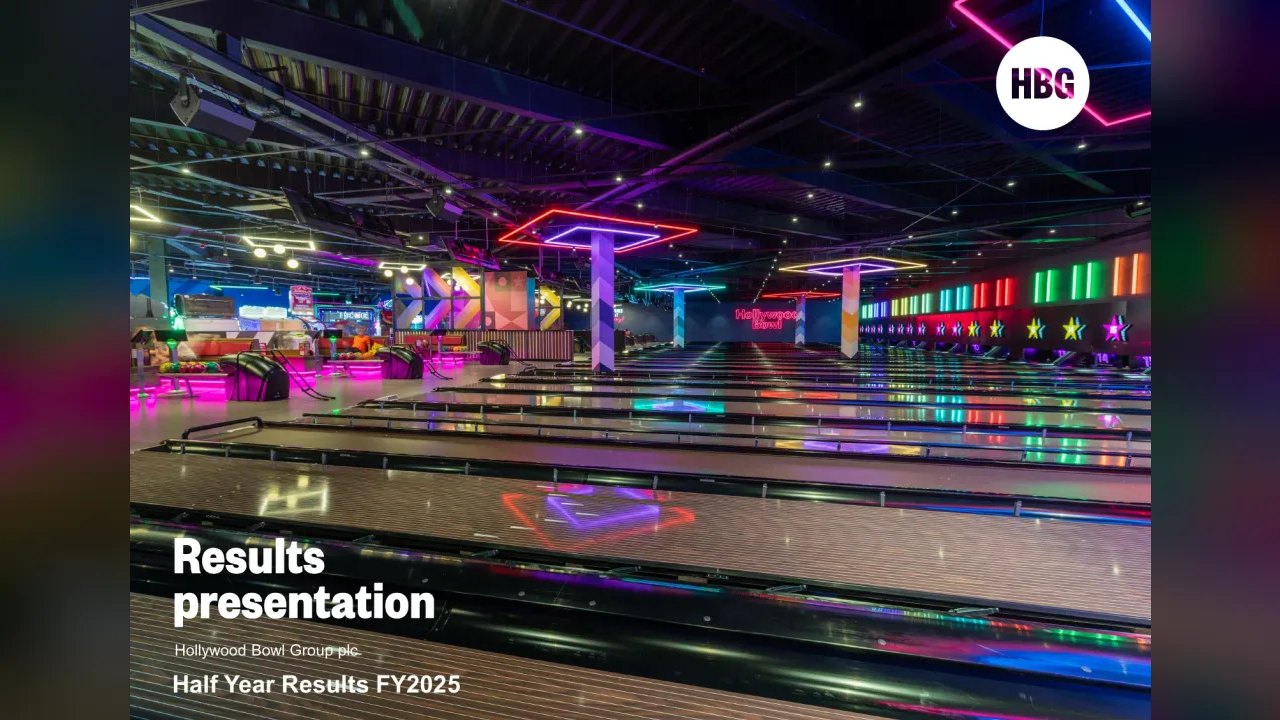
Interim Results hosted by Hollywood Bowl Group (LSE:BOWL) on Investor Meet Company, held 2025-06-02.
On 6ix: 6ix.com/event/hollywood-bowl-group-plc-bowl-interim-results
Automated transcript · Written by software from the replay's audio. It can mishear names and figures; the replay is the record.
0:01 Good afternoon, and welcome to the Hollywood Bowl Group PLC interim results investor presentation. Throughout this recorded presentation, investors will be in listen only mode. Questions are encouraged, and they can be submitted at any time by the q and a tab situated in the right hand corner of your screen. Simply type in your questions and press send. The company may not be in a position to answer every question received during the meeting itself. However, the company can review all the questions submitted today and publish responses where it's appropriate to do so. Before we begin, I'd like to start the following poll. I'd now like to hand over CEO, Steven Burns. Good afternoon, sir.
0:31 Yeah. Good afternoon. Thank you, everybody, for taking the time out of your days to, dial into our presentation. My name is Steve Burns. I'm the chief exec of Hollywood BOWL GROUP. I'm joined by our CFO, Lawrence Keane. I'll take you through a brief overview of the highlights of The UK, highlights of Canada operationally, and Lawrence will take us through the numbers. Starting with slide three. So the first half of our financial year has been a record performance for the group with revenues of 129,200,000, which were up 8.4% in the same period last year. And despite the increased cost burden, record EBITDA of 38,800,000. We opened five new centers in the half, three in The UK, two in Canada, and are well on track with our refurbishment program.
1:18 And despite despite the significant levels of CapEx that we deployed, the completion of a 10,000,000 share buyback, We finished the half with net cash of 22,700,000 on our balance sheet as well as having, a revolver revolving credit facility that we've recently, renewed, which remains undrawn. I'll now hand over to Florence who will take us through the numbers. On Slide five, we lay out the revenue range for H1. Total revenue was impacted by the September 2024 closure of the HOLLYWOOD BOWL CENTRA in Surrey Quays as part of an overall landlord redevelopment and also the requirement to close our center in Liverpool Edge Lane.
2:02 Growth from there in terms of like for like revenue was up 1.5% in The UK, with spend per game growth of 6.3% and game volume reduction of 4.5%. As noted by Steve, like for like revenues were negatively impacted by Easter moving to the second half, which was 0.9% on revenue as well as a negative effect of having the leap year in FY 2024 and not in 2025, which is worth 0.2%. The weather impact in late February and all of March as well as the continuing competition from competitive socializing offerings, which we'll talk about later, were also factors in the game volume reduction versus h one. Now whilst we have seen game volumes reduction, our spend per game is up 6.3% to just £11.87 in the first half of h one f sorry, first half of FY twenty twenty five as customers continue to seek value for money.
3:00 The like for like revenue growth in The UK as well as the performance of the new centers resulted in record UK revenues of just over £108,000,000 a growth of 4.7% compared to the same period last year. Canada like for like center growth was 3.7%, which is a strong performance noting the prior year like for like as well as the weather impact in the earlier the half when it was significantly warmer than expected, as well as the fact that Toronto got more snow in ten days of February than it did in all of 2024, combined impacting like for likes by 2.7 percentage points. New centers have contributed significantly over 4,000,000 Canadian dollars in the first half as is the performance of Stryker, our supply part business, which saw revenue growth of over 100%.
3:51 In total, this resulted in Canada revenues of $38,000,000 On Slide six, we set out the EBITDA bridge. First, just want to bring the attention to the one offs that we saw in H1 of last year. When comparing to the first half of last year, the group is negatively impacted from one offs to the value of £3,000,000, including the business rates rebates that we received last year of 1,100,000. The Surrey Quays and Liverpool Edge Lane closure that I spoke about in the previous slide of 900,000, and then the Easter and leap year impact that we spoke about, which was worth £1,000,000. The rebased h one FY twenty twenty four number would have been £35,800,000. Now as you can see from the slide, despite the big inflationary costs in h one compared to last year, like for like centers absorbed all of this.
4:45 It is just worth noting and pulling out the utilities increase of 700,000, which is as a result of our very low hedge that we had from June 2020 until September 2024, and then we entered a new hedge that started at the beginning of the first half of FY twenty twenty five. The EBITDA growth from the group came through new centers in The UK worth $2,200,000 and in Canada worth $1,200,000 with more to come as those centers continue to reach maturity. These contributed to an EBITDA of $38,800,000 and growth of 8.8% when compared to the rebased FY 2024 number. On Slide seven, we set out the income statement and covered up a lot of this on the previous slide. The gross profit margin or cost of goods saw a reduction of 40 basis points to 83%, all due to revenue mix.
5:42 Gross margin in The UK business was actually up by 30 basis points to 84.2%, whilst gross margin in the Canadian business was in line with expectations at 76.8% due to the effect of the striker business. The splitsville bowling centers actually had a gross margin on cost of goods of 83.3%, down on the prior year, but all due to the higher revenue growth that we've seen within amusements, food, and drink compared to the growth that we've seen within bowling. Centre level admin costs were up 15.1% to 55,800,000, with the largest part of this being employee costs that are £24,900,000. And as you can see from the slide, The UK is now at 19,900,000 and the Canadian business at £4,900,000.
6:37 Total property related costs accounted for on a pre IFRS 16 basis were 24,600,000, with 21,400,000 of this for The UK business, and that was up $2,700,000 on the prior year. Rent costs in The UK increased to $9,900,000 from $9,200,000 And their business rates, as we spoke about on the previous slide, were $3,700,000 in the first half, an increase of CAD0.7 million compared to the prior year. Canadian property costs were CAD5.8 million, an increase of CAD2.6 million just due to the increase in the size of the estate with no increases in other rents. In corporate costs, we saw a small increase of GBP 400,000. The UK business was actually GBP 200,000 down year on year.
7:25 And as we continue to build out our support center in Canada, the corporate costs increased there marginally by £500,000 Exceptional costs, pre interest in the first half totaled £700,000 credit. The first, a £1,600,000 income related to business interruption claim, insurance claim received in the period. The second, 100,000 related to the closure of the Hollywood Bowl in Surrey Quays. And then the final element is the earn out for our Canadian president, which is an exceptional cost of 1,200,000 in total with 900,000 of it sitting in this line and 300,000 of it sitting in interest. Now as we continue to invest in the expansion of the business from an estate perspective, investing in refurbs, IT as well as significant amounts of investment within the Canadian maintenance CapEx, depreciation has increased year on year to £9,400,000 with the largest sorry, a large increase of this of 800,000 in relation to the Canadian business.
8:29 Now despite this investment and the associated depreciation, clearly, not all of the benefit from the investments in The UK and Canada is evident at this stage in the group profits due to the growth and expected maturity curve of the capital spend, which will be seen in the years ahead. Statutory profit before tax for the year was £28,300,000 and the group delivered profit after tax of £20,600,000 at basic earnings per share of 12p. Now with cost inflation top of mind with RPI hitting 3.5% in April, On slide eight, we set out our position on inflation. We're mindful of the inflationary pressures, but well positioned to manage these due to our PNL mechanics.
9:15 The impact from national living wage and national insurance is significant as laid out on the slide. And pre any inefficiencies, the impact from national minimum wage and living wage alone is in excess of 6%. Business rates in h two will see an increase of 4% versus the same period last year given the change in the uniform business rate as highlighted in September 2024. And I won't go over the utilities piece again, but we do have now 33 centers in The UK with solar installs, and we are looking at the opportunities in Canada, albeit at the moment, it's not something that we're pushing ahead with in the short term.
9:54 From a Canada perspective, inflation forecasted to be lower. For comparison, April was at 1.7% versus 3.5% we see in The UK, and this has resulted in lower expected increases in other areas that are based on RPI. Toronto payroll inflation is due to increase by 2.3% in October 2025. And whilst there is no statutory increase in Alberta or Vancouver, we will obviously be making sure that our teams are recompensed appropriately. On Slide nine, we cover off the invested CapEx. In the first half, the group invested net CapEx of GBP 20,000,000, including GBP 10,100,000 in relation to the record five new centers opened in the first half.
10:41 A total of 4,100,000 was invested in the refurbishment program with four centers refurbished in The UK as well as the completion of two refurbishments in Canada in late March. The group's strong liquidity ensures it can continue to invest in growth, and we will open two further new centers in The UK, Uxbridge, which will open at the end of this week, and Reading, which will open during July. We also completed the full refurbishment of our center in Liverpool Edge Lane in the middle of May. And we will complete another four refurbishments in Canada, leaving just two centers to be refurbished in Canada after this. The new center pipeline for FY '26 and onwards continues to grow both for UK and Canada, and we expect total CapEx for this year to be in the range of 40 to 45,000,000 before dropping next year and the year after to about £25,000,000.
11:39 Now on slide 10, we lay out a reminder of our capital allocation policy. And in line with this, we paid out a final dividend for FY 2024 of 8.08p per share. There's a small update on our policy and to provide investors as well as analysts with a clear review on interim dividends, the group will declare interim dividends equivalent to 34% of the prior year's full ordinary dividend. And in line with this, the board has declared an interim dividend of 4.10p per share with a record date of the June 27 and a payment date of the 07/25/2025. As you'll also be aware and as Steve mentioned, during FY '25, the group completed a £10,000,000 share buyback.
12:26 Now based on historic special dividends, this buyback represents the equivalent of two years' worth of special dividends. And in our view, it was a much more efficient way of distributing cash to shareholders during this period. We're also pleased to confirm that during the second half of FY 'twenty five, we will read a new three year £25,000,000 revolving credit facility with an associated £5,000,000 accordion with our current provider Barclays. This was effective as of the 05/08/2025. The terms of the new RCF remain similar to the current to the old one, except for the fact that margin rate has reduced to 1.3% above Sonya from 1.65%.
13:11 And as Steve mentioned earlier, that revolving credit facility remains undrawn. Now I'm sure based on how much sun everybody's been getting, you've all been enjoying the sunniest March and April since records began in 1910, which as everybody will know, isn't favorable to indoor leisure. Despite this and the government prescribed cost increases as well as RPR, we're confident of revenue growth in The UK and in Canada as well as the success of our new opening program. Also, it makes for easier comparatives in FY 'twenty six as weather shouldn't affect our FY 'twenty six quantum revenue numbers. We're well positioned against inflation, as mentioned earlier, and our capital allocation policy remains unchanged with a 55% of adjusted profit after tax.
14:04 With significant investment in the estate in FY 'twenty four and 'twenty five, we're on course for enhanced EBITDA contribution in the short term and years ahead. K. Thanks, Laurence. We'll just take a look at what's been driving the growth in both The UK and Canada from an operations perspective. And actually, we've got a couple of questions, one presubmitted and one just whilst we've been talking around competition. And look. The competitive social market has shown no signs of slowing down post the big leg leg up. It was given as we emerged from the COVID lockdowns. The shift from consumer spending on retailers continued, resulting in more locations becoming available at much more accessible rents for leisure. And as a consequence, a big increase in the number of new operators. Some of you may have seen the article that was in the Sunday Times, which just showed the number of exponential leisure operators going up from 250 to over 800 in the years post COVID. Now, clearly, there's a level that that can go to. You know, the new entrants tend to be more focused on the young adult, late night, and corporate consumer, you know, albeit there's much more choice now available for all customer types.
15:12 Value for money and inclusivity, however, remain key. Bowling's still by far the activity of choice from the vast majority of people. It's very few other offerings that are so inclusive that, crucially, a value for money price point that has such wide consumer appeal. And we've worked really hard to maintain our position as both the market leader in quality, on price, and on experience. I mean, relative to inflation, it's actually cheaper to come bowling than it was back in 2019, and you're receiving a better experience following the investments in the businesses. We're also, like, located in prime position in the markets in which we operate with both sustainable rents and the market leading offer, and we're continually improving.
15:58 And we've got the sustainability and profitability to weather all of the various different economic cycles. Starting with The UK, we opened three new centers in the half, all on time and on budget, taking the total numbers of the centers in The UK to 75. Hollywood Bowl Swindon opened, incredibly successfully, £3,500,000 spend, which is what it costs us to open a new Hollywood Bowl. It's in a great location, colocated with casual dining, cinema, 22 lanes occupying 25,000 square foot, and it's trading nicely in line with expectation. We target a 19% return on the gross capital invested. And the difference between the gross CapEx and the net CapEx is then the landlord contributions that we get, which are on average between 500,000 and 1,000,000 for new site openings, but we target ourselves on the gross capital invested.
16:55 We opened HOLLYWOOD BOWL Preston on the March 8, another fabulous location, 25,000 square foot 18 center, again, colocated with cinema, a new car parking offer, and multiple restaurants just a stone's throw from the city center. Again, that center is trading in line with expectations. HOLLYWOOD BOWL in Venice opened then on the March 29, so the last center that we've opened. The scheme's car anchored by view cinema. It's got a good mix of retail and leisure within the city, and early trading has been very encouraging indeed. In terms of new site openings, we've got Reading, which opens in a few months' time, Oxbridge, which opens this weekend. So they'll both be up and trading in the second half of this financial year, and and we we have have five more centers signed for the pipeline and on track to achieve our ambition of opening operating 95 centers by 2035.
17:49 Lawrence touched on the refurbishment program, but all going incredibly well and all delivering returns in line with expectation. And just as a reminder, or if you didn't know, we target a 33% return on capital invested from refurbishments, and that's on all of the spend. We don't cherry pick between what's revenue generating, what's maintenance. We spend on average £380,000. So it could vary between 300,500,000 depending on the size of the site, and the refurbishment cycle is around about every seven years. And because we do something a little bit different in every site that we refurb and every site that we open, by the time it comes around to the investment cycle seven years' time, the customer's getting wholly incremental improvements to the experience. That gives two things really. One, a reason to revisit, and and it it opens the business up to a slightly wider market.
18:39 Secondly, it earns us the right to charge a little bit more, which supports the returns as well as the group like for like growth. The second part of our growth strategy focuses around enhancing the experience for our customers to drive spend per game and dwell time. And we complete the rollout of pins on strings, which replace the old free fall machines across the estate. We also complete lane upgrades scoring upgrades across the whole of the business. Our amusement offer continues to excel with the amusement spent game of 11.6% versus the same period last year, and that's been driven by machine by more machines,
19:21 offering a better choice to customers, as well as new payment systems, which allow us to charge a little bit more in the amusement areas for the better games. We are, first and foremost, a people business, and having a well trained, engaged, and well remunerated team is the only way that we can continue to deliver the levels of customer experience that our guests demand. And we've once again been recognized as a great place to work, this time by the times coming in the top 25 best companies to work for. We've also seen record customer service scores and the resulting high net promoter scores. Turning our attention to Canada. I'm delighted with the progress that we've made in Canada. We acquired this business in 2022. This is a Splitsville and Striker businesses. And since the acquisition, we've trebled the size of the estate, trebled the levels of revenue, and grown the EBITDA from 2,800,000 to 9,500,000 Canadian dollars. And this Canadian business is now becoming a much more meaningful growth driver for the group representing 16% of revenues and 11% now of the group's EBITDA.
20:29 In the half, we opened two new centers, Splitsville, Qatar, the country's capital Ottawa, which opened on the February 28. We also opened Splitsville, Calgary on the March 27. Now these two new sites very much mirror the format of a Hollywood Bowl. It's the first time that we've brought that concept over to the Canadian market. Prior to these new
20:52 openings, we've been acquiring existing bowling centers, and they tend to be very focused around the sport of bowling, so league bowling rather than family entertainment centers. And we've been doing the refurbishments, and I'll come on to a case study of one of those in a second. But these two new openings are the first ones where we've tried The UK style concept in terms of size, number of lanes, amusement offer, and the way in which they're operated. And early results have been incredibly pleasing, both on track to deliver in excess of the 90% returns on invested capital. Similar cost to open the site in Canada as it is in The UK, 5,100,000 Canadian dollars, around about £3,100,000, £3,200,000. And the return profile of the new sites is very much in line with what we've experienced in The UK.
21:41 So looking at a case study of an existing center that we acquired. So this was our site in Kingston in Ontario. We acquired it on the '20 in July 2022 for just shy of a 100,000 Canadian dollars. We bought it from the owner operator who then leased the space back to us. A lot of the owners of and of operators of bowling sites in Canada tend to be single sites. There's very few multiples, and they're owned by and operated by the owners. So acquiring the site off the, off the owner and then leasing the space back to them provides an ongoing income for the seller and gives us, a center ordinarily at quite a low price. We have invested, however, the equivalent of what it cost us to open a new site.
22:27 Five So 100,000 Canadian was invested transforming this league focused center into a family entertainment center, which include touching every aspect of the goal. The center is performing incredibly well. Lifeline revenues are up over a 133%. EBITDA are up 300%, and this was on track to pay back within three years. So in line with that 33% return on invested capital target that we give ourselves. Elsewhere in terms of the operation outside out in Canada, we've now sort of defined the growth strategy for the Canadian business and certainly following the early learnings of operating the business since the acquisition. We're clear on what it is that we need to put in place to drive the revenues and profitability of the business. We will start to roll out the pins on strings in Canada following a successful trial, and seven of the 15 centers now benefit from the technology.
23:21 We'll be installing into the other centers as part of the refurbishment programs. Tests of wear and shoes have also been well received by customers as have selling games rather than time, which can be more profitable for us. Pricing trials are underway. There's no down in pricing in Canada like we we have them. We've worked to the to great effect in The UK. And we're able to do that now. All centers are running our proprietary booking engine software. In the amusements, we've entered into a new agreement with our UK partners under more favorable terms, and we're excited about the opportunity. In The UK, 27% of our revenues come from the amusement machines. In Canada, it's only 16%. And with the investments and operational changes that we're making, we expect to see that gap start to close.
24:08 We've also been making changes to the food offer. So in addition to leveraging our increased scale with suppliers, we've reduced some menu complexity, improving margin, quality, and consistency. We still got quite a long way to go with regards to team. It's the single biggest challenge that we face out there, recruiting the operators with the skill sets that we need to run the complexity of business that we're now trading. But we started talent development programs that have been so successful for us in The UK as well as expatriating some of our better operators to go and give them a hand over on the other side of The Atlantic. As you can see on slide 20, our new booking system has been fully rolled out and coupled with the restructuring of our marketing and IT teams led by a new CMTO.
24:55 We've started to unlock the opportunities identified as part of our digital transformation initiatives. We've made some really solid progress consolidating our operational processes across the two territories in which we operate, driving increased synergies and building a platform for our scale ambitions in both The UK and in Canada. So in summary, it's been another very successful period for the group. We are the market leader in the experiential leisure sector with our value fully proposition continue to generate strong demand from our customers, due very much in due to the difficult to replicate operating model. We're well insulated from the cost pressures and inflationary cost pressures, and we've plenty of growth left to come and a balance sheet that supports that growth ambition.
25:43 I'm happy now to answer any questions that any of you may have. That's great. Steve and Lawrence, thanks very much for your presentation. Ladies and gentlemen, please do continue to submit your questions, and you can do so just by using the q and a tab that's situated on the top right hand corner of your screen. But just while the company take a few moments to review the questions that have been submitted today, I'd like to remind you that recording of this presentation along with a copy of the slides and the published q and a can be accessed via your investor dashboards. As you can see, we have received a number of questions that have been submitted throughout today's presentation. Steven, if I could hand back to you to share the q and a, that'd be great, and I'll pick up from you at the end. Yeah. No. Fine. So we had a couple of questions around competition, which I hope I've answered as part of the slide deck. But if not, please just drop them back in. A question from Doug Douglas, how does the Canadian market compare with The UK?
26:29 I mean, it's it's it's it's different and similar, different in the way that it's an incredibly fragmented market. So in The UK, there's sort of four main operators and mult multi chain businesses. In Canada, there's there's those. We are the single largest operator. Canada's now operating 15 centers, but the other 240 odd sites, The other single largest operator has only got two and three centers. As a consequence, you know, it it's quite underinvested as a market in comparison to being owned and operated by a chain that's got higher levels of cash flow. Crucially, though, consumers the the role that the bowling plays in the customers' lives is incredibly similar to The UK from the very deep customer research that we did, one, before we went out there.
27:18 And then since we've been trading the businesses, it gives us real confidence that actually our UK operations and ways of working translate very well into the Canadian market. Question from Martin. The UK refurbishments are trading above 33% r ROI. Can you provide more detail on the performance delta between refurbished and nonrefurbished centers?
27:41 Lawrence, take that question. Yeah. I mean, the the effect can be as big as four percentage points, five percentage points in like for like revenues. These centers have a dramatic change in them. And therefore, based on the customer feedback, what we find is the customers, first of all, tend to spend longer in there and therefore spend money with more money when they're with us. And secondly, they come back more often. Now that is based on the information available to us, and we continue to see successful performance of these refurbishments. But there is a big delta between the two. What tends to happen after the first year is that they then they then trade trade in line with the rest of the estate. And what that essentially will do is then allow them to continue to track maybe even slightly above, but what it means is that they're trading from a higher base, and therefore, they do continue on that payback.
28:37 K. Thank you. I've got a message for Steven. On what basis do you think the share buybacks are superior to dividends for shareholders? This has not been supported by any empirical studies in The UK market. It reduces liquidity and free flow, hinders institutional investment. Why do you think the shares fell abruptly on the recent release of these figures? So two two questions there, Steven. I'll start with start with the first one. If we were to do a straw poll of all the people that sit on here now, I would imagine we'll get two very different sets of results. Some people who have share buybacks, some people who prefer cash as a a way of returning returning revenues to shareholders. And look. We have it is exactly the same with all the institutional shareholders, that we have meetings with. I've sat in meetings with institutions where even within the same team, there's differing views on whether or not people want buybacks or they want cash. The way that we look at it is on, what the effective rate of return is. We are incredibly cash generative as a business, as anyone who who will have, had spent any time looking into our numbers will see. That gives us the, ability to do three things. One, invest significant levels of cash in growing our business for new sites, acquisitions. It's all self funded, this growth. We don't have any debt. We've got net net cash balance.
29:54 We can then pay a very healthy dividend. 55% of our profits after tax are paid out in dividends. You know, 4.11¢ pence per share declared as our interim off the back of the high level of dividend that was paid in our full year. And despite all of that, we still generate cash. So we end up with an inefficient balance sheet, which gives us then two options. We either give it back as a special, or we do share buybacks if there's nothing else to invest our business in. Now by simply giving specials, which we've done in the past, again, is not regarded or respected really by particularly by the city. It doesn't pull pull into the share price. But, frankly, I'm not doing it to drive the share price. It's about giving the best possible returns to our shareholders. So we engage with our shareholders on the subject. We take their views. And then as a board, we decide what's the best use of capital based on a number of factors. One, obviously, being the share price.
30:47 And when the effective rate of return gets above 30% for our shareholders, then doing share buybacks on paper can be a good use of capital. In terms of answering the second question, why do you think the shares fell abruptly on the re release of these figures? If I knew that, Steven, I'd be doing your job and not mine. All we can do is look at based on the feedback that we've had from brokers. And there was some softening based on the fact that the sun has been shining. We are an indoor leisure based business. We outperform when it rains to about the same degree we underperform when the sun comes out. It's the one thing, unfortunately, I'm unable to control is the weather, and some short term investors will therefore sell as a consequence thinking that it may be softening on the full year numbers. There was also quite a lot of questions around the depreciation and the depreciation policy of the business, and there's various different analysts that are writing on us. We're covered by quite a lot of different houses, and some of them have got the depreciation treatment wrong in the guidance.
31:46 Not to say that it was wrong overall as a total number, just the way that it was treated. We also have the impact of the IFRS 16 on our lease liabilities. Now we are a leasehold business in fabulous locations, but nevertheless, we're penalized for having long term leases on that. Now when you're spending £3,500,000 on-site, you want a long lease, but that then harms you from an IFRS 16 perspective, which means that we have a higher depreciation charge. So they are the only reasons why we think at the minute the share price dropped as a consequence of the numbers. Hope that answers your question. I don't have any of the oh, yeah. We do. Sorry. We have some more questions. So question for Peter. How do you look to counter the continued rise of competitively socializing venues like escape rooms? Will you expand your offering? So, Peter, I mean, there's there's been a big shift in customer behavior.
32:43 You know, pre COVID, it's very much about retail having things. Post COVID, people are prioritizing their disposable income on experiences. So we've seen a growth in the overall market, which we have obviously benefited from. Even if you look at it on an absolute like for like basis, same center, 2019 versus where we are now, volumes are up over 9%. So it's some double digit growth, in the early post COVID years and then a little bit softening as we've come back to a level of normality. And so the overall market has grown as a consequence. Now there's there's still very little else out there that is as inclusive as bowling. There there are always actually, skateboards have been around a long time, so it's been kicking around since 2010, 2011.
33:29 There's quite a lot of them in The UK, and then there's it's a market that's ripe for consolidation. Some of the operators do it incredibly well, but we colocate really well next to competitive socializing. So sites that trade just on their own or with the cinema, don't trade as well as centers that are colocated with escape rooms, mini golf, other amusement type offerings because you create your own gravity, your own destination to go to, and we pick up the extra business because people are doing more competitive socializing than than they were before. Will you expand your offering? We do have a couple of centers where we have more than just bowling and amusements. We've got one in Canada. We've got a couple of centers in The UK, but, we don't have dead space in our businesses.
34:15 Every single one of our centers is profitable. We don't have a tail. The average EBITDA is over 1,200,000 in our states. We've got a really high quality estate with a very good quality offering with no real dead space or unutilized space that we could stick in a skate room or additional offering into. Now if we start to see things trending down and less spend in bowling or in amusements, we're still in fabulous locations. We do have the ability to expand or change the offer, but it's not something that we need to do right now. This message from Julia, which says the market seems disproportionate with a big drop in profit after tax. I think you're explaining in terms of one offs. When, how do you think those one offs will reverse? Yeah. So good question. And we have had a few questions similar to this. And it's one of those things where you get a one off credit in a year or a one off benefit from doing something.
35:10 And the two that come to mind really are business rates, the appeals to all of our business rates, invoices, and also the hedge from the electricity. To put into context, if we hadn't hedged our utilities, we'd have spent more than £6,000,000 over that period when we were hedged on incremental usage charges. But it is one of those things that then when it comes off, you don't get the benefit anymore, and everybody wonders why the increase is there because they quick forgot about the the one off credit. But the same with business rates. You know, last year, we had £3,000,000 worth of business rate deductions. There are no more appeals that we are able to do given that the business rates cycle doesn't start again until April 2026. But we do our utmost to appear in every single one. And, again, those big credits came through last year. We're rolling them for the rest of this year. In theory, there are no one offs this year. But if we were to get some credits come through this year, we'll definitely be taking them, and then we'll be talking about why they were one offs again. So it's one of those things that the one offs are great in the year. You get them, and then you try to lap them. They become exceptionally difficult to do.
36:21 Are there any other questions? Steven Lawrence, I think you've actually covered all the questions that have been submitted today. Of course, we will publish those responses on the investor meet company platform as well. But just before redirecting investors to provide you with their feedback, which is particularly important to the company, Steven, could I just ask you for a few closing comments? Yeah. No. But I mean, nothing mass massively more than we've already cut off. Just like to thank everybody for taking the time of your days today to meet with us. Happy to answer any further questions that anyone may have at a later date. That's great. Steven Lawrence, thank you once again for updating investors today. Could I please ask investors not to close the session as you now be automatically redirected to provide your feedback, and all the management team can better understand your views and expectations. On behalf of the management team of HOLLYWOOD BOWL GROUP PLC, we'd like to thank you for attending today's presentation, and good afternoon to you all.
Follow Hollywood Bowl Group PLC into a list and get an email when it puts out news.
Chief Executive Officer at HOLLYWOOD BOWL GROUP PLC
Chief Financial Officer at HOLLYWOOD BOWL GROUP PLC