Transcript
Automated transcript · Written by software from the replay's audio. It can mishear names and figures; the replay is the record.
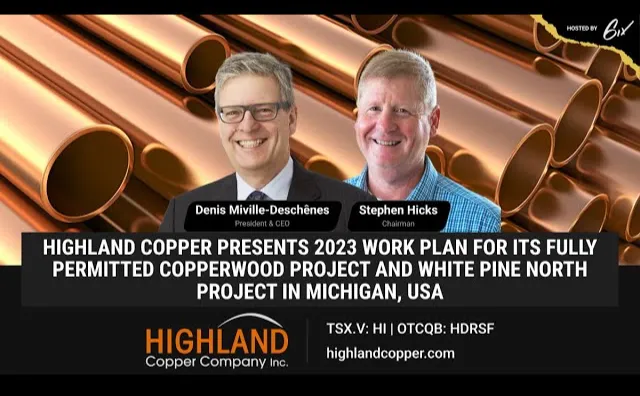
0:08 Hello everyone, and welcome to Highland Copper's live investment summit today, hosted by 6. I'm pleased to introduce the President and CEO of Highland Copper, Denis Miviel-Deschamps, and Stephen Hicks, their Chairman. Denis and Stephen are going to be walking us through a company presentation and after, we're going to be taking questions live. Remember that you can submit your questions using the Q&A chat on the right-hand side of your screen at any time during today's presentation and get in touch with the Highland Copper team using the survey that's linked in the chat at any time today or afterwards. But as always this event is being recorded and it's going to be available on six.com
0:39 in the coming days so look out for that if you want a refresher on today's content and without further ado, Denny, I'm going to pass things over to you so that you can get us started. Thank you Cameron and welcome to this webinar and thank you for the opportunity to present Highland why 2023 will be an interesting year for us and why it should be on your list of very interesting investment opportunity. Quickly, where we're at, and you may have seen a fair bit of that in the 2 press releases last week, We're sitting on 2 projects ready for development in Michigan, on the west side of Michigan.
1:26 2 projects are copperwood and white pine. Copperwood being fully permitted and combined, it is more than 9 billion pounds of copper that you find in the ground. And once developed, you'd end up having a mine life of more than 25 years. So all this in an environment where communities are very supportive, it makes for a very interesting position. And I say, if I go back a couple of years ago, we were more of an exploration and junior development company and we decided once we completed the acquisition of White Pine to make a shift and go for short-term value creation that we see possible in developing the assets versus exploration.
2:18 And at the time we ended up raising 26 million to get into engineering and advance the 2 projects. And we also revamped the board pretty much totally to bring in skills more aligned with this new phase of development. And we got in new skills on financing, on construction, project development, and very good knowledge of Michigan. And it's my pleasure to introduce you to Steve Vicks, who pretty much has all of those 3 skills and is now chairman of the board since last December and certainly a pleasure to work with. So that said, Steve, if you want to introduce yourself and have a few words.
3:13 Sure, I appreciate that, Denis. And thank you all for taking the time to listen to the great story of Highland Copper and its next steps. I joined the board with 6 other of my colleagues in December of 2021. It was after a rigorous search for new board members and we have quite a depth and quality of a, and committed board. So I'm really pleased to be their chair, which I took over in December, 2022. I'm just gonna give you a little bit of high level of why I joined, a little bit about me, why I think Michigan is the place to invest and employ and why our strategy, I believe, and so does our board and management team is going to be successful over the long run. So joined, obviously there's a strong market need. I don't need to go through that, but the project has very strong fundamentals. You can even witness back into 2018, 2019 and the feasibility studies. But there's an opportunity for us and for myself is to grow economic development in a region where I live, where I sit right now, the businesses and the projects are about 140 miles to my west as I'm sitting right now. But it can be done in an environmentally responsible manner, which is very important to myself and people in the upper Michigan as we have great natural resources and we want to make sure those great natural resources are for succession of our families going forward.
4:42 I've also witnessed, I live in Marquette, Michigan, I've witnessed the strong safety and environmental standards that Lundin Eagle Mine has put in place. And I'm very confident the Highland team will replicate that in the Western part of the Upper Peninsula. A little bit of background about myself.
5:00 I've been over 30 years investing and employing in Upper Michigan for a company by the name of JM Longyear. We're a 150-year-old company that has been in the region, and I am the current CEO of that company. I do have relevant experience. I've been involved in over $2 billion of, I would call it, projects. 1, about a billion and 5 in iron ore mining through steel manufacturing in a different state, but I also have been involved in the project level. So I know the rigor, the details, the focus that you need to do to make a very successful project. And I've also been involved in about, I would say about $400 million of projects in Michigan. I think, you know, one of the items I'd really like to emphasize to all of you on the phone today is why Michigan? I think There is no other state, this is my personal opinion, that can really boast the mining to mobility as we think about EV batteries, the need for key metals such as copper. We are the capital of the world, will be the EV capital of the world. I know there is very strong support throughout the state for mining through mobility.
6:03 And I think Highland Copper can fit that very well. We got a really strong support for local, regional and state stakeholders, whether it's political, elected politicians, whether it's just our neighbors. And so a very strong support for growing this business. Infrastructure in the state of Michigan and the workforce, I believe, are outstanding, which creates a competitive advantage for us. And lastly, I think Denny will go through this, but our strategy of sequencing copperwood and white pine. Is not only going to be- successful the right way to do our board is a unanimously supportive of that strategy- it but really gives us falling out really good at great advantage it gets us into business sooner- than try it also has really strong fundamentals It is a fully permitted mine to start with Copperwood for it first, then Wipe Pine.
6:54 There will be a large resource over time, as Denny talked about, the number of pounds we have, but It also does for investors, it limits the capital, limits the execution risk. And so I believe we're gonna be very successful. In the end, I'm really pleased to be involved with a great project that has strong fundamentals, but it can be done in an environmentally responsible way. And it also can be a partner to commit to the local communities to be an employer and investor. And so with that, I will hopefully take your questions at some point in time, but I'll turn it over to our CEO, Denis. Steve, thank you. Thank you. Okay, so going back to the location and the projects, Michigan has been a great place to do business in the last few years.
7:50 Interestingly, they managed their state permitting process. They certainly delivered in a timely manner on copper wood once the original feasibility study was completed. And I also believe really that as we see better copper prices like now and in the future, we are less likely to see disruption as potentially government and communities will push for a larger piece of the pie. And we're sort of protected from that in our region. And as I mentioned earlier, we're getting great support from the communities. On the resource side, 9.1 billion is not a bad position to start with.
8:38 55% of it is in the M&I category, material that we can use for feasibility study and development. And it's going to provide benefits for many years as when we looked at the projects it would take 5 years to develop both projects back to back and you'd end up having a mine life of plus 25 years as well after that. Financing, we do have strong shareholders. You'll see on one of the slides, but Orion, Mine Finance, Greenstone and Condier as well as a Cisco they've all been on board for 5 or 6 years.
9:37 White Copper, obviously Steve mentioned the, I'm not sure if the presentation is flashing for you guys, but we do have in this state of Michigan, strong support for copper, strong vision on renewable energy, electric vehicle, and not only they're talking about it but they've also invested into it as state fund as put 600 million in GM and similar amount to Ford for battery plant and they're very much supportive of all the EV and electrification.
10:24 Copper supply has struggled in the last few years to keep up or maintain and will certainly be under pressure to follow on demand as we continue to move towards more needs for electrification. I mentioned the permitting process already, it's strong, They've delivered for Copperwood and as we execute on White Pine, they've already have a team in place. They're interfacing with us on a monthly basis, supporting the process and helping us in making sure that we can file for permits and have a quick reply and receive the permits in the short term. So very, very supportive again there.
11:18 The 2 projects, Copperwood and White Pine, they're at different stages, they're also different sizes. Copperwood is certainly more advanced, We had a feasibility done in 2018 on Copperwood feasibility that we reviewed in 2022 and completed early this year. The results were published last week and it's also a project that's fully permitted, ready to go for construction. And we'll go into more detail around that a bit later, but we're planning at this point to get into site activities this summer to meet some of the requirement of the permitting process and timeline around impacts, initial impacts, and site preps, as well as mitigation work.
12:13 We'll be looking at the construction decision in early 2024. White Pine, bigger, larger deposit, probably at the end of the day more robust project. It's been mined for 50 years in the past, 5 billion pounds of copper were mined out and produced and at this point we're sitting on a similar amount. So when we look at White Pine, we're looking at close to 25 years of mine life capacity to produce 40 to 45,000 ton of copper a year. At the PEA stage, we announced last week we will finalize and update PEA for release in the next quarter.
13:04 And combine the 2 projects have the capacity over the next 5 years as they're being developed to produce 70,000 ton of copper on a yearly basis. Highlight from the feasibility study, somewhat there was a smaller increase on the M&I as we minimize the additional drilling and intend to do more of that once we have cash flow coming from the operation. But the inferred tonnage is substantial. We have a mine life of about 11 years in the feasibility study and certainly have the capacity to just about double that as we have more than doubled the tonnage when inferred or considered.
13:53 At this point, there are remaining potential activities, potential opportunities on the economic side of the project. We aren't doing more studies. We feel that the real value is really to get to site, do prep and get into construction and mining as soon as we can to get a cash flow and change our position from junior developer to eventually a producer. So we intend to do that in 2024-2025 and as you'll see or may have seen the the return on the project is somewhat robust at 17.6 close to 18% All that done at a $4 copper price and using the latest costs of 22, which are somewhat the high input costs, including high energy costs.
14:58 So, It's a base, it's sort of a reset of costs. I don't personally see these costs going down the short term. So that project at 18% will provide for investors a really good exposure to the copper price as the project is very sensitive to it. So, any increase to a 425
15:24 substantially increase the return on the project and at that base $4, The initial investment is at 390 million, a substantial increase from 2018, all linked to input costs and payback period is 3.5 years. I mentioned overall resource increase, 55% of it is in the inferred category
15:58 for copper, wood and White Pine combined, 9 billion plus pounds. We should see a revised number coming up in the next quarter as we complete the updated PEA. Copperwood, I mentioned fully permitted, ready to go. It's worth having a quick look at White Pine, as I mentioned, we're in the process of doing baseline and completing all permit requests for this year that will be done for Q4 2023.
16:36 And when we interface with the state and are going through the process at this point, we're talking about potentially receiving all permits within a year after filing, which would put us with a fully permitted project by the end of next year. Important to us is the water intake permit, as it is a past producer, is already in place. So are some of the operating permits or like the NIPDs as we are under closures completed, we are under monitoring situation. So the remaining permits are mostly linked to Part 632, updating the dam permit and air permit.
17:31 Both projects were designed or assumed being producing concentrate that would typically be shipped to a smelter either here in North America, Europe or Asia. The 2 projects are sedimentary deposits, chalcocite type, so the material is not acid generating, it has fairly low contaminants, which is a good for traders or smelters really as mixing material. But last year we ended up doing more work on the concentrate testing its leaching capacity and we know we can leach it and recover more than 98% of the copper.
18:23 This year we'll pursue with additional studies to define capital costs and operating costs if we want to leach the concentrate at site and I've cathode as a final product. And that would be really interesting, in particular in Michigan where you have a very strong manufacturing industry, you could sell likely all of the production within 500 miles. So that's one of the potential upside for this year, looking at this possibility. And certainly from the state perspective, it keeps all jobs and benefits in the state and with the strong manufacturing industry like we see in Michigan, there are certainly a number of groups that would like to put that in their ESG story.
19:25 Shareholders I mentioned our 4 main guys Orion is still sitting at 28%. They're in for the long term, although they'd rather have a 20% position than 28%. Condair bumped up their position to 16% in 2021 and Greenstone, they've been in since 2017 at 16% and we also have Cisco Gold Royalties at 6%. All these guys understand our path forward and are supportive of the next phases.
20:09 We've discussed a bit the feasibility and the results, the return at 17.6, the initial investment at 390 million. Investment at $390M. Operating costs roughly $1.80, $1.85 per pound of copper, somewhat lower in the first 5 years as we benefit from a much higher grade. The grade initially is between 1.6 and 1.8% copper for the first 5 years, giving us in between 150 and 160 operating costs up front, therefore the good payback.
20:54 And again, I mentioned this is, when you look at Copperwood and White Pine, a great exposure to potentially higher copper price. You see it quickly on the return and the initial payback. A bit here on where we're going with all this. We've been, as a number of you would know, studying how to approach the development of the 2 projects in the last couple of years. We've done feasibility on Copperwood, PEA on White Pine. And then we spent a fair bit of time last year studying the possibility of going for 1 central processing facility
21:44 at White Pine instead of building the projects on a standalone basis. And we ended up after a review this quarter, deciding not to proceed with this large project for a couple of reasons. We had assumed major synergies in 1 processing facility, pushing the 2 ores in there, but additional MEP tests, it was detrimental to Copperwood on the recovery side, it was detrimental to White Pine ore on the overall processing costs. Therefore, At the end of the day,
22:32 total capex for the project wasn't improving really. Operating costs weren't changing, but the pressure on executing 1 large project over a reduced period of time, sort of increased the risk. And it made a lot more sense for us after review to proceed back to back with the development of copperwood and white pine. So in the short term, 2023, we'll be looking at hitting the site this summer, getting roads in, site prep, clearing and grubbing and doing the initial impacts and stream relocation as per the permits to start of mitigation for completion in 2024.
23:30 And mitigation really is creating wetland and offsetting the impacts on stream relocation that we have. We will also start detail engineering activities so that at the end of the year, we know the long lead items, their specification and time for delivery. And it would allow us to take position on those long lead items, so that by summer 24, we can start construction. So to do that, we will need to get into project financing in the first quarter of 2024. We're assuming construction 24 and 25 for initial production early in 2026 at the pace of 30,000 tonne of copper per year.
24:29 And through that time, we will not stop advancing White Pine.
24:35 2023 will be used to complete the baseline and advance the permitting process, permits that we expect to receive at the end of 2024. 24 will be into feasibility study on White Pine. So that when we complete construction at the end of 25 at Copperwood, we can use those same crews to get into white pine construction over 26, 27 and part of 28 so that we can reach production at the end of 28. Therefore hitting the 70,000 ton of copper per year mark over that five-year period.
25:25 So in a nutshell, this is our business plan. We will need to raise some additional money in the second quarter of this year to start executing on the site activities. It will mean a bigger team at site around white pine and copperwood to execute on this. And as Steve mentioned earlier, we're fully committed to a high level of performance on the health and safety environment and interfacing with the communities while we slowly ramp up our activities at site.
26:15 And we're getting into that knowing fairly well the conditions in the mining industry, the limit and or challenges on hiring, so we're approaching it with a big focus on good training programs to maximize skills at site and local employment in the region. So again, 2023, a very interesting year for us. The start of a process going from a developer to a producer over the next 3 years. So that summarizes it for me, Cameron, and we can certainly open it up for questions.
27:07 Yeah, absolutely, Denny. Thank you so much for the great presentation. Just as a reminder to everyone in the audience, if you do have any questions, feel free to submit them in the Q&A chat on the right-hand side of your screen at any time. We've already received a couple of questions so far though guys. First one is this, what differentiates your business opportunity, it being in Michigan from others?
27:28 Look, Not everywhere you'll manage to get such a strong support from communities, regional businesses and state. The opportunity of selling a final product like cathodes to such a strong manufacturing industry with the GM and Ford and Mitsubishi, they're all there as potential buyers. And there's a tremendous energy in this state, and we felt that support through our activities. So that combined to the permitting process managed by the state, it's been great.
28:22 No, absolutely. Another question from the audience from Sandy. At what time are you gonna be reviewing the staffing needs to ensure that you have enough MSHA approved miners ready? How many miners is Island Copper looking to have on the ground between these 2 projects? Look, on the business plan, and the staffing plan, we're into this right now, fine-tuning the use of funds for the money needed for 2023 and 2024. As for the need for miners, We know this is an area that can be challenging. There are lots of miners that went in other states.
29:10 We will do our utmost to be attractive to all these guys, but we're not shying away from hiring up front a contractor to bring additional bench strength to our training programs and make sure we develop the skills. We've seen Eagle Mind start with contractors and get those guys on board as employees, as permanent employees and having a strong contingent of miners. So, we intend to really heavily focus on training and develop those skills. No, absolutely. And Sandy has a follow-up question.
29:56 I apologize if you have to reiterate anything, but she's just wondering exactly What type of MSHA mining will you be regulated under and what version of mining is being considered? Look, getting into the specific MSHA, I'm not sure, but for us the type of mining, it's going to be room and pillar. We're not stoping or going at great depth. Where mining is seen, that will vary from 2.5m up to a maximum of about 5.56m. It's room and pillar type, so very much like development, except that it is also a minimal to continuous miner. So a portion of the deposit will be mined using continuous miner and another portion, the narrow areas or more inclined areas would be mine using jumbo and more conventional type of mining.
31:01 Absolutely, thank you. John wants to know where does Highland plan to process ore and refine copper? Both sites will have their processing facility. The final product would be concentrate shipped to a transload facilities. As for smelter ultimate destination, we have options. There are smelters in North America
31:32 like Eagle Mine is shipping concentrate, copper concentrate to the horn smelter in northern Quebec. You have the option of shipping to Europe via a railroad up to Montreal and then a boat to Europe. So look, there are still at this point a number of destination possible, not to mention traders that do have interest in buying the concentrate for themselves, shipping to various of their final destination for their own concentrate. Right. James in the audience is wondering, how much money does Highland Copper need this year to trigger the wetlands permit and post the environmental bond for the 632 mining permit?
32:23 When we look at the activities, we haven't looked just at 2023, we're also extending into 2024. Once we start the impact and commit to that, we need to commit to the mitigation and the financial assurance. At this point, we'd be looking at close to 30 million at a minimum to execute on that while continuing the permitting process at White Pine. All right, great. 2 related questions just about water. James is wondering what your current plan for it is and John wants to know why doesn't Copperwood need a water intake permit? Look, I'm assuming the question is pertaining to the pumping station on Lake Superior that had been the request in the past and that we sort of let go.
33:23 This was a permit to install a small pumping station needed for the first 5 years of operation really to support mill startup. Michigan is, or has a positive water balance. Ultimately we will need to treat water and discharge. So instead of pumping water from Lake Superior, we will impound the water and have enough accumulated to support the processing facility startup before creating and discharge in the second half of May. Right. Peter wants to know what are some of the numbers on the tonnage of silver?
34:11 On the tonnages of silver, look Tonnages on a per day basis at Copperwood will be close to 7,000 ton a day of ore. White Pine will be 15,000 ton a day. Silver component is somewhat small at Copperwood. It represents less than 1% of revenue. And over White Pine, you must have about 50 million ounces of silver, not all recoverable, but it's a substantial portion of the revenue. All right, fair enough. Dave's wondering, when will there be an insight presence and who oversees the engineering plan? Or rather not who oversees the engineering plan, my apologies, who owns the engineering plan?
35:03 Well, the engineering and the studies that were completed were done by G-Mining out of Quebec. They've been very good at following up from engineering to site construction on a couple of big projects. They've done Marion in Suriname for Newmont. They've done Fruta del Norte for Lundin Gold in Ecuador with great success. And they're actually busy on a project in Brazil. We've used Golder out of Michigan to support on the water treatment side tailings dam design. As for the site team, we had a contingent at site back in Wakefield in 2019.
35:55 Right now we have just a few employees ensuring support and maintenance before we ramp up the activities. We should have more representation in the Wakefield office in the next quarter. We also have guys operating at White Pine As we had a drilling program this winter in White Pine, geologists were there. We have a house also where they live in White Pine. Absolutely. More of a housekeeping question just from a member of the audience, but is this presentation found online anywhere that they can go get it? Yes, this presentation should be on the website.
36:43 Great. Well, gentlemen, with that, That looks like all the questions we received for today. So I want to thank you for the great presentation. I also want to thank you for the great Q&A. Of course, I want to thank everyone in the audience who's joined us today, especially those who've asked questions. Again, if you want to get in touch with the team, feel free to fill out the survey that's linked in the chat. But before we wrap up for the day, Denny, I want to pass things back to you, or you, Stephen, for any closing remarks. Look, for me, thank you all for attending. Thank you for a great question. Looking forward to keep you updated on how we progress through 2023. And Steve, maybe final word. No, I think, thank you for the opportunity to tell this great story, especially we can do it very responsibly in Michigan.
37:30 And I think there was an earlier question about why we're different. I don't think you can see a state that's not only supportive, can do it in an environmentally responsible way, but really helping with climate change. This mining through mobility is going to be a key, I would believe, a strong support from the state of Michigan and I'm excited to be part of this. So thanks again.