Transcript
Automated transcript · Written by software from the replay's audio. It can mishear names and figures; the replay is the record.
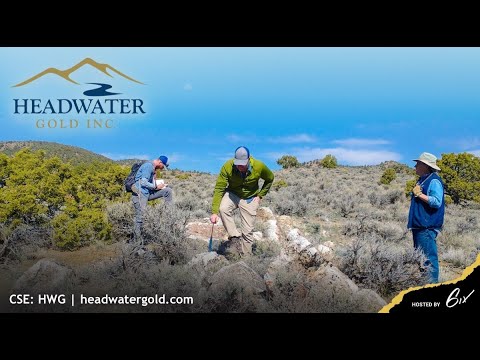
0:08 Hello, everyone, and welcome to Headwater Gold's live investment summit today hosted by 6. I'm joined today by Caleb Stroop, Headwater's President and CEO. Caleb's going to walk us through his company presentation and after which we'll move on to a live Q&A session where we'll be accepting and answering some questions. You can submit your questions using the Q&A panel found on the right hand side of your screen at any time during the presentation. As always, this summit is being recorded and will be available to watch afterwards on six.com. So without further ado, Kaleb, I'll hand it over to you. Okay, thanks, Cam. Let's get right into it here. So yeah, I will be making forward-looking statements,
0:40 so please take the appropriate caution. Headwater Gold is a recently listed exploration company focused on exploring for high-grade vein systems in the Western US. We've got a very technical team composed of geologists at the top and driven by a group of people with a diverse set of experience from major mining companies, junior explorers, as well as the capital markets. Currently, we have about 50 million shares outstanding and no warrants, which is actually pretty rare for a company at our stage. There's 41% insider ownership, so management is definitely motivated for sure. We have a large portfolio of projects. That's sort of a key component of our business model. We're taking a portfolio approach to exploration here.
1:30 We recognize that any given project has, you know, fairly low odds of success. That's just the game we're playing here. And to mitigate that to the extent possible, we choose to spread our risk across a bunch of different projects. And we continually generate new projects to add to the pipeline. Right now we have about 9 projects, which fits in well with our goal of keeping, you know, 8 to 10 to 12 projects in the portfolio. And having a goal as well is drilling 3 to 5 of these projects every year while we advance earlier stage projects in the background, either to be drilled by us at a later date or for joint venture opportunities down the road. A key component that I'll just touch on here is our ability to generate new projects.
2:18 That to a large extent owes itself to our proprietary database that we spend a lot of time early on building up this digital database that at a high level, basically what it is is a geospatial queryable database that takes a number of different data sources that are mostly publicly available things like geophysics, geology, geochemistry, and even claim staking history and permitting, as well as some proprietary information, aggregates that all together into one coherent, searchable, queryable database that generates opportunities that we can go verify in the field. So in one way or another, a lot of our success in generating projects came from that process.
3:07 So moving on here, yeah, as I said, we've got about 50 million shares out fully diluted with options, about 55 million. We have $4 million in cash right now, approximately. We last raised money in January, February, where we brought in about 4.1 in a financing done at 35 cents. So in addition to that 4 million, we also have a portfolio of securities in peer companies that we got through sales of non-core assets. So right now, that's worth on any given day, varies, but around $1 million as well. So here's where we sit relative to what we consider our peers in the Western US.
3:54 We've got approximately a $13 million enterprise value. So yeah, we've only been trading for about a month now and we've just begun drilling on our first project earlier this week. So we're still early in the game, especially relative to some of these companies, but we think that there's a lot of opportunity with our approach here and our news flow and activity in the Western U.S. To move up and right on this chart, putting us more in line with sort of where we think we ought to be in the 25 to $30 million range. So moving ahead, I won't go into any real detail in our board of directors, other than to say we've got a very strong board with, again, a diverse experience set that really will allow us to take the company in whichever direction we need to go. For more information, individual bios here, you can look at our website.
4:51 We've got a lot of information there as well. Likewise on the technical team, I won't go into tremendous detail, but I will say you'll notice a lot of these names have a PhD after them. And I think actually everybody has a master's degree or higher. So yeah, in particular, I will call out Randy Vance here, who's our US Exploration Manager. Randy has over 40 years of experience, mostly in the Western U.S., working for companies like Newmont, Klondex, and Hecla, and mostly working on deposits that fit the exact criteria we're looking for, these high-grade epithermal-batin systems. So he's seen these things underground, explored for them, and really has intimate knowledge of what we're looking for here. So our strategy from the beginning has been focused on exploring for high-grade deposits.
5:45 There's a number of reasons for this, but you know, grade is king, to summarize it. We really think that high grades solve a lot of problems and generate a lot of interest, both in a good market and in a softer market. So that has been the approach from the beginning. And the specific deposit model, which we chose to focus on, was this epithermal vein model. So without getting into real detail on the technical side, The opportunity here, as we see it, comes from the fact that after the last 30 years or so of exploring and studying these sorts of systems, we now understand that there is a pretty predictable set of alteration zonation, geochemical zonation, and structural controls that are common among these sorts of systems.
6:39 The analogs that we're using are household names in Nevada like MIDUS, Sleeper, Aurora, Comstock. These things were fantastic high-grade bonanza epithermal vein systems. And we think there's actually potential to find new systems like this that have never been seen underneath relatively barren cover. So that really is the opportunity with these systems. They tend to have a gold barren or at least very low grade alteration cap exposed at the surface. And in many cases, this alteration cap has been explored in the past by previous operators, which, you know, many times we're looking for shallow, low-grade, open, pittable sorts of deposits and almost always drilled less than 100 or 150 meters. This is back in the 80s and early 90s when the bulk of exploration in these things was done. So we think that there's a great opportunity to systematically move through projects like this, identify where we're at in terms of the geology, and target this, what we call the boiling zone, between 150 meters and 300 meters depth, where the bulk of the high-grade bonanza-type mineralization ought to occur.
7:58 And there's a number of things we look for at the surface to point to indications of mineralization at depth. One thing that'll come up a few different times in this presentation is silica centers, which are basically fossilized hot springs. And so these are things you can think of modern day yellowstone type environments where you have geysers and hot springs making silica terraces. Well we can still find these things preserved and fossilized at the surface which tells us something about the proximity towards finding something at depth. So the centers would be up here and you know again something like 150 to 2 300 meters at depth along the structural feeder zones is where we really are targeting our mineralization.
8:53 So, all right, here's a picture of the portfolio as it sits right now. You'll see the bulk of our projects in Nevada with a little cluster in far eastern Oregon and western Idaho up here. And in addition to that I've also highlighted here 2 new additions. Our Highland Project and our Spring Peak Project, which we announced 100% option deals on in the last few weeks, these will be the first projects that we begin drilling on, and they'll be the focus of this presentation, at least the early part of this presentation, describing what we plan to do here. So there's a reason we chose to work in Nevada, in Idaho and Eastern Oregon. It's logistically simple, fairly straightforward to permit, stable rule of law, all the things that make Nevada number 1 ranked in the most recent Fraser Institute ranking.
9:51 So that's very important to us as well. And yeah, we're going to get started here looking at Highland, which we just drilled or just began drilling earlier this week. Here's a timeline of what our drilling schedule is gonna look like over the next, say, 6 months. Beginning at Highland, we're gonna be drilling about 2,000 meters in 8 or 9 holes, which will take us probably into the first week of August. Then we'll be looking at something like a 4 to 6 week assay turnaround with results first being released sometime in early to mid-September is our goal. And then the rig will move to our spring peak project, which will be most of the month of August before we begin our program in far eastern Oregon at Mahogany.
10:44 And then following that, Katie, we'll be drilling straight through from this week through probably the first week of November, and we'll have assay results trickling in all the way through, likely up until the first of the year, so realistically. So as you can see here, we anticipate pretty steady news flow through the following 6 months. And in addition to this, we'll also be talking about some ongoing early stage exploration programs that we're conducting on some of our earlier stage projects. We'll likely be making new acquisitions as we move into the fall through claim staking season in September. So that's something to keep your eyes out for as well. All right, so we'll get into the Highland project.
11:32 Highland was recently acquired through a 100% option deal with Bravada Gold. So this is the lay of the land right now. There's 3 distinct zones of alteration and mineralization, really each of which could be a standalone project, and that's a very encouraging thing. We've got a system definitely that has some scale, and each of these zones is actually at varying stages of maturity from an exploration standpoint. The bulk of the historic work in the district has been done on this West vein zone area. For good reason, there's outcropping high-grade gold veins at the surface. And there has been some success in drilling.
12:18 Bravada in 2002-2003 ran a pretty successful campaign where they drilled up to 9.93 grams per ton gold over 9.1 meters. Those are pretty encouraging grades and widths, and they definitely tell us something about the strength of this system. So we're working now to figure out the details of this and try to offset both that type of mineralization, look at new structural controls, and also step farther back and explore the more green fields environment over here on the east side that has seen almost no drilling that we know about. So I'll zoom into the west vein zone here on the west side, give you a little bit of color in what exactly we're planning on doing here.
13:08 This is that best intercept from Bravada. It's hosted in this zone, it's called the A vein, which we interpret as offset by a series of cross structures that we think controls or shoots in a geometry like this. So as you can see, our plan drilling is to do something like that, test for or shoots in down dip and up dip off of the main intercept and zone of mineralization that's been hit before and test for new zones like that in these other chutes. So yeah, I think we'll drill 4 or 5 holes there. We're currently underway with our second hole and then we'll move to the Big Hammer Zone, which is a zone off to the east.
13:57 There's a few very interesting things about this Big Hammer Zone. The core area here is a rhyolite flow dome that has a linear feeder neck to it that has an associated golden soil anomaly, a fairly large and fairly high grades soil anomaly over 100 ppb. And there has been historic rocks in the core area here up to 15 grams per ton, which is definitely pretty interesting. It's a good indication that we're in a productive system, but all the exploration that's been done here has been very shallow. And so again, we're looking to offset these structures at that 150 to 200 meter depth to start and see if there is a potential boiling window down there.
14:46 In addition to this drilling, we'll also be testing another concept over on the east part of the Big Hammer Zone. That'll be right under, it'll be over here under this sinter deposit, which is shown in this photo. This is what these things look like. This is a fossilized hot spring. And based on the textures in here and the geochemistry, we think there's a good potential to find a feeder zone coming up one of these structural controls here. So that will definitely be a focus of what we're looking for. Okay, so after Highland is complete, we'll move on to Spring Peak, which is also in Nevada, just to the southwest in the Walker Lane. And this is immediately adjacent to Hecla's Aurora mine operation. This is on Karen Maintenance, but is a past producer of about 2 million ounces.
15:41 Interestingly, the first million and a half ounces of production out of Aurora were reportedly produced at a staggering 2 oz per ton. This was an exceptionally high-grade gold system. And we think that there's very good potential for high grades at Spring Peak as well, which is a fully preserved epithermal vein system that we think has really not been tested in the best structural zones at depth. So that's what we're going to do. One thing that I'll note with both Spring Peak and Highland is These were operated previously by Oceana Gold, who is a very experienced, very well-regarded epithermal vein explorer. They've got a lot of experience looking for these things specifically in New Zealand.
16:30 And they, in 2018 or so, made a decision to look at Nevada's epithermal potential, put together a couple of projects, of which Spring Peak and Highland were a piece of, and they conducted big exploration campaigns where they did CSAMT, soil surveys, a bunch of geophysics and geology, generated drill targets, permitted drilling, and did not test the best drill targets. In the case of Spring peak, they did all of that and actually mobilized a rig to site before they closed their Reno Exploration Office for non-technical reasons, nothing to do with this project or the jurisdiction,
17:12 more of a corporate thing. So we were able to seize that opportunity and negotiate deals to take on those projects, take on the permits, and all of the data came with it and we that really is a reason we're able to get to drilling so quickly out here. So I think both of these are really a great opportunity for drill-ready projects in a very competitive part of the western USA. So we'll look in a little bit more detail here at the spring peak targets, vein targets that we're looking at. Specifically, there's a center that cores this project area. That's this actually. These are what we call, so this is the center. These are what we call geyser balls.
17:57 Basically these are fragments blown up from a geyser, not unlike Old Faithful or something like that, blown up and rolled around until you get this geometry. They're pretty diagnostic of a near vent, high energy environment. So that's in the core of the project area, but there's also a relatively large silicified zone, what we call water table silica, that has linear ribs along interpreted fault zones. And we're planning on drilling all of these holes here, angled holes across these prospective vein horizons, looking for high grade at depth again. There is some historic shallow, mostly 70 to 90 meter RC drilling from the 1980s.
18:44 In many cases, they did hit some gold, but really did not even come close to testing the horizon we're testing. And the fact that they were able to get 0.25 gram to gram plus type values in the very near surface environment bodes very well for a system like this. OK, so I will now move on to the next 2 projects we'll talk about in the Idaho-Oregon border area here. These are Katy and Mahogany. These are located right in between Integra Resources Delamar project and Paramount Gold's Grassy Mountain project. This is a development scale project. This is a Grassy Mountain and Integra is conducting, you know, sort of advanced stage exploration in a near an old mine that actually has a pretty substantial resource, several million ounces on resource right now. So we were able to get in here in 2018-2019 and before this was a very high-profile district and we were able to acquire through claim staking what we think are the best projects in the area. KD and Mahogany are the 2 that we've advanced to a drill stage thus far and are planning on moving on starting in late August here and beginning drilling.
20:07 First I'll talk about mahogany. So mahogany is just about 20 kilometers to the northwest of Delamar. This is a 4 kilometer or so long alteration cell hosted by a pretty clear structural control in what we call the main ridge fault in this geometry. So this has been explored in the past, but again, very shallow in the 80s, some shallow drilling down to about 100 meters in rock sampling, identified some veins that had gold, up to a couple of grams per ton at surface. They look like this in this image.
20:50 But what we were able to do is demonstrate that not only is this a very high level part of the system, but actually at this high level part of the system there is Bonanza Gold values. Following up on some of these historic samples, we were able to find some higher grade breccia zones that ran 25 grams per ton all the way to 170 grams per ton. And we think that that's pretty significant and it bodes well for mineralization at depth. Here's an oblique aerial view from Google Earth in the system. You can see the main ridge fault zone right here. And there's also a secondary splay coming off of that that hosts 2 big phreatic breccias. These again demonstrate we have a very explosive environment and in this case they have blocks of cinters so we also know that we have a fully preserved system with that hot spring environment all the way preserved and potential feeder zones at depth.
21:50 So, you know, the bulk of the historic work was focused on the central Breccia Hill area. You can see some trenching that was done there. And our solicified Breccia over here, which runs high grades is basically undrilled. And the only historic hole that we know of that crossed this main ridge fault zone actually did so very shallowly at about 50 meters and they intersected 10.7 meters of 0.7 grams. So not the grades we're looking for, but definitely an indication that there's a real gold system
22:25 here and that gold continues to depth. So We'll move on to the Cady project, which will also be drilled this fall. And this is a very similar story to mahogany, linear structurally controlled alteration cells, which generally speaking have big blanket type silicification cut by some narrow high-level veins. In both cases, they've had historic rock sampling producing, you know, multi-gram per ton type gold values. And in both cases, they've had some drilling in the late 80s again that was down to about 150 meters depth that produced you know a few fairly encouraging intercepts you know 6 grams per ton over 3 meter type stuff in this West Zone 1 hole hit 37 meters of 0.7 grams again not what we're looking for necessarily, we're focused on the high grade component, but all of this does indicate we have a real gold system present and something that really needs to be followed up with at the appropriate depths. So that's what we're planning to do here as well.
23:37 Here's a drone shot of the West Vane Zone solicified knob. You can kind of see from this what the historic exploration looked like. Basically, they went out here and built a road around the altered and solidified knob and drilled a handful of mostly vertical RC holes and had a little bit of success, again, 0.7 grams over 36.6 meters. That's a pretty interesting intercept. And we're planning on stepping back off over on this side and drilling underneath this at the appropriate depth to look for, yeah, these sorts of high-grade mineralization that we're really looking to encounter.
24:24 Okay, so I'll just sum up what we think are the, you know, investment highlights for the company here. Big picture, you know, we're an experienced team. We have a strong local presence in a great jurisdiction, and we've taken great pains to ensure that we've got either 100% royalty-free project ownership or 100% options with a very minimal royalty burden. And so we have optionality with our entire portfolio to move it forward, and we're well exposed to any success. We also have the ability to generate new projects, to build an ongoing pipeline of opportunities to explore. And with management controlling 41% of the company, we're obviously motivated to make this a success and we're gonna do whatever it takes to make sure we realize some success here. So with that, I guess I'm happy to move on to questions.
25:22 Great, thank you for that Caleb. That was great. I'd like to take a second and remind everyone in attendance that now is the time to ask questions if you have any for Caleb. And going ahead with that, we have had a few questions, Caleb, come in in advance. So I definitely like to address some of these before we really get going here. The first question is this, why focus on high-grade epithermal gold? Yeah, so high-grade epithermal veins are among the highest grade and most profitable, highest margin mines in the world. As I said, grade is king, solves a lot of problems. And one key component here is that for high-grade underground mines, a number of different companies will be very interested in those things.
26:10 You know, there may only be a handful of companies that really is in a position to operate a large, very low-grade open pit, but everybody from mid-tiers to majors will pay attention to a high-grade discovery. Okay, fair enough. Another question that's come in is, what separates Headwater from other Nevada exploration companies? Can you name companies that have a similar approach? Yeah, well, I think one of the big things is our portfolio approach to exploration. You know, like we're working on a number of different opportunities simultaneously to take a probabilistic approach to it, recognizing that any given project, your odds are against it. And we're really looking to mitigate risk in that way.
26:57 And another thing that we're doing is really doing traditional exploration, looking for something new, something big to make a high impact discovery. So, you know, there are definitely a few companies in Nevada that are doing that sort of stuff, looking for high impact, high grade projects, I guess to, you know, Ridgeline Minerals is one example that has been very successful. They're, you know, probably about a year and a half ahead of us in terms of their listing and and their exploration. But yeah, they have a number of different projects looking in the Carlin side, but looking for a similar model. Right, okay. We've had a question come in from Christopher. Are permits currently in place for drilling for all of these? So the Nevada projects are fully permitted, ready to go. The Oregon projects are close. We've got the BLM, the federal permits in place and we're waiting on, we've submitted some revisions to the only remaining permit, which is a state permit that should be coming in relatively soon here in a matter of weeks.
28:03 Great. Lauren asks, does Headwater intend to be a project generator or would you move to produce your discoveries? So we definitely are not currently planning to, you know, move any of these projects into a production setting. So where we see our position in the industry is to make the high impact discoveries that will get an operator excited and get them involved in 1 capacity or the other. Right. Another question that came in ahead of time is how do you define success in your campaign? Well so for each one of these projects it might be a little bit different. You know the sort of targets that we're looking at, you know, let me just, I'll just go to one of these very green sinter type target areas.
28:57 If we are able to drill the first drill holes underneath one of those things and encounter anything, even, you know, 5 feet of, you know, multi-gram, not anything that would support, you know, not economic grades or widths, that would indicate that we have, you know, gold potential down in the boiling horizon, which would be in many ways a success. What we're looking for really though is an intercept that's greater than 10 grams per ton or so and anything over a meter or 2 starts getting pretty interesting at those grades. Okay, great. Another question that's come in in advance is, are you funded or what's your funding look like for the next 6 to 12 months? Yeah, so we have 4 million in the bank right now with the program that I outlined there, those 4 projects.
29:49 We're looking to end the year with about 1 million and a half in cash or something like that. And plus we have that, those equities as well as a buffer. So We'll be in pretty good shape. Obviously, if we wanna continue this pace of drilling and exploration, we'll probably need to do a financing in the next 9 to 12 months or something like that. But we're well positioned right now for sure. Fair enough, okay. Mark wants to know, would you be interested in submittals based upon historic data? Yeah, absolutely. We're always looking at stuff. We field a lot of submittals, signed CAs, and yeah, definitely. Great, okay. Awesome, Caleb. Well, listen, that's looking like we're, that's all the questions we've had come in so far today. So I'd like to thank you for the presentation and taking your time today. I'd also like to thank everyone in the audience for attending today and asking questions.
30:43 If you have any questions coming in, and I can even see that Jim, you have another one. So we'll make sure to get to that Jim, so we have plenty of time. But if you do have any questions or you think of 1 after the summit does end, there will be a survey going out and you can of course contact the Headwater Gold team at their website, headwatergold.com. So Caleb, just before we get to last remarks, Jim's question is, what are your plans for public relations? So on the investor relations side, actually, Brennan Zurb is present here. Brennan, do you want to take that question and give an update of our initiatives right now. Yeah, so IR and public relations as well as marketing, what we're doing currently is a whole range of things. Obviously we've got our news full that's coming in quite frequently.
31:34 We're also doing a lot of monitoring across different media channels as well, just to keep eyes on what's happening with Headwater, what's happening with our peers. As far as outreach goes, we continue to do outreach to all groups, including media, but also investors on the retail side, as well as the institutional side. We've got a system set up where all of our information and all of our marketing goes into a system as well, which allows us to keep tabs on our shareholders, on potential investors that we wanna bring on as well.
32:22 Great, thank you for that, Brennan. The insights always appreciated. So Caleb, we haven't, we're out of questions at this point. So do you have any final remarks or any points that you'd like to go over before we wrap things up for the day? Yeah, not really, other than to say, thanks to everyone in attendance. And yeah, we're very excited for the next 6 months. I think you can see it's gonna be a pretty active period and an exciting period for the company. So I encourage you to stay tuned and follow us on the appropriate channels and whatnot. But yeah, thanks again.