S. K. Bhajpai
Senior Vice President of Finance and Legal and CFO at GSFC Limited
Replay available
Gujarat State Fertilizers & Chemicals (NSE:GSFC) Q2 2027 earnings call, held 2026-11-04. Watch the replay and read the transcript on 6ix.
On 6ix: 6ix.com/event/gujarat-state-fertilizers-and-chemicals-limited-gsfc-q2-2027-earnings-call
Automated transcript · Written by software from the replay's audio. It can mishear names and figures; the replay is the record.
0:00 Ladies and gentlemen, good day, and welcome to the Gujarat State Fertilizers and Chemicals Limited Q2 FY 'twenty seven Earnings Conference Call. This call is being hosted by Anurag Services LLP on behalf of GSFC Limited. Representing the management, we have mister S. K., senior vice president of finance and legal and CFO alongside with other senior executives. As a reminder, all participant lines will be in the listen only mode, and there will be an opportunity for you to ask questions after the presentation concludes. Please note that this conference is being recorded. I now hand the conference over to Mr.
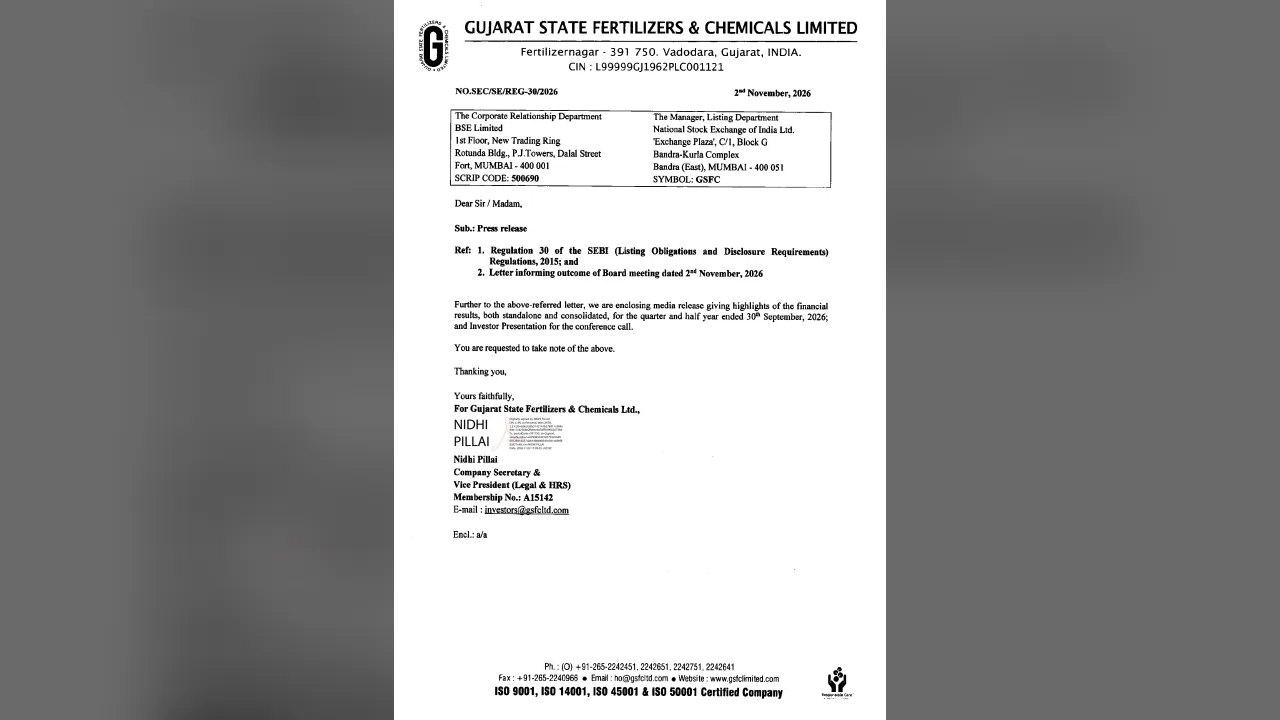
0:46 S. K. Bhajpai, Senior Vice President of Finance and Legal and CFO of GSFC Limited. Thank you, and over to you, sir. Okay. Thank you. So good afternoon, everyone. Thank you for joining us for Q2 twenty twenty seven earnings call of Gujarat State Fertilizers and Chemicals Limited. It's always great to connect with all of you and share the key updates that we have from the quarter. I hope you had a chance to review the financial results, media release and investor presentation available on the stock exchange and also on our company's website. If you see consolidated financial performance, sales is up by 49% in Q2 by o Y basis. Our PBT and PAT is reduced by 4238% respectively.
1:36 If we see consolidated H1 number by o Y basis, then we have 55% growth in the sales revenue to INR 8,003 and 24 crores. However, PBT and PAT again is down by 2622%, respectively. We see quarter over quarter, there is an increase of 32% in sales value to 4,741 crores. However, PVT and PAT, it is INR $2.49 crores and INR 200 crores, that is up by 2226%, respectively. So the company has delivered its ever highest Q2 and H1 top lines, achieving total sales of INR 4,711 on a stand alone basis in quarter two twenty six-twenty seven, a buy o buy growth of 50% and INR 8,293 crores in H1, twenty seven, a buy o buy growth of 56%.
2:33 In quarter two twenty seven, the Fertilizer segment recorded a 55% buy o buy growth in sales value, increasing by INR $13.87 crores despite 6% decline in sales volume from INR 6.08 lakh metric ton to INR 5.69 lakh metric ton. The growth was primarily driven by the higher DAP realization with DAP revenue increasing by INR $16.59 crores, supported by the government's DAP, a special package to compensate for international price variations. However, sharp increases in key raw material costs, particularly suffered by 327%, natural gas by 62 significantly impacted margins, compressing EBIT of the Fertilizer segment to INR 17 crores only compared with INR $2.24 crores in quarter two twenty six.
3:25 Nuclear subsidiary debt remains subject to revision following finalization of the actual pool gas rate by FICC and GAIL, which has been pending since April 26. The Industrial Products segment continued its positive performance in quarter two twenty seven also, with sales increased by INR 185 crores, registering a 30% growth over Q2 'twenty six. EBIT improved from INR 54 crore to INR 66 crore. The improvement was supported by better realization across major products in line with the market trends. Sales of caprolactam and nylon increased by INR 58 crore and INR 60 crores respectively, mainly due to higher realizations, while Anon sales increased by INR 36 crores driven by higher volumes.
4:15 TGU sales also increased by INR 26 crores, partly offset by INR 5 crore decline in Malama in sales. The Caprovanion spread improved significantly from US$5.12 per metric ton to US$8.49 per metric ton, overall against a backdrop of highlighted high tended geopolitical uncertainty and evolving global supply dynamics, the company sustained uninterrupted operations and ensured supply continuity during the quarter. While solid movement in key raw material prices put pressure on profitability, agility in product mix, responsive production planning and timely pricing actions enabled the company to mitigate the impact and defend core margins across business segments.
5:02 We continue to maintain a strong balance sheet with no long term debt, healthy network and adequate liquidity. As on 09/30/2026, the company had received subsidy dues for P and K fertilizers up to September and in case of urea up to October third week, respectively. The company continues to advance its CapEx plan aligned with its strategic growth roadmap, three ten modifications for 1,200 metric ton per day APS production in place of DAP as per market requirement at Sitka Unit Bus Commission on 10/23/2026. The country will enter the revenue season with comfortable fertilizer inventory levels, the highest in the past three years, particularly for UDI and PE grades, intensifying competitive pressures across the industry.
5:53 The subdued Southwest monsoon and lower reservoir levels, especially in the Southern India, are likely to constrain fertilizer demand. The prevailing price distortion between DAP and NPK fertilizers continues to influence farmers' purchase preferences, adversely affecting NPK offtake. The forthcoming NBS subsidiaries will play a vital role, in particularly mitigating elevated raw material cost and addressing price distortions. Concurrently, any easing of geopolitical tensions in The Middle East and Europe would soften international armature prices and provide relief to industry margins. The caprolactam engine is expected to moderate in quarter three 'twenty seven as regional supply normalizes, potentially impacting margins across the caprolactone nylon value chain. Demand for melamine and technical grade area is expected to remain steady, while at the fiscal reports exports may improve.
6:51 Amidst of subdued domestic demand, other industrial products are projected to maintain steady demand, delivering reliable baseline stability to the segment. I now turn over the call for questions and answers. Thank you very much. Will now begin with the question and answer session. Anyone who wishes to ask a question may press star and 1 on the touch tone telephone. If you wish to remove yourself from the question queue, you may press star and 2. Participants are requested to use handsets while asking a question. Ladies and gentlemen, we will wait for a moment while the question queue assembles. The first question is from the line of Saket Kapoor from Kapoor and Co. Please go ahead.
7:44 I hope I'm audible. Yes. Yes. Please go ahead. Sir, firstly, in terms of the CapEx program, my voice is echoing, sir. I'm... No, am good. I'm good. Sir, you may kindly me a question. The In terms CapEx program, which was alluded to us when we first phone call that we are contemplating some CapEx at SIGNA also and some power integration. So where are we, sir, in terms of the CapEx reduced for large chemical complex? Yes. As far as CapEx is to be put in, in the Sikka, we have finalized the PSF project at Sitka because phosphoric acid prices and sulphuric acid prices remains very volatile in international market.
8:44 So it is better to have our own sulphuric acid production capacity at Sitka so that the AP and other integrated grades of fertilizers can be produced at this minimal cost. So we have financed this project at around INR 3,000 crore and awarded the EPC contract very recently. And this will take around thirty three months to complete the completion activity, and then the production will start. And how will the metrics work in terms of the asset turnover and margin profile and other assets? This depends upon at that particular point of time when the production starts, what are the prices in the international level of the PA and sulphur, especially and rock.
9:32 Because rock for the rock, we are going to enter in the long term contract. But the while entering into the contract, no contractor is ready to fix the pricing. So it will prevail as on the date, particular date where the material is purchased. So that price will prevail as per the market conditions. But presently, we see that it has a comfortable 20% margin if we go by the BA production route rather than the purchasing of sulphuric acid and sulphuric acid. There will be margin addition and our dependence on the R and D expectation will also go down. Yes, yes, that's correct. And by what percentage, sir, we will be capturing the consuming rate?
10:23 It is 50%, actually. So whatever the total requirement for the APN and PGS fertilizers, 50% of the requirement will be met from the capital conversion. You mentioned the timeline of conversion by can you come again, sir? Is the thirty timeline to thirty three months. Thirty two to thirty three months. Sir, lastly in terms of the market conditions are different for market capitalization, other than that, what kind of value creation exercise can the board envisage going there for your for your investors? What can we expect in terms of what is the value creation exercise if some if anything was undertook in terms of buyback or any other activities?
11:18 No. Actually, whatever money in the project we are putting in, whatever the restrictions in the capacity utilization in Sitka, So by putting this facility, we are sure that we will be optimizing the capacity utilization at our Sitka plant. However, as far as buyback and other measures are concerned, still there is no discussion in the Board and at appropriate levels, we will discuss and then come back to you. Sir, this, lastly, the subsidy receivable part, you see closing balance of INR 3,400 crores, and you mentioned about a subsidy amount for UDL which is for October. So what is now the closing balance? Or how much you have received on account of UDIA?
12:04 No, UDIA, we have received, I think, to the last third week of October, all the subsidiaries. And there is so much impact on the urea because in the total subsidy bill, if you see the DAP and NPKK of fertilizers, it carries a lot of amount because of the high prices of sulfuric acid and ammonia. So in case of urea, we are comfortable as far as the subsidy is concerned. And it may impact INR 100 crores only. But since the regular production is there and excess sales of urea is there, so again, it will... We will create the bills and it will be on same level. So we are making that out of the closing balance of 3,400, only $2,300 is what is attributable to urea other than the NPK and the GSFCFC.
12:59 Yes. Yes. Yes. Sir, last week around the h two, how how do you think currently how the h two will shape up? I think it is very difficult to give any understanding on how the margins and all will shape up in such a so so much volatility. But but taking into account what our our the message with with with your business plan plan, what should be should be the understanding for H1? Sarkil, it is very difficult question as you rightly say, but yes, if you ask, I will give the question, I will have optimistic answer. Because this is a subsidiary, what is going to be announced by the government with effect from October 1 to thirty first March 'twenty seven for six months. These are very vital information, which will come from the government.
13:52 Till now, there is no notification published in this regard. However, we have started the production, and we are hopeful that whatever information we are having, if that rate is increased and approved by the Government of India at top level, then there will not be any problem. Whatever the deficit in the profits we have incurred during the last quarter, this will be compensated in the next quarter. So that I can say. And for the next six months, I think it is very good six month H2 for the company. There is no doubt about it. We are taking certain measures based on the growth strategy suggested by BCG. So there is some cost cutting measures we are already applying at our Chikka level at our Chikka plant. So that will be fruitful for the H2, I think.
14:41 So what kind of margin efficient are you working on, sir? Regarding this subsidy aspect also, what kind of incremental margin can we expect because of just the efficiency which you have just spoken? No, the subsidy is very important because whatever margins are coming, is from subsidy. If the subsidy goes out, then there is no margin in any of the fertilizer. Subsidiary rates are very important for us, even whatever the current level or whatever the infill level. So until as we come to know what is the levels of the NPK grades they are giving us, it is very difficult what percentage of margin we will be having. But as far as DAP is concerned, you know that it is fully compensated by Government of India by way of advantage, disadvantage regulations.
15:31 And in DAP, we are getting 4% margin. In urea, hardly there is any margin of around 3%, 4%. So NPK grade of fertilizer, only the margins can be determined after receiving the NPK and S rate of subsidiary rates effective from first of of October. And based on that, we will calculate the margin. Yes, I was just looking at the efficiency part, which you are mentioning that that will come into play for H two. So have you quantified the thing? I I got your point. The major is the such such a delay only. Other than that, the operation efficiency, anything to to take home or Yeah, appraisal efficiency whatever because of the solar power arrangement by the company in place of the costly power purchased from the electricity boards.
16:21 So that will increase unit as a whole, not as a particular product. Because whatever DAP and Piga crates or ammonium phosphates, whatever we are producing, etcetera, it will be distributed among the all products. So it will be difficult how percentage will be impacted, but we can quantify as the amount terms that around INR 20 to INR 25 crores per quarter, we can gain out of it. The next question is from the line of, an individual investor.
17:21 Yes. Sir. So my first question was on the distribution strategy. What will be our distribution strategy over the long term, 10 India? So as far as distribution of fertilizer is concerned, this is decided by the government, urea and other fertilizers. So we have hardly any role to play in the distribution thing. Wherever the requirement of the fertilizer is there and is affected by government of movement division of the Department of Fertilizers, accordingly, we have to supply the materials, okay, standing the level. Okay. And about industrial segment? Industrial segment also has to purchase resale, but it depends from where the market demand is there.
18:16 So we have the regular customers, whoever comes, we sell to pan in the LOEs. Okay, thanks. And my second question was on Yes. Industrial segment performed very well this quarter. Around 30% sales growth is there, and EBITDA is also increased. So now the chemical sector, as far as the input of fertilizer is there, whatever increase is there, the chemical sector has also the pain due to this geopolitical situation. And the pricing of the chemical has also increased. So wherever we have the margin by using our own capital consumption of the raw materials and the product mix, then we have a better margin, in fact, in the chemical side because there is no control in the MRP or something like that as in case of the fertilizers.
19:14 So we certainly have a better prospects in the IP segment, henceforth also. Guys. That's it from my side. Yes. Mic Anyone who wishes to ask a question, press star and one on your touch tone phone. Anyone who wishes to ask a question, kindly press star and one on your touch tone telephone. As there are no further questions from the participants, I now hand the conference over to Mr. SK Bajpai from GSFC Limited for closing comments. Yes. Thank you for all participants joining and asking the questions. And happy Diwali to all of the our customers and investors.
20:01 And I hope that the next quarter and the H1 of the next financial year will be good for not only for the company, but for all the investors. And thank you for the patient hearing. Thank you. Thank you. On behalf of GSFC Limited, that concludes this conference. Thank you for joining us, and you may now disconnect your lines.
Senior Vice President of Finance and Legal and CFO at GSFC Limited
at Kapoor and Co.