Replay available
Grupo Aeroportuario del Sureste SAB de CV (BMV:ASUR/B) Q2 2026 Earnings Call
Grupo Aeroportuario del Sureste SAB de CV (BMV:ASUR/B) Q2 2026 earnings call, held 2026-07-24. Watch the replay and read the transcript on 6ix.
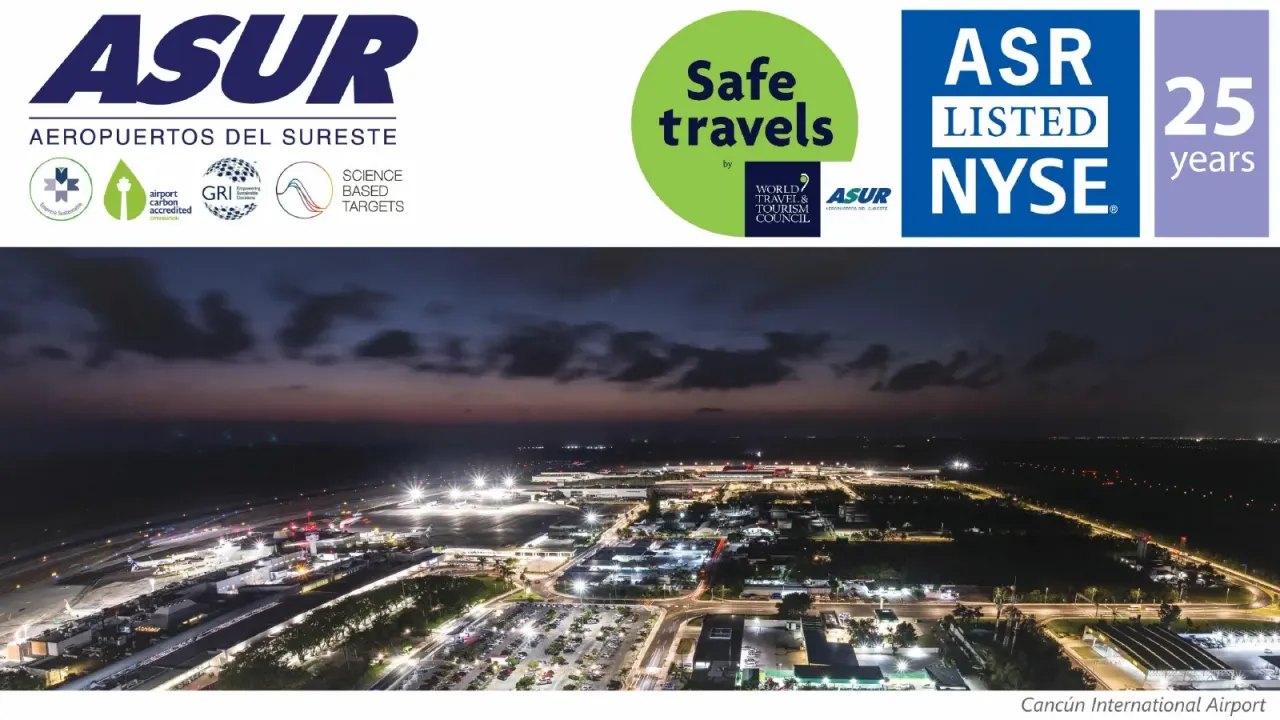
- Company
- Grupo Aeroportuario del Sureste SAB de CV (BMV:ASUR/B)
- Period
- Q2 2026 earnings call
- Date
- Fri, Jul 24, 2026, 10:00 AM ET
- Replay
- Watch the replay on this page · 39 min
On 6ix: 6ix.com/event/grupo-aeroportuario-del-sureste-s-a-b-de-c-v-asr-q2-2026-earnings-call
Replay
Transcript
Automated transcript · Written by software from the replay's audio. It can mishear names and figures; the replay is the record.
0:00 And gentlemen, and welcome to Assurant's Second Quarter twenty twenty six Results Conference Call. My name is Christine, and I will be your operator. At this time, all participants are in a listen only mode. We will conduct a question and answer session toward the end of today's conference. As a reminder, today's call is being recorded. Now, Mr. David Barlow, Corporate Governance Strategic Planning Manager and IRO at Azure. Please go ahead, sir. Thank you, Christine, and thank you, everyone, for joining us today to discuss Assure's results for the second quarter twenty twenty six.
0:52 With me on today's call is Ivan Focastro, Chief Executive Officer. Additional details about our results can be found in our press release, which was issued yesterday after market close and is available on our website. As usual, all comparisons discussed on this call will be year on year and our figures are expected in Mexican pesos unless specified otherwise. As a reminder, certain statements made during the call today may constitute forward looking statements, which are based on current management expectations and beliefs and are subject to several risks and uncertainties that could cause actual results to differ materially, including factors that may be beyond our company's control. Please refer to the forward looking statements disclosure included in this earnings presentation for additional information.
1:42 With that, I'll turn the call to Aeroportu. Please go ahead, Aeroportu. Thank you, David, and good morning, everyone. I'm going to start today's conference call with a discussion of the strategic initiatives that are setting the foundation of ASU's next stage of development and growth. Then I will briefly review quarterly results. Our objective is to continue building the leading airport group in The Americas. We are doing these by expanding into attractive markets, diversifying our geographic and revenue mix, diminishing the dependence in one market, increasing our exposure to commercial revenues, and improving the efficiency of our operational model.
2:32 The Mokiva transaction, as with U. S. Airports, development program at Cancun Airport, and the proposed internalization of the technical assistance services are key components achieving our goal. Let me begin with the proposal that we proposed to the shareholders meeting that is going to take place on August 20. First, we are asking shareholders to consider approving ASU's plan to internalize the special technical assistance and technology transfer services currently provided by our strategic partner, EAP. We believe this is an important step in ASU's evolution.
3:21 It will bring these capabilities, personnel, expertise, and know how into Azure, simplify our corporate structure, and better align our operational model with the scale and complexity our growing international platform. The transaction would be implemented through a merger and would involve the issuance of approximately 7,300,000 net new ASUS shares to Itau shareholders, equivalent to approximately 2.4% of the current shares outstanding. For reference, ASUR recognized approximately $4.00 1,000,000 pesos in technical assistance fees during 2025.
4:08 If transaction is approved, the services will be performed by Azure. While we will assume the related operating cost, the recurring external fee will be eliminated, and the future economic benefits of disabilities will remain within the company. The proposal was reviewed and initiated under the leadership of the Audit and Corporate Practices Committee, which is composed exclusively of independent directors and supported by independent financial and legal advisors. Deputy, the board has proposed two extraordinary cash dividends to be paid, 10 pesos per share, on November 24 and December 15, respectively.
4:57 The proposal reflects the strong financial position, solid cash generation, and disciplined approach to capital allocation. During the first half of the year, we generated $7,300,000,000 in operating cash flow, an increase of 21% year on year. This cash generating capacity allows to return excess capital to shareholders while preserving the flexibility to fund our investment commitments and pursue future growth opportunities. Shareholders will also be asked to approve amendments to the bylaws. First, to align them with the current regulatory framework, and second, if internalization is approved to reflect the changes resulting from the merger.
5:51 We encourage shareholders to review the information statement for additional details. Turning to Motiva. We are actively progressing to complete the acquisition during the second half of twenty twenty six. The transaction remains subject to remaining regulatory approvals and customary closing conditions. Once completed, the transaction with A. B. A portfolio of 20 airports across Brazil, Ecuador, Costa Rica, and Curacao, including entry into Brazil, the largest aviation market in Latin America. The portfolio handles approximately 45,000,000 passengers annually and will significantly increase the source of scale and geographic diversification.
6:41 Our underlevered balance sheet enables to fund these transactions with debt, while at the same time, preserving financial flexibility for other time return projects, including dividend payments. Moving next to the ASU US. ASU US provides directly exposure to the non regulated dollar denominated commission revenues at the free nature of those service. With over 35,000,000 annual customers and revenues above US benchmarks. Azure US also needs a platform which from we will continue further developing our commercial capabilities in The U. S.
7:31 On April 21, Caspo U. S. Completed the $125,000,000 commercial transformation of GSK Terminal 8, opening more than 60 dining, retail, duty free, and experiential concepts. At GSK's new Terminal 1, commercial development continues ahead of its expected operating towards the best quarter next year. As a result, the current financial contribution does not yet represent the earning potential of The U. S. Platform. At NAX, we continued remodeling and developing commercial spaces ahead of the Super Bowl in 'twenty seven and the Olympics and Paralympic Games in 'twenty eight.
8:18 In Mexico, construction of the new Terminal 1 continues at Campo, which we plan to be open during the fourth quarter. One separation of Terminal 1 will allow begin rebalancing passenger flows, including moving most of South American operations from Terminal 2. This should reduce pressure on Terminal 2 and improve the passenger experience and additional information capacity. In Ireland, we continue executing the growing mass development program. This includes a second phase of terminal core expansion, which will add forwarding new gates and connecting taxiway together with the related airside and roadway infrastructure.
9:07 The project is expected to be fully operational by the end of twenty eighth and is designed to expand capacity, improve passenger and air traffic loads, and support and longer term growth. Together, this initiative supports the same objective, a larger and more geographically balanced airport platform in markets with attractive long term demand, greater contribution from commercial revenues, and more efficient operating and equity structure. Turning to passenger traffic. Total traffic declined 2.7% year over year to approximately 17,000,000 passengers, reflecting soft ticket performance in Mexico and Puerto Rico, partially offset by continued growth in Colombia.
10:00 In Mexico, traffic declined 5%, primarily reflecting continued pressure at Tempur, where international traffic remained softer, particularly from The United States, our largest international source market. Airline capacity constraints, extreme bankruptcy and higher airfares, partially reflected elevated jet fuel prices, also affected the net. In addition, the one top did not generate incremental tourism flow into Mexico. Of our other Mexican exports performed better and partially offset the decline of their food. Passenger bonus to and from The United States, Europe, South America, Mexico decreased by eleven point seven, eleven point eight, 6.5, 1.9, respectively, while Canada increased 3.5.
11:02 Puerto Rico traffic declined 3.5%, reflecting the effects of dispute bandwidths, together with softer domestic and international demand. Domestics remain affected by airline capacity and trade dynamics in The U. S. Market, while international remain comparatively more resilient. It will take time for other airlines to absorb the speed passengers lost since May 2. Colombia traffic increased 3.6%, supported by a healthy demand and improved connectivity. Growth moderated against the strong comparison base that continued to hamper the rest of our portfolio. While year time conditions in Mexico and Puerto Rico remain challenging, we continue to fuel much of the current pressure as capacity and affordability related rather than a change in the long term fundamentals of the travel demand.
12:05 Fleet availability should gradually improve as aircraft return to service, although the timing remains uncertain. Turning to financial performance, as usual, the figures I will disclose exclude construction revenue and construction costs, although unless otherwise noted. Revenues were broadly stable at 74,000,000 pesos. Nonaeronautical revenues increased nearly 10% supported by the contribution from ASUR U. S. Airport, which added $444,000,000 pesos and 30% growth in Colombia. By contrast, aeronautical weather is contracted by mid single digit, mainly reflecting the softer traffic in Mexico for Puerto Rico and the translation effect of the stronger Mexican peso in our international operations and local operations with the U. S. Dollar combined.
13:06 Commercial revenues per passenger increased nearly 13% to 153 per passenger, primarily reflecting the addition of The U. S. Commercial bridge. A single digit decline to 145.7 per passenger in Mexico was offset by a low and high single digit increases in Puerto Rico and Colombia, respectively. Again, softer performance in Mexico and Puerto Rico resulted from lower traffic and FX headwinds given the strength of Mexican peso. The expansion of our commercial footprint is ongoing with 40 new commercial spaces, 29 in Colombia, eight in Puerto Rico, and three in Mexico over the past twelve months.
13:59 At the same time, as previously mentioned, we completed the commercial transformation of GFP Terminal 8 in the quarter. Moving on to profitability, consolidated EBITDA decreased nearly 9% to 4,600,000,000 By region, EBITDA declined 9% in Mexico, 17% in Puerto Rico, while increasing 1% in Colombia. As well U. S. Airports contributed to 20,000,000 of EBITDA, reflecting the Plata Point's wind development stage. This contribution is not yet representative of its earnings as GFK 10.8 continues to ramp up, and GFK new Terminal 1 is expected to open during the first quarter of this year, while commercial spaces at NIGX and Chicago have been expanded and upgraded.
15:01 Adjusted EBITDA margin declined by 150 basis points year over year to 62% due to lower revenues in Mexico and Puerto Rico and the consolidation of The U. S. Commercial business, which is operating at the lower margin. Net majority income increased 7% to $2,300,000,000 as lower foreign exchange loss in Mexico, lower income taxes in Mexico and Colombia was offset by the benefit from the amortization of the fair value adjustment related to the Colombian acquisition loan following its repayment. Turning into the balance sheet, we ended the quarter with cash and cash equivalents of nearly $12,000,000,000 and net debt to EBITDA of 0.9 times last twelve months' EBITDA.
15:56 Our balance sheet remains strong and provides flexibility to execute and fund our committed capital program, complete the Motiva transaction, and continue pursuing our broader strategic priorities. Lastly, during the quarter, we stepped up capital expenditures to billion with the majority of these funded in Mexico Sureste, as we advance in our capital program, including the projects at Campo Aeroportuario summing up, while the grading environment remains challenging, particularly in Mexico, as we are moving in the right direction as we are making progress executing our strategic growth initiatives, better equity structure and diversification, and with our expansion through the Mokiv acquisition, our U. S. Commercial operations, and the ongoing cost efficiency efforts are expanding our business and positioning the company for long term growth. At the same time, we remain busy paying with the capital allocation and cautious our outlook by continuing to create long term sustainable value for our shareholders, complemented with attractive dividend payments. With that, we are ready to take your questions.
17:26 Christine, please open the floor for questions. Thank you. We will now begin the question and answer session. To ask a question, dial in by phone and press star one on your telephone keypad. Make sure your mute function is turned off. And if you are using speakerphone, please pick up your handset before pressing the keys. To withdraw your question, press star then 2. Please limit yourself to one question and one follow-up. Join the queue again if you have additional questions. At this time, we will pause momentarily to assemble our roster. Thank you. Our first question comes from the line of Rodolfo Ramos with Bradesco B. I.
18:16 A couple here, if I may, into my follow-up there. We saw softer implicit tariffs in your aeronautical revenues. Wanted to check on your maximum tariff compliance and where you expect to end the year given today's FX. And the second is on your cost side, whether you think that this quarter represents a good base going forward and how does the internalization might play there? I don't know if you're seeing still extraordinary expenses on the Motiva acquisition and how can those evolve going forward. Thank you.
19:04 Thank you, Grupo. Yes, of course we are seeing some pressure in the margin tariff due to the fact that the passenger mix is changing in comparison with last year. So the decrease in The U. S. Traffic had an impact, but of course, as always, we will have a very clear objective, which is 99% passing back on balance by the end of the year. In terms of the cost, yes, we have onetime cost during the quarter related to Motiva, related to The U. S, some additional fees, legal fees due to the internalization the project. Nothing that will be there in the in the future. It's true.
19:57 Any any way that we can give us a sense of of of this of this expenses that you expect to Those are, I would say, internal things are not so important. The clear problem we had in the quarter was the loss of half a million passengers in the case of Cancun and 135,000 in the case of Puerto Rico. The trouble is in the Venezuela side. Okay. Thank you. You're welcome. Our next question comes from the line of Guilherme Mendez with JPMorgan. Please proceed with your question. Yes, good morning all. Thanks for taking the question. Hi, Adupo and Nadi. I have a couple in regarding Motiva's airports.
20:48 The first is on the approval. You set the expectation for the second half of the year. I recall in the last call you mentioned about the second quarter of the year. If you can share which of the four regions are taking longer than expected? And also regarding synergies, I recall you guys talking about not expecting a lot of synergies on the transaction, if anything has changed on that front. And lastly, if I may, if you somehow consider a potential partial divestment of those assets once you incorporate them on your portfolio. Thank you. Yes, the region that is COVID is the case of Brazil. We are very close to advance.
21:37 I would say I said second half, I would say third quarter. In the case of synergies, I don't see any important synergy. You know, as I said before, we are basically expecting the same business as usual. And in terms of selling some pieces, not for the moment. Very clear. Thanks, Adolfo. You're welcome. Our next question comes from the line of Jen Spies with Morgan Stanley. Please proceed with your question. Yes. Hello. Thank you also for taking my question. So on the administrative expenses in Mexico, they remain quite elevated. Should we I mean, they increased more than around 30% year over year. But should we expect this level to be more or less the the the new normal? And and and what's driving it? Is it mostly, like, labor cost, minimum wage increases, and so on? Or what is it?
22:45 Yeah. It's it's minimum wages. And, also, there was an issue with insurance costs that had increased significantly in the case of Mexico due to a tax the government. Okay. Alright. Thank you. You're welcome. Our next question comes from the line of Gao Frizo with Goldman Sachs. Please proceed with your question. Hey, Gao Frizo. Hey, Larry. Good morning, guys. I have a quick question around Kungkong traffic, right? Just wanted to hear your thoughts on why the weakness in that airport specifically.
23:31 In the past, we had the issue with Salloum ramping up. I think that's behind us right now. So I just wanted to hear your expectations for growth there going forward. And what is driving the weakness we saw in June but also in the months prior to that? Thank you very much, guys. Well, the shortness is a couple of matters. One of the important ones is, of course, the jet fuel increase. You know? Just to to say jet fuel increased 42% during the month of June due to the conflicts in The Middle East. That's one of the things. The the second one, of course, the bankruptcy of Spirit, and it's gonna take down for the other airlines to refute this.
24:19 Of course, in the case of sarcasm, which has been very high during this year, almost seeing the levels of last year during the summer. In terms of the recuperation process, my opinion is that the summer is and we are expecting the recuperation process up to the end of the summer season. So winter season, we see a better outlook and, I would say, more seats, more awkward seats than what we have last year. But that that will be up to November, December, this year.
25:09 That's great. Thank you very much. You're welcome. Our next question comes from the line of Abraham Fuentes with Banco Santander. Please proceed with your question. Abraham Floventa, your line is live. I think sorry. I think my question was already answered. Sorry for that. Our next question comes from the line of Pablo Rosales with ECAL. Please proceed with your question. Hi. Good morning, Adolfo. Good morning, Andre. Talking about the recent increase in tariffs in Mexico, which is, like, the maximum tariffs that you're charging now after July time. Are you able to do that?
26:04 The vaccine tariff is is not what you correct on every single day. The value is the whole year from January to December last year, at the end of the year. So what I what I said is what we're expecting is that the maximum time compliance for this year should be close to 99%. Okay. Thank you. Our next question comes from the line of Enriquez with GBM. Please proceed with your question. Alright. So thank you for for the call.
26:52 I just have one quick question. In the quarter, I assume you have been able only another with the contribution despite a third quarter of consideration. Could you provide more more color on when should we expect the business to reach a more normalized profitability level? I am really sorry, but I cannot hear you well. Could you repeat your question, please? Can you hear me now? It's it's better, but not so bad. Okay. Maybe maybe I'll I'll hang up and then I'm good evening.
27:45 Okay. Thanks. Thank you. Our next question comes from the line of Anton Mordenkire with GBM. Please proceed with your question. Hi, Adolfo. Thank you for taking my question. One of my questions, I'm not sure if you can provide some color on how the current traffic curve looks against the expectations that you set during the last MVP revision. That is one and another one that which I think is the one that Enrique was trying to ask is regarding Assured U. S. EBITDA contribution. I think in previous calls, you mentioned you were expecting somewhere closer to $20,000,000 in EBITDA normalized. I'm not sure if you are still expecting that those same levels.
28:38 Thank you. Thank you for your questions. Of course, we are below our expectation of the previous MVP. Were not expecting all of these things that are happening today. And in the case of The US, the $20,000,000 is not going to happen this year. Moreover, when we are not going to open new Terminal 1 this year. So originally, it was expected to be open as from June 1. Now we are expecting it at the end of first quarter next year. Thank you, You're welcome. Our next question comes from the line of Gabriel Himmelfarb with Scotiabank. Please proceed with your question.
29:32 Hi, Alberto. Good morning and thanks for the call. Just two questions. What's the EBITDA margin level we should consider sustainable for Assured U. S. Once the IFRS 16 effect normalize? And also, should we think about Assured U. S. As an asset or as a platform for future US expansions? Thank you. Gabriel, today's margin in The US operations is around 9%. So it's a completely different business of income margin rate that we have in Mexico, Puerto Rico, and Colombia. Even though I do believe that this margin will increase in the future, of course, we'll never be compatible with the margin in the case of Mexico.
30:29 Important to say also that today, we have some expenses in relation with the projects that we are progressing. We are doing in the case of new terminal work. Some of the processes related to this project that is not generating any revenue. No? Of course, what we have said is we want this be a capital to grow in The United States. That's the most important objective we have with this country. Okay, thank you very much. Our next question comes from the line of Alan Matias with Bank of America. Please proceed with your question.
31:24 Hi, good morning and thank you for the call. Just a follow-up on improving traffic, just focusing on domestic traffic, it has also been weak. The same factors apply for domestic traffic in Cancun? Thank you. You know, the problem with the domestic has been the engine problem that happened with Viva and Bolaz, but basically the case of Bolaz, and this has been improved. During the quarter, I had the opportunity to meet the. And he's saying that now, definitely, we are gonna be ready. They're after than than what they had before.
32:14 So I am confident that this that we will see some of these in the coming quarters at this respect. Thank you. You're welcome. Our next question is a follow-up from Jen Spies with Morgan Stanley. Please proceed with your question. Jen Steeves, your line is alive. Our next question comes from the line of Alberto Valles with UBS. Please proceed with your question.
33:06 Thank you. I'll go for the B. Sorry if can repeat any question. My name dropped it before. But if you could provide some details and when comes the the Pinal one operation set in the second half of the year, But should we need of the third quarter, more to the end, to the fourth quarter? And should we consider the second quarter as a bottom for Azure in terms of traffic, in margins, costs, tariffs? Should we see improvement for the following quarters? Okay. In the case of you're talking about the Terminal 1 in Cancun Airport I'm expecting that for the fourth quarter.
33:54 And new Terminal 1 at GFK is first quarter next year. In terms of winning this quarter with Boca Colomanga, what I hope, Not so sure, of course, in terms of the traffic. I do not expect something different for the quarter, and I expect some improvement during the fourth quarter. Okay. And if I may, a follow-up. In terms of dynamic of airlines, do you see that changing something with being one than it was before? Do you see a more volume power from them to negotiate tariffs or or not? Because you you see the cheapest one.
34:52 Well, basically, what I understand of their merge is that they will continue working separately independent. So that the merge is just giving them the power to be able to negotiate better with the the aircrafts. No? But in terms of the traffic, in terms of the routes, they should be independent. Okay. And somebody else's. Our next question is a follow-up from Rodolfo Ramos with Bradesco B. I. Just a couple of follow ups, Alec, if I may. The insurance costs that you mentioned, are these expected to be recurring or was this a onetime off? So again, if we if this is a good base to go off of?
35:56 And second, I mean, started to talk about a recovery in the fourth quarter and the winter season, you know, being the next test for Mexican traffic. I mean, do you have any visibility today as to how the winter season is looking? I don't know if, you know, it's early, but vis a vis other years, either bookings or just conversations with airlines? Thank you. Well, because of the insurance, is not one time. It's basically, I'll never give you the number. The cost of the insurance increased by 39%. So and it's it's gonna be there. It's not gonna change. In terms of the recovery, yes, we have some information using the the database of the feeds that are published by the airlines, and we see some increase in the parcel with last year going November and December this year, so the winter season.
37:04 Great. Thank you. Of the winter season. Thanks. As a reminder, if you have a question, please press star then 1. We will pause momentarily to assemble our roster. Thank you. Our next question is a follow-up from Gabriel Himefar with Scotiabank. Please proceed with your question. Hi. Hi again. Just a quick question. You mentioned that the new terminology, GAP will be on the third quarter twenty twenty seven. I think I did it well, and also for the new terminal in concluding fourth quarter this year. Thank you. Gabriel, yes. Terminal 1 in Cancun fourth quarter this year.
37:55 Terminal new Terminal 1 at GFA. First quarter next year. Okay. Thank you. You're welcome. Thank you. That concludes our question and answer portion of today's conference call. I would like to turn the call back over to Mr. Varlow for closing remarks. Thank you, Christine. And we would like to thank you all again for joining us on today's call. We look forward to speaking to you again in the next quarter and have a nice day. Thanks very much. Ladies and gentlemen, that concludes the store's second quarter two thousand twenty six results conference call.
38:47 We would like to thank you again for your participation. You may now disconnect.
Follow Grupo Aeroportuario del Sureste SAB de CV into a list and get an email when it puts out news.
Latest news releases
- BMV:ASUR/B — ASUR Announces Total Passenger Traffic for June 2026 · Mon, Jul 6, 2026
- BMV:ASUR/B — Asur proposes to its shareholders the internalization of technical assistance services, an extraordinary dividend, and an amendment to the company's bylaws · Tue, Jun 23, 2026
Companies on this call
More from Grupo Aeroportuario del Sureste SAB de CV
- Jul 24, 2026 Grupo Aeroportuario del Sureste SAB de CV (BMV:ASUR/B) Q2 2026 Earnings Call
- Apr 23, 2026 Grupo Aeroportuario del Sureste SAB de CV (BMV:ASUR/B) Q1 2026 Earnings Call
- Feb 25, 2026 Grupo Aeroportuario del Sureste SAB de CV (BMV:ASUR/B) Q4 2025 Earnings Call
- Oct 23, 2025 Grupo Aeroportuario del Sureste SAB de CV (BMV:ASUR/B) Q3 2025 Earnings Call
- Jul 23, 2025 Grupo Aeroportuario del Sureste SAB de CV (BMV:ASUR/B) Q2 2025 Earnings Call
- Apr 23, 2025 Grupo Aeroportuario del Sureste SAB de CV (BMV:ASUR/B) Q1 2025 Earnings Call