Transcript
Automated transcript · Written by software from the replay's audio. It can mishear names and figures; the replay is the record.
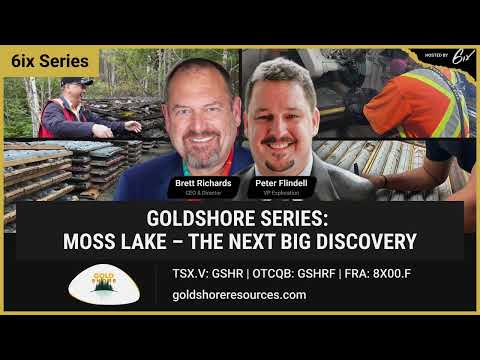
0:07 Hello, everyone, and welcome to the first episode of Goldshore Resources' monthly series, Moss Lake, The Next Big Discovery. I'm pleased to introduce the CEO and Director of Goldshore, Brett Richards, as well as their VP of Exploration, Peter Flindell. Brett and Peter are going to walk through the latest from Goldshore and afterwards take you through some questions live. Remember that you can submit your questions using the Q&A tab found on the right-hand side of your screen at any time. And as a note, this being a 6 series event with your registration and attendance today, you'll be automatically registered and notified of all future episodes. As always, this event
0:39 is being recorded and is going to be available on six.com in the coming days. Without further ado, Brett, I'd like to hand things over to you to get us started. Thanks, Cam. And thanks, everyone, for for attending today. And I know, you know, on November 1st today, it is the start of a bit of a run-up towards the Christmas holiday so welcome everybody. And with me today is Pete Flindell, who is our VP of exploration.
1:07 Hi, everyone. Yeah, a lot of people kind of are familiar with the story. And I think what we want to focus on today is kind of where Moss Lake is going. And for those of you who don't know the story very well, we've been developing Moss Lake since June of 2021. We've raised about $50 million in that period of time to support our development activities.
1:35 And we are about 65,000 meters through a 100,000 meter drill program that has gone through a little bit of a roller coaster just based on the capital markets. We had plans to ramp up quite significantly this year to 5 or 6 or 7 rigs and the capital markets just forced us to pull back.
1:56 For those of you who don't know the project, it's Northwestern Ontario. It has a historic 1.5 million ounce indicated resource and a 2.5 million ounce indicated inferred historical resource and combined about 4 million ounce historic resource. We are in, as I said, we are in Ontario and we've been kind of working through our development program for now for over about 18 months now. This is a little bit of information on the team. You can check out our website and check out the information about all of our people, our board, and our advisory board on the website. But let's just jump right into Moss Lake.
2:42 As I said, we are in Northwestern Ontario in an area that has fairly extensive mining and historic mining in and around it, both in the Timmins Camp, in the kind of Val d'Or Camp and in the Red Lake Camp. Where we are is a little bit, I'll say, underloved over the past 30 or 40 years, simply because these are low grade deposits that require a 12 or $1,300 gold price to work. And now that we've got a sustained gold price over these levels for some time, they've started to come back into attraction. But I think what we offer more so than a lot of the others, whether they be in Northern Ontario, Northern Northwest Territories, Inuvit, Northern Yukon, et cetera, is we have pretty extensive infrastructure in and around where we are. We are on the Trans-Canada Highway. So we have access to almost every possible piece of infrastructure, including extremely inexpensive 10 cent kilowatt hour power at the project site.
3:51 But we have road, rail and international port access to contractors, access to everything needed to build a big mining camp in this area.
4:03 Back in the summer of this year, we signed an earn in agreement with White Metals now called Thunder Gold to earn in to a property that's adjacent to ours called Vanguard and Iris Lake And we have flown that with a VTEM survey and we're gonna be putting together a drilling strategy on the Northeastern part of the property for 2023. We'll be preparing that early in 2023. Just a little bit of information on our cap structure. And this slide is a little dated. I apologize for that. We're gonna be putting on a new presentation today. We've got about 6 million, 5.5 to 6 million in the bank right now. We're still trading at around 20 cents or about a $30 million market cap. And we have about 143 million shares out. So, but I think that the highlight note here was we've got about $5.5M to $6M in cash.
5:00 Just some photos of what we've built at site and what Pete and his team have put together. This is the core shock and the camp where all of our activities are kind of coordinated, both on core logging and sampling, etc. And also core storage. There's been a significant advancement over the last 18 months in ESG. I think Pete and his team have done a great job. They have signed an agreement with one of our first host community First Nations and in the process of completing another one. And we have tremendous, I'll say tremendous relationships within the community, within our host First Nations supporting us. And, you know, quite frankly, there is a First Nations affiliated contractor that's doing our environmental baseline.
5:58 So, there is a lot of collaboration. It happens on, you know, at least once a month, there's quite a significant amount of dialogue back and forth between the communities and Pete and his team. As we said, we flew around 550 kilometer VTEM survey on top of our land, our VTEM and MAG survey we did earlier in 2021. But I think I'd like to highlight, you know, what this has delivered at the end of the day is some substantial targets of which we had originally planned this year to start hitting all of these targets, probably all the way down from Hamelin, all the way up to Iris. And we started our work in the Moss Lake area. We did a bit of drilling up in Cold Stream, But
6:47 we started to identify some unique, I'll say occurrences within Moss Lake, which led us to continue to follow those unique occurrences. And those unique occurrences were around hitting high-grade envelopes of the material in the space. You can see some of the high-grade areas over Moss Lake that we have intercepted. We are getting a significant amount of intercepts over 1g per tonne and well over 70, 80, 90,100m in some cases, and then higher grade envelopes contained within them. So Pete, maybe I'll just get you to walk through how we started to attack Moss Lake because there is a significant historic resource here. How we attacked it from a drilling strategy standpoint and then how we led ourselves to stepping out and stepping out a long strike. So I'll leave, I'll turn it over to you as to how we, how we went through this. Sure. Sure. Just before I start, I'll just point out that even though we pulled back the number of rigs and we didn't test a lot of those geophysics targets this year.
8:07 We have actually covered most of that ground with soil geochem, looking through the muskeg and with structural mapping and prospecting. We have a great field team. They're hard to keep out of the field and they've been everywhere over our ground and the white metals earning ground. So we're looking good over winter here to assimilate all that data and to prioritize what our scout drilling program will be next year.
8:42 So while the field team has been doing that, our projects team focusing very much on Moss Lake here. What we recognised in trying to model in 3D is the controls on the high grade, because at the end of the day, no matter what the grade is of a deposit, you need the highest grade possible. That needs to be prioritised through any plant. So it needs to be understood. And we brought in Brett Davis from Australia, a well-known structural geologist who has helped us with this. We have had our oriented core data which has been exceptionally useful. We just need more and more of this data. And it's helped us to understand that the high grades in this deposit, when I say high grade, up to 500 grams per tonne, are focused along shear zones that run along the length of the deposit.
9:43 And it's a 3 kilometre long strike length now. And these zones run in parallel and they are variously from a metre up to 20 metres wide. So they're significant in volume and particularly where we have several stacked structures or parallel structures at the main zone and at QES. A lot of our work has been at the main zone, and this is very well defined now. More recent work in the southwest zone is showing there's actually more higher grade shears in this area than this plan is showing. And the QES zone also needs a lot more drilling because these structures are more dip persistent and strike persistent.
10:35 And you can see that with our model here we have these little blebs that are all in a line and that's the nature or reflects the need for closer space drilling in these areas. But this high grade or plus 1 gram zones are the key to the next project for Moss Lake. As We know that we have a big sea of low grade, but the starter pit or the smaller initial operation will focus on these higher grade zones. And just to see what they look like in section, You can see that they run down through here. They're narrow but they're persistent and obviously open in many areas where we don't have sufficient drilling.
11:31 So that's moss. Then just to comment on East Coldstream, in the summer we did do some drilling up here because when we went to 7 rigs, we needed to spread them out. We found a similar pattern up here. This right now in our historic resource is quite low grade, but we actually found that there are coherent structural zones that will enable us to model this as a slightly higher grade deposit. Back to you, Brett. Yeah, thanks, Pete. So I think that's been the real key here is is identifying these high-grade seams and envelopes. And then our plan to, and this is really not updated, where our plan is to do a mineral resource estimate sooner than Q1. And we've telegraphed this to the market. We're actually working on the final draft of it right now. And We expect over the next 2 weeks to present it to the market.
12:35 And the rationale for that is rather than look at the big global resource at both Cold Stream but Moss Lake, look at the big global resource and come out with a
12:48 global resource that is current rather than historic, our view was we wanted to focus on the high grade. And yes, we will come out with a global resource along the way as well. But our focus needs to be kind of, you know, how do we separate ourselves from everybody who's the same as us? And you know, I can name your names and it's not telling tales out of school. A lot of our peers are sub-1 gram, whether that's, you know, Moneta or Troilus or Mayfair or 1st Mining or Treasury or Integra, they're all sub 1 gram deposits. They're all in like jurisdictions like Ontario or Quebec or USA. And they're all at the PEA stage. How do we separate ourselves from these? Obviously, the way we can separate ourselves from a peer group, and we're fortunate to be able to do that is because we have these high grade envelopes.
13:42 So putting a phase 1 project around the high grade makes a lot of sense for us because I think now we're going to see where we have more substantial grade than a gram in order to get this along and into PFS and eventually into visibility on a smaller project. Because having grade at 1.5g or 1.6g and having 1.5oz, that's a real project. It's a real phase 1 project. And it's not a cap out, blow out, billion-dollar project. It's a couple of hundred to $300 million CapEx project. And that's very
14:25 manageable in this market. And if we've learned anything over the last year, I think what we've learned is that CapEx is being watched very, very closely. The market does not like these big billion dollar projects, and we have migrated. We've been able to migrate from this being a large, low-grade operation to being a smaller, higher-grade operation that will eventually lay back into the sea of 0.X grams above cutoff into a larger project. And that gives the Goldshore shareholders lots of things to think about. And that is, first of all, it means that we have a project, a phase 1 project that could potentially be valued on a PEA.
15:17 Our thinking is we will put a PEA out in Q1 of next year, not so much in Q2, but in Q1.
15:24 We can get started on that as soon as we have our MRE done. Then we have some real visibility on what the economics of this higher grade mean. And I can walk through various scenarios, I'd be speculating, but I can walk through various scenarios that even at 120,000oz and $1,000 all in sustaining costs, that's a $600 margin today, or $75M or $80M of free cash flow. Companies like ours trade on either on a per ounce basis or on 2 or 3 times cash flow. That's a $200M company. Today, we're sadly at $30M. I see a lot of potential on the catalysts that are before us on both the MRE and both the PEA and Q1, whereby we're going to stop being valued at 6 or $7 a historical ounce and start being valued on a real project basis, current resource that we're going to be putting to the market in the next 2 weeks. I think that's a very, very big catalyst.
16:33 But the reality and the doability of a project like this, go back to my earlier slides on infrastructure, we can build this, we can build this in phases, we have the experience
16:46 and capable and willing to do it. But this is something that will get built and it'll get built in stages. And then if there is optionality down the road where the Gold price starts to run and you start and see a sustained $2,000 plus Gold price way out in the future, that's great.
17:06 And we would have lots of optionality to increase capacity of this project given the global resource. So I think we are approaching this for a number of reasons. First of all, it's the most sensible. It's the most digestible in the market today, but it also delivers the most value to our shareholders on any valuation metric you want to look at, whether that's on a per ounce basis. Some of our peers who are higher grade 1.5, 1.6, 1.7 trade on 70, 80, $90 a PEA ounce. And that's meaningful because of where we are today. So I guess in summary, we do have the right project and the right location and we've got the right people working on this. And one of my mantras is about having the right people in the right place doing the right things.
18:01 But I think as people know me, one of my other mantras is speed to market. And we're going to now be able to demonstrate a process and a project that will have greater speed to market than these big multi-million ounce projects that take big capex and higher Gold prices to get them into sustainable production. I think our approach is the right one. We look forward to getting the results out of the market in a couple of weeks time. And then in the spring, in first quarter, when we get the PEA done, looking forward to getting it out
18:43 and talking about the project economic returns of a PEA. So anyway, not a long update today, everyone. Pete and I are going to be over marketing in Europe prior to the holidays. We need to continue to keep our following. We've got a lot of great European shareholders who have followed Pete and I on our days of working in Africa and working on the London exchange. A lot of followers in Europe. So we do go to the gold forums over there and speak. And I'll be speaking in Denver on the 18th and Zurich. Sorry, I'll be speaking in Zurich on the 14th of November, the Deutsche Gold Mess on the 19th, and London 1-1 Conference will be on November 21st, 22nd, 23rd in London. So looking forward to seeing everybody out there and happy to field some questions right now.
19:40 So Cam, if you've got anybody that has any questions, happy to do it, But yeah,
19:46 I'll turn it back over to you. Yeah, no worries, Brett. Appreciate the great conversation. And Peter, thank you for your input. As a reminder to everyone in the audience, if you do have any questions, feel free to ask them in the Q&A chat found on the right-hand side of your screen. Eric's wondering if you can just review the corporate burn rate per month. Yeah, so, you know, we don't have a huge corporate burn rate. There's really just me and some of the backroom services we use. It's anywhere from $70,000 to $80,000 a month, depending on how active we are with press releases, marketing, investor conferences, et cetera. So advertising, we were very, very cautious with treasury throughout the June, July, August, September. We were also very cautious, you know, leading into this period of time with Treasury. So we backed off a lot of advertising and we backed off a lot of marketing. But these are very important conferences that we go to. So in a round number, we've got probably 7 or 8 months of runway as far as cash burn goes. But as you know, in this market, you never like to run things down to 0.
21:00 No, fair enough. Bob wants to know, with the current supply and demand deficit for Copper, do you see this project being a part of the worldwide demand for Copper?
21:14 We put out 1 press release on Copper up at North Cold Stream. We haven't properly drilled it. We need to properly assess what we've seen, the data, and we need to properly drill it right through the guts of the thing to get a good indication. Every Gold company is a Copper company. Every one of them. They all have to deal with it and they all have by-products. I think in our case, it's about where our dollar is best spent. And our dollar is best spent right now trying to prove up the Moss Lake project, getting it up through PEA, looking at some Scout drilling to maybe expand the higher-grade material, bring in some more higher-grade material and focus on that area.
22:04 Copper, in my view, for the next 2-years is a free option. It's there. We know it's there. We don't want to make it a focus because it would set us back 2 or 3 years on our development stages. So I think what we want to do is focus on what is going to deliver the nearest term cash flow by means of a project. So it's a free option. I like it. I'd love to be able to explore it, but it is something we just have to sit on for now. Yeah, just sort of, if I can add to that, one of the reasons to look at North Cold Stream was that we have a lot of these conductors. Many of them will be graphite and not copper. So we wanted to drill what we knew was an economic target and therefore understand what a pregnant conductor looks like.
23:02 And the other reason to drill it was that when we were building our 3D model of the historic mine, we found some cobalt numbers in the in the assays. And so we wanted to understand if those cobalt numbers were real, and we had a valid copper-cobalt target, or whether they were just an aberration from historic lab techniques and therefore not real. We found that we're real. So we know that we have copper-cobalt potential. There's more drilling that we can do at North Cold Stream, but more critically, there are other targets out there that are unmined North Cold Stream equivalents. Great. Well, that actually answers another question that we received from Andrew. So I hope that covers it, Andrew.
23:52 Another question. Could you review again the milestones that you have for the next 6 months specifically? Yeah. Yeah, Sure, Cam. So over the next 2 weeks, I'll say let's give us a couple of weeks where Pete and his team are in the final stages of putting together this mineral resource estimate. And It's well ahead of schedule. We talked about doing this at the end of first quarter of next year. We're doing it now. I think it's going to deliver some really positive results at the end of the day. That is certainly going to be a catalyst. On the back of that, we plan to put a project around that preliminary economic analysis of what that mineral resource looks like.
24:38 That will go on in Q1 of this coming year and we'll put that out to the market. Those are 2 significant milestones because it takes away from this historic, I'll say blur of what Moss Lake was always since 2013 and before 2013. I think the market right now is very odd on its valuation of BOS. It hasn't really given us any value. We're starting from a net sum of 0. And that's fine, happy to do that. But, but, you know, I think where the project has drifted and where it has taken us to this high grade is going to be a pretty, is going to be a pretty attractive project at the end of the day.
25:35 I'm excited about those 2 catalysts. The catalysts after that are really going to be more results of the same as we start to drill to PFS level. Ultimately, doing a PFS and getting this thing further optically down the road towards making a construction decision. So I think next year is going to be full of good news from our drilling program. And I think the 2 upcoming catalysts are going to be game changing for Goldshore shareholders. Great. And Earl is wondering, A, if the company is going to be working towards a PEA and if this is a potential 10 million ounce project, and if so, what will the drilling budget next year be compared to this year's?
26:24 Great question. I'm going to flip this to Pete in a second, but I think we answered the question on the PEA. We're going to try and get it out to the market by in Q1 of next year. As far as views go, I have a view. Everyone has a view. I actually think the mineral endowment we have on our land package exceeds, well exceeds 10 million ounces. I think we could scientifically demonstrate that. Can we prove it? Probably not, but I certainly think we can go a long way to waving our arms at that size of mineral endowment. And at that size, again, that's quite meaningful. And Pete, you know, hearing from the geologist is always the thing that people want to hear at the end of the day. So happy to hear your view as well.
27:17 Yeah, undoubtedly there's a big low grade resource here. These beasts are all throughout the greenstone belts of the Superior Craton and it's there. But the value right now for a junior company like us is to focus on the phase 1 project, the higher grade. We can get that into production. That's what we've done in our career. I'm certainly not happy to sit there drilling and adding ounces without actually adding dollars in the process. So that's where we need to get to. Okay, fair enough. Stephen wants to know, how deep do you estimate that you can mine open pit with moss-like grade thickness, or rather moss-like grades or thicknesses without the strip ratio becoming onerous?
28:14 Well, Yeah, keep in mind that the strip ratio for phase 1 project is theoretically 0, because usually you have a decision to make on waste or ore. And we don't have that decision because our waste is really our low-grade material below a certain cutoff, but above 0.3, and it will go and it will be treated differently than the higher-grade material. What that looks like, we still have to engineer, we still have to go through the PEA process to do it. Are we thinking that there's a heap leach alternative that we could send the low grade material to, get it to report to a leach pad and look at 75% recoveries on a leach pad and then process the remainder of the material through a traditional CIL.
29:05 There's a lot of questions that need to be answered and concepts that need to be proven through metallurgical test work. There still is a lot of met test work we need to do in order to be able to demonstrate all this. But also, this whole thing has to be engineered and it has to be engineered around the mineral resource estimate. It means putting together a viable mine plan. All of this is very doable. How deep will we go to answer your question? We could theoretically go down 400 meters. I don't think it would be a stretch. We could go deeper. Look at Detour Lake, 680 meter life of mine depth. So There's lots of scope here to go much deeper.
29:53 Do I think there is scope to cover an underground operation in the future? That's a question for Pete, and it's probably too early, but Pete, what's your view? Does this have underground potential at 500 metres? Oh, undoubtedly. We've got Bonanza Grades sitting in the deposit. It comes down to how well we can get them to stack together and ground conditions basically. But until we've identified what the maximum pit size is, we don't know whether we need to look at that or not. And really the maximum pit size or pit depth is going to come down to the stripping ratio.
30:40 So, you know, this mineralization goes down much deeper than we've drilled. It comes down to how wide is the zone. And right now it's grown from 2 to 300 metres wide as it was known 20 years ago to 3 to 400 metres wide. And we're still open to the South. So that's a question that we look forward to finding the answer to. Fair enough. Absolutely. Eric wants to know if the Pure Gold Mining High Grade Madsen project bankruptcy has put a damper on underground mines in Northwestern Ontario, the PAA followed by PFS, and then FS remains critical.
31:28 Yeah, you know, it's unfortunate because I've followed that project for some time and it's fortunate they've gone into kind of insolvency now. Has it put a damper on underground mines? I really don't think it has because when you look at historic operation, you look at historic mines or areas that you are going through a rehabilitation and getting things back up into production, that's one thing. Brand new mines that are going through the concept of exploration, development and study all the way up through a construction decision. Higher grade, 4-5g plus grade in underground.
32:24 There's many others in Ontario and Quebec. They're very successful. They make a lot of money. Their costs are reasonable. Do I think the pure gold situation has put a damper on things? I really don't. And there could be another insolvency tomorrow. I still don't think it would put a damper on things. The fundamentals of underground mining in Ontario, Quebec remain sound. It always comes down to grade. It always comes down to grade, number of working faces available. Are you able to move the tonnage? Are you able to get the tonnage through the mill? These questions, If they stack up and they line up, then these operations can be quite successful. All right. Well, listen, Brent and Peter, that looks like all the questions we received for today.
33:13 At this point, I'd like to Thank you for coming on, as well as everyone that's asked questions and participated in the Q&A. But before we wrap up today, I want to pass things back to you for some final remarks. Yeah, Cam, thanks for thanks for hosting us today. And Pete, thanks for coming on today. I know you're busy out in the field. You know, I think to everyone, yes, I appreciate your time and dialing into these updates. I think they're very important at the end of the day. I don't get too disturbed by the macro and the geopolitical environment that we are living in now for the capital markets, it's very, very difficult. It remains very, very difficult. We're trading at 18 cents today, a 52-week low. Don't get down on that, don't get depressed on that. See that as a buying opportunity because we have definitive catalysts coming in the near future that will separate us, re-rate us from where we are today. Where does that put us? I have no idea, but I do know one thing.
34:13 If you look at our peer group and look at their projects and look at our projects and what we're going to deliver to the market over the next 2 weeks. And then again, in 3 months, when we put a PEA together, there's significant value accretion to come for our shareholders. So thanks for being patient and thanks for dialing in and staying with the story because I think this is one of the best gold stories in our space right now. So yeah. Thanks, everyone. Thank you. You