Transcript
Automated transcript · Written by software from the replay's audio. It can mishear names and figures; the replay is the record.
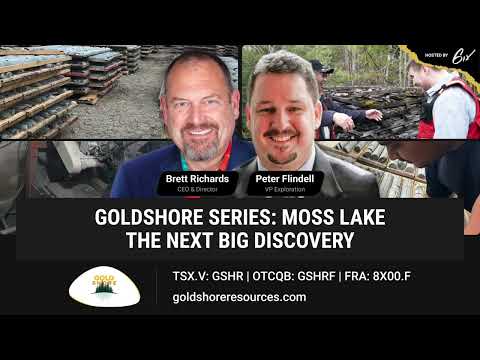
0:08 Hello everyone, welcome to the second episode of GoldShore Resources' monthly series, Moss Lake, The Next Big Discovery. I'm pleased to introduce the CEO and director of GoldShore, Brett Richards, who's going to be reviewing the latest from GoldShore and afterwards taking some of your questions live. And as a reminder, if you do have any questions, please submit them in the Q&A chat found on the right-hand side of your screen at any time today. And as a note, this being a 6 series event with your registration and attendance today, you'll be automatically notified of all future GoldShort episodes. But as always, this event is being recorded and it's gonna be available on six.com in
0:38 the coming days. So without further ado, Brett, like to hand things over to you so you can get us started. Yeah, Cam, thanks very much. And thanks everybody for attending today. I do need to draw your attention to our disclaimers and our forward-looking statements that are on our website. But welcome everyone. And what I wanted to achieve with this session is quite simple. I wanted to talk a little bit about the wins that we've had this year and the losses, and, but really focus on kind of what the future of 2023 and actually 2024 are going to look like. I go back to our original thesis when I got involved in this project.
1:28 And to me, it was about putting together a leading junior mining developer and project generator in Canada. And I think that that mission that we embarked on is still the same. And I put, I was very, very forthright in saying what our vision was from the very start, and that was to create sustainable value for our shareholders and to inclusively respect our stakeholders and project partners and to responsibly explore for gold opportunities in Canada and the US. And I think this year has been very punitive to our sector, to Goldshore. And I think everyone is going to kind of close off this year and be thankful is behind us because the macro situation in this world today has really kind of upset the capital markets from the geopolitical situation, the hyperinflation earlier this year that has run through the entire year, the increase in rising interest rates, putting strain on incomes yet again.
2:45 And still, we find ourselves in a position today where gold has actually performed quite well in 2022. It actually is flat on a US dollar basis. It's trading at about 0% from the beginning of the year. In US dollar terms, other currencies a little stronger. But what we've seen in this macro because of the geopolitical situation is we've seen the US dollar artificially inflated as a result of other currencies being not artificially, but really deflated. I speak to the euro, the pound, and the yen, which have been absolutely hammered this year.
3:31 Now, I think with the potential for the geopolitical situation in Russia and Ukraine to find its way in 2023, I think we'll see lower energy costs in Europe. I think we're gonna see an increase in the euro and the pound, which is going to bode well against the US dollar and weaken it. And another form of weakness that we're going to see in the US dollar is the fact that my view is that we're going to see quantitative easing come into 2023 and into 2024 as the Democrats prepare for primaries and a presidential election. I think we're going to see them try to avert a recession by printing more money, which is going to weaken the US dollar, and be good for gold. We have a number of these kind of parallel dynamics that are going on in the world today that some have been good for gold, some have been completely horrible for gold equities. And I think we saw the capital markets have been very volatile this year, but very, very punitive to mining stocks, mining companies generally, and to gold equities specifically, and to GoldShore.
4:51 We see the index off 25%, we see junior mining companies off 50% and 60% in some cases, and we haven't seen the start of the recovery yet. But I think there is hope. There is hope because I think on the macro, we are going to find our way through it. I think we're going to see interest rates taper at 4% and inflation come back to around 4% and stay there. And that's a very good environment for a gold price. And in addition to that, I believe we're going to see a weakening of the US dollar, which again is good for gold. Are the planets starting to align again? Yes, I think they are. Probably better than 2010 and 2011, because there are distinct differences from when we had the gold run 10, 11, 12 years ago, from where I see the gold price being for the next 12 to 24 months.
5:51 And I don't see a big gold run coming. I've said all along that gold is going to trade between $1,800 and $2,200 for the foreseeable future. But there will be times when it pulls back, and there will be times when it pulls back and there will be times when it spikes ahead of $2,200. And we've seen that this year, given the macro and the geopolitical situation, we've seen gold pull back. So where are we with Goldshore? I think we had an absolute banner year. Pete Flindell, our VP of exploration, couldn't be on the call today, but I think he has done an absolute tremendous job and his team on site have done a tremendous job executing on what we said we were going to do. We embarked on a very, very ambitious 100,000m drill campaign at the beginning of 2022.
6:42 We had already started it in 2021. We had some hurdles to get going, but we really smoothed things out in 2022. We have a tremendous drill contractor. His performance is absolutely stellar and he's done a great job for us. And our people have done a great job managing data and understanding this deposit and this region, I think better than anyone ever has. We have put a lot of work into understanding the geology, the structural geology. And from that, trying to really focus on what this deposit looks like. Being data-driven has served us well.
7:28 If everyone remembers, We approached all of this and we said we were going to conduct ourselves in such a way that the data would drive this, and it has. We had a 4Moz historic resource split between around 3.15Moz at Moss Lake and about 850,000 ounces at East Cold Stream. And there was a balance between, you know, indicated and inferred. Through our data analysis, we are more confident when we built the resource model in October and November of this year to categorize it all as inferred at this stage. There was a number of spatial errors in the historical data.
8:19 And what we want to do is earn credibility and earn credibility with not just our shareholders, but with other mining companies as to how we approach things. So we built a model and we announced a resource estimate on November 15th of this year of 4.17Moz, all inferred at a grade of 1.1g per tonne at Moss Lake. Moss Lake. But the real story behind all this is due to the sheer work of our team led by Pete in identifying the sheer domain that contains about 2.2Moz at 2g contained within the global resource of 4.17Moz at Moss Lake. A significant undertaking and a significant result here.
9:15 What this does for Goldshore is it separates itself from the pack. We can continue to follow this sheer domain system, this high-grade material, and We will translate that into mineral economics a little later on, but for now, it is separating us from all the other low-grade open pit development stage projects in Canada. You know the team, you know our board, and I'm not gonna spend much time on that. This is the breakdown of the resource as I mentioned and we still have a historic resource at East Coldstream that we will be bringing more data in and remodelling it and putting a resource there in 2023.
10:07 But when I look at projects, and I can't emphasize this enough, because when I look at projects for origination, everyone is looking for something special. And when I got involved with this project, I thought this was something special because of the size and the scale of the magnitude of the potential deposit. And the other thing I said from the very beginning that makes this something special is the available infrastructure that we have to build a big district scale mining camp, much like Red Lake, much like Timmins, much like Abitibi. This Chevanne-Dewan Greenstone belt is now ready at these gold prices, and we don't need these gold prices to be successful, but these low-grade projects need a higher grade, $1,800 Gold and above to be economic.
11:05 But we are on the Trans-Canada Highway. We're 100km away from an international port. We have 10 cent kilowatt hour power on our site. We have CNCP International Rail on our site. This is just a tremendous location for us to start the camp building with. I think we're one of the most advanced projects within our region in the Chabanois Greenstone Belt. I think we'll be the first one to lead the way and I get that. But what we have here is something special, which I think is different from everyone else in Canada, who are looking at these low 1 gram deposits. And that separates us because of what I mentioned about grade.
11:53 The cap structure slides a little dated. I'm happy to announce that this morning, we announced the closure of a 5.75 million prospectus financing. So we will go into the new year with fresh capital in the kitty. And it was a $5M financing with a 15% available uplift and we maximized it. And quite frankly, I think we're going to hear probably tomorrow that, you know, we'll probably do a small non-brokered private placement for everything that was, you know, and above that. We had a lot of support for this financing and I think our team, our finance team did a great job organizing and getting it done.
12:41 So, we're ticking a lot of boxes here moving into 2023. One of the boxes we're not ticking is the fact that our performance this year to our investors has been abysmal. And I'm talking about our share price performance. We opened the year at 65 cents. Today we're trading at 25 cents. And I get it. Our entire industry is off 50%, 60%. It is very, very difficult for development stage or even exploration stage projects who not just raise capital, but to get good positive liquidity on their stock. And we've had decent liquidity throughout the year, But however, we've had periods where shares have come out of lockup and have traded into an illiquid market, forcing the share price down substantially.
13:41 Even when we put out good news and we had, as everyone knows, we put out significant news this year, you know, a press release almost every 3 weeks, high grade intercepts, long intercepts over a gram. We put out an exceptional press release at North Cold Stream and we put out our MRE on November 15th of 4.17 million ounces. But really, it has not affected the market. It actually gave investors a liquidity opportunity to sell into. So when we had good news coming out, we actually had, we had, you know, we saw our share price go down in many cases. Now, I know the base we're starting from right now is quite low and we're trading at around $7 an ounce this morning.
14:33 Our high grade is really trading around $15 an ounce, but you can see the comparisons on current resource comparisons on a per ounce basis to our peer group. These are all open pit development stage projects in Canada, low grade. And you can see the difference of what grade means. We've got a couple of peers that have certainly a much higher grade than the mean or the pack, as we'll call them, and they're rewarded for that. They're rewarded substantially for that on a per ounce basis. And at this stage, we can only value our company on a per ounce basis as the market can too. So you will see, I think we're going to see the market start to calibrate us towards more of our peer group. And as we increase and put out additional mineral resource estimates, I think the market is gonna start to calibrate us more towards the higher end, the higher grade reward on a per ounces basis. So that's the only real sheer method of valuation for companies like us today.
15:40 But the next stage is really about how we're gonna value Goldshore going forward. And that's going to be on the back of some results I'll talk about in a minute. These are some of the open pit and in production projects or near production projects in Canada. And they're all around a gram, as you can see, they're all around 1 gram. They're all fairly large scale. They move a lot of material a day. I think in Detour's case, almost 60,000t a day, but big production profiles at which the scale and law of large numbers for them allows them to make significant operating free cashflow as a result of the amount they move. But these are very, very big CapEx projects as everyone knows.
16:27 And I don't think that's what the market wants today. And we have the opportunity here to do a bit of a pivot and I've talked about this pivot back in June, July of this year and that pivot has gone and started to work towards the high grade material. I'm very proud of Pete and his team as to the dedication and the work they do with the various programs we have in ESG. We have more than just established relationships with our host communities and our First Nations Indigenous partners. We have 2 exploration agreements signed so far, and that'll take us to an ILA. Beyond that, we continue to do environmental baseline monitoring and data collection in support of our permitting process down the road.
17:18 And Pete and his team continue to support and do a number of things in the local community. And we've got a number of really exciting projects we're going to be considering for 2023, both in the field and in our community. Great job everyone on the team for delivering on that. As we all know, we took a very comprehensive approach to this project, started with geophysics, got a number of targets and translated those targets into where we were going to prioritise drilling. As I said, this pivot started around April or May of this year, where we started to see high-grade intercepts, much like you see right here. You know, 6.3 grams over 56 meters is a very significant hole.
18:09 And quite frankly, we put the press release out and our share price went down. Again, the macro, an illiquid market, people with margin calls, people looking for liquidity, selling into anything, selling anything and everything into a market that is not receptive. So we were the, I'll say the benefactor of some of that selling. And as a result, our share price is where it is today. We have peers around us in Ontario that don't even have a resource, that have a market cap 3 times our size. So I know there is a day of reckoning, there's a year of reckoning, I think 2023 is going to bring a number of these things to culmination. And I'll speak more definitively about them in just 1 2nd. But this is what were those high grades led us. They led us to Moss Lake, to identifying these sheer domains and some significant findings, both in stepping out from the existing resource along strike and stepping out laterally to the southeast.
19:15 We've seen big hits and continued these parallel shears. These are sub-vertical, they go down quite, quite deep. And although we probably could have put out an underground inferred resource, the last resource estimate we did, I just didn't think it was meaningful. And I go back to looking at being credible in this business. If I could put in 1 million ounces out for an underground resource, which we probably could have, It's not going to sequence into our program what we're designing this for for 15 years or more. So is it really meaningful to put out there? Are we actually going to get any value for it? The answer is no. However, when we consolidate everything and we have a better understanding of the quantum, we will put it out. I think that is going to be what we need to do for later this year.
20:16 As we grow this resource, we see at East Cold Stream, this was not part of the mineral resource update for this year, for November 15th. This was still a historic resource of 850,000oz, but the key takeaway is the geological setting and the geology is very similar to Moss Lake. We have these high-grade shears contained within this low-grade halo of material And there seems to be an abundance of it outside of the historic resource, and we're gonna continue to develop that. So a really big story here in Moss Lake and East Cold Stream, And a completely different story here. This is North Cold Stream. And as everyone knows, we had a historic mine here that was completely decommissioned. And it was decommissioned because of probably low Copper prices in the 1980s.
21:19 We drilled our first hole around the outskirts of this deposit. It's got a very big geophysical signature and it's open at depth. We hit 62.8m, that 0.88% Copper equivalent, and that contained some Cobalt credits in there that are very, very intriguing. So this is what I say is completely different from what we're dealing with at Moss Lake. This is a VMS-style deposit in our view, However, we can't explain the cobalt, which is not normal in the course of a VMS style deposit, but we are going to do some more work on this. I'm not sure how we're gonna prioritize capital to get this down the road. Watch this space early in 2023.
22:07 And I want to drill this. I don't want to stop drilling Moss Lake to drill this. So we're gonna try and come up with a solution maybe where we can do both. And so like I say, watch this space. We're going to try and kind of deliver shareholder value from this really, really strong potential. Hits we've had and completely different element here, Copper, Cobalt, Battery Minerals, Electric Vehicles, everyone tweaks to that environment right now of electrification. And I think this would be something the market would be interested in financing. So watch this space, we're investigating what our options are with North Cold Stream and Vanguard.
22:56 This was the historic resource of 2013 and this was what the resource looks like now. It grew 33% in tonnage and maintained the 1.1g grade. You can see the shear zones defined within this. This was quite a tremendous achievement. When you have a historical resource, you don't build on it. You start from 0. And yes, it guides you. And yes, all the other work you do guides you. But this was quite a bit of work. Within the 70 plus thousand meters we've drilled, we were able to not only increase the resource by a third from the historic resource, but really this is a 4 million ounce, 4.17 million ounce maiden resource. And we've identified these high grade systems within it, which I think are gonna take us to the next level. And this was the resource that we identified.
23:50 When we look at grade, and I really believe grade drives a lot of value for shareholders. You can see us where we are positioned. That's just a high grade portion of the resource and then the lower grade portion of the resource and the combined resource here and where we think we can take this with immediate potential. Keep in mind, when we did this November 15th resource update we only 48 holes reported into that resource. We've drilled 120 holes so far in our campaign. We have more than 55% of the data still out there and still to go into another mineral resource estimate. A lot of it is going to be realised at Moss Lake, some of it's going to be realised at East Cold Stream, but I really believe that we're going to be able to expand the size and maintain the grade of what we have and what we've already reported.
24:54 This is the pitch shell that we put on to constrain the resource. We used $1,500 gold price assumptions when we constrained the shell. And there are people out there that use $1,700, $1,800 pit constraints. We just wanted to be very conservative. We wanted to use the same assumptions that a lot of the mid-tiers and majors use when they calculate resources. And when they calculate reserves, they usually do it at 1200. So we wanted to be consistent with what the larger guys who are the project builders and the project operators, what they do. This is a really, really good comparison of quality projects versus projects that require a high gold price to be economic.
25:45 We also use similar inputs. We use $2.50 for mining costs, 12.50 US for processing, and a $2.00 GNA. And these are all very consistent with what the mentees and majors use. So when they do comparisons of their projects to our project, it's gonna be very easy for them. So we have a lot of data still to come in. We're gonna fill in, which looks like a seasonal Martini glass here. It is really a cross section of our pit shell with these high grade shears that go down at depth and are open at depth. And we'll fill in some of this data with some of the 50, 60 holes still to report in.
26:32 One of the single most important things here is understanding visually the size and scale of what this potential is. We can wave our arms all day long that our entire land package is fully mineralised, which it is, but you have to take these things in steps. Every step is going to take you to that next level. This is our first step. This is Moss Lake. This is 4.1Moz of inferred resource. What we've done, we've been able to identify parallel shears down to the southeast of it. We don't think that this is actually a shear, a fault, which has separated the Southwest zone from the main zone and the QES zone, we actually think is a parallel system that runs in parallel to it. We're going to be drilling this in 2023 to see if potentially we can make this a wider pit.
27:30 Wouldn't that be a choice for a much larger project. We also have significant mineralisation down in this area with a number of mineralised drill holes to the southeast of the existing resource. But the hits we have, there are a number of drill holes to the northeast here that are all mineralized, very similar to Moss Lake. They've never made it in the resource and they haven't just due to spacing. And our job is to validate that, infill them and bring them into a resource. So we feel that even though this current resource is 3.5km long, we have 8km of potential mineralization to bring into a resource and potentially parallel structures.
28:20 And all this is gonna take drilling. And again, we have to do this in steps. Every step has to be methodical. It has to be able to be beyond reproach and credible. It has to be the right step for us because we're spending shareholders' capital and we're trying to create value. And I think we've done all the right things so far and will continue to do the right things. But I think if you remember going back over a year, a year and a half ago, when I first looked at this project and wanted to get Pete and I involved in it, was we saw the scale. And yeah, We saw the scale for this to be well north of 10 million ounces, and we believed that. And that was our only story at the time. And in building a 10 plus million ounce resource at 1 gram, I just didn't think, I really didn't think that there was anything wrong with that, but I think I've quickly learned that the market doesn't give you value for these big size deposits that have multi-billion dollar capexes because there's just too much risk in doing that, financial risk, execution risk, and the timeline in doing it. So where we are fortunate is that we can encapsulize a small project right where we are, right here. And there'll be a time when we make a decision this year coming where we'll start to do an economic analysis of what we have. So
29:53 we are going to drill throughout the year, but our focus now is getting to right here, which is a preliminary economic assessment. So we are starting to do very, very comprehensive metallurgical studies. As you would have heard from the past, we had over 20 geometallurgical domains and we've narrowed it down to a handful, I think 3. We are doing test work on the low-grade material, which is anything from 0.3g to 1g, and anything that starts to have a bit of a Sulphide association, we are going to be doing other tests. We're going to be doing flotation tests. We're going to be doing coarse bottle rolls. We're going to be doing possibly column testing to test to see if the low grade can be heat leached. So there's a lot of metallurgical work going on in Q1 to better understand recoveries.
30:52 I don't want to just use the generic 85% that historically we can demonstrate we have. I want to get this up into the 90s for the high-grade material and then see if there's an alternative to heap leach to the low-grade. That work will all be done in Q1 and into Q2. When that's done and when we have all the wireframes built and the models built, we will update the mineral resource, much like we did on November 15th, and we will do another one with all the outstanding data. As I said, 55% of the work we've done is still to report into an MRE. So we will update that at the end of Q1, possibly in the early stage of start of Q2.
31:40 And that will be the deciding point. That will be where we make the decision to start a PEA. And that is a small scale starter project in this sea of multi-million ounce resource. We're gonna put together a project that is manageable. It'll be around 5,000t a day, which is a shorter permitting process than 15,000t or 20,000t. We'll look at permutations of everything, 5, 10, 25. We'll look at permutations of everything when it comes to the size of the processing plant and we'll scale it accordingly. So there's a lot of engineering work to do. There's a lot of reverse engineering work to do to see where the optimum is.
32:34 And my view is I think the market can stomach a $350 million CapEx project, $400 million CapEx project, and a project like that that would deliver 150,000 ounces a year for 12 years with excellent cash costs and excellent all in sustaining costs. And north of 120 to $150 million a year of free cashflow. That's the style of project that we're leaning towards. We're not leaning towards this big 50,000 or 60,000 tonne a day style of feasibility study. We want to start again and make steps. This will be the first step. And this is a step that can be replicated.
33:20 You could do a 5,000 ton a day plant and do another 5,000 ton a day plant, directly in parallel to it. A lot is gonna be determined based on sequencing the higher grade material to the front end of the mine plan so that we can enjoy those economics at the front end. And so if we can maintain a head grade of 1.9 or 1.8 or 1.7 or 1.6 and then go back and look at satellite pits where we can chase the higher grade again, I think that will be how we approach this. We're trying to maximize and optimize cash flows, hence the reverse engineering and grade determination based on sequencing in a mine plan.
34:07 So all that work is gonna culminate in understanding what that PEA looks like. And we're going to have that done for around September 1st of this year. We've hit a lot of our targets, if not all of our targets. I told the market we were going to put an MRE out in the first quarter of 2023, but that was going to be our first one. And now we're almost going to have our second one done in that same time frame. I said that we're going to understand the metallurgical test work to maximize recoveries before we do a PEA, and that work is ongoing and we'll report that and We'll give the results of that to market when it's done. But the scale and size of the potential of this, I think, again, we're taking 1 step to build a starter project that I think the market can understand. I've built 3 mines in my career.
35:03 Pete and I have been on 2 of those mines together where we have built this exact same size of a capacity mine. And I think, you know, we're prepared to do it again. And that can be the start of something I think where we can get valued, not just on a per ounce basis, because that's the only place the market can value us today. I think we can get value on our economics. 2 times cashflow is the normal kind of economic valuation at a PEA, a development stage project level, or 0.3 times NPV. And these projects will have, this project will have a significant NPV. So when I talk about valuation metrics, there's a number of ways to do it and the banks all do it very consistently.
35:53 And as does the market, I think we're going to allow the market to have multiple opportunities to value our company based on the size of the resource we have, based on the size of the project we're going to put together, and based on the cash flows that will come from that. But we can't lose sight of the fact that this is a sea of millions and millions of ounces of gold, and we're only going to contain a small amount of it to get started. So I think there's valuation potential in the size and scale that we've talked about all along. I think there was a lot of people that kind of laughed at me when I said we have a tier 1 asset and our job is to move this towards defining what that tier 1 asset looks like.
36:38 And a tier 1 asset in the eyes of a major is 10 million ounces, lower half of the cost curve
36:45 and above median in the grade profile, all in a reasonable mining jurisdiction. Now, if we don't tick every one of those boxes, then I don't know how we can't. So again, we're taking steps to define ourselves as a tier 1 asset. And these things take time, they take capital, they take drilling, they take analysis, they take study, and they take time to get there. And I think our team and our company has done the right things at the right time. And we have delivered on what we said we're going to do. Sadly, the market has not rewarded us, but they will. And they will have no choice to, because when you start and look at peer comparisons, people will sell something that's overvalued to buy something where there's more value. And there will be trading and there will be positive, very, very positive viewpoints of shareholders and the market of GoldShore as we get through our development phases and as we get a PEA done. So 2023 is extremely exciting. We hope to start a Pre-Feasibility Study in 2024 based on that.
37:57 And along the way, we have a lot of catalysts and a lot of deliverables to the market. So there will be news flow coming out every 3 weeks as it has, and then we will continue to deliver on that. So that's really the year in review. And all the great work our people have done over this year to take us into kind of 2023 and beyond that in 2024, I think these guys have done a tremendous job. Our team, our management team and our board have been extremely supportive through very, very difficult market times. We have a tremendous endowment at Goldshore.
38:45 We are in one of the lowest risk mining rich jurisdictions in the world. We have a lot of optionality. We have targets we haven't tested. We have Copper and Cobalt targets that we need to expand and explore. We have a land package that's going to support extensive, extensive work for years and years to come. So when I talk about building a district scale mining camp and Gold Shore will be at the front of that, we will be at the fore as the builder and the pillars of building this district to something that is significant and sustainable and generational. That's why I'm excited. That's why we got involved with GoldShore. And that's why I think GoldShore shareholders are going to be significantly rewarded over the next 12 and 24 months. Market willing, gold price willing, but we don't need a $2,000 gold price to make this work because of the fortunate endowment we have with Grade, where we can sensitize this probably down to $1,200 or $1,300 and it's still economic.
39:53 So this is going to really power up in a really good macro cycle we are headed towards. I think precious metals are going to over-perform and out-perform the entire market for the next 5 years. And we are so well positioned to be able to enjoy that with the stage of development we're at and trying to bring a project through its development stages to a construction decision, I think the Goldshore shareholders are in for something very, very special in the next 12 and 24 months. So with that, I'm gonna turn it back to Cam to see if anybody has any questions. So yeah. No, absolutely. Thank you so much, Brett. Yeah. And if anyone has any questions, please feel free to submit them in the Q&A chat on the right hand side of your screen.
40:41 Rainer's wondering how much money you're going to have in the bank right now, especially after your successful share placement. We'll enter the year somewhere coming around 8 or $9 million, something like that. I don't have the exact figure with me, but that's kind of order of magnitude, somewhere around $8 million. And we're burning, we're gonna be burning about $750,000 a month. So, you know, we've got quite a bit of springboard here to keep working away. Absolutely. Stefan's wondering how much will the not included results add up on the ounces? Sorry, I missed that. How much will the not included results add up on the ounces? Sorry, I missed that. How much will the not included results add up on the ounces? That's a trap.
41:30 You know, I don't like to peg numbers. I don't like to put numbers out there, but would it be unreasonable to think that we could get this to over 6Moz and maybe close to 3Moz of high-grade? I don't think that's unreasonable to expect. I think a normal engineer who's followed the story and looked at the work well we've done, the model that we've produced, I think it wouldn't be unreasonable to think that we could get there. But again, that's just a step. We have many, many steps to take beyond that. So incrementally, that's the next step. We're going to do a mineral resource update at the end of 2023 as well. I think I failed to mention that, but you can see it right here. We're going to do an updated resource at the end of the year because there will be a whole year of infill drilling and step-out drilling that we will have done. So I'm not putting my hand on my heart when I say those numbers, I'm just speculating.
42:33 I have no clue what they're going to be, but a reasonable person could come to that assumption. Quite frankly, a reasonable person could come to an assumption that the next one's going to be 8, and the next one after that is going to be 10 or 12. It's a function of drilling, and that is going to be a function of how much we drill this year. Our plan is to try and lay down anywhere from 35,000m to 50,000m this year. 75% of that will be infill Moss Lake, preparing it for a Pre-Feasibility Study because we need this large resource and the high-grade material infill to indicate it to do a pre-feasibility study so we can start our permitting process.
43:18 So that's the drilling plan for this year. All right, Adrian's wondering if Westdome is a passive shareholder or do you combine resources in any way? They have 2 board appointees. So from a governance standpoint, they have a complete see-through of the company. We have regular discussions with them, but we're not active. I wouldn't say that they are a strategic investor or a strategic mining company that is invested in Goldshore. They are a high-grade underground mining company. They have the Eagle Project in Kena and that's their specialty, that's what they do.
44:05 I don't think their technical group can add a lot to low-grade open pit surface deposits, but, and we haven't gone down that road because quite frankly, this is an investment for them, and an investment they want to see through to the finish line. They haven't sold any shares, and I don't expect they're going to sell any shares anytime soon, but they want to deliver value to their shareholders, just like I want to deliver value to my shareholders. And it is a bit of a perceived overhang, but I don't see it like that. I just see it as a cap structure that's even tighter with them being on it. So yeah, they've been helpful. But we haven't gone to the degree of having like a strategic with you where you share back rooms and you share data and you are a little bit more integrated, that we're not like that.
45:05 All right, fair enough. Patrick's wondering what kind of stripping ratio do you think that you have on the high grade zones alone, treating the low grade as waste? Great, great question. And I've been looking at PAs and Feasibility Studies over the last little while and trying to get a feel for where we're going to land because in the resource, the strip ratio is probably around 5, close to 5. I suspect that by doing an SMU study, Selective Mining Units, I think what we'll be able to do is prioritise the high-grade and keep the stripping ratio as low as possible and sequence satellite areas and or satellite pits. Rather than building a big pit that was down 500m, you're going to have several pits, a long strike that go down 100m or 150m.
46:03 I think that balance, and because there's very little overburden, the pre-strip is very, very light. I suspect that, I can't say that it's going to be lower than 5, but right now that's what it is. It could potentially, if we go deeper, it could actually be a little higher in some areas, but I think when we get this to a PEA and we put a proper mine plan on it, I think that's when we'll optimise it and bring it down a bit. I use just looking at marathons because there are a lot of comparisons between us and marathon because of our grade, because of their grade. We have, obviously we have a instant infrastructure And they have a little bit of infrastructure that they've built so far and more they need to build. But their strip ratio is over 10.
46:52 And it's still very, very economic. And it's a stellar project. It's one of the best in class. And I don't say that in full disclosure, I am a shareholder of Marathon because I like the project. And I have 40 junior gold mining stocks in my portfolio and Marathon is one of them because of grade. And I look for projects that can stand that sensitivity and the test of down markets. And even though share prices come off, the ones that have great, the ones that have size and scale and potential are the ones that accelerate on a trajectory much faster than the general market. And that's why you hold them. That's why you buy them. That's why you identify them. So that is why I have GoldShore and for that very reason. So I've been trying to kind of understand where this project looks at the end of the day. And I wouldn't be disappointed if it was a 5 to 1 strip ratio for our project, but maybe there's a chance we can do better.
47:57 We'll see. All right, great. Adrian claims that insiders already own a decent amount, but he's asking if insiders have been buying more at these low prices. You probably saw some of the insider reports that came out in October, November, because I was buying in October and November. I've just subscribed recently to this $5 million financing as did all of our entire management team, our CFO, VP, Pete, we're all in this financing. And we have a lot of long-term, we have a lot of long-term shareholders that came in as well, and for big numbers. Here's my view of things, and it's a bit of a tangent from the question, but in these down markets, it's very difficult to raise money. It was very difficult to raise $5 million.
48:56 And 5 years ago, I could have raised $50 million easier and I raised this $5 million. And so it's difficult. But I think the support of our shareholders has allowed this project to continue. And it's only because of the support of our shareholders. And it's not just management and not just the insiders. It's all shareholders. Because I said to people, I am not stopping. We're not just gonna sit here with the lights on and do nothing. That is value destructive, and I'm just not gonna destroy value that way. We have to keep going, we have to keep pursuing. And I get it. It means that people have to follow their rights when we do financings to keep their position and to maintain, yes, they average down their price, but it costs capital to do that. But it's the right decision because when we do get rewarded in 2023 and 2024, and that's my view that we will very soon get rewarded for the work that we've done, you will be on that trajectory and you will get that return back. So, even though management continues to buy and we like the story, we don't do it for any other reason than if there was a better opportunity out there, we'd put our money into that. And quite frankly, I don't see one in our space. If I want gold exposure, I buy GoldShore.
50:25 If I want leverage to the gold price, I buy GoldShore. If I want leverage to the markets based on where we are today and our potential to grow exponentially, I buy GoldShore all day long. And I've told this to the most recent conferences I was at, and we have got a lot of interest. Now, there's not a lot of liquidity out there, but I think that's when we're gonna see it in 2023. I feel the market is starting to turn. In this past couple of weeks, I felt that the market is fatigued of what we've seen, and we're starting to see some strength coming back into Gold. All right. Adrian wants to know how quickly you can expect to get an assay results back next year.
51:11 Assays? Yeah. They're turning 6 weeks, 7 weeks right now, sometimes 8 weeks, but they're better than they were when we started in 2021, but they're not as good as they should be. And it's not a function, it used to be COVID, you know, everyone's COVID, COVID, COVID. And, you know, people were sending assays to Mexico and Peru and craziness, but it's no longer COVID. But the problem we have in Thunder Bay and the region is people don't wanna work. After COVID, there is this big gap in the work environment where labs that we deal with are having a difficult time getting people to fill spots and to fill roles.
51:56 And yes, that's general labor type, unskilled labor, but even a skilled labor, they're having difficulty with getting people to come back to work. I think COVID taught a lot of people that you can work from home. And a lot of people enjoyed that for 2 or 3 years, and simply don't want to go back to the workplace. So the problem we have now with assay turnaround is more about availability of good people working in these labs to actually facilitate the demand than it is COVID or labs being shut down. We're not seeing that at all. And I think our lab, we've been very fortunate, from day 1, we've been very fortunate. I think we've chosen a great partner and they've done a good job for us.
52:42 Great, well, listen, Brett, that looks like all the questions we received for today. So I wanna thank you for coming on and I wanna of course thank everyone in the audience, especially those that asked questions. But without anything else, I'd like to pass things back to you for some closing remarks before we wrap up. Yeah, thanks Cam. Yeah, I just wanna thank everyone for attending today and wish everyone a very happy and joyous holiday. Merry Christmas.