Russ Shaw
CFO at GENEDRIVE PLC
Replay available
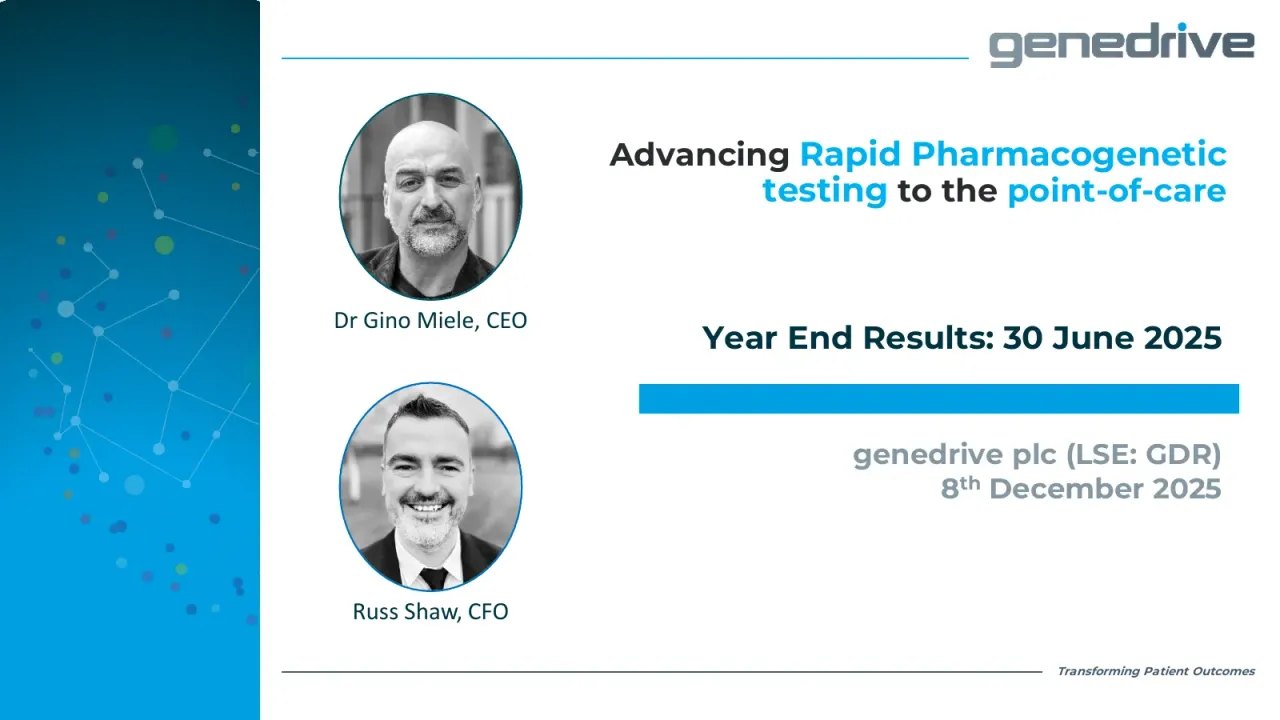
Full year results briefing hosted by Genedrive (LSE:GDR) on Investor Meet Company, held 2025-12-08.
On 6ix: 6ix.com/event/genedrive-plc-gdr-full-year-results-briefing
Automated transcript · Written by software from the replay's audio. It can mishear names and figures; the replay is the record.
0:00 Good afternoon, and welcome to the GENEDRIVE PLC Investor Presentation. Throughout this recorded presentation, investors will be in listen only mode. Questions are encouraged and could be submitted at any time via the Q and A tab situated on the right hand corner of your screen. Simply type in your questions and press send. The company may not be in a position to answer every question it receives during the meeting itself. However, the company can review all questions submitted today and publish responses where it's appropriate to do so. Before we begin, I'd like to submit the following poll, And then I'd like to hand you over to the management team from GENEDRIVE PLC. Gino, good afternoon, sir. Hi. Thanks, Lee. Afternoon, everyone, and welcome. Thank you for taking the time to join us today. I'm joined by our CFO, Russ Shaw. And what I'd like to take you through today is I'd just like to spend a bit time just reminding you or refreshing you on the unmet clinical need that we address with our products and the positioning of these products.
0:55 The highlights from our FY '25, which ended in June 25, obviously, and progress we've made since then. I'll hand over to Russ to guide you through the FY '25 financials, and then I'll just spend a little bit of time discussing what we see as the outlook for the company. So just to take a step right up elevator elevator view, what GENEDRIVE does. So GENEDRIVE at a glance, we as a company provide rapid pharmacogenetic testing solutions, and I'll come into bit of detail about that. And that's specifically for emergency health care settings at the moment. We've got two CEIVD certified pharmacogenetic products that address significant unmet clinical needs in two very important areas. One of these is neonatology, where we address antibiotic induced hearing loss in neonates. And the second of these is in stroke and cardiovascular patients who are unlikely to respond to commonly prescribed medication. So we cover neonatology, neurology and cardiology.
2:01 Both of these have been co developed with, NHS partners. They are first to market and or best in class, and both products are recommended by NICE for use in the UK NHS. The products the interventions themselves and in fact, our products are backed by very clear national, international clinical guidance and recommendations. And they both have significant patient outcome impact and very strong health economic and productivity gain drivers for health care systems, which is really, really important. And one thing just to just to to, reemphasize is that these products are guideline ready. So the products were more or less developed in advance of the guidelines emerging and they continue to emerge. So we're in a very good place here.
2:46 We've got very well evidenced product market fit. And by that, I mean we have early national and international commercial traction, and implementation into routine clinical use and practice in early adopter hospitals and trusts. So they're all just being used for research. They're all just being used for, pilots. They're in routine clinical use, making differences to patients in these areas on a daily basis. We, as a company, are capital light. We outsource quite a lot of manufacture, but we are poised for scale with those partners. And in terms of addressable value opportunity, we estimate in the order of $190,000,000 per annum recurring annual revenue. And in The UK, that's $26,000,000 across both products. And importantly, this is just in our Phase one target countries, and I'll come to that towards the end. We do have a growing revenue base from 50 ks in 2023 up to circa 1,000,000 in our last financial year.
3:44 So what is the clinical problem that we're trying to solve? Well, very, very simply, a lot of medicines are ineffective in a large number of people. And the underpinning of that is DNA variation. So this DNA variation can influence how you respond to a drug, poor, poor response, no response, or even harmful side effects and toxicities. And these are called adverse drug reactions. And they can account for sixteen and a half percent of hospital admissions and cost the NHS a staggering amount of money. And, you know, a lot of money spent on these these prescription medicines. You see the figures here. In two thousand twenty three, twenty four, the NHS spent 20,000,000,000 on prescription medications. And in three areas where we know very well from the scientific literature that PGX can have a strong influence, antidepressants, antiplatelets and analgesics, there's a significant amount of money spent on those medications each year.
4:45 So pharmacogenetics can transform what we call trial and error prescribing, where you'll know yourself, you go to the doctor, you'll get a drug, you'll see if it works, they'll up the dose, they'll reduce the dose, you'll have some side effects, They'll change it to another drug. All of that trial and error prescribing in these areas can be completely removed. Well, not completely, but it can be removed substantially by knowledge of the PGX or the genetic variations upfront. So it can improve patient outcomes, obviously, but it can also save money and waste unnecessary prescriptions. So medicines optimization. So that's our solution. Genotype guided prescription. So do do the PGX, do the genetic before you prescribe the drug to get the right drug at the right dose for the right patient at the right time.
5:34 So ninety five percent of individuals have at least one actionable pharmacogenetic variation for a common medication. And that's a very high number. And these are well known, DNA variations. And obviously, knowing those, creates a lot of power, you know, for you as a patient. If you know this upfront and the clinician knows that upfront, they can tailor the medicines for you. And that drug choice and dosing based on understanding that that pharmacogenetic variation is, we and lots of others believe, the future of precision medicine. Now these DNA variants can be measured by sending a sample back to central labs, so diagnostic labs or genomic laboratory hubs in the NHS, for example.
6:21 But it takes days to weeks. You know, that DNA, your samples are sent to the lab, your DNA is isolated from it, and these variants are assessed. And then the results are sent back, excuse me, to the clinician. But that can take days to weeks to provide results. This the actual lab test might only take a few days, but the logistics of getting it from you right to the right back to the clinician with the result to action your prescription change can take days to weeks. And that's just not viable for certain time critical emergency health care paradigm. It works okay for certain, instances, but for time critical emergency health care, it does not work. So to implement pharmacogenetics into time critical emergency care, you need rapid genetic testing solutions. And that's what we do.
7:07 We provide near patient rapid genetic testing. So it's rapid, it's actionable and in time critical clinical situations. And we do this with our instrument, so the GENEDRIVE system, which is an inexpensive rapid thermocycler designed with the NHS with substantial user led feedback from the NHS for use in the NHS. And that can enable relatively complex pharmacogenetic testing results to be available to a clinician in as little as twenty six minutes. We also deploy our tests on this instrument. So as I said before, we have two of these, the GENEDRIVE mtRNA-one test and the GENEDRIVE CYP2C19 test, both of which are room temperature stable. Very, very important for both use in the NHS and logistics of shipping around the world that the room temperature is stable. No cold chain requirements whatsoever. And it's a very, very simple test procedure where a simple cheek swab is taken either from a Nene or an adult and put in our cartridge, and then the cartridge is placed in the instrument.
8:11 Test is run, and then the result is clearly visible to the clinician. Quite importantly as well, there's no toxic waste liquids that you frequently find with more complex nucleic acid procedures. Everything is disposable in the clinical waste. And that allows us that allows us to do rapid, laboratory quality pharmacogenetics in a time frame that is suitable for emergency health care, so clinically actionable. And this genetic testing can be done now for the first time by non laboratory health care professionals. So you see an example up here of our RNR1 test being used in our neonatal intensive care unit, where the baby in the incubator is being swabbed prior to use and being tested on our instrument.
8:57 So a true near patient time critical emergency setting pharmacogenetics. We're obviously, as a company, ISO thirteen thousand four eighty five compliant in order for us to manufacture and sell medical device and immunodiagnostics. With respect to products, I'm just going to spend a little bit of time just reminding you about each of these products and background to them and then move on to progress. So the first of these, antibiotic induced hearing loss. So this is this is our MTR and R1, ID kit. So the situation here is it's for neonatal emergency care. One in seven babies born in The UK are admitted to NICU annually, and that equates to about a hundred thousand in The UK each year. And a significant proportion of those, because they're suspected of having sepsis, require treatment with aminoglycoside antibiotics. So aminoglycosides are a class of antibiotics.
9:49 One particular member of that is gentamicin, which I'm sure you've heard of. The clinical sepsis guidelines require administration of aminoglycosides within one hour. So it's called the golden hour. So within one hour of the decision to treat, the clinician should be administering aminoglycosides. The problem is, that's okay in the majority of cases, but the problem is approximately one in five hundred individuals have a DNA variant in a gene that predisposes them to profound bilateral irreversible and lifelong deafness following exposure to those antibiotics. And that requires geocochlear implants later in life. And obviously, this deafness occurs at pre linguistic neonatal stage, So the downstream side impacts are very, very profound indeed.
10:38 Obviously, the risk of before our test, the risk of death from sepsis outweighs the risk of deafness. You know, so it's it's it's a natural thing that the antibiotics are continued to be to be given, but it can be avoided. Laboratory testing cannot address this because it needs to be done within one hour. So absolutely cannot cannot, address it. And we estimate that this would affect about two hundred babies in NICU in The UK that are at risk of antibiotic induced hearing loss. So there's our solution. Our solution is the MTRNAR1 ID kit. It's the world's first rapid pharmacogenetic testing that's been used in neonatal intensive care. And it's as an interventional pharmacogenetic test, it enables the clinician to test the baby while they're being stabilized, know the result before they administer immunoglycoside antibiotics and make a decision whether it's safe to do so or not.
11:34 In terms of cochlear implant savings alone, it could save the NHS 30,000,000 per year, and it can prevent up to two hundred babies each year from going unnecessarily deaf from, aminoglycoside exposure. Plus, as I said, you have all of the downstream, societal impact, and disability savings as well. And here you see other examples. This was actually, baby Kobe, who was the first baby, to be identified as positive in, Greater Manchester and avoided going avoided being exposed to gentamicin unnecessarily. The second product is to address what's known as clopidogrel resistance. So this is prevalent in or this is relevant in stroke and cardiovascular pharmacogenetics.
12:20 So the numbers around this are there are one hundred thousand stroke per year in The UK, that's twelve million globally. One stroke every three seconds, and one in four people will experience this in their lifetime. It's the second leading cause of death. Ninety four million people are living with the effects of stroke at a global cost of $890,000,000,000 per annum. And these are the numbers in The US that you can read later. Obviously, these slides will be available afterwards. These conditions are treated with an antiplatelet drug, one of which is called clopidogrel. But the problem with clopidogrel is it's ineffective in thirty percent of people. So that's a rough estimate, one in three. It can be up to fifty six percent in certain, certain ethnic groups. And these patients experience worse outcomes. Of course they do, because you're being administered a drug at a very vulnerable, time in your life, and that drug is doing, you know, not working for you as optimally as it should because you have DNA variants that mean that, it can't be metabolized properly.
13:24 And in stroke, that's really important. You know, after your first stroke, the risk of a recurrent stroke is very high and is high within the first forty eight hours following your first stroke. So it stands to reason. It's very important that rapid testing is conducted within a short time frame, ideally within twenty four hours, in order to make sure you're on the right antiplatelet therapy, you're not being prescribed one that isn't going to work for you, and you optimize your outcomes the best you can. Our solution to this is a CYP2C19ID kit. This targets five of these DNA variants that we know about. And so it's got broad coverage for that. And by that broad coverage, what that means is it includes various ethnic groups that have a high frequency of some of these variants and therefore reduces equitable access to health care disparities that you might see if these, variant weren't included in certain panels.
14:23 We believe that it's best in class. NICE recommended it and as the rapid point of care platform of choice as well. So they also recommend it as best in class. And in publications, it's been shown outperform far more expensive and time consuming laboratory testing methods. Independent analysis has shown that the intervention itself could offer a £160,000,000 of value to NHS England each year. So £160,000,000 of value by introducing a test such as this. And the rapid genetic testing element of it has been modeled to show it could prevent three thousand recurrent stroke admissions, release sixty two thousand five hundred beds in The UK NHS and release over zero two five million health care professional hours. So in terms of productivity gains, financial gains and patient outcome, substantial numbers there in favor of implementing CYP2C19 genotyping.
15:25 Both of these products are backed and driven by very strong national clinical guidance, recommendations and positive health economics. And again, I just list some of them here for you to look at your leisure following the meeting. On CYP2C19 on this side. An important one that just came out in the last few days, as I'm sure you'll be aware of, is the Centre for Excellence for Regulatory Science and Innovation in Pharmacogenomics, with CIRCE PGX, recently published. And whilst other guidelines maybe focus on, you know, the scientific aspects of recommending CYP2C19 genotyping, the SIRC group focus very much on the the clinical aspect. You know, what should you do if you find a person with a variant? What drug should you give them?
16:17 What indications should it be used in and such like? And they conclude that any patient who's about to be prescribed clopidogrel, regardless of the underlying indication, should be should have their CYP2C19 gene tested. And also, whilst NICE recommend this testing for patients in, ischemic stroke and transient ischemic attack, They didn't go as far as recommending for people who are already on clopidogrel, because the numbers are very large and the health economics are quite complex to, work out for that. But what the Sarsi Group have also said is, as as you would expect, it stands to reason people who are already on clopidogrel, should have knowledge of their CYP2C19 genotype as well if it's not already available in their medical record. And in terms of indication, stroke in IS and TIA, when the diagnosis is made, and also in acute and coronary acute and chronic coronary syndrome, either a hospital admission or first contact. Now obviously, there's there's there's both rapid methods and there's laboratory methods of doing that. But I think it stands to reason that the quicker you get CYP2C19 genotype in the hands of a clinician, the quicker they can make the decision about what the most optimal therapy is for that patient and the higher the chance of as favorable an outcome as can be you would predict.
17:42 In terms of political drivers, there's been a big shift in recent years to towards genomics as a whole in medicine, precision medicine and the use of genetic information. And that was underpinned very beautifully by the, you know, the recently published NHS England ten year health plan, which, you know, you can't get any more obvious than, placing a picture of the DNA double helix on the cover of that plan, just how they feel about the importance of genomics. And indeed, they highlight it as a transformative technology. One of the key pillars in this NHS plan is to prioritize health prevention over treatment. So deal with move everything upstream and prevent a condition from occurring rather than deal with the consequences of treatment downstream.
18:33 And also NICE have expanded their technology appraisal pathway, mandating NHS funding in the future for products and medical devices, including diagnostics that go through that pathway. We're well positioned here, obviously. We've got two NICE recommended interventional pharmacogenetic diagnostic products that align very, very well with these goals. And in particular, the prevention aspect as opposed to the treatment aspect. So in terms of the drivers and the market opportunity, obviously, as I've said, we've got we're addressing clinical issues, clinical unmet needs that have global relevance. This isn't just a UK problem. It's the same in every country, essentially.
19:19 We're first to market and or best in class. Both of our products have a high margin. And when they're implemented into routine clinical practice, they have a recurring revenue model because now you have a clinical service that's being offered routinely. I think I hope I've shown you they've got substantial productivity gains, cost savings and substantial patient outcomes. Our model is direct sales in The UK and Ireland, and we use a focus distributor network internationally. But the direct sales in The UK is obviously very important for us. But outside of our Phase one target market, there's obviously an opportunity for scale up and growth expansion into additional markets that we can obviously focus on as we grow. And with respect to estimated addressable opportunity in The UK by selling direct, not having distributor transfer margins, we estimate over both products, GBP 26,000,000 annual recurring revenue in The UK.
20:22 Elsewhere, in countries that are that can afford complex molecular diagnostics, and they also recognize the CE IVD mark. We estimate in the order of 190,000,000 per annum. And outside of that, two sixty four million countries where they recognize the CE IVD mark, but there's additional regulatory certification. So where the barriers might be a bit higher and by that, one example would be the The US. And, obviously, the remainder after that, there is a group of countries that have the same clinical problems, but they're price sensitive, or there's no and or there's no clear regulatory route, which in in instances can be beneficial, but in other instances, it can be it can be very problematic.
21:10 And each of these countries operates differently. They all require market access and reimbursement mapping, distributor qualification, sign up, key opinion leader engagement. Usually, they start to lead an in country pilot prior to wider adoption for routine clinical use. So there's quite a broad market access pathway that has to be followed. With respect to progress, so for R and R one, I'm going to tell you about R and R one first and then CYP2C19. Just as a reminder, within the financial year, obviously, we have the NIHR, an Office for Life Sciences funding package of 500,000 to address the real world world revenue generation that NICE, requested in order to transition from conditional recommendation to full. And that program is called Paleo UK.
22:06 So obviously, that conditional recommendation was the highest recommendation that NICE could give under that pathway. And it's it's able to be used in the NHS for clinical decision making whilst further evidence is generated. And that's what that program program does. So we launched Paler UK across four UK nations. Obviously, is led by a principal investigator, Bill Newman at the University of Manchester. That's been launched. We're live in all four UK nations. And it's assessing in addition to large NICU tier settings, you know, busy NICUs. It's also assessing performance you know, smaller NICUs with less of a throughput of of of babies.
22:51 And at the moment, we're in routine use in 14 hospitals, and that equates to about 10% of The UK market if you go by those numbers. Quite a big success for us as we've been accepted onto the NHS procurement system. And what that does, there's a long process. You know, it's it's it it requires, you know, qualification of the products. It requires qualification of cybersecurity, digital tool compliance, lots of different things. We're accepted on that framework. And what that allows now is it allows direct procurement by regional NHS trusts, you know, straight off of the the NHS procurement system. In terms of Scotland, we had, obviously, where we referred to the Scottish Health Technology Group for an assessment, and that led that was positive. Obviously, that led to the Scottish government committing 800,000 investment to support phased implementation in Scotland.
23:49 And the pros the the progress with that at the moment is we're we're live in the Royal Hospital for Children in Glasgow, and Royal Alexander and Princess Royal are soon to follow. And we'll we'll we'll try and keep you updated, you know, as as those as those progress. It is a phased implementation, so it's gonna be staged, but it is intended that within eighteen months that that covers all health boards in Scotland with the neonatal units. So in eighteen months' time, we should be in all health boards in Scotland, and that equates to about three thousand babies per year at the moment, maybe increasing to six thousand, depending on the extent of the intensive care units that are included.
24:35 We're really, really proud of the fact that as of now, we're approximately twenty babies have been identified as being positive for the variant since introduction of the test into the UK NICUs. And that brings us to a frequency of about one in four hundred. So it is a bit higher than the one in five hundred estimated with respect to those that that would benefit from the test. And all those all those kids have avoided lifelong hearing loss because they weren't exposed to gentamicin unnecessarily. Outside of that PALO UK program, we're implemented in Dublin's Rotunda Hospital in Ireland. And we continue to make good operational and commercial progress in our key international geographies, including Europe, Middle East and with well positioned and aligned in country distributors. We're very focused on The UK, very focused on European countries recognizing CE certification, and we're very focused on the Middle East region as well.
25:36 You'll have seen our communication recently about our memorandum of or rather our distribution partner memorandum of understanding with the Saudi Arabia Ministry of Health. And this is very significant. This is to introduce a test under what's called the Generation Secure program. And the purpose of that is as a pilot in the public health system with the intention of leading to national implementation under that initiative. We obviously, we have breakthrough device designation from the US FDA. And everyone, quite understandably, is always keen to understand what the update with that is. You know, we have had several rounds of formal engagement with the FDA. It takes time with the breakthrough device designation team clarifying evidence generation requirement.
26:30 So, you know, this is a a novel product. It's the first to, try and access, vulnerable, challenging to access patient group neonates with sepsis in neonatal intensive care units, and that's the first time that a rapid genetic test has been brought to the market to enable those clinicians to run that test. So quite understandably, it's the first time it's come across with the US f d it's the first time the US FDA have come across something like that, which is why it's awarded breakthrough device designation. But it also brings with it, you know, some challenges around evidence that would have to be generated. So we've gone through, you know, a number of meetings with the FDA, and we're in a place where we we understand what would be what would likely be acceptable.
27:19 We've always said that would be towards the end of calendar year 2026 that we would look to submit. That's still the case, obviously, pending certainty of cash runway. So for our CYP2C19ID product, as I've said before, there are several national and international guidelines that support CYP2C19 genotype and in stroke and cardiovascular disease to tailor antiplatelet therapies. These include, the Clinical Pharmacogenetics Implementation Consortium in The US, NICE in The UK, the US FDA, have it as a black box wording on Plavix, which is Clopidogrel, and also the American Heart Association. And as I said before, NICE recommends the GENEDRIVE CYP2C19ID kit as the preferred rapid testing platform of choice for genotyping and stroke and transient ischemic attack. They haven't covered acute coronary syndrome yet.
28:17 Their guidance is restricted to stroke and transient ischemic attack. We had a study called DEVOTE, which had been completed, and that was assessing the clinical performance of our CYP2C90ID kit. That was published in Journal of Molecular Diagnostics. And we're really pleased with that. It highlighted superior performance compared to laboratory. And this laboratory platform costs, £150,000 and require DNA isolation. And it takes a lot longer to conduct than our test, which can be done within sixty nine minutes. And we also were pleased to note that we identified several individuals with DNA variants that would be missed by some existing laboratory tests and other rapid genetic testing platforms that included in NICE report as well. So, yeah, we're very happy with that report with respect to your target coverage, speed, accuracy, and we had a lower percentage of tests which would fail as well than the laboratory test, which is quite remarkable.
29:27 Well, UKCA marked that, and we achieved CE certification in May 2025 under the new European and Vutero Diagnostics Regulation. So obviously, that permits registrations and commercial progress in the EU, which is a relatively recent near term sales catalyst and any other countries accepting CE certification. So obviously, you have to wait for the CE certification, then you can go through the registration process with a distributor that you've identified within that country. So it takes a little bit of time. With CYP2C19, we're also accepted onto the NHS dynamic procurement system. So in the same way with RNR1, it permits direct procurement by regional NHS trust. We had our first commercial sales to Salford Royal Hospital, which annoying significantly is England's largest hyperacute stroke center, and that is still currently in routine clinical use in Salford, HSU.
30:26 In addition, we have Peterborough City Hospital, who implemented the test for routine clinical use and continue to use it. And with respect to the NICE guidance for ischaemic stroke and stroke, we have a study ongoing that's been led by Manchester Foundation Trust to look at expanding the use case in The UK outside of stroke into acute coronary syndrome, which is obviously backed up by the Searcy clinical guidance that I alluded to earlier on. And also the US American Heart Association don't necessarily delineate where it should be used by indication. Whenever you're going to prescribe clopidogrel or if you're on clopidogrel, you would benefit from CYP2C19 genotyping.
31:13 And in the same vein as with RNR1, the CYP2C19 product was referred to the Scottish Health Technology Group, and that led to the Scottish Government investing in national supporting national testing of CYP2C19 in stroke patients. They do they do have a historical laboratory testing element, and the majority of the funding is directed expanding that laboratory testing. But there is also a recognition that laboratory testing even in Scotland can't necessarily address what the requirements in a rapid TIA clinic. And so we're part of an assessment in Scotland as to, the benefits of rapid testing in rural, centres where speed is of the essence and it takes even longer to get laboratory result back.
32:08 We were included in the NHS England study looking at the logistics of CYT2C19 genotype in a scale. Everyone agrees that, you know, this this needs to be done. You know, it's it's it's very, very obvious. But the logistics of doing so at scale are, you know, a significant a significant question to to to address. So NHS England ran a pilot where they had some laboratory, some laboratories testing, providing results, and they had our rapid, genotyping platform providing results as well. And that led to the very recently, published NHS implementation guide, and the results of those were presented at the UK stroke forum. And in a nutshell, you know, as as expected, there are pros and cons of of of both methods. There are certain things you have to look at if you're looking to implement either of these methods. But what was very clear was that with laboratory testing, eighty eight percent of individuals were not available to at the time the result was available. So they've moved on further down the care pathway, being discharged, which creates quite a lot of problems for follow-up calls in order to get to the point of changing their changing their medication.
33:30 All of that can be solved by doing the test within the stroke unit. And that's obviously, as you would expect, we're very keen on promoting. We've been very active in trying to establish the market access route and reimbursement strategies in various international target markets. Again, that's UK well, it's actually including The UK, it's Europe, Middle East and US as well. And it's the same as with R and R one, very well chosen very carefully chosen, well positioned and aligned in country distributors. And, you know, we're very proud that we're also included in, you know, several big key European clinical studies that are currently using our product as part of the intervention with the clinical questions that they're asking within those. And those will those will become clear, you know, we'll communicate those as as they as they complete.
34:26 With respect to The US, obviously, The US is an important market for us for the reasons that we I stated earlier on. And this is a different regulatory submission route. This is five ten k route. And I I again, you know, obviously, everyone's very keen to understand where we are in that process. And where we are is we've, again, had several rounds of formal engagement with the FDA pre submission team. And this is all about making sure that, you know, what you're proposing to submit and the evidence that you're proposing to submit has a stands a stands a high chance of not being rejected. And so you're derisking the submission as you're going as you're going through. So, you know, and I I appreciate, you know, people may get frustrated with what they see as a long time frame for this. It's actually not very much very long a time frame, and it derisks the process as much as possible prior to submission, which you have to pay for.
35:20 So we plan to we'd originally planned to submit that at the end of Q2 next year. That's likely going to shift into late Q4, so at the end of the financial year. And again, pending certainty of cash runway. And we're very well on track with that. We fully understand what needs to be done to get that submission completed. And then we expect, with other if you go off other submissions, it's about a three to four month subsequent review period. So that's where we are with CYP2C19. Obviously, we're very, very committed to The US market. It does cost some money to do some studies that are required on US soil.
36:08 But these pre submission engagements with the FDA have enabled us to refine that and reduce it to as minimal as possible. So it's been quite valuable. And and also, you know, one thing that that that we've started to do is to we've developed quite a lot of IP in the rapid genetic testing space with CYP2C19. We recognize that The UK will have a blended model, and that'll include laboratory testing. And there are countries where laboratory testing is currently conducted or will be conducted. So we recognize, obviously, that laboratory testing is an important market, and we're keen to translate the IP that we've generated in a rapid point of care product into laboratory testing so that we can cover laboratory testing element of it with the same target DNA variants that we have in our point of care test. And you'll hear more about that as time progresses.
37:09 And with that, I'm going to hand you over to Russ, who's gonna spend a couple of slides just walking you through the financials. Thanks, GDR. So total income is sales revenue and grant income, and that was 1,000,000 for the year. This chart shows the revenue ramp by period. So of the 1,600,000 was in h two. And for the current financial year '26, we've got an order book of 900,000. That's probably 80% UK, 20% international, and we've still got seven months to go. The headcount for f y twenty five averaged at 43 full time equivalents.
37:57 That has been reduced to 37, and the breakdown there shows it by the various business units. So as you can see, we're very admin light, and we operate a very lean business model for a highly regulated medical device and diagnostics business that develops and manufactures. Moving on to the next slide, the income statement. So the 1,000,000 revenue was predominantly UK for f y twenty five. Diagnostics costs were 4,200,000, and that includes kind of r and d, engineering, engineering electronics, hardware, and software.
38:47 And that was similar levels to last year as we continue to invest in supporting the commercial stage products. Admin costs of 2,100,000, they've increased as we've pivoted from precommercial spend to commercial activities, so strategic sales, marketing, and enhancing the international distribution networks. Admin costs also includes regulatory and registrations. So the most notable costs for last year were associated with the CEIVD registration for CYP2C19, and that was achieved towards the end of the financial year. Loss before tax was 5,400,000.
39:34 That reports a significant improvement from the 7,800,000 in FY24, but the prior year did include a 1,900,000, noncash fair value adjustment and 600,000 in transaction costs. Moving on what this means in terms of cash flow. So net cash flow from operating activities, that improved from the 3,100,000 in h one to 2,000,000 in h two, and that increase was due to the the receipts from customers for the sales and also 500,000 from HMRC in terms of an r and d tax credit refund.
40:24 And the r and d tax credit refund was lower than the prior year, and that was due to a combination of less expenditure on qualifying r and d and the rates available from HMRC also reduced. We received 1,230,000 gross proceeds from investor funding in April 25, and that results in a net cash outflow of 4,000,000. The underlying monthly cash burn reduced by 100,000 a month in h 2 to 400,000, and we've continued to improve on that in the current financial year, and we're now averaging and expect to continue averaging for the next six months approximately 350,000 per month.
41:17 Thanks, Russ. So just in terms of summary and outlook, we believe we're very well positioned to capitalize on this emerging paradigm of near patient pharmacogenetic testing in emergency care. We've got two world leading genetic tests for use in this situation and in near patient time critical emergency health care settings. We both of these products address global unmet need. They're recommended by NICE either as the only product or as the the rapid product of choice. They're underpinned by national and international, very positive clinical guidance, very positive value assessments and exceptional study results. They have very, very strong health economic cases, both patient and financial, which is really important with, obviously, pressured health care systems at the moment. And our first phase, more immediately addressable country market revenue of approximately GBP 190,000,000 per year, 29,000,026 million of that in The UK.
42:27 We have no competitors that are currently similarly positioned with an equivalent offering. Certainly for R and R1, for CYP2C19, there is another vendor that offers product. It doesn't offer we have significant differentiation, we believe, over that product and so does NICE. We're on track with our regulatory and registration processes for our target regions. As I said, certification is the first step. That's what you use then to go in with your distributors and register in country. And we do have, as evidenced by our FY 'twenty five revenue, growing domestic and international commercial traction. Certainly operational, more commercial to come and our revenue base with recurring revenue potential.
43:16 So we're very excited about the products we have, the clinical needs that we can address with these products. And we look forward to bringing these further to the market. In terms of news flow, what you can expect to hear from us through the financial year. As you'll know, we have a potential GBP 1,000,000 shareholder loan. You'll hear about hear more about that very imminently. And also, longer term financing options. We'll continue to keep you updated on how we're progressing with Scotland with MTRN1 phased implementation in Scotland. And the Scottish NHS, we follow them. They do their PR, and we follow when they when they are releasing their news as well. So we're very much coming off of the coming off of the back of them with them first. And similarly with CYP2C19, we expect to, you know, release news flow around that in rural settings in in Scotland.
44:23 We'll obviously also, on a on a broader scale, keep everyone updated with our commercial progress on both products domestically and internationally. And as I think I've said before, we have to balance that with, you know, the the desire to quite rightfully keep shareholders updated. But, you know, there's commercial sensitivities around, you know, exactly who those customers are, where they are, who they are, you know, those those people being, you know, the the earliest adopters, and us not wanting to signpost everyone to to to where they where they are necessarily. So just bear that in mind that there is a balance between those factors. We'll keep you updated with our submission progress for CYP2C19 in The US and also the US FDA de novo submission process under the breakthrough device program for MTRN1.
45:14 Although, as I said, that will be towards the end of twenty twenty six, calendar year 2026. And then, of course, very importantly, the Paler UK program concludes May, June next year. And the results of that will be analyzed, presented back to NICE. And with that program completion, you know, we hope to be able to move from the new process under the early value assessment of conditional recommendation to full recommendation. And with that, I'll stop there and we are more than happy to work through some Q and A. G and A, Russ, thank you very much for your presentation. Ladies and gentlemen, please do continue to submit your questions just by using the Q and A tab situated on the right hand corner of your screen. Just while the company take a few moments to review those questions submitted today, I'd like to remind you that recording of this presentation, along with a copy of the slides and the published Q and A can be accessed via investor dashboard.
46:13 As you can see, we have received a number of questions throughout today's presentation. And if I may just start off with the first question here, which reads as follows. If the company gets the £1,000,000 loan from mister Nugent, that should take it until April. What happens after that? Yeah. So I think we're, you know, we're very grateful for the loan vehicle that's been offered to us, you know, on generous terms, and that addresses the short term cash runway. The company will continue to, you know, focus on maximizing short term revenue to minimize the cash burn further, and more permanent capital will be looked at in due course, and that'll provide sort of longer term financing to fund the commercial operations that the previous unsuccessful fundraise would have provided.
47:05 We are liaising closely with some of our largest shareholders, regarding this. That's great. I would appreciate some clarification on your deployment strategy, particularly regarding regions where gentamicin related hearing loss in newborns is most prevalent, such as China, Taiwan, and Africa? Yeah. Sure. I can take I can take this one. So good question. As I said earlier on, you know, our products source or solve clinical, issues that, are global in nature. They're not just The UK. So, you know, our route to market strategy does, of course, include countries where frontline practice for neonatal sepsis management does include aminoglycoside use, very important. But there's lots of other factors that play into into our route to market strategy. And I hope I hope we you know, I explained some of those in the previous slide. But just in summary, our focus is heavily on The UK.
48:01 Obviously, that direct and maximum margin for us. And it's followed by countries that accept CE Mark for registration, have affordability for molecular diagnostic, I IVDs such as ours, and the regulator regulatory route is, you know, clear. And that that that affordability is also accompanied by the population births and as well as reimbursement route. So there's lots of factors that go into that. I'm you know, and and with that, our focus is UK, Europe, Middle East and USA, I would say, a core. But of course, there are opportunities outside of those markets that present themselves. And we explore them, and we'll continue to explore them, you know, as they as they come up, and they do represent opportunity for growth in the future. But those are really our target regions for the for the the moment. As Russ outlined earlier, we're a small we're a small group, and we're trying to choose where we maximize our efforts and get best bang for our buck.
49:00 Thank you. Just moving on here. Assuming that the loan agreement is finalized with mister Nugent in the coming days, it still appears that the company will need further funding going forward. Has the board reevaluated funding options and or become aware of sources of potential funding now that we're not available or identified back in Q3? So I think that was covered probably in the first question. And as I said, we'll have some more communication coming out around that in the very near future, hopefully. Thank you. The next question we have here reads, can you detail the most likely pathway of revenue growth based on international assumptions and market analysis of uptake of AIHL and stroke market tests in The UK. Great to gain insight into how GDR is approaching selling to individuals NHS trust given that no inclusion with national commissioning has been achieved.
49:50 Yeah. Sure. So, you know, commissioning decisions for health care interventions such as ours have been devolved to, integrate care board level, so ICB level. And as everyone is aware, with the abolishment of, NHSC by DHSC, those ICBs have condensed from, down from 42, to to 27 or so, still being finalized. Our tests, whilst they're genomic, they're also point of care. And so a genomic test is normally overseen, you know, from a central commissioning to genomic laboratory hubs because our tests are point of care. They sit outside of that, and it's pathology services that are accountable for it. So that's also a nuance that we need to be very vocal and continue to be very vocal about addressing with respect to funding. But we we actively pursue, you know, wider adoption via an ICB level approach as well as from a hospital level and trust level. But it's all about ultimately leading to ICB level business cases because the ICB level, they can recognize the savings that are generated downstream and redistribute that budget to the point of intervention in a in a way that, you know, individual hospitals may not be able to do because the the the the the savings that are realized downstream don't they don't see any of that. They just see a budget increase that's required at the point of intervention.
51:19 And, you know, you see some of the output of all of that in some of the recent guidance communications. We continue to lobby, you know, very, very hard with very senior figures in NHS England, Department of Health and Social Care Office for Life Sciences to try and, you know, address these gaps and move them forward. So it's a very, very important thing, but we see it very much driven at ICB level, with respect to to both products. But, again, I just just repoint you back to we're on the NHS procurement system now. So that was a significant step. It took it took took in the order of a year, believe it or not, to get onto the NHS procurement system and all the quality checks and the data security that you have to go through. Everything's qualified. That permits wider purchase within an NHS.
52:04 So now it's all about, you know, continuing to build those business cases, productivity gains for each ICB. What does it mean for each ICB? And and that's how we're that's how we position things from from from this point. Thank you. The next question we have here reads, can you provide some insight into how MOU with Saudi Ministry of Health will progress and on what timescale? What is the size of the Saudi market? Yeah. No. Good good question. So so the the the I think as I said before, the memorandum of understanding is a commitment from the Saudi Arabian Ministry of Health with our partner in Saudi Arabia, Ideal Ideas, or our distribution partner, and that's to pilot the RNR one intervention in the public health system.
52:49 So they as as of this moment, they're they're in the process of formalizing the details of what that pilot will look like with the MOH, but it's likely to include, two sites likely, and the aim is for it to be conducted within 12. Naturally, you know, we work with ideal idea to try and maximize that so that maybe more than one to two sides and it can be conducted in a shorter amount of time. However, it's really important to remember, so significant achievement on the part of our our distribution partner in the region. You know, this is all about, you know, implementing a pilot that leads to national implementation within that within that country. So very, very important for us, and it's important to remember that that's the goal, national level rollout like Scotland.
53:37 And with respect to the last part of the question, what size the Saudi market? Again, our estimate would be in the region of, you know, GBP 3,500,000 recurring annual revenue if it's fully implemented nationally in the in the the public health system. Thank you. Just moving on. Has the company explored the potential for an industry partnership with possible strategic take in a in GDR? Some time ago, there was a very high level talk of an unarmed US partner, but nothing came of it. And there has has then been a renewed push on this now that things have further progressed with NICE? I can take this one. So I think that that would that that I think I should say I hope I should say unnamed US partner. Yes. So I think the short answer is no. Not at this point. We're very committed to growing the company to a more substantial and reflective market cap, at which point the Board will certainly be open to these sort of business arrangements being explored.
54:35 We are, of course, interested in joint ventures and collaborations that facilitate us bringing our products to the market in a cost effective manner, such as the one mentioned above, that clinical partner in The U. S. With an outreach of NICUs in various US states. It's unnamed because that's not our choice. That's that's their choice, and it's typical of very large organizations until you get to the point of completion of something. So it's not us holding that back if it's meant to meant to be unnamed US partner. It's it's just it's just it's just standard business. You. Has the company received correspondence from LSE or other public authorities following a recent media reports about potential market abuse targeting AIM listed companies?
55:26 The short answer to that one is no, we haven't. But we do welcome the LSE. Thank you. The next question we have here reads, as the company's order book increases, how is the company reevaluating its working capital requirements to ensure it has sufficient funds to meet new orders and unexpected costs or issues such as invoice payment delays? So the immediate focus is securing the short term loan, and we're having discussions with a number of larger shareholders about raising more permanent capital. In terms of the working capital increases, that obviously will will come as as we grow.
56:17 To date, though, the the NHS have, you know, been paying everything very promptly and international orders, the initial ones are all on a pro form a basis, so we received the money upfront. Thank you. Is the MOU signed with The Kingdom Of Saudi Arabia a likely template for other MENA markets? Yeah. I'm you know, each each each each country in that region operates very differently. And even from within, for example, in UAE, if you compare Dubai and Abu Dhabi, and they all they all adopt, you know, sort of different processes. You know, what's certain, though, that that will act as a template is countries such as Scotland adopted nationally and and have a nice recommendation and accreditation.
57:03 You know, when you go through the submission process with the various health authorities in each of these countries, you know, all of that evidence and guidance and recommendation and health economics that's been done elsewhere facilitates the process hugely. So everywhere is a bit different, but, yes, these should act as as as templates that facilitate operations elsewhere, but it's not a case of, you know, copy paste, plug and play. Each each country does have its own its own its own processes to follow. But they do facilitate it, and we would expect that to, you know, continue to grow as we as we increase our presence in various countries. Thank you. Not all shareholders received notice of the recent fundraising vote through their third party platforms leading to disappointment vote turnout. How can the company improve turnout and company shareholder votes?
57:56 Yeah. We do appreciate that not all platforms notify shareholders, and, you know, we are committed to improving our shareholder engagement. We have actually implemented a new system into the investor section of the website, and that will allow shareholders and interested parties to register, get verified, and opt in to notifications from the company. We expect that to go live within the sort of coming days, then we, you know, we're hoping that a lot of shareholders, if not all shareholders, will sign up and opt in, and then that will give us a, you know, direct communication. We also see the advantages of having that ability to communicate directly, answer questions, and, you know, a lot of regulated forum where we can participate, add clarity, etcetera.
58:58 Thank you. Have any shareholders signed an NDA to to access sensitive company information? Yes. So as part of the loan agreement negotiation and then also with longer term financing solutions, certain investors who are also shareholders are under NDA, which is sort of typical than what you would expect. Thank you. And I think the last question we've got here reads, how does the company believe patient prescribing decisions for nonmedicals for nonmedications such as clopidogrel using genetic data will be made in nonemergency settings? Yeah. Very, very, very good question.
59:43 Quite a lot to, work through there. But in in essence, you know, we believe that, CYP2C19 genotyping should be done for anyone who's going to get clopidogrel or who is on clopidogrel. And you can see from all the guidance coming out and the guidance that's in existence that, you know, the clinical community, believe that too. It will be a blended model, where laboratory testing may suffice for some of it, but there's also a large element where rapid testing is required. So we see it emerging into a blended model. But as I've said before, we fully anticipate to to capitalize as much as possible on on on both of both of those both of those routes. But in in essence, if someone's on, you know, why why continue to take it if you if it's not gonna work for you? You know? Knowledge is power.
1:00:36 That's great. Thank you both for answering all those questions you carry from investors. And, of course, the company can review all questions submitted today, and we'll publish those responses on the investment company platform. Just before redirecting investors to provide you with their feedback, which, you know, is particularly important to the company, Gino, could I please just ask you for a few closing comments? Yeah. No. Thank you. Well, listen, thanks, everyone, for making the time to listen to us today. You know, I hope you appreciate. We're very excited about the products we have. We're very excited about what these can do for patients and the benefit they can bring to health care systems, not just in The UK, but around the world as well. And we look forward to growing our presence with these products in various countries. We're a small company, but we're punching very, very high above our weight or for our weight, rather. It's very it's unheard of to have a company like ours that's got two NICE approved products and is in routine clinical use. And so we're very proud of what the company has achieved, and we look forward to your future support as we continue to bring these products to the patients who need them.
1:01:47 Gino, Russ, thank you for updating investors today. If I please ask investors not to close this session or should I be automatically redirected to provide your feedback in order that the management team can better understand your views and expectations. This may take a few moments to complete and I'm sure will be greatly valued by the company. On behalf of the management team of GENEDRIVE PLC, we'd like to thank you for attending today's presentation, and good afternoon to you all.
Follow Genedrive PLC into a list and get an email when it puts out news.
CFO at GENEDRIVE PLC
CEO at GENEDRIVE PLC