Dr Steve Mahon
Non-Executive Chairman at GELION PLC
Replay available
Investor Presentation hosted by Gelion (LSE:GELN) on Investor Meet Company, held 2026-06-04.
On 6ix: 6ix.com/event/gelion-plc-geln-investor-presentation-1
Automated transcript · Written by software from the replay's audio. It can mishear names and figures; the replay is the record.
0:00 Good morning, and welcome to the GELION PLC Investor Presentation. Throughout this recorded presentation, investors will be in listen only mode. Questions are encouraged and could be submitted at any time via the Q and A tab situated on the right hand corner of your screen. Simply type in your questions and press send. The company may not be in a position to answer every question it receives during the meeting itself. However, the company can review all questions submitted today and publish responses where it's appropriate to do so. Before we begin, I'd like to submit the following poll. I'd now like to hand you over to doctor Steve Mahon, Chairman. Good morning, sir. Good morning, and thank you all for joining us today. I'm Steve Mahon, Chair of GELION. I'd like to start by setting the tone for today's meeting right upfront. The collaboration with Nissan is a really important milestone for for GELION, demonstrates real momentum with clear execution against our strategy. And we've been explicit about our strategy, And I've outlined this in our annual report, build world class technology and validate it, partner with leading global players, scale thoughtfully to create long term shareholder value.
1:06 And what you'll see today is that this isn't a theoretical wish. You'll see that we're delivering against it. My own background is for thirty years, I've been involved in financing. I've probably raised and deployed over £500,000,000 into UK tech companies, grown those companies, and exited from UK technology and asset businesses. We, GELION, we are a deep technology company, an advanced materials company. For businesses like us, you can't operate in isolation. Success is defined by execution, working with customers, embedding into supply chains, removing barriers to scale. And our partnership with Nissan is exactly that.
1:51 It's a concrete strategic step forward for for GELION. Nissan, I'm sure, from all of you, is a recognizable name. It's the largest car manufacturer in The UK, a major global OEM, employs 6,000 people in Sunderland and is a pioneer of electric vehicles in The UK. This collaboration with GELION, Nissan, and the University of Oxford is at the heart of the future battery supply chain. And this is the first stage of a longer path with two important outcomes. For Nissan, to make The UK its European center for manufacturing for solid state batteries. For GELION, to establish regional production of our cathode materials here in The UK.
2:40 This is GELION moving from technology to industrial relevance and doing so with the right partners. Now I just mentioned manufacturing in The UK. To many, this is controversial, widely held belief in The UK that we can't make anything here anymore. My personal belief is that I fundamentally challenge that. Today, Longspur has initiated their independent research on July, which will be available on our website today, brings this question about manufacturing into sharp focus. The headline of the analyst report will be striking to some, and it should be because the headline is simply cheaper than China. Because our cathode technology changes the economics of battery production.
3:30 We removed the reliance on geopolitically sensitive, critical, and rare earth minerals, and we unlocked the potential to manufacture batteries competitively in The UK and in Europe and in The US. This is a structural shift, a seismic shift in the industry. It's a major reset for the battery industry where GELION is becoming a core enabler. So I step back and offer a view of the last twelve months and what you can expect going forwards, and it's a story of progression and execution. We've built a robust scientific foundation and assembled the IP components we need. We've proven our technology and had it validated with the best in the sector, and we're now securing partnerships required to take it to scale.
4:22 So today marks another step in this clear transition from development to commercialization and scale up. And importantly, this is not a one off moment. You should expect continued momentum from us and announceable progress as we continue to execute our scale up plans. So I hope this provides helpful context, and we'll take questions at the end. But for now, I'd like to hand floor over to John and Adrian to walk you through the details behind this collaboration with Oxford University and with Nissan. Thank you. Over to you, John. Thank you very much, Steve. It's a real honor, to lead this company, with the board that I have and the team that I have to work with.
5:10 And, today, I have, doctor Adrian Amig, our president of, July, Europe, with me. Adrian, could you give a little of your background? Of course. Thank you, John. Good morning, everyone. I I have a background in battery science. I've worked on software batteries for over ten years now and founded my company, Oxley Limited, about five years ago and joined GELION by wealth acquisition. And I'm now the president of GELION UK. I'm very proud of it. Thanks, Adrian. And I'm John Wood. I'm the the CEO of GELION. This is what I do, being a technology innovation commercializer throughout the full scope of my career, but I've never had an opportunity to steward quite like what GELION team GELION is creating here.
6:06 So first, our lawyers say say hello here. We are GELION, the sulfur battery company. We have an ambitious goal. There are two primary cathode materials used in the world today, LFP and NMC. We aim to make GELION's nanoencapsulated sulfur. We call it NES, LFP, NMC, NES, nano encapsulated sulfur, the third. We aim to replace the strategic materials that are used in current lithium ion battery cathodes to have NES stand alongside LFP and NMC as a fully tier one accepted cathode material for the world.
7:07 Now how are we going about that? We have a remarkable material, a material, that has exceptional performance characteristics. But as importantly, it's a practical material. And so you can see the the nest, in the bottle, in the picture in the left here. It's a black powder. On the right hand picture, you see a traditional cathode. I believe that one would be NMC going through production, and you see that the the material is printed onto the current collector. In the middle, you see our sulfur sulfur variant, the next variant in the middle.
7:55 You'll notice there's not a whole lot of difference between the one on the right and the one on the left. And sorry. The one in the middle. And that's because what we're doing and the way that we're proceeding with, NES is to make it fit into, the existing, manufacturing supply chain. The drop in is the the goal in our work here. By doing this, we maximize our rate of adoption, minimizing the hurdles to to get there. Now the material, as I said, is, quite remarkable. And sulfur, you know, it's sort of always been the ambition for the industry. It's known to be such a a low cost abundant material, and it's known to be very light. So we make batteries with very, very high, carbon metric energy density using sulfur. But it had a few things that were holding it back, And some of those things were cycle life.
9:00 It has for the technical people or the scientists in a room, a challenge called polysulfide shuttle, where sulfur can turn from solid to liquid to solid as you're charging at discharge. Well, thanks to some friends, our collaboration partner, Max Paint Institute of Colloids and Interface, we have mastered polysulfide polysulfide shuttle. We have very strong cycle life. We also have very good power, excellent power. We have wide temperature tolerance, and that has established sulfur, GELION's NEST, as not a lab only interesting technology, but as a third party validated industrially relevant material.
9:47 We're very proud of and grateful for our collaboration with TDK, where we went through the materials testing arrangements until we triggered a full collaboration with TDK. Now this is one material but it can make a lot of different battery types. As you can see in the diagram that I have in front of you, on the left hand side, if you combine NES with a lithium metal anode, you get an extremely high performance battery. You can put that battery, into things like drones. We're working, and we've announced, in the past our activities with TDK with lithium metal and our activities with Kinetic with lithium metal, where we're putting lithium metal anodes together with GELION NES.
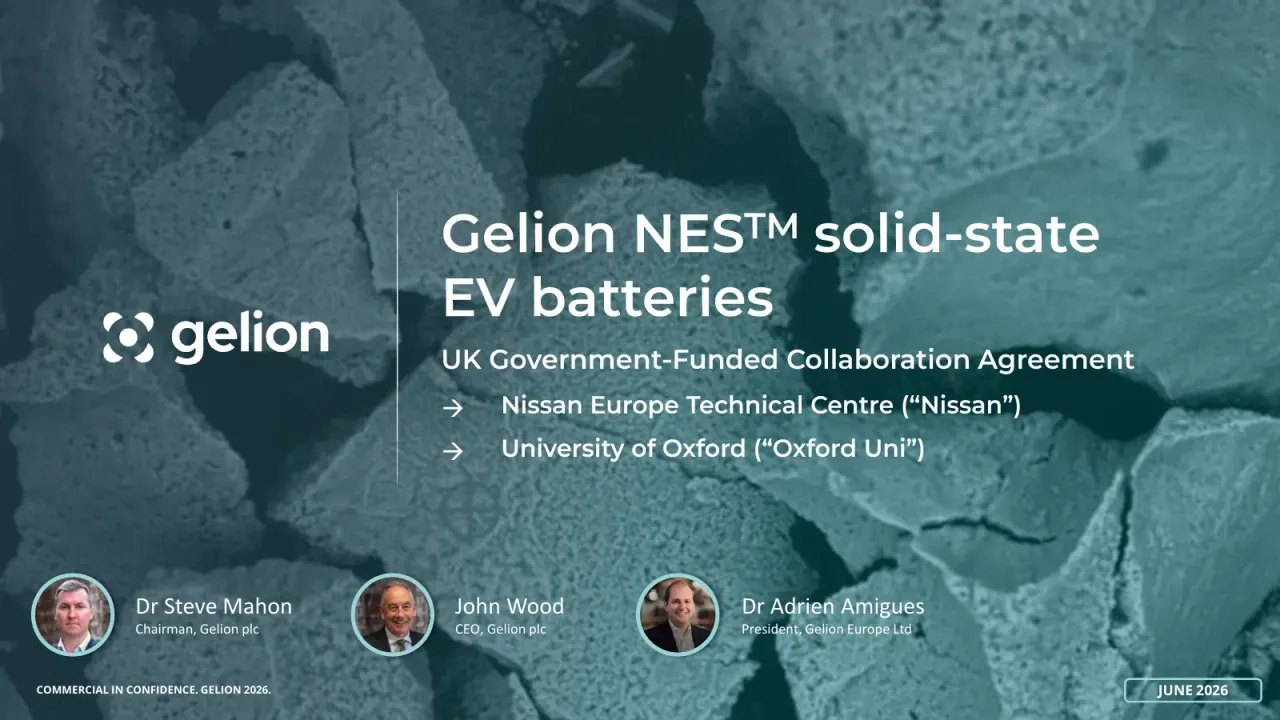
10:48 Just recently, we announced that we were extending beyond that. We were starting to work with TDK in the area of graphitic anodes. Now graphitic anodes are the go to. They're the anodes that are used most commonly around the world. We also announced we brought on board professor Yazami as a adviser who was indeed the gentleman who came up with the way of intercalating lithium into graphitic anodes. But those graphitic anodes are used in things like automobiles and devices. This week, we announced to you and we let you know that we will be collaborating, with Nissan in The UK towards making solid state lithium sulfur. Now solid state and and sulfur are regarded as the go tos for energy density. We put the two together here, and we aim to make a truly remarkable battery, together with Nissan and Oxford, and, with the with the fantastic support from Innovate UK.
11:57 And on the right, it is one more. This is the team know this one to be my personal favorite. This is room temperature sodium sulfur. The next material is truly unique. We can use exactly the same cathode material with lithium and sodium. Now when you put together the abundance of sodium with the abundance of sulfur, the low cost of both materials, then you open up all sorts of opportunity, particularly in low cost storage for global BES. Now I'd like Adrian, please, to take you through the the project. Thank you, John. This project is very ambitious and exciting and very much in line with Nissan's solar space battery program.
12:50 Together, we are going to be combining world leading technologies. So when you think about future next generation high performance batteries, you can think of solar state batteries or lithium sulfur batteries. Here, we decided to bring them together to deliver the very best possible product to market. In this project, GELION is going to aim to demonstrate that it's NES cathode material is the very best cathode technology for solid state batteries. And because so far is so cheap, we're going to have the potential to accelerate the adoption of solid state batteries across a range of industries including the automotive, defense, aerospace. So there is the opportunity here for an enormous economic and strategic impact, and that is why Innovate UK via its battery innovation program decided to support our project.
13:46 So this is a £3,400,000 program, which is enabling a world class collaboration. So firstly, Nissan. So Nissan is not just a global leading car manufacturer. It is also one of the the leading series to battery developers. It has been investing heavily in their own program for over fifteen years now, and they're about to start commercializing it. On the other hand, we've got the University of Oxford, which is also a a leading academic institution on the research of assisted batteries, but specifically on the development of high energy lithium metal anodes, which will be used in this project. And then ourselves, GELLIM, here in this project, we're going to be implementing our our NES catheter technology into Nissan's solid state platform.
14:43 So why software? And why software in solid state? So three main reasons. The first is that software is extremely low cost. So if you look at service state batteries today, they are using NMC in a very expensive form, which means that the product that they have today is very expensive. If they want to reach markets which are much bigger, much larger like the automotive, they need to decrease the cost significantly, which is why replacing NMC with sofa makes a lot of sense for players like Nissan. Secondly, a sofa has got a very resilient supply chain unlike NMC which contains both cobalt and nickel which are mined in only a handful of countries around the globe and which obviously subject to geopolitical risks.
15:35 So from the other hand, can be found everywhere on every continent, in Europe, in The US, and GELION finally has the opportunity to establish a resilient global cathode supply chain for its partners. And thirdly, the production of solid state lithium sulfur batteries is predicted to involve a 30 to 60% reduction in carbon emissions compared to the best existing lithium ion. That's significant and is a huge environmental benefits as well. So this is why those main three reasons is why solid state developers like Nissan are really excited to work with us and integrate our NES Getha technology into their solid state platforms. Now the aim of this project is to build an actual physical battery of high performance solid state lithium sulfur battery with extremely high energy, above 400 water per kilogram at cell level.
16:32 That's about 60% more energy than the very best lithium ion cells today. We want to someone to have longer duration, so we want a battery that that is gonna be used many times, charged, and discharged many times, and we've good power as well. So overall, this is a a very tremendous opportunity for our consortium to demonstrate a world leading product with a great market fit for a range of industries, defense, aerospace, and in the in the automotive. Over to you, John. But why why now? Why is this so important to The UK and to to July?
17:24 This is a very decisive and strategic opportunity for The UK. There's a a link here to a document recently published, the UK Gigafactory Commission, Britain's Battery Future. UK is now at a decisive moment. The UK Gigafactory into Britain's battery future recommends to fast track the scale up of next generation technologies, e g solid state and lithium sulfur. Now these are the two technologies we're putting together here to build domestic CAM manufacturing plants, and to accelerate, gigafactory delivery. There's that bottle of CAM again in this photo, and you can see that, with the multiple applications that we will be empowering with this remarkable material, we can be very important contributor to the future of The UK.
18:25 So the strategy here, is, towards solid state lithium sulfur leadership and towards UK based sulfur chem manufacturer for Europe. So we're selecting tier one partners. This is all part of our global campaign. We're building trusted partner relationships across Australia, The UK, Japan, and The USA. It's all market led, so this is not, GELION coming up with nice ideas. We're working here led with our partners, with cell manufacturers, automotive OEMs directly to derisk our product market fit. I've said that we've we've got partnerships in the cell manufacturing line.
19:12 Our goal now is above the line, and we're talking about hit that here with with with Nissan, working with the people who are actually making the products that use the batteries, and we're also working underneath as well in the supply chain towards battery, the the the production of our materials and the and the processes associated with it. We see this as a project that will have a catalytic impact, catalytic for July, but also can be catalytic in bringing and strengthening institutional investor support on AIM. And we see it also helping in terms of funding commercialization of downstream supply supply chain. We're working the liquid based solutions, and we're working solid state.
20:00 Well, I hope you can see an emerging picture here. We are active worldwide. Up in The UK, we've we've talked to you about Kinetic. We've talked to you about now, Nissan, our relationship with Oxford, talked about our relationship when we put in place with the Max Planck Institute of Colloids and Interfaces, in Germany. There are collaboration in Japan with TDK, and we're very grateful, for our support in The UK, coming from Innovate UK, the battery innovation program, and Faraday, And in Australia, we're very grateful, to our support that we get from Arena, which is, the Australian, government's clean energy fund as well.
20:47 And, I have, in our previous presentations, indicated that we are now starting our engagement activity in The USA as well. We see Ness as a product that is used across the full spectrum of battery applications, and we see NES as the start of a movement to utilization of sulfur globally. So we have structural tailwinds. Things are moving in our favor. The importance of batteries, the the importance to be on a onshore battery production, through, the battery cost reduction, through supply chain, security absolutely critical priorities now around the world, and we are enjoying the benefit of that in terms of the commercial and collaboration activities that we are moving forward.
21:48 We have a validated breakthrough. So the NEST sulfur cathode is, as far as we know, unique in its capabilities, and that's been validated with tier one, tier one partners. Strong OEM engagement, as Steve said at the start, watch this space. We are working to continue that theme. We've said we're going capital light working with working with partners and leading manufacturers and customers and materials production. The goal is to become recognized globally as the sulfur leader, as sulfur becomes the great emerging theme that it will be across batteries. And you're seeing the the clear catalysts, of that success. So you're seeing funded programs.
22:37 You're seeing OEM, milestones and collaborations, getting underway. Super proud of what team GELION right across the board is achieving. The technical stewardship technology stewardship by doctor doctor Louis Adriansens, our CTO, the financial governance by our CFO, Amit Gupta, and then all of the team, Adrian, Gareth over in The UK, knocking it out of the park, working long hours, really enthusiastic, gathering the momentum that, stewardship of this remarkable material, opens and celebrating, together with our our global collaboration partners as as we make this journey happen to the benefit of our shareholders, which is the core focus of our activities.
23:46 We'll now go to to the questions that have been submitted. That's great. Thank you very much for your presentation. Ladies and gentlemen, please do continue to submit your questions just by using the q and a tab situated on the right hand corner of your screen. Just while the company take a few moments to review those questions submitted today, I'd like to remind you that recording of this presentation along with a copy of the slides and the published Q and A, can be accessed by our investor dashboard. As you can see, we have received a number of questions throughout today's presentation. Simon, can I please ask you to share the Q and A with the team, and I'll pick up from you at the end? Thanks, Lily. John, let's start with a couple of China related questions. First of all, today's news that Nissan is looking at doing production in The UK for a Chinese company.
24:34 What effect do you think that will have on on on July and or or indeed The UK? Well, strengthens strengthens things remarkably. The Nissan setup for Europe up in Sunderland is very, very important. And the fact that that group is is expanding, becoming successful with this sort of work is important to us. We we see that this will be a a long standing collaboration. We aim to exceed all of the expectations that the collaboration partners have in this in this journey. So, yeah, it's very good news that is happening. Thank you.
25:24 Next question, given some of Oxford University academic's connections with Chinese companies and Chinese military universities, how are you going to protect your IP from leaking into the hands of Chinese companies when you don't want it to? Well, Simon, first and foremost, I trust that Oxford absolutely and totally. So Oxford is a a is a great partner, and we really respect and and love the opportunity to work with the great researchers that we are on this occasion. Now having said that, under this arrangement and under all the arrangements that GELION is entering into, we protect our IP. So in this case, all of the work on the cathode active material on the nest material is being done by GELION. We we actually don't open our open our kimono on that at all. It's it's all done within GELION, and all the IP for the work that is done on top of that technology also attributes into GELION.
26:35 The nature of the material itself and our fabrication processes lend itself to the protection of trade secrets, which is another thing that we're doing. We have I forget the number at the moment, but I think it's around a 170 patents in the area of of lithium sulfur, and we are continuously taking, additional, IP as our team, advances. So we're very serious about IP and, in the protection of our trade secrets. So another way is as well, Simon, that we're protecting ourselves, frankly, is by having strong partners who can stand with us and defend, the, the edge that we have managed to, succeed with. Thank you.
27:22 If all goes well on this program, what what's the eventual outcome? Is it going to be a commercial agreement, a full commercial agreement with Nessan? That would be the objective of the the program. So the objective of the program would be to earn that right or else this wouldn't be involved. We wouldn't be involved, and Oxford would be involved. The focus is definitely 100% commercial. We wanna make a great battery together for use in automotive cells. Nissan is a is a leader in solid state. Their first solid state will be NMC based. Our goal is to, through this project, make a a cell, a sulfur cell for future generations of of of batteries.
28:18 Could you give us an update on the types of partnerships that you're looking at in The US? And is this going to involve any government based contracts or grants? I have to stay inside the balance of what the company has announced. Now what what we've announced is we've started engagement in in The US now. Oh, that's a tough question. Here here we go. Look. In The UK, you know that we're working with Kinetic. We've told you the fields of that we're working on Kinetic. We've told you we're working with with Nissan. So we're working in in high performance strategic applications in, The UK, and we're working in, consumer applications like automotive, in The UK.
29:09 That gives you an idea of two areas in which our material are important. The first one of those is that if you put it into something that flies, it'll fly further. So it's a light material that's important in performance. It's a material that has high power, high energy, long cycle life, works in a wide temperature range. So that makes it a strategically important material. It's a material that's low cost, high performance that makes it a commercially important material. There's there's there's one thing that I I hadn't really haven't explained also. It's not just the low cost of the components that the the precursors that make up the material that is important. But, also, as, you know, doctor Lewis Adrian is about our our CTO managed to point this out. We we use water based, slurry based, slurry techniques to make our cafe. Why is that important?
30:09 It means that when you scale the Gigafactory, we actually take away a lot of the energy cost in the Gigafactory. We take away the need for large dry rooms when you're doing the coding process for the for the cathodes. And so that leads to an interesting outcome, which is a lot of the difference in cost of making a cell in China and making a cell in The USA disappears. So it's an opportunity to reshor battery technology. So it's it's it has a lot of features that make it very important to people who are important and wanna achieve important things. And we're working all of those activities, not just in The UK and Japan and and The USA, but this is an important material at an important time.
31:09 A very careful answer, John. Well done. Next question. This is almost so detailed it could be coming from a competitor, but I'm going to ask it anyway. You announced in your update of March that your graphitic anode was still cycling and you mentioned seven fifty and it was still going. Any updates on that one and about the energy density? And it's a I think I can Simon, I think our competitors would love to know the answer to that one. We haven't we haven't given an update. But, you know, NES is really stable.
31:58 Really stable. You know, when we talk about competitors, I'm not sure that there are in the particular area that we're going with with sulfur. The particular test you're talking about combined a graphitic anode with NES sulfur cathode. When people traditionally have spoken about sulfur, they've talked about Adrian, I don't know. Help me here, mate. 50 cycles used to be pretty good, maybe a 100. About a 100. Yeah. A 100. So people used to talk about sulfur as being a technology that was good for a 100. NES is really stable. When you put it when you put it up against a graphitic anode that can can cycle, it's the it's the anodes that that we noticed degradation in at the moment of the cathode.
32:50 So watch this space. We will bring out more results. And when it's the right time to share those results with our shareholders, then we'll tell our competitors at the same time as well. Thank you. Is Nest compatible with Tesla's dry cathode process? And what are you doing to put it in front of them? I that question came from Tesla. Look. We we believe it is compatible with dry cathode, but that is the development area for us, not an area that we have tested and have results for. It is included in the scope of the activities that we are investigating with our material at the moment.
33:45 We have not provided the material to Tesla for their testing at this point in time. Couple of questions on revenue roadmap. When do you expect first commercial revenues? And do you still think that's likely to come from aerospace applications? That's a great question. Look. First commercial revenues, and again, it's always hard on these questions because you gotta stay I'm really supposed to stay inside the boundaries of what we've what we said before. You're gonna see first commercial revenues come in a couple of ways. There are different applications that I've talked about for the technology.
34:33 So I've introduced that fact. Each of those technologies will move at a different pace. So, you know, the the lithium metal high performance cell is an early cell. That is a cell that will go out early. And so relatively early. And so that's one one that you will see. They're typically higher value sales when you're using lithium metal. So we're in the throes at the moment of doing qualification, and then after qualification, there'll need to be certification, and then, you know, we'll we'll have to continue to progress on that frame. The other area that I think you're gonna start to see commercial revenue or income as well is that there's a lot of partners now that are coming to us to put partnerships together.
35:33 And so we anticipate that that that will become a source of revenue as we exchange materials and and and work together with our collaboration partners. Could you please let us know about the solid state electrolyte that will be used or developed in the CorSoLis project And what needs to be achieved with the electrolyte development, if anything? I'm gonna pass that to Adrian in in just a minute. The the work that's been going on there, our guys have have been really impressive. Adrian, can you That's a very good question. So that indeed several types of solid state batteries that use different types of electrolytes, solid electrolytes.
36:25 The one that we're gonna be focusing focusing on in this program of Nissan is a sulfide type of electrolytes. Why? Because it's extremely light. It's what companies like Nissan use in their product, and it's a great fit for the markets that we are trying to to achieve. So there is no actual work on the development of the electrolyte itself because it's off the shelf from our suppliers today. So it's very much focused on our sulfur cathodes and integrating that into the processes used by Nissan to manufacture. You. Does the increase in sulfur prices about 200% in the past year impact your value proposition at all?
37:13 No. Sorry. But sulphur is coming off such a low base. There is there is so much sulfur in the world that the actual sulfur material that we use is a small component of the price of the battery. And so we can afford an increase in the price of sulfur. Lithium also has increased in the course of the last year as well. But we are blessed by the fact that sulphur is a very low cost material. Thank you. A shareholder here or potential shareholder with competition concerns. Firstly, he says within lithium sulfur, Leiden already has gigascale manufacturing in deeper pockets than you guys.
38:07 What's to stop them reaching commercial scale first? And secondly, more broadly, with silicon anode cells already shipping four fifty watt hours per kilogram plus other products such as solid state and sodium ion advancing fast, what stops one of those chemistries taking the markets that you're targeting? Where where does lithium sulfur specifically still win? All of the all the above we consider our friends. So let me explain. Firstly, Lighten. Lighten is a a great company doing a great job. Creating a a market for its own cells. It's a manufacturer. So it's just bought the Norfolk manufacturing, with the intention of of making cells itself.
38:55 How does GELION compete with Lighten? Well, we do it Capital Light. We do it by working with the largest manufacturers in the world, and we do it by making it possible for them to adopt sulfur in alongside their existing manufacturing capabilities. The scale of that is, of course, absolutely enormous. Now the second part of that question went on to talk about silicon. Yeah. Love it. Love silicon. I think that one of the one of the most important cells that will come in into GELION's portfolio will most likely be an eight or 10% silicon carbon anode with a GELION S sulfur cathode.
39:47 It's gonna be a super high performance cell. It's gonna be low cost, and it's gonna be a really important cell. So silicon is a friend, not a competitor to what we're doing. We make the cathode active material. We compare that cathode active material to silicon. We can pair it to graphitic. We can pair that material to lithium metal, and we can even use sodium as a as a current carrier or as a charge carrier. I think I missed the third part in that question, which was about sodium ion. Of course. And I love sodium ion. Sodium as a charge carrier is compatible with NES.
40:35 Oh, I like the way that that came out actually. It's compatible with NES. We are compatible with sodium as well. So as sodium becomes more broadly adopted, we will have the capability to have NES support sodium. It is actually the same material. So our our sinus here have taken the same cathode material with the same NES, and they've made cells cycle using sodium, and they've made cells cycle using lithium with the same cathode material. I don't think there's another I don't know. Adrian, help me. I don't think there's another electrode material out there that you can use interchangeably with sodium and lithium? No. This is the strength of our technology is how agnostic it is. So as you said, all of these technologies are friends to us. It's just opportunities.
41:31 Thank you. K. Final question on the project. The project is focused on meeting the KPIs of automotive solid state battery applications. What what are those KPIs? Adrian, I'll pass to you. It it really depends on on on, firstly, the manufacturer, but the actual automotive application as well. There there is a broad range. So in a general way, you're talking about high energies. So today, the very best cells are NMC cells. You're talking about 250 watt of a kilogram. Here, we're targeting 400, so much higher. You're talking about long cycle ability as long as possible so that the end user doesn't have to replace his battery on a you know, every year, but rather every five years.
42:23 And that's what we're targeting. Our sulfur cathode is extremely stable, so we we can meet the the that kind of cyclicality very easily. So it's all about now whether service state batteries can, and that's where we rely on our partners to meet those KPIs. And finding high power. A high power is is important when you want to accelerate the car. And, again, this is one of the strengths of of our cathodelectric material, which can operate up to to 10 c. So it can be discharged in six minutes without much capacity loss. So we are, you know, we are doing our best to work with the best out there to integrate our Gethro technology to meet the KPIs of of broad range of market.
43:13 So that's what we do. Very important what what what Adrian just reinforced there. In all of the activities that we're doing, because we're collaborating with the tier one partners, where we're targeting KPIs, those KPIs are coming to us from our partners. So we're keeping it real for our shareholders. Okay, last couple of commercial questions. What exclusivity is there in this deal? Can GELION apply the findings to solid state batteries for other manufacturers? Yes. That was easy. And finally, have you looked at listing on the ASX as well or on US markets? Do you not think that might attract a wider pool of investors?
44:00 I'm a believer in rational markets. We have our head down at the moment. We are delivering results. GELION is becoming known, around the world. We are not gonna slow down on that. We are continuing with some really important activities at the moment. We're on AIM, and, you know, our value is what it is today. I believe that, as we continue to, perform, that's gonna be recognized by investors all around the world. Now the board has its options around what we do here, but it's all about the shareholders, at the end of the day.
44:55 So my focus on, at the moment with the team is towards generating those, those outcomes, those successes, delivering the, the collaborations, delivering the technical performance, getting it turning that into commercial into commercial outcomes, for our team, winning the grants to maximize the utilization of every dollar of shareholder money that we've been given, and moving forward commercially as fast as we can. I think the capital markets are going to recognize that and catch up with us as we go forward. I don't think that's going to take a whole long time based on what I see our team achieving and the rate at which they're achieving that now.
45:46 John, Adrian, thank you very much indeed. I'll hand back to Lily for wind up. That's great. Thank you for answering all those questions you can from investors. And of course, the company can review all questions submitted today, we'll publish those responses on the investor meet company platform. Just before redirecting investors to provide you with their feedback, which is particularly important to the company, John, can I please just ask you for a few closing comments? Look. Thank you for for joining this, this meeting with, Adrian and and and I and Steve. Thank you for the introduction. It's an honor to work with with Steve. He's quite remarkable. He's always available to me as a as a CEO, which is really important to be able to reach out and get decisions made. The board is always available to Steve and I to to get things done.
46:34 We've got a a very exciting period of time coming up. We got a lot of goals that we're hoping to kick in fairly quick order. They're all logical. They all build around getting this nest material out across all of the applications and getting it out around the world. Steve, would you like to close off there? No. I think we've covered everything. All I would say is, judge us by the company, we keep. You look on the science side with Max Planck and the University of Oxford, you look at the commercial scale up with Kinetic, and now Nissan, and and I'm sure there will be others as we deliver our model, judge us by the company we keep. Thank you, Steve. Thank you. Thank you all. That's great. Thank you for updating investors today. Can please I please ask ask investors not to close this session as you'll now be automatically redirected to provide your feedback in order that the management team can better understand your views and expectations.
47:29 This may take a few moments to complete, and I'm sure it'll be greatly valued by the company. On behalf of the management team, we'd like to thank you for attending today's presentation, and good morning to you all.
Follow Gelion PLC into a list and get an email when it puts out news.
Non-Executive Chairman at GELION PLC
CEO at GELION PLC
President – Gelion UK & Europe at GELION PLC