John Wood
CEO at GELION PLC
Replay available
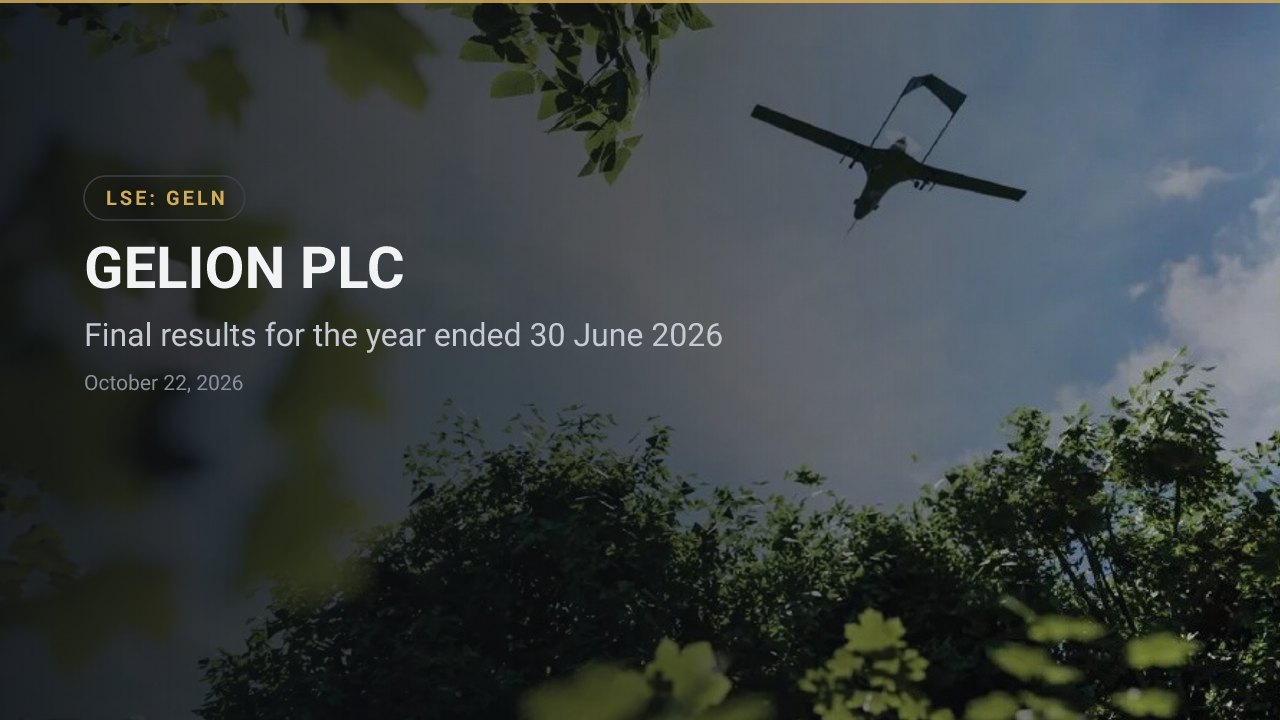
Final results for the year ended 30 June 2026 hosted by Gelion (LSE:GELN) on Investor Meet Company. Replay available.
On 6ix: 6ix.com/event/gelion-plc-geln-final-results-for-the-year-ended-30-june-2026
Automated transcript · Written by software from the replay's audio. It can mishear names and figures; the replay is the record.
0:01 Good morning, and welcome to the GELNINE PLC final results investor presentation. Throughout this recorded presentation, investors will be in listen only mode. Questions are encouraged, and they can be submitted at any time using the Q and A tab situated at the right hand corner of your screen. Simply type in your questions and press send. Before we begin, I would like to submit the following poll, and I would now like to hand you over to CEO, Matt Wood. Good morning. Good morning, and good morning, everyone. Welcome to GELION's twenty twenty six results and strategy presentation. My name is Matt Wood, and it is my great pleasure to be the CEO of GELION and to steward the company on behalf of our shareholders. I've spent more than twenty years in energy and materials, primarily focused on developing, scaling, and growing materials businesses, including in the battery materials space.
0:53 Today, I'm joined by Amit Gupta, our chief financial officer, who's a deeply experienced finance professional, who also brings experience in corporate development and m and a. Amit will walk us through the details of our 2026 financial results. I'm also joined by Louis Adriansens, our chief technology officer who has more than twenty years working in material synthesis and electrochemistry, including as the supervisor for chemistry, for Panasonic at the Tesla Gigafactory in Nevada. Louis will present some of the fantastic technical progress we've made this year with our partners. I will then talk about GELION's strategy and where we're going. However, first, I will touch briefly on who GELION is, our mission, and what nanoencapsulated sulfur is.
1:42 So GELINE is an advanced battery materials company. We are developing and commercializing a sulfur cathode material called nanoencapsulated sulfur or n e s or NES. In a lithium ion battery, you can see on the screen, there are two main types of cathode active material. That's on the left. They are called LFP, which is an iron phosphate based cathode material, and NMC, which is a nickel, cobalt, and manganese based cathode material. And these are black powders. They are then mixed into a slurry or an ink and applied as a coating to a foil, which you can see in the center center picture, and then dried and rolled to produce a cathode, which is on the right hand picture.
2:31 Our NES is a direct replacement for these cathode materials. It is also a black powder, and you can see that now in the in the left hand picture. It replaces NMC or LFP, and all of the rest remains the same, the cathode coating, and the production of the cathode itself. So NES is a proprietary high performance cathode material made from an abundant byproduct, which is sulfur, and which is a drop into existing battery chemistries and existing battery manufacture. So here, on the next slide, you can see, our mission, and that is to establish our NES sulfur cathode, as a compelling replacement for today's today's cathodes. We're pursuing this mission in order to provide a cathode market, which is in shortage, with a high performance, cost effective alternative that can be made through a domestic supply chain from an abundant raw material.
3:31 And this slide shows that there is... In terms of abundance, there is over 20 times more sulfur produced globally each year than lithium, nickel, and cobalt combined. It is also a byproduct of the desulfurization of oil and gas, and so its supply is geographically distributed unlike LFP and NMC, which rely on mining and processing supply chains that are heavily concentrated in certain territories. And so there are two well understood benefits of sulfur as a as a cathode. It has extremely high capacity to store energy, around four times that of of NMC.
4:16 And as we've just seen, it is abundant. However, traditionally, there are several shortcomings of of traditional sulfur cathode technologies. So it's inherently low power, and it suffers from something called the polysulfide shuttle effect whereby the sulfur in the cathode leaches out of the cathode into the electrolyte, and that causes a rapid capacity fade. And so the high capacity that you get drops very quickly.
4:45 So other sulfur cathode technologies aim to mitigate this effect by redesigning the rest of the battery cell using bespoke components, such as bespoke electrolytes. GELION has solved the polysulfide shuttle effect using something called nanoencapsulation. So you can see the animation in the center of the screen. Effectively, we build a cage or a shell around the sulfur, which allows the lithium or sodium depending on what the charge carrier is. It allows the lithium in and out, but keeps the sulfur in place. And so you can see in that animation that the yellow sulfur particles are being encapsulated by a black shell, and then the colorful lithium or sodium ions are able to shuffle in and out, but not the sulfur.
5:36 So effectively, traditional sulfur cathode technologies mask the symptoms, whereas GELION's nanoencapsulated sulfur has cured the problem. This means our NEST cathode provides high energy density, high power performance, stable cycle life, and a very broad operating temperature range, all from an abundant raw material. And we like to say by locking up the sulfur, we unlock its benefits. So on to 2026. We have made significant operational progress in technology development, in market validation, and in setting up the path to scale. With existing partners, we signed an exclusive license with the Max Planck Institute. Our partnership with TDK has proven Ness in power cells and continues very much on track.
6:28 And we had outstanding results from the drone mission demonstrator with Kinetic. And Louie's gonna talk through some of the specific results from those programs shortly. But we've also, in the past year, secured new partnerships which go beyond the objectives that we laid out for the year. In electric vehicles, we secured a grant funded partnership with Nissan in Europe to incorporate nano encapsulated sulfur into solid state batteries. And more recently, we secured partnerships with a top 15 and a top five automotive OEM to evaluate NES in a wide range of electric vehicle battery chemistries, one of which is a co funded program. We also announced our entry into The US market in partnership with the National Lab of the Rockies, which is the leading federal institute in The United States for energy technologies.
7:21 And that program will both validate nano encapsulated sulfur's performance and also provide a pathway to pilot scale production. And then lastly on this slide, we have a co... A funded JDA with Mitsui Kinzoku, which both provides commercial revenue in in 2027 through their option... Sorry, and through their option to negotiate a license for certain territories in Asia. That sets out a path for the commercial production of NES and associated license and royalty revenue when we get there. So a lot going on and a lot being delivered, but the key message is momentum. Momentum on technology, momentum on market validation in defense, in commercial drones, and in EV applications, and in setting out the path to scale and commercial revenues.
8:16 And much of that has been announced since June, which we believe shows accelerating traction. And it's all been done against the backdrop of strong financial stewardship, which has yielded good financial results, which you can see the headlines here on the screen. And we're very, very proud of this. It's taken a lot of hard work, a lot of care, and attention to detail. And so let me invite Amit now to walk us through those financial results. Thank you, Matt, for the great summary. In terms of financial results, as Matt summarized, we have achieved all the financial metrics, which is above market expectations. It's it's not easy. It takes a lot of careful consideration of all the development programs that we are running and the requirements for those.
9:07 As you can see on the next... On the slide, our adjusted EBITDA loss was 4,100,000 compared to market expectations of 4,400,000. The increase is largely due to the integration services revenue. In last year, in FY twenty five, we generated approximately 900 k pounds of integration services revenue. That was almost nil this year. And Matt is going to talk about the strategy around the integration services business as well. A large part of this decline in revenue was offset by the grant income and the r and d tax credits in UK and Australia. These are very, very important for a business like GELN, which is deep tech and does a lot of development activity.
9:55 This is non dilutive funding, and it shows the support that the Australian government and the UK government provides to GELION and their belief in the technology that we are developing. R and d expenses increased slightly. However, in f y twenty five, approximately one third of that related to zinc program, which we're not running anymore. So you can see in '26, we are all in on sulfur and going further as well. All the money, all the capital is going through the sulfur development program. Overheads increased slightly. This represents expansion in territory. So US entry, the recruitment of our senior VP, Trace... Tracy Sizemore in The US for global partnerships program, and you have seen the result of all the partnership that we have signed.
10:43 The key metric that I'm sure everyone is monitoring for GELN and we do very, very carefully as well is the pro form a cash and cash equivalents number. £9,600,000 at June 30. This includes the r and d tax incentive as well as the grant income that we have earned but not received, so receivables. But even in the cash... Reported cash reported cash number at the end of the year, we are so about 20% above the market expectations. So, again, I think this is the 50 in in a row where we have exceeded market expectations, and it's been done very, very deliberately. And we are very proud of the results. And the summary is we are we are taking very good care of shareholder capital.
11:29 We are tapping into non dilutive funding as much as possible and trying to fund that development program of the business as much as possible as well. This slide summarizes our actual performance compared to market consensus across all the metrics you can see at adjusted PBT, it's 5% better than what was the consensus compared to the pro form a cash and cash equivalents, which is above 21%, and income being 17 and a half percent above. We will... The way we plan our business and the way we go through go through the development programs and other activities in the business, we want to keep hitting these numbers year on year and very excited for what's next year... What what the next year holds for July.
12:17 I'll only focus on the bottom two charts on this slide. Grant funded r and d. You can see 63 and a half percent... 63.2 of our development program was funded in 2026 compared to 49.8%. That's a significant jump. The grant programs are live. They are valued for the next couple of years as well, but we're not stopping there. We continue to look for additional programs that we can sign up for to continuously subsidize our development programs. It... It's a very, very good use of that nonvalidative funding. And the bottom right chart, which is underlying net cash use. Matt summarized all of the technical and the commercial progress that we have made, but we have done all of that within our expense kind of pool of capital that we allocated last year. When we came in October 2025, we communicated approximately £5,000,000 of annual run rate, so in terms of cash spend. And the good news is we have stuck to that number, and we have delivered everything over and above what we promised within within that pool of capital that we'd allocated.
13:28 When I look back of what 2026 meant, it's a year of enormous achievements, technical, commercial. We have executed agreements which are co funded plus the JD agreement with Mitsuri Kunzuku. FY '27 is going to be a phenomenal year for us. We are at inflection point. We start generating commercial revenues, although modest at this stage, but we will generate commercial revenues in FY 2027. As Matt said... Matt Matt spoke about the potential licensing and royalty income as well. So these are all pathways of us moving towards increasing commercial revenues in the in the next year or two. And then who knows what what is...
14:16 What 2027 has to provide to GELN. With all the traction that we have got in the last... Especially in the last three to four months. We're expecting that to continue with new partnerships and programs announced as we execute them, but there's definitely a lot of interest in the market space about what GELN is doing. Thank you, and I'll pass it on to Louis to take through... Take us through the technical program. Alright. Thank you very much, Amin. So the technical progress that I'm gonna talk through today, largely looks at taking some of the phenomenal results from our NES material that we showed last year. And how we've taken those results in that material, we've moved it towards more more commercially relevant cell types, so pouch cells, and how we've done that with the facilities of of our partners. We spoke a lot about our partners, and we're really proud of those partners. They gave us a lot of capability.
15:13 And these technical results essentially show how we're able to take those those embryonic results that we had last year and turn those into something with much more commercial relevance. So if we start with the panel at the left on on this slide, this is data from TDK. So TDK are our tier one cell producing partner. And what this data shows is the exceptional durability of of our nest material. So if you look at the green line, which goes horizontally, and that's very important across from one side of the plot to the other, That green line represents the capacity. And what I want you to focus on here is that as we go beyond cycle 100,200,300, that line rip... That line retains a high degree of horizontal nature. And what that shows is that as you go go beyond those very, very important cycle numbers, the capacity fade is minimal.
16:05 Now very critically, we're not doing this at a a weak c rate. We're using an aggressive c rate, which is actually designed to accelerate degradation. So this is a one c, one hour discharge, and 100% depth of discharge. And I would like to highlight that this is in a pouch cell, a multilayer pouch cell produced by TDK at their facility in Japan and tested at their facility in Japan, backing up what we said a year ago about the durability of our material. Moving to the panel on the right, this is some recently announced data from, our collaboration with Kinetic. So this is part of the ARM four program, which is recently completed very successfully. Kinetic are, of course, a UK headquartered company with focus on defense and aerospace.
16:51 And what we were able to do with Kinetic was actually send them our material. They assembled that material into a pouch cell at their facility. They tested that pouch cell at their facility. And if you look at the data, what I want you to focus on is I want you to focus on the black line, which is actually going across from left to right, the bottom black line. This black black line represents the discharge of the battery, and it's that discharge which is involved in actually powering all the maneuvers that this simulated drone would undergo. So starting at the left, we have a six c vertical takeoff. So we're we're presuming this is a quadcopter drone. We have six c, which represents a vertical takeoff of that drone, and that pulse... That high power pulse actually allows us to do that aggressive maneuver. We then transition to an aggressive quadcopter cruise. That's a three c phase there. And then when that three c phase is done, the quadcopter cruise is done, we then engage in a vertical landing maneuver, which is again a six c a six c maneuver.
17:51 These are incredibly aggressive cycles, and I want to highlight that it's not just one cycle. This battery was able to actually achieve 50 times of these cycles, showing that not only can we engage in these aggressive maneuvers, but you can actually then recharge the battery with the same device, actually do that again. Now for my assessment, considering that this is a battery that's capable of a fully domestic supply chain, within that group of batteries, these results are really unique. And these results, specifically the power capability in partnership with the with the durability of our battery, have actually raised a lot of attention from players who work in industries which make devices like the quadcopter drones that we've shown on this slide.
18:39 If you go to the next slide, please, Amit. As have our results from the National Lab of the Rockies. I'll just give a brief introduction. Matt did a great job on that earlier, but a brief introduction of the National Lab of the Rockies. They're part of The US Government laboratories over the national labs, and specifically, National Lab of the Rockies is the the division of that, which is focused on research development and application of energy storage and energy usage. So, specifically, what we're looking at here is a phenomenal power capability again of our battery. What we... What what National Labs were able to do was take our material, assemble that into a cell, and test that cell at their facility. And now those are the results we're looking at here. Starting at the left, you have a 0.1 c rate that corresponds to a ten hour full charge and discharge.
19:28 And on the right, you have a two c rate that corresponds to a half hour charge and discharge. That is a 20 fold increase in rate. In doing that, we retain 92% of the capacity going from a ten hour charge discharge to a thirty minute charge discharge. Compare that to a standard lithium ion battery where you'd be looking at retention of between 80 to 90. So we're able to make this battery with a fully domestic supply chain, and we're able to at least match, if not better, the results which are obtained using a standard lithium ion battery. What's really important about this, especially these results of the National Lab of the Rockies, is that the National Labs actually represent a pathway to US government institutions and agencies. So for instance, the Department of War.
20:15 And critically for GELION, it also represents a pathway to the actual procurement programs of those agencies. So for us, this is a phenomenally important result, and we've been very, very happy with the traction that we've gotten from this result both within the national labs and beyond. At this point, I wanna... If you go just just back for a second, please, I just wanna highlight that we've shown data from Asia, so Japan, data from from Europe, so The UK, and also data from The United States. Remember that GELION operates with a licensing model. So the ability for our materials to be shipped to partners and work out of the box as advertised is absolutely critical. And so we're really, really proud of the fact that we're able to actually take our material, we're able to send it out to our partners, and we're able to actually have that that material operate first time out of the box as advertised.
21:10 It's critical to the way that the company operates, and and it's just something we're really, really proud of. I also wanna point out
21:16 that with all of these partners, especially with with the national labs, these results are only gonna get better. These partners have their own technologies in supporting componentry, so for instance, the anode and the electrolyte. And as we actually leverage some of those technologies, we expect that this performance is is actually gonna improve. So you go to the next slide, please, Amit. So we had ambitions that we spoke about when we came out a year ago, five key ambitions, and and we're really happy to say that that we've hit every single one of those. I wanna focus on the middle one. So progressing market fit with TDK or a tier one cell manufacturing partner. In doing that, we've kind of identified two key battery types that we're working on and developing towards commercial application.
22:05 So the first is is a a variant which uses our NES cathode and pairs that with a lithium metal anode. This would be a battery which is focused to defense or aerospace. We've talked through some of the performance there. So very high power, capable of three c continuous and six c pulse to do all of the aggressive maneuvers that are required for anything that operates in aerospace. High specific capacity greater than 800 milliamp hours per gram of cathode active material. I want you to compare that to 200 milliamp hours per gram, which is observed for high performance NMC and and and high nickel. So this is over four times higher specific capacity than those incumbent technologies. Excellent durability, 300 cycles under aggressive conditions in a pouch cell assembled with lithium metal. These are really phenomenal results.
22:54 And, of course, the wide temperature range that we spoke about before, operating down to minus 20 c and up to 40 degrees c. Moving to the other cell format. This is a graphitic anode cell format. All of those performance metrics and performance advantages still apply. So we've got high power, high specific capacity, and, of course, also a wide temperature range. But moving towards a graphitic anode, we're looking more towards a a broader spectrum commercial application. So this would be commercial drones, devices, and EVs. Here, we partner with a graphitic anode, which is a much more stable and safe anode compared to lithium metal. And in doing so, we're able to in... Increase our durability. So we're able to go to above a thousand cycles, again, under very, very harsh one c charge discharge conditions, a 100% depth discharge, which brings us in line with where we need to be to actually operate in those markets.
23:47 And pair that with the fact that our material is compatible with lithium ion battery components. That means the electrolytes, the separators, and the anodes, and all of the machinery that's used to make those components and and and handle those components in cell assembly in Gigafactories today. That gives us the opportunity to move our material forward as an actual drop in. So we don't need to retool factories. We don't need to make new factories. We can use the Gigafactories that are available today. And because of that compatibility, we can actually drop in there. Additionally, a domestic supply chain, as Matt talked about before, we use sulfur and we use carbon. Both of these byproducts of local industries, so for instance, refineries, which are available in most places in the world, giving the world, let's say, a democratic viewpoint in how they can produce their their batteries.
24:35 And last of all, just briefly touching this, there's an economic advantage. We've had our batteries third party cost model, and they come in at cell level. So not just the cathode active material, but actual wholesale level, 15% lower than the incumbent with the equivalent performance. So that's a massive cost benefit which pairs with all of the performance advantages. I just wanna summarize and say, you know, that these are really fantastic results, and we've done this in a very, very careful and thoughtful way as Amit highlighted. We're very proud of them. We think it's been a great year for GELNINE. And with that, I'll hand back to Matt, who'll talk you through what our ambition is for the year to come. Thanks, Louis. So not only do we have a fantastic product, which as Louis described, been validated by leading players in our target markets, but there's also a significant commercial opportunity.
25:30 And I'd like to just spend a few minutes talking about where that is, what it is, and and why we believe in it. And so, really, why sulfur, and why cathodes? And so on this slide, we see some data from Benchmark Mineral Intelligence, a leading market intelligence and price reporting agency who specialize in batteries and and critical minerals. The chart on the left shows the rapid growth in battery demand, and the chart on the right shows the global cathode market. We can see on the right the benchmark forecasts that the global cathode market is in deficits in 2026, followed by a prolonged deficit from 2032 onwards. Furthermore, with the dominance of NMC cathodes and LFP cathodes, from a performance perspective, today in the market, there's a there's a two size fits all approach.
26:26 And therefore, we really see the need for an alternate cathode technology that combines high performance with manufacturing practicality, and a lower risk supply chain. So we have a large growing battery market driven by the macro trend of electrification, of energy infrastructure, of mobility, of defense, which is served by a cathode market today that has unmet supply needs and unmet performance needs. So there is a material opportunity for GELION's NES cathode. To deliver on this, we need to focus. We need to focus our efforts, attention, and our resources on that massive opportunity. So today, we have three business units at GELION.
27:13 We have chosen to focus on our NES cathode business on the left, where we have a significant market opportunity as I've just described, and have advanced to the point where we are poised for success. However, this means making prioritization decisions elsewhere in our portfolio. So we have taken the difficult decision to wind down our integration solutions product offering. This unit was established with the aim of generating revenue from GELION through the integration and installation of battery energy storage systems or BESS using third party cells. However, after delivering successfully an initial project, the market has become significantly more challenging. It's become commoditized and oversupplied, and GELION doesn't have a sustainable competitive advantage in that in that market.
28:06 And so we've chosen to wind it down, which will save around £800,000 per year, which can be redeployed to our core Nest business so that we can continue to grow the amount of activity that we're doing in that business without materially widening the operating envelope. Additionally, we have a battery recycling unit, and this is actually fantastic technology that GELION has taken to the point now where it's also ready to scale technically. But this will require meaningful investment, and it will be competing for capital with our Nest Cathode business. And so we're currently... I... Working through a strategic review to identify how this fits within GELION and whether working with a partner could be a better path forward.
28:54 And so we have chosen to put our strategic focus on our Ness sulfur cathode material. And then within that Ness cathode business, our strategic priority is on the applications and activities that will lead us most directly to commercialization. We call this strategy the drive to commercialize, and there are three pillars against which we're aligning our our resources and our priorities. They are discovery, which is r and d, demonstration, which is market validation, and commercialization. And we have chosen within that to prioritize commercialization ahead of demonstration and discovery. And so there'll be more emphasis on commercialization. That's why it sits on the left than on demonstration and discovery, but there will still be demonstration and discovery activities because they're still very important.
29:49 In terms of what each of these entails, we will commercialize NES for defense and aerospace in lithium metal cells as Louis described. We will commercialize NES for commercial drones, devices, electric vehicles in graphitic cells, and we will scale up our NES production to serve those programs. And I'll talk shortly a little bit about how we intend to do that. Within demonstrate, we will narrow our focus to NES for solid state batteries for EVs, which has a really meaningful prize in high performing EVs, but a longer time horizon and still validation work to do. And then there are many, many other opportunities for nanoencapsulated sulfur and nanoencapsulation technology, but our discovery efforts will focus very clearly only on programs where we have access to both funding and partnerships.
30:50 These are really, really important. There are so many things we could do, and they are all very, very worthy things to do. And we believe that nanoencapsulation has a has a really strong role to play in many of them, but we need to focus. And we can come back to some of those once we reach commercialization of our NES. But in the meantime, we will focus on on discovery efforts around funded programs with partners. And an example of that would be sodium ion cells because NES can act as the cathode very, very ably in a sodium ion cell as it can in a lithium ion cell. So we are focus... Focusing on nano encapsulated sulfur. And then within that core business, we are focusing on commercialization in our target markets of drones and devices, which are nearer term, and EVs, are a larger market, but more medium term.
31:41 And then when we look at the progress we've made, we look at that strategy and we look at our current activities. How does this all fit together? So this is a little bit of an eye chart, but hopefully with the voice over, it will make it will make sense. So the base of the house is a very, very strong IP foundation that's now fully in place with our own IP, with ongoing IP arrangement with, exclusive IP arrangement with the Max Planck Institute and then IP that we've acquired both from Johnson Matthey, Oxus, and Oxlid. Built upon that is the fantastic market validation work that GELION... The GELION team has completed together with our partners, much of which Louis has described. And then in the market, we have programs underway with leading partners across all of our target applications in the right chemistries, and then feeding that will be a successive successively different scales of production.
32:40 And so I'll just sort of talk through that. So we have lab scale production today in in Sydney. We are at the second scale of that production, and we are in the process of, delivering the third and final, scale of that production that will happen during this fiscal year... Early in this fiscal year, and supported by our partners. You can see on on the screen. That will provide us with sufficient material to keep feeding the market validation programs that we have in the top row of this diagram. But they're hungry, and as they come, they go through successive levels of requirements. So if you imagine the difference between creating enough material to put in, you know, several handfuls of cells for testing with one of our partners, That's very different to needing sufficient material to eventually put into enough cells that go into a pack and drive a car around a track...
33:39 A test track. And so we will need to get to pilot scale production. And then beyond that, we will get to commercial scale production, but we will do that with partners. And one of those pathways is with the joint development agreement, the funded joint development agreement with Mitsui Kinsoku. That's an example of where we have a pathway to negotiate a commercial scale license and production. The pilot plant is is important because not only will it feed the programs above as they get to the requirement for volume, but, also, it will give us the engineering package that we can license. So instead of licensing only technology, also licensing engineering packages.
34:26 And so this is this is a really, really important step for us. And lastly, please, you know, don't forget to go right back to the beginning. This looks very complicated, but it's actually quite simple. This is all built around and fed by one single black powder, a nano encapsulated sulfur. And, Amit, if you don't mind just clicking the build on on the slide. And so the IP is around that single black powder. The validation work is using that single black powder. The the market work with our partners is around that single black powder into multiple chemistries for multiple applications. And when we go through that scale up of successive levels of production ourselves and with partners, it will be making that that single and and very fancy black powder.
35:20 And so I wanted to sort of bring it back to to where to where we started. So looking ahead, what to expect next from GELION? The executive team and I believe, that actually it's very clear what we need to do. There's a lot to do, but we believe it's very, clear what we need to do. And so, it falls into two reasonably simple, work streams. So on our partnerships, we need to deliver against the milestones for our existing collaborations. We need to deliver the commercial revenue for those that have commercial revenue associated with them, and we need to add a discrete number of new drone and EV partnerships into that stable of market partnerships.
36:06 And then on scale up, we will deliver the increased lab scale cathode production, cathode active material production, our nest production from our our lab, and that's underway so that we can continue to feed those programs in 2027. We will scale up our lab scale pouch production... Pouch cell production both in Australia and in The UK. That's not because we want to be a a cell manufacturer. That's because we need to produce cells to be able to partner with our customers on validation. And then we will advance our project for the pilot scale production. So we will initiate that and the first piece of which is early stage engineering. And so we think it's relatively straightforward. And and the last thing I would like to add is having been now in the seat for three or four months, that we have a great team to get all of this done. You've you've met two key members of the team today, but we have a great team to get all of this done. I am extremely grateful to my predecessor, John, for various things, but the principal among those is the great team that I've inherited. And so I have total confidence in this team's ability to deliver the things that we just laid out on that last slide.
37:18 So in summary, we have delivered strong financials in the past fiscal year. We have done that whilst delivering continued progress on market validation and on our partnerships. As promised and in some cases beyond what was promised, we have, I believe, a very clear strategic focus on commercializing our NES cathode opportunity and clarity within that on how we want to go and do it and what's most important to us as we make careful choices about our resources. And we have fantastic momentum. We have built and continue, to enjoy fantastic momentum in our target markets, of drones, both defense and commercial drones, and EVs.
38:04 And then lastly, I would like to thank our shareholders for their support. There are many, many stakeholders that go into achieving all of this, but our shareholders are very, very important stakeholders among those. And so we'd like to thank you for your support. And now I'd like to open up to any questions that you might have.
38:21 Fantastic. Thank you very much indeed for your presentation. Ladies and gentlemen, please do continue to submit your questions using the q and a tab situated on the top right corner of your screen. While the company take a few moments to review those questions submitted today, I would like to remind you that recording of this presentation along with a copy of the slides and the published q and a can be accessed by our investor dashboard. At this point, if I may hand over to you to chair the q and a, and I'll pick up from you at the end. Thank you. And so I think probably the the best place to start, we've had a question around share price. And so the the question was we are... Why are we seeing such large fluctuations in the share price, and why have we had such a negative reaction to recent potential commercialization announcements?
39:09 And so I'll take this one. We are acutely aware of the share price. We watch it every day, but I don't dwell on the share price. We don't control it directly, and there are factors such as market liquidity and the macro environment that have a huge impact and often in the opposite direction to the progress that the company's announcing. And so we are focused on getting our heads down and building a great business. That said, we are taking steps to engage more with the market. To give some examples, my role, the CEO position with John's retirement, the board have taken the opportunity to to to move that to The UK to be closer to the market.
39:55 And I'm now engaging more frequently both with our institutional investors, and we will be attending a number of retail shareholder events. That will include, actually, even in November, the Yellowstone advisory event, which I think is on the November 11, and I'll be at the MELO investor conference in London on the seventeenth and eighteenth of November. So we'd be very happy to see people there. And we will continue to look for those, both in London and and outside of London. So, yeah, just to recap, I don't dwell on the share price. We are acutely aware of it, but we're building a great business, and and we believe that that is where material shareholder value will be created. Okay. I was going to take the questions in order that they were submitted.
40:44 So the first one was how much of a threat to your strategy are recent advances in sodium ion? Great question. So I'll I'll take this, and then, Louis, I'm... I'll I'll open up to see if you've got anything you'd like to add to it. But I actually don't see sodium ion as a threat. I see it as an opportunity. And the reason is that sodium and sodium ion batteries, the ion, the sodium is the charge carrier. So it's the the element of the battery that that moves between the anode and the cathode through the electrolytes, and this is the charge carrier. And so it works like a lithium ion battery. It's just it's sodium rather than than lithium. And so there is an anode. There is a cathode, and sodium has distinct benefits can... And drawbacks compared to lithium.
41:36 And so our our material can work as the cathode in a sulfur... Sorry, in a sodium battery as it can in a lithium battery. And so it is actually part of our strategy in the discover pillar, but it's just a little bit longer wavelength. And so our near term focus is on commercializing nest in lithium systems for drones, EVs, and devices. But, hopefully, you saw in the strategy presentation that self... Sodium ion batteries are very much within our strategy. And as I said, that... That's a great opportunity. We don't see it as as a threat. Louis, anything you'd like to add to that? I just... Second, I think, you know, for the markets that we've highlighted in this particular presentation, sodium ion battery is not gonna be is not gonna be an applicable battery technology. So for things that fly, you need to be lightweight and and high power, and sodium is not gonna provide both of those.
42:34 The EVs that we're targeting are gonna be... They can be competitive with absolute state of the art lithium ion batteries. So, again, your sodium ion batteries aren't gonna provide that level of performance. So the markets we've highlighted to go into first, sodium ion is not a competitor. But as Matt said, we very much do have our eye on sodium, and we see it as an opportunity for the future. Thank you. The next one is a first of a number of technical questions. So how does the NES carbon structure perform under the intense pressures of calendaring? I will gladly defer to Louis on these. Louis, please. You can... It's it's a it's a really interesting question.
43:21 So the short answer is, what I'll you, I'll give you a little bit of the history. When we first started making the material, we did try some calendaring studies. In the first iterations of the material, actually, it didn't work. I'm very pleased to say now that with the the later iterations of the material, we are able to calendar it, and we don't see any drop in the utilization of sulfur. As we develop more and more, you know, there will be processing steps. And what we found is that as our understanding of the material and the way we make the material advances, we've gotten much, much better at actually being able to design not just better electrochemical usage, but also mechanical properties such as hardness and mechanical durability as well as those electrochemical properties, which are absolutely essential for things like processing. So short answer is yes. You can calendar it, after you calendar, performance is largely the same as it was before.
44:19 Thank you. Next technical question. You've reported four q aerial capacity in coin cells. How is that translating to larger pouch cells nearing 10 amp hours? Yeah. Sure. So the the most recent results or the most recent materials that we've shipped to TDK, they are all four milliamp power per square centimeter cathodes. The results that we recently were able to to acquire with Kinetic through the ARM four, a component of that was using four milliamp power per square centimeter cathodes. The importance of four milliamp power per square centimeter is that as you reach a 10 amp power cell, you... You're able to actually hit or exceed that critical number of 400 watt hours per kilogram. So that corresponds to a really lightweight battery, which is appropriate for things that fly.
45:10 So I suppose to answer the question, we are rolling that aerial capacity capacity out into our pouch cell development. There is a schedule of things that have to happen as you do that. So we've hit that step, and we're continuing to develop that material on towards 10 amp power pouch cells in the not too distant future. Thank you. The next question is for sure for you Louis. Regarding the September patents, how does the anode protection patent impact dendrite formation cycle life and performance for cells with lithium metal and silicon. Can you explain how the thermal control tech will impact cell to pack efficiency?
45:55 Is the anode protection and thermal control tech being integrated and tested in full sales packs in existing partnerships? Yeah. So so very good question. So, specifically, so the lithium lithium protection layer, that is for a alkali metal anode. So that would be lithium or sodium. What that patent actually protects is the application on top of that anode of an initial layer, which which functions to actually alloy with the sodium or lithium, which is plating or stripping onto that anode. And a second layer on top of that, which is an ionically conductive layer, but electronically insulating, which actually facilitates passage of the lithium and sodium onto that anode.
46:42 What that does is it smooths out the plating and stripping, and it vastly reduces the tendency to form dendrites. So that's how that technology works. I would see this as being a really, really important pattern for us, especially due to parallels and and connections to what's happening in The UK at the moment around developing our solid state batteries, it has a very, strong connection to that. So this is one of the patents that we acquired from Johnson Matthews through the office portfolio. And, you know, as we develop, we find that a lot of those patents are incredibly relevant to what we're doing at the moment. So there's a strong connection to the way we're going in The UK with that patent, and that's roughly how that works. The other patent on the thermal management, what that protects is way to actually cool or or heat or retain the temperature of of the batteries.
47:37 But what's specifically cool about it is rather than heating the pack and relying on the heat or or the the coldness to actually radiate into the batteries, you directly use the current collectors within the batteries, which are copper metal or or aluminum metal, highly conductive to actually translate that heat directly into the middle of the cells themselves. So this is a very, very efficient way to translate... Transfer heat into the batteries. And so as we start to scale up beyond cell level and into pack level, that will become a very important technology. Again, this is one of the patents that we acquired from Johnson Matthey, the boxes portfolio. And like I said before, we're seeing that a lot of those patents have a lot of relevance to to where we're going. As a specific example of how that thermal manage one... Management one might be useful, let's say, beyond EV where there's an obvious application, if you think of drones, right, and you think of things that need to operate in very extreme environments.
48:37 So for instance, in defense, the ability to actually control the heat of that battery. So let's imagine you're at an incredibly cold temperature. Let's imagine you're doing something in the Arctic, right, And you usually need to heat the battery. We have the power to actually operate that battery at a very, very, very low temperature. But let's say we're way lower than minus 20. Let's say we were operating at, minus 50, something like that. We can actually use that very efficient way to heat the battery. We use the residual power that the battery has. We transfer that directly into the cell. We heat that battery, and bam, our device comes to life. So that again is a really exciting pattern, not just from, let's say, commercial markets, but also for some more specific niche applications. That's how that pattern works and and that's how we might be able to harness it in the future.
49:27 Thank you. Can you give any idea on volume and packaging of NES and how it compares with the established LFP and n m... NMC cells? Yeah. Sure. So as a as a component of the work we're doing with one of the automotive partners that we've recently announced, We were asked about this. And to be completely honest, we don't have actual measurements of this at the moment, so we're relying on on modeling to look at that. This is a multiphase program. And as the phases develop, the performance of the battery will become better as we get the the assembly, the processing, for instance, the calendaring that we talked about earlier better.
50:14 We anticipate this coming in in the third phase of that project somewhere between an LFP battery and an NMC battery. So it will be more volumetrically energy dense than LFP, but likely be slightly shy of the volumetric energy density of of NMC or standard high nickel cathodes. As we develop beyond that phase three and we get closer to to full commercialization, that may change. But I think that's probably the best answer that I can give to that question at the moment. Thank you. Few questions here from Daniel. Scaling, you've kind of answered this. What changes in performance do you expect when scaling NEST from small laboratory cells to commercially relevant sizes? Have you tested at those larger sizes? And how did the measured results compare with your expectations?
51:03 So I'll take the beginning of that question and then I'll hand it over to Louis. So it's important to say that the good thing, one of the many good things, but one of the good things about the way we make nano encapsulated sulfur is that there is no invention of any kind of new process technology that's that's required. There are several process technologies that could be applicable. And so as we've tested the production of NES using different process technologies at different scales, actually, the electrochemical performance has worked in in each case. And so as we've done that lab scale through different process technologies at different scales within the lab, it tells us a lot, about how we might be best placed to make nest, and it's given us a lot of flexibility of how we might make nest at at commercial scale.
51:55 And so, we don't sort of worry about that. So the answer is, yes. We've we've tested it at different scales using different process technologies, and it's performed. Really, the one thing we have to watch out for, in my opinion, as we look at scale to commercial scale is is the the final sort of processing step as we think about particle size and that kind of thing. And that will... What's necessary there will be determined by which process technology we we we select. We will be working with really a leading engineering company as we go through our early phase engineering for commercial scale production in order to help us solve those or answer those questions, not really solve those problems. In terms of whether the measured results and how they compared, Louis, I'd have to to defer to you on that. But I think just to recap, we have tried this at different scales. We have tried it with different technologies, and at each of those, it has worked.
52:50 And, therefore, that would inform us that actually we have some flexibility on on how we do that at large scale, and we don't have major concerns about that. Clearly, we need to do it thoughtfully, and we need to do it, in a measured way with with data. But so far, the data has been very, very positive. I've got one thing I'll add to that. So I was very, very grateful for this question when I saw it come up. So regarding the test results that we presented from TDK, there's a variety of ways that you can cheat when you make a battery. So you make a coin cell or a pouch cell. You can use very, very thick lithium metal anodes. You can use a huge amount of electrolyte. What's really exciting about those results from TDK is that is is... Actually, those are those are some of the later results that we have where we've removed those, let's say, artificial advantages.
53:40 So those cells are made with an amount of lithium metal, a thickness of lithium metal, which is what we would expect to use when we're making a a cell which should be used, let's say, for instance, in drones, and also without using flooded electrolyte. So our first foray into into this and actually targeting some larger format cells and, let's say, more real world cells has returned very, very good results. So thank you for the opportunity to share a little more detail on those results from TDK. Cool. There are a couple of questions here, more than a couple actually, on when you expect to receive proper commercial orders and how you see revenue developing over the next two or three years.
54:25 Yeah. So I'll take the commercial orders part, perhaps, Amit, then I can I can flick over to you for for revenue? So there is nothing stopping us in getting to commercial orders other than than time. So I've I've worked in the material space for a long time, and battery chemistry is comfortably the most complex chemistry of any of the downstream applications that I've worked in in in plastics and coatings and rubber and and lots of other things and drilling fluids. Battery chemistry is comfortably the the the the most tricky, and it's comfortably the most application specific. And so that's why it takes it takes time. The companies to whom we're providing our materials and partnership on how to get it working, It is working, but there is a very well trodden path, that you have to go go through at different scales.
55:21 And then that varies that the time it takes, varies with, you know, what is the application, and therefore, what's the chemistry, And the and the approach that each company takes to that, the individual approach that it takes. So it just does take time. It's not a a great answer. It's not one that everyone's gonna be thrilled to hear, but it takes time. And and as we march through that so far, we are we are getting over every hurdle that's put in front of us, but we have to to persevere. The second thing I would say is, ultimately, you know, we we would like to pursue a licensing model, and therefore, it would ultimately be our partners that would be receiving the commercial orders. I saw a question in here that's related to this around, you know, downstream users. And so we are pursuing both, and it's really, really important in the battery material space that you you do pursue both. So we are talking to cell makers such as TDK, but also end end application producers. And so those could... Those are drone OEMs, and those are EV automotive OEMs.
56:29 And so you have to come at it from both angles. Ultimately, you can get to application and use equipment manufacturers who will then sort of... If they've got qualification capabilities as the ones we're partnering with have, they will then provide the pull through to their battery manufacturer. But we also need to work with leading battery manufacturers to show that it works and then get the pull through from them to their customers, and it's really, really important that we do that with with with both. And so that's the pathway. And then, Amit, in terms of expectations Yeah. I can give you the space to to answer that question. Yeah. Thank you, Matt. So I'll also cover... There are a few questions on cash, revenue, Mitsui, and Zuku. So I'll cover all of them in one go. So in terms of revenue expectations, as I summarized and Matt summarized, we are expecting more this revenue in f y twenty twenty seven. I think we have to we have to appreciate the last three or four months and the traction that we've got from funded agreements, and that's going to be our... Largely our focus going forward as well. So the more agreements we can enter in terms of funded agreements, the better for revenue recognition.
57:35 It's harder to say today what the revenue will be in f y twenty eight, say, for example, because you're working on a number of agreements at the moment. But, miss, so we have a 2,000,000 funded JDA based on milestones. We have invoiced the first payment to Mitsui, and we've received the cash already as well in the month of October. So it's starting with a very, very good... It's a very good start from Mitsui Kunzuku program. The top five, we have just signed. We have raised invoice. It'll go in the next couple of days, and we'll get fund... We'll get paid in the... As per the terms of the agreement in the next thirty, forty five days. So these have all started. We will continuously focus on this, and then there was a question on the cap rates. We just released our audited results. Clear going concern. We have looked at cash flow on the December 31, so the auditors didn't have any concern.
58:24 I have summarized about our current grant programs, which are there for the next years. We are looking for more grant programs in The US, in UK, in Australia to continue to fund our development programs through this grant and non dilutive funding as well. So I hope that answers the question. In terms of analyst research reports, Longspur and Albi, they both cover us. Longspur issued their report yesterday. So please go online on the London Stock Exchange website. The reports are available for everyone to download and rate. So they have got their forecast as to where the com... How do they look the company is going to go. And in terms of cash burn, I've summarized that we're looking at a £5,000,000 annual cash spend, give or take. Right? It'll depend on the number of agreements, on the number of programs funded, what portion is funded, what's not. But that's kind of the envelope we are looking at. It will go up some years. It will go down some years. We have just spoken about the cost cuts in terms of integration solutions, the 800 k of annual cost savings, which we will use to fund the growth of the software program. So we are still working within that £5,000,000 estimate of of the OpEx and CapEx combined.
59:39 I think I've covered most on the cash cash burn, cap raise questions, Matt, and then I think we have got a couple of minutes, maybe, Simon, to cover what's left. Sure. I think we're bang up against the hour now. So let's do one last question. What are the competing technologies to your technology? So I'll maybe set this question up and then ask Louis to to touch on this. So the important thing for our specific technology... So you've got in kind competition and you've got not in kind competition. And so there are other lithium sulfur sulfur cathode materials out there.
1:00:25 But as I said earlier in the presentation, our material with the nano encapsulation means we're solving the root of the problem. We're curing it rather than trying to mask the symptoms. And so what happens there is that our material is a is a drop in cathode material. We're we're providing to people and and selling people the value proposition of sulfur and a drop in cathode material. We are not selling people a redesign of the battery. And so a lot of sulfur chemistries, but but also others say, well, if you'd like to take advantage of the benefits of this thing, here's how you'd have to redesign the other components of the cell. And so they would be selling a cell chemistry, and we would be selling a a cathode active material. And so they are sort of in kind competition in sulfur, but actually offering something slightly different. And and there is certainly room in that gigantic and underserved cathode market for both of those things.
1:01:18 And then in terms of not in kind competition in the cathode market, I mean, fundamentally, a battery has a cathode, an anode separator, and an electrolyte, and and and several other things, but that's the architecture. And so when we look at that, the main competition, as you said, are NMC, and there are different flavors of that largely with higher and higher nickel contents. And then LFP, and there are some flavors of that as well. So those are the principal competition. There are other alternate cathode materials out there, but they don't have the traction maybe that sulfur has, generally speaking. And many of them also come with the sort of redesign or the the gymnastics that you'd have to do from a chemistry perspective. And so we could go for a long time on on the specifics of each of those.
1:02:08 And so, yeah, the main competition are LFP and NMC. It's a massive market. And to be successful commercially with this company for our shareholders, we don't need to fully displace them. We need a a modest share of an enormous market that's dominated by two two principal things. And therefore, there is room for GELION's NES for other sulfur technologies and for other cathode technologies. Louis, don't know if there are any specific cathode technologies that you'd want to flag at this stage. No. I think that's a I think it's a beautiful answer. I I think that the proof of our ability to compete in that market is is all of the the collaborations that we've managed to enter into. Many of them, you know, that that come with with funding and and that have very, very serious long term positive consequences.
1:03:00 That's not easy to do. Right? Batteries is a is a tough market, and what we've been able to do in the last year is really get people to to see it, believe it, and it operates out of the box first time as we say. And so, yeah, there's competition. I think you you did a really good job of of laying out the the market, and and we're right there, man. Okay. Matt, I think we're gonna have to call it a day there. If you could sum up what you'd like investors to take away, we can then close the presentation. Thank you, Simon. Well, looks... Thanks to the team, GELION, especially Amit and Louie for today. But I think the key things that I'd love people to take away from this are absolutely fantastic progress in the market with the validation and and moving to qualification, which is the path to commercialization of Ness.
1:04:00 We've done that with very sound financial stewardship of the company's money. So we've achieved an enormous amount without overstepping the boundaries and in a way that's yielded results above consensus expectation. We now have absolute crystal clarity on where we're focused and how we're going to go about that, and we have absolutely fantastic men... Momentum in in pursuing that. And so those are the four things I'd like the the the people to take away. Great progress operationally, sound financial stewardship, clarity on strategy, and, and great momentum. And with that, I would just repeat. Thank you very much. That's great, Matt, Amit, Louie. Thank you very much indeed for updating investors today. Could I please ask investors not to close this session as you now be automatically redirected to provide a feedback which help the company better understand your views and expectations?
1:04:56 On behalf of the management team, we would like to thank you for attending today's presentation.
Follow Gelion PLC into a list and get an email when it puts out news.
CEO at GELION PLC
CFO at GELION PLC