Replay available
Gaja Alternative Asset Management (NSE:GAJA) Q1 2027 Earnings Call
Gaja Alternative Asset Management (NSE:GAJA) Q1 2027 earnings call, held 2026-09-10. Watch the replay and read the transcript on 6ix.
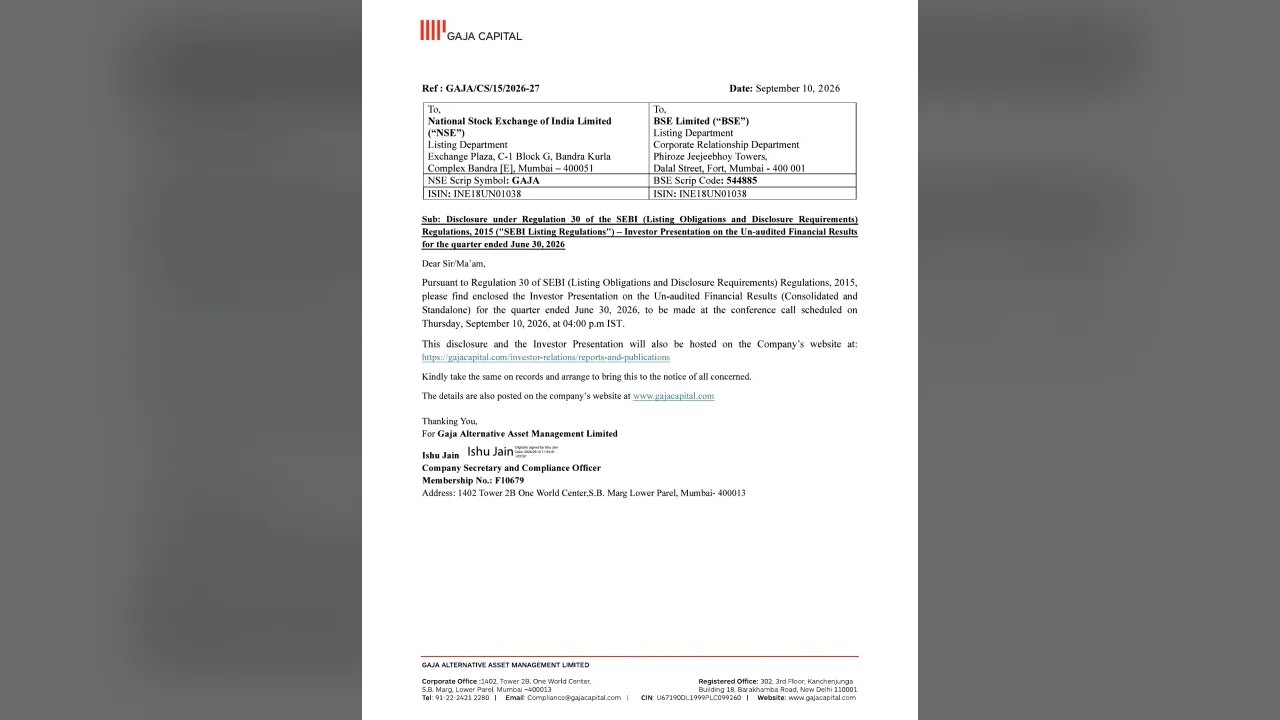
- Company
- Gaja Alternative Asset Management Limited (NSE:GAJA)
- Period
- Q1 2027 earnings call
- Date
- Thu, Sep 10, 2026, 8:59 AM ET
- Replay
- Watch the replay on this page · 1 h 1 min
On 6ix: 6ix.com/event/gaja-alternative-asset-management-limited-gaja-q1-2027-earnings-call
Replay
Transcript
Automated transcript · Written by software from the replay's audio. It can mishear names and figures; the replay is the record.
0:00 Ladies and gentlemen, good day, and welcome to the Q1 FY 'twenty seven Earnings Conference Call of Gaja Alternative Asset Management Limited. As a reminder, all participant lines will be in the listen only mode, and there will be an opportunity for you to ask questions after the presentation concludes. Please note that this conference is being recorded. At this time, I would like to hand over the conference to Mr. Gopal Jain. Thank you, and over to you, sir. Thank you. Good afternoon, everyone. I'm Gopal Jain. With me are Ranjit Shah, Executive Vice Chair Abhinav Jain, Chief Financial Officer of the company my Co Founder, Imran Jafar and Sushain Chopra, a key management person and partner in the firm. Thank you for joining our results call.
0:55 This is our first quarterly result call as a listed company. Who is Gaja Capital? Gaja Alternative ANC is a fund manager of alternative funds. In India, these are constituted as AIFs. We are also an adviser to offshore funds. Over the last twenty two years, we've built a global franchise across 20 countries. And over the next hopefully twenty years, we aim to build a globally significant private equity firm from India. Our funds invest in high growth innovation led mid market companies in India. And the mature funds have generated 3.8x multiple on invested capital.
1:42 Our first few funds were top decile funds. Our latest funds are top quartile funds. We are now on track to raise a fifth fund. And what do we do? What do we earn as a fund manager? As a fund manager, we earn multiple streams of income, management fee, carried interest, sponsor gain, and all of this generates a profit pool for the company. Our profits have grown between March 24 to March 26 from INR45 crores to roughly INR82 crores. So our historical profit trend line has been 35%, our total income trend line has been 23%. Alternatives, this term is used to describe venture capital, private equity, other forms of alternatives have grown 43x in India in the last ten years.
2:31 In the next ten years, they are expected to grow 6x to about $1,000,000,000,000 However, few retail investors can invest in AIS and also relatively few institutional investors are permitted or have the expertise to invest in these funds. Gaja Capital has emerged as the first pipe that connects India's saving system to India's alternatives. This has been done globally very successfully. Some of the world's top private equity firms are listed. They have outperformed mutual fund managers. They have outperformed their underlying funds and they trade at much higher multiples than mutual fund managers. Recently, we completed our IPO.
3:19 Between the pre IPO and the IPO, we raised INR575 crores of primary capital for growth. Our IPO was well received, 33x oversubscribed. We received close to 1,700,000 applications. We had very strong institutional interest. May I say that this has significantly expanded our brand in the country. We believe we have emerged as the preeminent dashboard brand in this industry and in some ways have become synonymous with the fastest growing part of India's financial services industry. I'll now take you through some of the key highlights of the quarter on Slide number three. Our total income for the first quarter in the current financial year twenty six-twenty seven grew 26% year on year to INR51.8 crores.
4:11 On a last twelve month basis ended June 26, our total income grew 39% crores. Coming to Patch, for the first quarter, on a quarter on quarter basis, our profit grew 35%, which is the same quarter of INR 20 six-twenty 7 compared to quarter of INR 20 five-twenty 6. For the quarter, our profit is INR 27.2 crores. On a last twelve month basis, our profits grew 38% to INR89.1 crores. Some other highlights. We've declared a dividend of 15%, per share. So we welcome every shareholder with a dividend.
4:58 Our payout ratio has been increased from last year of about 10% to 12.5%. We also received approval from SEBI for the launch of our next fund, Fund V. And as a matter of hygiene, just to inform everyone that our previous auditor maxed out and we'll be appointing PW, Pricewaterhouse as the statutory auditors for the company going forward. With these broad comments, it's my pleasure to hand over the mic to Mr. Ranjit Shah, the Executive Vice Chair of the company. Thank you, Gopal. And we will take you through the presentation that has been uploaded today. We'll basically do it in two parts. One is to explain the business further, and then we'll do the financials. And of course, we'll follow that with a Q and A.
5:47 So I want to take you to Slide four, Page four in our slide presentation. And as Gopal had mentioned, we've been operating for twenty two years now. We've focused on investing in Indian mid market businesses, backing ambitious entrepreneurs. The founding team has been together since 2006. We set ourselves apart by capturing 100% of the economics of the platform. And post IPO, the team holds more than 68% ownership of the AMC, which is a very significant holding. Our alignment with investors comes directly from the sponsor commitment we make across the funds, which averages 7.1%. Following the IPO, our network on the balance sheet stands at $10.50 crores.
6:38 On Slide five, as you can see, we have a Board that's highly experienced in regulation, markets and institutional building. Our Board is chaired by Mr. Sina. Mr. U. K. Sinha was has spent over thirty eight years in public policy and financial markets, including Chairman of SEBI and as Chairman and Managing Director of UTI Asset Management and also Chairman of Antrim. The other Board members are well known, don't really need any further introduction, except it's noteworthy to say that this is a highly experienced Board constituting of veterans in their respective fields, and they provide independent perspectives on regulation, governance, strategy, finance and human capital. I'll take you to Slide six. On the executive side, the defining characteristic of this team is continuity.
7:29 The three cofounders have worked together since 2006. The investment leadership is supported by Sushant Chopra, Hiraj Devta, both partners of the firm and Abhinav Jain, our Chief Financial Officer. Gopal has covered the high growth nature of alternatives in India, so I won't repeat that except to compare it with the other sectors. As AIFs grew 6x in the recent past, bank deposits have grown 2.1x. I'm referring to Slide seven in case some of you want to take a detailed look. And mutual fund AUM has grown 3.3x. AIFs in the similar time frame has grown 6x. So this represents really the high growth market that we operate in.
8:18 On Slide eight, we will take a minute to explain our structure. Public shareholders own shares in Gaja Alternative Asset Management Limited in the same way as any other listed stock. The company is the asset manager. It earns fee income and performance income, and it retains all those economics. The company manages the ARFs and offshore funds across two strategy groups. The flagship funds comprise of four funds with the fifth having recently received SEBI approval. Our second strategy on secondaries, Eastgate as one fund, which has also received SEBI approval. In the future, we may expand to other strategies, which will also be managed by the same AMC. The structural point is that the shareholder is not buying exposure to a single fund vintage.
9:08 A shareholder is buying the manager and therefore participates in the economics of every fund the platform basis, including those not yet launched. On Slide nine, I will explain in a little detail the fact that our income has two components, fee income and performance income. And the company retains 100% of each. Firstly, fee income, management fees are fixed and earned of the committed capital of every fund we manage. Second, performance income, which comprises of carried interest and income from sponsor commitment. Carried interest is the share of profits that we receive as the manager once the hurdle rate has been achieved.
9:53 We earn carried interest with full catch up across our funds, and we follow the European waterfall methodology, which is calculated on the fund as a whole rather than deal by deal. This ensures that the structure is not susceptible to any clawbacks in the future. Income from sponsor commitment is the return generated on the company's own capital committed to funds. Our valuation approach here is conservative and follows the SEBI prescribed framework and is audited at multiple levels. Moving on to Slide 10. Sponsor commitment is where alignment with our fund investors becomes measurable. Our sponsor commitment across our funds is approximately $5.89 crore, including our new funds, which represents 7.1% of the total fund size.
10:45 These levels are substantially above the minimum thresholds prescribed under SEBI regulations. Two consequences follow. First, our investors can see that we take the same risk they do, allowing us to raise capital via our network and reducing distribution costs. Second, we do not charge management fees or carried interest on our own commitment. So this capital works for shareholders without a fee drag and improves the unit economics of the platform. On Slide 11, I'll cover the investment strategy that we have with our funds. Historically, we invest across four secondtoral themes within the Indian mid market private equity space. These are all large growing sectors with substantial macro tailwinds.
11:33 We have added each sector carefully and gradually to our strategy, and it involves deep research, coverage and analysis of the markets. The value creation playbook is applied consistently across our investments. We engage actively on strategy, talent, sales, finance and governance. And we prepare portfolio companies for IPO, strategic and financial exits. The intent is diversification across attractive sectors without diluting a consistent underwriting standard. On Slide 12, our investor franchise is the engine of future fundraising. We have two ninety eight limited partners or fund investors who are invested across Gaja Capital's existing funds.
12:22 Our wider global and domestic investor network stands at approximately 900 investors with relationships across India and more than 20 countries. These investors include leading development financial institutions, sovereign wealth funds, leading Indian banks, top insurance companies and established domestic and overseas family offices. These relationships have been built over two decades, and they help us maintain a low cost of distribution. Because we raised most of our capital directly from this network, we rely less on distributors and intermediaries than would otherwise be difficult for a manager of our size. On Slide 13, we have set out the performance of each of our historical funds.
13:09 Fund IV, which closed in 2023 at $17.75 crores across seven investments is our most recent fund. It was 75% deployed as of the quarter ended June 30, and is currently tracking a gross IRR of 29% at a gross multiple of 1.8x. As the fund remains under deployment, that multiple is not representative of mature fund performance. All four funds, as Gopal had mentioned to you earlier, rank the first two in the top decile and three and four in the top quartile with the benchmark standards that are ranked as per service and CRISIL's efforts in the space.
13:55 On Slide 14, there are two key initiatives that will define the next phase of the platform, and both are proposed for launch in FY 'twenty six to 'twenty seven. Fund V is the continuation of our established flagship strategy. We are seeking commitments of INR 2,500 crore over a closed ended term of ten years. SEBI approval has been received, as I mentioned earlier. The strategy is unchanged. Investing in leading mid market companies at enterprise values of up to INR 2,000 crore with the scale potential to reach INR 10,000 crore of enterprise value, with ownership structures being either growth stage minority or participation in management buyouts.
14:43 Eastgate is our entry into secondaries. We are seeking commitments of INR 1,500 crore over the closed ended term of five years. This strategy provides liquidity to managers of Indian private equity and venture capital funds by acquiring stakes in portfolios of private companies across sectors. The case for Eastgate rests on four points: a large cohort of maturing private equity and venture capital investments that will generate deal flow a secondaries market in India that remains nascent and has considerable headroom the ability to acquire significant portfolio level discounts and the shorter tenure product that can support better IRRs.
15:30 Abhinav will now take you through the financial slides from Slide 15 onwards. Good afternoon, everyone. Let me cover the key financial highlights of the company for Q1 FY 'twenty six-'twenty seven. In the current quarter, the total income of the company grew 26% year on year to 51.8 crores. Total income for the last twelve month period ended June 26 grew 39% year on year to INR 168.4 crores. The profit after taxes for Q1 FY 'twenty six, 'twenty seven grew 35% to INR 27.2 crores. Profit after taxes for the LTM period ended June 26 grew 38% to INR 89.1 crores.
16:19 The net worth of the company as on 06/30/2026 is INR 6 and 33.6 crores versus INR $5.34 crores as of previous year. The ROE has improved from 14.7% to 15.3% as on 06/30/2026. The fee income of the company for Q1 FY 'twenty six, 'twenty seven grew 7% and the performance income grew 17% year on year. The performance income includes carried interest and fair value gains of underlying funds managed by GAJA Capital. The total expenses of the company for Q1 FY twenty six, twenty seven grew 14%. As a result, the cost to income ratio has declined year on year to 38.4% as compared to 42.3%.
17:10 The annual EPS of the company for Q1 FY 'twenty six, 'twenty seven grew 28% to INR 9.5 per share. The book value per share grew 19% from INR 47.3 per share to 56.1 per share. With this, we conclude the financial highlights of the company. Sadhguru, you can go ahead with the Q and A, please. Perfect. Thank you so much. We will now begin with the question and answer session. You may press star and then 2. Participants are requested to use handsets while asking a question.
17:58 Ladies and gentlemen, we will wait for a moment while the question queue assembles. Again, to register for a question, please press star and then 1. Your first question comes from the line of Siddant Lodaya with Sanchi Fund. Please go ahead. Firstly, congratulations to the entire team on the listing. Just one quick question. What would be the driver in point four? And how many investments are we targeting from? Noise on the line.
18:46 Can you hear us? We are unable to hear the question. Just give us a minute. Sure. Hello? Yes, sir. Please go ahead.
19:51 Sir, if you can repeat the question once again. Sure. Sure. Singh, firstly, congratulations to the entire team for the listing. Just one quick question on what would be the drag order in Fund four and how many potential investments are we targeting from that? Yes. Your question is on Fund four and we typically target about investment Sorry to interrupt. Just give me one moment,. Let me just check what's the issue at the line. Sure.
20:59 Yes, sir. Please go ahead. Okay. Thank you for that question on fund four, and it also is about our strategy on fund five. So typically from a fund, we invest in 10 to 12 companies, say 10 companies. In fund four until June 2026, we had made seven investments. Since then, another couple of our investments have been in the news. And... But as for the moment, I'd like to just stick to those seven investments. And, you know, we were 75% deployed as on June. Since then, we've made another call, which has taken the deployment to 81%.
21:46 Going forward as well, we intend to follow a strategy very consistent with our historical strategy, and we will make 10 to 12 investments from fund five o as well. Does this answer your question? Yeah. That's perfect. Thank you. Sudhan, sir, you have any further question? No. I'm good. That was the only question. Thank you. Our next question comes from the line of with Kiva Advisors. Go ahead. Yes. Hi, sir. Just wanted to understand that in terms of your strategy, what would be proportion of the carried interest or performance fee as a percentage of total income generally constitute?
22:39 And how is that trend likely to move over the next few years? And is there some considerable effort to make the pure fee income a larger share of your overall revenues? Actually the opposite. If look at mature companies, performance income grows over a period of time. Performance by nature, if you just read the word, is a very high quality aspect. So the quality of a private equity fund management firm is determined by the level of performance income. And over a period of time, performance income becomes highly predictable. Now you can see, for example, in our current quarter, out of the total INR 51.8 crores of income, roughly INR 16 crores is management fee income and roughly INR 30 crores is performance income.
23:39 So we believe that this is a reflection of the fact that we have generated high returns for our investors and the underlying funds, and this is the reason why we are today a 50 plus percent patch profit business with the current trend line. We raise money only once in a while. Unlike mutual funds, which raise money all the time, we don't raise money all the time. We currently have two funds on the drawing board. Also, our management fee does not grow in line with NAV. Therefore, for firms firms like us, the key growth vector is the growth of performance income, which becomes increasingly predictable as you can see from the data that we've shared with you on a year on year basis in the quarter and the LTM comparison over two years, it becomes increasingly predictable as a firm matures.
24:38 I hope this addresses your question. Sure. Sure, sir. I I understood that, but I'm just trying to understand. There could be lumpiness in quarter to quarter, but on an annual basis, what you're basically trying to say is that this... As as your firm has... Is is quite a mature firm, this is gonna be more of a secular trend. Is this correct? That is correct. And we should look at your numbers on an annual basis, not on LTM basis. On an LTM basis, mercifully, this quarter, it is steady, and there'll be quarters in which it will be steady. But the sanity comes from looking at us from an LTM perspective, last twelve months perspective.
25:27 Got it. Right. And what is the size of these two new funds that you are looking at? I'll hand over the mic to mister. Yeah. The flagship strategy, that is basically a continuation of what the work we've been doing so far is 2,500 crores. It may increase a bit. So that's the flagship strategy. And the secondary strategy is 1,500 crores. Okay. Thank you. Thank you. Your next question comes from the line of Soumil Zawedi with TMZ Partners. Please go ahead.
26:17 Yeah. Hi. Congratulations on the listing. Just wanted to make sure I understand the carried interest line a little bit better. Would my understanding be correct that the bulk of the carried interest is still contributed from Fund two? Yes. You can see that we've actually given a performance income line. The performance income line has two components. One is a carried interest line and the other is a sponsor gain line. The carried interest line, as you rightly said, comes from Fund two. The sponsor gain line comes from Fund three and Fund four. Got it. And just building on top of that, given that Fund III's gross IRRs are around 9%, is it fair to assume that we have to temper somewhat expectations of carried interest from Fund It's too early to say. Yeah.
27:18 Yeah. It's too early to say because generally, we carry valuations on a conservative basis. We've generally seen this trend that we, you know, we... We've carried NAVs on a conservative basis. I don't wanna make forward looking statements, but we believe that just as we have earned substantially on earlier two funds, we will continue with our performance income trends from fund fee as well. Of course, you're only raising a question with respect to carried interest. Irrespective of that, we will continue to earn on this once again line. We are confident of maintaining this trend into fund fee as well. Got it. Gopal, if I can squeeze a quick one in. Are the hurdles typically closer to 10% in the business? Pardon me, again, if some of the questions are a bit preliminary, just trying to get a sense of how the economics work.
28:13 Sorry. You didn't get the question. Are the hurdle rates typically 10 in terms of the performance fee hurdle rates that... Yes. Correct. For rupee investors, it's 10%, and for dollar investors, it's 8%. Got it. Thanks so much, Gopal. Wish you the best. Thank you. Thank you. Your next question comes from the line of Abhijit with AG Capital. Please go ahead. Hi. Good afternoon. Hope I'm audible. Indeed. You are. Please. Please go ahead. Yeah. First of all, thank you for getting listed. You know, your peers in the West took a longer time and listed at a higher valuation to fifteen years back. So thank you for getting listed this early. You are giving us an opportunity to participate in the journey with you guys.
29:08 So thanks for that. My first question is that I saw your investment deck, and I've seen your recent interviews also, and there is indeed focus on AI and the allied sectors. I think two of the investment that you mentioned in the public... Actual public sources is that practical analytics is one of them. Is the second one., I think you guys got in at $2,400,000,000 valuation pre IPO. I think currently, at $1,400,000,000 valuation. So I just want to understand from you because given the history, if you read into the history of KKR or Blackstone, most of their winners in their lifespan or most of their higher generating IRR deals are coming and they're entered in the cycle of the early sales of the cycle or they're entered in a down cycle.
29:54 They used to have a target, you know, cash yield of double digits when they were choosing on their equity valuation than in any company. That does not apply in this era, so I understand that. But I just want to understand that, you know, there is a lot of debate and discussion on at what end of the AI cycle we are in. Whether we're in the middle stages, whether we are in the back end, and that is there's concern for anti valuation for all of these AI transaction that comes in. So just want to understand from the data that you I have got the question. I I got the question. So first of all, the companies you're referring to speak from fund four. This is a call about the AMC, and, generally, we've discouraged discussions on the underlying funds and the investments made by them. But, nevertheless, I will entertain this question.
30:42 AI is a five layer cake, And, frankly, we've spent the last many years understanding AI. We've so far made two publicly known investments in the AI space. You're right, Fractal and Sarvam. Globally, everything is being redefined as far as AI is concerned. So, typically, we invest in 50 to... In companies that have an enterprise value of 50 to $200,000,000. That is considered growth stage. But for a sector like AI, the numbers are getting completely redefined. We've seen that for other sectors as well. If you look at financial services, growth stage is considered much higher than, let's say, growth stage for consumer companies or growth stage, say, for software companies.
31:30 So every set that has constitutes that stage. We invest at the growth stage. We typically do not like to put more than 20 to 25% of our capital from our funds into any particular sector. The sector that we are talking about is deep tech, and we will follow the same discipline. Overall, we want 80% of our capital in every fund to perform, and that's a discipline with which we have continued. So we have been very systematic. In fact, we've generally operated at the lower end, both fractal and Sarwang, in our opinion, are relatively mature growth stage opportunities.
32:18 We have refrained from taking venture stage opportunities. Their valuations relative, take factors valuation relative to the IT sector. It's a fraction of the median. If you take Sarvam's valuation relative to foundation model companies, it's a fraction. So in our opinion, these are growth stage companies. Whatever I've said is not about the AMC. It is about fund for investments. And it's it's our first call. We've taken these questions, but I just want to say that these are normally questions we take when we do fund calls with our LP investors who are investors in our funds. An investor in Gaja Capital AMC captures the economics of the fund as a whole.
33:05 We've given you some insight into that fund economics of fund four. It's currently running at a gross IRR of 29%. We're earning management fee from it. We're earning sponsor gain from it, and we hope to earn carry from it. I hope that answers your question. Perfect. Thank you for the flavor. Got some idea into the thinking of Amazon. So thanks a lot. My second question is just from a, you know, a vision statement or just from a longer term horizon. I wanna understand how do you see GAJA evolving. Obviously, it's too early, but I just wanna understand because if you see the successful team models out there, right, they have not, you know, type after them into just one type of an alternative. For example, just not being a minority.
33:54 They have diversified into real estate, their private equity, their diversified to buy a fund. And that has also helped them leverage whatever was the right opportunity at the right time. So just want to understand whether the management has thought about it, if there are some ideas out there, could we see a more evolved version of GAJA in which we see them participating in different types of alternatives also going into the future? No. That's a great question. The alternatives industry in The US is 60 years old. The alternatives industry in India is roughly 20 to twenty five years old. However, India is, you know, doing this journey of centuries and decades and the journey of decades and years. So mostly globally, earn the right to diversify after twenty years.
34:41 So you're seeing that we started building a platform a couple of years ago. The first few steps we take will be very measured steps around our mid market competence, and that's what we propose to do. But, you know, the firms that we generally speak about are firms that are more than 50 years old, in some cases 40 years old. So over a period of time, our platform will grow. We don't want to make future speculative statements as to how our platform will grow, say, five or seven years from now. But in the foreseeable future, our platform will grow in a very disciplined, measured way around the core competence that we have acquired over the past twenty two years. Hope I've answered your question.
35:27 Yes. Thank you, Bhag. All the best. Thank you. Your next question comes from the line of Jyotish Vijayan with Moat Financial Services. Please go ahead. Good afternoon, team. Congratulations for the IPO. And I have two questions. First one, first question is on the performance. When we compare the tariff fee on Q4 last fiscal and Q1 fiscal twenty There is a 95% jump in the tariff fee. So is it because of the most the realization are happening in this quarter?
36:22 Or which is very similar, which is very common in this kind of business? Abhinav, would you want to take this question? So as we explained earlier, the performance income of the fund consists of two portions. One, the carried fee or carried income, and second is income from sponsor gains. In last quarter of previous financial year, which is March 2026, the financial markets were at quite low, and and there was a multiple re ratings happening in the markets. Which kind of impacted the Q4 March twenty twenty six performance from the performance income perspective.
37:13 And the markets have recovered from their lows in March to June, which is the reflection that we are seeing in our fair value gains from our funds that we manage, the sponsored income that we manage, which has resulted in an outsized increase. But if you look at a longer trend, especially on an LTM basis, you will see that the increase is not very in terms of very, very on a year on year basis. Okay. Got it. But in your... I was... You mentioned that the that the revenue or the fees that you collected from the carry is mostly not not regular. It's mostly lumpy. So how can we, as an investor, judge your performance through quarter by quarter or year by year?
38:06 So as we discussed in earlier question as well, our performance should be best judged on a year on year basis. It will show a smooth linearity in numbers and that's a better way to see it. Some quarter variations could be expected, although they will be going forward minimized as much as possible as the funds diversify. Thank you. Your next question comes from the line of Devesh Agarwal with IIFL Capital. Please go ahead. Yeah. Thank you for the opportunity. So my first question would be, could you just break out the performance fee income into carry and sponsor?
38:58 I'm gonna hand this back to Abhinav. Yes. Sure. So for the q one FY twenty seven, the carry fee was negligible. The bulk of the performance income came from the Alright. And the fact that Just hang on. Yeah. Sure. So let let me take that question. So in q one FY twenty seven, roughly, in close... From Fund two. Fund two. So they Which is in the carried interest territory, and 17 close came from fund three and fund four, which is in the sponsor gains category.
39:52 So this makes up close to 29.7. That's been reported as performance income. This is q one FY twenty seven. If you want to take on an LTM basis, I'll give you the numbers on an LTM basis. On an LTM basis, the corresponding numbers are... You'll see that the performance and 20%. Thank you. Sorry sorry to interrupt. Sir, sir, the last few bit of your words got chipped. Okay. I was saying, I first gave you the numbers for q one, and then I gave the numbers for LTM. Last twelve months ended June 26.
40:37 I said if you look at the last twelve months ended June 26, the total performance income was 92.2 crores, and it breaks up into 72 crores and 20 crores, respectively. And we don't book carried interest on an accrual basis. We book carried interest on a realized basis. Sure. And, sir, the fact that you book carry much later in the life of the fund, given that, would you have the visibility as to what possibly could be the range for the carry for the next twelve months? So as a policy, we've chosen not to issue future guidance. As a twenty two year old firm, we have tons of historical data. Instead, what we've said is that we have we have confident that we maintain our historical trend lines.
41:24 And given the nature of our business, globally, it is not considered to be a best practice. So pardon my saying so, but we will not be issuing future guidance. No worries, sir. And on the management fee that we have earned in this quarter, what would be the related committed capital on which we have earned this management fee? So we are currently earning management fee from Fund three and Fund four, and the respective sizes are given in our investor deck. And it's it's roughly order of magnitude close to the fee paying initial committed capital. This is not the AUM because we only earn fee on initial committed capital. It's roughly order of magnitude about 3,200 crores. Yeah.
42:11 Right, And, sir, I understand the variation in the revenues given the business model. Which which which variation are you referring to? The variation in the carry interest and the sponsor income, which can differ on a quarter on quarter basis because in nature But in our in our case, you you can see that as we've shown that on a... It's pretty smooth and very consistent. So, yes, the theoretical point is there. But if you see our data, which has been presented in the investor deck, also what's contained in the RHP, you will see that what we've been saying is that the firm, which is twenty years old, earning economics from multiple funds cannot entirely eliminate volatility, but has relatively predictable and mod level income streams.
43:01 I I hope you appreciate that. Absolutely, sir. I appreciate that. My question was more on the expense side. So should we also expect some kind of a variation as we can see on a quarter on quarter basis between the employee cost and other overheads? Or that should be more of a steady state in nature between the quarters is what I want to ask. So let me give you the numbers. The quarter... If our first quarter FY twenty seven, our total expenses were 19.9 crores. For the same quarter last year, our total expenses were INR 17.4 crores. And for the last quarter, our expenses were INR 18 crores. So do you see that our expenses are fairly disciplined, steady?
43:47 And this is where our operating leverage is peaking in. My colleague said earlier in the call, this... The fact that our expenses are not growing in the same proportion as our top line is the reason our cost to income ratio has come down steadily. In fact, in the RHPUF data across multiple years. And just over a twelve month period, our cost to income ratio has come down from order of magnitude 42% to about thirty day... 38%. Sure. I was more talking in terms of employee and other, which has gone up from 6.7 to 10.3, while other expenses have come down from 9.2 to 7.4. You're referring the employee expenses in q four to the employee expenses in q one. Q one usually, there are certain bonuses that are paid out.
44:37 Therefore, the way to do this would be to compare q one of this year to q two... Q one of last year. And there you see it's all roughly in the same ballpark. 10 plus gross in both the quarters. Do you see my point? Yeah. So q one has the seasonality of the bonus. Right? That's correct. Okay. And lastly, sir, if you can just give basically on each of your fund in terms of timeline, if you have any broad timeline as to by when we think we'll be able to wind up fund two, fund three and fund four when we complete the deployment and by when we are expected to raise the capital of first close for fund five and secondary one. I'm afraid all of these all of these questions and answers to which would be in the category of future guidance, and we've been advised by our board as well as experts and peers not to issue future guidance.
45:36 So we are... We can tell you what has happened in the past with our funds when it comes to deployment. We can tell you where the funds are today, but we cannot issue future guidance while answering your questions. I I I hope you will pardon us for that. No. No. I understand, sir. Alright. Thank you so much, and all the very best. Thank you. Your next question comes from the line of with Catalyst Partners. Please go ahead. Your line is unmuted. Please proceed with your question. Hello. When was the valuation of your portfolio last...
46:25 Most recently conducted? And what is the total valuation of your portfolio including the limited partnership? So we... The the portfolio, we as per... We are a regulated industry. In India, the portfolio evaluations have to be done every quarter. We have given a table which gives you the gross for each of the funds. We do not have a direct answer. There's no one single portfolio. There are multiple funds, and each fund is distinct with its own set of investors. And there is no separate portfolio for our investments. We invest in the same funds, and we have a share of the same set of investments.
47:11 So a rough... So first of all, answering your first question, this is a regulated industry in India. As far as valuations are concerned, we have to follow semi guidelines and rules, and we have to issue valuations to LPs. LPs are the... Is the term we use for investors in our funds every quarter. The same valuations are used to determine the value of our holdings. I hope I've answered your question. Okay. Thank you, sir. Thank you. A reminder to all the participants, if you wish to register for the question, The next question comes from the line of Shital Kumar with Air France Management. Please go ahead.
48:04 Thank you for the opportunity and congratulations on listing. Although, means post listing the performance, their performance is not bad, but... And I I am not asking you for any answer on that. Maybe some marketing jittery about the... You have disclosed return of fund three, and it means it is hard to hard to digest that we are going to get performance out of this. But since you already said that the large disclosure was on March and now in June, of the... It means those valuations have increased, and you are seeing that we might get some performance fee out of that as well. So the first thing is that for the dollar investors, it is 8%.
49:01 And since 2008, the dollar is means just double. So are you are you seeing it in a dollar nomination again or in rupees terms only? And second thing is that if we... Since you are this... Following this European waterfall methodology, So even if it is... It just started getting profit beyond 10%, but still the... That profit will not reflect in our quarterly result as a performance fee. We have to wait till the... Till everybody get their own money. That's whatever that fine things are there. So what do you see that... When we will start seeing the performance fee of fund three in our quarterly results?
49:57 Yes, please. So as we've explained, that performance fee is based... Is comprises of two streams of income. One is carried interest and the other is sponsor gain. The good news is that we are Sorry to interrupt. Just a minute. Just now you said that the carried interest consists of two two components, performance fee and the second thing, the sponsor income. That is why I did not mention carry fee. I just mentioned performance fee. Please write it. So allow me to answer your question. If you go to our investor deck, you will see that the first line says fee income. The second line says performance income. I was explaining that performance income has two components, carried interest and income from sponsor gains.
50:49 The good news is that fund three is already clocking income from sponsor gains. So fund three is already generating performance income. You're absolutely right. Carried interest comes later in the fund. For dollar investors, the hurdle is 8 percent. For rupee investors, the hurdle is 10%. Once we return the fund and the hurdle, we will also start earning carried interest. At that point of time, every rupee we liquidate will result in a carried interest income also for the further firm. But as far as performance income is concerned, the good news is that has already started for fund three.
51:40 Sorry. Since when it will be Thank you so much. In in our quarterly results? It is already there in our quarterly results. So if you look at our quarterly results, we have 29.7 of performance income. Part of this performance income is from fund three. Yeah. But that is a sponsor commitment. Correct. That is not... That is gains on sponsor commitment. And at some point of time in the future, if things go as per planned, we cannot say whether it'll happen for sure or not. That will be making a futuristic statement, which we are not authorized to make. There will be carried interest as well, but that depends on performance from here.
52:29 Thank you. Your next question comes from the line of Manish with Shah Securities. Please go ahead. Thank you for giving this opportunity. First of all, sir, thank you. Congratulations for successful IPO and CB approval fund five and the planned launch of Eastgate and secondary platform. I know you are you have already restricted us that no future commitment or no future perspective, but just a small question from my side, if you can consider. How should investors think about that earning growth potential and scalability of the business over the next three to five years as a committed capital expense across these strategies? Sure. I think the place to start is to look at the industry. Right? Look at the growth of the industry and then contrast it with how we are expecting ourselves to grow and to ask yourself that as a twenty two year old firm, how likely are we to be able to raise these funds? Our level of confidence in being raising new funds is fairly high.
53:28 Then when it comes to deployment, we've been deploying for twenty two years. When it comes to growing the value in our firms, we've been growing for twenty two years. And then you have pure simple financial numbers in Buffett's peak. You have so much historical data on us. You can see that between March 24 and March 26, our profits grew at a CAGR of 35%. Now you have another quarter of data. So then the question you have to ask yourself is that as India is growing, as the alternative industry is growing, as we are becoming a larger brand, what are the chances that we can maintain our historical trend lines? Beyond this, if I start saying anything, it will be making futuristic statements. But, hopefully, this gives you enough to ask yourself in a very critical way that what are the... That here are the historical trend lines and how can GAJA Capital maintain the same trend line going forward.
54:27 Okay. Sir, continue with that. Can you just share your vision that how fund four... Fund five is to give second reason future investment strategy could transform Gaja Capital earnings and asset under management profile over the next several years? So from the information that we've already disclosed, on this call, we mentioned that our fee paying capital currently is INR 3,200 odd crores. From the see and remember that our fund five is 2,500 crores and as Eastgate second base is 1,500 crores. So that's a proposed addition of 4,000 crores, 3,200 crore number we have spoken about. Secondly, so that is the quantitative part. There's a qualitative part too.
55:15 So we will be deriving economics currently from three funds. It will become five funds. Strategies from one will become two. So there will be I mentioned I've also mentioned the element of diversification. I hope that answers your question. Sir, just just wanted to clarify. So we just wanted to check how you... Strategies and everything. How this will transfer Gaja Capital's earnings and AUM profile? Just just wanted to ask. So as we mentioned earlier, I'm going to repeat myself, just for clarity that we have dreams of income, fee, performance income.
56:05 The same would apply to these funds, Fund five was the secondary. It's the same. You know? There's nothing new because of the income streams that is going to happen. It is the quantum of funds, and second reasons and numbers that we are having for another opportunity in market. Our total income trend line is 24 a year historically, and our profit trend line is 30 plus percent historically. We cannot give guidance in the future, but we've given you a lot of inputs on the basis of which Thank you. Future one go away. Thank you.
56:52 Thank you. We take the last question coming from the line of Ankit with Oculus Capital Growth Fund. Please go ahead. Hi, sir. Thanks for the opportunity, and congrats on the successful IPO. My question is because our ability to raise more funds depends on the performance of our historical funds. So my question is on fund three's performance. And you mentioned that based on 9% IRR, it is in the first quartile of that period. And if I look at last ten years, even listed companies, nifty's returns have been 11% CAGR. The mutual funds have returned anywhere from 11 to 15% CAGR in this period even after reducing the management fees. Now what is the, set that we have taken for saying that we are in the first quartile for this 9%?
57:43 And this is the last ten years performance that we are talking about. So just wanted to understand, what we are comparing with and how 9% is a good return, which is in the first quartile. So these are not our numbers. This is crystal data. And in our industry, you refer to funds on a cohort basis. So our fund has been co compared to a relevant cohort by Crystal. This is publicly available data. Secondly, you raised a very relevant question that it doesn't seem like a high return, but remember, we are a twenty two year old firm with data across. Also mention after that is running That is a very sir. The line was breaking again.
58:33 Okay. I'll repeat that. That what every investor will look at is the data across all the four funds. Fund four is running at the gross IRR 29%. Fund one was five plus x. Fund two was 3.8. Both these funds, we believe, were top decile. So anybody who gives us capital today, the relationship has been built across multiple years. In some cases, they've invested across multiple funds. In some cases, they've invested in other funds, and they can contrast our performance with those funds. And this is how anybody will come to a decision on how they will invest in us. And overall, what is the picture? The first two funds are top decile.
59:19 The next two funds are top quartile. The latest fund is 29% IRR. These are, in our opinion, exceptional numbers, and this is why we have been able to historically attract very high quality capital directly without distributors from 20 countries as recently as Fund IV, and now we are done discussions for Fund V and secondaries. Ladies and gentlemen, this concludes our question and answer session. I now hand the conference back to the management for closing remarks. So thank you all for attending this call.
1:00:04 You will see that material that explain the nature of business and the nature of the business, the government capital, because we recognize we're the first, and we've done that in our materials. You will also see that in the annual report. Of course, we look forward to our next quarterly call. And, as you study the material on us, I'm sure many of these questions will get answered, from that. Thank you so much for attending this call, and we look forward to your attendance on the next call. Thank you. Thank you. Ladies and gentlemen, on behalf of Gaja Alternative Asset Management Limited, that concludes this conference. Thank you for joining us, and you may now disconnect your lines. Thank you.
Follow Gaja Alternative Asset Management Limited into a list and get an email when it puts out news.
Latest news releases
- NSE:GAJA — Gaja Alternative Asset Management Limited has informed the Exchange regarding a press release dated November 04, 2026, titled "Press Release Q2 FY 27". · Tue, Nov 3, 2026
- NSE:GAJA — Press Release Sep 10 2026 11: 33: 56 · Thu, Sep 10, 2026