Gary Fraser
CEO at FORESIGHT GROUP HOLDINGS LIMITED
Replay available
Results for the six months ended 30 September 2025 hosted by Foresight Group Holdings (LSE:FSG) on Investor Meet Company, held 2025-12-04.
Automated transcript · Written by software from the replay's audio. It can mishear names and figures; the replay is the record.
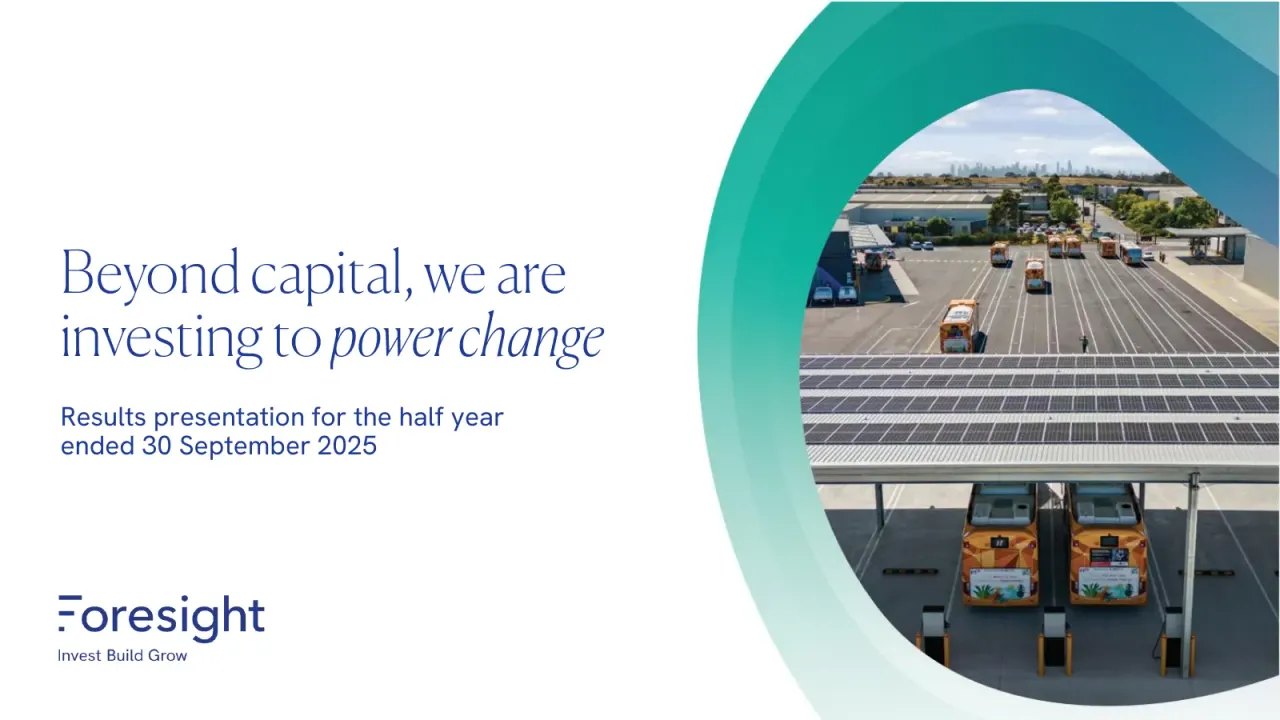
0:01 Good afternoon, and welcome to the FORESIGHT GROUP HOLDINGS LIMITED investor presentation. Throughout this recorded presentation, investors will be in listen only mode. Questions are encouraged, and they can be submitted at any time using the Q and A tab situated on the right hand corner of your screen. Simply type in your questions and press set. The company may not be in a position to answer every question it receives during the meeting itself. However, the company can view your questions submitted today and publish responses where it is appropriate to do so. Before we begin, I would like to submit the following poll. And I would now like to hand you over to CEO, Gary Fraser. Good afternoon to you, sir. Good afternoon, and and thank you for that, Alex. I'm my name's Gary Fraser. I'm the chief executive of FORESIGHT GROUP, and I'm here today to present the interim results for the half year to 09/30/2025.
0:49 So I take the first slide on FORESIGHT to give you a little bit of a flavor for FORESIGHT's strengths. I'm FORESIGHT is well renowned for its high quality earnings. So on an annual basis, we see about 85 to 90% recurring annual revenue, and that's as a result of a number of funds that FORESIGHT has. So unlike many of our competitors, FORESIGHT's got over 40 funds generating management fees. So every year, we start off knowing pretty much what our minimum amount of recurring revenue is gonna be, and we're able to build on that as we raise new funds during the year. Specialist capabilities are the second thing. So FORESIGHT really has three key verticals. One is private equity. The second is real assets or infrastructure as it was previously known. And the third one is FORESIGHT capital management where we invest in listed stocks with a sustainability bias.
1:44 In terms of market opportunity, within those verticals, we we target areas where we think that we can achieve, you know, maximize returns for shareholders and raise money for those market opportunity strategies. So within private equity, we're we're very well known for a regional PE strategy across The UK, which totals about 1,800,000,000. Within real assets, we're well known for renewable energy and energy transition strategies, which is about 10,000,000,000 of total AUM. And within FORESIGHT capital management, the listed side sustainability product is about 1,100,000,000 of AUM. Within each of those different verticals, we have a number of products. And as I said earlier, we've got over 40 funds within those products. So a combination of being able to raise money and invest for not only retail investors, but also institutional investors as well. So we're one of very few asset managers in the alternative space that invests money for both retail and institutional investors.
2:46 If I move on to the next slide. So since IPO, so we IPO ed listed in February 2021. So during that period, we've achieved our assets under management 15% CAGR compound annual growth rate from $7,200,000,000 up to $13,700,000,000 As I said in the previous slide, recurring revenue is 87%. So very high proportion of revenues are recurring on an annual basis. Within that management fee has increased from 1.1 to 1.2%, which considering the three different product lines is a very attractive management fee rate indeed. And over 90% of our capital, so the 13,700,000,000 that we have under management is long duration capital, which benefits not only FORESIGHT but investors because we're able to take a long term view in terms of investment decisions, and that helps us maximize potential profit on realizations for investors.
3:46 In terms of during that period, how have we done in terms of the bottom line? Well, core EBITDA pre share based payments has gone from 23,900,000 to 62,200,000. So 2.6 times increase in profits during that period. And consensus views has it about 68,000,000 in the current in the current period to 03/31/2026. So again, probably a traveling of profitability during that four year period. If I move on to the next slide, financial results. So as mentioned, AUM continues its healthy growth to 13,700,000,000. Clearly, I'd like that to go up more quickly, but who wouldn't? I think the fact of the matter is we're raising a amounts across both private equity and institutional real assets on a regular basis. So we're we're we're gradually increasing that in what has been a tough market for fundraising.
4:40 FUM showed stable growth at just over 1% at 9,600,000,000, but revenues were able because of the product mix between retail and institutional, we're able to deliver an 11% growth in revenue to 81,500,000 in the first half of the year. And that flowed through to a core EBITDA pre SVP of 30,600,000 or plus 6% during the period, up from 29,000,000 a year earlier. Finally, the f y twenty six interim dividend per share will be 8.1p, which is 9% up from the prior year. I that formula is based on 60% payout ratio of adjusted profitability. And so, it's based on one roughly one third of the previous year's dividend, which was 24.2 p, which is why we're seeing 8.1 this year with the final dividend usually paid in early October.
5:35 Moving on. So the AUM bridge, as you can see, fairly stable during the period. Inflows and outflows, not that different with some other movements effectively debt on assets making up the balance, taking us from 13.2 to £13,500,000,000. And then we have some FX movements because FORESIGHT is not only a UK company, it also has a distinct operations in not only in Europe, but in Australia as well, making up the overall group, which takes us to 13.68 or £13,700,000,000. During that period, we saw 223,000,000 raised into higher margin retail vehicles. So that's a combination of both VCTs, but also business relief where we're trying to address the SME gap in terms of investment within The UK and beyond.
6:26 We also completed the €505,000,000 first phase of fundraising for FEED two, which was very pleasing indeed. That one has a target of €1,250,000,000. And the fundraising environment is tough, but we expect to complete that by June 2027. FORESIGHT Capital Management, the listed part of the business, delivered positive investment performance of a 100 of 56,000,000, but net outflows of a 155. So net net down about 99, a 100,000,000 during the period. Again, listed funds are tending to see outflows within that sustainability space, but I expect that to turn around in time, but it's very difficult right here, right now to be able to put an exact timeline on it.
7:13 So in terms of the financial summary, very healthy in terms of the flows during the period. As I said, we've got 81,500,000 of revenue. After all costs and expenses, core EBITDA PSVP was 30.6. Margins suffered slightly due to higher costs in the period, and that was primarily as a result of an acquisition made during the period. So the acquisition of Web Ventures within the FORESIGHT Capital Management division saw a shave a little bit off margin, but I expect that to level out during the second half and start to push ahead again during FY '27 and beyond. And our medium term target for margin is to get up to the mid forties, so up to 45 by 2029 and beyond. So in terms of high quality revenue model, as I mentioned earlier, we have a number of funds in FORESIGHT, over 40 funds in total, which gives a real resilience to the revenue generation, but also the quality of revenue that we see on an annual basis.
8:14 And during the last four years since IPO, new fundraising has increased management fees by over 50,000,000 during that period. So it's a huge increase, and we continue to see that year on year increasing. And it really gives us confidence, underlying confidence in the value that of that we're creating for not only for shareholders, but value within FORESIGHT as a business as well. And the locked in nature of long duration capital provides us for a really strong revenue base for further growth, but also in making the right decisions from a resourcing perspective as well. In terms of staff costs or costs more generally, we did see higher than average inflation in costs during the period, but that's explicable.
8:59 There's several reasons behind the 10% increase. Principally, 4% was due to the the the acquisition of Webb within the FCM division. 3% was down to, you know, normal inflation in terms of wages, but also the national insurance increase from, you know, from the government. And 3% was due to additional headcount. So at FORESIGHT, I would say, right now, we're about 475 FTE, and I would say we're probably right sized as a business now. Now we may have some people in the wrong positions and some people in the right positions. So within that, you might see some movement between positions, but I think right here, right now, 475 feels like the right number. I'm and it really right sizes us for the next stage of growth within FORESIGHT in a number of areas that we're targeting. And I think over time, as I say, we might shift people in certain areas into different areas, but right here, right now, as I say, we're right number of people.
9:59 In terms of core EBITDA, pre share based payments, you know, generally, there's a weighting driven by retail fundraising dynamics in the second half of the year. So we tend to see more flows, especially in the specialist retail like VCTs towards the tax year end, and that does increase revenues in the second half compared to the first half. And as that part of the business has grown over the years, that's become more pronounced than it was in previous years. But generally, the trend since IPO in 2021, we're just over 23,900,000. As you've seen the increase grow over periods, so up to 31, up to 50, up to fifty nine sixty two, and now consensus at about 68 for the current year. So incrementally, we're improving the profitability of the business. We're growing the assets and funds under management, and there's nothing to suggest given the strategy that we've got right now and the distribution capabilities that we have that we'll continue to do that going forward, and there's a high degree of confidence that we'll see that. And we'll come on to that a little bit later on.
11:02 So in terms of dividends, again, we've seen a gradual increase in the progressive dividend policy. As I said earlier, it's 60 of adjusted profitability. And because profitability has continued to increase year on year, we're starting to see that increase in terms of absolute amounts as well. And as we continue to grow profits, that will continue to be the case. Over the first four years since IPO, roughly speaking, I think that's about 83 p in dividends, with an 8.1p per share dividend coming. So that will be about 90, just over 90 p over the four and a half years since we IPO. So very attractive yield on the stock, especially given where the price is right now. In terms of capital allocation, there's three key areas here. Dividend being one, which is the 60% payout ratio as I mentioned.
11:54 Share buyback. So during the course of this year, earlier in April, we announced a three year share buyback program of up to £50,000,000, which is a significant number. Over the period since then, we've bought back about £8,200,000 worth. So there's still a huge amount of capacity within the 50,000,000 capability. Now why have we done that? Well, the real reason or the reality of the situation is because FORESIGHT is trading on a multiple of about seven times, it's much more attractive for us to use our excess money because we're a very cash generative business to buy our own shares than it would be to buy expensive acquisitions. You know, public to private, the differential in in multiples is is is enormous at the moment. Public can be trading on seven or eight x, whereas private are expected vendors of private companies are expecting anywhere between fourteen and eighteen times.
12:49 We're not going to be using excess excess cash to be buying to be making acquisitions that are dilutive to the business, and therefore, we'll continue to utilize our share buyback program unless we see opportunistic or strategic m and a that is attractive at the pricing level that, say, we can justify to our shareholders. It's worth saying as well that during the period of the shares that we've bought back, we sold about 2,000,000 shares out of treasury to some institutional shareholders that were attracted by the FORESIGHT story. So probably net net as we sit here today, we haven't used much of the buyback program at all. I think since the 8,200,000 at the year at the half year, we've probably spent another a couple of million pounds of share buybacks.
13:36 But when we take the shares issued off of that, we're probably only 1,000,000 into the 50,000,000 share buyback program. Additionally, in addition in addition to using that cash to buy our own shares, what we found is that stimulated additional liquidity in the stock. So liquidity over the last eighteen months to two years has gone from an average daily volume probably in the very much close to a 100,000 up to somewhere close to 250,000. So it certainly had the right impact in in demonstrating that we can increase liquidity within the stock, which is one of the things that I think helps not only institutional shareholders, but retail shareholders as well. In terms of operational update, real assets, is principally our infrastructure business.
14:22 So we've seen a number of funds, you know, increase in terms of fundraising progress. So the first phase of FIP two, FORESIGHT Energy Infrastructure Partners, which is our energy transition fund, PANEuropean, has raised about 505,000,000 to date. As said earlier, that target size is about €1,250,000,000, but we remain confident of raising that. We're already seeing re ups from a number of existing investors and expect to achieve that total by FY 2027, so June 2027. We're also seeing a number of operational successes within that part of the business. So FEET two combined with another FORESIGHT fund to invest 210,000,000 into The UK battery storage company, HEIT, HEAT.
15:10 That on its own was 30% of the two hour battery storage capabilities of the whole of The UK. And early progress is, you know, early progress within that within that acquisition has been very good, and we're very pleased with that acquisition. In terms of additional, you know, operational updates, Zenith Energy, part of the DIT portfolio in Australia, was sold at a very attractive valuation, 1,700,000,000 Aussie dollars to a large private equity company earlier this year. And we've recently sold a share in Kinetic, is the go ahead bus company for approximately 4,000,000,000 Australian dollars as well. And what we've managed to do there is take the, you know, take that sale. We were 50% shareholders along with an Ontario pension fund and potentially taking some of those assets and putting them into a single managed account for the future.
16:08 So we're looking at that, you know, ways that we can maximize shareholders return by being innovative in terms of what we do in terms of exits. In terms of Harmony Energy Income Trust, it's quite an interesting story, this one. In addition to it being a, you know, the one of the largest batch two hour battery storage companies in The UK, it was very much a it was very much a a competitive process. So it was a listed company. I we made a bid for it. I'm we were this is all public knowledge. We were trumped in our bid by by Drax Energy, and then we bid again to ultimately win the company. As part of that, we delisted it. We've got those assets. They were already operational, and we're able to see additional revenue streams that we can we can source from those assets going forward. So I think, you know, in an early review of that process, we only completed it earlier this year, but it's been a very good acquisition for both FEEP and the retail investment fund from FORESIGHT that have acquired it. We're very pleased with how it's gone and looking forward to driving more investor performance from that asset in the future.
17:20 In terms of retail UK tax efficient products, we continue to be very big and perform well in VCTs. Fundraising progress has been good within business property relief, where we've seen a total of 223,000,000 raised in the first half of the year. And we're on track to raise 600,000,000 plus during the rest of the year. As I business relief products demand is up somewhere between 3040%, perhaps even more since last year, and they're consistently meeting or exceeding our target returns with flagship VCTs also providing best in class returns. We've recently launched a new business relief product that facilitates access to private credit for UK SMEs as well, And that's seen a a really good uptake so far. When I compare it to the launch of our original BR fund back in 2012, it's only been launched within the last year, and it's already at three or four times funds raised compared to what we raised the original business relief fund that, which is now about £2,100,000,000.
18:22 So we've had some early success in terms of that private credit fund. In terms of The UK budget, you know, last week, no material impact to the business relief and VCT products, but some significant tailwinds remained following the 2024 announcements. It's probably worth me just tackling VCT because there were changes. So although not necessarily material, there were changes both to the companies that can be invested in, but also the tax rate. So the tax rate for investors has fallen from 30% to 20% from the sixth of April next year. I still think that's a very attractive tax rate for investing in VCT. So I don't anticipate that having a a material impact on the amount of funds raised, certainly for FORESIGHT and probably not for the market more generally.
19:11 In terms of, you know, the the qualification for investments within VCTs, the government has made some changes there, which effectively means that more money can be invested in in investments and the and the investment size can be larger than it's previously been. And I think that opens up a much bigger market for VCT investments, so that's very good to see. I'm I mean, FORESIGHT's two main VCT funds raised a total of 25 and £30,000,000 last year. One of them closed within ten days and the other within five days. The reason that we don't raise more money or haven't raised more money is not because we can't. It's because it's very difficult to make quality investments if you're raising more than that amount because the universe of companies is is relatively small.
19:59 With these changes to the investment universe, I think we can raise more money, but also continue to to invest in quality investments. So we're not gonna dilute the quality of what we're doing by raising and investing more money in the future than we might have done in the past because of these changes to the rules. Also, in terms of the budget, we saw no no material changes in in business relief. Most of those changes were last year. The only real change was the ability between from husband and wife to effectively toggle the 1,000,000 limit into each other's pay allowances on the death of another. So I you know, that made a lot of sense and is quite a practical thing to do from the government's perspective. So I think that was a a slight positive for individuals as opposed to the fundraising piece. But I think overall, it was a a genuine generally positive budget for wealth management and wealth management investment.
20:59 In terms of regional private equity, we continue to raise money for our regional private equity strategy. Post period end, we raised a Northwest Fund three. That the third vintage at 90,000,000, if I compare it to to the second vintage two or three years ago, that's a 35 print percent increase in terms of the first close. It's our sixteenth regional fund, and and we've now got 12 regional offices. So we pretty much cover the whole of the country. I think we're one off, if not the largest player in regional private equity. And I think the fact that we're in the regions, we hire local people, and we're investing in local companies has been a real USP for us as a business. And it's one of the reasons I think that we you know, we're we're targeting local businesses.
21:46 We often do these deals on a bilateral basis, and it means that we get really attractive returns for our investors as well. In terms of operational success and supporting fundraising and delivery, we've deployed over 83,000,000 across across the growth private equity during the period in private credit, and the pipeline for h two is even stronger. Track record of returning 3.5 times in in terms of the average multiple on exit from growth companies, but and buyer investments. So that's excellent as well. And boots on the ground regional coverage has expanded with three new office taking us to the 12 I mentioned earlier, with new office opening in Bristol, Sheffield and Exeter. So in terms of current trading and outlook, think post period end, the multi vintage rollout of the group's regional private strategy has continued, as I mentioned, with a £90,000,000 fundraising, and I'd expect to see more of that in the second half of the year as well with either top ups or additional funds being raised or launched.
22:49 DIT agreed the partial sale of Kinetic, the go ahead bus company, to TPG, at a premium to holding value, and I expect to see more of those types of deals in the future as well. FORESIGHT GROUP HOLDINGS a 1.8 times MOIC, and I expect that we'll see more of those types of transactions. But what that really tells us is that rather than just buying and selling forestry, afforestation is really one of the critical factors in unlocking, you know, attractive returns within a natural capital space. I'd also expect it to see raise more money for natural capital over the next six to twelve months, either in FORESIGHT Natural Capital One or FORESIGHT NATURAL CAPTITAL ONE once FORESIGHT NATURAL CAPTITAL ONE has completed its fundraising piece.
23:39 So I think very good news there. And finally, tailwinds remain, as I said earlier, for tax efficient products due to the recent UK autumn budget, where I think that the stability that's been created around SME investing will be a positive for FORESIGHT more generally, but also for investors who invest with FORESIGHT. And we remain on track to double as a business to double core EBITDA pre SPP in the five years to f y twenty nine. So all in all, I think it's been a positive six months to the year, a first six months of the year to the end of September, and we we look forward to delivering another set of positive results for the year ended 03/31/2026. And I'll just pause there. That's great, Gary. Thank you very much indeed for your presentation.
24:26 Ladies and gentlemen, please do continue to submit your questions using the Q and A tab situated on the top right corner of your screen. While the company take a few moments to review those questions submitted today, I would like to remind you that a recording of this presentation, along with a copy of the slides and the published Q and A, can be accessed via our investor dashboard. And Ben, at this point, if I may now hand back to you to moderate the Q and A, and I'll pick up from you at the end. Thank you. Thank you, Alex, and thank you, everyone, for submitting your questions. Gary, maybe if we start with the Real Assets side of the business. One question we've had is, are any foresight funds impacted by the proposal to change renewable energy indexing to CPI from RPI? So, I mean, there there's there's three key funds that are impacted by that. So first of all, I would say that that change was going to happen, I think, in 2030 anyway. So the government's proposal is to move that from 2030 to 2026.
25:23 So, you know, some of these numbers are are approximate because until it happens and and and the mechanics around it. But I, off the top of my head, I would say FORESIGHT Solar Fund Limited would be impacted by probably about £1.61.0.7 per share. I FORESIGHT FGEN would be impacted by about £0.6.0.7 per share. And then if I look at, you know, our business relief fund, which is obviously much bigger fund at 2,100,000,000, but it doesn't have that much exposure. So that would be about a quarter of a penny in terms of NEV impact. So those would be the three core funds that would be impacted by it, but relatively modest impact in terms of that change if and when it happens.
26:15 Great. Thank you, Gary. One other real asset question is how do you view the downward trend in renewable energy asset valuations? And are you also seeing any margin compression in this space? So I think, you know, we're seeing downward trend in valuations because interest rates have remained higher for longer. And I think when you look at the the cash flows that you're seeing from these businesses, they're being discounted at a higher rate because you have a risk premium on top of, you know, the general interest rate in the market. So it's no surprise that we've seen those assets and the valuations trend downwards. I'm I think what I would say is that that where we've seen a companies within you know, whether it's a FORESIGHT companies or external funds managed by other managers selling. They have these assets have been selling at or above NAV.
27:09 So I think, you know, although you might be seeing, you know, a NAV valuation trending down, I think there's definitely inherent value in these companies. And where we see assets being sold, they're generally at or above NAV. So I think, you know, that moving down in terms of valuations is always a temporary thing. I think one of the key reasons in addition to to the discount rate is obviously the valuation around, you know, energy prices in the future and what people might think is going to happen to energy prices. I now those forecasts are just that, they're forecasts. But the rate you know, if we look at the expansion of data centers or electrification of the car network in the future, then I think that will support energy prices in the long term. And therefore, these assets are gonna, you know, gonna remain valuable.
28:00 And I would imagine that we won't see the downward trend continuing. Thanks, Gary. Next is moving to Australia and what does the investment landscape look like for you in Australia as compared to The UK? I think I mean, the investment landscape is greater in Australia, if anything, because they're, you know, a little bit further behind in terms of moving towards renewables. You know, there's still a lot of coal fired energy generation in Australia, and they're they're looking at ways that they can, you know, move towards renewable energy generation in a sustainable way. So there's still a lot lots of opportunity, not only in Australia, but internationally for FORESIGHT. I think we tend to be more focused now on energy transition rather than pure renewables because that's where where we see the most attractive risk balance returns for investors within the real asset space.
28:57 But that's not to say we wouldn't do renewable energy if if the returns were attractive enough. Great. Thank you. Moving on to private equity, could you provide any color on the sector exposure of the private equity regional funds? And where is the inflow growth coming from? So, I mean, it's it's very much a diverse exposure. So support service, you know, business support services, software, digital. It's probably easier to say the areas we don't invest in. So, you know, we we don't invest in pharma, and we've got a limited exposure to to retail. You know, specifically retail where we see real growth opportunity, then we'll continue to invest in that.
29:44 But those are those are key areas where we wouldn't invest, you know, it's very much spread across a really wide range of investment opportunities. And that's partly because because of the regional network, we see 3,000 deals a year on the private equity side. And so, you know, we filter through those deals, you know, in a tried and trusted way. But the fact that we you know, the sheer scale of that number gives us a wide diversification in terms of opportunities to invest. Great. Thanks, Gary. Maybe just a broader question now. Do you see consolidation in the industry, and would you be happy to be a part of that? Do you mean in the asset management industry? Yes. I believe that's right. So I I think we are seeing that.
30:31 Think, you know, if I look at it more specifically, I think you're seeing more a consolidation within the infrastructure space than you're probably seeing within within private equity and and FCM. And I think the reason behind that is because a lot of the the very large managers see infrastructure or real assets as a big investment opportunity in the future. And because they don't have those capabilities in house, they either have to grow that from scratch, which can take a, you know, quite a period of time, or they buy seasoned teams or, you know, asset managers with that expertise already. And we've seen that over the last two years. So I think that will continue. There's no question that that will be the case. Would I be happy to be part of that consolidation where I think I'd rather be a consolidator than a consolidatee.
31:25 But in saying that, I think as a a true private equity person would say everything's for sale at the right price. Great. Thanks, Gary. One quest question was just in relation to the share price reaction and following the half year results, please, on Tuesday. Just wanting to know some thoughts in terms of what could have driven that and whether anything has changed since the last updates in October. So, I mean, you know, you would expect me to say this, but we don't focus purely on share price. You know, we're focusing on on driving profits and and returns for investors and and, you know, doing the day to day work of the business. But in saying that, I, you know, I was shocked by the the share price reaction, if I'm being perfectly honest. I'm you know, we we're still within the consensus range very much so, you know, even if that will show 10% year on year growth in profitability, which I think is a great achievement in a tough market. If you look at the trend since we IPO ed, it's been consistently increasing profits over that period, which will be five years in February.
32:29 So overall, I felt it was a a good set of interim results. I thought it was business as usual, so I was surprised by the share price reaction. But the market reacts the way it reacts and it would be a fool to try and change the market. But I do think our shares offer a very good opportunity for investment in terms of both the yield and potential growth prospects. Great. Thank you. And maybe one final question. I know you touched on the growth guidance earlier, but we had a question in terms of could you please step us through the bridge of how you anticipate to achieve your published growth guidance of doubling core EBITDA, pre SPP in the five years to FY '29? Yeah. I mean, I think there's five key elements to to delivering that type of a, you know, what it is, you know, exceptional performance, you know, to double over that period when a lot of our competitors are going backwards.
33:28 So the first one is continued volume through specialist retail. I think I mentioned the number earlier, 600,000,000 this year. I think over the period to FY '29, it'll be closer to to 3,000,000,000. So in the outer years, it'll be higher than 600,000,000. The second thing is, you know, continue to expand with second and third vintages of our regional private equity strategy. So continue to push hard there. You know, private equity is currently 1,700,000,000. I think we can easily over the next few years, five years, achieve doubling that up to 4,000,000,000 plus. So I think there's a lot more to go out in terms of regional private equity and the new funds that we're launching there. The third thing is, you know, pushing ahead with FIP to 505,000,000 today beginning at that up to scale 1,250,000,000 plus over the next couple of years to June 27.
34:22 FORESIGHT Natural Capital, I mentioned, you know, we're looking to to see some fundraising come in there, which will then give us momentum into the fundraising for FORESIGHT Natural Capital too. I think then in Australia, we're also looking, as I mentioned a little bit earlier, you know, pushing ahead with fundraising there in our ARRIS strategy. So I think those that's the third thing I think will help drive that. I think and the fourth thing is as we raise more institutional money for real assets, that drives margin expansion because we're doing bigger deals with the same number of people. So that will then push through margin expansion business, so 38 in the first half. But as we get that money coming through that fundraising and those deals done, that will push into the forties and up to the mid forties between now and 2029 and beyond.
35:09 And the final thing is, over the last few years, our performance fees have been generated principally through private equity realizations. But as I mentioned earlier, we started to see performance fees coming through on the real asset infrastructure side as well, principally in Australia so far. So but when we get both of those joining together driving, you know, really good access for investors that deliver performance fees. If you get both firing at the same time, then those additional performance fees will be part of the bridge to 118,000,000 from 59 between now and 2029. So those are the five key things that underpin my confidence in that growth over the next few years. Great. Thank you, Gary. That concludes all of the questions we proceed. So, Gary, pass back to you for any closing remarks.
35:57 I I'd just like to say to thank you to everyone for taking the time to to listen to me today going through the interim results. You know, if there's any questions that haven't been answered or people would like to ask or come to you at the end or after we've we've finished the day, please feel free to reach out to me or or to Ben or the team. And, you know, we would more than happy to answer any additional follow ups that you may have. But, again, thank you for listening. Fantastic, Gary. Ben, thank you for updating investors today. Could I please ask investors not to close this session as you'll now be automatically redirected to provide your feedback in order that the board can better understand your views and expectations? This will only take a few moments to complete, and I'm sure will be really valued by the company. On behalf of the management team of FORESIGHT GROUP HOLDINGS LIMITED, we would like to thank you for attending today's presentation, and good afternoon to you all.
Follow Foresight Group Holdings Ltd. into a list and get an email when it puts out news.
CEO at FORESIGHT GROUP HOLDINGS LIMITED