Simon Phillips
CEO at CT AUTOMOTIVE GROUP PLC
Replay available
Results for the six months ended 30 June 2026 hosted by CT Automotive Group (LSE:CTA) on Investor Meet Company. Replay available.
On 6ix: 6ix.com/event/ct-automotive-group-plc-cta-results-for-the-six-months-ended-30-june-2026
Automated transcript · Written by software from the replay's audio. It can mishear names and figures; the replay is the record.
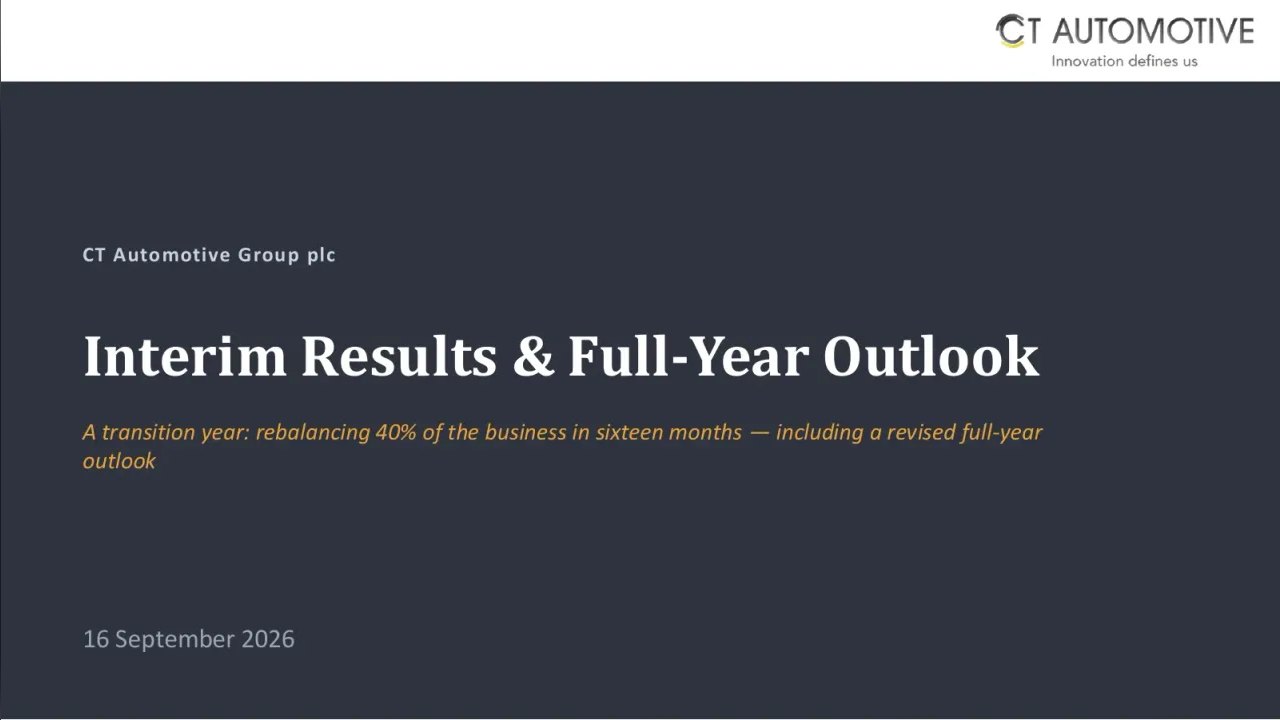
0:00 Good afternoon, and welcome to the CT AUTOMOTIVE GROUP PLC investor presentation. Throughout this recorded presentation, investors will be in listen only mode. Questions are encouraged and can be submitted at any time via the q and a tab situated on the right hand corner of your screen. Please just simply type in your questions and press send. Before we begin, I'd like to submit the following poll, and I'd like to hand you over to the management team. Good afternoon, everyone, and thank you for joining us. I'm Ray Bench, chairman of CT AUTOMOTIVE. I'm joined by our chief executive, Simon Phillips. Simon will present the results and the business. Over the next half hour, you will hear three things, what actually happened in the first half and why, a detailed account of the situation with our major customer, and why the business underneath these numbers is robust. This has been a year of deliberate compressed transition with some associated costs.
0:49 As of the August 4 trading update, the board were fully expecting to meet market expectations for the full year. Recent contract negotiations have given rise to us considering this position, and the board met Tuesday evening to review progress and make a decision regarding the likely timeline to conclusion and the potential impact on full year forecast. The outcome will be explained in detail in this presentation. Over to you, Simon. For three years running, we delivered profit growth from gross margin improvement on the slightly declining revenue line. That discipline hasn't changed. The year has. FY '26 is a transition year. We are rebuilding 40% of group revenue into our Mexico facility in sixteen months. Revenue is on target. The demand is there, and the programs have landed, and the issue is contained. Turkey and China are delivering to plan. Tooling and head office costs are on plan.
1:41 Everything outside Mexico is running to expectation. Ramping Mexico at this pace was deliberately ambitious, and parts of it have proved harder than planned. What we are building this year is the trajectory for f y twenty seven and beyond. These costs are the price of executing that once, not a change in the quality of the business. Let me give you the scale of what has been built. Monthly Mexico revenue goes from $900,000 in June last year to around 4,900,000 in October, five times. Injection molding machines from 29 to 63. Production lines from nine to 35 with around 13 new programs launched, 207 injection tools constructed, a spray paint facility installed and commissioned, headcount from 214 to 890, higher than trained.
2:33 By October, Mexico is roughly 40% of group revenue, all of that in sixteen months while the rest of the group ran to plan. Not many businesses of our size have executed a ramp up of that scale at that pace. Why so compressed? Because the work came to us at pace for reasons outside our control, and we accepted the challenge. Major OEMs have been urgently resourcing programs out of disrupted supply chains. Tariffs have pushed rapid localization into Mexico, compressing sourcing decisions that would normally take years, product development that typically takes well over two years. We have averaged in around six months across the last 13 launches. The overruns in this year's numbers are the cost of exception work at a quarter of the normal development window. The revenue from those launches builds through this year and underwrites the years ahead.
3:25 So to the first half, revenue of $61,700,000 up 14¢ on plan. This is not a demand problem. Gross profit of $16,400,000 adjusted EBITDA of $4,400,000 and adjusted profit before tax delivered of 1,600,000 Two things hit the half. First, 400,000 prudent adjustment to reflect negotiations with one of our key customers explained on the next slide. The 62,100,000 of revenue we reported in the August trading update is prudently reduced to 61,700,000. Second, 2,400,000 of ramp up costs and inefficiencies caused by tightening working capital. The customer position is covered on the next page and the cost on the page after. Now the customer situation, and I wanna be precise here because the two elements of it stand on different footings.
4:16 The FX element is contractual, the exchange rate basis, and the right to realign it are written on the business awards we signed. The inflation element is a standard cost escalation, as it is across our sector, and every other customer worldwide has agreed these adjustments and is paying them. During the first half, we submitted both, around $2,900,000 for full year '26, to our largest tier one customer, which is in chapter 11. The quantum remains under negotiation. The company has assumed a prudent level of recovery, 760,000 recognized in the first half, which is why the 62,100,000 reported revenue in August becomes 61,700,000 in these results. We are pursuing it in full. And to be clear about the level we have assumed, the increase remains under negotiation.
5:05 But our commercial team believes the assumed value should be agreeable because it lines up with the FX terms written on the awards and with inflation adjustments of the kind every other customer worldwide has already agreed and is paying. Separately, on the chapter 11 filing, our lender withdrew around 4,500,000 of invoice finance at short notice. We navigated that through cost management, our lender relationship, and new low cost facilities. Here is the first half in detail, dollars 2,800,000 of impact. And hold one thing, as you look at this page, every bar on it is Mexico. Turkey, China, tooling, and head office all ran as planned. The Amber buys the 400,000 of the customer claim following the company's prudent approach to this. That is the step from the 62.1 reported revenue in August to the 61.7 in these results, and it is pursued in full.
5:58 Then 2,400,000 of cost split by course. The majority, 140000058%, was driven by tight working capital. And let me make each line concrete. Storage, containers that could not be released in time, sitting at port, accruing charges. Expedited freight, where payments to suppliers ran late, shipments were held, and we then paid premium freight to recover the time. And labor, overtime kicked in as material arrived late, crews waiting on material, then working extended hours to catch the schedule up. Every one of those traces back to constrained material flow, the continued reduction of invoice finance as the customer remained in chapter eleven and six point two million of VAT held in Mexico. It unwinds as the cash lands.
6:43 Genuine operational issues were 800,000, the learning curve cost of the ramp itself being engineered out through Meta CI. And point 2,000,000 was geopolitics, late container shipments resulting from the disruption in the Strait Of Hormuz, entirely external and industry wide. The message is simple. The majority of the first half cost is the cash shortage, not operational failure. Solve the cash, and this business operates to plan. So next, let me show you how we solve the cash. Now the cash coming back. Two pulls, and note these are the positions at the June 30, the half year balance sheet date. 6,200,000 of Mexican VAT receivable built through the first half as the plant scaled. Refunds due on our near 100% export position.
7:29 And the 4,500,000 of invoice finance our lender withdrew on the chapter 11 filing back in September last year. On that second pull, let me be honest with you, while the customer continues to trade in Chapter 11, that funding is simply not available. No invoice finance lender will fund invoices to a company in that process. We carry those receivables on our own facilities until the customer emerges. The pool we can actively recover is the VAT, and I want to be honest about why it built up in the first place. Mexico has substantially tightened the refund regime for exporters, alongside far stricter electronic invoice enforcement. Every exporter in the country is on that learning curve. We absorbed it in the middle of the ramp. The evidential standard is completeness.
8:14 Every line across hundreds of thousands of records and a single mismatch restarts the clock. That is why we took extreme measures rather than incremental ones. Every claim now passes a 100 per cent line level AI review before submission, not a sample. We recruited a former director of the Mexican tax office to oversee and final review every claim, and the process now runs up to six claims in parallel, rather than one at a time. The first claim generated under the new system has been submitted, with initial indications that it will be approved. This is a significant cash inflow ahead of us and it is the same cash whose absence drove the first half cost you have just seen. 1,400,000 of cost in the half, 58% of the total was driven directly by tight working capital.
9:01 Without it, that cost simply would not have occurred. Briefly through the income statement. Revenue up 14% to 61,700,000. Production up 13%. Tooling up 31%, driven by the Mexico launches. Gross profit of $16,400,000 at a 26.6% margin, down on last year on freight, material costs, and start up inefficiency, partly offset by operating leverage from the higher volumes. Administrative expenses rose $1,800,000 to $12,500,000 That includes one nonrecurring item, and the balance is the larger Mexico cost base that supports the revenue growth. Underlying EBITDA of 4,700,000, operating profit of 2,500,000, profit before tax of 1,600,000.
9:48 One more way to read this statement. Had the ramp and cash shortage costs not landed, this half would have delivered around $4,000,000 of profit, roughly 18% ahead of last year, in the middle of the heaviest ramp in this company's history. On the balance sheet, total assets were up to 93,700,000. Two working capital items to write down, receivables of $35,900,000 on higher Mexican VAT and inventories of $27,100,000 reflecting the scale up and deliberate buffer stock on critical Mexico contracts. Net debt rose to $12,200,000 Government backed facilities became available during the period at attractive rates, and we used them to bring our debt facilities to a normal level for a business of our size.
10:34 But those facilities let us absorb the VAT, build the stock holding and the first half profit reduction without touching capital expenditure. We expect these elements to begin to unwind in the second half. Net assets increased to 31,800,000. Here is the movement in net debt. Dollars 7,700,000 at December to $12,200,000 at June, three deliberate uses of cash, 2,400,000 of net VAT outflow in Mexico, Timing, and it comes back. 3,200,000 of Mexico capital expenditure, the program investment, and $2,400,000 of lease repayments and interest. Operating cash flow absorbed the pressures I have described. The point I would leave you with, net debt today is below where it stood a year ago at 13,000,000 with a far larger business underneath it. The composition is on the page, 6,400,000 of cash held against the FGI facility and the China loans.
11:31 We expect an increase in net debt levels until the Mexican VAT position unwinds. The directors have considered going concern and are satisfied that the group has adequate resources in place for at least twelve months from the date of the approval of the h one hundred twenty six interim statement. That takes us to guidance. The Board met Tuesday evening to review and consider the FY '26 market expectations in light of progress with customer negotiations. Market expectation for the full year was $10,200,000 of profit before tax. The board considered it prudent to revise guidance to a range of 4,900,000 to $9,400,000 a range which we will seek to narrow based on the progress and conclusion of these discussions. The board do not think it likely that no price increase will be agreed. However, it is mindful of the importance of the relationship with our key customer and the added complexity that chapter 11 involves.
12:25 Four things to hold on to. First, the rest of the group is on plan. This is a Mexico ramp issue, not a group issue. Second, nothing structural. Every driver is recoverable, nonrecurring, or a ramp cost against revenue that arrives from here. Third, let me be precise about what comes back and what does not. The claim balance and the VAT are recoverable. The cost of cash shortage created, the storage, the premium freight, the overtime are spent, and they are not coming back. What they are is one off tied to this ramp and this cash position, not to how the business runs. Strip both out, and the genuine operational miss is 800,000. Fourth, the second half anticipates the cash shortage continuing.
13:10 The bridge from nine point four to four point nine is on the next page. I will hand over to Ray to run through that. Thank you, Simon. Following h one out term, we expected PBT to meet market expectations of $10,200,000. Having reviewed performance through July and August, the board is now expecting PBT of roughly 9,400,000 for the full year, assuming the price increases flow as they have with every other customer and mitigating the impact of the associated cash shortages in the second half. Unfortunately negotiations with our major customer remained inconclusive so in our h one reporting we have assumed a prudent level of recovery on the claim rather than the full amount however we are pursuing the claim in full with our key customer a total of $2,900,000 for full year '26 showing in the amber block.
14:00 We have assumed 1,600,000 of additional cost for the cash shortage continuing through the second half. That takes 9.4 to 4.9. A word on that 1,600,000 because I want you to see what sits inside it. We have assumed the cash shortage persists through the second half causing inefficiencies due to labor productivity gains arriving late, continued demurrage costs and material consumption efficiencies landing late. These are inside the 4.9 not further deductions to come. If the customer claim concludes earlier than we have assumed, those costs reduce, creating upside to the 4.9. Simon, back to you. One more thing the ramp built. Ramping a plant of this scale in sixteen months forced us to build something bigger than a ramp tool. Metas AI, agentic AI control of the whole factory.
14:48 These are agents that work twenty four hours a day, seven days a week, monitoring every critical aspect of the business as it runs, communicating directly with the workforce, and escalating to management where something needs a human decision. They do not sleep, they do not miss a shift, and they never stop watching the numbers. And I will be honest about what building it has taught us. The more of it we have built, the more we have realized just how impossible it is to run an efficient factory without it. Customer schedules land straight into the platform and drive everything downstream. Agents run the full material cycle with the controls that engineered out this year's freight errors. Production plans are raised against live demand. The full workforce cycle runs through it. Onboarding, attendance, hours verified end to end before anyone is paid, live efficiency of every line and machine as it runs, Quality run inside the operating system with issues caught on the line, not in the audit.
15:44 We are not aware of any manufacturer running this end to end on a live plant, live in Mexico by November, then rolled out across the group. So four messages to leave you with. Recoverable, both the cost recoveries we are pursuing, contractual on FX, industry standard on inflation, and the VAT held in Mexico are expected to come back. Nonrecurring. The ramp costs are launch specific. The launches finish in October. The ordering issues behind the freight costs are engineered out, already delivered. The capacity is built and paid for, 63 machines, 35 lines, the paint plant, a workforce of 890, and Metis CI. And the revenue it serves arrives in FY twenty seven and beyond. And capability, Metis CI, operational in Mexico, rolling out across the group in the first half of next year, a transition year with lights at the end of the tunnel.
16:39 That is everything from us this afternoon. Thank you for listening. Ray and I are very happy to take your questions. That's great. Thank you for updating investors today. I please remind investors to submit your questions just by using the q and a tab situated on the right hand corner of your screen. If you reference a recording of today's presentation, we're available in the Investor Me company platform shortly after meeting has ended. Guys, as you can see, we have received a number of questions during today's presentation. So, Simon, if I could just hand back to you at this point to read out the questions and give response where appropriate to do so, and I'll pick up from you at the end. Okay. So I'll I'll actually take the questions and propose most of them to you, Simon, if that's okay. Yeah. For sure. Before we get into the questions that have been submitted through IMC, we've actually had a couple that came through our own Investor Relations portal as well, so I'll start with those. I think there's probably going to be quite a bit of overlap between them anyway. So first question is, when did you become aware that Morelli was disputing your price increases and why didn't you update the market?
17:37 Okay. So I'll take that question then, mate. I mean, first of I think what's really important for everybody to understand is that price negotiations go on all the time within the auto industry. In our area, the areas that particularly sort of affect us is Turkey and Mexico because they're more sort of based around FX and inflation. So our commercial team has been working with Marelli since since April negotiating with these commercial agreements. Marelli is in, obviously, a very difficult position because they're a chapter 11 position, but the price negotiations were going on very well. But then in, I'd say, roughly about mid august mid, yeah, mid August, the commercial team said that Mirelli were disputing a few of the issues on the claims.
18:23 But as far as we the ourselves and the board were aware that this would all be concluded quite quite quickly. But then during the board meeting yesterday and yesterday, we'd having spoken to the commercial team and with the dispute still ongoing, the board really decided to take a bit of a prudent view and reduce some of that claim just to to potentially offset some of the risk. But as far as we're concerned and as far as the commercial team is concerned, the claim that we've put forward is is pass partly contractual, and the other section of it is pretty much in line with industry norm. Now the the thing to take away is that we're negotiating with multiple customers across this year in those two regions of the world.
19:11 And every single one of those customers have agreed claims in line with the expectation of the industry. So from the commercial team's perspective, they're gonna be pushing hard to close that claim, but the view for on the board from the board meeting yesterday was that we should be a bit prudent and reduce that down. I don't know if there's anything else you wanna add to that, Ray. Yeah. Other than just I think, know, the the board obviously looks at the financial performance of the of the business on a monthly basis. You know, we understand where the numbers sit and our forward forecasting of that. We compare actuals to that forecast, and up until this this issue became very real in terms of it as being seen as a dispute. You know, we had some good visibility towards the end of the year and didn't believe we had to come to market.
19:57 And what we have done, as Simon's alluded to there, is taken a prudent approach. You know, we've obviously reduced down the levels in that slide that you've just seen there to show what the worst case would be if the full £2,900,000 of the outstanding claim wasn't recovered. But also taking the worst case understanding of with that cash not flowing back into the business, some level of inefficiency continuing throughout the rest of the year, which is that additional $15,000,001,600,000 pounds which obviously also impacts the top line. Now, you know, if that money just land, whether that's accelerating the Mexican VAT returns or it's the concluding the MREL negotiations sooner than we think, some of that flows back in. That's why it's quite a broad range in terms of the forecast that's been given. We understand where the bottom boundary is. We understand where the top boundary is. And the likelihood is, it's going to be somewhere in between, but it's too early to say exactly where at this point. Clearly, as we get some more granularity around that, we will come back to the market and guide it accordingly.
20:54 Yep. Agreed. Okay. So moving on. Can you go into more detail regarding the claim? Is it contractual? If it's contractual, how can they dispute it? Okay. So the claim itself is pretty much same as every of one of our customers. I mean, it's it's generally sort of split into two baskets. I mean, one one area is currency. The other area is localized inflation. So to to give a, I guess, a bit more detail relating to to the Mexico side, those baskets are split roughly like this. 55% is raw materials, 45% is operational based, which is related to the peso. Now as we know, the peso has strengthened against the US dollar quite significantly across the, you could say, the last eight months. It's been shifting from what was our business nomination awards of somewhere in the region of, like, 19 to 20 pesos to the dollar, down to roughly about 17 pesos to the dollar at the moment. So that sort of currency has obviously quite a large impact on on our bottom line. So so in terms of the the business from a p and l perspective, you can sort of view it as 55% we have in natural hedge. 55% is, say, raw materials and all US dollar related costs within the business. 45% is is based around the pesos.
22:16 So so in terms of the contractual agreements, we have specified our our exchange rates on our business nomination awards, and that obviously has that direct impact with regards to the to to the FX movement. That part is contractual, and, really, there should be no question or argument about that. The second part is on the inflation. And and the inflation in Mexico has been quite significant over the last sort of few years, particularly with what is quite a socialist government driving up labor costs. So the the real negotiation is going on on around labor costs. And and just to sort of say again, I mean, like, the vast majority of our customers have accepted all of our late costs. And when I say vast majority, I mean everyone.
23:07 But the the problem is, I guess, particularly with Morelli, is they're they're trying to emerge from chapter 11. They're controlling profits extremely tightly. And, obviously, they this is this is this is an impact to their to their profits to accept it to accept this from us. So that's where the tougher part in negotiations going on at the moment. Since we've been meet we've been made aware at the board level with regards to to these disputes, I mean, I personally have have been involved in this. And and, you know, we have we do have meetings sort of set up. There's there's meant to be one on Friday and one on Monday, and we hope to, like, reach a decent conclusion on it. I mean, the only thing I would say is that it is it's sensitive. I mean, particularly given the facts that Morelli is 40% of our revenue and our largest customer.
23:59 You know, we have to do what's right for the business and protect the business, but we're also mindful of the relationship with particularly with them trying to emerge from chapter 11. Okay. A lot of data on that, Simon. So I think, again, we need to be mindful of those negotiations still still ongoing. Question about Mirelli again. So how much are dependent on Mirelli and how much are dependent on Mirelli coming out of chapter 11? So, I mean, like as I said I said earlier, I mean, 40% of the group revenue is dependent on on Marelli. I mean, we are of course, we want them to come out to a out of chapter 11 as soon as possible because it has hit our working capital. I mean, the the AR funding from already is roughly about $4,500,000.
24:44 And when we already went into chapter 11, FGI, our bank, understandably, no longer wants to fund that because they could no longer insure the debt. So that's being managed within within the business itself. But I would say that we're a 100% confident about them coming out of chapter 11 or emerging in some form because Mirelli is an enormous tier one with revenue somewhere in the region of 11,000,000,000, and that's obviously crossing multiple OEMs both in Europe and America. So just for the investors to to understand, I mean, if Marelli for some reason completely went down, they'd they'd take down the majority of the auto industry both in Europe and America. And clearly, that's not gonna happen and that's why they continue to get funded.
25:32 But, you know, we hope they'll they'll emerge soon, and then that will have a significant impact and improvements to our working capital. Okay. You've indicated your cash constraints. Do you have enough cash to continue as a going concern? Yeah. I mean, we've we've done this. We we've been through this in detail with the board, and we're quite comfortable that we are. I mean, just to sort of talk about that sort of cash constraint and liquidity. I mean, it has been a very it's been a very tricky year. I mean, it started obviously at the back end last year and we already went into chapter 11 and that 4,500,000 impact. I think there's some questions later, and I'll get more into the detail about the Mexican VAT at 6,200,000, but I think it it's been explained quite clearly in in the presentation itself. But that Mexican VAT receivable, you know, that $6,200,000 of cash that should be in our bank at the moment as is should be the Marelli $4,500,000.
26:31 So that has squeezed cash, which is sadly, you know, impacted the operational the operations of our business, mainly through us having to trade a little bit from our suppliers, which then causes material shortages or shifting containers out from out out out ports. But we have got adequate mitigation plans. I mean, one thing is is on that 6,200,000 of Mexican VAT, we have completely built this integrated AI system to do all of our VAT returns, and we've hired a next director of the Mexican VAT office to oversee it. Now the positive thing on that side is that having sort of built the entire system is that we can put up six claims in at any period in time. So at this point in at this point in time this week, those six claims have been maximized.
27:26 So what that means is that we're gonna start going through a recovery cycle on that, which is going to it's gonna flow in very quickly. And in the meantime, what we we've been doing on the 4,500,000 from Morelli is that we have been taking on some facilities facilities in China to offset that that AR. So as far as soon as this cash starts sort of, like, flowing in really quickly, then I think that that will completely resolve our our liquidity problems. And then and and then hopefully, you know, as a result of that, underlying business will perform perform as normal. Mhmm. I think you've covered one of other questions that come through about Mexican VAT in some detail. I know the slides covered it as well. So one of the other questions related to to working capital and cash is, are are you at risk of breaching covenants?
28:13 Well, you you know, we're we're looking at it from two directions. We're from FGI, but from the profitability side, which is fine. But then there's also the liquidity side, And so there there's a liquidity measure of an insurance. You have $3,000,000 liquidity at any point in time. During this period of time as we've been going through this, there are periods of times where we go slightly below that. But we have made FGI completely aware of that. So they're they're quite they're quite comfortable with the situation. Think they, like us, are just wanting to see this VAT start flowing through pretty quickly because that obviously resolves all of our issues. Okay. Next question. So so a question here about we're concerned about your finance function given the significant prior period adjustments last year and your change in your announced revenue number. What are you doing about it?
29:06 I mean, yeah. We have sort of discussed this before, but we we've obviously beefed up the finance team in India now to 14 people covering every aspects of finance right way way through the business. And and that is actually functioning really really well. I mean, we we've been over the history about the the the interims last year, so I think everyone's pretty much aware of that. Going into into this year and the situation of, like, where we are at the moment, There is nothing created that the finance function could have done that's sorry. Any better than what they want what they have actually done. I mean, it's they're they're reporting the numbers on time. We know what the situation is is in the business from a management perspective and operational understanding.
29:55 You know, the recent board events that happened yesterday, I think we're it's just taking a prudent view on on the Mirelli recovery and then looking forwards and thinking to ourselves, well, if the cash from Mirelli isn't really gonna come in at the speed that we expect it to be coming in at, what could potentially be the knock on effects that we've been seeing in the first half of the year? And and I think putting that sort of 1,600,000 aside for that is prudent. I mean, you know, that we're not saying that that is going to be used. We're gonna hope that we're not going to use it, but depending on, like, the situation with the SAT office and trying to recover some money recover this money from Marelli, these could be realistic results from the cash squeezed that we're in.
30:44 K. So did your auditors review these interim financial statements? No. Because, you know, it's a name listed company. That's not necessary. Although, would say that some of the finance accounting papers, obviously, we create do go to the auditors to review to make sure that we're lined up correctly for the end of year audits. Yep. Question regarding shares. So are your board and CEO buying further shares? I mean, I can certainly speak for myself in terms of as Ned that, obviously, I've invested my own money as of the other the Ned's as well. From the from the executive side, Simon, I think, you know, you well, I won't put words in your mouth, but you've you've sort of extended to me your your desire to want to buy shares, but, obviously, there are limitations in place at the moment regarding the takeover panel. So, you know, you cannot do that since you're as a concert party.
31:34 I mean, actually, there is a note to that to the effect in the the annual report from from '25 as well. So I mean, just to add to that, Ray, that you're quite right. And as you know in the conversations I've had with you and the board, I'm if if the I had the opportunity, I'd be fine 100%. But there are but it requires a whitewash and it requires and and due to the regulations over the 30% concert party, it appears not possible. But but frankly, you know, if I could, I would because you only have to, like, look at the business at the moment and you look at the underlying forms of the the business if you take out what we've been sadly impacted on with this with the Mexican SAT office and and Morelli and it's sound. You know, it's as sound as it ever has been.
32:24 And I think, you know, when you you look at the execution from the management team, you need to be able to build effectively shift 40% of revenue to a to a new factory to launch all these new programs to build a fully sort of, like, integrated agent AI system within the business within sixteen months. I mean, there is nothing wrong with that. The the business is performing exceptionally well. It's just, sadly, it's the implications we're having on a cash squeeze where this 4,500,000 and this 6,200,000 of fat is hitting us. Okay. Moving on. So Singers estimates that approximately 70% to 80% of the FY 2026 PBT must be earned in H2.
33:10 What precise operational and financial assumptions give the Board confidence that this can be achieved? Okay. Really, you you gotta step it back a little bit and say that the the reason why 70 to 80% become greater is because of our profitability at this point in time. But if you actually take out the the the the the cash flow impacts, then it would have been more like on a sixty forty split if we'd assumed that we we'd achieved full More normal historically, isn't it? Yeah. That which is a lot more normal historically. So so this was always the case, you know, the of what the management had set out in the in the year. We expected the strongest second half performance, and that's largely down to the fact that a lot of the operational launch costs are outweighed. So, I mean, if you can imagine it, I mean, you're gearing a plant up, you know, from from something like 27 injection molding machines to 60. You're building a paint plant. You're introducing 35 new production lines.
34:09 That is a monumentous task to do in that and that that sort of level of speed. And and there's a lot of costs associated with it. We're flying engineers around from China, from India, from different locations that stay in hotels. They're on the lines because the customers are there on the lines launching these new products. And so it takes a lot of engineering resource to to to push that through. Those those costs were baked into the first half of the year, so they unwind into the the second half of the year. But then the second half of the year, like I mean, just like as the example, you know, I'm here in Mexico at the moment, and I'm seeing it all firsthand. We've got, like, at least 10 new production lines that are just launching new forward programs, which will start to to push through in October. And and so, you know, from a a management accounting perspective, we expect high revenue in the second half that improves gross profit, fixed cost reduced basically down to the the operational cost of the the start up starting to fall away. So it was always the case of it. That was our expectation.
35:09 Okay. Next couple of questions are actually linked. I think we've covered some of it already, but let's just just just get back over it. So how much of half one cost over and is contractually recoverable from customers? How much has already been agreed, and when will the cash actually be received? Yeah. So, I mean, the the main cost overrun is the price negotiation with Marelli. And, you know, we have meetings set up later this week, next week, and then we can try and understand when we can receive that cash back into the business. So I can't be precise about that at this point in time when that cash will come through. Sure. The the things that is nonrecoverable is things like what we saw in terms of expedited freight, A a certain amount of delayed cost, which is due to, like, the inefficiencies of the the cash squeeze that we've been or that that we've been going through.
36:02 And the storage cost where you have containers stuck in store in ports waiting to be be cleared out. You know, it's sad to say that these are, you you know, these are the direct impacts of the of what's happened with regards to Morales chapter 11 and and what's been going on for the the Mexican VAT office. K. So I think you've answered the second part of that question there. We're talking about freight. So next question is the August broker report says that the Mexico inefficiencies have been identified and fixed. What measurable evidence supports that statement, and when did Mexico begin operating at the required efficiency level? I think actually this perhaps leads into the the the Metis discussion as well in terms of how you can measure parts of the business. Yeah. I mean, you know, to to be clear, we we we had some inefficiencies at the beginning part of the year, mainly down supply chain management errors and and supply chain management errors in terms of folding materials, that kind of thing leads into material shortages, which then leads into labor cost efficiency issues relating to relating to overtime and stuff like that in Mexico. But with Metis, what we have done is we have taken out the human element right away through production planning supply chain. At the moment, you know, within the within the business itself, operationally as it stands at the moment, there's roughly about 22 AgentsKI agents operating in the business, making sure that humans can no longer make errors.
37:31 It's just not possible anymore. Yeah. I mean, these agents are working twenty four seven, checking with checking them with suppliers, checking that materials coming on time, checking where ships are in the water, ready to be delivered at ports, doing all the production planning, making sure that works orders are created in an efficient way, that production is planned in an efficient way through the factory itself. And but this is all great stuff, and and actually, it goes to improve gross profit margin not just now but into the future. But I I I think the question is slightly wrong in some ways for you because the Mexican plant is not inefficient right now. It's the it's capable of achieving our expected gross profit margins. The only thing that has stopped us from doing that is the cash squeeze.
38:17 What Metis is doing is going to improve it further into the future. So I guess just to reiterate that the next question is probably asking the same question. So after including the launch costs and inefficiencies incurred to date, are the new Mexican programs still expected to deliver their originally targeted lifetime margins and return on capital? I think this one can be just simply calculated in the numbers themselves. Because I think if you if you just take the first half numbers and you remove the one off impacts due to what we've been seeing in cash shortage, the answer is apparent. The gross profit margin is in line with expectations. Okay. Moving on. So Cinger continues to forecast a gross margin of approximately 30% for FY 2026 and 2027. Is that still a realistic structural margin after the half one issues? And what gross margin is required in half two to achieve the FY '26 PBT forecast?
39:15 So first of all, when you when you look at the gross profit margin flowing into FY '27, you know, our our basic assumptions on that is that the the speed of recovery that we're putting in place on the SaaS office means that the cache unwinds and that we should not be seeing sort of like cache concerns we've had to be forced in seeing this year. If that's if that's the case and that's in place, then the gross profit margins will flow. But they that's apparent both in this year, and it's and and in our business modeling looks out towards next year. But when it comes to the gross profit margin, the exact numbers for the for h two to be able to hit the target.
40:02 I mean, to to be honest with you, would have to look at the maths on the on the the p and l. It's not something that I know exactly to mind at the moment. Okay. Some other questions are are coming through as well. So can you explain why your largest customer being in chapter 11 is not a concern for future customer demand? Because Mirelli when I with regards to future customer demand because Mirelli doesn't dictate customer demand. Customer demand's dictated through the through the OEMs to Morelli and then Morelli to us. So we're whilst Morelli in chapter 11, the one thing that Morelli can't do is dictate customer demand. They can't there's no customer, none of our OEMs that are going to start slowing down production when they can sell cars because Morelli, for example, might have some financial issues which is stopping them from producing goods they'll just support.
41:02 Okay. What was the value of the temporary Mexican inventory build at the June 30? And how much was subsequently unwound? And when will stock return to normal levels? Good question. I mean, we and this, you know, is what compiles things slightly harder on the cash flow front. So we increased our stock holding in in Mexico by about 1,400,000 US dollars. The the main reason why we started to do that, and it can be seen it's evident from the bar charts that we saw in in the first half of the year, is that the sort of geopolitical issues that that occurred with The Strait's Hormuz which then started on delaying containers coming into ports. You know, within the auto industry, you simply can never ever be late on delivering a part. You cannot be the company that starts stopping a production line in OEM. So if you have a ship on route and let's say the freight forwarders are telling you that it's gonna dock on time and everything else, and then as a result of the geopolitical issues, they then turn around and they say that it's two weeks off.
42:06 There is only one choice in a situation like that, which is to get parts on planes from China or Japan, wherever the supply chains are, and get that product into in into the factory. So the way that we could truly sort of, like, mitigate those severe risks was to increase our stock, which is what we've done. Now what I would say is this, is that the vast majority of that $1,400,000 worth of stock, it was actually quite large painted components that are coming in from sub supplies in China. That was one of the specific reasons why the the paint plant was built in Mexico to eliminate that supply chain risk and obviously to to increase the margins within the business as a result of no longer having to pay the container costs that to to ship these goods. And also to achieve the margins that that the painting supplies in China are currently doing.
43:03 So with regards to the unwinding of it, I know that Graham, COO has been doing a lot of work on this alongside Angela. And I would imagine most of that would be unwound by the end of this year. So that's another cash advantage for us going forward. So it's a slightly complicated question. Not complicated, convoluted, but perhaps does management still expect the f y twenty six equity free cash flow of approximately 2,200,000 and year end net debt excluding leases of 6,300,000? And if so, what working capital release is required in h two? Yeah. I mean, I I I think maybe this question's come in post the post our presentation, so I think our presentation explains it quite well. I I mean, like, really, I would love it to be like that, but the reality is is that we're net debt to be at about 15,000,000 by the end of the year. And and quite honestly, where's the 15,000,000 sit? It sits purely in the the Mexican Mexican SAT.
44:09 I mean, the Mexican SAT by the end of the year could be as high as 8,500,000. Take it off 15 million, we're bang where we need to be. So so that's the worst case scenario, I'd say. But but, obviously, we're trying to, like, be pushing in these six applications at a time so that we we we pull that money in a lot faster. Now within our cash flows, we've made the we've made the assumption that the SAT runs to the maximum period of time, which is about a hundred days, and that's hence why I'm sure sort of reducing the expectation in the cash flow. But on our side, we are trying to we're we've been having regular meetings with the SAT office now. We've been explaining the implications of what has gone on and how that's impacting us as a business.
44:54 And so therefore, we've been asking them to to try to ensure that we see a turnaround of, like, sixty days, in which case there'll be an improvement to that. Okay. Question actually about the Mexican paint facility. So it's really asking about annual cost savings, working capital reductions, and margin benefit with the Mexican paint facility produce and when it will reach normal utilization. Okay. So normal utilization, like, actually almost complete utilization will will occur in October. And, you know, if you think on the the when we first started looking at the next complaint facility, to be fair, we thought it was gonna cost about 2,400,000, and there was an overrun on the development because customers wanted additional technologies put into it, which took it up to about an extra 600,000.
45:50 But, excuse me, when we did the initial 2,400,000 investment plan, the ROI on it was eighteen months. So that gives you a bit of an idea. That's how much once it's flowing, how how much it's gonna improve sort of gross profit margin within the business. So we expect it sort of like impact so it impacts an improved gross profit margin to the tune of about 1.8 a year. 1,800,000 is the expectation. Okay. Next question, which is probably the easiest for me to answer actually is, please provide a year by year bridge showing how the 47,000,000 of annualized program wins secured in f y twenty five converts into revenue during f y twenty six, f y twenty seven, and f y twenty eight. Now clearly, if we were to provide that, then that would be given a very clear steer in terms of future year revenue forecast, which is not actually for us to do.
46:42 That's something that the analyst notes would normally do, having looked at the business plan of the company. What I would say though is that the the majority of those contracts are due to land in '27 and '28. So again, those those revenues that are detailed within the analyst notes will reflect those contract wins in the same way as they also reflect the wastage of old programs going out of production. So, you know, it's some of the the contract wins sort of like supplant contracts that are expiring and some of it is genuine revenue growth, and that comes through into the forecasts that get published by Singers. Next question is, if customer recoveries are delayed or Mexico improvement is slower than expected, what is the realistic downside range for FY 'twenty six adjusted PPT cash flow and net debt? So I think we covered this actually in the slide earlier in the deck, basically saying that the prudent sort of view that we've taken as a Board is to is to take pretty much that worst case scenario, know, that that bottom boundary is no recoveries, which obviously gives an issue in terms of cash as well, which knocks on to the the efficiency of the business as it runs.
47:55 Clearly, that's also modeled out as worst case in terms of the the cash flow and the net debt. It's not our view that that will come to pass, but but, you know, that's that what that's what causes the the lower boundary in that forecast. Moving to the other questions that we've got. Interesting one that we perhaps should address this. So this question that's come through actually on a couple of people I think is, is there a plan to announce a permanent CFO? So I think, again, you know what, I'd I'd reiterate the the the comments that you made earlier, Simon, about the the existing sort of finance team and the the building, the depth of that. I think at the last IMC meet strategy that we had, we said that, you know, as a board, we're open minded in terms of acquiring more talent, but also pointed out that, you know, finding experienced CFOs that were fully conversant within the automotive sector and understood businesses of this this complexity And not easy to find, you know, so there's not a huge manufacturing sort of base left in The UK to to pull from.
48:58 Not that it's limited to The UK. You know, we keep an open mind. If talent is available, we'd, you know, we'd clearly consider it. Looking also at the the growth strategy of the business and how how that could support it. So, you know, again, genuinely, the bit if the board keeps an open mind to this, and if we find a perfect fit candidate, we'd we'd certainly we'd certainly look at it in detail. Moving on to others that are flowing through here. So think we've got that. So comment here about I can't see any updated note from your broker, Singers. Is there any reason why? All I can say is that there is an updated note that came out from Singers first thing this morning.
49:43 If that can't be found through the the normal sort of route, it should be available through research tree. I think there's normally a couple of days lag, but it will certainly be available. Have you seen that debt evolving particularly post year end? So I think, again, we sort of covered that to the end of this year. I think, Simon, if you've got any views of the trajectory of net debt through '27? I I think we we we certainly discussed it, you know, at the board meeting. And obviously, we unwind the VAT, which brings us back to the position where we expect it to be. And post that situation where we're into a situation where the business is generating the the sort of level of cash that we expect it to be. And there's you know, one of the one of the models we were looking at was having sort of a limited net debt by the end of the year, somewhere in the region of, $4,000,000.
50:40 But as we discussed really where I think at the board meeting is that having met that at that low levels, we've given the sort of profitability side and the size scale of the business. Think the real sort of question is is is is just ensuring that liquidity is good because, you know, we've seen firsthand, right, this year what liquidity does to a business. Yeah. And on that basis, you know, I I I moved the view of sort of maintaining a bit more debt to to to ensure that liquidity is good because as we've seen, when liquidity gets tight, it has, you know, profound impacts on on the p and l. So next question again, referring back to to Marelli, being one of our largest customers. Are CTA working to diversify as far as possible away from from that level of Marelli exposure?
51:35 Yeah. I mean and that is something that we're working on. In fact, Marelli's percentage has dropped quite a lot this year compared to previous years. And and, you know, as as people have seen in in terms of our new business or or we spoke spoke about with regards to our new business strategy and what we're working on, We are we are diversifying into many more OEMs. And, you know, our expectation is to to grow that down something more like about 20% to 25% in the coming years. There's a question then about contracts coming to an end, which I sort of think are covered by saying that, yeah, you know, we've got natural wastage of of programs that come to an end after that five, six, seven years, then they get replaced by new business just to to to maintain the the revenue level, and then, obviously, the new business that goes on top of that grows it. So I think that's that's answered.
52:33 Just a quick look through to make sure we've covered everything else that's come through that we can answer today. I think I think we probably have. So I guess at that point, Charlie, I think you perhaps would ask us to to make a final few words. Yes. Thank you for updating investors today. But like you said, can we please just ask you, Simon, for some closing comments? Yeah. I mean, you know, thinking about the closing comments, I I would say it's it's the business has performed. I know it sounds difficult looking at the numbers, but the business has performed exceptionally. I mean, we have launched multiple new programs at places that people thought were impossible.
53:19 Six months within well, it's normally two and a half years. It's been six months. We've grown that business to, like, 40% of the company's revenue. I I you know, I've been here myself personally, near enough, the whole year in Mexico. I look at how those lines are operating, how efficiently and everything else they can deliver the gross profit margin. The difficulty is this whole year can be pointed to some simple single factors. I mean, obviously, was the Murray chapter 11 and the impacts from the 4,500,000 and the SaaS office, particularly their new rules this year, which is impacted not just us, has impacted most exporters within Mexico. That unfortunately has created a bit of a cash squeeze. And and sadly, what I tend to see is that a lot of the management spending a lot of time prioritizing what materials to bring in to keep lines running. And when those materials don't come in, those lines then have to run at weekends on overtime and that incurs cost. And that's exactly what we've been seeing, premium freight costs.
54:23 With the new AI systems that we've built with regards to the the VAT, that will unwind that situation incredibly fast. I think on top of everything else, what the company's done in terms of expanding that Mexico plan, launching these programs at speed, what has been built with what the team now of 10 with Metis AI, the agenda's AI system. I I believe we'll be one of the one of the, if not, the most advanced systems based business in the world by November. And and these are huge achievements from the management team. The the problem is, and it disappoints me to have to tell you this to the shareholders, is that it's just unfortunate about those two factors that have impacted our cash. But we are mitigating them, we're working through them, and we've got clear plans to to recover that situation. And then I think, you know, it's business as usual, and it is business as usual because when you look at the p and l, you see that. It's just those two those two things that are impacting us. So in so just to say, you know, thank you to, you know, all you guys for for coming on to to listen to us. Thanks to the management team for, like, what's been an incredible year of change.
55:38 And and that's it. That's me wrapped up. Perfect. Thank you, Simon and Ray, for updating all those investors today. On behalf of the management team of CT AUTOMOTIVE GROUP PLC, we'd like to thank you for attending today's presentation and good afternoon.
Follow CT Automotive Group PLC into a list and get an email when it puts out news.
CEO at CT AUTOMOTIVE GROUP PLC
Non-Executive Chairman at CT AUTOMOTIVE GROUP PLC