Replay available
Coromandel International (NSE:COROMANDEL) Q2 2027 Earnings Call
Coromandel International (NSE:COROMANDEL) Q2 2027 earnings call, held 2026-11-12. Watch the replay and read the transcript on 6ix.
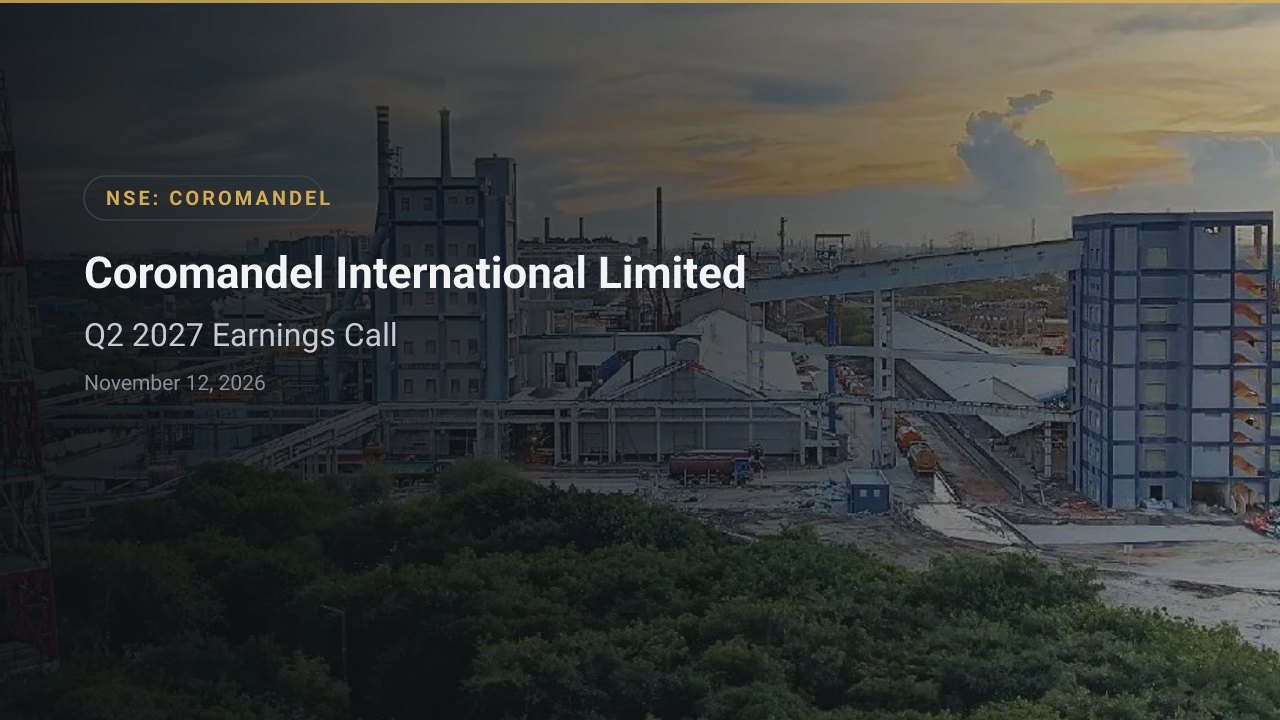
- Company
- Coromandel International Limited (NSE:COROMANDEL)
- Period
- Q2 2027 earnings call
- Date
- Thu, Nov 12, 2026, 6:22 AM ET
- Replay
- Watch the replay on this page · 1 h 2 min
On 6ix: 6ix.com/event/coromandel-international-limited-coromandel-q2-2027-earnings-call
Replay
Transcript
Automated transcript · Written by software from the replay's audio. It can mishear names and figures; the replay is the record.
0:00 Ladies and gentlemen, good day, and welcome to the Coromandel International Limited Q2 and H1 FY 'twenty seven Earnings Conference Call hosted by Systematics Shares and Stocks Limited. As a reminder, all participant lines will be in the listen only mode, and there will be an opportunity for you to ask questions after the presentation concludes. I now hand the conference over to Mr. Hamish Desai. Thank you, and over to you, sir. Thank you, Shaurya. Good morning, and welcome to the Q2 and H1 FY 'twenty seven earnings call of Coromandel International Limited hosted by Systematic Institutional Desk. From the management, we have Mr. Sankara Subramaniam, Managing Director and CEO Mr. Deepak Nitrajan, Chief Financial Officer.
0:54 I would like to thank the management for giving us the opportunity to host this call. We will begin the call with opening remarks from Mr. Sankar Subramaniam, followed by Mr. Deepak Natarajan for update on financial performance, post which we'll have a Q and A session. Thank you and over to you sir. Thank you. Thank you, Harmit, for organizing the call. Good morning, everyone. I hope you had a wonderful Diwali. My belated wishes to you and to your family. I'll begin with an overview of brief business environment experience during the quarter and also provide an update on operational performance. Then I'll request Deepak to take us through the financial performance. As you all know, Q2 was unprecedentedly challenging quarter for the industry. We had multiple headwinds coming together at the same time. We visited rainfall in key markets, rupee depreciation, elevated raw material prices, lower NPS rates and weak consumption impacted the operating environment.
1:47 In fact, rainfall deficit was around 20% to 30% in our key markets such as Andhra Pradesh, Srinagana, Karnataka, Maharashtra, and this has impacted the agricultural activity as well as input consumption. Also, the widening price differential between DAP and complex woodlases influenced the former buying behavior and impacted the offtake of NPKs. All these factors resulted in soft industry wide decline in fertilizer volume with production and consumption of NPKs has fallen considerably by 40% during this quarter. Happy to note that government yesterday announced the NPAs rate for a week 2627 season. This is a very timely and positive intervention, particularly given the fact that there has been a significant volatility in international fertilizer and raw material markets.
2:35 This improved subsidy support should help improving the viability of domestic manufacturing and restore better pricing balance between EAP and complex fertilizers, thereby supporting the adoption of balanced nutrition. We are still awaiting detailed notification. The raise rates appear to align with NBS mechanism, which is underlying principle of reflecting the movements in international raw material and fertilizer prices. The government has also announced a special support to address the exceptional increase in sulfur and sulfuric acid prices, which has significantly impacted the cost of phosphatic fertilizers. During the year, government launched the framework to fertilizers sales system on a pilot basis across select districts. These initiatives are very positive from the perspective of improving transparency and promoting efficient fertilizer usage.
3:27 And the initial implementation has also highlighted certain practical challenges, including longer purchase process for farmers, access to digital infrastructure and accommodating farmer choice and brand preferences. Industry has shared its feedback with the Department of Adolescents, and we are hopeful that these operational aspects will be suitably addressed before the framework becomes a reality. In ACCOM, we continue to see regulatory tightening, including restriction around certain molecules like carbosulfone and paraquet. Our permanent expected impact is not much. With respect to nonsubsidy businesses, restriction has been imposed by certain states on the sale of nonsubsidy fertilizers by fertilizer marketers. Industry has been engaging with the authorities in the state of UP, Bihar and Maharashtra, and we are hopeful that an appropriate framework can be evolved that protects farmer interest while continuing to increase balanced nutrition and innovation.
4:24 During the quarter, Andhra Pradesh has announced a major program to develop Ryalsima as a global horticulture and food processing hub, and significant expansion is planned in Article three acreage. Giving our strong presence in the region, our expected new granulation plant coming on stream in the near future, this augurs very well for Coromandel. And we see this as a positive long term opportunity across our various segments, nutrients, crop protection, specialty nutrients, especially through our retail platform. Coming specifically to Q2 performance. As I mentioned, it was a very challenging quarter. We sharpened our focus on differentiated offerings. We launched 10 new products across Nutrients and Crop Protection segments.
5:10 And reasonably, we managed the working capital well. Revenue grew by 6% to 10,348 crores, but however, EBITDA declined 18%, mainly due to compression in NPK fertilizer margins during this quarter. And also due to deficit in key markets and rainfall and higher input prices not adequately compensated by tariff NPS rates, our performance across the value chain has got impacted. In the portfolio business, volume uptake was impacted due to monsoon price differentials. However, we tried to increase our market share from 17% to 19%.
5:56 And our primary sales for the quarter was down significantly by 30% to 10 lakh tonnes and consumption also declined 33%. It's a conscious call taken by the company to moderate the primary sale and production and manage the working capital well and tracking the consumption, the production and supplies have moderated. The government announcing the new NPS rates for the rabbi season, we do expect that part of the benefits will be passed on in correcting the MRPs, which can revive consumption during the Ravi season. The production got moderated by 15% in Q2 to some point some of that due to softer demand. Our newly commissioned phosphoric acid and sulphuric acid plant at Katananda has committed right time to ensure availability of these key raw materials, even though we operated the plant at a lower capacity until we got the sulphur subsidy notification sometime in August.
6:55 With sulfur subsidy coming in, this new project is back on track and started operating at full capacity. And this will support the value creation in a highly volatile operating environment and thanks to the timely government intervention. Our granulation plant project is progressing well in Kakinada, and we hope to commission this by February of this year, and this capacity should be available for the next year. Overall, we can see a moderation in the global raw material prices. While urea has come off some time back, we have seen softening approach in sulfur as well. Sulfur is now likely to go below $900 due to shift resistance from metal segment as well as in the fertilizer segment.
7:45 I do expect sulfur used to be a disposal problem, and this can become opportunity to bring it down below $500 as well if we sustain our approach in terms of smart purchases. DAP continued to remain more or less at the same level in the last two months. Paucity prices have been rolled over at $1,700 as sulphur prices remained high during this period. SSP volumes again, got moderated by 13% to 1.9%. But our focus on differentiated grades in terms of GROM plus and Beauty SSD has been quite helpful and helped us to improve the contribution and margins. Moving on to Crop Protection segment.
8:33 Crop Protection demand remained soft during the quarter. The impact of rainfall had a cascading effect on the agrochemicals as well. And exports demand recovery has been gradual as farm economics was impacted due to high fertilizer costs and relatively docile agri prices. Encouragingly, we are seeing improvement in the price of certain agricultural commodities globally, and that should improve the offtake of the ingredients as well. Our protection business delivered 22% revenue growth during the quarter, supported by strong performance in export markets. Our diversified global presence continue to provide opportunities to deepen our presence across key geographies. Domestic market, we continue to invest in portfolio development and differentiated offerings with new products contributing 36% during the year. During the quarter, we introduced six new products across the group chemicals and biologicals.
9:23 There has been some impact on margin for few molecules, but it broadly remains at comfortable level, given the variability in crude linked intermediate experience in H1, customers have deferred the purchases and decided bearing on the production of products of cake as well. We are expanding the capacity of one of our key molecules that will come on stream by this month end. We're also planning to establish a fluoro launch plant at Ankleshwar as we strongly believe chlorination chemistry is going to be the next major intervention in agrochemicals value chain. And after successful trial of the launch plant, hopefully, it should pave the way for the ultimate commercial project for the specialty chemicals, which we envisaged two years before. On the subsidy NACL, where we have seen the numbers, revenues are at $3.74 crores, down 18% and EBITDA at INR 12 crores, significantly lower than corresponding quarter of the last year.
10:23 It's a one off operation that company witnessed due to significant margin pressure after carryover high cost inventory and the corresponding pass on could not happen due to market compression and prices of certain key molecules came down, and the company has to take a significant impact on the margins. A lot of initiatives are taken up to have a synergistic approach between crop protection business of Coromandel and NACL in terms of portfolio, in terms of sourcing strategies, optimizing the production capacities, leveraging on the product portfolio capabilities. Product initiatives are underway and hope to see a robust comeback of NACL performance in the coming quarters.
11:11 Our retail business had a very strong quarter, supported by continued focus on farmer engagement and cross specific campaigns across markets. We are seeing good traction on our proprietary product portfolio with some of our retail white label brands scaling up well and expected to cross INR 100 crores in annual sales this year. We also continue to expand our physical reach, adding 80 stores during Q2 and taking the overall network to 1,300 stores across Andhra Pradesh, Sembina, Karnataka, Tamil Nadu and Maharashtra. Retail is untold story. It's been playing out very well for us. The team has done an extraordinary job in terms of stressful monsoon situation. They provided alternate products, organic fertilizers, specialty nutrients, which helped them to achieve the bottom line. And some of the new stores have reached the breakeven much faster than what we initially expected.
12:00 The new stores have started contributing meaningfully, reinforcing our confidence and scalability of the models, and we are in our journey to enhance the network to 2,000 stores over the next two years. As Specialty Nutrients organic and biological business also performed well. In this stressful situation, the adoption of water solubles and the specialties are gaining traction and the government is rightfully positioned in terms of making this product offerings differentiated solution to the farmers. And is more relevant during this quarter's stress conditions and the growing emphasis on sustainable agriculture. So overall, I think with a better policy support through the revised NPS rates, improved farm economics, moderating in the input costs and the seasonal pickup in Rabi activity, I do expect operating environment is going to be much better H2 with improved bounce back on the production, sales, consumption.
12:56 Of course, I'm cautiously optimistic at this point of time. And I'm sure if Elino predictions are coming through by year end, Elino could move to the neutral position, which provides very optimism for the forthcoming Kalic season as well. Now I would request Deepak to talk about the financial performance. Thank you, Shankar. Good morning, all. Greetings and greetings to all. The company recorded a consolidated total income of INR 10,348 crores during the quarter compared to INR 9,771 crores in Q2 of last year, registering a growth of 6%. The revenue increase has been mainly on account of higher subsidy rates versus last year and growth across the various businesses.
13:49 It is pertinent to note that last year Q2 results includes NACL numbers effective 08/08/2025 onwards. Overall, the subsidy share of the business stands at 81% during the quarter, which compares with 83% in the last year. As far as profitability is concerned, the company reported a consolidated EBITDA for the quarter of INR $9.44 crores as against INR $11.47 crores last year, registering a degrowth of 18%. The decrease in EBITDA is mainly due to higher input prices on account of ongoing Middle East crisis and not commensurate with some of the revisions in the MBS rates and the retail prices, MRP.
14:39 The profitability share of subsidy business stands at 58% compared to 72% last year. Net profit after tax for the quarter was INR $5.23 crores in comparison to INR $7.93 crores last year. Moving on to the financial performance of the first half of the year. The company recorded a consolidated total income of INR 18,563 crores during H1 versus INR 16,897 crores in H1 of last year, registering a growth of 10%. The subsidy share of the business stands at 79% compared to 83% last year. With regard to profitability in H1, the consolidated EBITDA was reported at $170.05 crores against INR $19.29 crores last year, registering a degrowth of 12%.
15:34 The profitability share of the subsidy business stands at 53% compared to 70% last year. The net profit after tax for H1 was INR $90.05 crores compared to INR $12.95 crores in the previous year. As far as subsidy is concerned, during the quarter, company received INR 3,086 crores towards subsidy claims. Comment has been prompt in clearing all the subsidy dues. As of today, we have received subsidy claims till the September four week. In October, the company further received subsidy of about INR 1,200 crores. During H1, the company has received INR 4,478 crores towards subsidy claims.
16:20 The subsidy outstanding as of September was INR 3,535 crores compared to INR 3,199 crores in the previous year. With regard to ForEx, during the Q2, rupee traded in a range of about INR 94.5 to INR 96.6. Coromandel continues to hedge its exposure on a conservative basis. Thank you. With that, I hand it over to the Harmesh. Thank you very much. We will now begin with the question The The first question is from the line of Prashant Biani from Alara Securities Private Limited. Please go ahead.
17:26 Yes. Thank you for the opportunity and Diwali greetings to the management. Sir, what kind of MRP reduction is expected maybe gradually or at once after the subsidy increase? It's very difficult to put the number. We need to get the notification and then we'll respond. But at least I feel the NP grades like twenty twenty, which has seen a very sharp increase from thirteen fifty per bag to 2,800, there we expect the moderation to happen. It can be minimum 10% to 15% of moderation is possible in those fertilizers.
18:16 Let's not forget the fact that companies were incurring huge negative margins. This subsidy will partially offset that. And if still there is a scope, we may be able to do this MRP correction. Because again, ammonia started spiking. So we need to wait and see. Definitely, we will look for some moderation in prices. But it's not sustainable to continue to have wider gap with the DAP. Sure. Sir, how much of sulfur subsidy have you considered in our Q2 results? See, we you know the notification clearly says, subsidy is applicable with a floor price of INR800.
19:04 So when sulphur went up, we decided to curtail our purchases. So whatever shipments we have got beyond this price threshold level, they are only eligible for this subsidy. It's not very significant, but there has been quite helpful, especially for August and September. It's difficult for me to put the number, but it came handy, especially for our new plant. Our production was moderated and after the subsidy announcement, we could get back on track. Sure. And just lastly, along with the Ravi subsidy notification, has this also been approved by cabinet or it is yet to be approved by them? Yesterday is the cabinet approval. There is no more further approval required. It's all finally approved and cleared.
19:56 Even for sulphur. Okay. Thank you, sir. Thank you. Thank you. The next question is from the line of Ritu from Antics Top Broking Private Limited. Please go ahead. Hi, sir. Thanks for the opportunity. So my first question is regarding the non subsidy business EBITDA. So if you look at the subsidy business EBITDA that was very much lower compared to last year, but the non subsidy business EBITDA has seen a downturn in the H1 as well as in the 2Q. So what explain that if you could give some sense on this? In non subsidy business, the major step comes from power protection business, where one of the molecules, had a challenge because of the carryover inventory, what I spoke about on NACL.
20:52 Sulfur based derivatives, which influence the input costs, But globally, there has been correction in the market price. Where initially in the first quarter, the prices all went up. But naturally, the global agriculture prices have remained soft for major portion of Q2. Hence, the update for the price increase was not there. So there is a high cost input cost, not adequately compensated and the moderation prices have happened. Let us compress the margin. But a lot of corrective actions have happened in terms of input price correction. We have moderated the inventory, and we are getting back on track. But the rest of the businesses, whether it is bioproducts or retail or specialty nutrients or SSP, they all done well.
21:45 Another major reason, which is an aberration for this quarter, the ban on fertilizer companies doing sale of subsidized, nonsubsidized product, especially in these key states of Maharashtra, Bihar and UP has impacted the business. Hopefully, if that resolution comes back, we should come on track. We should come back on track. I think it's a temporary aberration. This should get restored. Understood, sir. And in the crop protection business, if you could provide the number for the stand alone CP EBITDA margin, a broad indication? If it CPG stand alone is 16% for the current quarter and off year is 17%.
22:49 Okay. Okay. Understood. And, sir, in the in the business, if I should look at in terms of the H1 or the 2Q performance for the industry, the volume was... Sales volume was flattish, while the NT business declined with 36, 38% on a Y o Y basis. So is this explained mainly because of the higher prices in the case? Or was there any any any any... Because of the crop drop wise shift that that we have seen in the in the current season? So first, this... And second, looking at the subsidy, so there is a high probability that it does to a spike car might happen. And with that also, we might be able to maintain our our margin profile. So with that, can we expect the the leftover inventory from Hari will get cleared?
23:44 And and if it's... And then then then how do you see the overall industrial channel inventory situation for the 2H of this year and how will be the impact overall for the DAP and NPK's inventory? The NPK switch DAP has happened mainly because of artificially DAP prices pegged at $13.50, whereas NP fitless is like $20.20, the price went up to 2,100. And in a stressful situation, farmer never wanted to pay this sort of a price increase. Naturally, there has been a demand contraction and farmers were looking for cheaper alternative DAP, which is a high P product.
24:31 This has been one of the major setback for the domestic manufacturers, and that is when government intervened and announced its sulfur subsidy. And then now they have corrected the Rabi rates to reflect the market reality. So up to 1,500 or INR 1,800 per bag of 2020, the demand contraction was not happening. Once it was going beyond that, we could see demand contraction. With the announcement of NBS rates, I think NPA and PK volumes will come back, and that will also reduce the import of DAP to a greater extent. So I think what it used to be sixty-forty between NPK and DAP turned out to be 30, 70, 30 for NPKs and 70 for DAP. So that is getting set right with the new NPS announcement.
25:19 In terms of the channel stock, I would say it is not very high because industry has cut down the production, cut down the imports, anticipating demand contraction due to bad Alino season. And thanks to that, the channel inventory buildup is not quite significant. There can be a marginal 5% to 7% higher levels compared to last year. But with the next two, three months, let's say, we'll continue to moderate these inventories, consumption will pick up with correction in MRP. I think we should see reduced inventory levels as we close this year end. I don't see major challenge and the system will can absorb these additional volumes, which has been placed in Kariv that should get consumed now.
26:07 Because outlook of Rabi is also depending on Northeast monsoon, we have seen two cyclones, and that has revived the prospects of Chile crops in South in Andhra market. And also in the North, it's early stage of Prabhi, peak cropping is likely to be normal. There can be impact on oil, seeds and pulses. But overall, Eastern region, potato crop has come up well. And we also expect Central region to pick up on volumes in crop acreages. So I think there won't be any major deviation on consumption in the rabies season. And with a reasonable level of inventory and the new NPS rates and the moderation prices, I do expect consumption to be able to happen, and we may end up with moderate inventory as we close this the base season by March.
26:55 Understood, sir. Thanks for the clarification. Last bookkeeping question. What is the closing what is the inventory that we are holding as on September? And out of which, how much at the dealer level and how much was at the factory level? It's a good question. I'll contact you specifically. I don't put out these numbers. It isn't there. Nothing extraordinary, I would say, at this point of time. It's more or less getting maintained to the last year level as far as channel inventory is concerned. As far as factory production is concerned, we have curtailed our production considerably, as I mentioned in my note. So we don't carry much of inventory in our plants and warehouses. Understood. Yes. Thanks for the clarification. Thank you.
27:45 Thank you. The next question is from the line of Darshita Shah from DSP Asset Manager. Please go ahead. Firstly, with the subsidy with the Sansha subsidy coming through, Shankar, sir, how are you seeing the backward integration spreads? Are they better than last year's? Are they the same, especially given that the proportion of backward integration versus last year has now moved up? So should we see backward integration spreads improving maybe for the second half of the year? Absolutely. In fact, from August onwards, are back on track. Still sulphur prices are really high, and we were not operating PA plant at full capacity, never been the case so far for Coromandel.
28:30 And now we are back on track. And from October onwards, we should scale up our volumes and the value gap also has improved considerably. I think this improved impact on the overall performance from the value gap should kick in, in second half. All right. Are the spreads similar to would it be anywhere in the range of $300 $350 Is that a safe assumption to make? Or could it be higher or lower than that? I think it's a safe assumption to make. Okay. Great. Secondly, sir, when we look at our crop protection EBIT, that was down about 20 odd percent, but our nonsubsidy piece has done significantly well. You mentioned that it is because of the Specialty Nutrient and the other businesses that we have.
29:21 So is this more of a proportion of the retail business being able to sell it better, or are we doing something differently to, you know, to grow these brands, firstly? And secondly, is there any aberration because of lower NP sales or lower DAP availability that the demand for these organic fertilizers have gone up? I mean, how should we be thinking about it, especially the non subsidy, non CP part of the business? No. You're absolutely right. It's a combination of factors, what you rightly alluded to. Retail has got its act right in terms of positioning the right product depending on the market situation. And that was quite helpful. And also we improved our network in Anja, Telangana that has also aided in fact most of the retail stores have improved the performance in a very short period of time.
30:09 And also when the NPNPK prices went up, the former tendency is to look for an alternate shape of fertilizers and organic fertilizers volumes have also picked up. And also in the stressful condition, the natural tendency is to use more of water soluble and specialties. So combination of multiple things, our retail connect, additional reach and scaling up of organic fertilizers, Bio globally, we are able to get the volume back. Ability to source NIM at a competitive price, all this has been helpful in achieving non CP, non subsidy products. It's increased network, improved the product and new product offerings also helpful. We launched two new products in organic fertilizers, which has received very well in the market.
30:56 And some of the white label products, which retail was doing, we are able to source it internally from our own business division that has scaled up well. Some of these products are reaching the size and scale of 100 crore brand. That was quite helpful. So thirdly, on the nano product, is it that we are seeing increased demand because of higher NPNBK prices? How should we be thinking about the overall contribution for the nano piece as well as on revenue as well as on EBITDA? See, nano has got a promising future. At least our experience has been extremely bullish on nano, not only in the domestic market, but also in the global markets. Unfortunately, the ban on this nonfertilizer by in certain states has dampened the volumes.
31:45 Key markets like UP, Maharashtra, we had a setback, and we didn't position these materials during this quarter. Ideally, this should have picked up and government has been promoting alternative chemical fertilizers. These products would definitely be on the top. But unfortunately, the state ban has impacted the sale of nano. But I think that's a temporary challenge. You should come back on track on this. Adoption has been very good. Over the last season, we are able to supply them nano this season as well. We have become a market leader on nano DAP. In fact, lot of new customers have come in. Globally also, we have started exporting certain containments. We are in the process of registering this product in Latin American markets and Middle East and South Asian countries.
32:31 Hopefully, we should see traction in nano volumes as well. And but it is very critical for us to remove this band in these key states where the adoption can be higher, which we are working on. Otherwise, I think it's a promising product with a significant margin coming in. In terms of revenue, it won't make a big impact on the top line because of the sizable commodity business what we have. But in terms of EBITDA margins, we are very healthy. Got it. I have a few questions. I'll get back in the queue. Thank you. Thank you. The next question is from the line of Sumayya Lee from Aventispark Private Limited.
33:29 Sir. So my first question is on the industry sale. For first half, what would be the cost complex sales decline, both in PKs and Tapp together? TEP, NPK is around 104 lectins as against last year, 121 lectins. Understood, sir. And also, we have the split between the NPK is 60 lectins as against last year 77 and DAP is flattish at 44 lectins, 40 four-forty four. So second question is on the our granulation facility. You mentioned about the recovery, Vistan.
34:19 What is the expectation in the next curve? What level of utilization we can get up to? And also in terms of marketing, we have been already going into some of the Northern markets and updating the product. So what is our expectation in terms of next year of this point in time in mid term that we place in the market? This year happened to be a very stressful season and the volumes have contracted in the current year. And always, even with this capacity, last year, we had done 4,000,000 by importing eight lakh tonnes of DAP and PK fertilizers. I think the new capacity coming in, and hopefully, the season won't be this bad like what we witnessed in the current year.
35:06 And we do expect Telenor to turn neutral by year end. I don't see any challenge in operating the plant close to the full capacity because Coromandel has been one of our hallmark, ensuring that all our CapEx is commissioned on time and relays the value on time. And we are expanding our retail network, that will be our main channel to drive part of the volume. And also, we'll be we have already started the seed marketing two, three years before in key other markets like UP, Rajasthan and MP. We'll try and improve our volumes going forward into next year as well. So I don't see any challenge in ensuring full utilization of the new facility next year.
35:56 Having said that, we'll also be focusing on differentiated product offerings, not to repeat the same generic grades what we have been doing. The facility, which is coming up has got capability to have multiple nutrients to be added to main NPK products like boron or zinc. During the current year, due to the sort of adopt policy changes, we could not come up with alternate products. With the way the NBS policy has restored the original design principle of announcing the race based on the prevailing cost that is giving us a freedom to reasonably come up with innovation and new products and differentiated product offerings.
36:42 So our aim would be to see how best we can leverage the new capacity to come up with new products, which can add value to the farmers and improve the productivity. So that is what we'll be focusing. To answer you in short, our target would be to operate the plant at full capacity for the next year. Sir, on the phosphate front, we are about 70% backward integrated. So there is still this 20%, 30% headroom. So is this something that we are looking forward? Or is there any operational challenge? Is the maximum limit that we can get to? First, we want to realize the value of the investment what we have made in Kakinada, operate the plant at full capacity and get the that has been always been our approach. Having invested INR 2,000 crores in setting up the PSA plant last year, and it's important for us to ramp up the volume and generate the cash out of that investment. And obviously, we will look forward to additional capacities as and when required. I don't see any challenge in the infrastructure or anything. And we have our mining operations also being scaled up at Senegal.
37:46 So I don't see any challenge if we choose to increase the volume. But as a matter of prudence, we'll always keep some exposure for water taxi. We'll not be going in for 100% captive. Understood. Sir, on Hakim, so if you could just share the split between exports versus domestic, the mix and also volume and price impact during the quarter? In terms of exports, I think we have got significant growth this year. Almost 40% of the growth has come from exports. And almost 45% of our revenue has come from exports, which is a very significant number we have got.
38:37 And thanks to some of our molecules gaining volume in the export market, that was quite helpful. Sorry? So this includes any sale? No, this is Coromandel's CPC segment. Any sale added feedback on exports, have to come back to you on the segmental growth of NACL across exports because we are seeing it on a stand alone basis. Coromandel Crop Protection business, exports growth has been 44% and the revenue share has been more than 40. You were referring to the opening remark in terms of a product led challenge at NAC, high cost inventory.
39:30 So is that being the write offs or which will kind of normalize now going forward? And we expect that impact to kind of not be there? Obviously, the high cost inventories have come down, but the input raw material prices, are renegotiating and also looking at some value chain, how do we make those intermediates also in house. And we are trying to optimize the production capacities between the two companies operating plants. Sometime when you operate the plant at low capacity, your efficiency and the conversion costs also goes up. So those issues are being set right and addressed. And we are also able to secure some of the raw materials at a competitive price in the current quarter. So hopefully, that should play out now.
40:15 See, these sort of challenges in agrochemicals will always be there in terms of sudden compression in margin expansion in next quarter. These things are going to happen. But the wider portfolio should get smoothened out. And we are also trying to see how do we cut down costs, how do we rationalize the field team. So we are working on various initiatives to improve the operational EBITDA. And those things will play out in the coming quarters. So we need to look at NHL in a little more broader sense rather than only studying the EBITDA. NACL is bringing in huge opportunity in terms of spare capacities of active ingredients. In fact, there may not be any need for Coromandel to invest in active ingredient capacity. We can leverage NACL capacity to a great extent. That is a first advantage.
41:03 Second is the R and D strength of NAFLD environmental on a combined basis provide necessary impetus for new age chemistries like chlorination chemistry. We would not have got into chlorination, put up a launch plant in such a short period of time, but for the talent available in NAFLD in terms of the R and D team and capability, they have done the pilot plant, and we are able to take it forward and get into this specialty zone, which otherwise would have taken another two years to do. So access to the spare capacities, access to the chemistry and the CDMO play in terms of ability to manufacture various intermediates connecting with the global players would be helpful as both the companies work towards having a long term contracts in the CDMO space.
41:50 I think these are all the things which play out at different point of time because of the current portfolio of NaCl, there is a challenge in the margin and EBITDA. And the molecules are not the new age molecule. They are old generic molecules. We are quite aware of the fact when we looked at this target as well. It will take some time because anything to happen in crop protection, it will take two, three years to get the new product registration going. And we have injected the right set of talents, and we are also working on various new products introduction. I think you all have to give some time for things to play out, may not be measured in terms of the quarterly EBITDA performance in the near future. Understood. So one last question from my side. So this chlorination plant that you had mentioned in a clay shop. So what is the road map there? What are the steps in terms of opportunity set potential next few years?
42:41 What are we expecting the ramp up in the specialty side? If you would just touch upon that. In this chlorination, what we are putting up is a launch plan. We have a pilot plant already in place. We are now putting up a launch plant. For any of these chlorination based chemistries, there are global customers who are keen to tie up with us, but they need samples to be given at all stage of the production, whether it is the R and D stage or a pilot stage or a launch plan stage. So this is on a commercial scale, we need to give the samples and get tested. And most of these are highly captive intensive projects, and we don't want to set up the facility unless we have a sign up with the key customers. So we are in the process of identifying those key intermediates, which we can sign up with the customers. And once the launch plan is ready with those products and products are cleared, this is a journey which we have embarked one year before and with any sales getting accelerated now.
43:32 Once we have a visibility on the product getting cleared with key players, we should be able to set up a commercial plan, which may involve CapEx of INR $203,100 crores, probably one, two years down the line, once we establish the feasibility and viability. That is what the road map we are having, and that can give a good amount of EBITDA margin, completely different from current portfolio. And chlorination based intermediates are also used in our own captive AIs. So we are looking at both the opportunities for in house usage as well as for the CDM update. I think this will open up the opportunity for us to enter into specialty chemical space, which we have been discussing in the past as well. But we wanted to do slowly. We don't want to commit the CapEx upfront unless we are sure about what we are doing. Thank you. Next question is from the line of Himani from ICICI Prudential Asset Management Limited.
44:29 Please go ahead. Hi, sir. Thank you for giving me the opportunity. On the biological side, while you have already highlighted that the growth has come from the bio fertilizers being available at the competitive prices versus high priced NPK. Just wanted to understand, should we look at this growth only from this use phenomenon? Or is this growth sustainable in future? Absolutely, it is sustainable. Biological has got two, three verticals here. One is the neem based biopesticides. Another one is the plant extract, what we have been doing microbial and plant extract. And third is the organic fertilizers, which are based on industrial waste like plasmid as well as municipal waste. And also, we have come up with variance in organic fertilizers by adding other phosphates and nutrients. So it's a complete boutique of products. And as a company, we firmly believe in integrated nutrient management, which means 20% of organic and 80% of nutrient chemical fertilizers.
45:27 The challenge here is in terms of ensuring the quality products available at the doorstep to the farmers and the logistics costs are quite high. And that is where when the retail centers coming up in all the remote centers, we are able to service the farming community closer to the face of consumption. And the adoption rates are quite high. And this is likely to sustain and it will grow. And there are a lot of smaller players with a good researched products available. It need not be global play. It can be a localized play with lot of micro nutrients, microbial addition. And we do our own in house testing and clear these products. It is one of the areas which Coromandel will drive through retail outlets to save for environment, save for soil and save for the farmers, affordable for the farmers as well.
46:15 So we are completely bullish on this, and we'll continue to grow on this space. In the biological bioproducts segment, we have made a beginning, a lot to catch up on this. In fact, last two quarters, we have been driving these bio verticals through the direct sales rather than piggyback on the current crop protection channel. And we have seen good traction because most of these bioproducts are concept selling. It requires a lot of engagement at the farmer level, right, from the crop development to until the fruiting stage. So I think this is the way to go. And we have got a few product pipelines. And currently, the share of bioproducts is relatively less. Our aim is to see how best we can scale up in the non surgery segment and be a significant play. And the EBITDA margins are completely different.
47:01 And we have seen the traction here, and we'll continue to build on this. It is not a one off game. It will sustain and we'll build and grow on this. Understood, sir. Thank you so much. Thank Thank you. The next question is from the line of Achat Joshi from Uvama Wealth Limited. Please go ahead. Hi. Good morning, sir, and greetings to the entire team. Sir, just one question. We had shared something on the battery grade for asset last... In in the last two interactions. Any developments there in terms of technology or any long term partnerships, any economics that you can help us with on that account?
47:49 Too much preoccupied with the nutrient, our main space was not there on this. They're taking a back seat. We are working on it. Technology is available. Here again, we need to ensure that we have a customer stickiness. We need to work along with some of the few end consumers of this battery grade asset. We will evaluate again back and there has been slowdown on this in the last two, three quarters because of the challenges and the headwinds we faced in the main business. Hopefully, we should come back to it in the fourth quarter. I have nothing much to share at this point of time. Sure, sir. No problem. Thank you. Thanks a lot. That's it from me. Thank you. The next question is from the line of Abhijit Akhilov from COTOX Securities Private Limited. Please go ahead. Yes.
48:35 Morning, Thank you so much for taking my questions. Good morning, Abhi. Good morning. First one was just now that the Rabih subsidy rates are known for the second half, Would we have sort of a fairer idea of where we could expect EBITDA per ton to settle at for FY 'twenty seven? Too early to count the chickens. Let's wait for the quarter to close because things are so volatile. The last two quarters have completely destabilized in terms of margin sectors, I would prefer to wait, but things have improved significantly. Our value addition is restored now. So the challenge here is not the margin per se per metric tons, more of a volume. How do we deliver the consumption? So what extent we need to set the market price?
49:24 These things will play out in the coming weeks. Probably one more quarter, should be able to give you a precise. But structurally, directionally, we are there. Even in this stressful quarter, we have done a decent number in Q2 in terms of both manufactured margin and some opportunistic imports, which has helped us to have a decent margin on imports as NPKs as well. So I think we should be able to come closer to what we have been talking about in the past from Q3 onwards. Until the consumption debates, I don't want to do any second guessing at this point of time, but things are looking positive. Sure. Understood. The second one was just on the subsidy announcement itself.
50:11 In your reading, does it seem somewhat more favorable towards the NPK segment rather than towards DAP? That was one question. And the other one is that footnote five of the financial results you have disclosed says that the necessary consequential impact of this MBS announcement will be taken in the subsequent quarter. So is there any adjustment required to be already declared free season results also or this will only be with prospective asset? There can be some positive impact on the channel inventory what industry is carrying because these subsidies are paid out on POS basis consumption. So there'll be a positive impact on the high cost carryover inventory. But it will nucleate the high cost. Otherwise, would have been a loss for the industry.
50:56 So rather than saying whether there's a positive impact, I think industry will not have negative impact going forward, I would say, because we had to be rightfully compensated for having purchased and produced and carrying the high cost inventory that will be reasonably compensated as we sell these fertilizers to the end consumers' farmers. So to the extent, there will be a positive impact in the coming quarter. And second, in terms of shift favoring NPK, ideally, it will always should be that way only. NPK is a balanced nutrition and domestic sector is focused on NP and PK fertilizers, and we can make it available during these challenging times. DAP capping at a thirteen fifty is an aberration. I think now we have come back to normalcy, and this is the way to go.
51:43 I do feel that NP and PK consumption should come back. And at some stage, even this capping of DAP may get released because government also cannot afford that sort of a higher subsidy. And let the farmer decide which facility he has to use. And that's the right thing to do, and that's what this industry also we have been advocating. Okay, sir. And just last two quick ones from my side. One is the framework for fertilizer sales. Does that apply only to urea and DAP or also to NPKs? And in such a if it's a latter, then is there some impact on possible volume growth in the NPK category also from here? It is applicable for all, but I do not know there have been some areas where ideally some of the cash pro formers need higher volumes of NPN PKs, which they are not currently able to do because of this restriction. Industry has already started engaging with the government and given this feedback to ensure that the farmer who needs the right dosage of NPN PKs should not be deferred on this. Package of practices developed by a little chain of cities need to be updated, and we have already returned to the government.
52:50 We'll be engaging with them. It's very important that right dosages, that is new innovative products are factored in the package of practices before they put out this system. This is on a pilot scale. The feedbacks have been given. We will take it up further with the government to see that it doesn't adversely impact the availability of these fertilizers to farmers who are in need of them. It's a serious concern, which we are trying to address. Perfect. So and the last one was on the fluorine chemical plant side. In the last two, three years, we have seen quite a lot of Chinese capacity coming up in the fluorine derivative space. And some of the larger Indian companies have also been undergoing some struggles in that space. So in that backdrop, how do we plan to differentiate whatever offerings you plan to put up over here? One or two things. Firstly, are trying to establish the proof of concept and looking at chlorination chemistry based agrochemical intermediates and certain pharma intermediates.
53:48 And right now, we are not creating complete downstream. But one unique advantage Coromandel has got is in terms of hydrofluorothelic acid, which helps us to divest the interfluorination chemistry rather than using false power route. So while China is competing on the first route, our ability to leverage on our byproduct, which is coming from our phosphoric acid can be a good value addition. So that can provide complete value chain in the chlorination chemistry space. So our unique advantage of our own capital raw material can give us a competitive advantage compared to others. But having said that, we need to establish the market and identify partners who will uptake the volumes. And these capacities will come up based on the market needs and looking for the market after the capacity comes. So we'll have a lock in customers before we move ahead with the CapEx.
54:42 Got it. So thank you so much and wish you all the best. Thank you. Thank you. The next question is from the line of Bharat Shed from Quest Investment Managers Private Limited. Please go ahead. Hi, sir. Thanks for the opportunity. Sir, my all question, can you give little more color on this non subsidiary and non agrochemical business, the size of the business and how do we are talking of very bullish? So how difficult is to scalable, I mean, and what are the kind of entry barriers that it has so people cannot enter into? Agrochemicals, at least, you are familiar. So there's a complete landscape known to everyone.
55:29 In terms of bioproducts, it's all the products are unique, specific to Coromandel, whether it is a neem based biopesticides or microbials. These are in house research product. And even these places, some of them are specifically registered and developed by us in house. So I think to that extent, it will be it has a strong entry barrier. But scaling above volumes would be a challenge because they are applied in low dosage, and it conceptually takes time to develop the market. So it's a combination of product uniqueness and the product branding and reach is important. And in the global markets, registration presence there is important where with our wider portfolio of crop protection, nano, bio, we are much better placed with agrochemical business in 80 to 90 countries, makes us easily accessible to these markets for cross selling these products, whether it is nano or bioproducts.
56:24 So to that extent, we are rightfully positioned to scale up the volumes. On the specialties, of course, it's a larger play, lot of competitors are there, lot of global players are there, and we depend on imported raw materials. And here, we are trying to invest on our own captive MAP. So a lot of key raw materials are imported from China. We are trying to reduce the Chinese dividend, and we are putting up our own MAP plant, which will feed into our own WSFR manufacturing. So here, again, our uniqueness of coming up with crop based autosoluble grades, bringing in differentiation from risk makes it important. And our significant market presence in key markets, articles of markets and presence over the last two, three decades in specialty nutrients that puts us in a very strong pedestal compared to the rest of the players.
57:14 We are having a sustainable volume growth of 20%, 25%. Even during this stressful period, we are able to manage this. Other advantage we have is our large sourcing capability in fertilizer can have a positive drop off effect in these businesses where the similar type of raw materials are being sourced. For sourcing efficiency or infrastructure, our dispatch supply chain to our common rates of fertilizers, all these are something unique to Coromandel, maybe difficult for us to the players to compete in the market space. And we don't compete on generic play, we focus on specialties. To the extent, we have less competition intensity. What is the current annual size of the business? And how do we look at scaling up the growth over next two, three years?
58:00 Which business? Yes, this business, I mean, YO and non agro non agro agro. Probably it is not differentiated as a separate segment. I'm not sure just one of them where you can put out those numbers. So probably I'd get back to you, but they are gathering momentum. They are very significant and they reach the size and scale comparable to the individual listed entities as well as specialty and nutrients and bioproducts, a significant play. And last question, sir, any update on the daksa? Waiting for good days. Next quarter, definitely, I should be able to give you good news in the different order.
58:46 The good Good thing, no. Good things have happened in the last quarter on Daksha. We have introduced two new variants and agreed rooms. We have scaled up our volumes of agri operations in Coromandel through the extra drones. And we have done sizable volumes through retail outlets, and we have seen wherever we are using drone spraying, our volume of liquid fertilizers and liquid have gone up significantly. So now we are attaching agreed drones to each of our retail centers, and there are pilots attached to each of the retail centers, and they will be executing this agreed drone services. I'm very reasonably confident that future agreed revolution in India will happen through drone spraying. Right now, it is confined to spraying, but it can move into precision agriculture at a later stage. This is as far as agri vertical is concerned.
59:36 On the defense side and surveillance drones and other fixed wing drones, we are already working on. We have come up with two, three new variants, and we are going in for registration with defense. And hopefully, once we get the order cleared for the earlier order, we should be able to make complete offerings. Some of the demonstrations we have given on these drones at the very high altitude in cargo sector was very well received by the army. And hopefully, we should be able to get the orders. This sector is growing at the annual CAGR of 25%. And not many established players are there, and we have created a large ecosystem with our facility for Lakh and 30,000 square feet, trying to develop indigenous vendors. We are looking to partner with other institutions to get the access to latest technologies.
1:00:28 We have worked much on the product offerings, range everything. It will take some time. Once we are able to execute the order, we should be able to realize the value out of this sector. I know it's completely different from Agree inputs, but being part of this on the results aside, don't have been helpful. On the different side, it opens up a new opportunity. Thank you and all the best, sir. Thank you. You. As there are no further questions from the participants, I now hand the conference over to Mr. S. Sankara Subramanian for closing comments. I think looking ahead, we are cautiously optimistic about the rabies season. Supported the improved fundamentals and nominal prices have started showing signs of moderation.
1:01:17 The recent revision in base rates also should be more supportive for fertilizer sector. The demand side, farm economics remain broadly supportive. Agreed commodity prices of key crops are holding above MSP level, and that should support corn cash flows and input affordability as we move to the rabies season. We are also seeing some improvement in agriculture environment. The recent rate fall has been quite helpful in replenishing the soil much in the country. And sowing has begun to pick up now, although aggregate acreage remains behind last year at this stage. So thank you for your insightful inputs and questions, and hope to see again next quarter. Thank you very much. Thank you. On behalf of Systematics Shares and Stocks Limited, that concludes this conference.
1:02:07 Thank you for joining us, and you may now disconnect your lines.
Follow Coromandel International Limited into a list and get an email when it puts out news.
Latest news releases
- NSE:COROMANDEL — Coromandel International Limited has informed the Exchange regarding a press release dated November 06, 2026, titled "Coromandel International Limited Posts Q2 FY27 Results ". · Fri, Nov 6, 2026
- NSE:COROMANDEL — Coromandel International Limited Press Release Jul 23 2026 · Thu, Jul 23, 2026