Hugh Osmond
Founder at COPPA COLLECTIVE PLC
Replay available
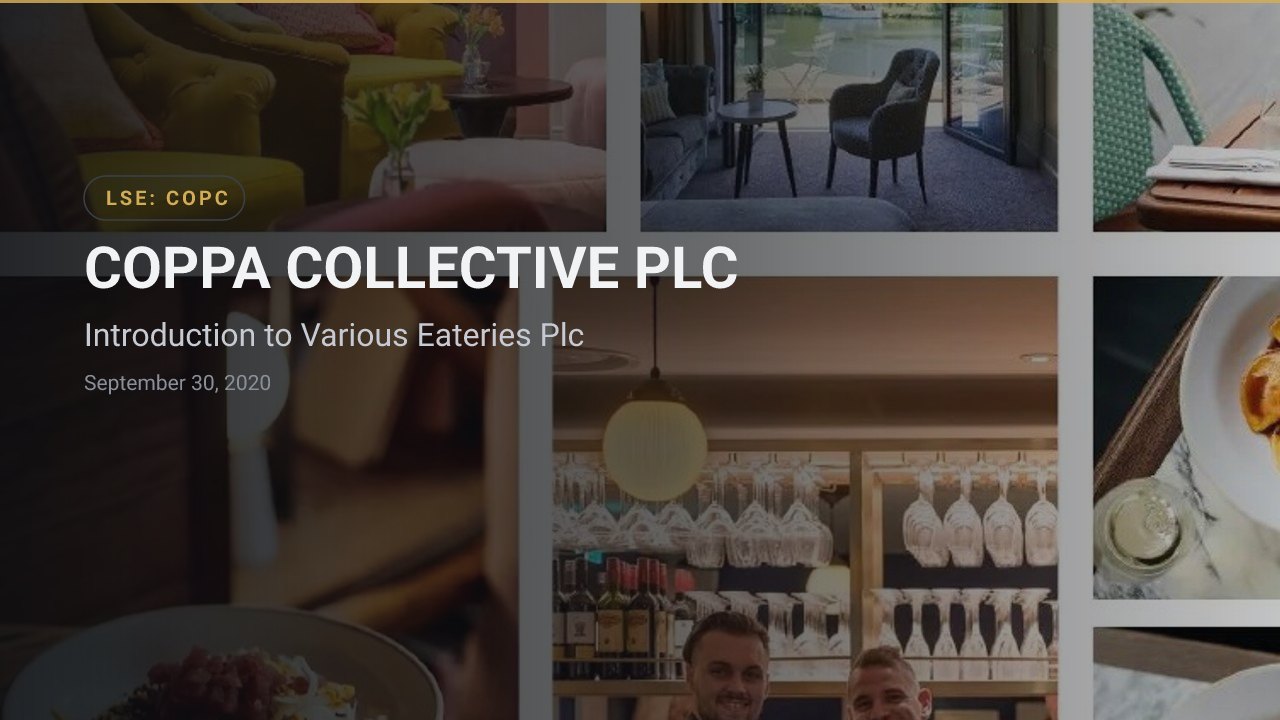
Introduction to Various Eateries Plc hosted by Coppa Collective (LSE:COPC) on Investor Meet Company, held 2020-09-30.
On 6ix: 6ix.com/event/coppa-collective-plc-copc-introduction-to-various-eateries-plc
Automated transcript · Written by software from the replay's audio. It can mishear names and figures; the replay is the record.
0:02 Good afternoon, ladies and gentlemen, and welcome to Introduction to Verus Eateries PLC Investor Meeting. Throughout this presentation, investors will be in listen only mode. Questions can be submitted at any time via the Q and A tab situated in the right hand corner of your screen. Simply type your answer and press send. The company may not be in a position to answer every question it receives during the meeting itself. However, the company will review all questions submitted today and publish responses where it's appropriate to do so. These will be available via your Investor Meet company dashboard. I'd also like to remind you that this
0:33 presentation is being recorded. Before we begin, we'd like to submit the following poll. I'd now like to hand you over to Andy Bacidone, Chairman Ishao Malcov, CEO and Ollie Williams, CFO. Good afternoon. Good afternoon. Good afternoon. Thank you for joining us. First, I must briefly apologize for the absence of Hugh Osman. He's actually, as as I speak, he's on the phone to the government representing the hospitality industry and arguing about whatever's coming up and what trying to find out whatever's coming up for us in this sector. And he he will be joining us shortly. I'm Andy Bastoni. I'm the chairman. I have had some thirty years experience of opening restaurants mostly in The UK, mostly multiple restaurants, chains of restaurants.
1:24 I started with those of you with older memories. They're my kind of town. Chicago Pizza Pie Factory, Chicago Rib Shack many years ago. It's small public company. Was very successful. And then I teamed up with Luke Johnson, and we started we acquired a little high end restaurants, the Ivy, Caprice, Jashiki, which is my first experience of running as a chief executive of high end restaurant group. And after that, we created Strada, which was a very successful, simple, wood fired pizza pasta and main course concept. We built that up to 27 restaurants. As you see, we sold it for 55,000,000, I think it was. And then we built and we built they doubled it in size and sold it for 140,000,000 relatively shortly afterwards.
2:15 What was the importance of that? The interesting difference between that and starting a chain restaurant business to stuff I've been involved in before is because I was running this high end restaurant group, I realized that this sounds obvious, but most of the chain restaurants, there wasn't enough focus on the quality of the food. So I got together with the head chef of Daphne's, which was a famous Italian restaurant at the time, and after that, we created the simple style menu. And you are rewarded by doing a high quality product. So it's high quality product of mid market prices. After that, I was involved with the cofounder of COAT restaurants, which are 96 now. I sold ads out at about 45, and COAT was a bit similar to Strada in the sense, there wasn't many people catering to the French market. You probably all remember Cafe Rouge, but that started in the mid eighties and it gradually calmed down and lost its way a little bit. So the market was wide open. So we we found a coat which was high quality, simple French bistro food at mid market prices.
3:29 Built up 44, sold for a 100,000,000, and then that was two years later, that sold for 240,000,000. That's now 96 COATs. It's still still still doing very well, and it's focusing again, focusing on the product. Around the same time, we were backed by entrepreneur to buy bills. Some of you have probably seen bills, but the original bills in Lewis and Brighton were very quirky daytime cafes. Lots of people wanted to buy them, and and then we could figure out how to roll them out. So we we we we bought them and with Bill Collinson, the founder, we expanded it quite different from the original idea. Get the spirit of the original idea, but we expanded it to a 65 strong restaurant group.
4:18 And finally, last piece of the puzzle, recent relevant history, was I was involved in the initial five restaurant rollout of the IV because in the past, I had run the IV as a premium restaurant group. And we were challenged to create a roll out version of the IV which we did and that's come on to be very, very successful and our chief executive, Isha Malcov, opened 30 of them over about three and a half year period and probably the most successful most complicated rollout possible. So we've lots of rollout experience. The other guys have a lot of rollout experience. It's just arrived. Hot off the hot off the telephone to the government. Hopefully, it's canceled all the all restrictions on the hospitality sector. Of course. Yeah. Hi.
5:04 Afternoon, everybody. Sorry. I was a a bit late. Yes. I I'm not gonna go back and dwell on the events of the early nineties with Pizza Express too much, although I'd love to because that was a very fun time. But the only point I would make, really, is that
5:25 although it may seem counterintuitive that we have just floated a restaurant business in the teeth of probably the worst crisis that's ever faced the hospitality industry, it is actually more similar to how it was in 1993 than any time in the intervening twenty seven years. The early nineties in The UK, particularly in the Southeast, well, actually, across The UK, was quite a severe recession. And we bought Pizza Express just at the end of that recession when the high street had been absolutely ravaged, shops were closed. It was actually a pretty grim time. But because we shored up the balance sheet, we expressed we repaid all the debt, we raised money for expansion, it was the best time to be expanding a business. On every high street, landlords could say, were the only quoted company at the time that we're doing that expansion.
6:19 We're the only people that had cash on the balance sheet. We were expanding. They were welcoming us with open arms. They were actually asking us to come to their town and saying, come into this property. Take it take it on. And it was obviously, I would like to say we had a fantastic team there, and and we did. And investors who backed that float made more than 20 times their money by the time I left the board. That's not any sort of forecast of what we can do. Understand. Although, you know, obviously, we have ambitions to do something great again. But one of the reasons, apart from the fact that I think we did have a brilliant team, was that it we had a real following wind. Sites were easy to find. People were easy to employ, and competition was much less.
7:06 It was just a fantastic time to be alive, and we had a really good time doing it. And so, you know, I think although this is in many ways a kind of
7:17 horrible time for the hospitality market, it's also the best possible time to have money in your bank account, have a and have a listed currency to be out there expanding. And we really have got a good team here. It's not just Andy Andy and myself. I mean, Andy's built up six different groups over the last twenty five years, every single one of which has made a really good return for investors. But we've also got the team on on my right. Maybe, actually, Andy, you talk about the Just, you know, as I was mentioning earlier about the Ivy, Ishai Malcov, he's got a ex military background, which is very clear in the way he approaches these problems.
8:02 Very, very structured, brings everybody along with him. Really, everything's got a critical path. There's a method of doing everything. But what's interesting about him, apart from his military background, is that he's worked in high end stuff and in rollouts. So and the ultimate student was rolling out the IV in many respects. And that that mixture experience is why we've been successful in the past with chain restaurants because we've got a food focus at the top. He worked in New York. He worked for all famous people, Gordon Ramsey, Zuma, Rocco, and he'll tell you some interesting stuff about that afterwards too. And so their approach to rolling out. Ollie Williams, first class cricketer, apparently. He's also another only ever works in hospitality sector. It's McDonald's.
8:53 As you'd expect in a public company, highly competent accountant, financial analyst. But really what's interesting for me is that he's a great man, manager of people. He's not afraid to roll up his sleeves and get into a restaurant and work with the managers and the head chefs on their financial targets and educate them on target setting and how to manage how to manage their costs. This an unusual combination on an FD in a CFO. Again, like we were saying earlier, a chef at the top table, Matt Fanthorpe, trained in one of the most famous Michelin style restaurants in Paris, has done business for many years, then worked in the initial rollout of Jamie's and in Oldenstein, and then worked with Hugh on the development of COPPA, which we'll tell you a bit more about. So it's always, for us, super
9:40 important to have a chef at the top table because we're in the food business. Many of our competitors don't have chefs in senior roles. We don't understand that because surely we're in the food business. The other side of the thing, the other competitive advantage I think we have I've worked with the same design builders for twenty five, thirty years. They've built all the restaurants I've been involved in. So they built all the ideas, all the starters, all the all the bills, all the coats, as well as working for others. We don't own them, but we've had a long term relationship with them. What does this mean? It means that under pressure, we can open many, many sites simultaneously. There was one year where I opened 15 bills sorry, 20 bills and 15 codes, and they built more. And that means on time, on budget, and this is a really super valuable resource. On top of that, we've got great supply chain guy who has been around since Pizza Express days, knows all the suppliers in Europe, ran John Metcalf ran his own wine business in in Italy.
10:45 And obviously, with combination of Brexit and COVID, he's really shown again his worth by making sure we have uninterrupted supplies and significant degree of choice when his suppliers got into trouble. So that that's the the head office team.
11:02 It's over to you, Hugh, on the customer business. Yeah. And look, we've, I think, laid the point on the team, and I think the the reason for that is management is the most important decision that I think an investor makes before investing in any business. And particularly in in troubled times like this. You want a team that have received that have seen recessions before, that have seen bad times before, and and good times before. And there's a lot of management teams who can sit in front of investors and say they've got a great restaurant concept or what any other concept, and they can open a 100 restaurants. Restaurants. But this team has actually done it, not once, not twice, but multiple times. Now this is, in my opinion, the best, you know, the most experienced, the most modest restaurant expansion team in in the whole of The UK.
12:02 And, you know, the names are just there, you know, not because I say so, but because they are there, you know, Pizza Express, COAT, My Kind of Town, Bill's, you know, most recently, the Ivy. You know, Andy and Isha have just come straight from, you know, opening the Ivies in the most high quality rollout in terms of fit out, quality of food, quality of that's ever yet been done. They've just been doing that, and and and we have now got them on our team. So probably the other most important thing, maybe it's more important than the management, certainly as important, is go to a COPPA, you know, go to Tavolino. You know, the this is not a concept we're selling. Yes. We're, I think, selling, hopefully, how good the team are to you. We're we're talking about. But, actually, this isn't this is a real business. We bought the first site for COPPA in 2014. We opened in 2015.
12:59 I'll talk more about it later, but it exists. You know, we've got these we've got these six COPPA sites that you can go and visit you know, today. You can see that 11:00 on a Tuesday morning, they are super busy and pumping. They are trading well now even with the latest latest measures, curfews, all the other stuff, the COPCRs are still trading flat to last year and actually significantly up on the sites out of town. You know, that is incredible.
13:31 Tavolino, again, go and visit it. We've opened it more recently, but it is a league above the high street the the high street Italian chain restaurants that have been around over the last few years. So that's the most important thing. You know, visit visit the actual restaurants and hubs, and we'll talk about COPPA COPCUB is more than a restaurant. It's not just a restaurant. Visit them, judge for yourselves whether you think the place is good, and then say, and is this the team that can roll them out? And one last point on this this slide, we raised the money to take advantage of this opportunity. None of us is taking any money off the table. You know, we have raised the money. It is in the bank account, so we can turbocharge this expansion and take advantage. Not take advantage of other people's misfortune because many of the people are are running.
14:30 In fact, we know almost everybody in the industry, and I wouldn't wish ill on any of them. It's a brilliant industry, and it's
14:35 really sad to see what has happened. But the site availability, the availability of staff, you know, now is the time to be spending this money, and that's why we raised it. Alright. Look. Do I need to tell anybody that this is the most disruptive event to hospitality in our lifetime? You know, maybe ever in the history of hospitality going back as far as the black bear. No. It's no. It's it's absolutely a huge disruption, and a lot of the poor and mediocre competition has sadly already gone to the wall. I think Andy has probably already said there's 22 or 26, I think. And it moves so fast. I I can't remember how many. It's 26 different major companies already gone into insolvency.
15:21 Even good businesses have been hammered by force closure and are desperate for investment. So even the good businesses coming out of this will will not be in a position to compete with us. We've got money in the bank and and this team, you know, household names, you know, COLLECTIVE PLC, BETTER ITALIA, CAFE RUCE, EASE, ARSPAR and PICIXpress. They've all all in some sort of insolvency. So great sites are now vacant, closed, even in the most prosperous towns. Mhmm. Landlords are desperate. And, you know, from this chaos and from the ashes of COVID, there's the opportunity to build
16:01 potentially one of the the biggest multi site leisure groups ever. You know, it's that big an opportunity right now. Yeah. I mean, I I think I think what because we've been around a long time in this industry now, I think there's a couple of things to just to remember. There's this concept of the food pound. How much do people spend of their food pounds in eating out? What's a food pound? A food pound is everything you spend on food. Could be grocery shopping, could be takeaways, could be eating in a restaurant. And when I started this business or after I started this business in the sort of '93, '94, I think it something like century? Yeah. It was something like 14 p in the pound was spent on eating out. And then over those years, so twenty seven years later, it's now $40.40 p in the pound It's now spent on eating out. So so what?
16:54 Well, why am I going on about this? I'm going on about this just because in The UK now, when I started this business, eating out was a massive treat and lots of people didn't do it. Now it's the the way people define their lives, you know. 70% couples work, both work, and they're cash comfortable and time poor. And you can see the growth of coffee shop businesses, all sorts of other related businesses wanting to spend money on food outside grocery stores. Now this is, you know, this is so why am I saying this? I'm saying it's because once COVID has passed and we found drugs and vaccines and testing systems that will help us either live with it or it will disappear, the hospitality business will come back with a bang because it has done that over a twenty five year period. And all those years, people would say to me, oh, Andy, you know, 2007, you know, what are you gonna do now?
17:46 Well, we're gonna found COPC, and we're gonna buy bills. We're gonna have 100 so restaurants. You know,
17:51 There's always a market for restaurants, and it's not going anywhere, and it's a cultural thing. So just making that point. So and one of the things that held us back in the good times, site availability, Hughes touched upon that. Whole relationship with landlords is gonna change. In the old days, you'd find a great site in Windsor. You'd probably have to spend £500,000 to buy somebody to get out of that site, then you've gotta pay top rent for it and off you go. And you've got a rent review every five years up to 10,000,000. That's if you could find the site. If you could get the site. I mean, that's the first thing. That situation, that site in Windsor, which I won't say which one it is, is now available for no premiums and no key money to get in, completely new terms and conditions on the lease that we can dictate.
18:37 And in the past, the relationships we've the power of the landlord has been really the big thing in The UK, and the tenant has not been in a very strong position. Because retail has gone down, restaurants have gone down, offices have gone down, commercial landlords now are desperate for tenants. So we will be able to get cheap sites in great towns, and we're already looking at literally, there's more than a thousand closed Italian restaurants, for example, between the chains. So when when COVID passes as it will surely will at some level or other, when people come out and go out to eat again as they and in fact, they still are doing that even in Central London, they will find much fewer restaurants to go to. So there'll be a structural reduction in our competition.
19:26 So we have lots of sites, have much less competition. I suspect 25% less restaurants. We will have unfortunately, this is a sad fact, but there are lots of highly talented, great quality hospitality staff who are either already lost their jobs or are gonna lose their jobs. And I take no pleasure in this at all. But recently, we advertised for two sous chef positions in the the big copper club of the igloo opposite Tower Bridge. We had 900 applicants. I mean, I can't tell you what a big number that is. We would
20:02 expect maybe 20 applicants in the past. So this is credible shift in talent. Also, there's been an explosion of business outside London, outside the center of London, you know. It's London suburbs are very busy. It's just that central part of London that's suffering. We think this will change. There'll be some change in consumer behavior, and we think people will be working not completely from home, but a day, a day and a half from home a week. And this is also very good for our particularly our COPPA brand. So the things that are holding it back are no longer holding us back. So we should talk about brands, COPPA. Yeah. Look, I let's say my best advice to anyone thinking of investing in the company is going to visit COPPA, and please spend lots of money while you're there because that will help investment, obviously.
20:53 So but what what is COPPA? If people haven't been to it, it's not a restaurant. So I spent little time trying to educate Isha, Ollie, and Andy that it's not a restaurant. And, you know, what what do I mean by that? Why is it important?
21:08 When I I took a bit of time off from the industry. Andy's well, Andy was on his fifth or sixth or seventh successful group. I took took a few years off. And when I came back, I didn't wanna compete head to head with the increasing competition from the all the different change restaurant on the high street. So I was really interested in what had what had changed since the early two thousands. You know, why were the coffee shops full at 03:00 when restaurants and pubs were empty?
21:35 Why did they close in the evenings when the pubs became full? And why did people leave the pub and go and often eat somewhere? And and and, you know, if if if girls were now drinking as much as as as those, where would where do they like to drink? And, you know, these may sound like strange things to ask, but and why were people sitting outside in December? So when we did design with COPPA COLLECTIVE, it was it was meant to take account of of those things. And so it's not a restaurant. It is it's SoHa house without the membership, you know, a little bit detuned. It's a place people can hang out all day. They can go have breakfast. They can go to work. They can go for coffee. They can go produce. They can have and and then they can sit on their laptops. And if that's all they do, we're we're we're not gonna hassle them. But most people then, they stay for lunch, they stay for the afternoon, you know, they have a bottle of wine or a beer in afternoon.
22:29 So it's a bar in its own right. It's not a bar where everybody goes to the bar, is waiting to go into the restaurant. And if they're in the bar, they don't have to get forced into going to the restaurant. Do they shy? No. They don't have to get hustled out of the They wanna just hang around in the bar, spend, you know, $20.30, $40.50 pounds on a few drinks in the evening and then go home, you know, they might come back the next day for for something to eat. So it's it's a bar in its own right. It's a coffee shop in its own right. If
22:57 just wanna go for coffee, you just go for coffee. It's a place to work in its own right. If that's what you wanna do, then that's what you wanna do. And there are places more set up where you can eat, but actually you can eat or drink anywhere in a coffee club. And so as a result of that, we don't compete head on with either restaurants or pubs or coffee shops because we're all of them. And we don't compete with customers, and we don't compete for sites. We look at sites that no self respecting restaurant chain would even look at. And, you know, our first site was a really, truly awful hotel in Sonning in Berkshire. And Sonning's a small village outside Reading, which was only famous because George Clooney had bought a house there.
23:44 And I think Theresa May is the local MP, and she came to our opening, and we had to think about whether that was on brand or not. But it was anyway, was great.
23:52 And so it was a terrible restaurant and a terrible hotel, and the hotel restaurant took less than £250,000 a year. It's £5,000 a week. We that same space now as a COPPA COPCUB regularly takes more than £300,000 a month. So it takes more every month than it used to take in a year. It's a real club venue. It rocks. And and a bit like SOHOUSE, again, it's not one type of venue. We don't just do that. We have flagship places a bit like a Babington house or whatever where there's rooms and maybe there's yoga on the there's a yoga studio and there's paddle boarding and there's a gym and and the the full kind of club experience with 50 rooms. And then we have kind of high street hubs like the one in Henley, which still have a bar kind of restaurant area and a lounge, but they're in a more traditional restaurant space. And then we have, like, Tower Bridge, Tower Bridge site, spectacular site, Igloo's, 150,000 Instagram followers, one of the top 10 things to do in London. It's a bit more glitzy, mega club brasserie. So it it's not a chain and it's not a restaurant. It's it's a club. And, yeah, it's rocking. First one's been open five years.
25:02 It's still rocking. And Tabilino Tabilino brand? Tabilino is our new Italian brand. Why Italian?
25:11 There's a parallel to the COPC story. You got just recently did a poll, so Italian food was not only number one cuisine in The UK, it's number one cuisine in the world. So what does that result in? That's resulted in a massive relatively it's a massive Italian chains coming, and I don't know why, but back to my original philosophy about, you know, chefs at the top. All of these chains did not have any chefs at the top of their organization, and they produced okay product, and then they competed on price. So they went into this discounting war. And the parallel is with the French market with COAT where nobody was doing it really. So there was a opportunity to do much higher quality French food at the same price as Cabir Rouge was at the time.
26:01 Now the Italian you know, there's a great demand for Italian food. Nobody's really focused on the product. So we're gonna do high quality Italian food at mid market prices. And if you go to Tavolino, you'll you'll see what I'm talking about. So we've got a great chef who's the starting point to help develop the menu a bit like the Danish chef who helped her do the original strata from Giorgio Locatelli's kitchen. And we produce this fantastic quality food. It's really being well received, and we think there's at least room for 50 full service tablinos, which are equivalent of Italian codes, if you like. And for the record, there's 94 codes now. And then and then within that, there's an opportunity to do pure pasta restaurants. In London, particularly, there's five or six emerging small brands who have been doing fabulous business just focusing on fresh pasta. And once you've eaten fresh pasta made on-site, you won't go back to a chain Italian restaurant because you'll notice a difference, and we can charge you the same price for that as you would in one of the chains.
27:08 So it's a it's a massively popular cuisine. We did it with French. We're gonna do it with Italian. There's also an opportunity for pure pizza. The only one I would cite, which I think is very good, is Frank and Manka. There's an opportunity to do a the a another type of specialist pizza out there as well. And we think in total, there's room for a 100
27:31 conservatively Italian operations that we can develop and run. So I'm I'm really excited about that. And it's high quality food at mid market prices. Nobody objects to that. Right. So Andy and Hugh will talk for hours about the opportunities that present themselves and why our brands in particular are sort of perfectly placed to exploit them. I think you've you've been in luck today. That's the least stuff that they've ever done. But I wanna talk about the business that we currently have right now and and go back to that that Hugh alluded to earlier because we have a strong base business now. We have some fantastic assets, and we have some highly profitable assets. The the COPPA COLLECTIVE estates across the the different formats, and they are different. We have sort of two of what each of the the sort of formats we would look at are all profitable. So all six sites are profitable and doing well right right now.
28:18 So Andy and Isha joined us sort of about twelve months ago now, and we've been busy preparing for this growth. I think we as as it's clear, we were going to roll these sites out anyway pre COVID. Obviously, the the opportunity from COVID accelerates this, but we were we were ready to go before COVID. We opened three sites in the in this financial year before COVID, all above our expectations, all strong profitable sites, and we were we're on-site now. We're about to open our seventh copper club in Covent. And I we started a board meeting just before COVID when we signed that off, and we were excited about that site. And I think it's almost that site in particular is almost perfectly designed for this post COVID world and fits perfectly with what what what we're about to or trying to achieve.
29:05 I think we've we've been working on the menu. As as Andy alluded to, it's so important as a restaurant brand to not forget the quality of the food, and we've not only worked on that on the quality of the food, we've also improved the operations and the margins on that menu, and we won't lose focus on that as we grow. We've consolidated the hotels at Sonning and Streetly to the hotels that Hugh talked about into the group so that we can consolidate the management of those and and run them as as single entities. And finally, Andy sort of touched on the brand of Tavelino and the new site at at Moor London at Tower Bridge. What he didn't touch on is that we've got two other strata sites ready to go to be converted into the Tavolino brand, and that is is a really exciting kick start for, you know, at the moment, just a one site brand that we've got two other sites ready to go to really kick start that, and the site on the South Bank is is a fantastic site to do that.
30:00 And and and finally, I just wanted to touch on on the performance post lockdown because when you work for a restaurant chain, when you see if over a restaurant chain and the government tell you to shut and you're sitting at home for three months with with no money coming in, you you obviously worry about what the future looks like and whether you're whether you're the right brands to take advantage of the the world post COVID. And I think we were all fairly confident or very confident that our offers will be perfectly suited, but you don't know it until it happens. And I think our results have have been, you know, really impressive, above our expectations since we reopened with with positive like for likes in in the COPPA COV estate up to the end of August, and that is obviously split across the sites. But you've got some sites outside London doing some absolutely fantastic double digit growth.
30:47 And then finally, the Tavolino site, which has only been open for a month or so, but it's performed above our expectations or in our expectations, and it's really exciting. I think we're really keen to see to see where that's gonna go when when everyone comes back to London. Isha is gonna talk you through the the growth. Yeah. Sorry. I'm I'm just I'll be repeating sort of some of the things that Hugh and Andy already said, but just to sort of illustrate how this looks. So our growth will be made up of COPPA and the different iterations that COPPA can be, Tavolino and the iteration that Tavolino can be, the acquisitions and that that potential acquisitions that enroll out that Andy touched on. So we find a a nascent brand that we feel some complements what we do and that we can help them about sort of superimposing our structure and our strength and helping them, grow.
31:39 And then last and but not least is the hotel element of our business. So aside from from restaurant, we are also we we also have two hotels as part of our state, and we are we have a hotel operating arm. So we are specialists in both ends. I mean, I personally have worked in both in restaurants and hotels, but we we you know, they don't naturally mix, you know, I guess, the the the old adage about hoteliers not knowing how to provide restaurants and vice versa. You know, there's maybe some truth to it. Luckily for us, again, we have the expertise and what we can do is especially in, I guess, in this environment where a lot of country hotels, you know, maybe an owner has maybe 10 or 15 sort of three, four star hotels out there, and, obviously, business has been suffering with everything that's happening.
32:25 And what we can do is we can offer a solution to sort of utilize their real estate, you know, make sure that the rooms run properly, that we give them a a reason for being putting a a a COPCUB in that in that hotel and and giving them sort of a new lease of life, you know, being able to run their events for them or any part of those or rooms events or or or F and B. Those are this is our four pronged attack, so to speak. And and I said the other thing I would like to to touch on is maybe again, I'm not sure how many of our of the participants today are from the industry or from outside, but sort of, you know, touching very briefly on how is this going to work. So why, potentially, are we better placed than our competitors out there? What does it take to actually make this work? Because as Hugh said initially, you know, anyone can sit in front of you and say, we can open a 100 restaurant or 200 restaurant. You know, we've got the money for it. The the money is one element of it, but, really, the money is a technicality.
33:22 In order to do this, so be able to to to grow at pace, to take something, make sure it grows at pace, you need to have a few things. One thing that you need is you need military structure and discipline for it. There's no other way, especially in times like this. You have to be able to be extremely militarized. You can't be, you know, this can't be a democratic process where everybody sits around the campfire. You sort of you you sort of talk about it through the night and then decide what to do. It needs to be quite military like. So everybody has a role to fulfill. I know it's it's besides the point, but it is very important and not everybody out there hasn't. The second thing that you need to do is you need to have gone through a crisis to be able to know how to act during a crisis because it's one of those things that until you've done it, you don't know how that works. You know, where Andy alluded to, you know, what happens in 2007, 2008 when everything was crumbling and, you know, COLT was snapping up sites.
34:13 Q back in the nineties with with Pizza Express. I mean, personally, my my my personal experience in in '9 in in 09/11 in in in New York when, you know, obviously, you know, with the Twin Towers, and it was a very tough time for the industry. And and and there was a lot of fallout from that, but also with that fallout, there came a lot of opportunities and a lot of learnings for me personally. So, again, the military structure, the experience, and then sort of I know it's oversimplification, but how do you how do you do this? How do you open a vessel? We need three things, Chris. You need quality, consistency, and pace, which we've all touched about on, but I just wanna focus on them. So quality meaning, quality is always at the top. So whether Andy was referring to the food being quality, you know, quality in, if you control it well, it means quality out. And the quality is first consistency, the ability to deliver that quality consistently in multiple openings and to be able to do it at pace. So the speed in which you do it is also a big factor. Now there are operators out there, and we've sort of mentioned them by name, they do a fabulous job, and have done a fabulous job. But, also, we know that the the past six months have shown a lot of weaknesses in in in in others.
35:25 And I think I'd be hard pressed to say how many operators out there do you know a person or a person that that can deliver that quality, consistency, and pace. And I I would be hard pressed to be able to count more than a few. And I think that's where our expertise and experience enables us to take advantage of this sort of situation. So we, you know, we've been there before. We are the right size, so we we don't have 200 sites now. We we are 10 sites, and they're all profitable, and we don't have a large tail behind us. We've got the structure and the know how, and also we have the right product for these times. So both with Tableau and with COPPA, we are you know, whether by luck or by by by you know, I think part of it is, you know, there's a lot of planning on on Hugh's part in doing it for a long time, but also some of it may be may be luck. I don't know. We do have the product now to fit these these these these new realities. So I think it's now done to us just to you know, now that we've got the money in the bank is basically the pounds and and utilize these opportunities.
36:28 Hugh? Thanks. Thanks, Ishai. Yeah. Look. Every if you're gonna open, you would in one year in Pizza Express, we opened 52 restaurants. We had an ambition to do one a week, and we did that back in '95 or something. But to do that, every team needs the military guy. And so we've got one of those as well as the concept guys and the food guys. You've gotta have the military guys who gets the gets the stuff done. Use of funds. As I said, this is a 100% expansion capital. Neither Andy or I or anybody else taking a penny off the table. We've no intention of doing so anytime soon. Before we thought of floating, we were going to open we plan to open two to three COPPAs, two to three TAVALINOs a year. You know, we had it all mapped out. We had nice you know, it was a it was a nice plan. It would have grown profits, you know, very happily as it was.
37:30 We are raising the this money to turbocharge that expansion, and that is why we're raising it. Now I cannot tell you how the the being a listed company with money in the bank, I cannot tell you how big an advantage that would give us, but it will be massive. You know? All the landlords looking at people, private equity back, loads of debt, loads of this, struggling, and then we'll be there. Money in the bank, share price they can see in the paper, they will want us in those sides. You know? I absolutely guarantee that will be the case. And as I said, you know, this this team, we've got the experience. I'm not gonna tell you again how wonderful we are. May maybe one more time. No. I won't. Okay. I won't won't go on about that anymore. But actually, it's not because we say so. It's because the actual documented proven track record says so.
38:23 And the the business, again, we said, mean, it is partly luck. You know, we designed COPPA COLLECTIVE. It's trying to design the way the market was going, and COVID has accelerated all that. It couldn't have been designed better for a post COVID world, you know, big spaces, plenty of room for social distancing, set up for people not in the office to able to work, you know, those who say they're not They're working from home. Actually, quite a lot of them are working from COPPA and while also being fed and watered. You know, it's a it's a good concept for the twenty twenties. And likewise, Tavolino, I mean, the devastation in the high street has hit the mid market chain Italian sector harder than anybody else. If there was ever an opportunity to bring in a a high quality Italian, you know, the level between the sort of coat and the ivy, now is the time. COVID has again completely accelerated that opportunity.
39:13 And In terms of other things, we know everyone, you know, pretty much who's anyone in the industry. We know what's going on with all the other companies. We know who who's which is a good company. It's just been hit by COVID, which is a bad company before. We're monitoring all the other opportunities. There may be other stuff as well. You know, with with the money in the bank, the listed currency, we're going to build this into something pretty good, I think. And thank you for listening, and we'll move on to questions. Thank you. Thank you very much. Thank you, Hugh, Andy, Eshali. Thank you very much for presenting. Ladies and gentlemen, do please continue to submit your questions using the Q and A tab situated on the right hand corner of your screen. I just want the company to take a few moments to review those investor questions submitted already. I'd like to remind you that recording of this presentation, along with a copy of the slides and the published Q and A, can be accessed via your investor dashboard on the Investor Meet company platform.
40:10 Lastly, before I hand back to the team, we'd like to remind you that your feedback is important to the company. Immediately after the presentation has ended, you'll be redirected for the opportunity provide feedback in order the company can better understand your views and expectations. Perhaps before we look at some of the live questions that have come in, we did have a couple of pre submitted questions, most of which you've covered off. But perhaps there's one just about geographic focus for your rollout. If I could just pose that to you. Did think you did cover most of that off, but just if there's anything else to add there, please. Well, I think, you know, good operational practice is you build out from build out from the South. You know, that's what I've done with all the businesses. So, you know, we're predominantly in in the South, and we will just continue growing. It just makes life easier. You know? There's absolutely no science to it. It's just obvious that rather than rush up to Edinburgh, we'd rather get a bath.
41:02 Not that there's any difference between those restaurant towns just in terms of logistics. Fantastic. Thank you very much. And perhaps if we could just have a little look through the q and a that's come in and if there's anything you can add or answer, that'd great. If you could just read out the question, that'd be fantastic. I'm looking for rolling out the actually, there's one here from Nick. What's the time you are looking to rolling out? And are you waiting for a little more COVID clarity? Well, two two things there. One, yes, obviously, we're all waiting for a bit more COVID clarity, but what we do think is going to happen is this is the first wave of of problems that the industry is facing, and we think there's been a lot of government support, and we think even more, unfortunately, for people involved, even more sites will become available in the early part of the New Year when the various government sports teams peter out.
41:52 So we've got I think we've got a sick eight eight in total, six openings and two conversions planned for this year. We'll probably go a bit slowly at the start and speed up once we've got more clarity with COVID and also when more opportunity arises because we're only halfway there in terms of the shakeout. Maybe you can answer the next one. So just another question from Abby Abby I'll do that one. Oh, yeah. Maybe you so as as as you mentioned, there are a number of distressed brands. What's your preferred route to buy the stressed brand or to go down the right route? I look. I I think on that, first, there's two different sorts of distress. You know, there's one that were a number of restaurant concepts and chains that were really kind of in trouble or fading anyway.
42:45 And however distressed those are, however cheap, we we would not be trying to turn around brands that we didn't have a future. That's, you know, way too hard if indeed it's possible at all. And in fact, you know, I mean, I would even with a strong company, I would hate to be in a position with 300 sites going into this even if I had a good company. The idea of negotiating on 300 landlords, 300 sets of staff on furlough, 300 I mean, it's just a nightmare. So I think that is all really difficult stuff. On the other hand, as Andy said, there were some really good young companies, you know, with just one, two, three, four, five sites who are doing nothing wrong, running a bit lean on capital as you do when you're in a start up. And they had really good concepts going into this, but they've been really badly affected.
43:34 And now they need a bit of help financially and with the rollout, and it could be that amongst those kind of emerging brands, we find something good to add to our portfolio. But the main I mean, the the the main thrust of it is organic rollout. Mean, there are so many opportunities out there. It is difficult to rule anything out. The opportunity we can see right here and now is that in Andy's inbox, he's got a thousand sites, many of which were in places where before you couldn't buy a site for love or money. That's the main opportunity. Having said that, every day, things change change. We know everything that's going on. If a really interesting group comes up that we think still got growth potential and expansion potential, and it's a purely financial, or, you know, where we can help financially and with expertise, then, of course, we'll look at that too. I mean, it's just it's filtering the opportunities now as opposed to trying to find them.
44:25 We've all got calls coming in every day. I think there's a there's a yeah. Yeah. So how much is maybe that's most for Ollie. So how much of the 25,000,000 from Alex? How much of 25,000,000 is already earmarked for expansion plans, and how much will you keep as dry powder during the current crisis? Yep. Thanks, Alex. So yeah. Just first of all, just to be clear that the the money raised, the 25,000,000, as as you said, is all staying in the business, it's all for expansion. The in terms of the current crisis, I think as we alluded to, we're we're we feel like our sites as large sites are well set up to cope with the next three, four, five, six months, however long these restrictions go on. We have big sites which make social distancing easier. And, obviously, the the shutting at ten is, you know, is a pace of pain for everyone, but I think we're not people we're not a restaurant business that rely on the the wet trade late in the evening. So I think that we will look after each other and I as so can you imagine, we'll look after every penny over the next three, four, five months and make sure that the the money's still there in the bank for the exciting expansion plans as the sites become available. There's a problem there there's a question from Nick s, freehold or leasehold if the latter, how long a lease, and what size of site do you consider?
45:41 I meant to actually mention the freehold. One of the things that was very good for us at Pizza Express in those early nineties was we could sometimes pick up freeholds. We've just done this down in Cobham. There was a small strata restaurant there, but it wasn't big enough for a COPPA or a tabolino. The bike shop next door went went bust, then the estate agent got in arrears to rent. We've now bought the whole building freehold, and we're going to be able to put a roof terrace with igloos on it in the middle of Cobham, which is gonna be amazing. And the reason we could do that is because we bought the freehold, and hence, we could get planning permission for the whole site and do something really special. Long term, will we keep freeholds? I don't, you know, I don't know. But we certainly having the money in the bank and the and and the PLC government gives us that opportunity as well, and and so that's on it. In terms of size of site, the big coppers need very need need big property need big sites, so five, six thousand square foot for the full kind of flagship site.
46:39 But then we do the high street kind of hub model of copper, and Tavelino is much more suited for a more traditional restaurant site in a really good place. So the flexibility of the concepts we've got is we can take different types of site, and I think that answer that. And while I'm on that question, Matt, pieces 31 below parts portfolio. Yes. It is. It's essentially COPPA COLLECTIVE PLC It's the bar version of COPPA as opposed to being a separate brand. It's it's a little bit small for the social distance world we're in at the moment, So we're gonna have to reassess how this lasts and how this runs before we decide it its future. Because it's more of a bar, it's it's probably our only slightly COVID less friendly venue. So We're opening opening it tomorrow. We're opening tomorrow. So we'll see how, yeah, how that goes.
47:34 And yeah. Good. That I think that's me again on the typical COPPA customer. So, yes, I'll just read it out. So Ben is asking, how would you describe typical COPPA customer versus lounger customer, for instance? How many Henley owned tenants out there in The UK in terms of rollout, and how does the demographics work? Yeah. And I look. I've really kicked myself for missing lounges as an investment because I was aware of it when they just had two places, and I thought this is absolutely absolutely on the money for the way the market is going. And what they've done is an all day clubby type version of pubs. And COPPA is a little bit it's it's it's slightly higher up the market and more towards a solo house, as I've said. So, you know, that's really the the difference. It's the kind of so so house type customers who don't wanna actually sign up for $2 a year of membership, etcetera, wanna drop in and work and whatever.
48:29 Lounges is doing similar thing, but in the kind of pub cost pub customer trading up, if you like, for the all day. So a lot of the themes are similar. Our customers are, you know, a little bit a little bit different. We sell actually more food. We have more people working and doing all day stuff compared to them. But lounges is is a brilliant concept, and I cannot believe that having missed the opportunity to invest in Nando's in 1994, having turned down that one, I turned down lounges, like, two or three years ago. So that was but it's still it's a it's a a good concept, and if you like, we're an upmarket version of of that. And the answer to the Henley On Thames point, it it you know, it's interesting. If you go to London, there's loads of places you can use like a COPPA. You know, there's the and there's the SOHOUSE. There's all these clubs and hotels.
49:17 Soon as you go outside London to all the kind of wealthy, you know, well reasonably wealthy areas, they don't exist. There's no way you can go and hang out all day. Yes. There's a coffee shop. Yes. There's a pub, and yes. There's a restaurant, but there is nothing like a COPPA COLLECTIVE in these towns and not just in the Southeast. But I as Andy said, the Southeast for logistics purposes is the obvious place, but you could just as well be in York or Leeds or, you know, Manchester, assuming city centers ever reopen. So it's there there's demand for this way of working, you know, for sure. Think It's probably more. There's maybe a couple more questions. Sorry. I can't see any any new ones. I think that that is I think, guys, you're the you've gone through, and you've done a very, very great job of actually answering all the questions as you've gone through. So thank you very much indeed.
50:08 And of course, if any more questions do come through, the company will be able to review those questions submitted today by investors and publish responses to appropriate to do so on the platform. Just conscious of time as well, so we are coming up to that hour. Just before we do go, Hugh, perhaps I could just ask for a couple of couple of lines just to wrap up from your head of directing investors some feedback. Okay. Yeah. Well, I think I've say, I've summarized the the proposal completely. You know, it's obvious that this is it's counterintuitive to launch an IPO of a of a restaurant group into the teeth of the worst crisis in hospitality ever. We understand that. That's why we're doing it. And I'm pleased to say we got it done.
50:54 Thanks to WHO and who did a great job, and thanks for the investors for supporting it. You know, all the investors that have come on board, I guess, they see why this opportunity exists. And I can say the next, you know, three to six months, we fully expect to be tough for the industry. But within that toughness will be the opportunity for us and people I don't believe long in the long run, human beings are gonna get less sociable. Human beings are gonna want to go out less, and I don't think people will actually go back to wanting to cook every meal at home. So in the long run, hospitality industry will revive, we'll and be right up there, hopefully, leading it. And so thank you to everyone for for tuning in.
51:41 Yeah. Well, thank you. You. That's great, guys. Thank you very much for such a comprehensive run, Fiori, and congratulations on your recent recent listing. So thanks again to the various Eateries team for updating investors today. And could I ask investors not to close the sessions? You will be automatically redirected for the opportunity to provide feedback. If you've accessed the meeting through our website, the feedback form will appear a couple of seconds after the end of the webinar in front of you. If you access via the link in the email, you'll be asked to log in and give your feedback. Do please take a few moments to do so. Your feedback is always important. So on behalf of Veritas Eateries PLC, an investor meet company, thank you very much for attending today. Concludes today's session. Thank you. Thank you very much. Thank you. Thanks. Thank you.
Follow Coppa Collective PLC into a list and get an email when it puts out news.
Founder at COPPA COLLECTIVE PLC
Executive Director at COPPA COLLECTIVE PLC
CEO at COPPA COLLECTIVE PLC
CFO at COPPA COLLECTIVE PLC
at COPPA COLLECTIVE PLC
Adviser at COPPA COLLECTIVE PLC
IR at COPPA COLLECTIVE PLC
PR at COPPA COLLECTIVE PLC