Shaky Panchera
at Kirin Advisors
Replay available
Cochin Shipyard (NSE:COCHINSHIP) Q1 2027 earnings call, held 2026-09-10. Watch the replay and read the transcript on 6ix.
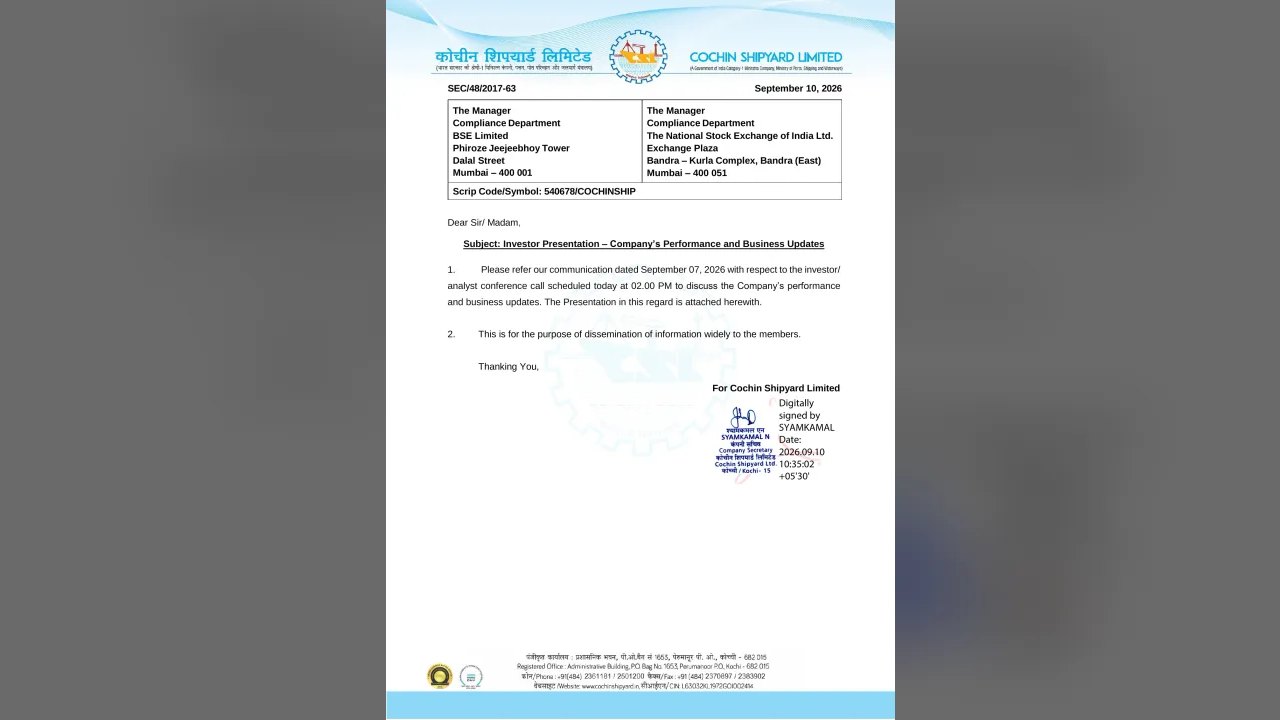
On 6ix: 6ix.com/event/cochin-shipyard-limited-cochinship-q1-2027-earnings-call
Automated transcript · Written by software from the replay's audio. It can mishear names and figures; the replay is the record.
0:00 Ladies and gentlemen, good day, and welcome to Cochin Shipyard Limited Investor Conference Call hosted by Current Advisors Private Limited. This conference call may contain forward looking statements about the company, which are based on the beliefs, opinions and expectations of the company as on date of this call. These statements are not guarantees of future performance and involve risks and uncertainties that are difficult to predict. As a reminder, all participant lines will be in a listen only mode, and there will be an opportunity for you to ask questions after the presentation concludes. Please note that this conference is being recorded.
0:46 I now hand the conference over to Ms. Shaky Panchera from Kirin Advisors. Thank you, and over to you, ma'am. Good day, everyone. On behalf of Caren Advisors, I welcome you all to the investor conference call of Cochin Shipyard Limited. From management team, we have, chairman and managing director and director of finance. Doctor Hari Krippan s director of operations director technical VP, executive director, chief general manager of finance and Company Secretary. Now I hand over the call to CEO for opening remarks. Over to you, sir. Good afternoon, everyone, and welcome to the Cochin Shipyard Limited Investor Conference.
1:35 I'm Josu Vijay, CMD, Cochin Shipyard Limited. And I'm joining today by Doctor. Hari Krishna, Director of Operations Sri Rajesh, Global Assistant Director, Technical Sri Shriva Priti, Executive Director, Shipbuilding Sri Shibhu John, Chief General Manager, Finance and Sri Sham Kamal, Company Secretary. Let me start by giving you a brief overview of our operational performance during FY 'twenty seven so far. During the period, TSL delivered three vessels, including the third vessel in the series of eight anti submarine shallow watercraft being built for the Indian Navy. The second multipurpose vessel under the export order for our German client, the double ended Roro Furry to Cochin Shipyard.
2:26 Our only owned subsidiary, Udupi Coast Shipyard, also delivered three vessels during the period, including two three thousand eight hundred EW General Cargo vessels to Wilson Group Norway and a 70 tonne Golar Puttuck to Azul's All Star Market and Adani Group company. Over to financial performance. Let me now briefly touch upon these details. For the first quarter, our turnover stood at INR $10.94.21 crores compared with INR $10.68.59 crores in the corresponding period last year. PBT was INR 202.49 crores compared to INR 49.54 crores last year, while PAT stood at INR 151.45 crores compared with INR 187.82 crores in the corresponding quarter.
3:18 Our EBITDA margin for the quarter was around 24 percentage, while PAT margin stood at around 14%. Joint venture details about the joint venture which is tied off well Dubai. Coming to future strategic initiatives, I would first like to update you on an important decision taken by Board of Directors that is meeting held yesterday. It has also been indicated to the stock exchanges. The Board has approved the proposal to form a joint venture with Dairok World Dubai, a deep world company for owning, operating and managing CSL International Ship Repair Facility, ISRF, at Wilmington Island, Cochin.
4:06 As you are aware, ISRF is a state of the art ship repair facility developed by CSL over an area of around three thirty acres of land. The facility has a 6,000 tonne shift lift and transfer system, six work stations and around 1,400 meters of berthing space. It can handle vessels of up to 130 meters and has an annual throughput capacity of up to 82 ships. The proposed joint venture will have equal shareholding with CSL and DDW holding 50% each. The JV will not only operate the existing ISR, but also undertake capacity augmentation through the addition of 10 more workstations.
4:54 From a strategic perspective, we believe this partnership brings together the complementary strength of both the companies. ESL brings its established presence in the Indian maritime sector and its existing ISR of infrastructure, while DGW brings significant international experience, operational expertise and a global customer network in Jupiter. The partnership is expected to help us improve operational efficiency, adopt global best practices and advanced technologies, reduce turnaround time and importantly, attract international customers to Cochin. We believe this will provide a strong platform for scaling up the ship repair business in Cochin. I would also like to highlight the transaction structure.
5:42 The ISR undertaking is proposed to be transferred to the JV company on a slump sale basis as a going concern for a consideration INR 1,800 crores. ASL will receive 50% of the consideration in cash, while the balance 50% will be received in the form of equity in the shares of JV company. The valuation of INR 1,800 crores is based on an independent third party valuations. The definitive agreement, including the joint venture agreement, shareholders' agreement and business structure agreement and license agreement have been finalized. The JV agreement will be signed tomorrow on the sidelines of the BRICS submitted at New Delhi, while other agreements will be signed after incorporation JV and receipt of requisite approvals.
6:32 There are certain regulatory and shareholder approvals required before the transaction can be completed. These include approval from the Ministry of Food, Shipping and Waterways, DEEPPA concurrent and shareholders of KSHIP. In particular, shareholder approval is required for the proposed transfer of the ISRF undertake. We will, therefore, be coming out with a postal ballot to seek the requisite approval of our shareholders. Subject to receipt of the necessary approvals, the transaction is targeted to be implemented before the end of the current financial year. Another important update I would like to share with the investors is regarding the proposed block fabrication facility at Cochin. As you may recall, PSLAS signed an MoU with the HD KSOE of Korea for exploring various areas of cooperation, including setting up a block fabrication facility at Valarbadam, Cochin for utilization of for the new drydock and the joint shipbuilding activities.
7:35 Since then, CSL and HD KOC have had series of discussions and engagements. However, we have not been able to arrive at a mutually agreed definitive terms for establishing VFS facility through a joint venture. CSL now will proceed with the development of the facility independently at a smaller scale, while we will continue to keep the option of a suitable strategic partnership open if such an opportunity provides value to the company in future. I would also like to clarify that this decision is specific to the Block fabrication facility only. Both CSL and HD KSOE remain positive about the relationship and have expressed their willingness to continue exploring opportunities for collaboration in other areas of mutual interest.
8:30 Another important project is our proposed ship repair facility at Wadhina, Gujarat, which GSL is developing jointly with Dindhaya Airport Authority. The project has already received CCA approval in May this year. The facility will have two floating dry docks capable of handling large vessels of around two fifty meters in line. We expect the environmental clearance shortly. And once the required clearance are in place, we are targeting to operationalize the facility within thirty six months from the receipt of environmental clearance. Now that our joint venture with Dry Dog World Dubai have been finalized, we may also explore the possibility of collaborating with them for the operation of this facility also at Gardev Vadina.
9:21 Another important update we would like to share is regarding our proposed facility at Vio Sidampara in Suthukuri. CSL participated in an e auction conducted by the court for a thirty year lease of land and waterfront to establish a hybrid shipbuilding and ship repair facility and we emerged as a successful bidder. Under this arrangement, against a onetime payment of INR 305.76 crores, CSL will get access to around 110 acres of land and 17.29 acres of waterfront area for a period of thirty years. We believe this provides an excellent opportunity for CSL to expand its presence and develop a hybrid shipyard in that location.
10:13 The facility will enable us to participate in the governing the growing midsized and niche shipbuilding segment, including European short sea vessels and wind energy vessels. It can also provide additional capacity to our subsidiary, Udupi Coast in Shipyard, which is currently constrained by availability of the land and as a result, has limited scope of taking up new orders. We are currently working on the modalities of developing the facility with shipbuilding, ship repair and offshore fabrication activities being planned at that location. For all these strategic projects, government support and policy initiatives will be very important, and CSL has already applied for financial support under the Government of India Shipbuilding Development Scheme for our greenfield and brownfield expansion project, which will help reduce the overall funding requirement and actual cash flow cash outflow of both these investments.
11:14 We also plan to fund these projects through a combination of debt and equity. In this context, Maritime Development Fund, interest incentivization fund, which provides interest of up to three percentage on the loans extended to shipyards and shipping companies, will also be very helpful in supporting the financing of these strategic initiatives. Finally, coming to our order book. Our current order current unexecuted order book stands at around INR 22,000 crores, which continues to provide us with good revenue visibility. We have also declared us L1 for a high number of next generation survey vessels for the Indian Navy valued approximately 5,000 crores.
12:00 Once this contract concludes, the order book will be around INR 27,000 crores. With that, I will conclude my opening remarks. We would now be happy to take your questions. Thank you, everyone, for joining us today. Thank you very much. We'll now begin the question and answer session. Participants are requested to use handsets while asking a question. I request to all the participants kindly limit yourself to two questions per participant, and rejoin for a follow-up. Ladies and gentlemen, we'll wait for a moment while the question queue assembles.
13:01 First question is from the line of Mohit Jornasir, Individual Investor. Mohit, may I request to unmute your line and proceed with your question? Due to no response, we move on to the next participant. The next question is from the line of Garvit Goel from Serene Alpha. My question is on Green Maritime, Maritime Propels JV.
13:46 I wanted to understand more on the product basket, which which will be catered by this JV. And and also, what is the ballpark scale that that JV is targeting over the next three years within that product basket? And lastly, when can we expect some meaningful contribution coming out of that JV? March. March. The company was incorporated in June 26, and we are targeting a product range of energy storage system, especially for the marine sector, then electrical power management system and all. And we are targeting here as per our business plan, we are targeting a revenue of INR $6.40 crore by INR 15.
14:37 This is our plan. And what kind of competitive landscape do you see for these sort of markets that you mentioned? How do you see like how many competitors are already there or maybe coming in the coming years? I'm just trying to understand what kind of margins we can have in these products. We expect a margin of around 20. And as per the green tech transition program and other various initiatives in the green sector, we expect a lot of orders for the battery in India in the coming years. So the prospects are very high. See, the basic purpose of constructing that JV is that, see, now, it's really the number one battery manufacturer, but they are not in the marine sector.
15:27 And we have our expertise in the marine sector. So this company will modernize that battery requirement for the marine usage. So now all the batteries and the battery systems are being imported for the marine operations. So already, we are building four green tugs, the battery system for that that are being routed through the JV. So already the CSL has already given order for that JV company. But we are not expecting much revenue or top line or existing from that company in the immediate future. So progressively, we are aiming a target of around $6.40 crores in the fifth year. Okay. And this 20% margins that you mentioned, is it fat margin you are speaking about or EBITDA margin?
16:18 It is on a ballpark figure because there are a lot of R and Ds also involved. But you are mentioning a bit... Yes. The business plan is actually evolved. We are on the process of making a business plan. Okay. Okay. Okay. And your partner, HPL, has mentioned that the JV has placed orders for batteries for two electrical drugs. Right? I wanted to understand with respect to this particular sort of category, what is the size of what is the market size do you people see maybe in next three years for electrical? Is the big pipeline there? And how many competitors are currently bidding in along with Ardal?
17:10 See, actually, this electric propulsion and on the TUG segment is just evolving. And this is because the Government of India has also recently declared the GTTP or the Green Tug Transition Program, wherein they're trying to put some major ports to start off with electric propelled tugs. We feel it will take a little time for a mass movement on this front, purely because the electric propelled tugs would cost almost twice that of a conventional diesel propelled tug. But having said that, with environmental requirements becoming more and more stringent, there is definitely no other way to go but move on this front. The Government of India is also wanting to see 50% of our tugs go green by around 2035% to 40 So there are going to be volumes that will come up. But I think the real movement will probably happen maybe three, four years down the line.
18:16 So to add more to that, so as per this program that all the conventional diesel powered harbor trucks will be replaced with a zero emission vessel. So this is implemented across various phases. And by 2040, sir, we are targeting a 50% green truck by year 2035. So the total investment in this sector is around 1,000 crores in the next ten years, and major buy is for the battery. So we foresee a good scope for this batteries in the coming years. And in this JV, 60% is held by HBL and 40% is clear, sir. So we have only 40% stake in that company.
19:02 Okay. And ultimately, whatever the sub loaders we are getting in this JV, batteries will be supplied by HPL, right? Yes, yes. Understood. And what kind of capital we are looking to deploy in this JV, sir, over the next three, four years? Not much because it is a technology driven because the manufacturing will be done by the SBL. So we are not getting we're not to be set up a manufacturing facility at all. We'll be marketing under the R and D, let's see. And the total capital is only INR 50 crores. Okay. This tug will be manufactured by HBL or you? Because you people are having that skill, isn't it?
19:50 No. Ship will be manufactured. Shipyard will be manufactured by us. The battery will be manufactured through by the facility, the existing facility of HBM, some type of contract manufacturing, contract manufacturing. Understood. Understood. Understood. And this entire revenue of the, for example, this that will be splitted between sixty-forty, right, HP 60 and 40U? Not the Battery. Battery. Battery. Can you explain a bit more like I'm just confused here. I mean how the revenue will be split? Because what I am understanding is if you people are selling the TU, right, the JV is selling the truck. Right? So battery is the internal component if you are purchasing from HPL as a stand alone entity.
20:44 See, that order for the truck will be taken by Cochin Shipyard, and the order for the supply supplying the battery will be given to the JV. The JV will have the turnover for only the battery. Okay. Okay. And that will be manufactured by HBS? Yes, yes, yes, yes. So this INR $6.40 crores, which you are speaking about, this will be the JV revenue, right? JV revenue and that will be consolidated by HBA only because they are holding 60%. That is by the 50%, progressively, six forty by 2031. Okay. And just last thing, then I'll join back the queue. This 20% number which you mentioned, is it EBITDA margin or the net margin, It's EBITDA level, but the business plan is to be finalized. We are discussing that only, but it's certainly the ballpark year of 20%.
21:46 Got it. Got it. Thank you very much, sir. Thank you. All the best for the future. Thank you. Next question is from the line of Adikvein Wakil from PhillipCapital. Congratulations on the joint venture, sir. My first question is on the line, sir. So you mentioned about the trade called JV. So what I wanted to understand over here is that now will this... So while the complete operation lies with d w... Or DDW, so what kind of orders... So will will will you be involved in terms of ordering or anything, or will will this facility just cater to DP World's vessels as to how about... How how will be the operations going on? So is it just an entity covering for DP World or or it will be it will still cater to the domestic demand as well?
22:44 Yes. So it's like this. The reason for bringing in DDW is to bring in global scale, global efficiencies and connect into the global market. Having said that, CSL today commands a significant capital market in India for this type of vessel. The ISRF facility can handle vessels up to 130 meter long and 6,000 tonnes in weight, and we have a fairly good capital market for this. We also have a lot of defense and other government vessels, which fall under this size and category, which will continue to be rooted through CSL. These orders will be taken by CSL. So and will be executed by it's a sort of an execution JV, if you may call it so, with the freedom for DJW to bring in their clients, and it will become an add on sort of add on to the capacity, which we currently or the market that we currently target.
23:54 So it is seen from that perspective. So the business being held by CSL currently will continue to be available for the facility. And how about opportunity which is there, which is addressable by both? So considering that yours is also DTW will be a JV, and you also have an active ship repair presence in India. So for the orders where both of them are qualified as to how the split will happen or whether there will be any market share loss or whether any such thing which can happen, which can be detrimental for CFL? No. See, actually, the ISRF can handle vessels only up to 130 meter long and 6,000 tonnes in weight. So even today, all the larger vessels are being handled across the main CSL yard and across all our units.
24:45 So we have, between the two of us, have a very clear understanding that there will be no ingress into that market by DDW, and the current market share of CSL in the other segments will continue to be held by CSL. The JV will also continue to do the jobs that I told earlier, but we are expecting more global vessels to be brought in by the JV by DDW and because they will now want to tap into their global clientele as well. So otherwise, there will be no impact on the business that we hold. Got it, sir. That's very encouraging. Sir, second question on the lines of your auto book and auto pipeline. So you mentioned that your auto pipeline, currently, are L1 into a defense order for next generation survey vessel.
25:39 Beyond that, what is the auto pipeline maybe in a year or two that you're looking at either in defense or in the commercial side of it or even in the export side of it? Which one can give us the visibility on the order inflow and the order book for the company? See, actually, in the defense, there are a lot of programs are running in the order book, like as you are aware that the LPD is there than the... Mines? LPD from different size, the major order which we are expecting soon is around LPD four numbers. That will be approximately INR 32,000 crores. Then 12 numbers, MCMV, approximately INR 36,000 crores. Then Q17 Bravo seven numbers, that will be approximately INR 49,000 crores.
26:27 So these are the major orders which we are expecting from the different side. Because there are other competitors also. So we will also be participating in the bids. And from the Indian commercial side also because of the demand aggregation being run by the There Government of is a requirement of around over four thirty two vessels over a period of ten years. So already SCA and the newly formed joint venture company, BCSL, have come out with three or four centers already. We are participating in that, and other companies are also participating in that. So the pipeline is good for all companies in India, all shipyards in India. Got it, sir. Sir, any contract finalization expected in this year among the inter commercial side?
27:20 Do you see interest? So Marcel, because we are actively negotiating with one more dredger because we are still aware, we are building one twelve thousand NQ dredgers for the dredging operation of India. They one day repeat one for that, so that negotiations are going on. It's through a nomination basis to CSL. Then other we are also discussing with the Andaman for a four numbers 500 passenger vessels. That is also under it's all will be on a nomination basis. This then we have also participated very tender, various tenders of ACI, which the MR tenders and all, but that result of that is to be published. Got it, sir. Sir, last question. So you mentioned about the block fabrication unit that you are coming up with at that COCHINSHIP facility, and now you're going solo into it. And maybe it will be at a a smaller size than first.
28:16 So can you help us with what is the current block fabrication capacity, and what could be the block fabrication capacity once the new facility comes in? Personally, our block fabrication facilities are on 12,000 tonnes per year in CSL main facility. But because having commissioned the new dry dock also, we need more steel throughput. So what we are expecting is that with the Hyundai, we were planning to have a one lakh tonne capacity blocked application security. Since we are going alone now, we are planning to have a capacity of around 60,000 tonnes per annum. Got it. So it's already encouraging. So 60,000 tonnes from the new block facility, plus 12,000 from our existing facility. So it will be around for the throughput will be around 72,000.
29:12 Got it. Got it. Thank you so much, sir, and all the very best. Thank you. Thank you. Next question is from the line of Mohit Chauravya, Individual Investor. Please go ahead. Hi, sir. Thanks for taking the question. Just wanted to understand the cash flow side of the business a little better. Despite the strong debt in FY 'twenty six, operating cash flow was negative mainly because of that increasing now you are entering another investment cycle in ship repair including the. So from normalized perspective, what's the kind of cash conversion should we expect from the business?
29:57 And now on new ship repair investment, what sort of ROT or a return threshold are you targeting? Can you can you repeat the question once again, please? Even the FY '26, that was very strong. The operating Mohan, sorry to interrupt you. Can you speak through the handset directly, please? Hello? Go ahead. Am I audible? Yes. Yes. Yes. So I was asking that even the FY '26 pack was strong, the operating cash flow was negative mainly because of the receivable and inventory. And now we are entering the another investment cycle. So from normalized, what's the kind of cash flow should we expect from the business? And this new investment, what sort of ROT we are targeting here?
30:53 Steve, why is that operating cash flow is negative? Mainly because we have taken as you are aware, we have commercial orders from the export also, the European customers. The European export market, the cash flow is tail and the like. During the concession period, they will pay around 30% during concession period and 70% on delivery. Like on signing, they will pay 10% days, then key laying 10% days, launching 10 percentage and delivery, maybe 70 percentage. So now the vessels deliver the orders, which has been taken during the period of 2324 are down. They have all stated to be delivered now. So we have already completed the concession of around 80% to 85% to 90%, but whereas we have received the money up to 30% only.
31:43 So once that this year, we are targeting delivery of around 10 vessels during this current financial year. As mentioned in my opening remarks, we have already delivered three. So once we start delivering the vessels, we get the 70 percentage or 60 percentage money from the owners, so the cash flow will become positive. Okay. So we can expect that cash flow will become positive in FY 'twenty seven, right? Yes. FY 'twenty seven, the cash flow will be positive. Okay. Okay. And what kind of ROE we are looking with the new investment? Around 14%.
32:32 Our sales are around 14% to 15% days. Next question is from the line of Prabhupad Gulv from Serene Alpha. Sir, again, the question is on billing at the time. I understood that HPL will be playing the manufacturing partner role for the component, right? What will be the role of CSL there across the product basket that we will be catering to? This is a synergy between our shipbuilding skills and the experience of HBM in the manufacture of the energy storage system. So it's actually a synergy between the two companies.
33:32 Our inputs will actually come in helping HPL to modernize the systems. See, the thing is our battery companies are all catering currently to the land side segments, automobiles or land side segment. So marineizing requires a little bit of expertise and knowledge to come in from the marine sector, and that is what we will come in. And now in India, all these marine batteries are being imported as of only. So once we develop such a technology, this JV company can supply that marine batteries to CSL and to other shipyards also. This is a process which they are... Maybe if I can just explain that a little for you.
34:18 Recently, we have delivered India's first indigenous hydrogen fuel cell vessel. It is now operational in Varna Sea. So here also fuel cells, India does not have marine fuel cells. So we teamed up with KPIT Pune, who had developed fuel cells for automobiles, and this was marinized and used on a ship or a vessel for the first time. So this is something similar that we will do with HPL. Okay. And sir, on that side also, this hydrogen marine fuel cell vessel, how much sale are we targeting there? And what kind of arrangement do we have for our technology partner, which is KBIT Pony, as you mentioned, How do you see this business, this venture to scale up over the years? And what kind of commercial arrangements do we have with them?
35:15 Are we going to share some royalty? Or how exactly is it going to take place? See, this was actually a technology demonstrator. We had actually done it as a pilot project. Worldwide hydrogen fuel cell is just in the initiation stage. People are just starting off. So it's more it has a lot of factors that will come into play. One is, of course, the development of hydrogen fuel cell of propelled vessels. But again, the land side infrastructure, the hydrogen availability, the bunkering facilities, a lot of systems have to come into play. The ecosystem will take time to develop. So we were just wanting to be onboard the technology and see how it goes so that we have that front runner advantage and we have the technical and the technological capabilities, which is what we proved. So converting that into a business and returns will take a little time, but what I can assure you is we will be up there when the time comes.
36:18 Got it. Got it. And from the JV, have we delivered some can we expect some revenue to kick in FY 'twenty seven? See, JV... INR 30 crore. It is around INR 30 crore is only INR $30.30 crore we are expecting. But it will all come to our top line. Okay. But at least bottom line will be there, right, because the JV 40% should be there? Yes, yes. Thank you, sir. Thank you very much. Thank you. Next question is from the line of Bhavya Gandhi from Bajaj Alternates. Please go ahead. Yes. Hi, thanks for the opportunity.
37:06 Just wanted to understand, basically, order book INR22000 crores that we have, how much of revenue booking can we expect over the next two years? And also on the margin front, if you can throw some light on the EBITDA margin, how much of the EBITDA margin can one expect over the next two years? The revenue booking, the last year, we did a consolidated return of 5,000 crores. Normally, we get around INR 1,000 crores from year to the investors. So we will we are still seeking on to that because normally, we guide around 12%. But finally, we may end up between something around 12% to 15% every year. That's what but conservatively, we right around 12%. Margin will be around 14%, blended.
37:55 Okay. And also, this is the order pipeline, You said you are already l one for the next generation of the vessels. When can we expect the order contract signing for this? And also, for any other contracts with pipeline that... Which is there in the pipeline, when can we expect the contract signing for them? When can we see the order book rising here on? Yes. That NGS is a bit longer. We expect that started to be inked around November this year. And DCI is a repeat order for the next third year. It can happen within two months. That's what we expect. Do you have any follow-up question?
38:51 Yeah. I just missed out the second one. Which order did you mention, sir? It's DCI, Dredging Corporation of India. We are building a dredger currently. They require a sister vessel for that, second vessel, so that we will be getting on a nomination basis. So discussions are going on. So that contract may be concluded within two months. The What will be the order value, sir? That is around 1,300 crores, one shift. Okay. Okay. So basically, this year, we can expect INR 5,000 crores and INR 1,300 crores order wins. That is the right understanding? That is already there is a visibility because we have been about that L one orders some short orders.
39:39 But there are other centers also we are participating and the export orders also we are negotiating that will take as many as some. We cannot tell a definitive time for that. Okay. Fair enough. Thank you so much. That's it from my end. Thank you. Next question is from the line of Abhishek Pordar from Citadel. Please go ahead. Hi. Thanks for taking my question, sir. First, regarding the margins, so if you look at last three years, the margins were stronger than Abhishek, sorry to interrupt. Can you please speak with the handset? Is it better now? My voice is clearer. Can you speak a little louder, please? Okay. I'll try to. Yeah. Sir, regarding the margins, if I look at last three years, the EBITDA margins were much higher than 14%.
40:32 How do you think about the margin from here? You have guided to 14% this year. This is mainly because of the lower margin in this ship repair? And how would we should we think about next two years? The higher margin for the last three years is mainly because we had some denominated orders like in aircraft carriers for the shipbuilding, the indigenous aircraft carrier. In ship repair also, there were two aircraft carrier refit. So the margins are higher. But going forward, we cannot expect such margins from the commercial orders or the different orders because now all the tenders from the different is also on a tender basis. And also, now that the higher EBITDA margin was also on account of fees, we're having a cash surplus of around INR 2,000 to INR 3,000 crores always.
41:21 That interest was also steadying for every year. So having capitalized or commissioned the two CapEx projects of INR thousand dry dock, which where we have spent around 3,200 crores without any loan, that cash surplus is also not there now. So these are the reasons why that EBITDA margin is coming down. Understood. So this EBITDA margin includes the interest income that we earn on cash? EBITDA margin, normally, we include the interest income also because it is certain for every year. Last if you take the last ten years, this interest income was is the normal routine interest income. So that we were used to include that. Understood. So because I was looking at the first quarter, what you have reported, and that was like more than 17%.
42:12 So we should assume that the remaining quarters and all, it will be a little lower than 17% to kind of reach an average of 14% for the year? Normally, we guide 14% because normally, in shipbuilding, around 12%, normally 10% to 12%. And shipbuilding, we get around 20% to 22%. And shipbuilding constitutes around 70% and ship repair constitutes around 30. So that will be around 14%, 15%, something like that. Okay. Yes, that makes sense. Thank you for that. Second question is regarding this inquiry pipeline that you mentioned, LPD and LCMB and P17 Bravo. What should we expect to get ordered in next twenty seven, twenty eight next twelve to eighteen months?
43:00 See, Navy is yet to come out with the RFP for the LPD. But I understand, C-seventeen is always already... They the RFP. Have even if they now I think the post three months of the time... Submitting the After that, normally, Naveed, the procedure is to finalize the bid. It takes time because the NGS is also after emerging as L1, it has become almost one year almost. So they have a CCS approval, then they do a P and C and also. We can't expect the time line for that, but we are actively participating in all this bids. And that time line is not in our control, we cannot say anything.
43:49 Understood. Because last time, P70 Bravo was built by other shipyards, Garland Leach. And so we have to... Yes. Do we have capability also if we have to bid for it? We are a category shipyard and we are qualified. We are a category issued and we are qualified to bid for that, and we are submitting the bid also. Understood. So this will be financial L1 bid and L2 bidder who will get the contract here? Yes, yes, yes, yes. Understood, sir. Thank you and all the rest. Thank you. Next follow-up question is from the line of Deepa Nwakil from PhillipCapital.
44:35 Please go ahead. Yes. Thank you for the follow-up opportunity, sir. Sir, you mentioned about the 10 vessels that are to be delivered in FY 'twenty ten out of which three are delivered. So can you tell us about your schedule as to which vessels are you planning on delivering whether those are anti safari, warfare now, so multipurpose vessel, MGM? And what would be the status on MGM? MGM, yes. We are planning to deliver 10 vessels in this financial year. So one man is among the three submarines we have planned this year. We have already delivered one and the balance will be delivered by December 2026. That's two more ASWs. Two more ASWs.
45:21 Regarding the multipurpose vessel, we have already delivered one. We are planning to deliver two more in this financial year. We will be delivering that trailing section hopper treasure by next month. So it is under the back end of construction and trials we are planning to start by the end of this month. Then we will be we have got an order for two commissioning service vessels for a Cypress client, and we will be delivering this one by October 26 and the other one by end of February or early March. Then we are building two emission zero emission container vessels for Samskip, Netherlands, and we are planning to deliver one number by end February.
46:12 And this is our plan scheduled for this year, financial year. Got it, Anurag. Yes. So that's it from my side, sir. Thank you so much. Thank you. Next follow-up question is from the line of Garavik Goel from Serene Alpha. I wanted to understand the kind of differentiation we are trying to make in the terms of the modernized batteries that we will be manufacturing in the JV. You mentioned currently, all these batteries are getting imported into India. So against those batteries, what kind of differentiation we will be bringing in, in the terms of is it in the terms of cost or is it in the terms of quality? How we should detect that?
47:14 This marine battery has to undergo more strength conditions like short vibration, etcetera. So and being in the electric mobility sector, HPR has got expertise and technology in this area. So we want to leverage those advantages. Okay. But how we should expect the cost differentiation against the imported batteries? Because ultimately, why those buyers will shift to this JV instead of keep on importing the batteries? Yes. See, there will be they have got multiple advantages. One is the cost reduction. Local production significantly will reduce the transportation costs and import duties. So this will obviously aid to decrease costs. Then there will be a supply chain of lanes in the especially in this period of crisis and all, it will improve the supply chain of lanes if it is indigenously manufactured.
48:17 So disruptions can be addressed evenly. Then delivery, this will be faster delivery if you are producing this battery in India. And moreover, being since we are focused on sustainability goals, obviously, this venturing into an electric battery production is of more significant, especially in this transition period to electric mobility and all. These are the core advantages. So for informatively, major shipyards in the world are now having strategic alliances with this battery manufacturer for their improve their supply chain resilience and all. So we are also moving in the same path.
49:05 Next question is from the line of Deepa Kashnam from Kodak Institutional Equities. Please go ahead. Hi, sir. Am I audible? Yes. Go ahead. Yes. Just wanted to understand these, you know, the various CapEx plans that you have. So, you know, today with, say, 1,800 code ISRF, what is sort of the revenue potential we are looking at? You know, maybe three years, five years. Similarly, by when does phase two CapEx get done, what is the revenue potential for that? And if I look at the other CapEx also, you know, three years, you said why did not ship repair facility and the $1,516,100 crores there. What is the vision in terms of maybe, you know, after three years, assuming, you know, you get it in one year, that's easy and then, you know, how much is the revenue potential paid by 2030, 2032 equivalent.
49:58 And similarly, your block fabrication facility as well as your critical facility. For all of these four that you are spending, you know, literally, if I look at it, I would have spent 6,000 crores of CapEx over the next five years, six thousand five hundred crores. Broadly, what are the revenue targets from this? And, you know, how are you looking at these investments? Yes. So from the ISR facility, we are expecting to get around 600 crores turnover over a period of next two years to start with. Then it will scale up to around thousand thousand 200 crores for a period of five years. And from Vardana, the revenue will start recognizing only from thirty six months from the date of getting environmental clearance.
50:52 So after three years, we may get that an hour of around to start with around INR 300 crores to around INR 500 crores to 600 crores. That's what now. That in Tutukulin, Tutukulin, we are in the DPR stage only. But there also, we are expected an hour of around should start with around INR $6.50 crores to INR 700 crores to scale up to around INR 1,800 crores to INR 2,000 crores over a period of next seven to eight years. And this CapEx will be spent over a period of next five years, and we will be going mostly through a debt equity ratio of around 2,080.
51:38 And there is also a shipbuilding development scheme announced by the Government of India, by which we get a 25% CapEx subsidy for all these projects and also the interest incentivization front of around three percentage of pension also, interest of pension also, we will get. So we want to tap all these benefits while executing this CapEx. Sure, sir. And maybe just wanted to understand, IAC two, at this point, there is no visibility. Is that understanding correct? Maybe only Actually, after there is no visibility because as of now, it does not reach the AON stage because maybe as they've called the approval of necessity. Even as per our information, I mean, we don't have that other information, but it does not reach the AON stage also.
52:30 But if it come, they will take the decision. It will come to us. That's what we feel. Sure, sir. And maybe, you know, I just wanted to sort of understand on the the various programs that are there, which ones on the naval side do you think you have a higher probability, like some of the previous participant asked? The P-seventeen Bravo, there are there's always someone who's done P-seventeen alpha. So maybe if I look at the potential programs, what are the ones that can come through you? And this entire domestic shipbuilding, what kind of order inflow potential over the next two, three years or revenue potential you see from SCI and the other entity that sort of created for containerized vessel manufacturing? It's of the different order book pipeline, as you rightly said, the P70 in bravo because other vessels are more competitively.
53:23 They may be because they have the expertise or they have already done the vessels. But if you look into that aspect, then the LPD will be the most suitable for us and more comfortable that we will most possibility is more on LPD because we have already done aircraft carrier, and we have a large dock and the steel heavy platform is the LPD. So the LPD and the MCMB will be the most suitable for us, compared to P17 travel. Though we will participate in all the tenders. Sure. And similarly, just on the domestic commercial shipping opportunity we have, what is the sizable realistic orders we are targeting maybe if not this year, this year, next year and maybe next couple of years? And then what is the cycle of these orders and what is the potential revenue that we can get maybe 28%, 9%?
54:19 We have said that for MR tankers and we have submitted the technical bids. And the indicative cost is around INR 1,500 crores. Similarly, Aframax tanker, have given an expression of interest, and the indicative cost is around INR 2,600 crores. Sure. And by what is the order cycle for this? Typically execution cycle for this type of orders? Normally, thirty six months for the first one and the subsequent vessels, six to eight months. Sure. And maybe on your margins, I still didn't get 14% guidance. Could you just highlight that how much is shipbuilding and how much is safe repair?
55:06 And maybe different than commercial if you're giving that split as well? The shipbuilding, as a whole, it's around 10% to 12% is margin. And ship repair, is around 22% to 24%. So the blended will be around 14%, which I guided because shipbuilding constitute around 70% of the turnover and ship repair around 30% of the turnover. Sure. Sure. I get that. And excluding other income, how much would be this EBITDA? Like you're saying 200 basis points is the other income impact, roughly? This is excluding other income only because now we don't have that much other income because going forward. Yes, yes. Okay. Sure. I get that. Sure, sir. Those are my questions. I'll get back in the queue. Thank you very much. Ladies and gentlemen, we'll take that as the last question.
55:56 I'll now hand the conference over to Ms. Aki Panjera for closing comments. Thank you, everyone, for joining the investor conference call of Cochin Shipyard Limited. If you have any further queries, please write to us at riskreeneradvisors dot com. Once again, thank you, everyone, for joining the conference. Good day. Thank you very much. Thank you all. On behalf of current advisers, that concludes this conference. Thank you for joining us, and you may now disconnect your lines. Thank you.
Follow Cochin Shipyard Limited into a list and get an email when it puts out news.
at Kirin Advisors
CMD at Cochin Shipyard Limited
Director of Operations
Global Assistant Director, Technical
Executive Director, Shipbuilding
Chief General Manager, Finance
Company Secretary
at Individual Investor
at Serene Alpha
at PhillipCapital
at Individual Investor
at Serene Alpha
at Bajaj Alternates
at Citadel
at PhillipCapital
at Serene Alpha
at Kodak Institutional Equities