Gavin Ferrar
CEO at CENTRAL ASIA METALS PLC
Replay available
Full Year Results hosted by Central Asia Metals (LSE:CAML) on Investor Meet Company, held 2025-09-10.
On 6ix: 6ix.com/event/central-asia-metals-plc-caml-full-year-results-2
Automated transcript · Written by software from the replay's audio. It can mishear names and figures; the replay is the record.
0:01 Good afternoon, ladies and gentlemen, and welcome to the CENTRAL ASIA METALS PLC full year results investor presentation. Throughout today's recorded meeting, investors will be in listen only mode. Questions are encouraged. They can be submitted at any time just using the q and a tab situated on the right hand corner of your screen. Just please simply type in your questions at any time and press send. The company may not be in a position to answer every question it received during the meeting itself. However, the company can review all questions submitted today, and we'll publish those responses where it's appropriate to do so. Before we begin, we'd like to submit the following and I'm sure the company will be most grateful for your participation.
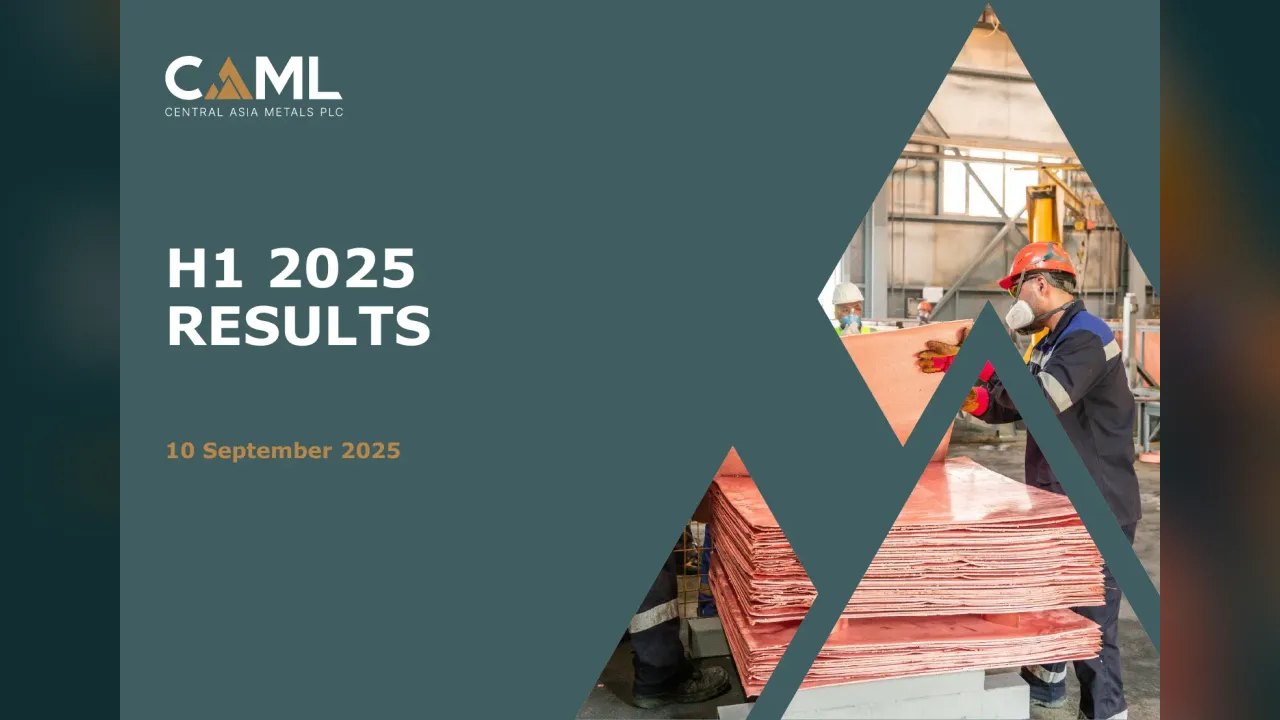
0:32 I'd now like to hand over to the management team, Gavin, Louise. Good afternoon to you both. Good afternoon. Good afternoon. Thank you, and welcome to the presentation of CENTRAL ASIA METALS half one twenty twenty five results. These are the results through to 06/30/2025. So if we pop onto that slide just by way of introduction for those of you who are new followers of the business, just an outline of our operations. We have two operating assets, the Sasa lead zinc mine in North Macedonia. This is an underground mine that commenced production back in the nineteen sixties and is still in production today. We've a life of mine out to 2039 there. And the Kunrad copper project in Kazakhstan, which is a copper extraction facility utilizing what we call SXEW technology to treat copper that is harvested off of old Soviet era dumps.
1:25 That is licensed out to 2034. In addition, we have some longer term opportunities in the portfolio and investment in a company called Aberdeen Minerals, where we hold 28.4% of those shares of a private company, and they are exploring for copper and associated metals in Scotland on the Arthrath project and CAMLEX which is an exploration venture we established in Kazakhstan to pursue earlier stage exploration opportunities targeting decent scale copper projects in that region. So that's the business right now. What we're here to discuss are our results to the end of June, as I said, where we achieved copper production of 6,218 tonnes, which was in line with our forecasts and leaves us on track to achieve our final year guidance of 13,000 to 14,000 tons a year, and then zinc production of 8,692 tons, lead 12,613 tons at the Sassa mine in North Macedonia.
2:25 Now we revised our guidance on that asset in July this year where we noticed that some of the production was faced with a few challenges, which we'll talk about a little bit later, but currently on track to achieve that revised guidance. Of this production was conducted in an extremely safe manner and I'm very pleased that we had no lost time injuries during the period.
2:49 That operational performance drove the financial highlights set out on that slide, which include revenue of $99,500,000 for the half, 39,900,000 of EBITDA for an EBITDA margin of 40%. And importantly, this morning, we announced a dividend of 4.5 p supplemented by a $10,000,000 share buyback program. That keeps cash returns to shareholders more or less consistent to what we paid in the first half of twenty twenty four and in fact, second half of twenty twenty four as well. This is underpinned by a strong balance sheet and a good cash position of $47,700,000 in the bank at the end of the period. And operationally, CAML remains at the lowest end of the cost curve and the capital projects that we've spoken about over the last two three years really which are mainly to do with changing the mining method as we get deeper into the mine plus also treating our tailings and depositing our tailings differently both underground and on surface Those are largely complete now with the completion of our dry stack tailings plant in March and we're now utilizing that dry stack tailings landform which was built at the beginning of the year.
3:59 So I'm going to hand over to Louise now to talk you through those finances in more detail and we'll get back to the operations after that. Thanks, Gavin. If we just look at the market conditions that framed the results that we've announced this morning first. So firstly, in terms of commodity markets, we experienced a lot of volatility in the first half, mainly around the March, April time with the Trump trade wars. Taking all that into account and comparing commodity prices for the first half of h one twenty twenty five versus h one twenty twenty four, we got a 3% increase in the copper price that we received, a 1% increase in the zinc price that we received, and a 7% decrease in the lead price that we received. In terms of treatment charges, that's the cost to us for the smelters to process our zinc and lead from Macedonia.
4:49 It's a good time right now to be a miner rather than a smelter. So treatment charges are lower than they have been historically. For the first half of the year, we've seen treatment charges around about $3,000,000 lower than they were in the first half of last year. And then just looking at foreign exchange, some good news for us and some bad news for us in Kazakhstan, because that tenge weakened by about 10% period on period and that helps our operating costs when when we report those in US dollars. On the flip side to that, in North Macedonia, the Dinar which is pegged to the Euro was stronger than the than the US dollar and that has the opposite effect. So that effectively increases our US dollar denominated costs.
5:38 Turning to the income statement. As Gavin mentioned, we've reported revenue of $99,500,000 for the first half. That was pretty much similar to the first half of last year, just 2% lower and that's reflecting lower sales volumes of all three of the metals that we produce. And that's compensated by those lower treatment charges that I mentioned on the previous slide. Our cost of sales was up 14%. That's around about $7,300,000. There's a few factors for that. One is this weakening of the US dollar versus the Macedonian Dinar that I mentioned. There was also a doubling of the concession fees, which is a revenue royalty that we pay in North Macedonia for the metal we produce.
6:24 We paid $2,300,000 for that this year, and that's up from 1,200,000 last year. We also had higher wages at both operations. We also paid more for silver. As you may recall, we stream our silver and we record silver in the revenue and also the same amount of silver in cost of sales to purchase that silver for the stream. So the two net each other out, but nevertheless that does contribute over $2,000,000 to that increase in cost of sales that you can see. We also had some increased depreciation because now we're operating the dry stack tailings plant that was completed in the first half of of the year as well. Group admin costs, they rose 24%, which sounds like a large number. That was about $2,800,000 and that was pretty much exclusively related to our business development activities.
7:19 The 2,300,000 additional BD costs that's mentioned on the slide, that's pretty much all related to the New World Resources attempted acquisition, which we pulled out of in July. We spent $1,100,000 on exploration at SASSA and at CAMLEX and that was up from naught $300,000 in the first half of last year. And we also disposed of an asset called Copper Bay, which we wrote down some years ago as well. So taking all that into account, we've reported group EBITDA of $39,900,000 at a margin of 40%.
7:58 If we look at the cost now for the two operations, we had a great first half at Kunrad where we reported our absolute c one costs having decreased by $600,000 and that's mainly reflecting the Kazakh 10 ks devaluation. There was also some lower costs for reagents that was in terms of usage and costs as well. The c one costs they rose by 1¢ per pound. That was solely related to the fact that we produced a little bit less copper in the first half of this year than we did last year.
8:30 We have also given our employees an 8.5% pay rise, but that has been largely mitigated by the week of 10 k as well. So all in all, we are reporting a 72% EBITDA margin for CUNRAL and that's the same as we reported for the first half in twenty twenty four.
8:51 Looking at SASSA, our run of mine costs at SASSA increased from around $60 a ton in the first half of last year to $65 a ton in the first half of this year. That's around about an 8% increase. And that's due to the salaries that we've talked about. It's due to the weaker dollar versus the Macedonian dinar. There was also higher costs for running these new tailings plants as well. So we've got a full year now of operating the paste backfill plant. Sorry, a full six months I should say. And a portion of that period for operating the dry stack plant and the dry stack landform as well. Our electricity costs were also about $900,000 higher this half than they were in the first half of last year as well.
9:39 If we look at our c one cost base though, that's increased by only 3% from $31,000,000 to $32,000,000 and that's positively affected by those lower treatment charges that we talked about initially. We reported a 26% EBITDA margin for SASSA for h one twenty twenty five. In the first half of this year, we spent $7,400,000 on CapEx, 6,300,000 of that was sustaining CapEx and $1,100,000 was on capital projects at SASSA, which are now pretty much concluded. We commissioned the dry stack tailings plants and we completed construction of the initial portion of the land form and we are now placing our tailings or filter cake because it's called onto that landform and that's all going very well.
10:32 We are expecting to spend 11,000,000 to $14,000,000 of CapEx in the second half of this year. We only just started this raised boring program at the end of the first half that will continue in the second half. We are planning to extend the dry stack tailings land form as well. We have additional underground equipment to purchase and more development to do underground as well. So we are reiterating the guidance that we originally put in place for CapEx, which is 18,000,000 to $21,000,000 We now take a look at the balance sheet. I'll just point out a few key points here. PPE looks like it's increased quite considerably, notwithstanding depreciation, and that's all related to the weaker US dollar versus the Macedonian Dino. So that's all currency related.
11:26 We report in our group cash balance of $48,000,000. That's the 47.7 plus the 300,000 of restricted cash. On top of that, there's 1,800,000 cash in transit, which we had mentioned in our q two production update, which through the audit process has been reclassified as this cash in transit. Effectively, we've received that already in the second half of this year. And also post the period end, we sold the shares that we'd bought in New World Resources for $18,700,000 and we also received a break fee of $1,600,000 as well. So our cash position has been bolstered by those aspects too. In terms of any debt, we only have bank overdrafts. That's the only debt we had.
12:14 At the end of June, we had 6,600,000 drawn and that has been substantially reduced post the period and we're now down to around $1,000,000
12:28 And then final slide for me, if we look at our cash flow and our free cash flow. So from our operations in the first half of this year, we generated $34,000,000 We paid $20,600,000 of dividends out. That was the final 2024 dividend. We paid taxes, that's income tax and withholding tax of over $16,000,000 in the first half and that's $8,000,000 higher than it was in the first half of last year. We've paid 7,400,000 in CapEx that we've just talked about. We purchased those New World Resources shares in the first half for $16,700,000 and we drew an additional 5,900,000 of our overdraft during the six months as well. So all that takes us to the $47,700,000 excluding that 300,000 of restricted cash.
13:19 Our adjusted free cash flow for the period is then $16,200,000 and we do reiterate that post the period end, we received the 18,700,000 from the sale of those New World Resources shares, the $1,600,000 break fee and the 1,800,000 cash in transit to bolster our cash position as well as our existing operations and sales. So on that note, I'll hand back to Gavin to run through the operations. Thanks, Louise. So starting with Kunrad, we've had another consistent and reliable performance from this asset in Kazakhstan. We produced just over 6,200 tonnes of copper cathode from our facilities there. And we're on track, as I said earlier, to achieve that 13,000 to 14,000 ton guidance for the year.
14:06 Our solar plant that we put in place almost two years ago now is operating really well, saving us a decent amount of money on our electricity now, where it's producing just under 17% of our requirements. And actually, in May, we achieved a record where it got to 22% of our electricity requirements there. And you can see from the the histogram that that really consistent performance from CONRAD over the last few years. The challenge is to keep it at that
14:36 consistency going. We're doing that by sort of expanding a little bit of CapEx, as Louise said. If we go to the next slide, Richard. That relocation of Dump 15, that's now completed and that'll allow us to access another area of the dumps through 2026 and 2027. And we're also replacing anodes and cathodes and from an operational perspective, what that means is it just keeps the plant ticking over at its required rate. As bits of the plant wear out and these are two key components to the electrowinning circuit, we need to replace anodes and cathodes and to make sure that, the copper production remains consistent all the way through. What we're stating here on the remaining recoverable copper is quite interesting because that 79,000 tons is based on the initial feasibility study, which was carried out at the, 2008, 2009, 2010. So what we've actually seen in reality is an outperformance of that initial estimate. You can see from that curve that we put on the bottom left hand side of your slide, the actual recovery on
15:43 the solid line versus the forecast recovery, which is the dots. You can see that outperformance on the Western dumps. We're actually getting more copper out than we initially expected. What this means is that by the end of 2034, we'll probably have surpassed that 79,000 tons and or being able to extend the life of the facility beyond that 2034. But there's quite a lot of work to be done before we start making too much noise about that and the guys on-site are starting that work in the next couple of months and we hope to report over the next twelve-eighteen months some success on that front. Probably, hit the next slide then. Richard, in terms of sustainability, we think that it's a a core part of our business is the relationship with with the community and also being a good custodian of these assets.
16:31 So, as I said earlier, zero lost time injuries for the half, but CAMRD, simply stunning performance there. No LTI since 05/20/2018. In spite of that, we still take health and safety very seriously and we've completed a full safety and occupational health assessment on-site. We've got a biodiversity management plan that's just been completed and are reviewing our water management on-site as well. In addition to that, we continue to support the local communities through cultural, medical, educational, and other youth initiatives where we have looked after people from from the local surroundings. And we've also paid a heap of tax in Kazakhstan, $320,000,000 of tax paid since we started that operation back in 2012.
17:21 Moving on to SASA, if we look at the right hand side of the slide, those... The table there, we've got all mined is up 8% half on half now. Those of you with us at the last presentation we gave, we were expressing some disappointment of achieving a much lower tonnage rate out of SASSA than we'd we'd hoped for and partly due to the disruptions then caused by the transition to the new mining methods plus also the construction of two plants and a central decline into the lower levels of the mine. With all of those programs now completed, can see that the rates of mining have gone up closer to that 800,000 ton a year run rate that we've been looking to achieve. So that's a positive. Unfortunately, what we've experienced though is lower grades both zinc and lead.
18:11 There's two reasons for that. One is we're still having a few teething problems with the new mining methods. As the guys become more familiar with these methods, we expect dilution, which means taking a little bit more waste than we'd like into the plant. That'll reduce as the guys familiarize themselves and get more expert with these mining methods. But more importantly, we've encountered variable geology at depth. Now we knew that we were gonna be confronted with a much narrower ore body, but what we didn't account for was the sort of changes in the ore body both in geometry orientation and also grade at depth. So we need to sort of confront those challenges head on, and we'll be doing that over the next half or so. Let me talk about that a little bit on the next slide, which is where we're talking about the strategic review. What that means is a full operational review of the Sasamein. Now as a management team, we're out on-site in the first quarter, and we realized the guys there were struggling, although they were coming up with some good ideas. So we tasked them with coming up with initiatives to improve, their productivity in terms of mining, processing, and so on.
19:19 And we've also provided them some help by getting an external consultant in as well to review all aspects of the ore body. So it's mining processing right down to things like laboratory processes, how they treat the samples, how we get people to and from the faces and etc. So as I said, we expect that ore body to narrow, we need to do is now understand the geology a little bit better so we're gonna have to do a little bit more drilling and that means putting platforms in place to get the drills in place to inform us a little bit more so that we confronted with fewer surprises as we go underground. I'm also going to tighten up on some grade control and once that are made by the external consultants are put together with our own recommendations, we'll be spending the rest of this year and probably into the first quarter next year implementing many of those initiatives where we should start seeing operational performances improving through that period.
20:16 Again from a sustainability perspective SASSA has performed very well zero lost time injuries during the period and 60% of our tailings has now gone either underground or onto that dry stack tailings facility which gets us closer to our 70 target which we hope to achieve by the end of next year. We've also tested an emergency alarm system around the tailings facility which makes it even safer than it was last year when we achieved the conformance with GISTM And we've continued with educational support both on-site and in the surrounding community. Another thing we've initiated this year is a Kickstarter program for local businesses to ensure that the local community is sustained long beyond the life of the mine itself. As I mentioned earlier, we have two earlier stage activities underway exploration in Scotland on the Arthrath project through Aberdeen Minerals.
21:11 Now phase 2b is the drilling campaign that's currently underway that was to follow-up on some very encouraging visual results that we achieved in phase 2a that effectively proved that there was mineralization at depth. Phase 2b is test the extent of that mineralization and basis the results of this drilling program, we'll make a decision on whether or not to follow our money and invest another £2,000,000 into Aberdeen Minerals. So we got some core members of our team visiting that asset in the next few weeks to start making those determinations. And in Kazakhstan, we've got four licenses under exploration there, mostly surface mapping, sampling for geochemical analysis plus also geophysical surveys going on there and those will continue until the end of the summer season which is drawing to a close pretty soon and then basis those results we'll be making decisions on whether or not to drill some of the targets in 2026.
22:09 We've also got some more advanced projects on the slate there, which we're looking to progress and more news on those problems the next time we speak in March. Getting on to capital allocation, which I'm sure a lot of you in the room with us today. We're very pleased to announce that 4.5 p dividend, and in conjunction, that share buyback program of up to $10,000,000. What that means for our shareholders is that total cash returns remain consistent with the prior period and also even the last six months at around $21,000,000 It also takes our cash returns to shareholders since IPO to $400,000,000 which for a company of our size is an amazing achievement. Over time, we're going to revert to our policy of paying between 30% to 50% of free cash flow as dividends, and we committed to capital returns to shareholders whilst we're managing our cash for future growth opportunities. So we believe that the share buyback program provides us with that flexibility.
23:08 It is an accretive way of returning capital
23:11 to shareholders. It's a good use of our capital in the absence of any significant growth opportunities there. So to summarize, in terms of outlook, we're on track to achieve guidance at both CUNRAL and SASSA, although at SASSA, we have continued challenges that we need to face up to. And sustaining CapEx at both operations will be the sort of norm going forward because we've now completed the capital programs, the major capital programs at SASSA. As I mentioned just a couple of seconds ago, half one dividend of 4.5p plus that $10,000,000 share buyback, which is already in action this morning. And we remain committed to securing material growth opportunity as well.
24:00 That's all going to be done off the back of a flexible balance sheet, as Luis said, just under $48,000,000 of cash at date of the accounts, plus some cash collected after that from the New World Resources transaction, which unfortunately failed. But, our, well established operations do allow us to com... Compete, in terms of getting debt, and that debt will help us finance any acquisitions on a non dilutive basis. So that's the business. That's where we sit today. Thank you for your attendance. We look forward to answering all your questions. That... That's great, Gavin. Louise, thank you very much indeed for updating investors. Ladies and gentlemen, just while the company reviewed your questions submitted already, I just want to remind you that recording of this presentation along with copy of the slides and the published Q and A will be available via your Investor Meet company dashboard.
24:50 Richard, as you can see, you've had a number of questions from investors throughout today's presentation. So firstly, thank you to everybody for your engagement this afternoon. If I may, Richard, just hand back to you to navigate us through that q and a, and I'll pick up from you at the end. Thank you. Alright. First question submitted prior to the presentation. It's from the standpoint of benefiting shareholders. What is the reasoning behind pursuing diversification by acquisition instead of juicing the current assets with their still decade long run and returning capital aggressively to shareholders?
25:22 It's a good question, but I think what you've got to consider with the mining industry is the length of time it takes to move a project from, you know, discovery through to production. And, you know, the CAML X things I was talking about earlier, you know, those... The gestation period there is probably at least eight years, maybe longer, similar at Arthrath, to be honest with you, even though, you know, we're sort of taking less discovery risk on that one. So that's why we looked at something like New World Resources, which was a feasibility study level project. And in terms of optimizing that feasibility study and then raising the CapEx and then building the project, that probably would have taken three years itself, which, you know, if you start thinking about the ten year life of the assets, as you mentioned, you're starting to eat quite a long way into the life of those assets. So we do need to do something.
26:16 The earlier we do it, the better for our shareholders. It'll be accretive, and we we make sure that everything we look at is accretive, and that accretion is considered in the light of the capital return programs that we've got in place. So, you know, what we're going to do is spend dollars to make money for our shareholders. You know, and if in the absence of doing that, then we'll be returning it via the dividend and the share buyback. Right. So now we got some live questions. Question from John h on growth. Have you considered quality Kazakh explorers such as East Star Resources?
26:49 Thanks, John. Look. We don't like to mention names to protect the innocent here. So we do focus on Kazakhstan as one of the jurisdictions given our operating experience there and knowledge of the geology. So anything interesting there, you know, we would probably cost... You know, run the rule over at some point. And we think currently with CAMLX team, we've got a great team that is originating some really good ideas and some very good opportunities. So we're backing that team for now. Right. There's a question here from Keith m. Gavin, how many shares do you hold, and do you intend to sell them back to the company in the share buyback?
27:28 So, Keith, I I own a modest amount of shares. I think it's just under 10,000 shares, which I purchased myself a couple of years ago. We're also, as a management team, incentivized quite heavily via a long term in... An LTIP program effectively, is geared 75% of the value of those are on total shareholder returns. So we're very focused on the on the capital returns and also other returns to shareholders. I have no intention, and I don't think I could, frankly, sell my shares into the into the buyback. In fact, if I had some spare cash, I'd be buying shares right now. Another question from Keith. He's really asking why we did a buyback rather than a special dividend on the basis of special dividend distributes cash equitably to all shareholders, but a buyback only goes to those who sell their shares.
28:17 And with the amount that we... That we've devoted to the buyback being almost equal to the to the dividend cut, why not pay a special dividend?
28:26 If you... If you're trying to use a buyback to reduce shares in issue, then you could do that by a consolidation and achieve the same thing. There's a lot a lot of that there, Keith. So what I'll say is that, you know, partly the share buyback was in response to a lot of requests or, you know, considerations from our shareholders to consider a share buyback. And the board has considered it carefully and decided that in terms of deploying our capital in an accretive manner for shareholders, that is probably the best way to go right now. And special dividends seem to offer shareholders a small sugar rush, that's it. You never really know whether you're gonna get one next time or not. But the share buyback that has a longer lasting effect by, as you say, reducing that share count and the value per dividend per share then therefore goes up in future as well.
29:15 A question from George S. To what extent do you feel confident in delivering against full year production and cost guidance? And what factors could move you above or below the current ranges?
29:26 George, we we're very confident in the Kunrad asset in terms of getting into that guidance. We modestly reduced the guidance at SASSA. And as I said earlier, we are still faced with some of the challenges there. So, you know, we are striving to get in that guidance range at SASSA, but, you know, there's there's a little more risk around that, I'd be, you know, be honest with me to say. What was the second part of the question, Richard? Sorry. You moved down. Talking about what what Oh, cost guidance. Yeah. Yeah. Sorry. We we we actually don't get... We don't give cost guidance as a company. So, you know, I think I think factors that could move us below the ranges really would be additional
30:11 production challenges and SASSA would be the main main risk there. Right. How do you determine the correct price to buy back your shares? For example, if you're an investment trust, then your net asset value will be mark to market every day, and buying back at a discount enhances value to other holders. But with real assets, how do you determine if your shares are undervalued or not? Well, I think the very fact that we've put a share buyback in place signals that we think the shares are undervalued. And we do have some flexibility around, price and and volume there, but, ultimately, you know, there there are market abuse regulations in place that even though we are doing this buyback outside of that safe harbor mechanism, we are going to try and adhere to them. So we are limited on flexibility around price in particular, but the volumes, you know, can be determined by Amar. We can move outside of that if we do see additional value for ourselves there. But effectively, we wouldn't have put the share buyback in place at all if we didn't think it was going to be an accretive method of capital return to our shareholders.
31:20 Question here on the SASSA Foundation. Given that SASSA is currently loss making, is it not appropriate to reduce the 0.5% of revenue you donate to the SASSA Foundation, which you state in last year's final results was doubled? Yeah. That's an excellent question, Jeffrey. And I don't wanna give too much away, but rest assured that was a strongly debated item at the last board meeting that we had. Okay. Adrian r is quoting the purpose of the buyback from this morning's RNS is to reduce the share capital of the company and to return capital to those shareholders wishing to participate. What is the real sense of the last seven words? Having read the notice very carefully, they seem completely hoochios. What are they doing in an official communication? So the last seven words is to return capital to those shareholders wishing to participate in the buyback.
32:10 One, two, three, Oh, Adrian, I think I think think very simply, we're saying we're giving the option to you and your fellow shareholders whether or not you want to venture shares into the buyback, and that's a decision that's entirely up to you. So we're giving you the option to participate in the buyback, plus you get in the dividend. And... No. I don't... I mean, I don't think there was anything controversial in the wording myself. I agree. Given the operational headwinds and the need for capital for potential future growth, is a 10,000,000 share buyback the most prudent use for company funds? I think one thing I'd add to this kind of debate is we've had, and it goes along with the special dividend discussion as well.
32:57 We have over the years, sort a lot of feedback from shareholders in terms of capital allocation, be it dividends, special dividends, share buybacks, growth, exploration. And, you know, if you ask three people, you'll get four different answers. And we've we've tried to build all of this into what we're doing now. We have... And the dividends that we have been paying, these have been at a yield of around about 12%, which does seem very high to us. We've had lots of requests to look at, to look at buybacks. So this is something that we're having a look at. We're not experts on this actually. We haven't done a buyback before in this management team. So we're going to see how that works out as well. Specials, I'd argue that if we're paying over the dividend, we've been paying specials for a very long time, maybe not marketed as that way.
33:56 So there's lots of factors come into play in terms of our capital allocation. One of the other factors when we look at growth as well is do we keep, you know, some sort of cash build up. So when we go to buy something else, we've got a little pot of cash. Equity investors have changed as well over over a period. There used to be, you know, pretty
34:19 fundamental agreement that if we paid dividends back, then we could go back to shareholders and ask them to support us in a transaction. Again, that's not necessarily the case because lots of investors have got less money than they used to. So we're trying to balance all of our capital allocation, and trying to please a lot of people. And each person you speak to will have a different priority. And for sure, buybacks will be a priority for a lot of people, specials for some people, growth for some people. So there's definite people with different with different views. And and ultimately, we've got to do what we think is right for the business. Alright. Question here from Ben s. What is management's strategy for achieving long term growth beyond the existing assets, especially after the decision to terminate the acquisition of New World Resources and its Antler project?
35:11 Well, Ben, I don't think the strategy has changed. I think we've been very transparent about our growth ambitions for quite a long time now. You know, over the last five years, we've been telling the market what we're looking for, where we're looking for it. And I think, you know, it's disappointing that the New World Resources transaction went away from us. But I think what we did there was demonstrate, you know, the capital discipline that's been come... That's been expected of us over the years in not overpaying, but also not letting the asset go for something we would have paid for it. So, yeah, we're back back looking for new assets. Louise and the and and the team are are out there, you know, trying to originate new ideas, scouring the... Starring the globe for similar things to New World or even better. So, you know, we we we do need to, to grow this business, as I said earlier, you know, given that we're sitting on depleting assets every day.
36:03 So the strategy remains the same. Question for Philip r. SASSA made a loss of 2,100,000 in the period. Do you expect the results of the strategic review to result in profitability? Philip, I'd absolutely hope so. I think... Look. It's it's jet... In all seriousness, that is the biggest focus for management over the next six months is implementing the results of this review in order to return that asset to profitability. And a question for Bill c. If all proceeds well with Aberdeen Minerals and CAMLEX, it seems substantial equity will be required. Do you think that might require an equity partner? All... Yeah.... Options for funding as Yeah. Yeah, as the situation evolves.
36:55 Okay. Well, that's that's all the questions. I... Oh, actually... No. I think that's all the questions. That's great, Richard. And, of course, any other questions that do come in, we can make available to you post today's meetings. Firstly, thank you again to everybody for your engagement this afternoon. Gavin, I know investor feedback will be particularly important to you and to the management team, and I'll shortly redirect those on the call to give you their thoughts and expectations. But perhaps I could just ask you for a couple of closing comments before I send investors for feedback. Thanks, Mark. Look. I'd just like to thank everybody for attending today, for all the questions, those of you that we weren't able to answer. You know, as Mark said, we may publish the the answers at some point. Some of them, unfortunately, we couldn't answer. But what I do wanna say is we certainly appreciate your continued interest in the business, your continued support for the business, and, you know, we are an open bunch of people with a... Know, there's an info at... Email address. If they... If any questions arise that you want answered, please send them in there, and we'll do our best to get back to them as quickly as possible.
37:56 But thanks again for attending the results announcement. We look forward to seeing you again in six months' time. Gavin, Louise, Richard, thank you once again for updating investors. If I please ask investors not to close this session as we'll now automatically redirect you to the opportunity to provide your feedback in order the company can better understand your views and expectations. This may take a couple of moments to complete. I'm sure we'll be greatly valued by the company. On behalf of the management team of CENTRAL, Metals, I'd like to thank you, ASIA METALS. I'd like to thank you for attending today's presentation. Wish you all
Follow Central Asia Metals PLC into a list and get an email when it puts out news.
CEO at CENTRAL ASIA METALS PLC
CFO at CENTRAL ASIA METALS PLC