Andrew Newland
CEO at CELLBXHEALTH PLC
Replay available
Investor Presentation hosted by Cellbxhealth (LSE:CLBX) on Investor Meet Company, held 2023-04-28.
On 6ix: 6ix.com/event/cellbxhealth-plc-clbx-investor-presentation
Automated transcript · Written by software from the replay's audio. It can mishear names and figures; the replay is the record.
0:00 Yep. Good morning, and welcome to the Angle PLC investor presentation. Throughout this recorded presentation, investors will be in listen only mode. Questions are encouraged and can be submitted at any time by the q and a tab situated at the right hand corner of your screen. Just simply type in your questions and press send. Due to the significant attendance on today's call, the company may not be in a position to answer every question it received in meeting itself. However, the company will review all questions submitted today and publish responses where it's appropriate to do so. Before we begin, I'd like to submit the following poll. I'd now like to hand you over to Andrew Newland, Chief Executive Officer. Good morning to you, sir. Thank you very much, and good morning, everybody. And thank you very much for joining this investor meet company presentation that we're doing. Our our aim with this is not to repeat the prelims presentation that we did last Friday. That's available as a webcast on our website as we speak.
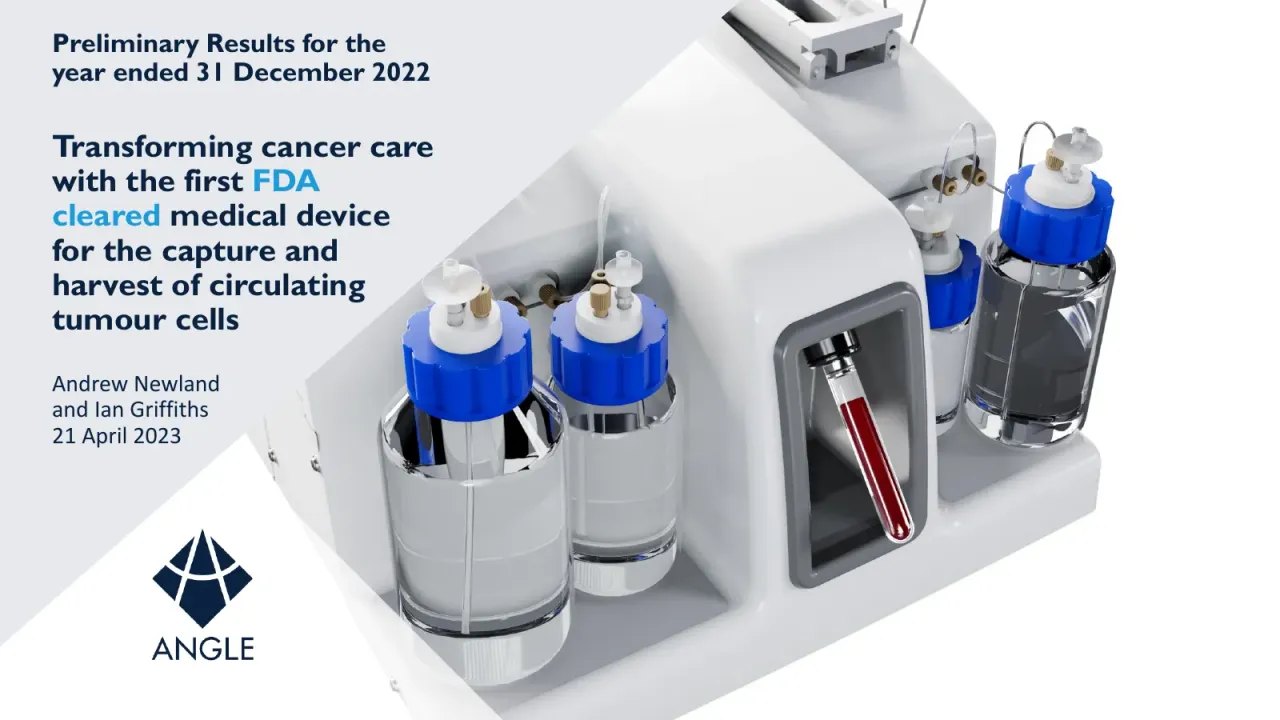
0:56 But, actually, this interaction is more about two two different things, the potential for new investors to hear the story. So we want to give an overall background presentation on what's happening in the company. And then critically to, enable us to answer a number of questions which our existing investors, and shareholders have have submitted to the company. So, we're we're seeking to give as much information as possible, for those two different groups. And so following this introductory presentation, there will then be, some detailed, questions and answers, which Ian and I will handle, together. So, without further ado, I I'm going to start into the presentation. So what you see here is a picture of the ParSortix, FDA cleared PC one, system.
1:48 And that device, it's fairly simple, in concept, but it's actually very transformational in its, application. It enables a simple blood test, to be processed to recover cancer cells for analysis. And this is a a key component of of personalized cancer care, is coming through, in very near term. So, how how does the system have an impact? Well, the fact is that cancer changes over time. It's heterogeneous, and that means that each patient has a different cancer. They might they might have three, patients with prostate cancer, but actually all of those patients have a different cancer, and therefore, it will respond differently to different drugs. So it's standard of care to investigate the cancer via a tissue biopsy, and that is what happens with all patients when they present. The tissue biopsy involves removing the cancer cells from the patient, taking them to a laboratory, and investigating them. And from that, they can confirm the diagnosis, and they can, make the right treatment decision for the patient.
2:59 The patient's cancer will, however, change over time, and therefore, it's essential to have a good information on what's happening and how it's changing. But, unfortunately, that's not possible, with the tissue biopsy because you can't go back to the same site. Once it's been cut out. It's not possible to access it again. So what we have developed is an ability to recover cancer cells from blood for subsequent analysis. And that's possible because those cancer cells are how the cancer spreads within the patient. There may only be one cancer cell in a thousand million blood cells. So we were delighted to have achieved the first ever FDA product clearance for our system. And FDA is the global gold standard, for medical devices. We're the only system that has been given an FDA clearance, and that came after six and a half years, of work. And so it represents a very significant, we believe, at least a five year market lead and potentially a decade lead, on competition in this critical emerging, field.
4:16 So why what how how do we know that, that clinicians actually want to have a liquid biopsy? Well, if you look at the national cancer guidelines for metastatic breast cancer, which is where our FDA clearance was granted, and what you see is that and this is in The United States. And what you see is that when the cancer has spread to a secondary site, then the patient is advised to have a tissue biopsy. So that means if the breast cancer has spread to the lungs or the liver or the bone or the brain, then where that is accessible, it is standard of practice to cut out some more tissue. Why are they cutting this tissue out? They're cutting it out simply to get cancer cells to analyze to make treatment decisions, to assess what's the what's the status of that patient's cancer, which drugs would be appropriate for the patient.
5:07 And despite it being in the National Cancer Guidelines, over fifty percent of patients fail to have a successful, biopsy of their secondary cancer site. And that may be because they're too ill, the tumor is not accessible, or there's insufficient tissue. So those patients get no repeat biopsy. And in any case, you would want to repeat the biopsy multiple times, not just once, and virtually no patients will have more than one repeat, biopsy. So, what we're doing is addressing a very, very clear unmet medical need, to recover cancer cells, from the patient blood for subsequent analysis. And that means that all of the work that's usually done on a tissue biopsy can be repeated, but just using cancer cells that have come from the from the blood. And therefore, it's noninvasive for the patient. It's also cheaper.
5:58 The average cost of a metastatic biopsy in in breast cancer is $16,000, whereas, of course, the blood test would be a lot cheaper than that. So what what's good about circulating tumor cells is that they are intact living cells within the patient blood. And because because they're intact and alive, everything can be done with those cells. You can do morphological analysis. You can do DNA. You can do RNA, and you can do, protein analysis. That is analogous with, the tissue. So we believe that the circulating tumor cells recovered by the parsortic system offers the best possible sample for liquid biopsy. That said, there are a number of substantial companies, and there's a a lot of work going on with another analyte called circulating tumor DNA.
6:50 CtDNA is fragments of dead cancer cells, and that's, relatively easily accessible, difficult to analyze, but easily accessible from the plasma components of the blood. And that that analyte can be used for investigating DNA, but it can't provide you with any information on RNA or protein expression or morphological examination of of the actual cells. So, it's it it is more limited analytes. Nevertheless, we put a lot of effort into combining the two, the two different analytes from the same tube of blood. So if you've got a parsoid system, you can recover the plasma and do CT DNA analysis as well as resuspending the cells and then, recovering them with parsortics to do evaluation of CTCs.
7:37 So our offering actually combines both, and we do see the CTCs as being very complementary, to the ctDNA. In time, our, clinical lab expects to be offering DNA sequencing of both ctDNA and, cell DNA from CTCs. So, in order to exploit this enormous opportunity, the PASOTIX system, can work with all different solid tumor, types of cancer, and it can be used for numerous different applications. We've got a very clear and and, well thought out commercial strategy. We're we're ex exploiting this technology in two different ways. The core part is via a product business. Because we have a patent protected, system, we can sell the instrument and we can sell the consumables to any any laboratory or customer around the world. And that's our our products business. So, the idea is that the customer is a clinical lab who buys the system, and they then use it to, treat treat patients or or possibly to support pharma pharmaceuticals cancer drug trials.
8:45 And they pay us to essentially first buy the instrument and then buy the consumable, which is a one time use, cassette. The second business area is services. This is where rather than selling the machine and the consumable, we will take blood, to our clinical labs, and we will do the analysis and provide the results. Now, and we've got two clinical laboratories set up to achieve that, one one in The United States and one in The UK providing global coverage. And the the the thinking behind that is that there's a near term large scale market opportunity, particularly working with pharmaceutical cancer drug trials where the bloods can be sent to Angles Labs, we process them, and provide the results that that we find. And that, service business, basically operates as an accelerator and a demonstrator.
9:35 It's an accelerator because it means that we can generate revenues faster, and it's a demonstrator because it can show the, the outside world what the opportunities are when you've got these cancer cells and how you can use them. And the idea is that, many other players will want to adopt the Parsonortix technology, and and we will happily encourage them and support them in setting up the Parsonortix laboratories of their own. Health care businesses are complex, and there are multiple different factors which are necessary, to be, dealt with in order to get success. And we're very, very clear on the five key activities that Angle has to deliver in order to to achieve a substantial success, with our PASORIC system. And those five key, elements are on the right hand side of that slide. The first one is regulatory clearance.
10:25 So I cannot underestimate, the or overestimate the importance of getting the FDA clearance. It's absolute, tremendous difference than any other system in the world. We're the only FDA cleared platform, and we have also got a CE mark covering Europe and MHRA approval in UK. So we've got regulatory clearance for the platform. We now, embarked on assay development. So assay development means developing content, that we can use with the ParSortic system to to provide an end to end solution. And we've got various imaging and molecular assays that we're developing, which I I will explain. The clinical studies is a key area because this is demonstrating for real world conditions that the patients actually do benefit and click and key clinical decisions can be made using the circulating tumor cells from ParSortics.
11:24 And we're running various clinical studies, which are I will highlight. Fourthly, we believe that it's essential that Angle forms partnerships with a a range of large companies in order to bring this technology to market. The the far reaching impact of the technology is such that we need to engage with the existing industry structure and let them have access to the Parceltic system and drive the sales and distribution of that system alongside of our own, direct activities. And, fifthly, reimbursement is a is a key element. So the health care systems around the world have to be, to pay for this so that they, we get adoption by the, by the health care sector. And we're engaged in a variety of different activities to ensure that we get reimbursement and have the health care and insurance companies pay for these tests.
12:17 What all of this translates into is a substantial, revenue opportunity for the business, with three core elements to it. The the largest and, near term immediate revenue source is from, pharma services, and we've already set up, the pharma services business. We've got, several customers in place. We've and we're having repeat contracts with those customers. And we believe that has the potential, to build to at least a £50,000,000 business with the current capacity that we have in our laboratories. Slightly further behind that, but coming very soon, is laboratory developed tests. That's us offering services from our labs in order to, to manage patients' management. So in other words, blood tests from patients to make treatment decisions done on behalf of clinicians, around the world. So that will involve us launching, lab developed tests from our clinical labs, and that's coming very soon. We we are hopeful that that will be in place in h one of next year, and there's a lot of preparation work going on at the moment.
13:23 And that has, again, a potential to build out at least a £100,000,000, revenue business opportunity. The third and and key part is the products business. That is already in place. We've already sold products around the world for research use. We're we're establishing distributors and other, connection points in order to sell more products into clinical laboratories. So that is a building opportunity right now. And long term, that's where we see the business. The the current suppliers, we have third party manufacturers of the product, and the consumables, that that they have, ready capacity to build out a potential annual revenue of up to 500,000,000. So, there really is an opportunity to to build a very large scale, business utilizing the approaches that I've, just been describing.
14:15 So, just to just to zoom in now on the the the near term opportunity, which is the pharma services, business opportunity, just looking at four different cancers, you can identify many tens or hundreds of thousands of patients that are within these trials. Now the Angle is currently charging a base price of, $1,000, for each tube of blood that is processed, and that is likely to increase to $2,000 or thereabouts when we when we add molecular analysis to the parsortic separation, pricing. And these prices, by the way, are quite acceptable to our pharma customer base, who spend often well over a $100,000, per patient in their trials over time.
15:05 So we anticipate in the pharma business, what we see is a minimum of three sample points for each patient, before, during, and after therapy. And, actually, some of the customers one customer has had up to seven time points, for each patient, because they wanted to monitor the patients for a longer period of time after they come out of the trial. So if you just look at the breast cancer, situation, on clinicaltrials.gov, there were published, details of pharmaceutical, trials of 950 such trials, and they're enrolling 247,000 patients. So if you think of a minimum of three repeats, you can see the scale of the business opportunity for Angle. And, actually, that can convert into approximately $2,000,000,000, revenue opportunity, per annum, for just these four cancer types, and we're not limited to that. So the pharma business is a a serious opportunity for Angle. We're building it out very well at the moment. We already have, five customers.
16:11 And the four customers that we had, last year have three of the four have already signed repeat contracts with us, and they're very happy with the work. The fourth one is actually discussing a repeat contract as well. So, what do we need to really make the Passortex system, useful is content. So I liken this to the iPhone, if you or or any smartphone. If you have an iPhone, you it's not that useful unless you've got some things you can do with it. So we now all use our iPhones or other smartphones for numerous applications or apps that have been developed, using that basic product. And that makes the, the iPhone an extremely valuable product, and people pay a lot of money to have it, so that they can get, access to all these applications.
17:03 And just as Apple first developed the first applications for the iPhone, Angle is developing the first applications for PassAutics. But in time, we expect to see the entire world adopting the PassAutics system and themselves developing applications. So the applications that we're targeting are in two main areas. The first one is called, is branded Portrait Plus. So this is an angle branding, and that is imaging assay. So that means immunofluorescence staining of the of the cancer cells, to look at their attributes, to look at, their phenotype. Are they epithelial cancer cells? Are they mesenchymal? Are they EMTing? And you can do that by using targeted antibodies with immunofluorescent tags and then looking at, the cancer cells underneath the microscope.
17:53 And we're developing very specific assays in imaging. We've got a Portrait FLEX assay which will phenotype all the cancer cells and allow their automatic imaging and and enumeration. And then we've got various, derivations of that. We've got a PD L1 assay which will look at all the cancer cells, and then in addition, we'll look for a protein called PD L1, which is associated with immunotherapy. We've developed a DNA damage repair assay, for our for one specific pharma customer, but now we're we're making that available for all of our pharma customers, and that's looking at two different proteins relating to DNA damage. And we're starting work on a HER two assay, which is measuring a protein called HER two in breast cancer. So there's multiple different, imaging assays under the Portrait branding that are that are being, developed, that are currently under development and making strong progress.
18:54 The second major area is in molecular. And our molecular, we believe, is is the future. This is doing DNA and RNA sequencing of the cancer cells. And and we are we are developing
19:08 landscape branded assays to do that. And we're using third party, systems. So third party digital PCR systems such as, for example, the QIAGEN power acuity system, Angle's using at the moment, and third party, sequencing platforms, For example, Luminous NGS systems, Thermo Fisher, and various other systems. So what we're doing here, our asset development work is to work with the output of ParSortix and demonstrate protocols that show you how you can use existing third party molecular platforms for DNA and RNA analysis. That that work is really gonna add enormous value to, the angle proposition because as soon as it's complete, then anybody who owns one of those third party molecular systems and they we're picking ones with large installed base, they can buy Parzortics.
20:02 And once we publish the protocol, they'll then be able to run the Parzortic cells through, the molecular platform and gain information. And we see that that is a extremely powerful way to expand the sales of, of the Parsonotic system. And, also, once we've got a good data package to demonstrate the value, we can go to the manufacturer of that platform and negotiate potentially to do a development partnership with them, and or a sales and distribution partnership. Now in terms of building the content, we are very keen to do that in conjunction with third parties, because what that means is we can, we can generate revenue whilst we're going through the development phase. So we signed a deal on HER two with, with BioView, which was announced, last week.
20:52 Now BioView is a leading, automated microscopy company. We've selected the BioView microscopes to use in our clinical lab. Because they've been optimized for image capture and analysis on circulating tumor cells. And we're actually helping BioVue, in terms of the specifications that we need in in the, automation process and then then tweaking, the the whole process so that we get very, very good identification and image capture of circulating tumor cells.
21:24 Now the, the reason we decided to go with BioView on the HER two assay, development is because BioVue is FDA cleared in conjunction with, Abbott's, PathVision FISH probes to do HER two analysis on tissue biopsy. So her her two analysis in breast cancer is something that every breast cancer patient will have on presentation. So, if the patient's got a lump, the lump is cut out, that's taken to a laboratory, and that's a tissue biopsy. And then the cells the cancer cells are stained for, HER two, either by immunohistochemistry or by FISH or both usually. And that methodology is used to determine whether the patient is HER two positive. If her cancer is HER two positive, then the patient will be given Herceptin, is which also known as trastuzumab.
22:15 Now because BioVue, is FDA cleared for doing the HER two analysis on on cancer cells from tissue, it makes sense for Angle to combine our FDA clearance, with ParSortix for recovering the cancer cells with theirs. So that's why they're a very good partner. Now we've structured this deal in such a way that Angle will be, generating revenues of £1,200,000 over the over the twelve month development phase. Now that's, very helpful because it means that rather than us spending all our all our money, on development, we're able to get somebody else to, generate revenues from that activity. With the the ultimate opportunity is very significant. There are 2,500,000, tissue biopsy HER two tests done every year, and we think that patients could, sensibly have three repeat blood biopsies in order to determine their current HER two status.
23:11 Because the key point is, on presentation, approximately twenty five percent of patients are HER two positive, seventy five percent are negative, and that changes over time. So patients who are not given Herceptin should be getting it and vice versa. So there's a possibility of a 7,500,000 tests, per year with the HER two blood test, and that represents a $2,500,000,000, annual market for HER two kit that we're developing, with BioVue. Now in addition to that, every single one of these tests will need, the customer to have acquired a Parthsortic system and Parsonortix consumables in order to run the precondition, which is to recover the cancer cells from Parsonortix before we put through the reagent kit, to do the HER two, analysis.
23:59 Following the development phase, which I mentioned is a twelve month phase, there'll be a further clinical study phase and regulatory phase in order to get clearance. And we anticipate adding some large companies to our development partnership to share in the, the revenue from the HER two kit. Obviously, they won't get the ParSortex revenue, just the the HER two kit part. And in that way, we expect to take the next phase, the clinical study phase, and turn that also into a revenue generating
24:26 activity for Angle. So Angle is being smart in the way it thinks about these things to turn, investment costs into actually revenue generation. Now as I mentioned, it's critical in in the, health care space to have clinical studies to support commercialization and and generate information and data that shows the value of of what's being done. We've already completed, the ARG six, pelvic mass studies. That's our ovarian cancer study, which we announced, last year. And we've done two studies of 200 patients each and showed that analyzing the Parzaltics harvested cancer cells is a very specific analyte, for detecting ovarian cancer in women with an abnormal pelvic mass. That was a very challenging set of, studies. It's difficult to diagnose cancer, and our results of the area under the curve accuracy of over ninety five percent far exceeded, any any alternative methods that are available.
25:26 We're also running a large metastatic cancers, program in The United States and The UK, targeting enrollment of a thousand patients. And, we get multiple time points on these patients. Now what this is doing is enabling us to have patient material that we can then use for the various different assays that we're developing, the molecular assays, for example. So these samples are being processed. We're getting about 50 patients a month at the moment,
25:55 And the parsortic cancer cells are then being essentially lysed, which prepares them for molecular analysis, and stored in a freezer. So as and when we have the molecular assays ready, we will be able to test them not only on the contrived samples that we develop in our laboratory, but also on these already stored patient samples. So we'll be able to get packets of information on lung cancer, breast cancer, prostate cancer, ovarian cancer, etcetera. We're running ANGO 12, the domino study in prostate in The United States at the moment. This is a 100 patient pilot study, which is designed, to assess the ability to detect, prostate cancer and assess its, severity.
26:40 And one of the things that we've done here, which we think is, very smart, is that we partnered, with the largest group of urology clinics in The United States to do this work because because they are the route to market to commercialize these this test in the first instance. So they have over 700,000 patients a year who have urological conditions, most of which is prostate related, and they could offer to those patients on a private pay basis, a blood test. They would then make money out of that test, but send the samples to Angle, we process them, and and get paid by them. So they're a single large customer for a prostate test. And and what we will do, of course, is use them as the first customer and and look to roll this test out much more widely. And that that clinical study is due to provide headline results by the end of this calendar year, with a view to us moving towards, implementing a laboratory developed test, in the first half of next year.
27:42 The final one on the list here is, PD L1, which is, an immunotherapy study which we're planning in lung cancer. That hasn't started yet, but I would expect it to be kicking off later this year. So I'm just gonna be, more slides, and, then we can move across to the questions. The first one here is, just to highlight that, it's not just Angle making these, these comments. There are actually now 79 peer reviewed publications that have been, published in leading scientific journals utilizing the Pathologic system and demonstrating, different uses, with the Pathologic system. All of these publications are positive, and, they're available on our website, for for anyone who wants to look at them. They've been generated by 35 independent, cancer centers around the world, and they've demonstrated uses of the Parsonic system in 24 different cancer types. So this truly is a system that can revolutionize the way that cancer is treated, in all different types of cancer and in a variety of different ways.
28:51 Angle now has the platform in place for commercialization. So, just a quick update on, how things are looking right now. Well, we started 2023 very strongly. The first quarter revenues unaudited for 2023 are ahead of the whole of, the first half revenues for 2022. And both our products and our services business, revenues are progressing well. So we're very pleased with, the traction that we're getting. The pharma services business is also doing extremely well, both, a new customer, Crexendo Biologics, which we've announced, coming in onboard this year already, and repeat business being signed with existing customers.
29:37 We've got a a pipeline of around 30 additional prospects that, we're working to convert. So we expect to see more customers being added in due course.
29:47 The, the HER two CTC assay development program with BioView does open up a major new market opportunity in breast cancer, and we believe that we will be able to add a number of large com scale commercial partners to that in due course. The prostate cancer pilot, study is tracking well. The enrollment's in good shape, so we're confident of the headline results around the year end. The work on third party molecular platforms has yielded some very good, encouraging initial results. So we're hopeful that we will be able to to, put together some very good assays based on these third party, molecular platforms, which will be assays that the market is crying out for.
30:34 In terms of the pipeline of assays in development and in content, we we will be launching multiple new assays during the year, and they will add the content that is needed to get the, widespread adoption of the Parasortic system. So the the company's, very confident,
30:52 in strong growth in 2023, and we feel that, the business is moving very well in the right direction. So that's the concluding, comment. Maybe we could move to questions now, please. Andrew, Ian, thank you very much for your presentation. What I'll do now is I'll just bring your cameras up for the Q and A session. We have received a number of questions and thank you to all the investors for submitting those. Ian, it might be best to hand over to you at this point to share the q and a. Once you've addressed all these presubmitted questions, I'll pick up from you at the end. Great. Thanks very much. And, as we've highlighted in the announcement when we put it out, we've, received questions in advance. We've grouped them, and we'll be addressing those under a number of key themes and in no particular order.
31:37 But the first question was related to how soon do you envisage angle breakeven, which I will answer. Obviously, the timing to break even depends on both the revenue ramp and the associated gross margin and the level of spend on development within the business. On the current plan, where we're keeping our spend tightly focused on a a limited number of core activities, Andrew's just described in the presentation. We're targeting cash flow breakeven in financial year 2026. Obviously, it could be a bit earlier if revenues ramp faster or we secure, in particular, some milestone payments from some commercial deals or we further restrict investment in certain areas of the business. But, obviously, we're we're deploying the capital we've got to deliver against key milestones, and there is a risk if we restrict the investment too much that that could have a negative impact on that milestone delivery.
32:32 Obviously, in context, it's still challenging to forecast revenues because it's a it's a new product and services in an emergent market. So there are both opportunities to the upside and also some risks to the downside. We try and manage the risk to the downside by tightly controlling our costs.
32:51 As, for example, you've seen in the last year, we closed down the operations in Canada for a number of reasons, including the adverse r and d tax credits. But we're also taking a partner approach to to manage the spend and also to accelerate commercialization. So you have just seen that with the BioView deal, which generates both revenues as well as a significant reduction in the assay development cost to get into that HER two breast cancer market. And we're also seeking to commercialize or seeking to approach is to commercialize with partners so that we can leverage their sales and distribution channels so we don't need to make a massive investment in in building out the our own direct sales and distribution force. And that's the approach we're taking, for example, with the Solaris Health partnership in prostate cancer, which offers our routes or one of our routes to market. So tightly controlling costs, but that's the that's our take on when we'll achieve cash flow breakeven.
33:51 The next question was around Nasdaq. Oh, there's a few questions around this as well, which was essentially, has the downturn in biotech stroke med tech made you reconsider the prospects of a Nasdaq listing? And do you now see that as being closer or further away than post FDA approval? I'll answer that one as well. So, obviously, Nasdaq remains an attractive option, given the deeper pools of capital available, the greater presence of specialist life science life science investors, and the greater understanding of the liquid biopsy space. Obviously, the majority of the liquid biopsy companies are based in America. And, you know, they rec the investors there recognize the long term potential and the absolute critical need of or unmet need that LiquidBox is gonna fulfill.
34:43 But we do have to recognize exactly that point that life science valuations on Nasdaq have suffered, excuse me, over the last eighteen months or so. So for the timing for a Nasdaq listing, it's likely to be a bit further away because, obviously, we have to have delivered on our own commercial milestones, and the market also needs to be right for looking at that. But just a reminder, we do we do have a platform technology. It's worked with, every cancer that we've, investigated so far. Andrew highlighted 24 on that other slide. It works across, you know, the the the the patient pathway in all different areas from diagnosis to treatment. So if we truly want to exploit, the opportunity in front of us, that will require additional capital, to take that forward. And as I highlighted in the cash flow breakeven point, we're keeping it very tightly focused on a limited number of areas around prostate, breast cancer, ovarian cancer, and pushing out the and developing the pharma services business. So we're tightly cons controlling what we're doing, but it does mean that, know, there's a lot of opportunities that are having to stay on the back burner for the time being.
35:55 In terms of the next question, this is for Andrew to answer. Do the board currently have criteria for determining whether or not they will make FDA five ten k applications? And if so, can they take this opportunity to outline them now? Thanks, Vin. So, obviously, what we have is an FDA clearance in metastatic, breast cancer. Just sort of recapping, when we approached FDA initially, we suggested that we could have a pan cancer clearance, because the system does work, without modification in all different cancers. They strongly advised us, against that in the first instance, be because, they require detailed, information on every single cancer, and it would just make the whole process even more complex.
36:46 So we our clearance is in metastatic breast cancer. And if we wish to sell the system with a clinical label on it to to hospitals, we must limit what we talk about to metastatic breast cancer. However, there's a little bit of a nuance here, which is that the the the customer, if they are an accredited clinical lab, which in The United States, they pretty much all are, then they have the ability to validate their tests, their assays in their own laboratory
37:18 under their regulatory clearance. And it's perfectly acceptable for them to acquire our system and use it for prostate or lung or or any other cancer that they feel they can verify and validate an appropriate test in their lab. And so we we're we're actually seeing strong interest in multiple cancer types. So we we can tell the system for research use in any cancer type. And if we want to make a claim in clinical, we're limited to metastatic breast, but it does not stop our customer base implementing across multiple different cancers. And, of course, we've got, the large number of peer reviewed publications in multiple cancers, showing showing the value of it. That said, we we most likely will look for additional FDA clearances at, at some point.
38:08 And those clearances might, for example, relate to a next generation system where we've got a number of improvements, and we want that to be FDA cleared. Or it could relate to a very specific clinical use. So we might and probably will, we've got the appropriate large scale development partner, look for an FDA clearance of a breast cancer HER two kit using pass audits. That would be a very specific use. Now the key thing to to recognize from this is that we now have the opportunity to use the five ten k process, which is basically doing a comparison against an existing CLEAR platform. So, obviously, the existing CLEAR platform is our own PassAudit's p c one system. So this makes the whole process of clearance much, much easier.
38:57 And in fact, it's why there's a, one of the reasons there's a strong interest from pharma in in working with Angles platform because, ultimately, if they want a companion diagnostic test to go with their drug, they have to get an FDA diagnostic clearance. So we're offering them an already cleared platform where if you add some additional content with the appropriate clinical study, you can then look for an FDA clearance for that specific use, which might be as a companion diagnostic for a particular drug that's coming to market. So I would say at the moment, our largest priority is on developing the content to use with the Parcelsortic system. And then at a certain point, we may look for some additional FDA clearances. But just to reiterate, we are not limited in what our customers do with the system, and we've got the halo effect of the, global gold standard FDA clearance. We've got that across the whole of the, system, not not just limited in the way that people think about it because the FDA obviously is extremely rigorous assessment of a system, and then and any customer knows that that has been done.
40:05 So that's that's the end of that answer. Thank you. Thanks. And the next questions questions also for Andrew, and there's a group of questions received here around when will ANGLE have completed and submitted its first lab developed test to enable licensing of the laboratories? Yeah. So we've got, we've got the ISO fifteen one eight nine, laboratory accreditation in place, and that means that we do the systems are operating very advanced quality control systems and laboratory information management systems, patient record handling, etcetera, and meets all the requirements, that pharma have for a a a top level laboratory handling their their samples. So we've got that already in place. We've also got all all of the, required systems for a a CLEAR accreditation, and we are CLEAR registered.
41:02 The accreditation itself is pending, us actually processing patient samples for for patient management, which we're not currently doing, but we will be doing, well, we expect to be doing that in q one or q two of next year, ideally with the prostate cancer assay and the ovarian cancer assay. So it's just a point of at the at the time when we're ready to offer the test for patient management, then we will basically reengage with CLIA. They will come along and do their audits, and and and we we will get the get the registration the accreditation. So the documentation is all in place. The staffing's in place. The training's in place, etcetera. So, I would expect to see, the clear accreditation coming through in the second in the first half of next year, so h one next year.
41:51 Thank you. Great. Thanks. And the, next question is, were you disappointed not to have done a deal with Abbott at this stage for a HER two assay? We've continued to be in discussions with Abbott. Obviously, we used Abbott in the FDA studies. We used that PathVision FISH test probes in in the as one of the uses for the breast cancer submission. And we're using the Abbott, PathVision FISH probes again in the development work with BioView, and Abbott has agreed to collaborate with us and provide those free of charge. They can they they're maintaining a very, keen interest in the, development work. So we remain, very hopeful that they will engage, and take a larger position in in the development work after this initial phase.
42:42 It doesn't have to be just then. There's as I mentioned in in the presentation, there are more than one method to look at her too. There's immunohistochemistry, which in in our terms is immunofluorescence, and then there's also FISH. So Abbott's a key player in FISH. They're they're not part of the immunofluorescence. But we're hopeful that they will join in in in the overall development because, as I said, there's a $2,500,000,000 market opportunity available, and we could we we'd be more than happy for them to take a a large share of that because we want to benefit from their sales and distribution channel. Noting, of course, that anybody who uses the HER two solution that we're developing has to buy a ParSaltix and pre and run the samples through ParSaltix in order to be able to do the the analysis.
43:33 Thank you. Thanks. And the the next question is around what is the difference between the p d l one Portrait FLEX assay due to be launched in q three and any previous p d l one assays? For example, the assay presented as a poster at the twenty twenty one AACR conference. Yes. I can I can see that it can get a little bit confusing, that we have multiple different sort of levels of these assets? The first generally speaking, the first level is where a third party, research customer of Angle comes up with some initial data, and maybe they publish that in a peer reviewed publication. And in in PD L1, that's definitely the case. There's been there's been multiple independent cancer centers who reviews the Part Sausages, and they've said, we can do PD L1 assessment.
44:24 One of them has said that they've got an initial correlation in a small number of patients between the PD L1 expression on the cancer cells from Parsortix and whether the patients responded to the immune checkpoint inhibitor or or didn't. So that's the first level. That's a third party doing a a a sort of proof of principle pilot study. The next level is where Angle does some similar work in our own r and d labs, and that's what we presented at AACR is is work done by done by angle. In order to get a test adopted in the marketplace, there are a much, much more rigorous set of development needs to be undertaken to assess the the assay's performance in a whole range of different conditions to basically codify its sensitivity, its specificity, its linearity, its reproducibility, how it operates with interference, and and a lot of other requirements.
45:23 So the the the next level for us, which is discussed in the presentation, is is being able to launch an assay in our a fully validated and verified assay in our clinical lab. There's actually a a fur further level beyond that is if we can launch it as a product. So that's launching it as a reagent kit so that third party labs can use that. The the we're gonna be doing the portrait, plus reagent kit in q three of this year. And I'm hopeful that end of q four or beginning of q one, we will have a portrait plus p d r one kit. So that's the next level on. So just just to sort of kind of put that back into lay speak, each one of these different levels, proof of principle, r and d evaluation, adoption within a clinical lab, and then sale as a product are have higher burdens of proof and need more data packets behind them to support them in order to meet, regulatory and and and other requirements.
46:31 I I appreciate that's a little complex, but, the bigger message is, that the immunotherapy market is very, very large, and, the average cost of immunotherapy drug is a 135,000, dollars on average, and only one in five patients benefit. At the moment, there is no way to assess which is the one in five who will benefit. So the prize is very, very large, if we can get an assay to analyze circulating tumor cells and look at the p d l one protein expression and determine whether a patient should be given immunotherapy. That can benefit patients by making sure people get get the drugs that will help them, and it can also reduce health care costs by avoiding very large amounts of spend on, ineffective drugs, which just have, have toxic side effects. And, you can't do this successfully on tissue biopsy because by the time the patient's having an immunotherapy drug, they they've been ill for a long time, and their tissue biopsy is out of date. So the information on it is is not really helpful.
47:35 And you can't do it with the other form of liquid biopsy, is circulating tumor DNA fragments of dead cells because PD L1 is a protein, and you can't measure protein on fragments. Thank you, Ian. Thanks. And the next question is also for Andrew. Assuming the clinical study with Solaris Health is successful, how soon afterwards are they likely to adopt the test and for revenues to be generated? So what the the good thing about Solaris Health is they are the first route to market. We're engaging with them to discuss the the the launch plans, obviously, on their very successful, clinical studies. We would expect in, either q one or q two of next year, we would have the initial launch of, a prostate cancer test being offered by Solaris Health to to their patients on a private pay basis. So that means that the patient pays for the test themselves.
48:34 Thereafter, we will obviously seek in conjunction with Solaris and and maybe other parties to get an agreed reimbursement code to pay for that test, from the from the health care insurance companies. And at that point, we would hope to, to see it become a standard test because the the blood test, as well as being noninvasive, and and avoiding the, the the procedure, the the tissue biopsy procedure, which is at best uncomfortable and at worst, actually dangerous, to to to the patient. As well as avoiding that and and having a simple blood test alternative, we believe that the assessment of whether the cancer is aggressive is crucial in terms of improving prostate cancer management. Because at the moment, cancer patients will have radical prostatectomy, which leads to impotence and urinary incompetence, and pretty much every every patient will have that.
49:30 Whereas, in fact, the statistics show that sixty percent of prostate cancers are indolent, slow bone cancer that doesn't need that kind of aggressive intervention. The question is which one's which? And by measuring cancer cells in blood, we believe we'll be able to determine the aggressiveness of the cancer. And the reason for that is biological. It's the way that cancer spreads is via the cancer cells in the blood. So ergo, if it's spreading more aggressively, there's going to be more, aggressive cancer cells in the bloodstream. Thank you. Thanks. Next question is also for Andrew. In your presentation of analysts, you termed short term as five years. No investor would agree with that description. Do you regret that terminology? No. That's a complete misunderstanding of where the way the slide was set up, so apologies.
50:22 It obviously wasn't as clear. Firstly, it didn't say short term. It said near term. And what that meant was that this is revenues that we are generating today, right now, and that the revenues from pharma services building out to 50,000,000 is is something that we're focusing in on for over the next five years. So it it doesn't mean that there's nothing now. It's quite the reverse. The the the real advantage of the pharma services business is that we can add value to the pharma today, and they're increasingly beginning to recognize that. So, if you think about the way that, drug trials work, at the moment, the pharma company has to recruit a cohort of patients to be given their drug. They then have to recruit a matching cohort of patients to be given a placebo, and then they wait possibly for several years to see which one of those cohorts did better in terms of survival, overall survival and progression free survival. So that's a really blunt, and lengthy process, which is costing a great deal of money whilst the farmer waits for results.
51:28 If instead they monitor the patient during the trial via blood tests, they can get a very rapid response as to whether, the the drug is making an impact, on the cancer cells or whether it isn't. So they can speed up their trials. They can also utilize the system to look for bespoke, markers of action of their drug. So, we offer to our pharma assay development. So if they define, which protein that that drug is targeting, we can develop an assay paid for by them, which will look at that, protein specifically. So now they're getting a very, very specific measure of the status of cancer in the patient and indeed whether it exhibits the characteristics their drug is going after. So it adds a lot of value to pharma, and we're working to, to basically spread the word and get them to understand that there is actually a new way, of improving their trials to reduce their overall spend and and improve the effectiveness.
52:25 Thank you. Thanks. And the and the next question, I'll answer, which is, are you anticipating a mirror material change in the company's profile, excuse me, an inflection point that will drive a rerating ahead of the next major round of financing? And, obviously, we're working and and certainly working to achieve that, and we recognize that we need to continue to deliver commercial milestones and trust that the share price will reflect such progress and earn us earn us the right to raise funds in the future. Obviously, we've got multiple areas that we're progressing, any one of which can can have a significant impact on the perception of the company. And, for example and these this isn't a, you know, a definite a a defined list.
53:14 There's a there's other opportunities as well, but this could be new pharma services contracts with major pharma. We've already talked about the rollout of the assays and building out the pharma services business there. We're launching the imaging product kits and progressing through the distribution channels with multiple customers from that route. Obviously, we've talked about the completion of the prostate cancer, pilot study and the headline data around the year end, the tran the successful transfer of the ovarian cancer results, and various other activities that we're progressing through the year. So, we are we're excited about the the products and the services that we're adding to our offering and believe that the customer engagement and and conversion of that into contracts will significantly pick up.
54:09 The next question is also one that I will answer. Due to the low share price, does the company feel vulnerable to a low ball takeover? How would the company defend itself in that eventually? Obviously, to some extent, we we've been in that position for a while. And but at the moment, if a low ball offer came in, if there was a substantial premium to that, we we would have to consider that, put it to shareholders. However, we do believe that we've got a very strong case as to why we should remain independent and build the build a much higher value within the company. But, ultimately, the decision is down to shareholders.
54:55 But we think the fundamental investment proposition is still there. There's a massive unmet need. There's a massive market opportunity. We've got significant first mover advantage. We've got the only FDA clearance. We're we're very well advanced over the competition. We're very strongly differentiated against ctDNA. So there's a lot of fundamental aspects there, and we believe that we've got you know, our major shareholders see that and are very supportive and wouldn't sell out to a local offer. But, ultimately, you know, we're seeing it with a number of other companies on the listed company. UK equities are on the cheap side, and it it is a risk. So we try and make sure we've got the right shareholders, and we try and make sure we're delivering on the business.
55:47 Next question is for Andrew. How does the company justify the LTIP share price targets for the board being below the ATP placing price? Thank you. So, I mean, obviously, that's a matter for the independent, remuneration committee. It it's very worth, while they're to sort of think about the backdrop in which we're operating. So the placing was in July 2022, whereas the LTIP was awarded in March 2023. And the market, unfortunately, has fundamentally changed since then. And, right across the board in The UK and across The United States, the biotech and life sciences sector are are significantly down. So the situation was very different on those two days.
56:33 However, the remuneration committee made its decision based on a a consideration of a variety of different factors. One of which was the fact that, the company performed extremely strongly in, 2022 and hit key milestones such as the FDA clearance and, the very, very high quality ovarian cancer results and also the prostate cancer deal with Solaris being signed. So in the context of a performance against all of these key milestones, there was an anticipation across the management staff that the performance bonuses in relation to that would be reasonably significant. The the remuneration committee took the view that, actually, they didn't want to pay performance bonuses and cash bonuses in relation to 2022, and they favored instead a a share based approach on share options. And share share so so no bonuses were paid for 2022 despite there being very strong performance in the in order to focus the company's available money to make sure that we get maximum output from the current cash runway that Ian's described.
57:44 Now chair options are considered for allocation each year. Very often, there's an allocation annually. In fact, in in 2022, the the the the what's due to be one towards the end of the year, but in fact, it it's pushed over into 2023. So the the allocation of options that came out in March was in the normal course of business. Now the critical point is motivation incentivization of the staff. We're in a very, very competitive market despite there being difficult turbulent sort of share price conditions. There is actually a lot of competition for staff. And particularly the senior recruitment that we're trying to make is very, very competitive. So we need to be able to offer suitable remuneration for staff and and try to do that without going overboard on on cash cash based, salaries.
58:37 Instead, share option allocation is a key component of the, the company's incentivization and retention policy. And if indeed we offer, share we grant share options to every single member of the company once they've, gone through their probation period. Now, of course, unfortunately, with the drop in the share price, we the motivational value of the existing share options from prior periods has, for for the moment, at least, disappeared, because they're they're underwater. And consequently, the view was taken that, we should allocate a, a set of share options, but we should target those share options. Remuneration committee was very clear that those share options should be targeted on retention, so nobody is able to exercise any share options from that round for a three year period. So it's what's called cliff edge vesting.
59:30 And in terms of and and by the way, for the executive directors, that's a five year period. So there's a further two years of holding beyond the three year period. So the the the those options cannot be exercised until that period is completed. And then on top of that, there are share price appreciation targets, which have been set for all the management and the executive directors, which have to be hit, which require the share price to have increased compared to the starting point at which those options are allocated. So and and the the compound annual growth rate used for that formula has been consistent with with prior awards. So there was no no difference there. It's just that the starting point was the current share price, which is obviously currently somewhat lower. Now bear in mind that the share price targets are a requirement in order to be able to exercise the options. So if that if if the share price hasn't risen in accordance with those targets, then the options are are worthless. So management have to be committed over this longer term period, three three years for management and five years for executives, and they have to deliver the growth in the share price in order to get any gain at all.
1:00:48 And as mentioned, the the bonuses from from last year were were not paid. So that's the background. The the share price target, by the way, in no way diminishes the overall objective, which I can assure you that all members of the staff and management are absolutely committed to the success of the business and building share price to benefit of all all of the shareholders. So the the renovation committee's decision was on a balanced basis, which took into account the focusing of cash resources and also the motivation and retention of staff over a longer period to build shareholder value. Thank you, Ian. Thanks. The next question, which I'll answer, the presentation to analysts revealed an active development program, but the question is funding beyond h two twenty twenty four.
1:01:40 Does the board have a strategic vision and appetite to be something bolder than a dilutive equity raise to extend the cash runway for a further twelve months? So, obviously, as we've highlighted in the presentation earlier, we're anticipating multiple key milestone events, which will build the value of the business and hopefully generate investor interest. And those milestone deliveries can support an equity fundraising, which is the approach we've historically taken to developing the business. Now we're also excuse me. We're also seeking to support and conclude other corporate deals, in particular, around specific uses of particular cancer or a biomarker and enter into major pharma collaboration agreements, which could generate nondilutive milestone payments.
1:02:33 So so we with the runway out to h two twenty four, we have no immediate need. But, clearly, as I described earlier, we also are not currently cash flow breakeven. That's forecast out to be at later. So there is there is a funding gap. And and what I'd say is all funding options are on the table, and we'll progress whichever we think is the most appropriate. We do we do have a a gap that is acknowledged, and I think we we know that. And we are trying to build the company that we can get through to to that breakeven position. We've already touched on the sort of takeover. There is a risk for that. But as I said, historically, we've been supported by investors in both The UK and The US, and they see the opportunity and the fact we're trying to build a significant liquid biopsy company, and we've got a very strong differentiation.
1:03:30 What we do have to be careful on is one the question involved the word sort of sort of bold. One does have to be careful about being non vanilla if that does create issues with many of the existing shareholders. So so we we as I said, we'll look we'll look at all options. We try and plan well ahead just as we did with with the previous fundraise, and we'll take account of the market conditions and the company requirements at any particular time. Linking into that is the next question, which is which I'll also answer. It says I'm a shareholder in angle. I believe in what the company is doing and the commercial opportunity. However, the current external funding environment is very difficult, and we're seeing loss making companies have their existing equity scrubbed out or heavily diluted.
1:04:18 Are you able to offer shareholders any reassurance? Are you encouraged by your current institutional shareholder base and any additional prospective shareholders you're in dialogue with? As I said, we've we've found institutional shareholders being very supportive, but equally, you know, people are disappointed with the share price and and don't believe it reflects the value of the business at present. I certainly agree with the observation that the external funding environment is very difficult at present, and it has been for a while. I mean, many of you will know that we try to plan ahead, and in the indeed, the expectation that it was gonna be a tough environment was one of the reasons we undertook a fundraise shortly after the FDA clearance last July. Now, obviously, when we did the fundraise, we actually got a hell of a lot of criticism at the time. But if we hadn't done it, we would have been in an extremely difficult position now as the markets were even worse now than they were back in July when we did the race. So we do, you know, try and plan ahead.
1:05:20 It does mean we're not in a a position where we have to do a a forced raise, and we have seen a number of companies in the sector done that, obviously, at significant discounts. And as I said, we we keep on trying to build the commercial program of the company, execute on the plan, show progress. Hopefully, the share price will reflect that. And, you know, the the institutional investors have have remained very supportive in in a tough environment. But, you know, we do need to show that commercial progress to keep that support. In terms of there was also a link to new investors. What we are finding is that on the back of the FDA progress and the commercial sorry, the FDA clearance and the commercial progress that we're making, we are finding increased investor interest. And indeed, we're we're we're we have been and are are attending numerous investor conferences, and we've got quite a few coming up over May and June in The UK and The US with European and and US investors.
1:06:27 And we're encouraged with the meeting schedules that we've got and and potential new investors, including some large ones where we've had ongoing dialogue. So there there remains interest in in our differentiated proposition and what we're offering and the progress we're showing. So in terms of the broader market, it it it is still tough, but we are still beginning to see a few green shoots in the in market sentiment in the sector. And as I said, we've got a robust cash position out to h two twenty four so we can execute on our plans. In terms of the next question, this is one for Andrew. Why is it that DNA based discoveries are frequently trumpeted by mainstream UK media and Parzortics never is? Surely, the demand will increase significantly if more cancer sufferers knew of its benefits.
1:07:23 Well, by DNA based discoveries, I think the question is meaning ctDNA, discoveries, which is circulating tumor DNA, the fragments of of dead cancer cells. And, it it it is quite right that there's been two things, two studies with the NHS that have been highlighted in in the sort of media, particularly the ones with GRAIL, which is doing a multi multi cancer early detection trial with the NHS and with Guardant Health. And both of those both of those trials, we we need to bear in mind, it's not like the NHS is choosing these technologies. These companies are large US companies that are spending a lot of money with the NHS. They're basically paying the NHS, to get samples. It's not that dissimilar from, the INFORM study where we're we're seeking a thousand patients. It's just that we haven't, we haven't been getting that level of profile.
1:08:17 So why why do other companies get, more press than we do? Well, what I find is that if you look closely, it's either small sort of academic, startup, small private companies get a lot of hype on very early stage stuff, which is not anywhere near the clinic. Or it's sort of big pharma who who've got products coming through, new drugs or whatever. In the middle, small smaller public listed companies like Angle are are seriously disadvantaged by the regulatory system in terms of getting PR. And the reason for that is that the rules have changed such that we we're not allowed to issue any information which has a price sensitive nature to it.
1:09:06 So if we if we have a major study that comes out and we've got some price sensitive information, like our FDA clearance, for example, we were not allowed to put out under embargo that information a week ahead. And that is a standard process that's used by the press, to enable them to write up their articles and publish on a timely basis. So if we're not allowed to give them the information under embargo because it breaches the London Stock Exchange price sensitive rules, then what happens is the financial PR company chases all the journalists immediately that we announce, and they say, well, we haven't got time to write an article on this. And by the time it's the next day, it's not it's not new news anymore. So it we are disadvantaged in that in that respect.
1:09:54 I can assure you that we're putting maximum effort into marketing and and PR, and I anticipate that the situation will change when, we have notable news which is not necessarily stock price sensitive. So what I mean by that is once we've got, tests out in the market and we've got patient stories about patients benefiting and getting better patient management, patient impact stories, etcetera, those kinds of stories are not necessarily read across to the annual stock price and will will generate a lot more interest in in the press because press wants to write about somebody who's got cancer and has had a major improvement or whatever. They don't really want to write about commercial stories.
1:10:40 So so that's that's the background on that. Regarding the NHS, though, we we continue to talk to the NHS, and, effort is going in there. It is a difficult market to access. And, incidentally, the two companies American companies I mentioned earlier, there's there's very, very, there's no evidence whatsoever that the NHS will adopt those tests. They're just running a clinical study, which is funded by the company. So that so that's the position. We we do take, marketing and PR very seriously, but we do recognize it's extremely difficult when you're a relatively small company compared to these multibillion dollar companies, and your arms are tied behind your back that you can't put put out information under embargo. Thank you.
1:11:25 And I'll I'll wrap it up now. I I recognize that we've we've we've gone over the time a bit, but we did have quite a few questions in. Just one final question. When will the new website be available? Thank you. That's a a really easy one to answer. It'll be in the next few weeks. I I expect it'll probably be in June. We've we've got a good website already with a lot of content on it. And so if you haven't looked at it, it's very well worth looking at it. But because of following the FDA clearance and the ovarian results and so on, what we're doing is a sort of revamp of the website, which will target it. And also, we're bringing more content in for the pharma services business. So it's one to look forward to. It won't be very long. A few more weeks to go.
1:12:11 Thank you. Andrew, Ian, thank you very much for being so generous for your time there and addressing those questions from investors. Perhaps before redirect investors provide you with their feedback, which I know is particularly important to you both and the company. Andrew, could I just ask you for a few closing comments? Yes. So I would like to say thank you to everybody. This has now gone over an hour. And if you're still listening, let's hope some of you are, that shows a considerable interest and commitment to the company, and we're very, very grateful for your support. It's critical to us that we have a very supportive shareholder base. If you're a new investor that's thinking of getting involved, we would love to have you join our shareholder register. We believe that we have the opportunity to generate a tremendous financial return on any investment that is made despite the current low share price, which gives a very low entry point, of course. And and, of course, at the same time, we think that we can make a major difference to cancer patient sufferers all over the world to improve the way that they're treated and reduce health care costs.
1:13:18 So if if you are, supportive of us, please tell other people and try and get as many people involved as possible. Thank you very much. Andrew, Ian, thanks once again for updating investors today. Could I please ask investors not to close this session as you'll now be automatically redirected to provide your feedback in order that the management team can better understand your views and expectations. This will only take a few moments to complete, but I'm sure be greatly valued by the company. On behalf of the management team of Angle PLC, we'd like to thank you for attending today's presentation, and good afternoon to you all.
Follow Cellbxhealth PLC into a list and get an email when it puts out news.
CEO at CELLBXHEALTH PLC
Finance Director at CELLBXHEALTH PLC