Replay available
Canara Robeco Asset Management (NSE:CRAMC) Q2 2027 Earnings Call
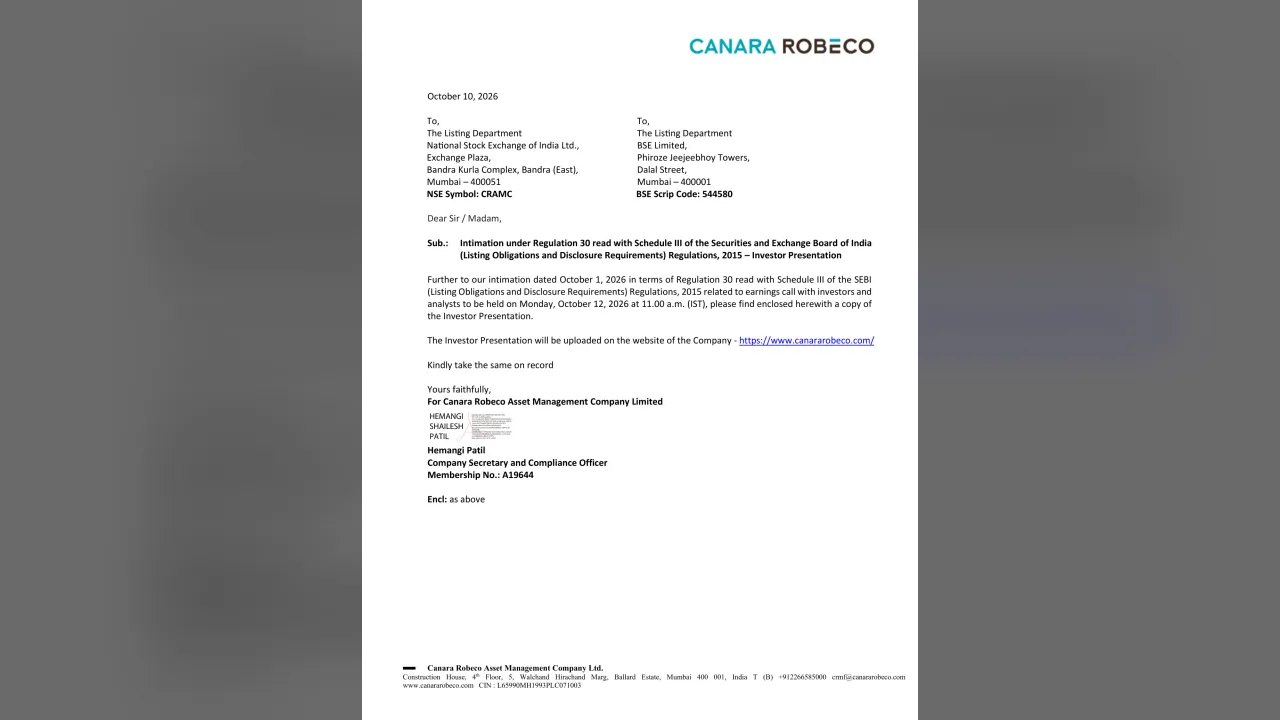
Canara Robeco Asset Management (NSE:CRAMC) Q2 2027 earnings call, held 2026-10-12. Watch the replay and read the transcript on 6ix.
- Company
- Canara Robeco Asset Management Co. Ltd. (NSE:CRAMC)
- Period
- Q2 2027 earnings call
- Date
- Mon, Oct 12, 2026, 8:17 AM ET
- Replay
- Watch the replay on this page · 48 min
On 6ix: 6ix.com/event/canara-robeco-asset-management-company-limited-cramc-q2-2027-earnings-call
Replay
Transcript
Automated transcript · Written by software from the replay's audio. It can mishear names and figures; the replay is the record.
0:00 Ladies and gentlemen, good day, and welcome to Q2 and H1 FY 'twenty seven Earnings Conference Call of Canara Robeco Asset Management Company Limited. Before we begin, I would like to point out that this conference call may contain forward looking statement about the company, which are based on the beliefs, opinions, and expectation of the company as on date of this call. These statements are not the guarantee of future performance and involve risks and uncertainties that are difficult to predict. As a reminder, all participant line will be in the listen only mode. There will be an opportunity for you to ask questions after the presentation conclude. Please note that this conference is being recorded.
0:47 I now hand the conference over to Mr. Wattar Shah from AdFactors PR. Thank you, and over to you, Wattar. Good morning, everyone, and thank you for joining us on the Q2 and H1 FY 'twenty seven Earnings Conference Call for Canara Robeco Asset Management Company Limited. Today, we are joined by Mr. Rajunesh Narula, Managing Director and Chief Executive Officer Mr. Ashwin, Financial Officer Mr. Gaurav Goy, Chief Business Officer and Mr. Adith Turakya, Head of Corporate Development and MS. We'll begin the call with the opening commentary by the management followed by a Q and A session. I would now like to invite Mr. Rajneesh Narula, Managing Director and Chief Executive Officer for Canara Robeco Asset Management Company Limited to give his opening remarks. Over to you, sir. Well, thank you, and good morning, and thank you for joining us today. I hope you've had an opportunity to go through the investor presentation.
1:40 Let me start by setting the context for the quarter first with a brief perspective on the broader industry environment and then with a closer look at our performance for the first half of the year. On the industry and market environment, the first half of FY twenty twenty seven was characterized by global and domestic volatility due to geopolitical development and macroeconomic uncertainty shaping the market environment. September was particularly challenging. The Nifty fifty declined by approximately 6% during the month, raising the gains accumulated in the first two months of the quarter and closing nearly 14% below its fifty two week high. Indian equities face pressure from elevated U. S. Bond yields, a strengthening U. S. Dollar, foreign portfolio outflows, geopolitical tensions in West Asia and concerns around crude oil prices.
2:30 Despite these headwinds, one of the key positives was the results of the domestic investor participation. Domestic institutional investors more than offset foreign selling, recording net purchases. More importantly, SIP flows continued to provide a structural anchor for the mutual fund industry. Monthly SIP contributions crossed INR 32,000 crore, while the number of SIP accounts are above the INR 10 crore mark. The domestic retail investor base has matured significantly and is increasingly becoming a steady long term and relatively price agnostic source of capital. In my view, this resilience of domestic flows is one of the most important developments shaping the Indian Kuchu fund industry today. We come to the company operational highlights.
3:16 On the operational front, our closing AUM as of 09/30/2026, stood at INR 1.17 lakh crore. Our September 2026 quarterly average AUM saw a growth of 4% on a year on year basis. As of 09/30/2026, our investor folio stand at INR 50.1 lakh, reflecting the continued trust of our investors across the country. Individual investors contribute over 86% of our AUM. Contributions from systematic plan was INR676 crores in September across INR19.6 lakh active SIP accounts. B30 strength, the monthly average AUM from beyond the top 30 cities was 28,944 crore, which reflects 23.6% of our total AUM.
4:03 Our distribution network has expanded to over 57,186 in panel partners, and we have 29 branches. We are looking to expand our product offering and targeting to come out with a couple of NFOs this financial year, subject, of course, to the regulatory approvals. With this, I would like to now hand over to Mr. Ashwin Prahit, our CFO, who will take you through our financial performance for Q2 and H1 FY 'twenty seven in detail. Over to you, Ashwin. Thank you, sir. Good morning, everyone. For financial performance for the quarter and half year ended thirty eight September twenty twenty six. Financial highlights. Q2 FY 'twenty seven performance. Revenue from operations to date 121.6 crore for the quarter compared to INR 103.9 crore in Q2 FY 'twenty six, registering a Y o Y growth of 17%.
5:02 Total income stood at 128.1 crore compared to INR 108.00 crore for Q2 FY 'twenty six, representing a Y o Y growth of 19%. On the profitability front, PED stood at INR 59.2 crore compared to INR 48.7 crore in Q2 FY 'twenty six, registering a Y o Y growth of 21%. Now I am moving to our H1 FY 'twenty seven performance. Revenue from operations stood at INR 237.8 crore compared to INR 201.0 crore in H1 FY 'twenty six, registering a Y o Y growth of 18%.
5:55 Total income stood at INR $2.74 crore compared to INR 229.3 crore in H1 FY 'twenty six, representing a Y o Y growth of 19%. Our H1 FY 'twenty seven PAT stood at INR 134.8 crore compared to INR 109.7 crore of H1 FY 'twenty six, registering a Y o Y growth of 23%. We are also pleased to announce that Board of Directors has declared an interim dividend of INR 2 per equity share for FY 'twenty six'twenty seven, equivalent to 20% of our base value at INR 10 per share.
6:45 With this, I will open the floor for the question. Thank you very much. Thank you, sir. Ladies and gentlemen, we will now begin with the question and answer Anyone who wishes to ask a question may press 1 on their touch tone telephone. If you wish to remove yourself from the question queue, you may press 2. Participants are request to use handsets while asking a question. Ladies and gentlemen, we'll wait for a moment while the question queue assembles. First question comes from the line of Sukrit Deepaatil from ISAT Fintech Private Limited. Please go ahead.
7:43 Yes. Good morning, the team. I have two questions. The first question is just to understand a forward looking guidance. Beyond the regular outlook, what are the top two to three execution priorities you're focusing on in the next few quarters, primarily to drive growth across the SIT franchise and main NF holdings? And alongside that, what do you see as a key risk from market volatility changing in investors' point of view or competitive pressures? And how are you preparing to manage them while you're strengthening the company's position in the market? Thank you. That's first question. I'll ask you second question after this. Thanks. Okay. So thank you very much. I think it's a very good question.
8:29 So in terms of execution priorities for the next six to twelve months for us is of course focusing on new products, which I had mentioned earlier as well. And also looking at perhaps a new line of business. We are evaluating a few new lines of businesses that we can choose from. So they are passive, they are SIF, AIF and Gip City. We will choose one of them to go ahead over the next six to twelve months. So those are the initiatives that we plan. On the SIP agenda in particular, we have a renewed focus on SIPs and we are working with selected partners on increasing our market share on SIPs as well. So those are initiatives that the company is looking at. And maybe Gaurav, who is the CBO will elaborate a bit more on the SIP initiative.
9:19 Sure. So I think from a SIP perspective, as Rajesh said, you did that, okay, we are working with our channel partners and entering different strategies, particularly when you look at channel partners like Canara Bank, which have a large network. So our SAP strategy is focused in terms of how we can harness the potential there and can work with our bank partners, how we can work with our MFDs and Indies and digital partners to incur it. What we have seen is, of course, as you see that we were early ones in terms of our SiP journey. And therefore, some of our vintage funds where we have seen that maturity of the SICs, which are happening. But at the same time, I think what we are also finding it very encouraging that in the product lines like mid caps, multi caps, which are which we have launched recently in the last three years, we have seen a very, very healthy growth in terms of our SIC book.
10:18 So it's a combination of both in terms of our product strategy, of how we are positioning our SIC and also working with our channel partners. In addition to it, we have strengthened our communication around SiPs because of the last two years of the market volatility and being a flat market. Of course, there is some kind of nervousness which we see in the investors and therefore we have strengthened our communication around in terms of continuing staying invested to the investors and distributors. We have launched a new initiative, which is called Goal SiP, which is again in terms of targeting the behavioral aspect of the SiP and how we can encourage investors to stay invested towards their goals. So these are some of the initiatives which we have taken. Also, there is a focused SiP team, which is working with some of the key channel partners where we are working very, very closely with these channel partners to build up the entire SiP.
11:17 Thank you. My second question is just touching base on the last point that you mentioned, given the current market scenario, how the markets are going and along with the geopolitical uphill that's going on, do you expect any guidance from the government in regards to this to stabilize the market? Just want to understand if you have any point of view on this. Thank you. As you can see that the government and RBI have been stepping in periodically to stabilize the market. You see initiatives coming from the RBI to stabilize the rupee, you see that. The government did do something last September, October last year on the GST front as well. So the government is doing all that it can. It's got enough in its toolkit to make sure that the markets are stable.
12:07 So if you see the kind of volatility that has actually happened, especially globally, and the impact on India, to my mind, India has withstood that very, very well. And that's, I guess, to do with the policies that the government and the rest of the regulatory bodies have had. So we're very positive for the Indian markets going forward. Thank you and best wishes. Thank you. Thank you. Our next question comes from the line of Vini Jan with Jan Investments. Please go ahead. Hello?
12:52 Yes, Vinny. You may please go ahead with your question. Thank you. So in the previous earnings call, the management indicated that a new product launch is expected within the subsequent two to three months, and it is identified as a practice product with a short to medium term opportunity. So could the management now share an update on the product launch pipeline? Yes. I think what we had said in the last call was we were looking at new product launches over the next one or two quarters. We are on track with that. So you will see at least a couple of product launches that will happen before the end of March twenty twenty seven, subject, of course, to regulatory approvals. As you're aware, the products require regulatory approval.
13:38 And we are quite confident that we will have those approvals in place to be able to have those launches. Passives and the other lines of businesses, like I mentioned earlier, which is to do with CIF, AIF and GiftCity, are all being evaluated. They will one of we will launch them sequentially and not necessarily all of them, but one or two of them for sure over the next six to twelve months. Got it. I think that answers my question. Thank you. You're welcome. Thank you. Our next question comes from the line of Aditya Chera with Incred Capital AMC. Please go ahead.
14:29 Yes, hi. Two questions. First on the yields, they have held up in line with Q1. Our outlook was that we could see some moderation. So if you can share your outlook on the yields? And second on the SiP strategy, we've seen the book is slightly shrinking with some decline in SIP accounts and number of full years are also down. So what is driving this, whether this is due to the bank channel share flipping Or if you can throw some more outlook on the what is happening on the Si2 side? Yes. On the yields, we've been very consistent in terms of giving a range in terms of yields. We've always said between thirty five percent and forty is where we are comfortable, and that's the range with which we'd like to work with. So that remains the same. And for us, our view doesn't change on that. On the SiP, we continue to work on different strategies with different partners to increase our SiP throughput.
15:30 But if you look at the value of total SiP AUM, it's actually up. I think it's roughly about 42,000 crores. INR 41 in terms of value, our SIP book is up, contributing to roughly about 34% of our AUM. But we continue to develop new initiatives with strategic partners to build on the SIP strategy for the company. Sure. So your endeavor is to improve this directionally, but what we would like to understand is what has not worked over the last, let's say, twelve months on the data that I'm looking at, let's say, on the SIP book syncing. What is the industry's book sort of rising?
16:16 So something on that. What has happened in the last twelve or eighteen months? So for example, this is generic. I would imagine it's also for the industry in a way perhaps. But you would find the tax saver fund where the law has changed. So people who had SIPs there will not be inclined to renew SIPs in the DAC fund because the tax advantage is gone. So we see some of that. We also see SIP maturities happening, and therefore, people redeem at that point in time. Some, of course, ship closures are also due to volatility in the market. So you've got to factor in a lot of different things that happen. But having said all of that, this continues to be a very stable source of flows for us and the industry.
17:06 And it's an important aspect of our business. So it's a huge building block for us. And like I said earlier, we will continue to focus on this to make sure that it continues to remain strong throughout going forward as well. Right. My last question is on the outlook that you shared about evaluating new lines of business. Now this is about, let's say, the Y o Y growth. We are absent in some of the segments, let's... Such as on the passive side. So are you packing growth for the, you know, for the AMC versus the categories that we are present in the industry? And ex of that, would your growth be materially better if we have to look only the category growth?
17:55 If you can share some analysis around that, if you would have done it internally. No, you're absolutely right. It's actually a very good question. So if you look at growth in the categories we are present, of course, our growth is far better. But we always present data, which is the industry data. So for example, arbitrage fund, if you look at that segment itself, we are not present there, but the industry does grow in that segment. So but we don't take that off when we look at our numbers. So you're absolutely right. If you just look at our numbers, ex of that, we will be a lot better. But I think it's only fair, these are choices we make. So it's only fair to compare ourselves with what the broader market is all about.
18:42 Got it. Thanks. Thank you. Our next question comes from the line of Sonal with Crescent Capital. Please go ahead. Hi, sir. Am I audible? Yes, you are. Sure. Thanks. Thanks for giving me the opportunity. I'll ask this question even in the last call. If you could start disclosing the net inflows that will be helpful. And from what I think the numbers we calculate based on publicly available data, the net inflows seem to be negative. Is that correct? Is that the way you and the team look at the business? Just want to understand that. I'm going to pass this question to Atif to respond. But just to give you a general view, we disclose what is disclosed in the industry itself.
19:34 But go ahead, Atif. Yes. So thanks for the question. And like Rajesh mentioned, we are in line with industry. So we are trying to maintain the same standard of disclosure that has been anti other participants of the industry. And hence, unfortunately, at this point of time, we are not disclosing the net flows data as of now. Got it. Okay. Second question is, we were looking at your quartiles of your top four, five schemes. I think if you look at a little longer term data basically, the quartiles for the teams basically has fallen over time. And this is also linked to the second part of the question, which is where the competition is going and there are some new AMCs which has come up. So given that the number of mutual fund players are up and they are coming with newer products, there's competition, how do you see maintaining depending your quartiles over time?
20:33 That's the second question. So as you're aware, all funds across all fund houses will go through cycles. You will find funds sometimes being in one, two or sometimes three and four as well. Every fund, irrespective which house manages that money, especially over a five, ten year period would have seen or would find themselves in different quarters at different points in time, depending on the views taken by the fund manager at that point in time. So it's not unique. It's not something new to us. But what really helps us is a, the process and discipline for investing. So there is a lot of background to how we manage money, and it's a very disciplined approach. That's one.
21:24 Two, we continuously strengthen our investment team and our research capabilities in house, And we've done that over the last two years by adding more people to that team so that there is broader coverage. As the size grows, the number of stock that we need to track are that much more. And hence, we need that capability internally. And of course, we have, for us, the brand, the Canara Robeco brand is extremely strong in India. And that helps us during both across cycles. Money does come to us irrespective what cycles the market is in or what cycle our funds are in. So a lot of that combined is the strength of the company.
22:16 But we are very confident where we find some funds of ours, which may be challenged at the moment in terms of quartiles. We are quite confident they will bounce back pretty soon. Got it, sir. And does that have to be so improvement in quartile is linked to the KPIs for the fund manager and the research team, just trying to understand that because you emphasize research and I really appreciate the investments individuals that we do the company wise. So just trying to understand is there KPIs is linked to fund managers' performance and the fund performance? Well, absolutely. The KPIs do link the fund performance for fund managers.
23:04 There is a weighted for the one year performance and a three year performance. So it's not that we restricted to a short term performance alone. And similarly, the research analysts are tracking the model portfolio as well. So their KPIs are also linked to performance. Sure, sir. Thank you. I'll call back in the queue. Thank you. Thank you, sir. Thank you. Our next question comes from the line of Vitesh Ashant with Chagun Capital. Please go ahead. Hello? Hi. We can hear you. Yeah. So very good morning, sir, and to the team. So while markets have been volatile in the past two quarters, wanted to understand, I think last year, BRHP, we had mentioned our equity market share was about 2% plus. So how are we in terms of maintaining our market share? And do we plan to use Canara Bank's network to grow to grow the market share over the next few years? So what is the long range strategy in terms of growing market share with equities?
24:13 And how do we plan to do that? Yes, it's a good question. Market share continues to be stable around the 2% mark. So that remains stable. We continue to use Canara Bank along with the other strategic partners we have as avenues for us to grow our business. Clearly, the new product launches that we anticipate over the next three, six months are geared towards increasing the equity base as well for us. Yes, at the end of the day, equity continues to contribute a large proportion of AUM. It's now at about 91% of our AUM. Structurally, for us, that is a good position to be in.
25:00 The last earnings call you had mentioned, you are quite bullish on equities. And seven out of ten years, we expect equities to outperform. And the past two years have been volatile and sort of flattish. So I'm sure you'll be seeing equities outperforming from here on maybe in the next few quarters. So just wanna understand, given our commissions to distributors, I mean, are paying much higher, obviously, compared to the rest of the industry. So are we satisfied with the inflows they are bringing in? I understand markets have been tough, so getting in AUM is a challenge in these times, but just want to get a sense of that. Yes. Our view on yields is a little different. I've explained our view on yields. Like I said, our range of 35 to 40 is what we are comfortable with.
25:46 So for the industry, I mean, one has their own strategy in terms of yields and commission payouts. Yes, I did I still believe that seven out of ten years equities will outperform the broader markets. I still believe that. And if you could look at our numbers in terms of company profitability, despite the challenges in the equity market and despite us having over 91% of our AUM equities, our PAT is on a year on year basis, September 25 and September 26, is up by about 17%, 18%. So clearly, despite the huge volatility, the company has inherent strengths and has delivered a very strong performance.
26:35 Absolutely. Sir, one last question from my end. The last quarter, there was this other income that we saw INR 29 crores. So I just want to understand what was that logic. I think it's something to do with your debt investments, the INR 600 crores book that you guys have. So just want to get a sense of how will that work out in the next few quarters? Well, that's actually got to do with the skin in the game. As you're aware, from a regulatory perspective, we are required the fund house to invest in all our schemes a certain percentage of the scheme with our own capital. So we have roughly about INR110 crores of skin in the game roughly, and that needs to be every quarter mark to market to reflect the actual value. And you'll see that will move quite substantially if the markets are very volatile quarter on quarter.
27:29 So September quarter was lower than the March quarter that you would see. But if you notice, we split our income from into two, which is income from operations and the other one is other income. So income from operations is what shows you the steady state growth in the business itself. And the other income, which basically includes this skin in the game, that will vary quarter on quarter going forward because of the fact that it is invested 90% of it is in equity. Okay, sir. Understood. Thank you. Our next question comes from the line of Meghna Luthra with Intrad Equities.
28:19 I just had a few questions. One is, again, on the SiP front. Our SiP monthly contribution has also seen a decline. It has been soft over the last few quarters. Sir, is there any reason, particularly because the industry has not seen this kind of softness compared to our numbers in monthly contribution? Is it largely because the accounts are closing down or anything else? Yes, I'm going to get Gaurav, who's our Chief Business Officer to answer this question for you, Meghna. Sure. Thanks, Meghna, for asking that. And I think Rajnish alluded to it. I think the way we look at in terms of SiP when you compare it with market, I think one of the aspects I'm sure you will appreciate that it's a very highly concentrated flows what we are witnessing in the market and which is largely towards few product categories.
29:13 While when we look at internally in terms of the way our SiP growth is, I think we apart from the quantity of the growth, think if you look at the qualitative aspect of that growth, I think we are very much in terms of satisfied with the direction which is there. And when I say in terms of the qualitative aspect of that growth, what gives us comfort is in terms of the way our product mix is, in terms of our volumes, which both in terms of inflows, which we're getting and even the SIP registration. I think what particular to us, one aspect which is coming in is one that on the ELSS space, when you look at, I think we were pretty much in terms of our contribution, we were pretty much very strong there. And that because of both in terms of the market trends, we are seeing that, okay, there is a decline and in terms of the net folios also, there is a drop, which is happening and which is some kind of impact to us. The second is in terms of the we were early one in terms of our SiP growth journey and therefore some of the vintage funds we are seeing the SiP maturity And therefore, that is some kind of impact it is showing as far as in terms of the number of portfolios or when you look at in terms of the SIB book.
30:30 But when you look at I think overall, when you look at our product mix, there are many funds where we are seeing very good growth, which is happening there. So if I could just give you a perspective, what I mean in terms of the quality of the growth, even in terms of our AUM growth, when you look at, so for example, our large our flagship scheme has seen now, it's more than INR25000 crore fund. But apart from it, we have four funds which are more than INR10000 crore fund. We have another three funds which are in INR5000 to INR10000 crores and particularly our new strategies like multi cap and mid cap, which we launched three years back, have crossed INR 5,000 crores. So I think what we are really the way we are looking at in terms of our growth is how widespread, how diversified it is across the channels, across the products, and that is actually moving in the right direction. From a SiP perspective, we have taken various initiatives to address that, which one aspect is in terms of some of the product launches, which we have done. So clearly, we are filling up those gaps and really they are really becoming our growth engines and helping us in terms of further growth. Second is channel specific initiatives also which we have taken, particularly with the strategic partners, retail banks and M and B partners that is going to help us in terms of our SiP growth, even initiatives in terms of the product initiatives like Goal SiP, which I have talked about is because also what we are witnessing is that
32:02 because of the market volatility, some of the older SiPs were apart from tenure, there is a behavioral aspect also which we are addressing. So we have taken various initiatives right from the training initiatives for our partners, talking about this new initiative in terms of whole SiP, strengthening our entire communication around SiP. I think so there are multiple initiatives which we are working to kind of address that growth aspect. But when you look at and compare it from a market perspective, I think you need to keep into account that from a market perspective, it is very, very concentrated. I think even if you look at the market flows, 65 of the flows in this half of the current year is only in the three product categories. But for us, when you look at in terms of AUM growth is very well diversified across channels and across products.
32:57 Got it. Thank you for the elaborate answer. So just one more thing, what proportion of our SiP would be coming from ELSS, say, last year as compared to this year? That would help give more color on the impact of... I think that's not the data in the public domain, which has been there. So I can't share on that. But that is one of the funds where, of course, industry wide also there is a challenge, which is happening because of the changes in the taxation. And that has had some impact in terms of when you look at the full year count and the SIB. Okay. And what is the average tenure of our SIT book? So I think if you look at it, I think Rajesh has alluded in terms of our SIT AUM. So I think we that will be a very good parameter for you to look at it. And SIT AUM has increased to INR 41,000 crore, which is about onethree more than onethree of our equity AUM. So I think that long term contribution of the long term assets to the overall AUM is very, very healthy for us.
34:06 But specifically on the tenure, which you mentioned, my understanding is it's above three years would be the average. Okay. And sir, lastly, is there anything in the pipeline, equity scheme, semantics or sector scheme? Yes, we are planning to have a fund launch before the end of March twenty twenty seven, which would be an equity fund as well. Clearly, that's on the cards. Great. Thank you. All the best. Thank you. Thank you. Our next question comes from the line of Prateek with Monarch, PMS. Please go ahead. So I if you could first spell out segment wide yield of Duty, Debt and Liquid.
34:54 And if you can help us understand, I'm saying yield expansion of four to five bps. So if you could help us understand the reason for that. Yes. I'll ask Datti to respond to you on that. Yes. So yield for the quarter was somewhat in the range of on an overall basis was between 37 bps and 38 bps. Equity yield was around 40 bps level. Our fixed income yield was somewhere around 28 bp level and our liquid and overnight was around the two bp level. So that's the breakup of the yield. Thank you. Next question comes from the line of Varun Gujaria with Boating AMC. Please go ahead. Hi, sir. My question has already been answered.
35:41 I tried to opt out of the queue, but didn't. Sure. Thank you. You. Our next question comes from the line of with A3 Capital. Please go ahead. Hello. Good morning. So just I wanted to know, like, it has been one year now, we have got listed as a firm. Sir, I just wanted to know as a medium term outlook, like, how as a firm house we see to, we see ourselves, like, we want to be branch heavy or we want to be, like, the 90% of our equity oriented scheme. Our investments are going into equity. So what are the age groups we are targeting as in front house? And what is the attrition sir of the SIP counts? Can you if you have the number, can you let us know? So thank you for your question. I would like to broadly answer that we are a fund house that looks long term, plans for long term.
36:39 So we want to be an AMC that survives time, if you know what I mean. That's what we are building and that's what we that's our ambition. That's what we want to be. So we will put into place short term strategies that help us with a long term goal, which is to make sure that we remain relevant across periods of time. So at the end of the day, quarter on quarter is something that while we are mindful of it, it doesn't drive medium- or long term strategy. For us, medium- long term strategy is, like I mentioned, to be being relevant across time frames. So we are building this AMC for the long term. That's clearly our stated goal. And everything that you see right now, even in the kind of product launches that we do, we're not a penthouse that rushes in and launches multitudes of products. We have probably given our size, one of the smallest we have probably one of the smallest baskets of products. So there is enough scope for us to launch new products going forward as well as in lines of businesses.
37:46 As you can see, we're kind of purely focused on the mutual fund space, but are looking to diversify based on what we believe will be the right and opportune moment for us to do so and in the segment that we'd like to choose. But if you want to look at us, I think it is we are a long term fund house. And in all aspects, that's what I'd like you to take away as well. Asa, do you have any number like what is the accretion in the safe accounts? That detail is not in public domain, unfortunately, we'll not be able to share. And sir, what is the average like what is the average years of your SIP accounts? Like do you have that number also?
38:39 Did mention, I think it's over three years that the average SIP account would be. Thank you, sir. Thank you for the elaborate answer. Thank you. Thank you, Jay. Thank you. Our next question comes from the line of Saikiran Pulaverdi with Pulaverdi Advisors. Sir, just a very broad level question, the products which you choose to be a concentration and the products you chose to ignore, what is the rationale behind it? Because as you rightly mentioned some time back, maybe the alternatives, hybrids are one of the fastest growing and you chose to stay put at this point of time. If that's the thing, how would you like to maintain the market share or grow the market share over a very long period of time? Thank you.
39:36 I think it's the rationale for choosing certain products or certain lines of business is based on basically two things. One is focus. The other is what are your strengths. So to us, those are the key determining factors for us before we get into any particular product space. And I always believe that this is in our industry, there's very limited first mover advantage because it's your performance of your scheme that really counts at the end of the day. You could be the first one with a certain product, but if you don't have a track record that merits consideration that you won't get inflows, you could be also the last one in the same product category. But if you're able to deliver better performance than your competitors, then the likelihood of you getting more flows than the others will also stand up. So to us, like I said, there are two things that we look at is we need to focus and second is build on our strengths.
40:41 That's the argument looking at the distribution channel. For a small distributor, if AMC or the manufacturer doesn't provide full book of products, then the probability of dealing with you in terms of the distribution and then making giving inflows will also significantly reduce over a period of time. How do you think about this? Well, actually that's a good question. But I think the generic products that everyone looks for is available with us. So on the debt side and on the equity side, the generic products are available. It's only in certain specialized parts of debt or equity that we perhaps may not be present. And clearly, that's for a niche kind of distributor as well. But on a generic basis, I think we have covered most of the basis on the debt side and the equity side.
41:37 And one last question from my side, sir. We would need to understand that there are certain regulations which are changing in terms of restricting the overlap of holdings between the schemes. As we understand, the overlap is significantly higher for Canara to cope equity schemes. That's the impact in terms of the performance. As of now, what we see is also two types of fund houses. One, where all the schemes all perform at the same point of time, under performance at same point of time. When I say all, majority of them, thanks to the style which they stick to. And there are certain fund houses which allow different styles of, what I can say, asset management. Looks to me like you are in the first bucket and it's going to impact and it brings cyclicality to your inflows. Do you think this is a fair assessment or would you like to deliver on this?
42:27 To be honest, that's a question for my Head of Equities to respond because at the end of the day, portfolio construction is entirely their domain. But having said that, on a broad basis, the overlap in terms of your products. It's just a very recent regulatory guideline that has come through. Everyone is assessing it. I think when you look at us across the industry, we're actually better than the industry. There's only one product of ours, which is an outlier. But other than that, everywhere else we've prepared favorably with the rest of the industry as well. But clearly, it is something that the equity team is cognizant of. They are looking at. And if they believe there are certain changes required to couple of schemes, they perhaps may implement that.
43:23 Thanks, Rahul. This is really helpful. Thank you. Thank you. Next question comes from the line of Ashish Pimple with Nomura. Please go ahead. Hi. Thank you so much for the opportunity. I just wanted to I was doing this exercise of breaking down the equity AUM growth, specifically on a closing basis, to come to the conclusion of how much inflow that we might have gotten. The exercise is that around we are flat in terms of inflows, net equity inflows for the quarter Q2. Assuming that NSE five hundred has gone down by 4% in the quarter, Would that be a fair assessment that the inflows have been flat this I mean, zero this quarter?
44:20 Unfortunately, Shiraz, I can't respond to it only because I can't give you the data because it's not in public domain. But having said that, the equity markets are challenged. We all see that. And the flows, as Gaurav mentioned, are coming only in selective products at the moment across the industry. But yes, I mean, it's really a question of time when the markets turn and you will see better performance across the industry for all mutual funds going forward on this particular. So I can't elaborate unfortunately more than that. Sure. I understand. And thank you so much for the response.
45:07 Question was on the pass through of because the yields that we have seen this quarter has been flat revenue yields quarter on quarter. The pass through that we had because of the change in TR to BR structure last quarter, we had seen improvement in the yields. Do we think that this is I mean, is it behind us? And is there any how is the dynamics with the distributors now? Is there any chance of rationalization of commissions? Can you elaborate on that a little bit, please? Well, I think, like I said earlier as well, Shriaz, that we are comfortable between the thirty five percent and forty range. So we will continue to be there.
45:59 We would rather focus on growth and additional volumes than focus solely on yields. So clearly, our partnerships are built around making sure that the distributor gets a fair remuneration for the work that they do for us. And clearly, we are very happy with the kind of structures currently that we have with our key distributors. Sure. That answers. Congrats on the quarter and all the best. Thank you. Thank you. Ladies and gentlemen, due to the time constraint, that was the last question for today. I now hand the conference over to the management for the closing remarks. Thank you, and over to you today.
46:52 Well, to conclude, the market correction during the quarter was a reminder of the importance of disciplined and long term investing. Encouragingly, our investors continued to demonstrate resilience and stay focused on their long term financial goals. Despite heightened market volatility, the vision for industry and our business have remained resilient, supported by strong structural drivers such as rising retail participation, steady flows and deeper penetration across Tier two and Tier three cities. Looking ahead, our priorities remain clear. We will continue to focus on delivering consistent risk adjusted performance for our investors while deepening our retail and supply franchise and expanding our product offering. We will also leverage technology to make investing simpler and the overall investor experience more seamless and user friendly.
47:42 With a strong foundation, disciplined execution and structurally growing industry, we remain confident in our ability to deliver sustainable long term growth and create sustainable value for all our stakeholders. Thank you for your time this morning and your continued support. Thank you so much, sir. Ladies and gentlemen, on behalf of Canara Robeco Asset Management Company Limited, that concludes today's call. Thank you for joining us, and you may now disconnect your lines.
Follow Canara Robeco Asset Management Co. Ltd. into a list and get an email when it puts out news.
Latest news releases
- NSE:CRAMC — Canara Robeco Asset Management Company Limited has informed the Exchange regarding the "Intimation of Earnings release related to Unaudited Financial Results of the Company for the quarter… · Sat, Oct 10, 2026
- NSE:CRAMC — Canara Robeco Asset Management Co. Ltd. Press Release Jul 21 2026 · Tue, Jul 21, 2026